Exploiting Rapid
Change in Technology
Enhanced Learning
… for Post Graduate Education
SURVIVING THE VIVA OR FINAL DEFENSE
I can't change the direction of the wind, but I can adjust
my sails to always reach my destination.
Jimmy Dean
Ambition is the path to success. Persistence is the
vehicle you arrive in.
Bill Bradley
Our greatest weakness lies in giving up. The most
certain way to succeed is always to try just one more
time. Thomas Edison
Agenda
Part One
1. The variations in the final parts of the journey
2. How dissertations/theses are evaluated
3. Examination standards
4.Tools on the DN sites
5. Exercise
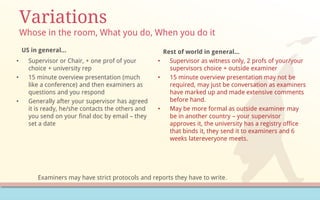
Variations
US in general…
• Supervisor or Chair, + one prof of your
choice + university rep
• 15 minute overview presentation (much
like a conference) and then examiners as
questions and you respond
• Generally after your supervisor has agreed
it is ready, he/she contacts the others and
you send on your final doc by email – they
set a date
Rest of world in general…
• Supervisor as witness only, 2 profs of your/your
supervisors choice + outside examiner
• 15 minute overview presentation may not be
required, may just be conversation as examiners
have marked up and made extensive comments
before hand.
• May be more formal as outside examiner may
be in another country – your supervisor
approves it, the university has a registry office
that binds it, they send it to examiners and 6
weeks latereveryone meets.
Whose in the room, What you do, When you do it
Examiners may have strict protocols and reports they have to write.
How are theses/ dissertations evaluated?
1. Examiners may have reports/guidelines
1. https://docs.google.com/document/d/1-UbS2OYb-
UIk_fDpg_ts6tDDYwCsmL6caUCIS2uQu5o/edit?usp=sharing
2. Or they may be evolving from a common ethos based on the
examiners prior existence.
3. Either way their votes are final -
How do standards develop?
What is Unacceptable?
• Is poorly written
• Has spelling and grammatical errors
• Has a sloppy presentation
• Contains errors or mistakes
• Plagiarizes or deliberately misreads or misuses sources
• Does not understand basic concepts, processes, or conventions
of the discipline
• Lacks careful thought
• Looks at a question or problem that is trivial weak, unoriginal, or
already solved
• Does not understand or misses relevant literature
• Has a weak, inconsistent, self-contradictory, unconvincing, or invalid
argument
• Does not handle theory well, or theory is missing or wrong
• Relies on inappropriate or incorrect methods
• Has data that are flawed, wrong, false, fudged, or misinterpreted
• Has wrong, inappropriate, incoherent, or confused analysis
• Includes results that are obvious already known, unexplained, or
misinterpreted
• Has unsupported or exaggerated interpretation
• Does not make a contribution
•
What is
Acceptable?
• Is workmanlike
• Demonstrates technical competence
• Shows the ability to do research
• Is not very original or significant
• Is not interesting, exciting, or surprising
• Displays little creativity, imagination, or insight
• Writing is pedestrian and plodding
• Has a weak structure and organization
• Is narrow in scope
• Has a question or problem that is not exciting--is often
highly derivative or an extension of the adviser's work
• Displays a narrow understanding of the field
• Reviews the literature adequately--knows the literature but
is not critical of it or does not discuss what is important
• Can sustain an argument, but the argument is not
imaginative complex, or convincing
• Demonstrates understanding of theory at a simple level,
and theory is minimally to competently applied to the
problem
• Uses standard methods
• Has an unsophisticated analysis--does not explore all
possibilities and misses connections
• Has predictable results that are not exciting
• Makes a small contribution
Evaluation
What Makes for Outstanding?
• Original and significant, ambitious, brilliant, clear, clever, coherent,
compelling, concise, creative, elegant, engaging, exciting, interesting,
insightful, persuasive, sophisticated, surprising, and thoughtful
• Very well written and organized
• Synthetic and interdisciplinary
• Connects components in a seamless way
• Exhibits mature, independent thinking
• Has a point of view and a strong, confident, independent, and authoritative
voice
• Asks new questions or addresses an important question or problem
• Clearly states the problem and why it is important
• Displays a deep understanding of a massive amount of complicated
literature
• Exhibits command and authority over the material
• Argument is focused, logical, rigorous, and sustained
• Is theoretically sophisticated and shows a deep understanding of theory
• Has a brilliant research design
• Uses or develops new tools, methods, approaches, or types of analyses
• Is thoroughly researched
• Has rich data from multiple sources
• Analysis is comprehensive, complete, sophisticated, and convincing
• Results are significant
• Conclusion ties the whole thing together
• Is publishable in top-tier journals
• Is of interest to a larger community and changes the way people think
• Pushes the discipline's boundaries and opens new areas for research
1. General quality – pass at
the outstanding, very
good or acceptable level.
2. Has internal consistency
3. Meet the benchmarks
Internal Consistency – Know Your Golden Threads
Methods (con’t)
• In alignment with the question addressed and the theory used
In addition, the author demonstrates
• An understanding of the methods' advantages and
disadvantages
• How to use the methods
Component 5: Results or Analysis
The analysis
• Is appropriate
• Aligns with the question and hypotheses raised
• Shows sophistication
• Is iterative
Amount and quality of data or information is
• Sufficient
• Well presented
• Intelligently interpreted
The author also cogently expresses
• The insights gained from the study
• The study's limitations
Component 6: Discussion or Conclusion
The conclusion
• Summarizes the findings
• Provides perspective on them
• Refers back to the introduction
• Ties everything together
• Discusses the study's strengths and weaknesses
• Discusses implications and applications for the discipline
• Discusses future directions for research
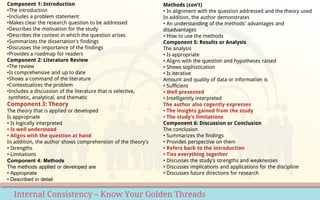
Component 1: Introduction
•The introduction
•Includes a problem statement
•Makes clear the research question to be addressed
•Describes the motivation for the study
•Describes the context in which the question arises
•Summarizes the dissertation's findings
•Discusses the importance of the findings
•Provides a roadmap for readers
Component 2: Literature Review
•The review
•Is comprehensive and up to date
•Shows a command of the literature
•Contextualizes the problem
•Includes a discussion of the literature that is selective,
synthetic, analytical, and thematic
Component 3: Theory
The theory that is applied or developed
Is appropriate
• Is logically interpreted
• Is well understood
• Aligns with the question at hand
In addition, the author shows comprehension of the theory's
• Strengths
• Limitations
Component 4: Methods
The methods applied or developed are
• Appropriate
• Described in detail
Tools to help you get there
Go to your DN Portal…
1. Go through criteria at end of each of the self
assessment tools
2. Search on “checklists”
3. Review the section in preparation for defense at
end of Phase 2 and 3
subtitle
The Exercise
Figure out what inspires you and keep up those exercises as you move forward
The Practice…
Know How YOURS is Outstanding
• Original and significant, ambitious, brilliant, clear, clever, coherent,
compelling, concise, creative, elegant, engaging, exciting, interesting,
insightful, persuasive, sophisticated, surprising, and thoughtful
• Very well written and organized
• Synthetic and interdisciplinary
• Connects components in a seamless way
• Exhibits mature, independent thinking
• Has a point of view and a strong, confident, independent, and authoritative
voice
• Asks new questions or addresses an important question or problem
• Clearly states the problem and why it is important
• Displays a deep understanding of a massive amount of complicated
literature
• Exhibits command and authority over the material
• Argument is focused, logical, rigorous, and sustained
• Is theoretically sophisticated and shows a deep understanding of theory
• Has a brilliant research design
• Uses or develops new tools, methods, approaches, or types of analyses
• Is thoroughly researched
• Has rich data from multiple sources
• Analysis is comprehensive, complete, sophisticated, and convincing
• Results are significant
• Conclusion ties the whole thing together
• Is publishable in top-tier journals
• Is of interest to a larger community and changes the way people think
• Pushes the discipline's boundaries and opens new areas for research
Athletes always know their
scores – your score is
how/where your work meets
this standard.
Know it and highlight it in your
slides.
Exercise – Learn to
know your
strengths and play
to them
What’s Up at DoctoralNet?
Have you scanned all the webinars for this quarter? You might want to do that
as they are filling up and do not have an unlimited number of spaces.
May 2016 – remember our emails & control panel done in Phases/ or by Year
per the theme – so theme for May = thinking/planning ahead for summer
Sign Into doctoralnet.com – drops you into your control panel
1. Phase 1 year 1… links for goodies to organize your thoughts, find gaps in
the lit, and fine tune your research
2. Phase 2- year 2… homework to make writing chapters easier and to
upgrade academic writing and critical analysis
3. Phase 3 – year 3 … keeping on track, tools for analysis, and motivation to
hold you through to the end
4. Phase 3 + - years 4, 5, 6, and beyond… Links and ideas to keep the
motivation up as you get close to finishing.
Backwards Map to Graduation
Agenda
Part Two
1. Backwards map from results and findings through to
graduation – know the steps and outcomes
2. What should your slides look like?
3. Know the questions you may be asked
4. Q & A
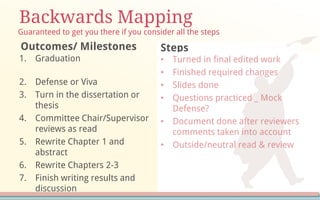
Backwards Mapping
Outcomes/ Milestones Steps
Guaranteed to get you there if you consider all the steps
• Turned in final edited work
• Finished required changes
• Slides done
• Questions practiced _ Mock
Defense?
• Document done after reviewers
comments taken into account
• Outside/neutral read & review
1. Graduation
2. Defense or Viva
3. Turn in the dissertation or
thesis
4. Committee Chair/Supervisor
reviews as read
5. Rewrite Chapter 1 and
abstract
6. Rewrite Chapters 2-3
7. Finish writing results and
discussion
What should your slides look like?
How many have been to a conference?
Conference slides – 12-15 speak for 15 to 20 minutes
Follow the general outline of a journal article
Background/significance
What is known before this
Description of the Study
Overview of Results
Discussion and conclusions
Ask around your university as there is a lot of variance here
Range of Questions…
Findings
1. How do your findings fit with or contradict the rest of the literature in this field?
2. How do you explain the differences of findings, or estimation, or interpretation between your work and
that of other authors?
3. What will you do after graduation with your topic?
4. What are the main implications or lessons of your research for the future development of work in this
specific sub-field? Are there any wider implications for other parts of the discipline? Do you have ‘next
step’ or follow-on research projects in mind?
1. Be prepared to discuss your empirical work – is it verifiable?
2. Have you delimited your scope?
3. What are the assumptions you made before you started and how did they influence your outcomes?
4. Are these assumptions acceptable within your field? Can you give an example of who else has worked
with or mentioned them?
5. What scales operationalize your variables? How do you know they are valid?
6. What are your findings in terms of effect size?
7. For quantitative evidence – take us through your test(s) of power.
8. For qualitative evidence – take us through the process through which you developed/triangulated
your themes.
Range of Questions…
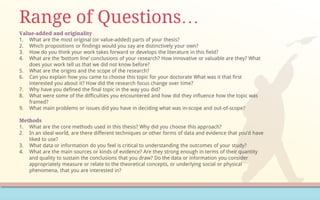
Value-added and originality
1. What are the most original (or value-added) parts of your thesis?
2. Which propositions or findings would you say are distinctively your own?
3. How do you think your work takes forward or develops the literature in this field?
4. What are the ‘bottom line’ conclusions of your research? How innovative or valuable are they? What
does your work tell us that we did not know before?
5. What are the origins and the scope of the research?
6. Can you explain how you came to choose this topic for your doctorate What was it that first
interested you about it? How did the research focus change over time?
7. Why have you defined the final topic in the way you did?
8. What were some of the difficulties you encountered and how did they influence how the topic was
framed?
9. What main problems or issues did you have in deciding what was in-scope and out-of-scope?
Methods
1. What are the core methods used in this thesis? Why did you choose this approach?
2. In an ideal world, are there different techniques or other forms of data and evidence that you’d have
liked to use?
3. What data or information do you feel is critical to understanding the outcomes of your study?
4. What are the main sources or kinds of evidence? Are they strong enough in terms of their quantity
and quality to sustain the conclusions that you draw? Do the data or information you consider
appropriately measure or relate to the theoretical concepts, or underlying social or physical
phenomena, that you are interested in?
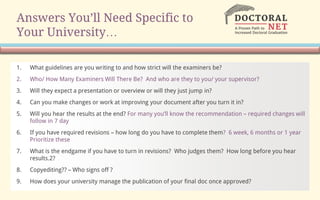
Answers You’ll Need Specific to
Your University…
1. What guidelines are you writing to and how strict will the examiners be?
2. Who/ How Many Examiners Will There Be? And who are they to you/ your supervisor?
3. Will they expect a presentation or overview or will they just jump in?
4. Can you make changes or work at improving your document after you turn it in?
5. Will you hear the results at the end? For many you’ll know the recommendation – required changes will
follow in 7 day
6. If you have required revisions – how long do you have to complete them? 6 week, 6 months or 1 year
Prioritize these
7. What is the endgame if you have to turn in revisions? Who judges them? How long before you hear
results.2?
8. Copyediting?? – Who signs off ?
9. How does your university manage the publication of your final doc once approved?
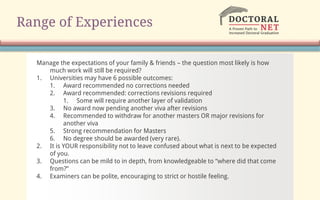
Range of Experiences
Manage the expectations of your family & friends – the question most likely is how
much work will still be required?
1. Universities may have 6 possible outcomes:
1. Award recommended no corrections needed
2. Award recommended: corrections revisions required
1. Some will require another layer of validation
3. No award now pending another viva after revisions
4. Recommended to withdraw for another masters OR major revisions for
another viva
5. Strong recommendation for Masters
6. No degree should be awarded (very rare).
2. It is YOUR responsibility not to leave confused about what is next to be expected
of you.
3. Questions can be mild to in depth, from knowledgeable to “where did that come
from?”
4. Examiners can be polite, encouraging to strict or hostile feeling.
Q & A
Let it all out – what have you heard? What are you curious about?
What’s Up at DoctoralNet?
Have you scanned all the webinars for this quarter? You might want to do that
as they are filling up and do not have an unlimited number of spaces.
May 2016 – remember our emails & control panel done in Phases/ or by Year
per the theme – so theme for May = thinking/planning ahead for summer
Sign Into doctoralnet.com – drops you into your control panel
1. Phase 1 year 1… links for goodies to organize your thoughts, find gaps in
the lit, and fine tune your research
2. Phase 2- year 2… homework to make writing chapters easier and to
upgrade academic writing and critical analysis
3. Phase 3 – year 3 … keeping on track, tools for analysis, and motivation to
hold you through to the end
4. Phase 3 + - years 4, 5, 6, and beyond… Links and ideas to keep the
motivation up as you get close to finishing.

Survive your PhD Final Defense or Viva - 2017

  • 1.
    Exploiting Rapid Change inTechnology Enhanced Learning … for Post Graduate Education SURVIVING THE VIVA OR FINAL DEFENSE
  • 2.
    I can't changethe direction of the wind, but I can adjust my sails to always reach my destination. Jimmy Dean Ambition is the path to success. Persistence is the vehicle you arrive in. Bill Bradley
  • 3.
    Our greatest weaknesslies in giving up. The most certain way to succeed is always to try just one more time. Thomas Edison
  • 4.
    Agenda Part One 1. Thevariations in the final parts of the journey 2. How dissertations/theses are evaluated 3. Examination standards 4.Tools on the DN sites 5. Exercise
  • 5.
    Variations US in general… •Supervisor or Chair, + one prof of your choice + university rep • 15 minute overview presentation (much like a conference) and then examiners as questions and you respond • Generally after your supervisor has agreed it is ready, he/she contacts the others and you send on your final doc by email – they set a date Rest of world in general… • Supervisor as witness only, 2 profs of your/your supervisors choice + outside examiner • 15 minute overview presentation may not be required, may just be conversation as examiners have marked up and made extensive comments before hand. • May be more formal as outside examiner may be in another country – your supervisor approves it, the university has a registry office that binds it, they send it to examiners and 6 weeks latereveryone meets. Whose in the room, What you do, When you do it Examiners may have strict protocols and reports they have to write.
  • 6.
    How are theses/dissertations evaluated? 1. Examiners may have reports/guidelines 1. https://docs.google.com/document/d/1-UbS2OYb- UIk_fDpg_ts6tDDYwCsmL6caUCIS2uQu5o/edit?usp=sharing 2. Or they may be evolving from a common ethos based on the examiners prior existence. 3. Either way their votes are final - How do standards develop?
  • 7.
    What is Unacceptable? •Is poorly written • Has spelling and grammatical errors • Has a sloppy presentation • Contains errors or mistakes • Plagiarizes or deliberately misreads or misuses sources • Does not understand basic concepts, processes, or conventions of the discipline • Lacks careful thought • Looks at a question or problem that is trivial weak, unoriginal, or already solved • Does not understand or misses relevant literature • Has a weak, inconsistent, self-contradictory, unconvincing, or invalid argument • Does not handle theory well, or theory is missing or wrong • Relies on inappropriate or incorrect methods • Has data that are flawed, wrong, false, fudged, or misinterpreted • Has wrong, inappropriate, incoherent, or confused analysis • Includes results that are obvious already known, unexplained, or misinterpreted • Has unsupported or exaggerated interpretation • Does not make a contribution •
  • 8.
    What is Acceptable? • Isworkmanlike • Demonstrates technical competence • Shows the ability to do research • Is not very original or significant • Is not interesting, exciting, or surprising • Displays little creativity, imagination, or insight • Writing is pedestrian and plodding • Has a weak structure and organization • Is narrow in scope • Has a question or problem that is not exciting--is often highly derivative or an extension of the adviser's work • Displays a narrow understanding of the field • Reviews the literature adequately--knows the literature but is not critical of it or does not discuss what is important • Can sustain an argument, but the argument is not imaginative complex, or convincing • Demonstrates understanding of theory at a simple level, and theory is minimally to competently applied to the problem • Uses standard methods • Has an unsophisticated analysis--does not explore all possibilities and misses connections • Has predictable results that are not exciting • Makes a small contribution
  • 9.
    Evaluation What Makes forOutstanding? • Original and significant, ambitious, brilliant, clear, clever, coherent, compelling, concise, creative, elegant, engaging, exciting, interesting, insightful, persuasive, sophisticated, surprising, and thoughtful • Very well written and organized • Synthetic and interdisciplinary • Connects components in a seamless way • Exhibits mature, independent thinking • Has a point of view and a strong, confident, independent, and authoritative voice • Asks new questions or addresses an important question or problem • Clearly states the problem and why it is important • Displays a deep understanding of a massive amount of complicated literature • Exhibits command and authority over the material • Argument is focused, logical, rigorous, and sustained • Is theoretically sophisticated and shows a deep understanding of theory • Has a brilliant research design • Uses or develops new tools, methods, approaches, or types of analyses • Is thoroughly researched • Has rich data from multiple sources • Analysis is comprehensive, complete, sophisticated, and convincing • Results are significant • Conclusion ties the whole thing together • Is publishable in top-tier journals • Is of interest to a larger community and changes the way people think • Pushes the discipline's boundaries and opens new areas for research 1. General quality – pass at the outstanding, very good or acceptable level. 2. Has internal consistency 3. Meet the benchmarks
  • 10.
    Internal Consistency –Know Your Golden Threads Methods (con’t) • In alignment with the question addressed and the theory used In addition, the author demonstrates • An understanding of the methods' advantages and disadvantages • How to use the methods Component 5: Results or Analysis The analysis • Is appropriate • Aligns with the question and hypotheses raised • Shows sophistication • Is iterative Amount and quality of data or information is • Sufficient • Well presented • Intelligently interpreted The author also cogently expresses • The insights gained from the study • The study's limitations Component 6: Discussion or Conclusion The conclusion • Summarizes the findings • Provides perspective on them • Refers back to the introduction • Ties everything together • Discusses the study's strengths and weaknesses • Discusses implications and applications for the discipline • Discusses future directions for research Component 1: Introduction •The introduction •Includes a problem statement •Makes clear the research question to be addressed •Describes the motivation for the study •Describes the context in which the question arises •Summarizes the dissertation's findings •Discusses the importance of the findings •Provides a roadmap for readers Component 2: Literature Review •The review •Is comprehensive and up to date •Shows a command of the literature •Contextualizes the problem •Includes a discussion of the literature that is selective, synthetic, analytical, and thematic Component 3: Theory The theory that is applied or developed Is appropriate • Is logically interpreted • Is well understood • Aligns with the question at hand In addition, the author shows comprehension of the theory's • Strengths • Limitations Component 4: Methods The methods applied or developed are • Appropriate • Described in detail
  • 11.
    Tools to helpyou get there
  • 12.
    Go to yourDN Portal… 1. Go through criteria at end of each of the self assessment tools 2. Search on “checklists” 3. Review the section in preparation for defense at end of Phase 2 and 3 subtitle
  • 13.
    The Exercise Figure outwhat inspires you and keep up those exercises as you move forward
  • 14.
    The Practice… Know HowYOURS is Outstanding • Original and significant, ambitious, brilliant, clear, clever, coherent, compelling, concise, creative, elegant, engaging, exciting, interesting, insightful, persuasive, sophisticated, surprising, and thoughtful • Very well written and organized • Synthetic and interdisciplinary • Connects components in a seamless way • Exhibits mature, independent thinking • Has a point of view and a strong, confident, independent, and authoritative voice • Asks new questions or addresses an important question or problem • Clearly states the problem and why it is important • Displays a deep understanding of a massive amount of complicated literature • Exhibits command and authority over the material • Argument is focused, logical, rigorous, and sustained • Is theoretically sophisticated and shows a deep understanding of theory • Has a brilliant research design • Uses or develops new tools, methods, approaches, or types of analyses • Is thoroughly researched • Has rich data from multiple sources • Analysis is comprehensive, complete, sophisticated, and convincing • Results are significant • Conclusion ties the whole thing together • Is publishable in top-tier journals • Is of interest to a larger community and changes the way people think • Pushes the discipline's boundaries and opens new areas for research Athletes always know their scores – your score is how/where your work meets this standard. Know it and highlight it in your slides. Exercise – Learn to know your strengths and play to them
  • 15.
    What’s Up atDoctoralNet? Have you scanned all the webinars for this quarter? You might want to do that as they are filling up and do not have an unlimited number of spaces. May 2016 – remember our emails & control panel done in Phases/ or by Year per the theme – so theme for May = thinking/planning ahead for summer Sign Into doctoralnet.com – drops you into your control panel 1. Phase 1 year 1… links for goodies to organize your thoughts, find gaps in the lit, and fine tune your research 2. Phase 2- year 2… homework to make writing chapters easier and to upgrade academic writing and critical analysis 3. Phase 3 – year 3 … keeping on track, tools for analysis, and motivation to hold you through to the end 4. Phase 3 + - years 4, 5, 6, and beyond… Links and ideas to keep the motivation up as you get close to finishing.
  • 16.
    Backwards Map toGraduation
  • 17.
    Agenda Part Two 1. Backwardsmap from results and findings through to graduation – know the steps and outcomes 2. What should your slides look like? 3. Know the questions you may be asked 4. Q & A
  • 18.
    Backwards Mapping Outcomes/ MilestonesSteps Guaranteed to get you there if you consider all the steps • Turned in final edited work • Finished required changes • Slides done • Questions practiced _ Mock Defense? • Document done after reviewers comments taken into account • Outside/neutral read & review 1. Graduation 2. Defense or Viva 3. Turn in the dissertation or thesis 4. Committee Chair/Supervisor reviews as read 5. Rewrite Chapter 1 and abstract 6. Rewrite Chapters 2-3 7. Finish writing results and discussion
  • 19.
    What should yourslides look like? How many have been to a conference? Conference slides – 12-15 speak for 15 to 20 minutes Follow the general outline of a journal article Background/significance What is known before this Description of the Study Overview of Results Discussion and conclusions Ask around your university as there is a lot of variance here
  • 20.
    Range of Questions… Findings 1.How do your findings fit with or contradict the rest of the literature in this field? 2. How do you explain the differences of findings, or estimation, or interpretation between your work and that of other authors? 3. What will you do after graduation with your topic? 4. What are the main implications or lessons of your research for the future development of work in this specific sub-field? Are there any wider implications for other parts of the discipline? Do you have ‘next step’ or follow-on research projects in mind? 1. Be prepared to discuss your empirical work – is it verifiable? 2. Have you delimited your scope? 3. What are the assumptions you made before you started and how did they influence your outcomes? 4. Are these assumptions acceptable within your field? Can you give an example of who else has worked with or mentioned them? 5. What scales operationalize your variables? How do you know they are valid? 6. What are your findings in terms of effect size? 7. For quantitative evidence – take us through your test(s) of power. 8. For qualitative evidence – take us through the process through which you developed/triangulated your themes.
  • 21.
    Range of Questions… Value-addedand originality 1. What are the most original (or value-added) parts of your thesis? 2. Which propositions or findings would you say are distinctively your own? 3. How do you think your work takes forward or develops the literature in this field? 4. What are the ‘bottom line’ conclusions of your research? How innovative or valuable are they? What does your work tell us that we did not know before? 5. What are the origins and the scope of the research? 6. Can you explain how you came to choose this topic for your doctorate What was it that first interested you about it? How did the research focus change over time? 7. Why have you defined the final topic in the way you did? 8. What were some of the difficulties you encountered and how did they influence how the topic was framed? 9. What main problems or issues did you have in deciding what was in-scope and out-of-scope? Methods 1. What are the core methods used in this thesis? Why did you choose this approach? 2. In an ideal world, are there different techniques or other forms of data and evidence that you’d have liked to use? 3. What data or information do you feel is critical to understanding the outcomes of your study? 4. What are the main sources or kinds of evidence? Are they strong enough in terms of their quantity and quality to sustain the conclusions that you draw? Do the data or information you consider appropriately measure or relate to the theoretical concepts, or underlying social or physical phenomena, that you are interested in?
  • 22.
    Answers You’ll NeedSpecific to Your University… 1. What guidelines are you writing to and how strict will the examiners be? 2. Who/ How Many Examiners Will There Be? And who are they to you/ your supervisor? 3. Will they expect a presentation or overview or will they just jump in? 4. Can you make changes or work at improving your document after you turn it in? 5. Will you hear the results at the end? For many you’ll know the recommendation – required changes will follow in 7 day 6. If you have required revisions – how long do you have to complete them? 6 week, 6 months or 1 year Prioritize these 7. What is the endgame if you have to turn in revisions? Who judges them? How long before you hear results.2? 8. Copyediting?? – Who signs off ? 9. How does your university manage the publication of your final doc once approved?
  • 23.
    Range of Experiences Managethe expectations of your family & friends – the question most likely is how much work will still be required? 1. Universities may have 6 possible outcomes: 1. Award recommended no corrections needed 2. Award recommended: corrections revisions required 1. Some will require another layer of validation 3. No award now pending another viva after revisions 4. Recommended to withdraw for another masters OR major revisions for another viva 5. Strong recommendation for Masters 6. No degree should be awarded (very rare). 2. It is YOUR responsibility not to leave confused about what is next to be expected of you. 3. Questions can be mild to in depth, from knowledgeable to “where did that come from?” 4. Examiners can be polite, encouraging to strict or hostile feeling.
  • 24.
    Q & A Letit all out – what have you heard? What are you curious about?
  • 25.
    What’s Up atDoctoralNet? Have you scanned all the webinars for this quarter? You might want to do that as they are filling up and do not have an unlimited number of spaces. May 2016 – remember our emails & control panel done in Phases/ or by Year per the theme – so theme for May = thinking/planning ahead for summer Sign Into doctoralnet.com – drops you into your control panel 1. Phase 1 year 1… links for goodies to organize your thoughts, find gaps in the lit, and fine tune your research 2. Phase 2- year 2… homework to make writing chapters easier and to upgrade academic writing and critical analysis 3. Phase 3 – year 3 … keeping on track, tools for analysis, and motivation to hold you through to the end 4. Phase 3 + - years 4, 5, 6, and beyond… Links and ideas to keep the motivation up as you get close to finishing.