





Exploiting Rapid
Change in Technology
Enhanced Learning
… for Post Graduate Education
Analyzing Dissertations
What Makes These Work? Or Not?
It isn't the mountains ahead to climb that wear you out;
it's the pebble in your shoe. Muhammad Ali
It's better to look ahead and prepare, than to look back
and regret. Jackie Joyner-Kersee
Why? Because you’ll develop…
1. Your own voice faster
2. A toolbox that works for you
3. Understanding that will help your relationship
with your supervisor/committee chair
4. You’ll begin to understand your dissertation or
thesis as a project you are managing…
transferable skill #1
Goal: To Get You to Look at
Others Finished Dissertation or
Theses Differently
Agenda
Taking a look at what makes them good…
Innovation vs Good Solid Work… both are important
Part I
1. Abstracts
2. First Paragraphs
3. Layouts/organization
4. Writing style
Part II
1. Lit review logic
2. Clarity of methodological design
3. Good use of theoretical frame
4. Great and unusual findings.
Literature Review - Logic
Dissertations / Thesis
From WVU, Morgan State – keywords education
1. First year student expectations: General education goals at a
multi-campus community college by Sherri Anna Robinson
2. http://pqdtopen.proquest.com/doc/894213089.html?FMT=AI
Chapter 2: Review of Literature (33 pages)
Theoretical Models Related to Student Effort and Persistence
Community college student expectations
Essential college outcomes
Community college and general education
Summary
First year student expectations: General education goals at a
multi-campus community college by Sherri Anna Robinson
This chapter will explore college student expectations and perceptions of general education
outcomes, goals and related curriculum. In order to understand the impact of student
expectations on the college experience, the first sections will provide an overview of relevant
college impact models pertaining to student effort and retention. Pace's Path for a Student
Development and College Impress Model (1979, 1984) and Vincent Tinto's Longitudinal Model of
Departure from Institutions of Higher Education (1975, 1987, 1993) provides an understanding of
how student experiences affect their quality of effort and decisions to withdraw from college.
Next, the relevant empirical literature surrounding several key issues will be explored.
First, the review will provide an overview of the expectations of community college students and
their reasons for choosing to attend. The top eight intellectual skills identified by the
Association of American Colleges and Universities (AAC&U) member institutions as common
learning goals will be reviewed. Next, it will highlight the literature describing general education
in community colleges to reveal how the learning outcomes are presented to students. The last
section will explore undergraduate students' perceptions of their general education experiences
to provide an understanding as to whether there is a connection or a mismatch between intent
and reality.
Use of the Council for the Advancement of Standards (CAS)
by career services directors at two-year public community
colleges by Barbour, Wayne C.,
http://pqdtopen.proquest.com/doc/753944231.html?FMT=ABS
Chapter 2: (73 pages)
Background
Student Affairs
Career Services (6 subheadings)
Accountability in Higher Education
Professional Associations and Organizations (2 subheadings)
History of the Council for the Advancement of Standards in HE
Purpose and Use of the CAS Standards (7 subheadings)
Summary
Use of the Council for the Advancement of Standards
(CAS) by career services directors at two-year public
community colleges by Barbour, Wayne C.,
This study determined how professional standards are being used, specifically at two-year
public community colleges by career services directors. In addition, by determining if the
characteristics of career services directors and their institutions are associated with the use of
the Council for the Advancement of Standards in Higher Education (CAS) at two-year public
community colleges, this study addressed the problem related to the lack of research
regarding the use of professional standards for assessing career services programs at two-
year public community colleges.
The first section acknowledges the services that are provided under the umbrella of student
services. The second section provides a discussion on the evolution of career services in higher
education. The third section explores accountability issues in higher education that have
directly impacted the quality of student services programs in colleges and universities. The
fourth section characterizes professional associations and organizations. Finally, a review of
the literature is provided, which concerns the need for and the creation of the Council for the
Advancement of Standards for Higher Education as a guide for professionals in the areas of
student services.
Methodological Design
Dissertations / Thesis
Comparative Studies: one quantitative and one comparative case study
The Positive Alternative Credit Experience (PACE) Program
A Quantitative Comparative Study
by Warren, Rebecca Anne
http://pqdtopen.proquest.com/doc/910007849.html?FMT=AI
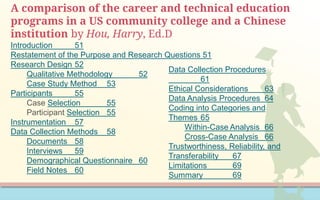
A comparison of the career and technical education
programs in a US community college and a Chinese
institution
by Hou, Harry, Ed.D
http://pqdtopen.proquest.com/doc/763233591.html?FMT=AI
A comparison of the career and technical education
programs in a US community college and a Chinese
institution by Hou, Harry, Ed.D
Introduction 51
Restatement of the Purpose and Research Questions 51
Research Design 52
Qualitative Methodology 52
Case Study Method 53
Participants 55
Case Selection 55
Participant Selection 55
Instrumentation 57
Data Collection Methods 58
Documents 58
Interviews 59
Demographical Questionnaire 60
Field Notes 60
Data Collection Procedures
61
Ethical Considerations 63
Data Analysis Procedures 64
Coding into Categories and
Themes 65
Within-Case Analysis 66
Cross-Case Analysis 66
Trustworthiness, Reliability, and
Transferability 67
Limitations 69
Summary 69
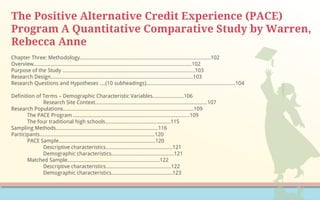
The Positive Alternative Credit Experience (PACE)
Program A Quantitative Comparative Study by Warren,
Rebecca Anne
Chapter Three: Methodology...........................................................................................102
Overview..............................................................................................................102
Purpose of the Study ............................................................................................103
Research Design...................................................................................................103
Research Questions and Hypotheses ....(10 subheadings)..............................................................104
Definition of Terms – Demographic Characteristic Variables…………...….…106
Research Site Context..............................................................................107
Research Populations...........................................................................................109
The PACE Program .................................................................................109
The four traditional high schools…………………….…………………115
Sampling Methods………………………………………………………...……116
Participants……………………………………..……………………………….120
PACE Sample……………………………………………….…….……120
Descriptive characteristics…………….…………...…….………121
Demographic characteristics…….…………………..………..…121
Matched Sample……………………………………………….……….122
Descriptive characteristics……………………...……………….122
Demographic characteristics……………………….……………123
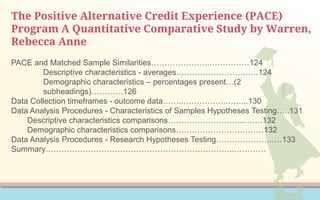
The Positive Alternative Credit Experience (PACE)
Program A Quantitative Comparative Study by Warren,
Rebecca Anne
PACE and Matched Sample Similarities………………….……………124
Descriptive characteristics - averages……………………….…124
Demographic characteristics – percentages present…(2
subheadings)…………126
Data Collection timeframes - outcome data……..…………….….…..130
Data Analysis Procedures - Characteristics of Samples Hypotheses Testing…..131
Descriptive characteristics comparisons………………………..…….132
Demographic characteristics comparisons……………………………132
Data Analysis Procedures - Research Hypotheses Testing………………….…133
Summary……………………………………………………………..…………
Theoretical or Conceptual Frames
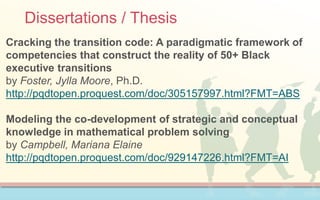
Dissertations / Thesis
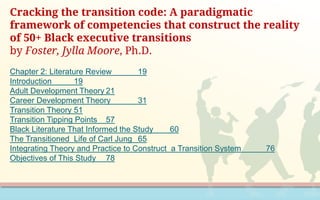
Cracking the transition code: A paradigmatic framework of
competencies that construct the reality of 50+ Black
executive transitions
by Foster, Jylla Moore, Ph.D.
http://pqdtopen.proquest.com/doc/305157997.html?FMT=ABS
Modeling the co-development of strategic and conceptual
knowledge in mathematical problem solving
by Campbell, Mariana Elaine
http://pqdtopen.proquest.com/doc/929147226.html?FMT=AI
Cracking the transition code: A paradigmatic
framework of competencies that construct the reality
of 50+ Black executive transitions
by Foster, Jylla Moore, Ph.D.
Chapter 2: Literature Review 19
Introduction 19
Adult Development Theory 21
Career Development Theory 31
Transition Theory 51
Transition Tipping Points 57
Black Literature That Informed the Study 60
The Transitioned Life of Carl Jung 65
Integrating Theory and Practice to Construct a Transition System 76
Objectives of This Study 78
Cracking the transition code: A paradigmatic framework of
competencies that construct the reality of 50+ Black
executive transitions
by Foster, Jylla Moore, Ph.D.
There are three primary streams of theoretical literature that converge to form the
foundation for this research. As noted in Figure 2, adult development theory, career
development theory, and transition theory intersect to formulate the literature review.
These three streams further integrate conceptual constructs that were derived from
the exploratory interviews and extant literature that related to this participant set that
are the subjects of the study. Careful examination of the competencies for success
discovered within these literature streams, combined with the exploratory interviews,
revealed a framework to determine key competencies for success in transitions.
Cracking the transition code: A paradigmatic framework of
competencies that construct the reality of 50+ Black
executive transitions
by Foster, Jylla Moore, Ph.D.
Most of the scholarly literature relative to adult development theory explores stages of the
life cycle prior to the 50+ transition phase. The emerging population of 50+ Black executives
who have transitioned or are transitioning with the shifting of the population demographics is
a critical group of individuals to research. Established definitions of adult development and
career stages have been researched as comingled components to establish the transition
competencies for this study.
A gap exists at the intersection of the theory explored and the practice associated with the
transition of 50+ talented Black executives. Within this gap resides the question that was left
unanswered in the literature that was examined: What are the transition competencies
employed by 50+ Black executives who transition from first careers to second pursuits?
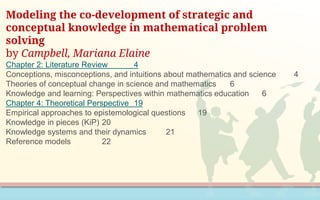
Modeling the co-development of strategic and
conceptual knowledge in mathematical problem
solving
by Campbell, Mariana Elaine
Chapter 2: Literature Review 4
Conceptions, misconceptions, and intuitions about mathematics and science 4
Theories of conceptual change in science and mathematics 6
Knowledge and learning: Perspectives within mathematics education 6
Chapter 4: Theoretical Perspective 19
Empirical approaches to epistemological questions 19
Knowledge in pieces (KiP) 20
Knowledge systems and their dynamics 21
Reference models 22
Modeling the co-development of strategic and conceptual
knowledge in mathematical problem solving
by Campbell, Mariana Elaine
Knowledge in pieces (KiP)
The Knowledge in Pieces (KiP) epistemological perspective (diSessa, 1993) is a
powerful and evolving heuristic framework for considering the nature of knowledge,
its deployment, and how knowledge organization changes as individuals learn.
Though many of the principles can be (and have been) stated quite generally, KiP
remains most elaborated in the domain of physics (Notable and more recent
exceptions in the domain of mathematics that have strongly guided the current
analysis include Izsák, 2000; 2005; Pratt & Noss, 2002; and Wagner, 2006; 2010).
Modeling the co-development of strategic and conceptual
knowledge in mathematical problem solving
by Campbell, Mariana Elaine
Historically, Knowledge in Pieces as a perspective on knowing and learning was
informed by two main traditions: developmental psychology (e.g., Piaget’s genetic
epistemology) and artificial intelligence. From developmental psychology came an
interest in and ultimate accountability to be able to explain long-term and central
learning and developmental processes. From artificial intelligence came a
commitment to the fine- grained accountability that is required by attempts to model
moment-to-moment cognitive activity, ultimately computationally. Thus, one can see
that the commitment to understanding change across very long time scales is paired
with the commitment to understand the details of learning at very small, moment-to-
moment timescales.
Great and Unusual Findings – Left for
another webinar later this summer
What’s Up at MN & DN this summer?
1. VERY IMPORTANT – backwards
map your summer work
2. 30 day writing challenge, 30 day
work-life balance challenge, and
365s -
keep you in touch with your work
3. Group work – RLC writing OR
Lingerers
1. For non – university users… Buy a book and get the website usage for free
2. For anyone who has literature & a story with or without data…. Time to get
published?
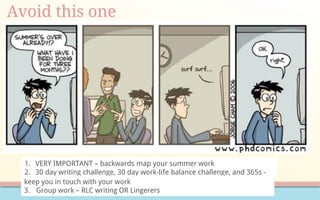
Avoid this one
1. VERY IMPORTANT – backwards map your summer work
2. 30 day writing challenge, 30 day work-life balance challenge, and 365s -
keep you in touch with your work
3. Group work – RLC writing OR Lingerers

Model dissertations What makes these good part 2

  • 1.
    Exploiting Rapid Change inTechnology Enhanced Learning … for Post Graduate Education Analyzing Dissertations What Makes These Work? Or Not?
  • 2.
    It isn't themountains ahead to climb that wear you out; it's the pebble in your shoe. Muhammad Ali It's better to look ahead and prepare, than to look back and regret. Jackie Joyner-Kersee
  • 3.
    Why? Because you’lldevelop… 1. Your own voice faster 2. A toolbox that works for you 3. Understanding that will help your relationship with your supervisor/committee chair 4. You’ll begin to understand your dissertation or thesis as a project you are managing… transferable skill #1 Goal: To Get You to Look at Others Finished Dissertation or Theses Differently
  • 4.
    Agenda Taking a lookat what makes them good… Innovation vs Good Solid Work… both are important Part I 1. Abstracts 2. First Paragraphs 3. Layouts/organization 4. Writing style Part II 1. Lit review logic 2. Clarity of methodological design 3. Good use of theoretical frame 4. Great and unusual findings.
  • 5.
  • 6.
    Dissertations / Thesis FromWVU, Morgan State – keywords education 1. First year student expectations: General education goals at a multi-campus community college by Sherri Anna Robinson 2. http://pqdtopen.proquest.com/doc/894213089.html?FMT=AI Chapter 2: Review of Literature (33 pages) Theoretical Models Related to Student Effort and Persistence Community college student expectations Essential college outcomes Community college and general education Summary
  • 7.
    First year studentexpectations: General education goals at a multi-campus community college by Sherri Anna Robinson This chapter will explore college student expectations and perceptions of general education outcomes, goals and related curriculum. In order to understand the impact of student expectations on the college experience, the first sections will provide an overview of relevant college impact models pertaining to student effort and retention. Pace's Path for a Student Development and College Impress Model (1979, 1984) and Vincent Tinto's Longitudinal Model of Departure from Institutions of Higher Education (1975, 1987, 1993) provides an understanding of how student experiences affect their quality of effort and decisions to withdraw from college. Next, the relevant empirical literature surrounding several key issues will be explored. First, the review will provide an overview of the expectations of community college students and their reasons for choosing to attend. The top eight intellectual skills identified by the Association of American Colleges and Universities (AAC&U) member institutions as common learning goals will be reviewed. Next, it will highlight the literature describing general education in community colleges to reveal how the learning outcomes are presented to students. The last section will explore undergraduate students' perceptions of their general education experiences to provide an understanding as to whether there is a connection or a mismatch between intent and reality.
  • 8.
    Use of theCouncil for the Advancement of Standards (CAS) by career services directors at two-year public community colleges by Barbour, Wayne C., http://pqdtopen.proquest.com/doc/753944231.html?FMT=ABS Chapter 2: (73 pages) Background Student Affairs Career Services (6 subheadings) Accountability in Higher Education Professional Associations and Organizations (2 subheadings) History of the Council for the Advancement of Standards in HE Purpose and Use of the CAS Standards (7 subheadings) Summary
  • 9.
    Use of theCouncil for the Advancement of Standards (CAS) by career services directors at two-year public community colleges by Barbour, Wayne C., This study determined how professional standards are being used, specifically at two-year public community colleges by career services directors. In addition, by determining if the characteristics of career services directors and their institutions are associated with the use of the Council for the Advancement of Standards in Higher Education (CAS) at two-year public community colleges, this study addressed the problem related to the lack of research regarding the use of professional standards for assessing career services programs at two- year public community colleges. The first section acknowledges the services that are provided under the umbrella of student services. The second section provides a discussion on the evolution of career services in higher education. The third section explores accountability issues in higher education that have directly impacted the quality of student services programs in colleges and universities. The fourth section characterizes professional associations and organizations. Finally, a review of the literature is provided, which concerns the need for and the creation of the Council for the Advancement of Standards for Higher Education as a guide for professionals in the areas of student services.
  • 10.
  • 11.
    Dissertations / Thesis ComparativeStudies: one quantitative and one comparative case study The Positive Alternative Credit Experience (PACE) Program A Quantitative Comparative Study by Warren, Rebecca Anne http://pqdtopen.proquest.com/doc/910007849.html?FMT=AI A comparison of the career and technical education programs in a US community college and a Chinese institution by Hou, Harry, Ed.D http://pqdtopen.proquest.com/doc/763233591.html?FMT=AI
  • 12.
    A comparison ofthe career and technical education programs in a US community college and a Chinese institution by Hou, Harry, Ed.D Introduction 51 Restatement of the Purpose and Research Questions 51 Research Design 52 Qualitative Methodology 52 Case Study Method 53 Participants 55 Case Selection 55 Participant Selection 55 Instrumentation 57 Data Collection Methods 58 Documents 58 Interviews 59 Demographical Questionnaire 60 Field Notes 60 Data Collection Procedures 61 Ethical Considerations 63 Data Analysis Procedures 64 Coding into Categories and Themes 65 Within-Case Analysis 66 Cross-Case Analysis 66 Trustworthiness, Reliability, and Transferability 67 Limitations 69 Summary 69
  • 13.
    The Positive AlternativeCredit Experience (PACE) Program A Quantitative Comparative Study by Warren, Rebecca Anne Chapter Three: Methodology...........................................................................................102 Overview..............................................................................................................102 Purpose of the Study ............................................................................................103 Research Design...................................................................................................103 Research Questions and Hypotheses ....(10 subheadings)..............................................................104 Definition of Terms – Demographic Characteristic Variables…………...….…106 Research Site Context..............................................................................107 Research Populations...........................................................................................109 The PACE Program .................................................................................109 The four traditional high schools…………………….…………………115 Sampling Methods………………………………………………………...……116 Participants……………………………………..……………………………….120 PACE Sample……………………………………………….…….……120 Descriptive characteristics…………….…………...…….………121 Demographic characteristics…….…………………..………..…121 Matched Sample……………………………………………….……….122 Descriptive characteristics……………………...……………….122 Demographic characteristics……………………….……………123
  • 14.
    The Positive AlternativeCredit Experience (PACE) Program A Quantitative Comparative Study by Warren, Rebecca Anne PACE and Matched Sample Similarities………………….……………124 Descriptive characteristics - averages……………………….…124 Demographic characteristics – percentages present…(2 subheadings)…………126 Data Collection timeframes - outcome data……..…………….….…..130 Data Analysis Procedures - Characteristics of Samples Hypotheses Testing…..131 Descriptive characteristics comparisons………………………..…….132 Demographic characteristics comparisons……………………………132 Data Analysis Procedures - Research Hypotheses Testing………………….…133 Summary……………………………………………………………..…………
  • 15.
  • 16.
    Dissertations / Thesis Crackingthe transition code: A paradigmatic framework of competencies that construct the reality of 50+ Black executive transitions by Foster, Jylla Moore, Ph.D. http://pqdtopen.proquest.com/doc/305157997.html?FMT=ABS Modeling the co-development of strategic and conceptual knowledge in mathematical problem solving by Campbell, Mariana Elaine http://pqdtopen.proquest.com/doc/929147226.html?FMT=AI
  • 17.
    Cracking the transitioncode: A paradigmatic framework of competencies that construct the reality of 50+ Black executive transitions by Foster, Jylla Moore, Ph.D. Chapter 2: Literature Review 19 Introduction 19 Adult Development Theory 21 Career Development Theory 31 Transition Theory 51 Transition Tipping Points 57 Black Literature That Informed the Study 60 The Transitioned Life of Carl Jung 65 Integrating Theory and Practice to Construct a Transition System 76 Objectives of This Study 78
  • 18.
    Cracking the transitioncode: A paradigmatic framework of competencies that construct the reality of 50+ Black executive transitions by Foster, Jylla Moore, Ph.D. There are three primary streams of theoretical literature that converge to form the foundation for this research. As noted in Figure 2, adult development theory, career development theory, and transition theory intersect to formulate the literature review. These three streams further integrate conceptual constructs that were derived from the exploratory interviews and extant literature that related to this participant set that are the subjects of the study. Careful examination of the competencies for success discovered within these literature streams, combined with the exploratory interviews, revealed a framework to determine key competencies for success in transitions.
  • 19.
    Cracking the transitioncode: A paradigmatic framework of competencies that construct the reality of 50+ Black executive transitions by Foster, Jylla Moore, Ph.D. Most of the scholarly literature relative to adult development theory explores stages of the life cycle prior to the 50+ transition phase. The emerging population of 50+ Black executives who have transitioned or are transitioning with the shifting of the population demographics is a critical group of individuals to research. Established definitions of adult development and career stages have been researched as comingled components to establish the transition competencies for this study. A gap exists at the intersection of the theory explored and the practice associated with the transition of 50+ talented Black executives. Within this gap resides the question that was left unanswered in the literature that was examined: What are the transition competencies employed by 50+ Black executives who transition from first careers to second pursuits?
  • 20.
    Modeling the co-developmentof strategic and conceptual knowledge in mathematical problem solving by Campbell, Mariana Elaine Chapter 2: Literature Review 4 Conceptions, misconceptions, and intuitions about mathematics and science 4 Theories of conceptual change in science and mathematics 6 Knowledge and learning: Perspectives within mathematics education 6 Chapter 4: Theoretical Perspective 19 Empirical approaches to epistemological questions 19 Knowledge in pieces (KiP) 20 Knowledge systems and their dynamics 21 Reference models 22
  • 21.
    Modeling the co-developmentof strategic and conceptual knowledge in mathematical problem solving by Campbell, Mariana Elaine Knowledge in pieces (KiP) The Knowledge in Pieces (KiP) epistemological perspective (diSessa, 1993) is a powerful and evolving heuristic framework for considering the nature of knowledge, its deployment, and how knowledge organization changes as individuals learn. Though many of the principles can be (and have been) stated quite generally, KiP remains most elaborated in the domain of physics (Notable and more recent exceptions in the domain of mathematics that have strongly guided the current analysis include Izsák, 2000; 2005; Pratt & Noss, 2002; and Wagner, 2006; 2010).
  • 22.
    Modeling the co-developmentof strategic and conceptual knowledge in mathematical problem solving by Campbell, Mariana Elaine Historically, Knowledge in Pieces as a perspective on knowing and learning was informed by two main traditions: developmental psychology (e.g., Piaget’s genetic epistemology) and artificial intelligence. From developmental psychology came an interest in and ultimate accountability to be able to explain long-term and central learning and developmental processes. From artificial intelligence came a commitment to the fine- grained accountability that is required by attempts to model moment-to-moment cognitive activity, ultimately computationally. Thus, one can see that the commitment to understanding change across very long time scales is paired with the commitment to understand the details of learning at very small, moment-to- moment timescales.
  • 23.
    Great and UnusualFindings – Left for another webinar later this summer
  • 24.
    What’s Up atMN & DN this summer? 1. VERY IMPORTANT – backwards map your summer work 2. 30 day writing challenge, 30 day work-life balance challenge, and 365s - keep you in touch with your work 3. Group work – RLC writing OR Lingerers 1. For non – university users… Buy a book and get the website usage for free 2. For anyone who has literature & a story with or without data…. Time to get published?
  • 25.
    Avoid this one 1.VERY IMPORTANT – backwards map your summer work 2. 30 day writing challenge, 30 day work-life balance challenge, and 365s - keep you in touch with your work 3. Group work – RLC writing OR Lingerers