FINAL (PS)_PR2_ 11_12_UNIT 2_LESSON 4_Writing a Research Statement for Quantitative Research (1).pptx
This document discusses writing a research statement for quantitative research. It explains that a research statement includes a concise problem statement and research questions. It describes the characteristics of good research questions, such as being relevant, specific, clear and measurable. The document provides guidelines for constructing a research statement, including finalizing the research topic, drafting questions, and writing the general problem and a refined problem statement. It also differentiates between descriptive, comparative, evaluative and explanatory research questions.
Introduction to formulating research problems and questions, emphasizing their importance in quantitative research.
Engagement activity where students consider what questions to ask the President of the Philippines about national issues.
Description of a statement of the problem in research, including its context and relation to specific research questions.
Overview of different types of research questions: descriptive, comparative, evaluative, and explanatory, with examples.
Essential attributes of effective research questions including their relevance, specificity, clarity, analytical depth, and measurability.
Guidelines for writing a well-structured research statement, including topic finalization, drafting questions, and refining statements.
Interactive practice session for students to provide examples of different categories of research questions.
Quick assessments to reinforce understanding of categories of research questions and the position of the statement of the problem.
Summary of key concepts including the significance of the statement of the problem and characteristics of quantitative research questions.Cites sources for further reading related to quantitative research questions and methodologies.
FINAL (PS)_PR2_ 11_12_UNIT 2_LESSON 4_Writing a Research Statement for Quantitative Research (1).pptx
1.
Practical Research 2
SeniorHigh School Applied - Academic
Unit 2: Developing a Research Problem
Lesson 4
Writing a Research Statement for
Quantitative Research
2.
ENGAGE EXPLORE EXPLAINEXTEND
EVALUAT
Why is it
necessary to
formulate good
research
questions?
2
3.
Learning
Objectives
At the endof the
lesson, you should
be able to do the
following:
ENGAGE EXPLORE EXPLAIN EXTEND
EVALUAT 3
● Identify the problem statements
and research questions.
● Determine the characteristics of
good research questions.
● Demonstrate the process of
constructing the statement of
the problem.
3
4.
ENGAGE EXPLORE EXPLAINEXTEND
EVALUAT
You were given the
opportunity to interview
the President of the
Philippines about any
problem of the country
today.
4
4
5.
ENGAGE EXPLORE EXPLAINEXTEND
EVALUAT
1. What kind of problem will you ask?
2. What are the specific questions that you will
ask to target this problem?
5
5
6.
ENGAGE EXPLORE EXPLAINEXTEND
EVALUAT
A statement of the problem is an integrative
but brief discussion of the research problem,
its context, and the questions of the study.
Statement of the Problem
6
7.
ENGAGE EXPLORE EXPLAINEXTEND
EVALUAT
It is written as part of the introduction and
provides a concise overview of the topic in
relation to the research questions.
Statement of the Problem
7
8.
ENGAGE EXPLORE EXPLAINEXTEND
EVALUAT
A research question identifies the specific
aspects of the topic that the current study
seeks to investigate and may vary depending
on the extent of their focus.
Research Questions
8
8
9.
Remember
A statement ofthe problem
usually begins with introducing your
general problem statement
followed by the specific research
questions that aim to address the
research problem.
9
10.
ENGAGE EXPLORE EXPLAINEXTEND
EVALUAT
Categories of Research Questions
10
10
Descriptive research questions
● Descriptive research question are used to
describe certain patterns and focus on
single and noncomplex variables.
● It may also be used to quantify or categorize
variables in the study.
11.
ENGAGE EXPLORE EXPLAINEXTEND
EVALUAT
Examples
11
11
● How frequent is the production of essential
oils for herbal medicines?
● What criteria are considered by customers
in choosing a store?
12.
ENGAGE EXPLORE EXPLAINEXTEND
EVALUAT
Comparative research questions are mainly
used for comparing and contrasting similarities
and differences between groups and variables.
Categories of Research Questions
12
12
13.
ENGAGE EXPLORE EXPLAINEXTEND
EVALUAT
Examples
● What is the difference between the quality of
natural and synthetic ink?
● How do Gen Z and millennials differ in terms
of dating attitudes?
13
13
14.
ENGAGE EXPLORE EXPLAINEXTEND
EVALUAT
Categories of Research Questions
14
14
Evaluative research questions
● Evaluative research questions are formed to
assess a particular observation or
phenomenon based on an established model
or theory.
● They are usually observed in organizations,
workplace, programs, and effectivity of
projects.
15.
ENGAGE EXPLORE EXPLAINEXTEND
EVALUAT
Examples
● How satisfied are you with the
implementation of the K-12 curriculum?
● Did the art therapy program work for the
patients with post-traumatic stress disorder?
15
15
16.
ENGAGE EXPLORE EXPLAINEXTEND
EVALUAT
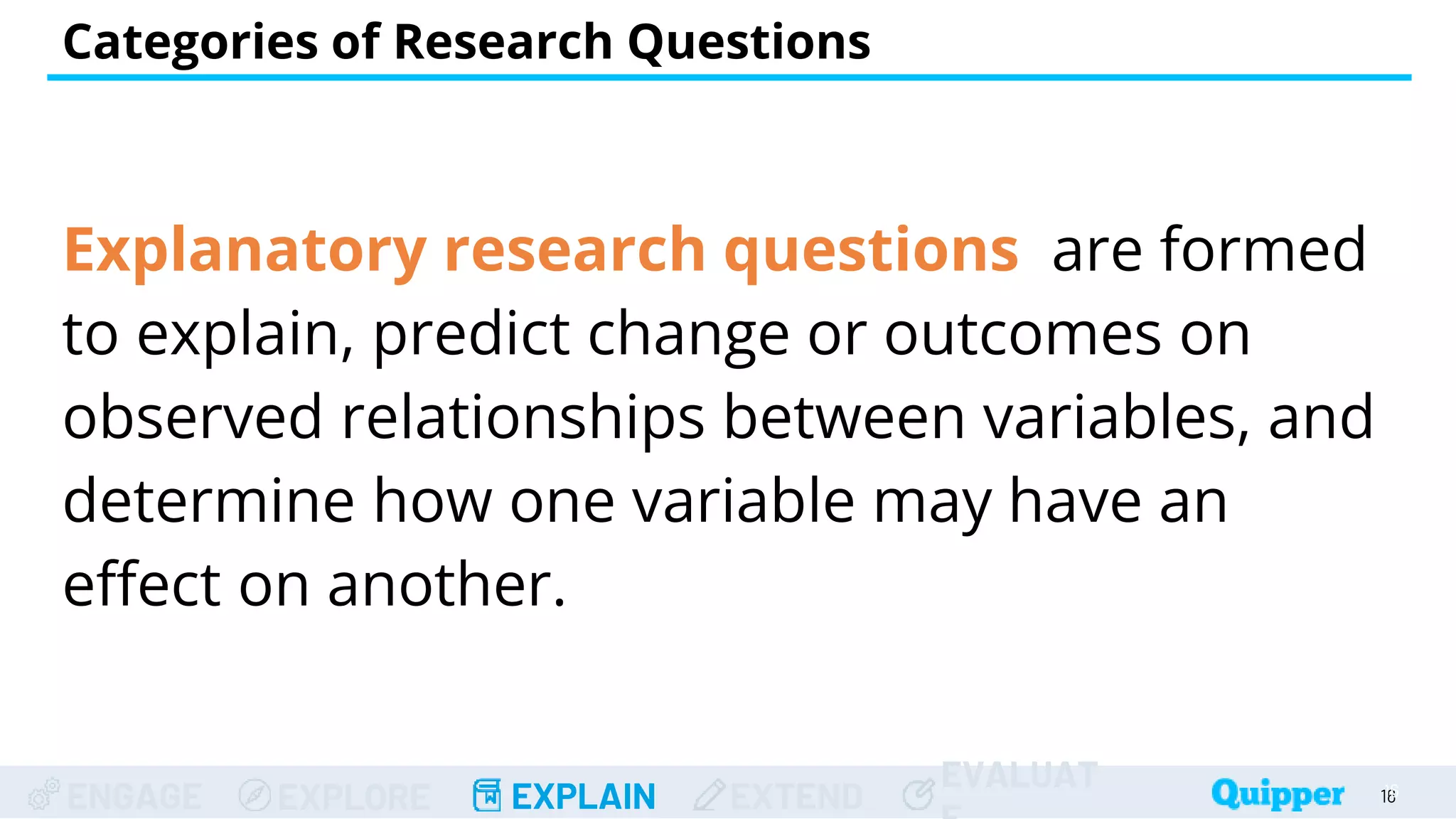
Explanatory research questions are formed
to explain, predict change or outcomes on
observed relationships between variables, and
determine how one variable may have an
effect on another.
Categories of Research Questions
16
16
17.
ENGAGE EXPLORE EXPLAINEXTEND
EVALUAT
Examples
● How does nurse intervention affect a
patient’s presurgery stress level?
● How does employment tenure contribute to
productivity of workers?
17
17
ENGAGE EXPLORE EXPLAINEXTEND
EVALUAT
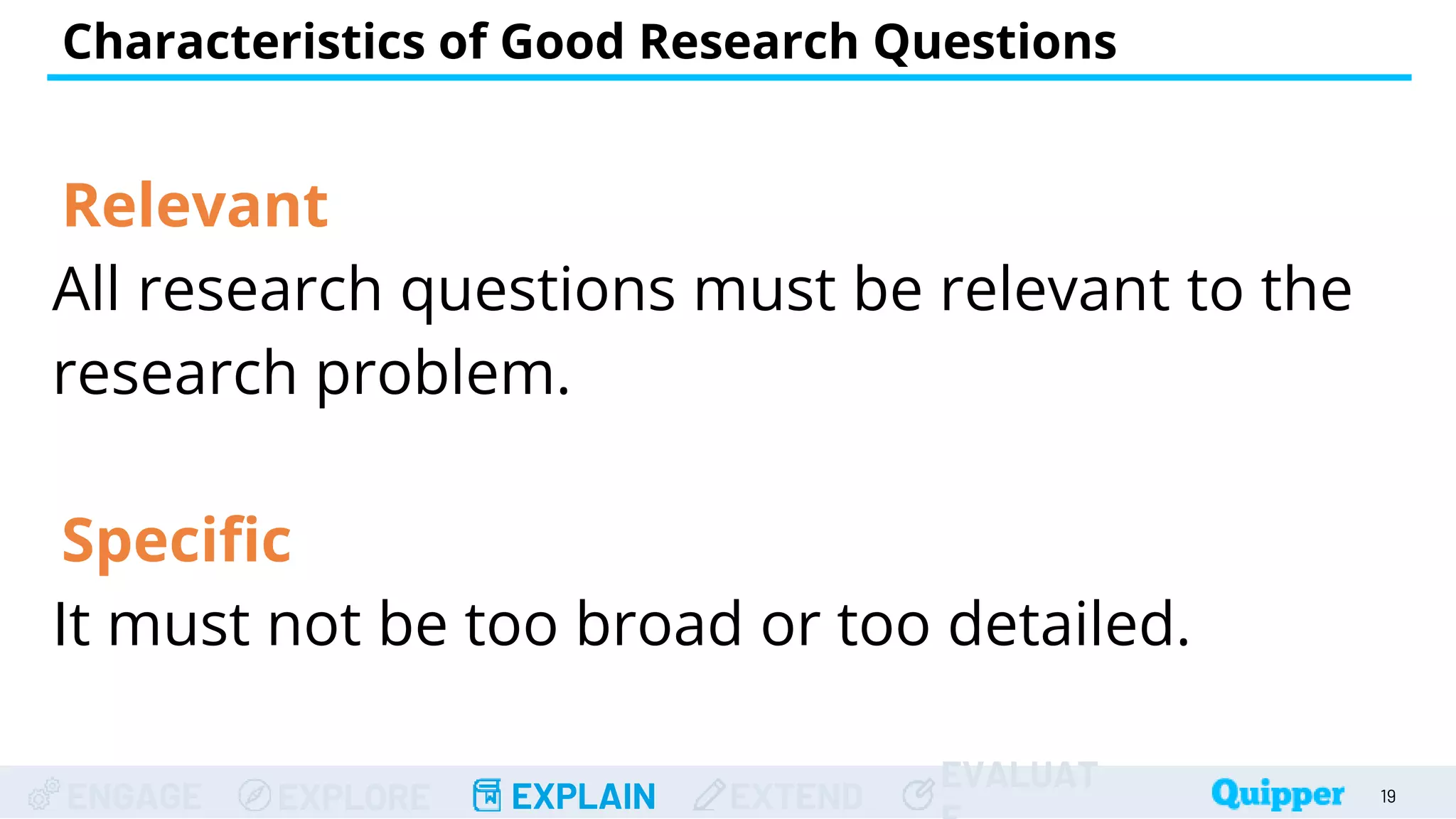
Relevant
All research questions must be relevant to the
research problem.
Specific
It must not be too broad or too detailed.
Characteristics of Good Research Questions
19
20.
ENGAGE EXPLORE EXPLAINEXTEND
EVALUAT
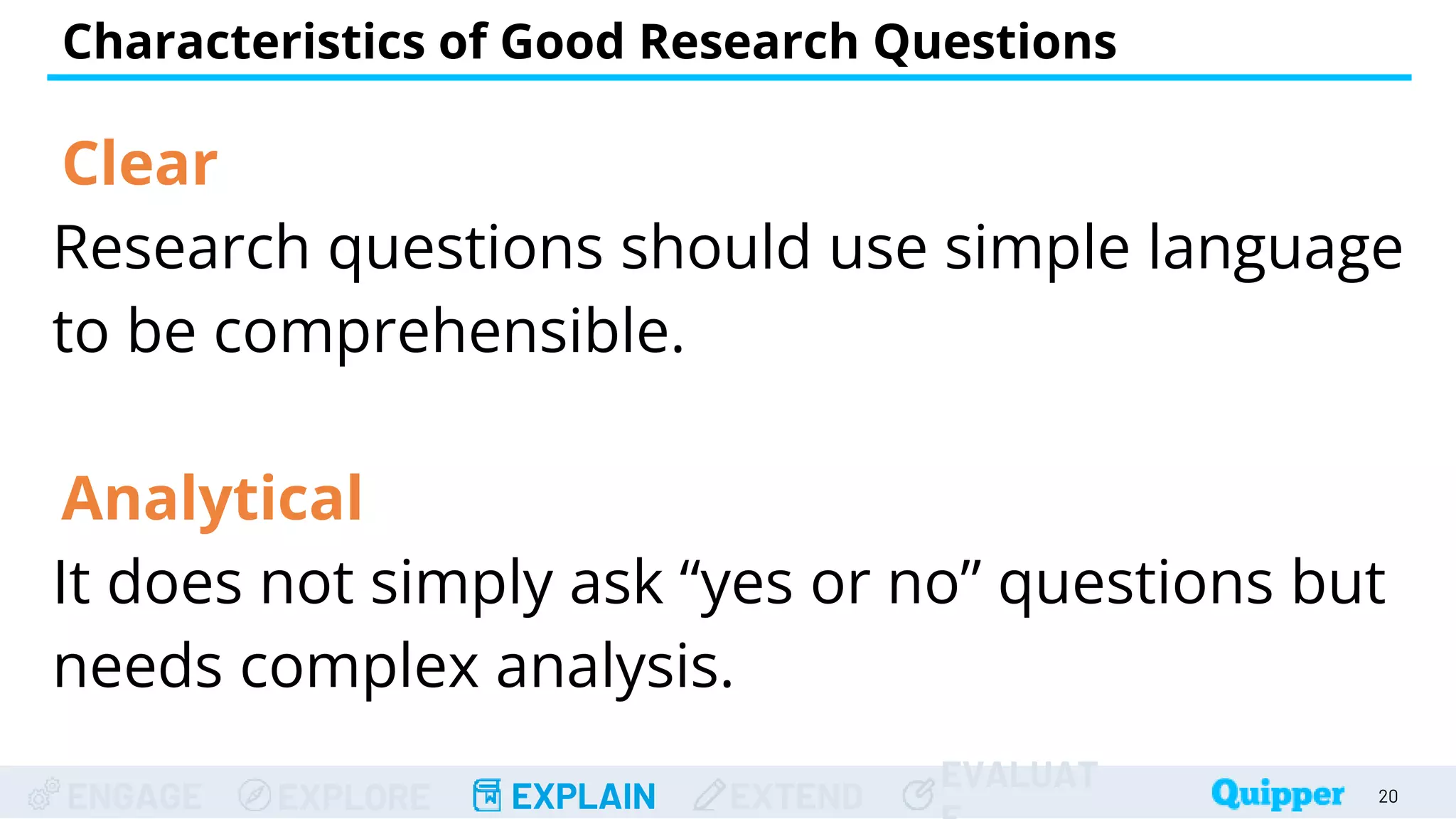
Clear
Research questions should use simple language
to be comprehensible.
Analytical
It does not simply ask “yes or no” questions but
needs complex analysis.
Characteristics of Good Research Questions
20
21.
ENGAGE EXPLORE EXPLAINEXTEND
EVALUAT
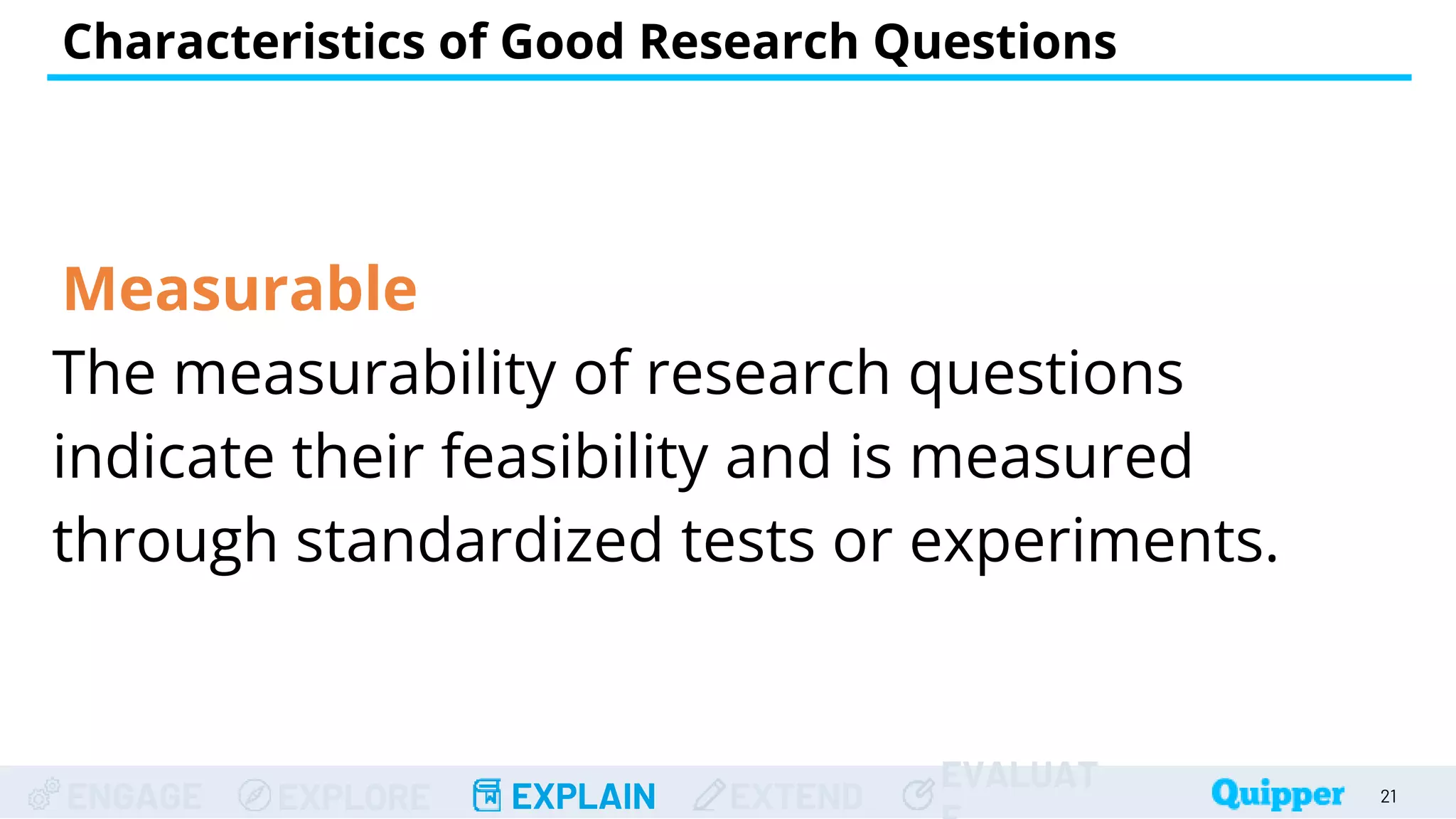
Measurable
The measurability of research questions
indicate their feasibility and is measured
through standardized tests or experiments.
Characteristics of Good Research Questions
21
22.
ENGAGE EXPLORE EXPLAINEXTEND
EVALUAT
Writing the
Research
Statement
22
22
The following guidelines
may be observed in
creating a well-
structured research
statement.
23.
ENGAGE EXPLORE EXPLAINEXTEND
EVALUAT
Writing the Research Statement
23
23
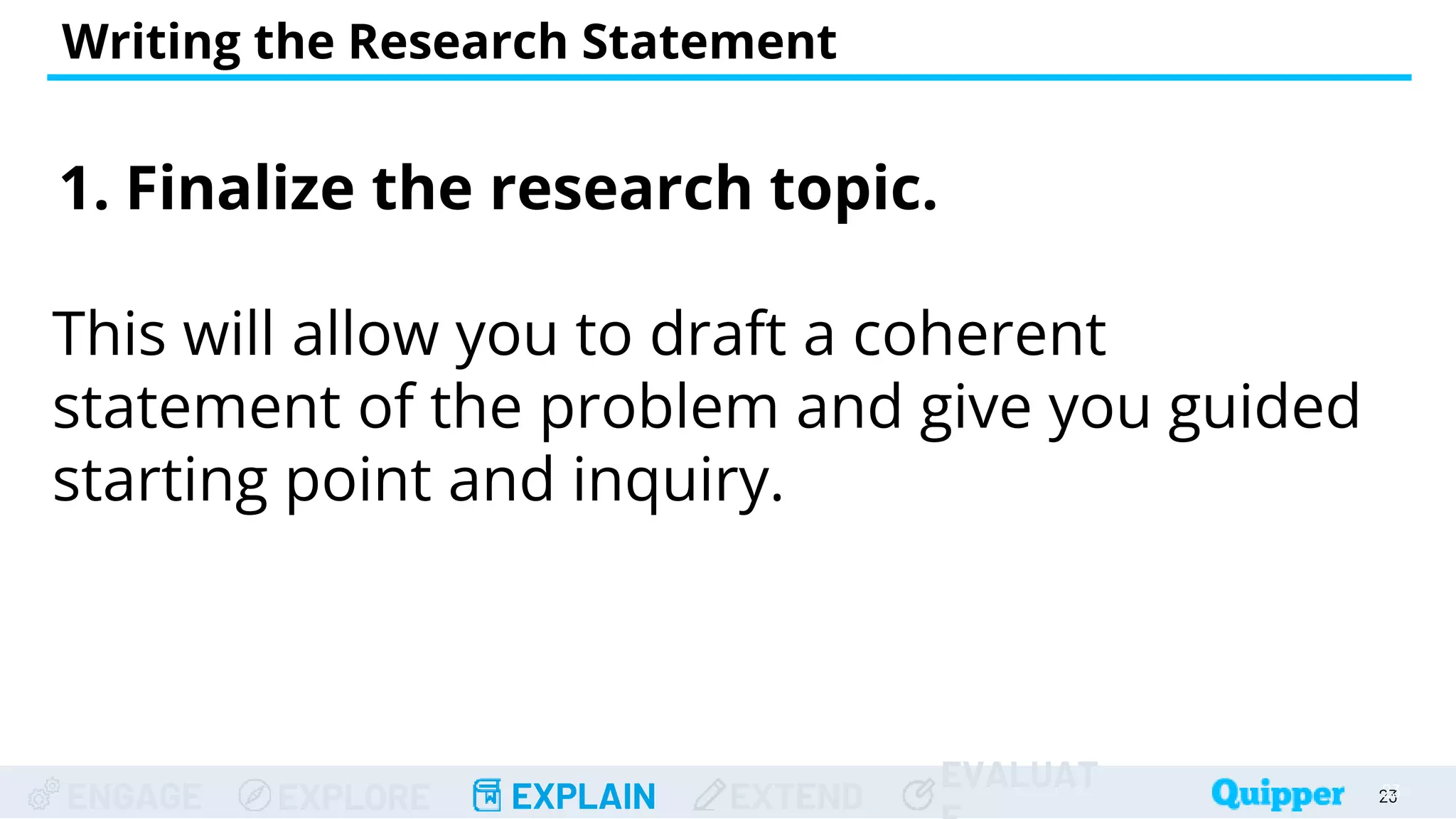
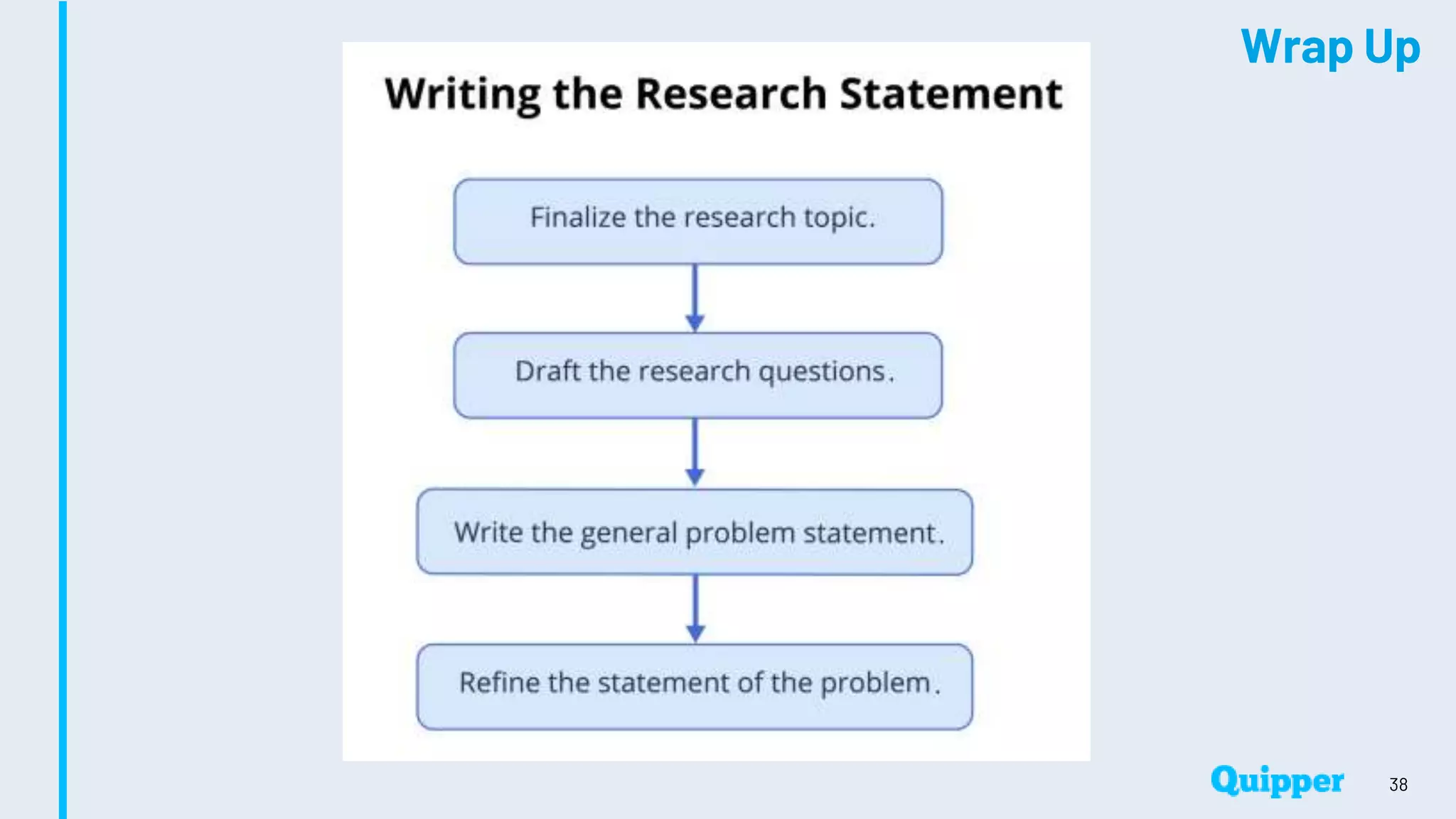
1. Finalize the research topic.
This will allow you to draft a coherent
statement of the problem and give you guided
starting point and inquiry.
24.
ENGAGE EXPLORE EXPLAINEXTEND
EVALUAT
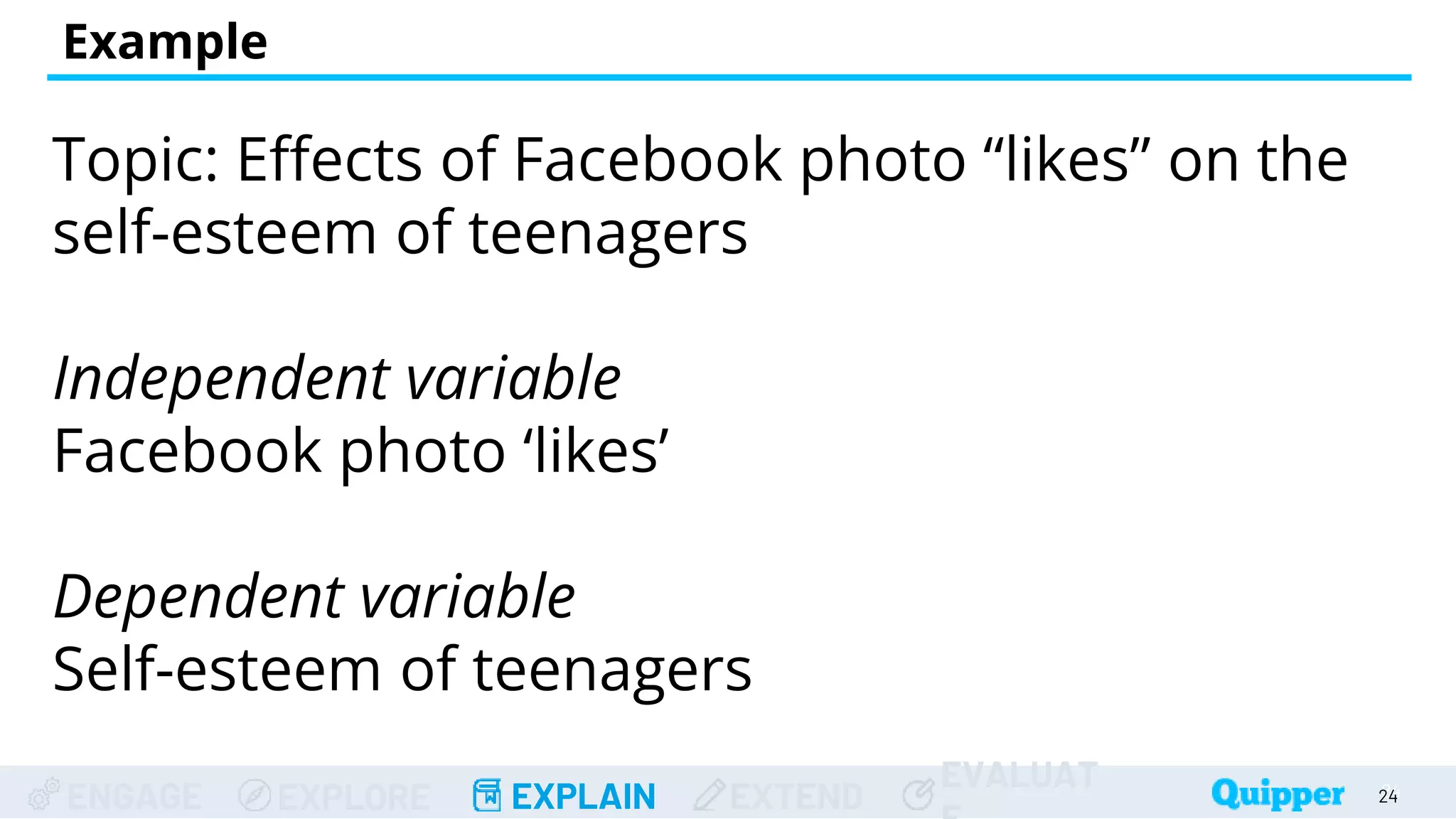
Example
Topic: Effects of Facebook photo “likes” on the
self-esteem of teenagers
Independent variable
Facebook photo ‘likes’
Dependent variable
Self-esteem of teenagers
24
24
25.
ENGAGE EXPLORE EXPLAINEXTEND
EVALUAT
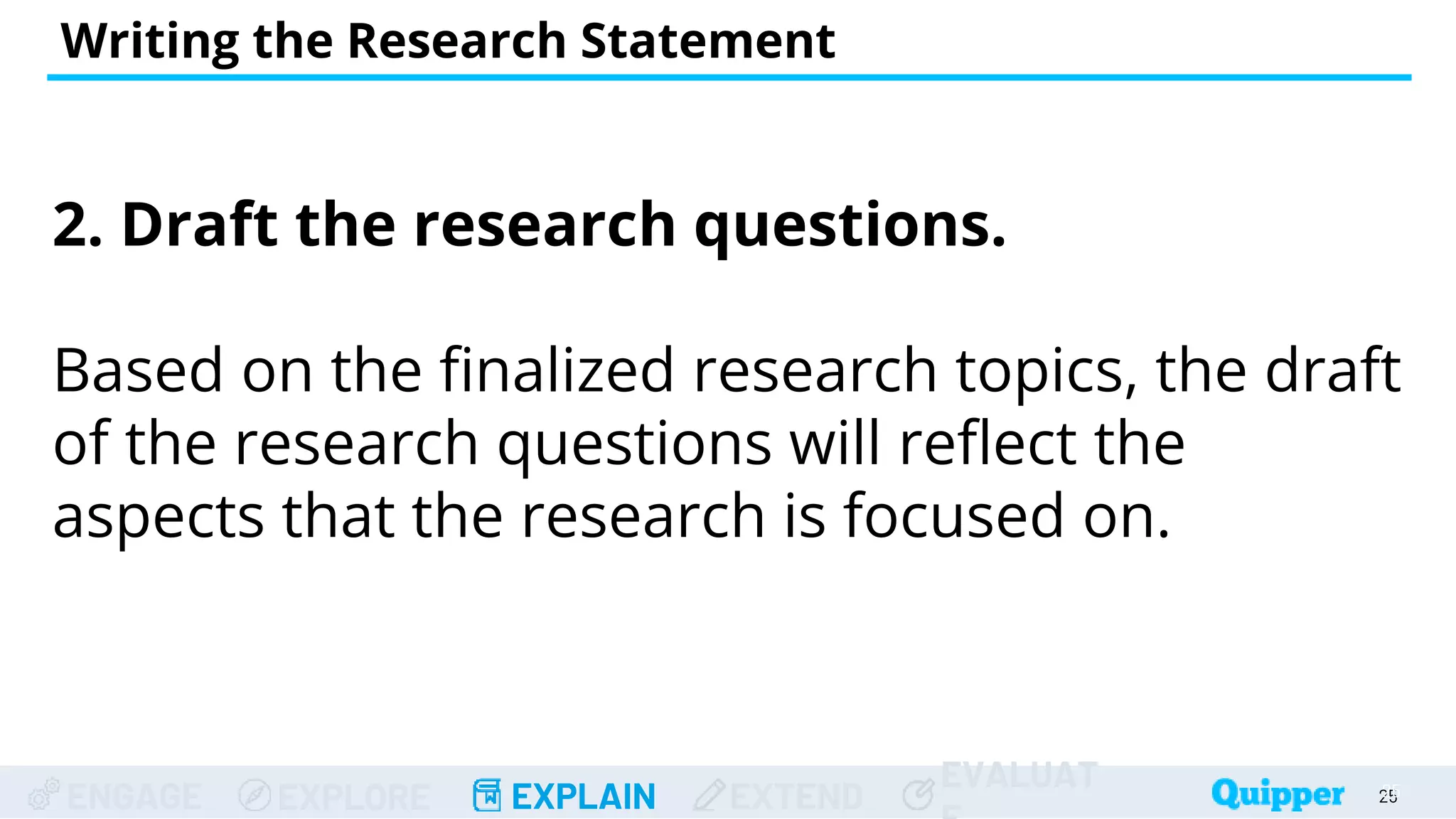
2. Draft the research questions.
Based on the finalized research topics, the draft
of the research questions will reflect the
aspects that the research is focused on.
Writing the Research Statement
25
25
26.
ENGAGE EXPLORE EXPLAINEXTEND
EVALUAT
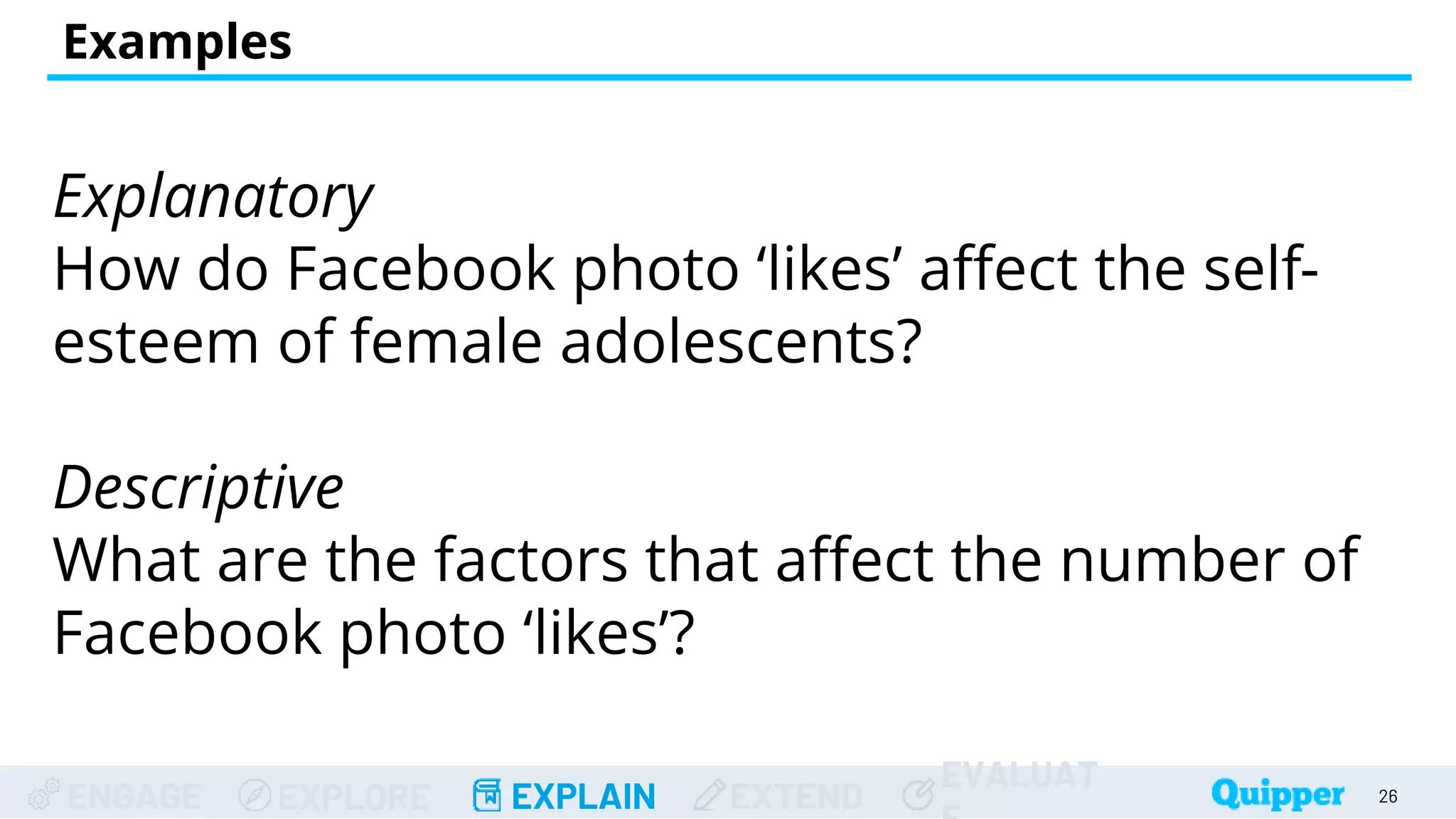
Explanatory
How do Facebook photo ‘likes’ affect the self-
esteem of female adolescents?
Descriptive
What are the factors that affect the number of
Facebook photo ‘likes’?
Examples
26
26
27.
ENGAGE EXPLORE EXPLAINEXTEND
EVALUAT
Writing the Research Statement
27
27
3. Write the general problem statement.
● The general problem statement establishes
the overall goal and direction of the
research.
● It should contain the research topic, the
main objective of the study, and the
variables.
28.
ENGAGE EXPLORE EXPLAINEXTEND
EVALUAT
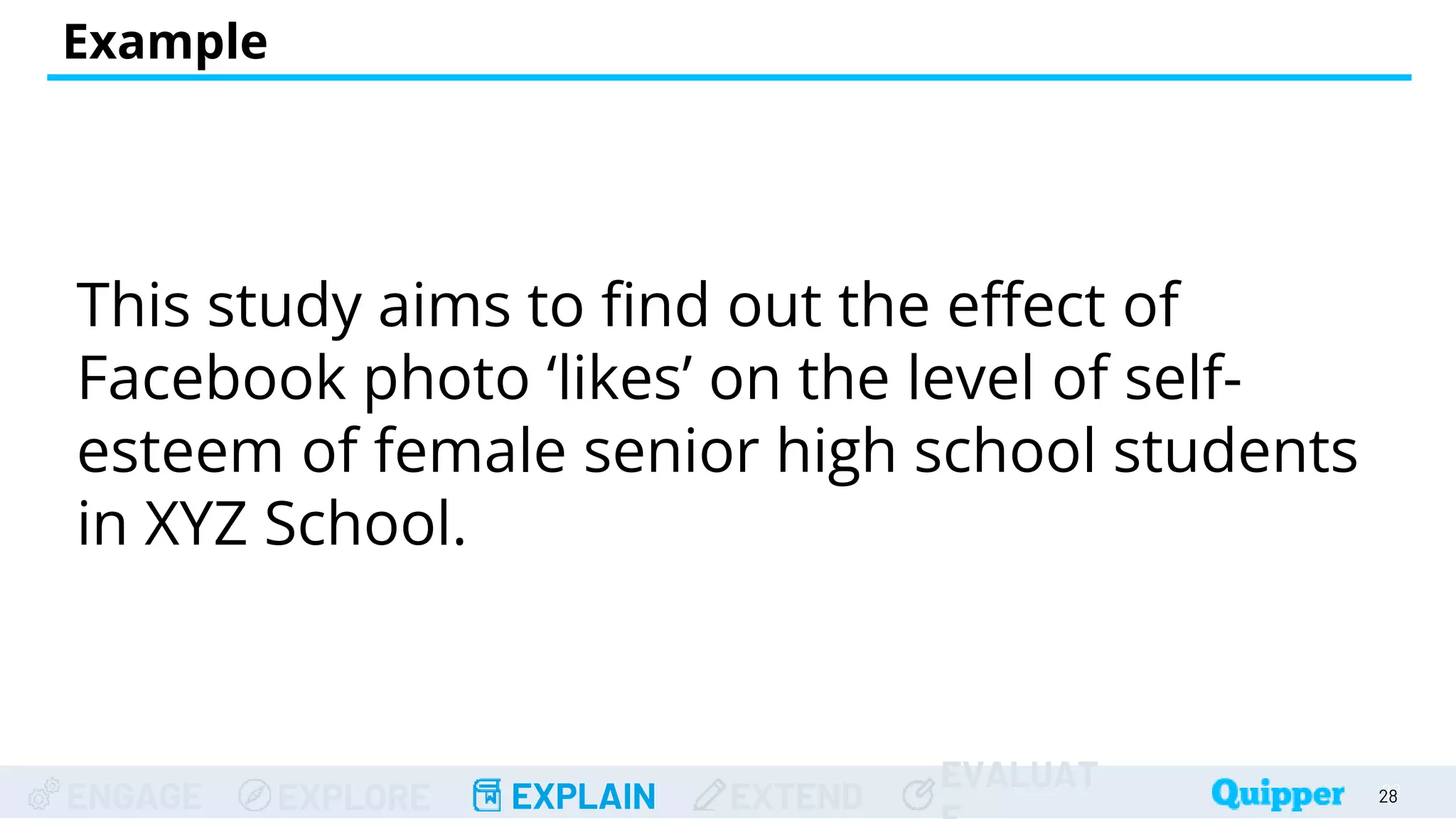
Example
28
28
This study aims to find out the effect of
Facebook photo ‘likes’ on the level of self-
esteem of female senior high school students
in XYZ School.
29.
ENGAGE EXPLORE EXPLAINEXTEND
EVALUAT
Writing the Research Statement
29
29
4. Refine the statement of the problem.
● A refined statement of the problem includes
the research questions and the potential
benefits of the current study.
● The research questions should be written in
declarative sentences.
30.
Tip
Keep the statementof the problem
short and simple. Make sure that
the statement of the problem
reflects the research problem,
research questions, and the aims
of the study.
30
31.
ENGAGE EXPLORE EXPLAINEXTEND
EVALUAT
Practice
31
Provide one example per type of research
question.
● Descriptive
● Comparative
● Evaluative
● Explanatory
32.
ENGAGE EXPLORE EXPLAINEXTEND
EVALUAT
ENGAGE EXPLORE EXPLAIN EXTEND
EVALUAT
Quick Check
It is the type of research question that looks
into the similarities and differences between
groups or variables.
32
33.
ENGAGE EXPLORE EXPLAINEXTEND
EVALUAT
ENGAGE EXPLORE EXPLAIN EXTEND
EVALUAT
It is the part of the research study where
the statement of the problem is commonly
located.
Quick Check
33
33
33
33
33
34.
ENGAGE EXPLORE EXPLAINEXTEND
EVALUAT
ENGAGE EXPLORE EXPLAIN EXTEND
EVALUAT
It is the characteristic of good research
questions that avoids being too broad or being
too detailed.
Quick Check
34
34
34
34
34
35.
Wrap Up
The statementof the problem provides
context to the research problem. It is
usually included in the introductory part of
a research study.
35
36.
Wrap Up
The researchquestions are the basis of
the statement of the problem. There are
four main categories of research
questions, namely: descriptive,
comparative, evaluative, and
explanatory research questions.
36
Bibliography
Business & IPCentre. “What are Typical Quantitative Research Questions?” British Library. Accessed
May 7, 2020. https://www.bl.uk/business-and-ip-centre/articles/what-are-typical-quantitative-
research-questions.
Johnston, Deirdre, and Scott W. Vanderstoep. Research Methods for Everyday Life Blending
Qualitative and Quantitative Approaches. California: John Wiley & Sons, Inc., 2009.
Royal Roads University. “Thesis Statements/Research Questions/Problem Statements.” Royal Roads
University Library. Accessed May 7, 2020. https://library.royalroads.ca/writing-
centre/writing/structure/thesis-statements.
39
40.
Bibliography
40
Singh, Kultar. QuantitativeSocial Research Methods. New Delhi: Sage Publications India, 2007.
University of Southern California. “Organizing your Social Sciences Research Paper.” USC Libraries. Last
modified April 20, 2020. https://libguides.usc.edu/writingguide/researchproblem.
Waters, Donald. Quantitative Methods for Business. 4th ed. England: Pearson Education Limited, 2008.
Editor's Notes
#5 Suggested activity:
You were given the opportunity to interview the President of the Philippines about any problem of the country today.
What kind of problem will you ask?
What are the specific questions that you will ask to target this problem?
#32 Identifying the nature of the research can help you identify the type of questions to be used in the statement of the problem. Different categories of questions can be found in different research designs.











![[ME Fil 8 Q1 0102] PS Mahahalagang Kaisipan sa Karunungang Bayan.pptx](https://cdn.slidesharecdn.com/ss_thumbnails/mefil8q10102ps-240227230202-5d4d2687-thumbnail.jpg?width=640&height=640&fit=bounds)


