Exploiting Rapid
Change in Technology
Enhanced Learning
… for Post Graduate Education
June 6th - Lingerers – Having more fun!
Success is no accident. It is hard work, perseverance, learning,
studying, sacrifice and most of all, love of what you are doing or
learning to do. Pele
Your work is going to fill a large part of your life, and the only way to
be truly satisfied is to do what you believe is great work. And the only
way to do great work is to love what you do. If you haven't found it yet,
keep looking. Don't settle. As with all matters of the heart, you'll know
when you find it. Steve Jobs
Learn to enjoy every minute of your life. Be happy now. Don't wait for
something outside of yourself to make you happy in the future. Think
how really precious is the time you have to spend, whether it's at work
or with your family. Every minute should be enjoyed and savored. Earl
Nightingale
Agenda
1. Check in… ruthless honesty
2. Bringing the best of ourselves to these practices
3. Critical thinking - how to review our own work…
Next topic(s) – having more fun!
check in…
Tasks from before…
Did you try speed writing, reading and sorting?
How are you doing with your writing habit?
Are you better at singletasking?
Remember – everyday just do one thing –
somedays you’ll want to do more but one thing
will keep the habit building
Critical Thinking
The Eight Elements of Thinking Critical thinking requires thoughtfully using
these components:
"Whenever we reason, we must reason within some point of view or frame of reference.
Any ‘defect’ in that point of view or frame of reference is a possible source of problems
in the reasoning.”
1. “Purpose” – Thinking is always purposeful. The purpose may be conscious or
unconscious. Critical thinkers understand their purpose and think accordingly.
2. “Point of view” – All thinking takes place from a particular perspective. You cannot
think without a frame of reference or point of view.
3. “Assumptions” – An assumption is a presupposition that helps shape your point of
view. Assumptions may be true or false, justified or unjustified. Examine and test
your assumptions.
Paul, R., & Elder, L. (2012). Critical thinking : tools for taking charge of your learning and
your life (3rd ed.). Boston: Pearson.
Critical Thinking: 8 Elements.2
4. “Implications” – Implications are inherent in a situation or a decision. They reveal
possibilities that might result from the situation. Consequences are the realization
of such possibilities.
5. “Information” – Thinking requires constructing information from raw facts.
6. “Inferences” – Use the process of drawing out deductions to make sense of data.
7. “Concepts” – Conceptual reasoning shapes data into identifiable patterns. Concepts
are the implicit "theories, principles, axioms and rules" that guide your thinking.
8. “Questions” – The question may be first or last in the list of the elements of thought.
It may precede the purpose and it may come after concepts have been fashioned.
The critical thinker will pose questions throughout the thought process.
Standards of Critical Thinking
• “Clarity” – Thoughts must be clear. Nebulous or ambiguous thinking leads
to questionable conclusions and bad decisions.
• “Accuracy” – Accurate thinking is in accordance with the facts. Inaccurate
statements, for example in advertising campaigns, can persuade uncritical
thinkers.
• “Precision” – Precision infers an adequate but not excessive amount of
detail. Specificity and precision are necessary to optimize clarity and
accuracy.
• “Relevance” – Relevant thinking is germane to the purpose.
• “Depth” – Deep thinking goes beyond the superficial and grapples with the
complexity underlying the thought.
Standards of Critical Thinking
• “Breadth” – People who use broad thinking take into account all perspectives,
points of view and arguments, and assess them fairly.
• “Logical order” – Thinking that moves according to logic is sound and strong, not
self-contradictory or disconnected.
• “Significant” – Significance ensures that thought will not chase trivial tangents, but
will focus on issues at the heart of the problem.
• “Fairness” – Fairness gives due respect to the opinions of others, and avoids
stereotyping and prejudice.
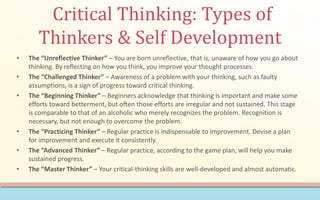
Critical Thinking: Types of
Thinkers & Self Development
• The “Unreflective Thinker” – You are born unreflective, that is, unaware of how you go about
thinking. By reflecting on how you think, you improve your thought processes.
• The “Challenged Thinker” – Awareness of a problem with your thinking, such as faulty
assumptions, is a sign of progress toward critical thinking.
• The “Beginning Thinker” – Beginners acknowledge that thinking is important and make some
efforts toward betterment, but often those efforts are irregular and not sustained. This stage
is comparable to that of an alcoholic who merely recognizes the problem. Recognition is
necessary, but not enough to overcome the problem.
• The “Practicing Thinker” – Regular practice is indispensable to improvement. Devise a plan
for improvement and execute it consistently.
• The “Advanced Thinker” – Regular practice, according to the game plan, will help you make
sustained progress.
• The “Master Thinker” – Your critical-thinking skills are well-developed and almost automatic.
Critical Thinking: Bottom line…
1. We don’t want to be lazy thinkers
2. Keeping a list of points to consider helps us look at
things from all angles
3. We have to be comfortable confronting our self
deception = the essence behind peer review
4. Our abilities improve with practice.
What’s Up at MN & DN this summer?
Let’s Get Published!!! Begins in June
1. VERY IMPORTANT – backwards
map your summer work
2. 30 day writing challenge, 30 day
work-life balance challenge, and
365s -
keep you in touch with your work
3. Group work – RLC writing OR
Lingerers

Critical Thinking for PhD Lingerers

  • 1.
    Exploiting Rapid Change inTechnology Enhanced Learning … for Post Graduate Education June 6th - Lingerers – Having more fun!
  • 2.
    Success is noaccident. It is hard work, perseverance, learning, studying, sacrifice and most of all, love of what you are doing or learning to do. Pele Your work is going to fill a large part of your life, and the only way to be truly satisfied is to do what you believe is great work. And the only way to do great work is to love what you do. If you haven't found it yet, keep looking. Don't settle. As with all matters of the heart, you'll know when you find it. Steve Jobs Learn to enjoy every minute of your life. Be happy now. Don't wait for something outside of yourself to make you happy in the future. Think how really precious is the time you have to spend, whether it's at work or with your family. Every minute should be enjoyed and savored. Earl Nightingale
  • 3.
    Agenda 1. Check in…ruthless honesty 2. Bringing the best of ourselves to these practices 3. Critical thinking - how to review our own work… Next topic(s) – having more fun!
  • 4.
    check in… Tasks frombefore… Did you try speed writing, reading and sorting? How are you doing with your writing habit? Are you better at singletasking? Remember – everyday just do one thing – somedays you’ll want to do more but one thing will keep the habit building
  • 5.
    Critical Thinking The EightElements of Thinking Critical thinking requires thoughtfully using these components: "Whenever we reason, we must reason within some point of view or frame of reference. Any ‘defect’ in that point of view or frame of reference is a possible source of problems in the reasoning.” 1. “Purpose” – Thinking is always purposeful. The purpose may be conscious or unconscious. Critical thinkers understand their purpose and think accordingly. 2. “Point of view” – All thinking takes place from a particular perspective. You cannot think without a frame of reference or point of view. 3. “Assumptions” – An assumption is a presupposition that helps shape your point of view. Assumptions may be true or false, justified or unjustified. Examine and test your assumptions. Paul, R., & Elder, L. (2012). Critical thinking : tools for taking charge of your learning and your life (3rd ed.). Boston: Pearson.
  • 6.
    Critical Thinking: 8Elements.2 4. “Implications” – Implications are inherent in a situation or a decision. They reveal possibilities that might result from the situation. Consequences are the realization of such possibilities. 5. “Information” – Thinking requires constructing information from raw facts. 6. “Inferences” – Use the process of drawing out deductions to make sense of data. 7. “Concepts” – Conceptual reasoning shapes data into identifiable patterns. Concepts are the implicit "theories, principles, axioms and rules" that guide your thinking. 8. “Questions” – The question may be first or last in the list of the elements of thought. It may precede the purpose and it may come after concepts have been fashioned. The critical thinker will pose questions throughout the thought process.
  • 7.
    Standards of CriticalThinking • “Clarity” – Thoughts must be clear. Nebulous or ambiguous thinking leads to questionable conclusions and bad decisions. • “Accuracy” – Accurate thinking is in accordance with the facts. Inaccurate statements, for example in advertising campaigns, can persuade uncritical thinkers. • “Precision” – Precision infers an adequate but not excessive amount of detail. Specificity and precision are necessary to optimize clarity and accuracy. • “Relevance” – Relevant thinking is germane to the purpose. • “Depth” – Deep thinking goes beyond the superficial and grapples with the complexity underlying the thought.
  • 8.
    Standards of CriticalThinking • “Breadth” – People who use broad thinking take into account all perspectives, points of view and arguments, and assess them fairly. • “Logical order” – Thinking that moves according to logic is sound and strong, not self-contradictory or disconnected. • “Significant” – Significance ensures that thought will not chase trivial tangents, but will focus on issues at the heart of the problem. • “Fairness” – Fairness gives due respect to the opinions of others, and avoids stereotyping and prejudice.
  • 9.
    Critical Thinking: Typesof Thinkers & Self Development • The “Unreflective Thinker” – You are born unreflective, that is, unaware of how you go about thinking. By reflecting on how you think, you improve your thought processes. • The “Challenged Thinker” – Awareness of a problem with your thinking, such as faulty assumptions, is a sign of progress toward critical thinking. • The “Beginning Thinker” – Beginners acknowledge that thinking is important and make some efforts toward betterment, but often those efforts are irregular and not sustained. This stage is comparable to that of an alcoholic who merely recognizes the problem. Recognition is necessary, but not enough to overcome the problem. • The “Practicing Thinker” – Regular practice is indispensable to improvement. Devise a plan for improvement and execute it consistently. • The “Advanced Thinker” – Regular practice, according to the game plan, will help you make sustained progress. • The “Master Thinker” – Your critical-thinking skills are well-developed and almost automatic.
  • 10.
    Critical Thinking: Bottomline… 1. We don’t want to be lazy thinkers 2. Keeping a list of points to consider helps us look at things from all angles 3. We have to be comfortable confronting our self deception = the essence behind peer review 4. Our abilities improve with practice.
  • 11.
    What’s Up atMN & DN this summer? Let’s Get Published!!! Begins in June 1. VERY IMPORTANT – backwards map your summer work 2. 30 day writing challenge, 30 day work-life balance challenge, and 365s - keep you in touch with your work 3. Group work – RLC writing OR Lingerers