Selecting a Research Topic
The ability to develop a good research topic is an important skill.  Sometimes instructors will assign a specific topic, usually they will ask you to select a topic that interests you.  When you choose your own topic, you will need to:
brainstorm for ideas  read general background information  focus in on a manageable topic   make a list of useful keywords   be flexible   define your topic as a focused research question  research and read more about your topic  formulate a thesis statement
Step 1: Brainstorm to get research topic ideas   Choose a topic that interests you. Even if a topic has been assigned, you may be able to choose a particular aspect of the topic that interests you personally. Use the following questions to help you generate topic ideas.  Do you have a strong opinion on a current social or political controversy?  Did you read a newspaper article, or see a TV broadcast recently that piqued your curiosity or made you angry or anxious?  Do you have a personal issue, problem, or interest you'd like to know more about?  Do you have a research paper due in a class this semester?   Is there an aspect of one of your courses you are interested in learning more about?  Look at some of the following topically oriented Web sites and research sites for ideas
Step 2: Read general background information     Read a general encyclopedia article on the top two or three topics you are considering .    Use  article databases  to scan current magazine, journal or newspaper articles on the topic.     Use Web  search engines  to find Web sites on the topic.
Step 3: Focus in on your topic   Keep it manageable.  A topic will be very difficult to research if it is too broad, or too narrow. One way to narrow a broad topic such as "the environment" is to limit  your topic. Common ways to limit a topic are:   by geographic region  by culture  by time frame     by discipline    by population group  
Remember that a topic will be more difficult to research if it is too:  locally confined   recent    broadly interdisciplinary  popular   If you have any uncertainties about the focus of your topic:  discuss your topic with your instructor  discuss your topic with a librarian
Step 4: Make a list of useful keywords    Keep track of the words that are used to describe your topic.   Look for words that best describe your topic.  These words will be found in the encyclopedia articles and other reading you do while selecting your topic.  Find synonyms, broader  and narrower terms for each keyword you find in order to expand your search capabilities  Keep a list of these words to use as keywords later as you search in catalogs and other online databases
Step 5: Be flexible   It is common to modify your topic during the research process.   Keep in mind the assigned length of the research paper, project, bibliography or other research assignment.
Step 6: Define your topic as a focused research question   You will often begin with a word, develop a more focused interest in an aspect of something relating to that word, then begin to have questions about the topic.  For example:   Ideas  = Frank Lloyd Wright or modern architecture  Research Question  = How has Frank Lloyd Wright influenced modern architecture?  Focused Research Question  = What design principles used by Frank Lloyd Wright are common in contemporary homes?
Step 7: Research and read more about your topic   Write your topic as a thesis statement.  This may be the answer to your research question and/or a way to clearly state the purpose of your research. Your thesis statement will usually be one or two sentences that states precisely what is to be answered, proven, or what you will inform your audience about your topic.
The development of a thesis assumes there is sufficient evidence to support the thesis statement.  For example, a thesis statement could be:  Frank Lloyd Wright's design principles, including his use of ornamental detail and his sense of space and texture opened a new era of American architecture. His work has influenced contemporary residential design. 
The title of your paper may not be exactly the same as your research question or your thesis statement , but the title should clearly convey the focus, purpose and meaning of your research.  For example, a title could be:  Frank Lloyd Wright: Key Principles of Design For the Modern Home. Remember to follow any specific instructions from your instructor.
Think of the who, what, when, where and why questions:   WHY  did you choose the topic? What interests you about it?  WHO  are the information providers on this topic? Who might publish information about it? Who is affected by the topic? Do you know of organizations or institutions affiliated with the topic?  WHAT  are the major questions for this topic? Is there a debate about the topic? Are there a range of issues and viewpoints to consider?  WHERE  is your topic important: at the local, national or international level? Are there specific places affected by the topic?  WHEN  is/was your topic important? Is it a current event? Do you want to compare your topic by time periods?
After all said and… *Find a study that has already been done and duplicate that study.  Replication is an important part of the research process.  -or-  *Find a study that has already been done and replicate it using new definitions of some of the variables in the study.  -or-  *Find a study that has already been done and replicate it using additional moderator or control variables  -or-
After all said and… *Find an existing study and develop a different way to test the hypothesis  -or-  *Follow an author’s suggestions for further research needed –  usually found at the end of an article  -or-  *Contact the author of an interesting study using the internet for ideas for further study  -or-  *Choose a problem, analyze it, and invent a completely new study  -or-  *Use a combination of the above techniques
Example 1   If you started to brainstorm with this idea...   sports and violence  Your focused research question might be ...   Are professional athletes more violent than  the average male?  Your thesis statement may be ...   Many factors contribute to a higher than  average rate of violence among  professional athletes.  Your keywords may be ...   professional athletes, sports, violence, abuse
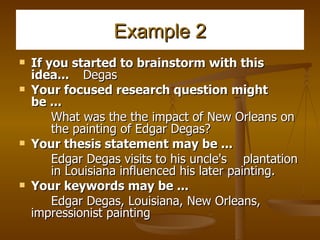
Example 2 If you started to brainstorm with this idea... Degas Your focused research question might be ... What was the the impact of New Orleans on  the painting of Edgar Degas? Your thesis statement may be ...   Edgar Degas visits to his uncle's  plantation  in Louisiana influenced his later painting. Your keywords may be ...   Edgar Degas, Louisiana, New Orleans,  impressionist painting
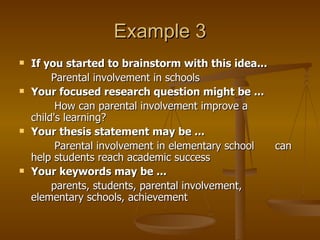
Example 3 If you started to brainstorm with this idea... Parental involvement in schools  Your focused research question might be ...   How can parental involvement improve a  child's learning?  Your thesis statement may be ...     Parental involvement in elementary school  can help students reach academic success  Your keywords may be ...   parents, students, parental involvement,  elementary schools, achievement 
Source 1 Weber State University, Stewart Library. Copyright © 2011 All Rights Reserved. Stewart Library - Weber State University - Ogden, Utah 84408. (801) 626-6403 - Copyright © 2008 ALL Rights Reserved library.weber.edu/ref/guides/howto/ topic selection.cfm
Source 2 xa.yimg.com/kq/groups/.../name/ Choosing +a+ research + topic . ppt

Research topic analysis

  • 1.
  • 2.
    The ability todevelop a good research topic is an important skill. Sometimes instructors will assign a specific topic, usually they will ask you to select a topic that interests you. When you choose your own topic, you will need to:
  • 3.
    brainstorm for ideas read general background information focus in on a manageable topic  make a list of useful keywords  be flexible  define your topic as a focused research question research and read more about your topic formulate a thesis statement
  • 4.
    Step 1: Brainstormto get research topic ideas Choose a topic that interests you. Even if a topic has been assigned, you may be able to choose a particular aspect of the topic that interests you personally. Use the following questions to help you generate topic ideas. Do you have a strong opinion on a current social or political controversy? Did you read a newspaper article, or see a TV broadcast recently that piqued your curiosity or made you angry or anxious? Do you have a personal issue, problem, or interest you'd like to know more about? Do you have a research paper due in a class this semester?  Is there an aspect of one of your courses you are interested in learning more about? Look at some of the following topically oriented Web sites and research sites for ideas
  • 5.
    Step 2: Readgeneral background information   Read a general encyclopedia article on the top two or three topics you are considering .   Use article databases to scan current magazine, journal or newspaper articles on the topic.    Use Web search engines to find Web sites on the topic.
  • 6.
    Step 3: Focusin on your topic Keep it manageable. A topic will be very difficult to research if it is too broad, or too narrow. One way to narrow a broad topic such as "the environment" is to limit  your topic. Common ways to limit a topic are:  by geographic region by culture by time frame   by discipline   by population group  
  • 7.
    Remember that atopic will be more difficult to research if it is too: locally confined recent   broadly interdisciplinary popular If you have any uncertainties about the focus of your topic: discuss your topic with your instructor discuss your topic with a librarian
  • 8.
    Step 4: Makea list of useful keywords  Keep track of the words that are used to describe your topic.  Look for words that best describe your topic. These words will be found in the encyclopedia articles and other reading you do while selecting your topic. Find synonyms, broader  and narrower terms for each keyword you find in order to expand your search capabilities Keep a list of these words to use as keywords later as you search in catalogs and other online databases
  • 9.
    Step 5: Beflexible It is common to modify your topic during the research process. Keep in mind the assigned length of the research paper, project, bibliography or other research assignment.
  • 10.
    Step 6: Defineyour topic as a focused research question You will often begin with a word, develop a more focused interest in an aspect of something relating to that word, then begin to have questions about the topic.  For example:  Ideas = Frank Lloyd Wright or modern architecture Research Question = How has Frank Lloyd Wright influenced modern architecture? Focused Research Question = What design principles used by Frank Lloyd Wright are common in contemporary homes?
  • 11.
    Step 7: Researchand read more about your topic Write your topic as a thesis statement. This may be the answer to your research question and/or a way to clearly state the purpose of your research. Your thesis statement will usually be one or two sentences that states precisely what is to be answered, proven, or what you will inform your audience about your topic.
  • 12.
    The development ofa thesis assumes there is sufficient evidence to support the thesis statement. For example, a thesis statement could be: Frank Lloyd Wright's design principles, including his use of ornamental detail and his sense of space and texture opened a new era of American architecture. His work has influenced contemporary residential design. 
  • 13.
    The title ofyour paper may not be exactly the same as your research question or your thesis statement , but the title should clearly convey the focus, purpose and meaning of your research. For example, a title could be: Frank Lloyd Wright: Key Principles of Design For the Modern Home. Remember to follow any specific instructions from your instructor.
  • 14.
    Think of thewho, what, when, where and why questions: WHY did you choose the topic? What interests you about it? WHO are the information providers on this topic? Who might publish information about it? Who is affected by the topic? Do you know of organizations or institutions affiliated with the topic? WHAT are the major questions for this topic? Is there a debate about the topic? Are there a range of issues and viewpoints to consider? WHERE is your topic important: at the local, national or international level? Are there specific places affected by the topic? WHEN is/was your topic important? Is it a current event? Do you want to compare your topic by time periods?
  • 15.
    After all saidand… *Find a study that has already been done and duplicate that study. Replication is an important part of the research process. -or- *Find a study that has already been done and replicate it using new definitions of some of the variables in the study. -or- *Find a study that has already been done and replicate it using additional moderator or control variables -or-
  • 16.
    After all saidand… *Find an existing study and develop a different way to test the hypothesis -or- *Follow an author’s suggestions for further research needed – usually found at the end of an article -or- *Contact the author of an interesting study using the internet for ideas for further study -or- *Choose a problem, analyze it, and invent a completely new study -or- *Use a combination of the above techniques
  • 17.
    Example 1 If you started to brainstorm with this idea... sports and violence Your focused research question might be ... Are professional athletes more violent than the average male? Your thesis statement may be ... Many factors contribute to a higher than average rate of violence among professional athletes. Your keywords may be ... professional athletes, sports, violence, abuse
  • 18.
    Example 2 Ifyou started to brainstorm with this idea... Degas Your focused research question might be ... What was the the impact of New Orleans on the painting of Edgar Degas? Your thesis statement may be ... Edgar Degas visits to his uncle's plantation in Louisiana influenced his later painting. Your keywords may be ... Edgar Degas, Louisiana, New Orleans, impressionist painting
  • 19.
    Example 3 Ifyou started to brainstorm with this idea... Parental involvement in schools Your focused research question might be ... How can parental involvement improve a child's learning? Your thesis statement may be ... Parental involvement in elementary school can help students reach academic success Your keywords may be ... parents, students, parental involvement, elementary schools, achievement 
  • 20.
    Source 1 WeberState University, Stewart Library. Copyright © 2011 All Rights Reserved. Stewart Library - Weber State University - Ogden, Utah 84408. (801) 626-6403 - Copyright © 2008 ALL Rights Reserved library.weber.edu/ref/guides/howto/ topic selection.cfm
  • 21.
    Source 2 xa.yimg.com/kq/groups/.../name/Choosing +a+ research + topic . ppt