PREPARED BY:
CLEOFE A. LAŇAS
INTRODUCTION
The first chapter of the research paper is usually titled
"The Problem" or "The Problem and Its Background."
Its purpose is to introduce the problem, clarify important
variables, and discuss its significance to the field of study.
It also looks into the study's delimitations, which pertain
to specific choices made by the researcher that should
be mentioned, and limitations, which are about the
influences that the researcher cannot control,
particularly those that place restrictions on the
methodology and conclusions.
BEGINNING OF THE RESEARCH
Overall, it has the following essential elements:
1. Introduction
2. Statement of the problem
3. Scope and delimitation
4. Significance of the study
5. Notes in Chapter 1
It should also be noted that the researcher has to
introduce the different elements of the first chapter by
giving a brief description of each element, so that the
reader knows what to expect from the chapter.
INTRODUCTION
The introduction is important in establishing the cognitive
setting of the research. It has the following elements:
1. Rationalization of the need to research on the problem
2. Clarification of the important terminologies for the reader
to easily understand what the research is about
3. Establishment of the degree of seriousness of the
problem which prompted the researcher to look for
solutions
The following questions can aid the researcher in formulating the
introduction:
1. What is the rationale of the problem? This question is answered by
sharing the reasons why the researcher decided to look for solutions to
the problem. A rationale may include a narration of personal
experiences, a description of an article read, a scene witnessed, a news
heard, or a theory that needs to be clarified. The researcher should
describe the existing and prevailing problem based on his or her
experience. Aside from personal experiences, other factors considered in
selecting the research problem such as time, resources, and scope can
also be discussed in the rationale. The scope may be local, national, or
international. Ideally, the rationale can start from a global perspective to a
more personal one.
Example:
As a Grade 12 student, Arjohn David experienced some
difficulties in performing well because of various factors
such as the attitude and teaching methods of ho teachers,
the absence of laboratory facilities, and inadequacy of
books in the library He is having difficulties in his quirzes and
class performance.
2. What is the setting of the problem? The setting is part of
the delimitation of the study. It defines the geographic
boundaries of the research. This describes the place where
the research was conducted, especially if the location has a
significant bearing on the variables being studied. The
description of the setting must highlight its distinctive
characteristies such as if the place experiences various
environmental phenomena and other peculiarities. The
setting also includes the psychological setting which refers
to the mental and emotional characteristics of the
participants of the study.
Example:
The psychological setting of a homogeneous class as the star
section should be considered as compared to the other
sections or classes in the school. The location of a
community in a war zone should be looked into in studying
the attitudes of people towards the peace process.
3. What is the basic literature foundation of the study? This
is different from the review of the related theories,
conceptual literature, and research literature. This part
seeks to provide the researcher clarity on the terms or
variables used in the study. The terms and variables must be
clear to the researcher for an easy understanding of the
readers As such, sufficient background can assist the
investigator in determining the boundaries of the study. This
part is derived from different literature sources. The use of
various references is crucial in this part of the first chapter
Example:
As teaching is considered to be a complex activity (Medley, at
citert in Iqbal, 1996), the scholars and researchers in the field of
education have since long been exploring into and analyzing the
teaching phenomenon. Teaching is an arrangement and
manipulation of a situation in which a leaner tries to overcome the
learning problems. Teaching is also a multidimensional set of
activities intended to facilitate learning (Torrington et al., 2003).
However, it is universally recognized that teachers instructional
performance plays a key role in students' learning and academic
achievement (Panda and Mohanty, 2003).
4. How serious is the chosen research problem? The
researcher is tasked to identity the intensity and magnitude
of the problem. When the gravity of the problem has
already been described, he or she may then gauge the kind
of action to be used to identify the
problem. In most cases, the researcher at this point looks
for statistical or quantitative evidence to assess the
significance of the problem at hand.
Example
Based on the DepEd Division Memo series 2012, among
the 12 schools with the most poorly performing students,
Puting Capunitan Elernentary School ranked 12th.
5. What is the general objective of the problem? This is the general
statement of the problem or the major tasks of the researcher to
discharge and should also be the basis of the enumerated
statements of specific problems.
Example
With the abovementioned scenario and situations, it is the main
objective of the researcher to determine the common reasons of
the poor performance of the students. Therefore, the research
findings on that objective become the basis of an Intervention
program for school effectiveness.
6. What is the overall purpose of the problem? It is important to
note that the researcher must be totally aware of the purpose of
the research problem. He or she must fully understand the
implications of the resulting findings of the study
Example:
This is mainly for the purpose of letting the students acquire the
needed competencies before graduation and enabling the school to
perform better in the Regional Achievement Examinations.
The questions that you ask in your research will determine the
data that you want to have, answer, and specify in Chapter 4.
Hence, it is a crucial stage to attain your research objective.
Research questions help writers focus their research by providing a
path through the research and writing process. You should ask a
question about an issue that you are genuinely curious and/or
passionate about. The question you ask should be developed for
the discipline you are studying. A question directed towards
Literature, for instance, is different from an appropriate one in
Mathematics to Biology.
Formulating Research Questions
A research question is an answerable inquiry into a specific
concern or issue. It is the initial step in a research project. The
research question is the first active step in the research project. Let
us use this metaphor--the research project is a house. Your data
collection forms the walls, and your hypothesis that guides your
data collection is the foundation. So, what is the research question?
It is the ground beneath the foundation. It is what everything in a
research project is built on. Without a question, you can't have a
hypothesis. Without the hypothesis, you won't know how to study
what you're interested in.
Let’s get into the details
A research question forms the base of where you are going, so
we have to write a good research question. If your foundation is
built on something shifty, like a house built on sand, then
everything following that will be about correcting that initial issue
instead of on making an awesome home/research project.
Let’s get into the details
Writing a good research question means you have something you want to
study. Let's say you're interested in the effects of television. We will
examine the steps and then look at how you could write a research
question.
✔ Specify your specific concern or issue
✔ Decide what you want to know about the specific concern or issue
✔ Turn what you want to know and the specific concern into a question
✔ Ensure that the question is answerable
✔ Check to make sure the question is not too broad or too narrow
✔ This is the basic process in writing a research question. Writing a good
question will result in a better research project.
Writing a Research Question
✔ Clear. It provides enough specifics that one’s audience can easily
understand its
purpose without needing additional explanation.
✔ Focused. It is narrow enough that it can be answered thoroughly in the
space the
writing task allows.
✔ Concise. It is expressed in the fewest possible words.
✔ Complex. It is not answerable with a simple ‘yes’ or ‘no’, but rather
requires
synthesis and analysis of ideas and sources prior to composition of an answer.
✔ Arguable. Its potential answers are open to debate rather than accepted
facts.
A research question should be (from the Writing Center of George Mason
University):
Every paper you write should have a main point, a main idea, or central
message. The argument(s) you make in your paper should reflect this main
idea. The sentence that captures your position on this main idea is what we
call a thesis statement.
A thesis statement focuses your ideas into one or two sentences. It should
present the topic of your paper and also make a comment about your
position in relation to the topic. Your thesis statement should tell your reader
what the paper is about and also help guide your writing and keep your
argument focused.
You should provide a thesis early in your essay -- in the introduction, or in
longer essays in the second paragraph -- in order to establish your position
and give your reader a sense of direction.
Writing the Thesis Statement
A. Avoid burying a great thesis statement in the middle of a
paragraph or late in the paper.
B. Be as clear and as specific as possible; avoid vague words.
C. Indicate the point of your paper but avoid sentence structures
like, “The point of my paper is…”
Tip: In order to write a successful thesis statement:
A. Original thesis:
There are serious objections to today's horror movies.
B. Revised theses:
Because modern cinematic techniques have allowed filmmakers
to get more graphic, horror flicks have desensitized young
American viewers to violence. The pornographic violence in
"bloodbath" slasher movies degrades both men and women.
Today's slasher movies fail to deliver the emotional catharsis that
1930s horror films did.
Please see these examples on how to improve your thesis:
✔ Unless you're writing a technical report, avoid technical
language. Always avoid
jargon, unless you are confident your audience will be familiar
with it.
✔ Avoid vague words such as "interesting,” "negative, "exciting,”
"unusual," and
"difficult."
✔ Avoid abstract words such as "society," “values,” or “culture.”
Tip: In order to be as clear as possible in your writing:
ASSESSMENT
1. Researchers need to examine literature from published
articles because they: __
A. are excellent source of ideas.
B. are already edited.
C. can be copied so that researchers do not need to work a
lot.
D. are abundant in the library and on the internet.
Choose the letter of the correct answer.
2. These people are good sources of ideas about a
research study, EXCEPT those:
A. Who aspire to do research study?
B. Who are knowledgeable about the topic?
C. Who have opposing views about the research?
D. Whose opinions may differ from the researcher?
Choose the letter of the correct answer.
3. One of the following is a broad topic for research.
A. Film Industry in the Philippines
B. HIV: Causes, Prevention and Cure
C. Aftermath of Terrorism in Maguindanao
D. Body Tattooing as a Form of Art in the Philippines
Choose the letter of the correct answer.
4. An example to this source of research topic is the
symposium on drug addiction.
A. Replication
C. Wide Reading/Critical Film Viewing
B. Social Networking
D. Lectures, Talks, Seminars
Choose the letter of the correct answer.
5. Controversial topic should be avoided because it
_______________.
A. lacks focus in along the process.
B. is prone to opinions of the subject.
C. requires thorough and extensive reading.
D. has no available materials to support it.
Choose the letter of the correct answer.
6. The remedy to a broad research topic is to:
A. narrow it down.
B. make it even broader.
C. do extensive reading and investigation on it.
D. challenge oneself to finish it in whatever means.
Choose the letter of the correct answer.
7. In research, this will be your guide in identifying the
specific contribution of your
study.
A. Hypothesis
B. Research topic
C. Problem statement
Choose the letter of the correct answer.
8. Significance of the study. This is one component of a
research question that is
narrow enough to be answered thoroughly in the space
the writing task allows.
A. clear
B. complex
C. Focused
D. Content-driven
Choose the letter of the correct answer.
9. Choose a clear thesis statement from the following:
Research Topic: Vegetarianism and its benefits
A. People practice vegetarianism for five major benefits it
provides them.
B. The reasons why people practice vegetarianism are
varied.
C. Vegetarianism is an essential practice.
D. Vegetarianism as a healthy lifestyle.
Choose the letter of the correct answer.
10. In writing the significance of the study, the researcher
should follow this format.
A. general to specific contribution
B. specific to general contribution
C. direct to specific contribution
D. none of the above
Choose the letter of the correct answer.
11. One of the components of a research question that
provides enough specifics that
one’s audience can easily understand its purpose without
needing additional
explanation.
A. Complex
B. Clear
C. Arguable
D. Concise
Choose the letter of the correct answer.
12. Choose a statement below to translate this unclear research question
to a specific one.
Unclear: How should social networking sites address the harm they cause?
A. What action should social networking sites like Myspace and Facebook
take to
protect users’ personal information and privacy?
B. What are the steps to eliminate harm caused by social networking sites?
C. Why do social networking sites a contributory factor for teenager’s
psychological struggles?
D. How to minimize the disadvantages of social networking sites?
Choose the letter of the correct answer.
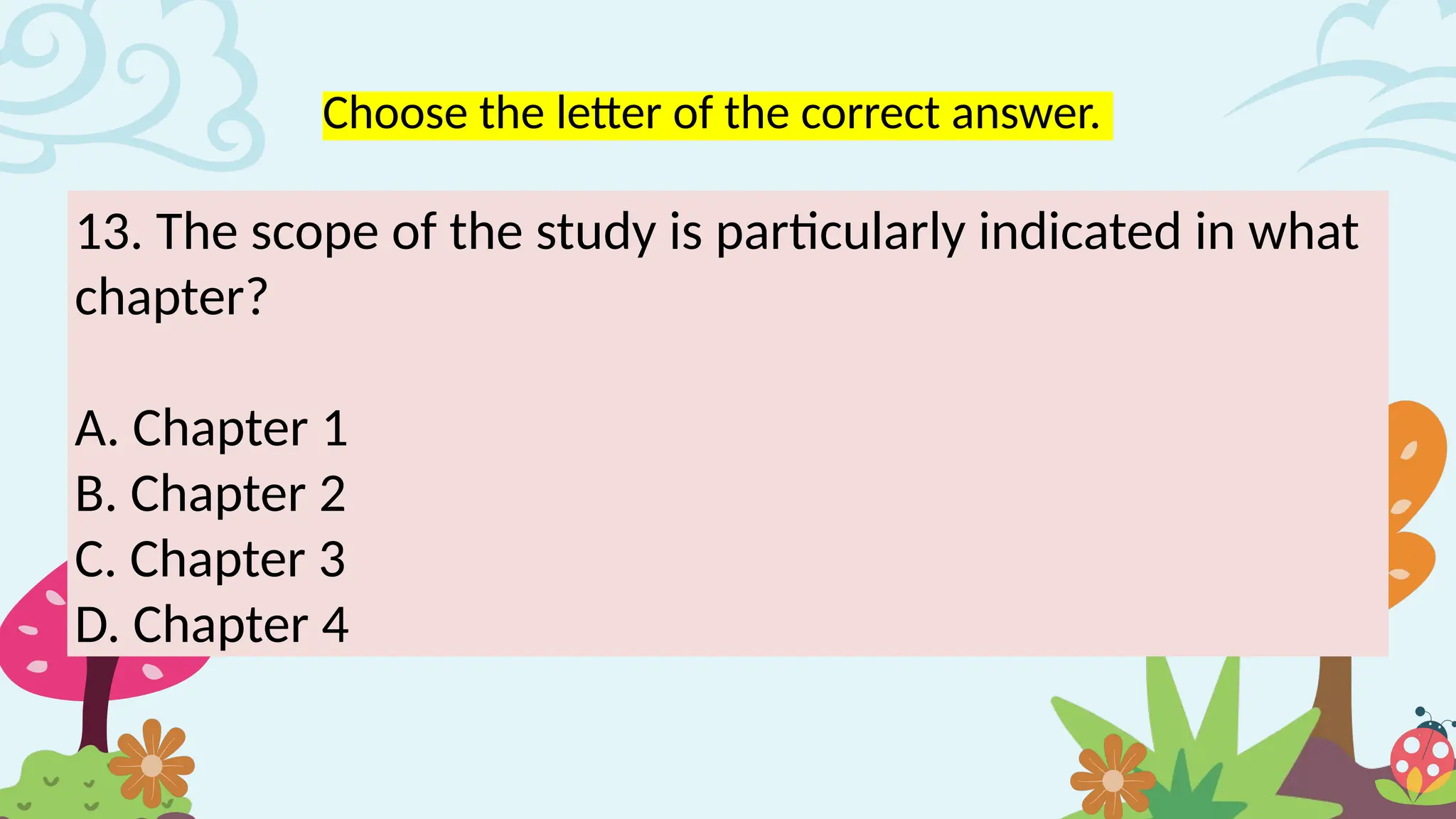
13. The scope of the study is particularly indicated in what
chapter?
A. Chapter 1
B. Chapter 2
C. Chapter 3
D. Chapter 4
Choose the letter of the correct answer.
14. You cannot formulate questions unless you have
already identified your:
A. References
B. Research topic
C. Research design
D. Significance of the Study
Choose the letter of the correct answer.
15. Research is usually limited in scope by the following
except for:
A. sample size.
B. time.
C. culture.
D. theme.
Choose the letter of the correct answer.
Mabuha
y!

Practical Research Grade 11 April 1-5.pptx

  • 1.
    PREPARED BY: CLEOFE A.LAŇAS INTRODUCTION
  • 2.
    The first chapterof the research paper is usually titled "The Problem" or "The Problem and Its Background." Its purpose is to introduce the problem, clarify important variables, and discuss its significance to the field of study. It also looks into the study's delimitations, which pertain to specific choices made by the researcher that should be mentioned, and limitations, which are about the influences that the researcher cannot control, particularly those that place restrictions on the methodology and conclusions. BEGINNING OF THE RESEARCH
  • 3.
    Overall, it hasthe following essential elements: 1. Introduction 2. Statement of the problem 3. Scope and delimitation 4. Significance of the study 5. Notes in Chapter 1 It should also be noted that the researcher has to introduce the different elements of the first chapter by giving a brief description of each element, so that the reader knows what to expect from the chapter.
  • 4.
    INTRODUCTION The introduction isimportant in establishing the cognitive setting of the research. It has the following elements: 1. Rationalization of the need to research on the problem 2. Clarification of the important terminologies for the reader to easily understand what the research is about 3. Establishment of the degree of seriousness of the problem which prompted the researcher to look for solutions
  • 5.
    The following questionscan aid the researcher in formulating the introduction: 1. What is the rationale of the problem? This question is answered by sharing the reasons why the researcher decided to look for solutions to the problem. A rationale may include a narration of personal experiences, a description of an article read, a scene witnessed, a news heard, or a theory that needs to be clarified. The researcher should describe the existing and prevailing problem based on his or her experience. Aside from personal experiences, other factors considered in selecting the research problem such as time, resources, and scope can also be discussed in the rationale. The scope may be local, national, or international. Ideally, the rationale can start from a global perspective to a more personal one.
  • 6.
    Example: As a Grade12 student, Arjohn David experienced some difficulties in performing well because of various factors such as the attitude and teaching methods of ho teachers, the absence of laboratory facilities, and inadequacy of books in the library He is having difficulties in his quirzes and class performance.
  • 7.
    2. What isthe setting of the problem? The setting is part of the delimitation of the study. It defines the geographic boundaries of the research. This describes the place where the research was conducted, especially if the location has a significant bearing on the variables being studied. The description of the setting must highlight its distinctive characteristies such as if the place experiences various environmental phenomena and other peculiarities. The setting also includes the psychological setting which refers to the mental and emotional characteristics of the participants of the study.
  • 8.
    Example: The psychological settingof a homogeneous class as the star section should be considered as compared to the other sections or classes in the school. The location of a community in a war zone should be looked into in studying the attitudes of people towards the peace process.
  • 9.
    3. What isthe basic literature foundation of the study? This is different from the review of the related theories, conceptual literature, and research literature. This part seeks to provide the researcher clarity on the terms or variables used in the study. The terms and variables must be clear to the researcher for an easy understanding of the readers As such, sufficient background can assist the investigator in determining the boundaries of the study. This part is derived from different literature sources. The use of various references is crucial in this part of the first chapter
  • 10.
    Example: As teaching isconsidered to be a complex activity (Medley, at citert in Iqbal, 1996), the scholars and researchers in the field of education have since long been exploring into and analyzing the teaching phenomenon. Teaching is an arrangement and manipulation of a situation in which a leaner tries to overcome the learning problems. Teaching is also a multidimensional set of activities intended to facilitate learning (Torrington et al., 2003). However, it is universally recognized that teachers instructional performance plays a key role in students' learning and academic achievement (Panda and Mohanty, 2003).
  • 11.
    4. How seriousis the chosen research problem? The researcher is tasked to identity the intensity and magnitude of the problem. When the gravity of the problem has already been described, he or she may then gauge the kind of action to be used to identify the problem. In most cases, the researcher at this point looks for statistical or quantitative evidence to assess the significance of the problem at hand.
  • 12.
    Example Based on theDepEd Division Memo series 2012, among the 12 schools with the most poorly performing students, Puting Capunitan Elernentary School ranked 12th.
  • 13.
    5. What isthe general objective of the problem? This is the general statement of the problem or the major tasks of the researcher to discharge and should also be the basis of the enumerated statements of specific problems. Example With the abovementioned scenario and situations, it is the main objective of the researcher to determine the common reasons of the poor performance of the students. Therefore, the research findings on that objective become the basis of an Intervention program for school effectiveness.
  • 14.
    6. What isthe overall purpose of the problem? It is important to note that the researcher must be totally aware of the purpose of the research problem. He or she must fully understand the implications of the resulting findings of the study Example: This is mainly for the purpose of letting the students acquire the needed competencies before graduation and enabling the school to perform better in the Regional Achievement Examinations.
  • 15.
    The questions thatyou ask in your research will determine the data that you want to have, answer, and specify in Chapter 4. Hence, it is a crucial stage to attain your research objective. Research questions help writers focus their research by providing a path through the research and writing process. You should ask a question about an issue that you are genuinely curious and/or passionate about. The question you ask should be developed for the discipline you are studying. A question directed towards Literature, for instance, is different from an appropriate one in Mathematics to Biology. Formulating Research Questions
  • 16.
    A research questionis an answerable inquiry into a specific concern or issue. It is the initial step in a research project. The research question is the first active step in the research project. Let us use this metaphor--the research project is a house. Your data collection forms the walls, and your hypothesis that guides your data collection is the foundation. So, what is the research question? It is the ground beneath the foundation. It is what everything in a research project is built on. Without a question, you can't have a hypothesis. Without the hypothesis, you won't know how to study what you're interested in. Let’s get into the details
  • 17.
    A research questionforms the base of where you are going, so we have to write a good research question. If your foundation is built on something shifty, like a house built on sand, then everything following that will be about correcting that initial issue instead of on making an awesome home/research project. Let’s get into the details
  • 18.
    Writing a goodresearch question means you have something you want to study. Let's say you're interested in the effects of television. We will examine the steps and then look at how you could write a research question. ✔ Specify your specific concern or issue ✔ Decide what you want to know about the specific concern or issue ✔ Turn what you want to know and the specific concern into a question ✔ Ensure that the question is answerable ✔ Check to make sure the question is not too broad or too narrow ✔ This is the basic process in writing a research question. Writing a good question will result in a better research project. Writing a Research Question
  • 19.
    ✔ Clear. Itprovides enough specifics that one’s audience can easily understand its purpose without needing additional explanation. ✔ Focused. It is narrow enough that it can be answered thoroughly in the space the writing task allows. ✔ Concise. It is expressed in the fewest possible words. ✔ Complex. It is not answerable with a simple ‘yes’ or ‘no’, but rather requires synthesis and analysis of ideas and sources prior to composition of an answer. ✔ Arguable. Its potential answers are open to debate rather than accepted facts. A research question should be (from the Writing Center of George Mason University):
  • 20.
    Every paper youwrite should have a main point, a main idea, or central message. The argument(s) you make in your paper should reflect this main idea. The sentence that captures your position on this main idea is what we call a thesis statement. A thesis statement focuses your ideas into one or two sentences. It should present the topic of your paper and also make a comment about your position in relation to the topic. Your thesis statement should tell your reader what the paper is about and also help guide your writing and keep your argument focused. You should provide a thesis early in your essay -- in the introduction, or in longer essays in the second paragraph -- in order to establish your position and give your reader a sense of direction. Writing the Thesis Statement
  • 21.
    A. Avoid buryinga great thesis statement in the middle of a paragraph or late in the paper. B. Be as clear and as specific as possible; avoid vague words. C. Indicate the point of your paper but avoid sentence structures like, “The point of my paper is…” Tip: In order to write a successful thesis statement:
  • 22.
    A. Original thesis: Thereare serious objections to today's horror movies. B. Revised theses: Because modern cinematic techniques have allowed filmmakers to get more graphic, horror flicks have desensitized young American viewers to violence. The pornographic violence in "bloodbath" slasher movies degrades both men and women. Today's slasher movies fail to deliver the emotional catharsis that 1930s horror films did. Please see these examples on how to improve your thesis:
  • 23.
    ✔ Unless you'rewriting a technical report, avoid technical language. Always avoid jargon, unless you are confident your audience will be familiar with it. ✔ Avoid vague words such as "interesting,” "negative, "exciting,” "unusual," and "difficult." ✔ Avoid abstract words such as "society," “values,” or “culture.” Tip: In order to be as clear as possible in your writing:
  • 24.
  • 25.
    1. Researchers needto examine literature from published articles because they: __ A. are excellent source of ideas. B. are already edited. C. can be copied so that researchers do not need to work a lot. D. are abundant in the library and on the internet. Choose the letter of the correct answer.
  • 26.
    2. These peopleare good sources of ideas about a research study, EXCEPT those: A. Who aspire to do research study? B. Who are knowledgeable about the topic? C. Who have opposing views about the research? D. Whose opinions may differ from the researcher? Choose the letter of the correct answer.
  • 27.
    3. One ofthe following is a broad topic for research. A. Film Industry in the Philippines B. HIV: Causes, Prevention and Cure C. Aftermath of Terrorism in Maguindanao D. Body Tattooing as a Form of Art in the Philippines Choose the letter of the correct answer.
  • 28.
    4. An exampleto this source of research topic is the symposium on drug addiction. A. Replication C. Wide Reading/Critical Film Viewing B. Social Networking D. Lectures, Talks, Seminars Choose the letter of the correct answer.
  • 29.
    5. Controversial topicshould be avoided because it _______________. A. lacks focus in along the process. B. is prone to opinions of the subject. C. requires thorough and extensive reading. D. has no available materials to support it. Choose the letter of the correct answer.
  • 30.
    6. The remedyto a broad research topic is to: A. narrow it down. B. make it even broader. C. do extensive reading and investigation on it. D. challenge oneself to finish it in whatever means. Choose the letter of the correct answer.
  • 31.
    7. In research,this will be your guide in identifying the specific contribution of your study. A. Hypothesis B. Research topic C. Problem statement Choose the letter of the correct answer.
  • 32.
    8. Significance ofthe study. This is one component of a research question that is narrow enough to be answered thoroughly in the space the writing task allows. A. clear B. complex C. Focused D. Content-driven Choose the letter of the correct answer.
  • 33.
    9. Choose aclear thesis statement from the following: Research Topic: Vegetarianism and its benefits A. People practice vegetarianism for five major benefits it provides them. B. The reasons why people practice vegetarianism are varied. C. Vegetarianism is an essential practice. D. Vegetarianism as a healthy lifestyle. Choose the letter of the correct answer.
  • 34.
    10. In writingthe significance of the study, the researcher should follow this format. A. general to specific contribution B. specific to general contribution C. direct to specific contribution D. none of the above Choose the letter of the correct answer.
  • 35.
    11. One ofthe components of a research question that provides enough specifics that one’s audience can easily understand its purpose without needing additional explanation. A. Complex B. Clear C. Arguable D. Concise Choose the letter of the correct answer.
  • 36.
    12. Choose astatement below to translate this unclear research question to a specific one. Unclear: How should social networking sites address the harm they cause? A. What action should social networking sites like Myspace and Facebook take to protect users’ personal information and privacy? B. What are the steps to eliminate harm caused by social networking sites? C. Why do social networking sites a contributory factor for teenager’s psychological struggles? D. How to minimize the disadvantages of social networking sites? Choose the letter of the correct answer.
  • 37.
    13. The scopeof the study is particularly indicated in what chapter? A. Chapter 1 B. Chapter 2 C. Chapter 3 D. Chapter 4 Choose the letter of the correct answer.
  • 38.
    14. You cannotformulate questions unless you have already identified your: A. References B. Research topic C. Research design D. Significance of the Study Choose the letter of the correct answer.
  • 39.
    15. Research isusually limited in scope by the following except for: A. sample size. B. time. C. culture. D. theme. Choose the letter of the correct answer.
  • 40.