THE
RESEARC
H
PROBLEM
Reporter: Karen Jean Bongay-Beronque
MS- General Science Education
Professor: James L. Paglinawan, PhD.
Presented to Educ241-Methods of Research
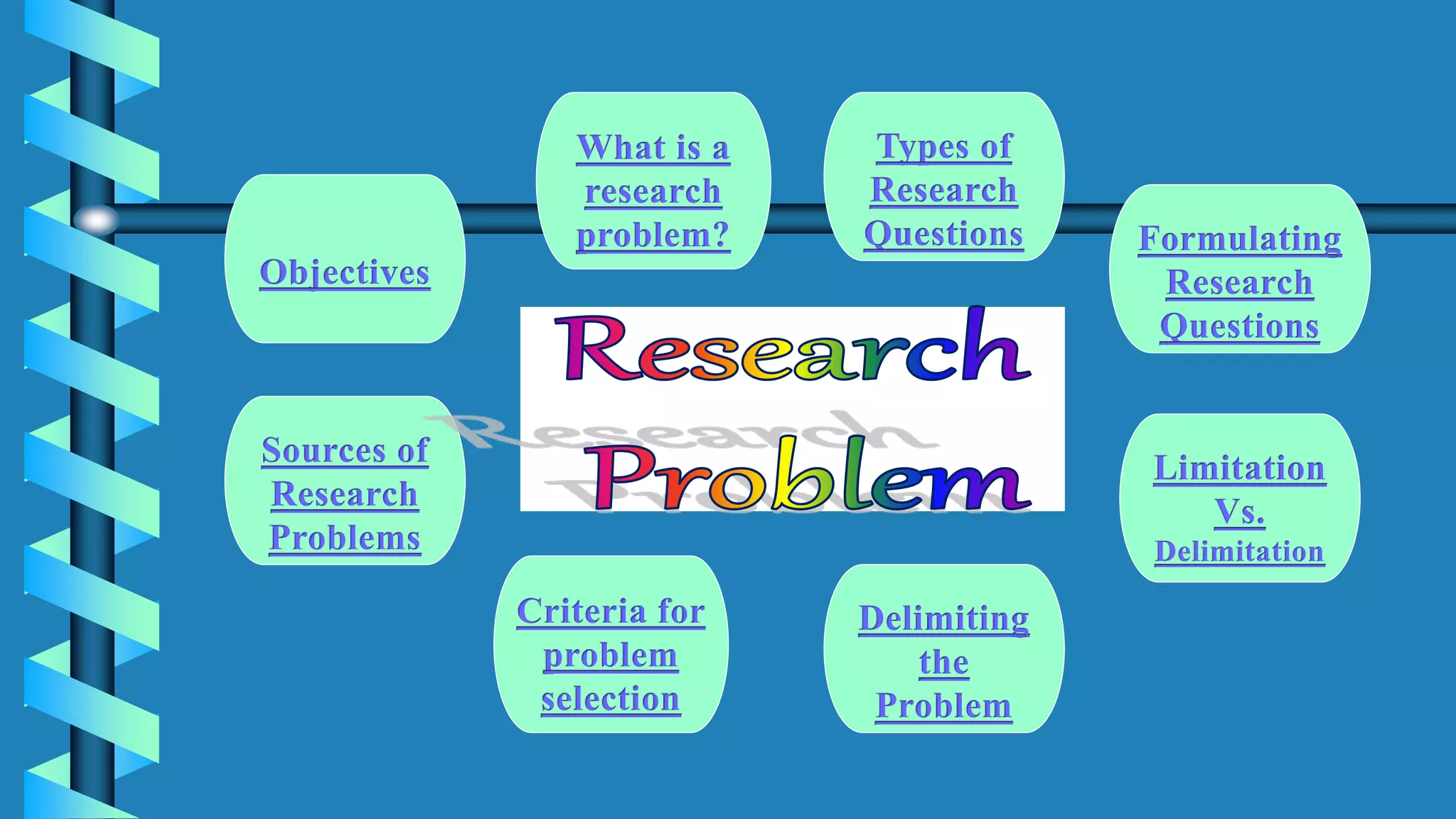
Types of
Research
Questions
What is a
research
problem?
Criteria for
problem
selection
Formulating
Research
Questions
Limitation
Vs.
Delimitation
Delimiting
the
Problem
Objectives
Sources of
Research
Problems
 Identify sources of problem in research;
 Define and delimit a research problem
 Evaluate a research problem according to
established criteria
 Formulate good problem statements
 Compare different types of research questions
Possible Sources of Research Problem
 Experiences: workplace, library, seminars, farm,
 Interests in your field of specialization
 Theory which remains to be proven
 Innovations whose worthiness is to be supported by
research data
 Priority areas for development.
What is a Research Problem?
 It is a question that a researcher wants to answer
or a problem that a researcher wants to solve.
 A question concerning the relationship existing
between sets of events/ variables (Ary et al., 1985)
variable-is something that can take on one or
more values.
 It is an area of concern where there is a gap in the
knowledge base needed for professional practices.
What is a Research Problem?
 The heart of every research is the problem.
 It is like the foundation of the building that if the
foundation is well designed and strong, you can
expect the building to be strong as well.
Criteria for Problem Selection
1. Can a problem be effectively resolved through the
process of research?
2. Is the problem significant? Will it be a contribution
to organized knowledge? Will it open avenues for
further study?
3. Is the problem new or was it already answered
before? If already answered, are there some aspects
which need to clarify further? Or is there still need
for more extensive documentation?
Cont.,
4. Is the research problem feasible,
a. It is suitable for the researcher’s ability? Does it
deal with an area of interest for the researchers?
b. Are pertinent data accessible?
c. Can the researcher afford to conduct the study?
If not, are there available funding agencies?
d. Can the researcher allot the time required for the
research?
e. Does he possess the courage and determination to
pursue the study until its completion?
Cont.,
Specific criteria for the beginner:
1. Staff: How many persons are needed to
accomplish the study? What expertise is
necessary? Are these available?
2. Budget: How much will it take to complete the
research? Can a researcher afford it?
3. Time: How long will it take to finish the
investigation? Can the researcher allot the time
needed?
Considerations in Selecting Research Problem
Consideration
Factors
Description
1 Interest If you choose a topic which does not greatly interest you, it would become
difficult to keep up the motivation to write.
2 Expertise Before selecting a research problem, you need to ensure that you met certain
level of expertise in the area you are proposing.
3 Data
Availability
If your research title needs collection of information (journal, reports,
proceedings) before finalising the title, you need to make sure you have these
materials available and in the relevant format.
4 Relevance Always choose a topic that suits your interest and profession. Ensure that your
study adds to the existing body of knowledge. Of course, this will help you to
sustain interest throughout the research period.
5 Ethics In formulating the research problem, you should consider some ethical issues
as well. Sometimes, during the research period, the study population might
be adversely affected by some questions.
Delimiting the Problem
Delimitation- are boundaries of the study
(Best and Khan, 1998).
Examples:
– The study on educational history and academic achievement
may be delimited to 80 freshmen in the secondary
department of ABC University.
– The influence of oversea employment on the lifestyle of a
community may involve two barangay’s in a municipality in
Pampanga.
Limitations vs. Delimitations
 Limitations are those conditions beyond the
researcher’s control that may put restrictions on
the conclusions of the study and their application
to other situations.
 Delimitations are boundaries of the study. It is
subject to the researcher’s control. Narrowing
down the variables, sample size, coverage, and
other aspects of research.
Examples of Limitations
 Research instruments whose validity and reliability
have not been established.
 Inability to randomly select and assign subjects to
both the control and experimental group.
 Administrative policies, rules and regulations of
respondent institutions.
 Veracity of the respondents’ answer to the
questions.
Formulating Research Questions
 Formulating the research problem is the first and
the most important step in the research process.
 Research problem should be stated in question
form.
A good statement of the problem must:
1. Clarify exactly what is to be determined or solved.
2. Restrict the scope of a study to specific
question/s.
3. Determine the type of research to be conducted.
Types of Research Questions
 Descriptive Questions-are addressed when a study
is designed to describe what is going on or what
exist.
 Relational questions- are posed when a study is
designed to look at the relationships between two or
more variables.
 Causal Questions-are asked when a study is designed
to determine whether one or more variables cause or
affect one or more outcome variables.
Examples:
 Descriptive:
What is the students’ level of academic achievement?
 Relational:
 What is the relationship between teachers’ job
satisfaction and their job performance.
 Causal:
Does the teaching method (cause) influence students’
achievement in Science (effect)?
References
 Best, J. W., and Khan, J. V. (1998). Research in education (8th ed.). Boston, MA: Allyn
and Bacon.
 Prado, N. I et.al (2001). Research Methods. Researchers at CMU, Musuan, Maramag,
Bukidnon. CMU-IMDC.
 OUMÊs Digital Library Gallupe R. B. (2007). Research contributions: The tyranny of
methodologies in information systems research. ACM SIGMIS Database , Volume 38,
Issue 3, ACM Press. [available at ACM]

The research problem

  • 1.
    THE RESEARC H PROBLEM Reporter: Karen JeanBongay-Beronque MS- General Science Education Professor: James L. Paglinawan, PhD. Presented to Educ241-Methods of Research
  • 2.
    Types of Research Questions What isa research problem? Criteria for problem selection Formulating Research Questions Limitation Vs. Delimitation Delimiting the Problem Objectives Sources of Research Problems
  • 3.
     Identify sourcesof problem in research;  Define and delimit a research problem  Evaluate a research problem according to established criteria  Formulate good problem statements  Compare different types of research questions
  • 4.
    Possible Sources ofResearch Problem  Experiences: workplace, library, seminars, farm,  Interests in your field of specialization  Theory which remains to be proven  Innovations whose worthiness is to be supported by research data  Priority areas for development.
  • 5.
    What is aResearch Problem?  It is a question that a researcher wants to answer or a problem that a researcher wants to solve.  A question concerning the relationship existing between sets of events/ variables (Ary et al., 1985) variable-is something that can take on one or more values.  It is an area of concern where there is a gap in the knowledge base needed for professional practices.
  • 6.
    What is aResearch Problem?  The heart of every research is the problem.  It is like the foundation of the building that if the foundation is well designed and strong, you can expect the building to be strong as well.
  • 7.
    Criteria for ProblemSelection 1. Can a problem be effectively resolved through the process of research? 2. Is the problem significant? Will it be a contribution to organized knowledge? Will it open avenues for further study? 3. Is the problem new or was it already answered before? If already answered, are there some aspects which need to clarify further? Or is there still need for more extensive documentation?
  • 8.
    Cont., 4. Is theresearch problem feasible, a. It is suitable for the researcher’s ability? Does it deal with an area of interest for the researchers? b. Are pertinent data accessible? c. Can the researcher afford to conduct the study? If not, are there available funding agencies? d. Can the researcher allot the time required for the research? e. Does he possess the courage and determination to pursue the study until its completion?
  • 9.
    Cont., Specific criteria forthe beginner: 1. Staff: How many persons are needed to accomplish the study? What expertise is necessary? Are these available? 2. Budget: How much will it take to complete the research? Can a researcher afford it? 3. Time: How long will it take to finish the investigation? Can the researcher allot the time needed?
  • 10.
    Considerations in SelectingResearch Problem Consideration Factors Description 1 Interest If you choose a topic which does not greatly interest you, it would become difficult to keep up the motivation to write. 2 Expertise Before selecting a research problem, you need to ensure that you met certain level of expertise in the area you are proposing. 3 Data Availability If your research title needs collection of information (journal, reports, proceedings) before finalising the title, you need to make sure you have these materials available and in the relevant format. 4 Relevance Always choose a topic that suits your interest and profession. Ensure that your study adds to the existing body of knowledge. Of course, this will help you to sustain interest throughout the research period. 5 Ethics In formulating the research problem, you should consider some ethical issues as well. Sometimes, during the research period, the study population might be adversely affected by some questions.
  • 11.
    Delimiting the Problem Delimitation-are boundaries of the study (Best and Khan, 1998). Examples: – The study on educational history and academic achievement may be delimited to 80 freshmen in the secondary department of ABC University. – The influence of oversea employment on the lifestyle of a community may involve two barangay’s in a municipality in Pampanga.
  • 12.
    Limitations vs. Delimitations Limitations are those conditions beyond the researcher’s control that may put restrictions on the conclusions of the study and their application to other situations.  Delimitations are boundaries of the study. It is subject to the researcher’s control. Narrowing down the variables, sample size, coverage, and other aspects of research.
  • 13.
    Examples of Limitations Research instruments whose validity and reliability have not been established.  Inability to randomly select and assign subjects to both the control and experimental group.  Administrative policies, rules and regulations of respondent institutions.  Veracity of the respondents’ answer to the questions.
  • 14.
    Formulating Research Questions Formulating the research problem is the first and the most important step in the research process.  Research problem should be stated in question form.
  • 15.
    A good statementof the problem must: 1. Clarify exactly what is to be determined or solved. 2. Restrict the scope of a study to specific question/s. 3. Determine the type of research to be conducted.
  • 16.
    Types of ResearchQuestions  Descriptive Questions-are addressed when a study is designed to describe what is going on or what exist.  Relational questions- are posed when a study is designed to look at the relationships between two or more variables.  Causal Questions-are asked when a study is designed to determine whether one or more variables cause or affect one or more outcome variables.
  • 17.
    Examples:  Descriptive: What isthe students’ level of academic achievement?  Relational:  What is the relationship between teachers’ job satisfaction and their job performance.  Causal: Does the teaching method (cause) influence students’ achievement in Science (effect)?
  • 18.
    References  Best, J.W., and Khan, J. V. (1998). Research in education (8th ed.). Boston, MA: Allyn and Bacon.  Prado, N. I et.al (2001). Research Methods. Researchers at CMU, Musuan, Maramag, Bukidnon. CMU-IMDC.  OUMÊs Digital Library Gallupe R. B. (2007). Research contributions: The tyranny of methodologies in information systems research. ACM SIGMIS Database , Volume 38, Issue 3, ACM Press. [available at ACM]