Research Methodology
Md. Badsha Alam
Jatiya Kabi Kazi Nazrul Islam University, Mymensingh, Bangladesh.
Presentation outline
•What is A research problem?
•some components of a research problem
•Can we study all problems?
•When a problem is researchable?
What is Research Question
 A research question is usually the first step in any research
project.
 It is a specific inquiry which the research seeks to provide a
response to.
 It resides at the core of systematic investigation and it helps a
researcher to clearly define a path for the research process.
 It is the primary interrogation point of your research and it sets
the pace for your work.
Cont.
 Typically, a research question focuses on the research,
determines the methodology and hypothesis
 It guides all stages of inquiry, analysis, and reporting.
 With the right research questions, you will be able to
gather useful information for your investigation.
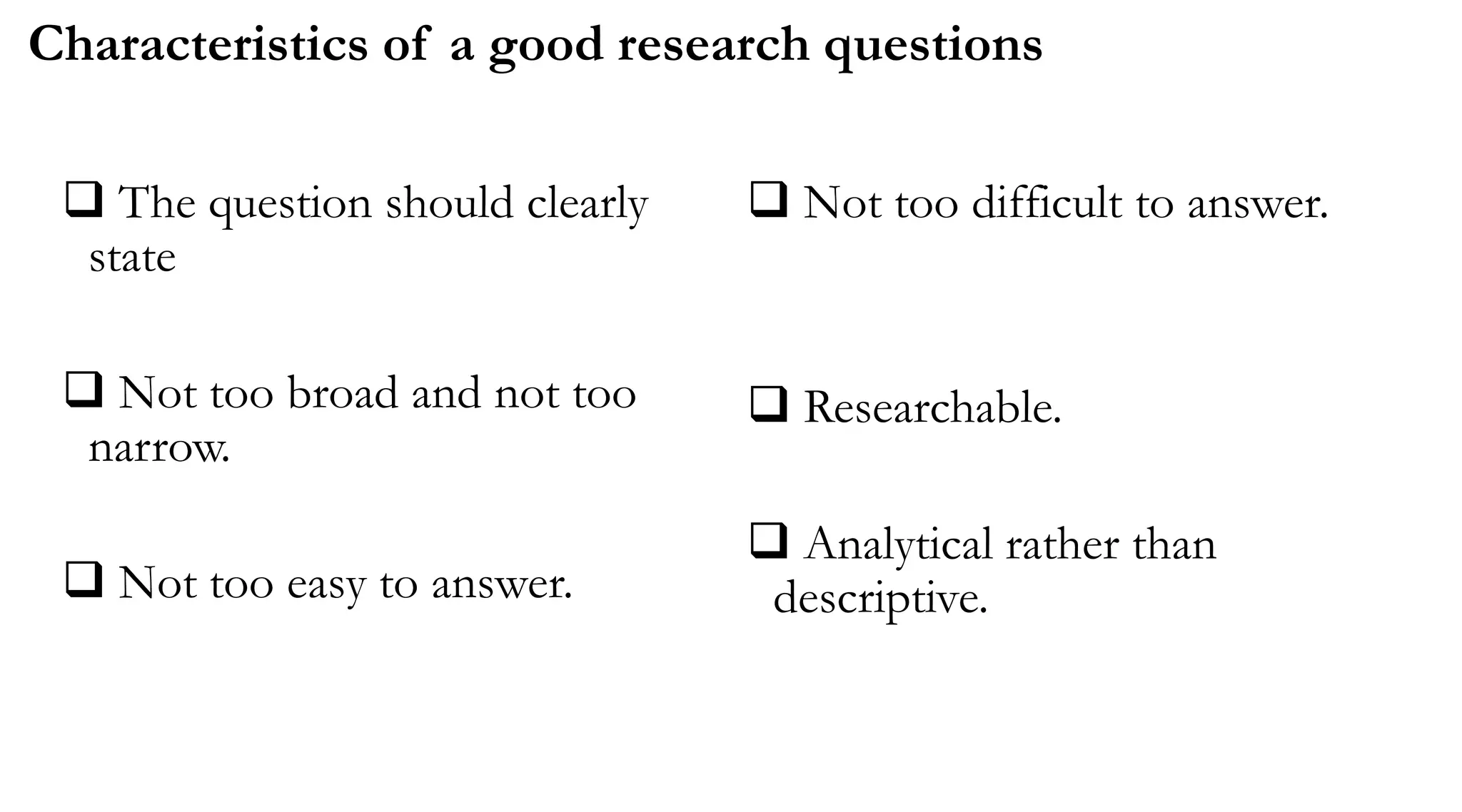
 The question should clearly
state
 Not too broad and not too
narrow.
 Not too easy to answer.
 Not too difficult to answer.
 Researchable.
 Analytical rather than
descriptive.
Characteristics of a good research questions
Sources of research Question
1. Personal sources:
• List your interests as they pertain to your specific discipline
• Consider one of the items on your list
• Now find the answers to this question: “Who? What? When? Why? How?
So what? And What if..?” These represent possible “gaps” in one’s
knowledge.
• Find an open-ended question you would like to answer.
Cont.
2. Read:
Sometimes, we are curious about something new topics that interest us first, then
• Should go to the library
• Search online academic and professional sites related to our discipline and
topics
Types of Research Questions
There are three basic types of questions that research projects can
address:
1. Descriptive. When a study is designed primarily to describe what
is going on or what exists.
Public opinion polls that seek only to describe the proportion of people who
hold various opinions are primarily descriptive in nature. For instance, if we
want to know what percent of the population would vote for a Democratic
or a Republican in the next presidential election, we are simply interested in
describing something.
2. Relational. When a study is designed to look at the relationships
between two or more variables.
A public opinion poll that compares what proportion of males and females say they
would vote for a Democratic or a Republican candidate in the next presidential
election is essentially studying the relationship between gender and voting preference.
3. Causal. When a study is designed to determine whether one or more
variables (e.g., a program or treatment variable) causes or affects one or
more outcome variables.
If we did a public opinion poll to try to determine whether a recent political
advertising campaign changed voter preferences, we would essentially be studying
whether the campaign (cause) changed the proportion of voters who would vote
Democratic or Republican (effect).
 Focused on a single problem or issue.
 Researchable using memory and/or secondary
sources
 Feasible to answer within timeframe and practical
constrains
 Specific enough to answer thoroughly
 Complex enough to develop the answer over the
space of a paper or thesis
 Relevant to your field of study and/or society
more broadly.
All research Question should be:
Evaluating a Research Question
• Research question must be as clear as possible.
• Research question must be specific enough to be well covered in the
space available
• Research question should be answerable
• Considering the available time frame and the required resources
• Research question should be measureable and will the process produce
data that can be supported or contradicted.
Formulating Research Question
 Qualitative Study
• Usually starts with ‘what’ or ‘how’
(qualitative questions with ‘why’ as this implies cause and effect).
• Identify the central phenomenon you plan to explore (tell in your question what
you are going to describe, explore, generate, discover, understand).
• Avoid the use of quantitative words such as relate, influence, effect, cause.
For example: What are the experiences of people working night shifts in health care?
 Quantitative Study
• Usually start with ‘ how,’ ‘what’ or ‘why’.
• Contain an independent and a dependent variable.
• Look at connections, relations or comparisons between variables.
For example: Does a stressful work environment lead to higher turnover rates?
Two types of quantitative study
• Correlational studies: A correlational study is non-experimental,
requiring the writer to research relationship without manipulating of the
research.
For example: What is the relationship between long distances trains and eating disorders?
• Experimental studies: Experimental studies are ones where researchers
introduce an intervention and study the effects. It requires the writers to
manipulate and randomly select the subjects of the research.
For example: Does the consumption of fast food lead to eating disorders?
Mixed study
A mixed methods research design is a procedure for collecting,
analyzing, and “mixing” both quantitative and qualitative
research and methods in a single study to understand a research
problem.
For example: What is the relationship between long distances
trains and eating disorders?
Thank you
Methodology.pptx

Methodology.pptx

  • 1.
    Research Methodology Md. BadshaAlam Jatiya Kabi Kazi Nazrul Islam University, Mymensingh, Bangladesh.
  • 2.
    Presentation outline •What isA research problem? •some components of a research problem •Can we study all problems? •When a problem is researchable?
  • 3.
    What is ResearchQuestion  A research question is usually the first step in any research project.  It is a specific inquiry which the research seeks to provide a response to.  It resides at the core of systematic investigation and it helps a researcher to clearly define a path for the research process.  It is the primary interrogation point of your research and it sets the pace for your work.
  • 4.
    Cont.  Typically, aresearch question focuses on the research, determines the methodology and hypothesis  It guides all stages of inquiry, analysis, and reporting.  With the right research questions, you will be able to gather useful information for your investigation.
  • 6.
     The questionshould clearly state  Not too broad and not too narrow.  Not too easy to answer.  Not too difficult to answer.  Researchable.  Analytical rather than descriptive. Characteristics of a good research questions
  • 7.
    Sources of researchQuestion 1. Personal sources: • List your interests as they pertain to your specific discipline • Consider one of the items on your list • Now find the answers to this question: “Who? What? When? Why? How? So what? And What if..?” These represent possible “gaps” in one’s knowledge. • Find an open-ended question you would like to answer.
  • 8.
    Cont. 2. Read: Sometimes, weare curious about something new topics that interest us first, then • Should go to the library • Search online academic and professional sites related to our discipline and topics
  • 9.
    Types of ResearchQuestions There are three basic types of questions that research projects can address: 1. Descriptive. When a study is designed primarily to describe what is going on or what exists. Public opinion polls that seek only to describe the proportion of people who hold various opinions are primarily descriptive in nature. For instance, if we want to know what percent of the population would vote for a Democratic or a Republican in the next presidential election, we are simply interested in describing something.
  • 10.
    2. Relational. Whena study is designed to look at the relationships between two or more variables. A public opinion poll that compares what proportion of males and females say they would vote for a Democratic or a Republican candidate in the next presidential election is essentially studying the relationship between gender and voting preference. 3. Causal. When a study is designed to determine whether one or more variables (e.g., a program or treatment variable) causes or affects one or more outcome variables. If we did a public opinion poll to try to determine whether a recent political advertising campaign changed voter preferences, we would essentially be studying whether the campaign (cause) changed the proportion of voters who would vote Democratic or Republican (effect).
  • 11.
     Focused ona single problem or issue.  Researchable using memory and/or secondary sources  Feasible to answer within timeframe and practical constrains  Specific enough to answer thoroughly  Complex enough to develop the answer over the space of a paper or thesis  Relevant to your field of study and/or society more broadly. All research Question should be:
  • 12.
    Evaluating a ResearchQuestion • Research question must be as clear as possible. • Research question must be specific enough to be well covered in the space available • Research question should be answerable • Considering the available time frame and the required resources • Research question should be measureable and will the process produce data that can be supported or contradicted.
  • 13.
    Formulating Research Question Qualitative Study • Usually starts with ‘what’ or ‘how’ (qualitative questions with ‘why’ as this implies cause and effect). • Identify the central phenomenon you plan to explore (tell in your question what you are going to describe, explore, generate, discover, understand). • Avoid the use of quantitative words such as relate, influence, effect, cause. For example: What are the experiences of people working night shifts in health care?
  • 14.
     Quantitative Study •Usually start with ‘ how,’ ‘what’ or ‘why’. • Contain an independent and a dependent variable. • Look at connections, relations or comparisons between variables. For example: Does a stressful work environment lead to higher turnover rates?
  • 15.
    Two types ofquantitative study • Correlational studies: A correlational study is non-experimental, requiring the writer to research relationship without manipulating of the research. For example: What is the relationship between long distances trains and eating disorders? • Experimental studies: Experimental studies are ones where researchers introduce an intervention and study the effects. It requires the writers to manipulate and randomly select the subjects of the research. For example: Does the consumption of fast food lead to eating disorders?
  • 16.
    Mixed study A mixedmethods research design is a procedure for collecting, analyzing, and “mixing” both quantitative and qualitative research and methods in a single study to understand a research problem. For example: What is the relationship between long distances trains and eating disorders?
  • 17.