33
99
11
66 88
22
1010
44
77
55
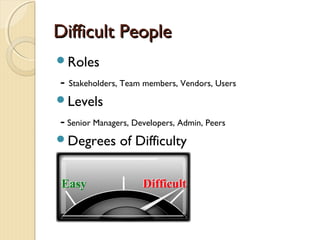
Difficult PeopleDifficult People
Roles
- Stakeholders, Team members, Vendors, Users
Levels
- Senior Managers, Developers, Admin, Peers
Degrees of Difficulty
YOUR CLASS PROJECTYOUR CLASS PROJECTCommonSituation
You are in a group for a class project and one
of your group members is not doing ANY of
the work and has failed to hand in their
portion of the assignment.
Meanwhile, there is another group member
who is being very controlling and has taken
it upon themselves to do all of the project
and to edit the work you’ve handed in.
YOUR CLASS PROJECTYOUR CLASS PROJECTCommonSituation
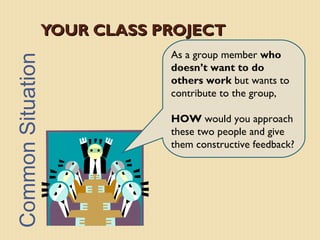
As a group member who
doesn’t want to do
others work but wants to
contribute to the group,
HOW would you approach
these two people and give
them constructive feedback?
Understanding Difficult BehaviorUnderstanding Difficult Behavior
Who is the difficult?
In general:
Someone exhibiting negative behavior with
most people, most of the time
For you:
A colleague exhibiting negative behavior
towards you
Understanding Difficult BehaviorUnderstanding Difficult Behavior
Difficult people are usually a result of
conflicting personalities not because
of intentional behaviors
If you notice someone is more difficult
around you than others, it may be
because your personalities
clash
Understanding Difficult BehaviorUnderstanding Difficult Behavior
It’s important to remember we can all be
difficult whether we mean to or not
NO FEAR! I’ll give you some tips to help
you deal…
The 4 StrategiesThe 4 Strategies
Change YOUR Attitude
Change THEIR Attitude
Take a Stand
RUN
Check your perception
See beyond “difficult”
Understand their point of view
Change YOUR AttitudeChange YOUR Attitude
Understand why they are difficult
Show them another angle
Help them see you as a person
Change THEIR AttitudeChange THEIR Attitude
Take a StandTake a Stand
Used when:
Your attitude is not the problem
You cannot change their attitude
It goes beyond attitude to hurtful actions
Running is too costly
How to Take a StandHow to Take a Stand
Understand your options
Develop a strategy
Confront and collaborate (good guy)
The “or else” (bad guy)
Take action
Persevere
RUNRUN
Last resort
Used when you have nothing to gain
from:
Change YOUR Attitude
Change THEIR Attitude
Take a Stand
Types of Difficult PeopleTypes of Difficult People
Silent Complainer Sniper Aggressive Cranky
Cranky PeopleCranky People
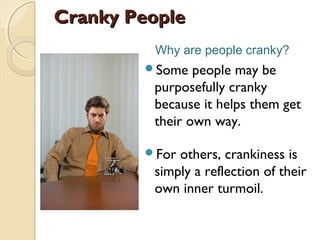
Some people may be
purposefully cranky
because it helps them get
their own way.
For others, crankiness is
simply a reflection of their
own inner turmoil.
Why are people cranky?
How to Deal with Cranky PeopleHow to Deal with Cranky People
Try to determine the real message the person
is telling you.
Are you any part of the problem?
What can you change about your own
behavior?
Don’t remain silent. Agree with any part of
the cranky person’s statement that may be
true.
In a neutral tone of voice say,
“Would you please speak to me in a calmer tone of
Aggressive PeopleAggressive People
Overly aggressive people
expect others to either:
◦ Run away from them
◦ React with rage
Why are people aggressive?
How to Deal with AggressiveHow to Deal with Aggressive
PeoplePeople
Stand up to them, but don’t fight.
Wait for them to run out of some steam.
Call the hostile person by name and
assert your own opinions with
confidence.
◦ “Hani, you interrupted me. We can discuss my
project scope after you listen to it.”
Subtle SnipersSubtle Snipers
These people are experts
in pot shots and sneak
attacks in subtle ways,
such as:
◦ Humorous put downs
◦ Sarcastic tones of voice
◦ Disapproving looks
◦ Innuendos
How to Deal with SubtleHow to Deal with Subtle
SnipersSnipers
Respond to the sniper with a question.
◦ “That sounds like you’re making fun of me. Are you?”
◦ “What are you trying to tell me with that look?”
◦ “Did you really mean what you said?”
A sniper will usually respond with denial
or volley the responsibility to you.
◦ “I’m only joking.”
◦ “You’re so serious. Can’t you take a joke?”
Speaking up lessens the chance of similar
attacks in the future.
ComplainersComplainers
These are fearful people
who have little faith in
themselves or others
because they believe in a
hostile world.
Their constant
discouragement and
complaining can bring
everyone to despair.
How to Deal with ComplainersHow to Deal with Complainers
Don’t try to argue them out of their
negativity.
Respond with your own optimistic
expectations.
◦ “I think that everything will turn out great.”
◦ “I am sure we will get done on time.”
Silent PeopleSilent People
They are timid people
who retreat into their
shells to avoid conflict and
responsibility.
They get away with not
talking because most
people are uncomfortable
with silence and are too
quick to fill in the gaps.
How to Deal with Silent PeopleHow to Deal with Silent People
Ask them questions that cannot be
answered with just a “yes” or “no”, such
as:
◦ “Would you please help me understand the
problem you are facing?”
Wait at least one full minute. Then, if the
silent person won’t respond, set another
date to discuss the matter.
Do Not ...
A difficult person’s behavior is habitual.
He behaves this way with most people.
Don’t take the difficult person’s behavior
personally.
Don’t make excuses for the difficult
person’s behavior.
Think of other people who have faced
adversity and have not become difficult.
You lose control when you make excuses
for difficult people.
Do Not ...
Don’t try to beat them at their own game.
They have been practicing their skills for a
long time, and you are a beginner by
comparison.
Don’t fight back.
Don’t try to appease them.
It won’t work because difficult people
have an insatiable appetite for more.
Do Not ...
You can’t change other people.
You can only change your response to
their behavior.
By changing your responses, they may
decide to change…or they may not.
However, you will feel better.
Don’t try to change the difficult person.
THANKYOUTHANKYOU

Dealing with difficult people

  • 1.
  • 3.
    Difficult PeopleDifficult People Roles -Stakeholders, Team members, Vendors, Users Levels - Senior Managers, Developers, Admin, Peers Degrees of Difficulty
  • 4.
    YOUR CLASS PROJECTYOURCLASS PROJECTCommonSituation You are in a group for a class project and one of your group members is not doing ANY of the work and has failed to hand in their portion of the assignment. Meanwhile, there is another group member who is being very controlling and has taken it upon themselves to do all of the project and to edit the work you’ve handed in.
  • 5.
    YOUR CLASS PROJECTYOURCLASS PROJECTCommonSituation As a group member who doesn’t want to do others work but wants to contribute to the group, HOW would you approach these two people and give them constructive feedback?
  • 6.
    Understanding Difficult BehaviorUnderstandingDifficult Behavior Who is the difficult? In general: Someone exhibiting negative behavior with most people, most of the time For you: A colleague exhibiting negative behavior towards you
  • 7.
    Understanding Difficult BehaviorUnderstandingDifficult Behavior Difficult people are usually a result of conflicting personalities not because of intentional behaviors If you notice someone is more difficult around you than others, it may be because your personalities clash
  • 8.
    Understanding Difficult BehaviorUnderstandingDifficult Behavior It’s important to remember we can all be difficult whether we mean to or not NO FEAR! I’ll give you some tips to help you deal…
  • 9.
    The 4 StrategiesThe4 Strategies Change YOUR Attitude Change THEIR Attitude Take a Stand RUN
  • 10.
    Check your perception Seebeyond “difficult” Understand their point of view Change YOUR AttitudeChange YOUR Attitude
  • 11.
    Understand why theyare difficult Show them another angle Help them see you as a person Change THEIR AttitudeChange THEIR Attitude
  • 12.
    Take a StandTakea Stand Used when: Your attitude is not the problem You cannot change their attitude It goes beyond attitude to hurtful actions Running is too costly
  • 13.
    How to Takea StandHow to Take a Stand Understand your options Develop a strategy Confront and collaborate (good guy) The “or else” (bad guy) Take action Persevere
  • 14.
    RUNRUN Last resort Used whenyou have nothing to gain from: Change YOUR Attitude Change THEIR Attitude Take a Stand
  • 15.
    Types of DifficultPeopleTypes of Difficult People Silent Complainer Sniper Aggressive Cranky
  • 16.
    Cranky PeopleCranky People Somepeople may be purposefully cranky because it helps them get their own way. For others, crankiness is simply a reflection of their own inner turmoil. Why are people cranky?
  • 17.
    How to Dealwith Cranky PeopleHow to Deal with Cranky People Try to determine the real message the person is telling you. Are you any part of the problem? What can you change about your own behavior? Don’t remain silent. Agree with any part of the cranky person’s statement that may be true. In a neutral tone of voice say, “Would you please speak to me in a calmer tone of
  • 18.
    Aggressive PeopleAggressive People Overlyaggressive people expect others to either: ◦ Run away from them ◦ React with rage Why are people aggressive?
  • 19.
    How to Dealwith AggressiveHow to Deal with Aggressive PeoplePeople Stand up to them, but don’t fight. Wait for them to run out of some steam. Call the hostile person by name and assert your own opinions with confidence. ◦ “Hani, you interrupted me. We can discuss my project scope after you listen to it.”
  • 20.
    Subtle SnipersSubtle Snipers Thesepeople are experts in pot shots and sneak attacks in subtle ways, such as: ◦ Humorous put downs ◦ Sarcastic tones of voice ◦ Disapproving looks ◦ Innuendos
  • 21.
    How to Dealwith SubtleHow to Deal with Subtle SnipersSnipers Respond to the sniper with a question. ◦ “That sounds like you’re making fun of me. Are you?” ◦ “What are you trying to tell me with that look?” ◦ “Did you really mean what you said?” A sniper will usually respond with denial or volley the responsibility to you. ◦ “I’m only joking.” ◦ “You’re so serious. Can’t you take a joke?” Speaking up lessens the chance of similar attacks in the future.
  • 22.
    ComplainersComplainers These are fearfulpeople who have little faith in themselves or others because they believe in a hostile world. Their constant discouragement and complaining can bring everyone to despair.
  • 23.
    How to Dealwith ComplainersHow to Deal with Complainers Don’t try to argue them out of their negativity. Respond with your own optimistic expectations. ◦ “I think that everything will turn out great.” ◦ “I am sure we will get done on time.”
  • 24.
    Silent PeopleSilent People Theyare timid people who retreat into their shells to avoid conflict and responsibility. They get away with not talking because most people are uncomfortable with silence and are too quick to fill in the gaps.
  • 25.
    How to Dealwith Silent PeopleHow to Deal with Silent People Ask them questions that cannot be answered with just a “yes” or “no”, such as: ◦ “Would you please help me understand the problem you are facing?” Wait at least one full minute. Then, if the silent person won’t respond, set another date to discuss the matter.
  • 26.
    Do Not ... Adifficult person’s behavior is habitual. He behaves this way with most people. Don’t take the difficult person’s behavior personally. Don’t make excuses for the difficult person’s behavior. Think of other people who have faced adversity and have not become difficult. You lose control when you make excuses for difficult people.
  • 27.
    Do Not ... Don’ttry to beat them at their own game. They have been practicing their skills for a long time, and you are a beginner by comparison. Don’t fight back. Don’t try to appease them. It won’t work because difficult people have an insatiable appetite for more.
  • 28.
    Do Not ... Youcan’t change other people. You can only change your response to their behavior. By changing your responses, they may decide to change…or they may not. However, you will feel better. Don’t try to change the difficult person.
  • 30.