Leadership Is Action, Not Position
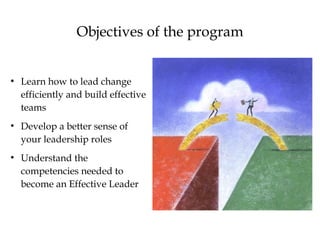
Objectives of the program
●
Learn how to lead change
efficiently and build effective
teams
●
Develop a better sense of
your leadership roles
●
Understand the
competencies needed to
become an Effective Leader
Introduction
Now a days a lot of emphasis is given on choosing the
competencies that will create wealth for organizations.
Competencies link organizational strategy with people, and
people who are aligned with strategic goals are better able to
meet challenges .
No matter, which issues people face, they want to know where
they fit in, what the work is, and what competencies they need.
Competency based approach and response is a powerful answer
to the problems people and organizations face.
Introduction contd..
While most people in the leadership field are familiar with
competencies like problem solving, financial analysis and
marketing savvy, these skills do not, of themselves make a
Leader.
It is the nine competencies in addition to the traditionally
valued competencies, which make a well-rounded Leader.
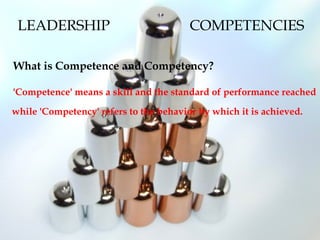
LEADERSHIP COMPETENCIES
What is Competence and Competency?
'Competence' means a skill and the standard of performance reached
while 'Competency' refers to the behavior by which it is achieved.
In other words
●
Competence describes what people can do and
Competency focuses on how they do it.
●
Competence is skill based and Competency is behavior
based.
Let us take a look at the Leadership Model
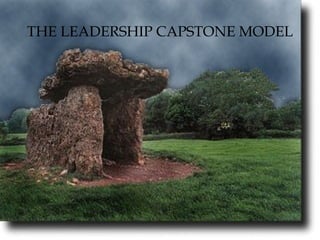
THE LEADERSHIP CAPSTONE MODEL
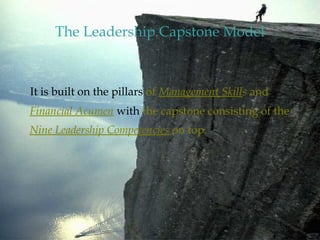
The Leadership Capstone Model
It is built on the pillars of Management Skills and
Financial Acumen with the capstone consisting of the
Nine Leadership Competencies on top.
Advantages of the model
●
This model will help you build a frame work to act in
your leadership moments.
●
Your personal mastery of the Capstone piece will
define and differentiate your role as a Leader
Building your capstone will make you:
●
Aware of opportunities to act in leadership moments.
●
Incorporate competencies into your succession planning
process.
●
Build cohesive teams.
●
Provide a base to build loyalty and trust.
Let us understand the
Nine Leadership Competencies
●
Passion
●
Humor
●
Courage
●
Integrity and Trust
●
Energy/Vitality/Enthusiasm
●
Building a Team
●
Setting priorities
●
Creativity
●
Vision
It is an intense concentration (focus) on a belief that a task can
be completed despite scarcity of human support or any other
resource.
How to raise your passion competency
●
Lead a team in your organization.
●
Tie the team activities to organization's mission
statement or vision.
●
Mentor an employee.
●
Write an article on your Passion for your company
newsletter.
Passion contd...
●
When you get involved in activities you really enjoy,
you become energized and people can tell that you
have a sense of purpose, which brings out your natural
leadership abilities.
Brooklyn Bridge Story
HUMOR
It is the ability or quality of people, objects, or
situations to evoke feelings of amusement in other
people.
The term encompasses a form of entertainment or
human communication which evokes such feelings, or
which makes people laugh or feel happy.
Humor-How does it help?
●
It helps to relieve day-to-day
pressures .
●
Executives who are open with
humor become more
approachable to their employees.
●
Allows everyone to perceive and
view things in a different light.
Remember
It is dangerous to confuse professionalism
with seriousness.
You can take your job and your world seriously,
and still take yourself lightly.
COURAGE
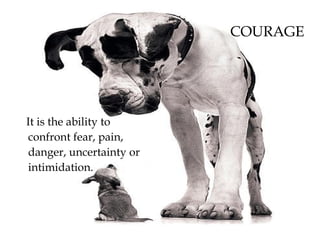
It is the ability to
confront fear, pain,
danger, uncertainty or
intimidation.
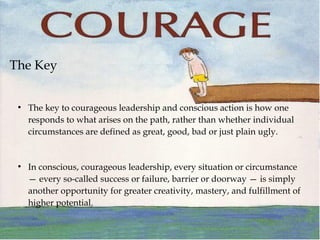
The Key
●
The key to courageous leadership and conscious action is how one
responds to what arises on the path, rather than whether individual
circumstances are defined as great, good, bad or just plain ugly.
●
In conscious, courageous leadership, every situation or circumstance
— every so-called success or failure, barrier or doorway — is simply
another opportunity for greater creativity, mastery, and fulfillment of
higher potential.
Tips to improve your Courage quotient
●
Choose role model who exemplifies behavior, values and beliefs
that show courage in action.
●
Learn to coach a colleague on one aspect of his or her job.
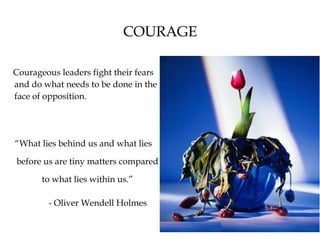
COURAGE
Courageous leaders fight their fears
and do what needs to be done in the
face of opposition.
“What lies behind us and what lies
before us are tiny matters compared
to what lies within us.”
- Oliver Wendell Holmes
This is what Osho says about courage:
●
"You cannot be truthful if you are not courageous - You
cannot be loving if you are not courageous - You cannot
be trusting if you are not courageous- You cannot inquire
into reality if you are not courageous - Hence courage
comes first and everything else follows."
Case Study- Courage
INTEGRITY AND TRUST
Integrity:
Firm adherence to a code of moral or artistic values.
Trust:
Firm reliance on the integrity, ability, or character of a
person or thing.
Integrity
Integrity is set of values that we hold ourselves responsible
for and demonstrate in our behavior toward others.
We can develop and maintain integrity .
We develop self-awareness and become independent
thinkers by keeping our promises.
Trust
●
If we break our promises to ourselves and to other
people, then we erode trust.
●
It is necessary to 'walk the talk'. The assuring words
that you speak or write are like promises. People
expect these promises to be kept. And if they are not
then the problem arises as the trust and credibility are
lost.
●
Thus always remember, 'When you break a promise,
more than the promise gets broken.'
Leadership in Action
“Re-examine all that you have been told...Dismiss that
which insults your soul.”
- Walt Witman
Exercise- Integrity and Trust
End of Day 1
Day 2
Energy/Vitality/Enthusiasm
Energy:
The capacity of being active or capacity for doing work.
Vitality:
Power to survive or grow.
Enthusiasm:
Strong excitement of feeling.
By practising this competency you can:
●
Pursue goals passionately.
●
You are driven to be the best in whatever you do.
●
Find the opportunities and make the most of them.
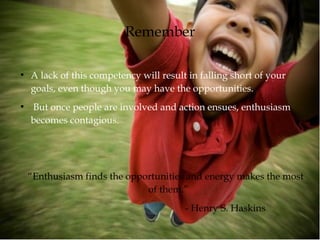
Remember
●
A lack of this competency will result in falling short of your
goals, even though you may have the opportunities.
●
But once people are involved and action ensues, enthusiasm
becomes contagious.
“Enthusiasm finds the opportunities and energy makes the most
of them.”
- Henry S. Haskins
Exercise- Energy/Vitality/Enthusiasm
Building a Team
●
Build: To develop according to a systematic plan, by
a definite process, or on a particular base.
●
Team: Is a group of people linked in a common
purpose.
Tips to team building
●
Live the question: Keep asking yourself constantly - 'of all that is required to
happen, how can I use my time most valuably right now?'
●
The Philosophy of Continuing Improvement: Ability is strength. Work
consciously everyday, at getting a little better at every little thing you are
involved with.
●
Maintain integrity: An effective leader is known for his integrity. Always
keep your word.
●
Recognize your most valuable asset: While your products or your bottom-
line may be terrific, internalize the knowledge that your most valuable asset
is the people who work with you.
Tips to team building contd...
●
Feel-good factor: Strive to create an environment that encourages your
people to feel good about themselves, take pride in their work and in doing
it well.
●
Declare your objectives: Tell your people what your objectives are and what
their role is in meeting those objectives. And then, allow them to get on with
their job.
●
Acknowledge: To get your team to constantly give their best to you, you
must continually acknowledge them and let them know how important they
are to you.
●
Recognize special talents: You may have a team member who has some
special talent that is not being tapped in the present set-up. Recognize the
value of that talent and create a position to put that talent to good use.
Tips to team building contd...
●
Learn to listen: Make time to listen to your team members and hear what
they are actually saying. Sometimes, people don't know how to clearly say
what they mean. Learn to listen to even what is not being said.
●
Lead by example: Your team will only truly learn the standards you expect
of them, if you walk your talk. You, be their example.
●
Confronting fear: True leaders are not fearless people. They are those who
face their fear, acknowledge it and move ahead towards their objective
inspite of the fear.
●
Dress right: The way you look has an impact on the responses you get.
Ensure you dress crisply, neatly and in keeping with your role....don't
overdo it, at the same time avoid being sloppy. Dress to convey you mean
business. Image is important when leading other people. Dress for success.
In the game of people, they tend to judge you by the way you look on the
outside.
Remember
●
Building teams helps organization move to a
competency based structure.
●
It helps team members to know what skill sets are
required.
●
Mutual trust and respect are a foundation for team-
based organizations.
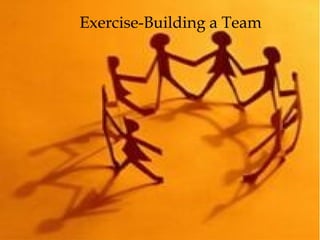
Exercise-Building a Team
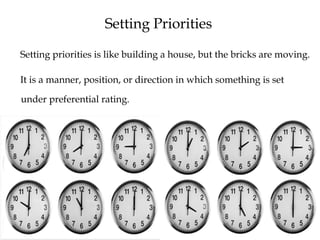
Setting Priorities
Setting priorities is like building a house, but the bricks are moving.
It is a manner, position, or direction in which something is set
under preferential rating.
How...
●
Narrow your objectives
●
Focus first on the goals that matter
●
Be prepared for conflicts
●
Put time on your side
How...
●
Choose carefully
●
Start now
●
Sweat the big stuff
●
Be prepared for change
Remember
“The way the organization handles the personal
agendas determines the success of the
enterprise.“
Exercise-Setting Priorities
Creativity is defined as the tendency to generate or
recognize ideas, alternatives, or possibilities that may be
useful in solving problems, communicating with others,
and entertaining ourselves and others.
Methods of creativity
●
Brainstorming
●
Utilizing a round-robin
●
Playing games
●
Working with a colleague
●
Setting up an innovative center
●
Holding think-tank sessions
It helps as it:
Allow employees to unleash their talent at the same
time eliminate potential barriers.
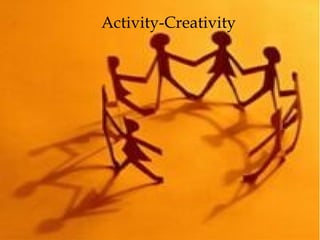
Activity-Creativity
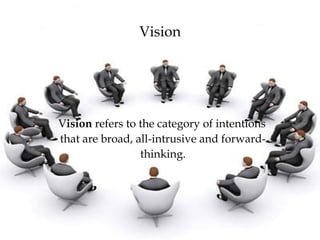
Vision
Vision refers to the category of intentions
that are broad, all-intrusive and forward-
thinking.
Vision is ....
●
Building a personal commitment to values by
creating visual images of the future.
●
The collective values and aspirations of individuals.
●
A dream created in our waking hours of how we like
our lives to be.
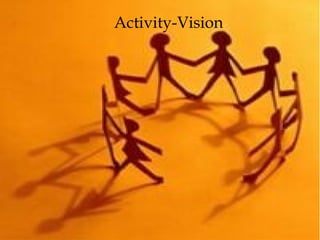
Activity-Vision
The Bottom Line
●
Look at your own work and acknowledge your
strengths as well as what skills you need to improve.
●
Your focus should be to lead your organization to
success.
●
Ensure positive results through implementation of
various competencies.
Acknowledge your competencies
Putting it all together
●
Based on the situations you face everyday you can
determine which of the competencies you will use to
ensure the success of your efforts.
●
Recognize that sometimes we have to 'stretch'
ourselves to make a positive difference in the lives of
others.
Remember
Excellence is measured one step at a time, and it all
begins with effort.
Leadership workshop

Leadership workshop

  • 1.
  • 2.
    Objectives of theprogram ● Learn how to lead change efficiently and build effective teams ● Develop a better sense of your leadership roles ● Understand the competencies needed to become an Effective Leader
  • 3.
    Introduction Now a daysa lot of emphasis is given on choosing the competencies that will create wealth for organizations. Competencies link organizational strategy with people, and people who are aligned with strategic goals are better able to meet challenges . No matter, which issues people face, they want to know where they fit in, what the work is, and what competencies they need. Competency based approach and response is a powerful answer to the problems people and organizations face.
  • 4.
    Introduction contd.. While mostpeople in the leadership field are familiar with competencies like problem solving, financial analysis and marketing savvy, these skills do not, of themselves make a Leader. It is the nine competencies in addition to the traditionally valued competencies, which make a well-rounded Leader.
  • 5.
    LEADERSHIP COMPETENCIES What isCompetence and Competency? 'Competence' means a skill and the standard of performance reached while 'Competency' refers to the behavior by which it is achieved.
  • 6.
    In other words ● Competencedescribes what people can do and Competency focuses on how they do it. ● Competence is skill based and Competency is behavior based.
  • 7.
    Let us takea look at the Leadership Model
  • 8.
  • 9.
    The Leadership CapstoneModel It is built on the pillars of Management Skills and Financial Acumen with the capstone consisting of the Nine Leadership Competencies on top.
  • 10.
    Advantages of themodel ● This model will help you build a frame work to act in your leadership moments. ● Your personal mastery of the Capstone piece will define and differentiate your role as a Leader
  • 11.
    Building your capstonewill make you: ● Aware of opportunities to act in leadership moments. ● Incorporate competencies into your succession planning process. ● Build cohesive teams. ● Provide a base to build loyalty and trust.
  • 12.
    Let us understandthe Nine Leadership Competencies
  • 13.
    Nine Leadership Competencies ● Passion ● Humor ● Courage ● Integrityand Trust ● Energy/Vitality/Enthusiasm ● Building a Team ● Setting priorities ● Creativity ● Vision
  • 14.
    It is anintense concentration (focus) on a belief that a task can be completed despite scarcity of human support or any other resource.
  • 15.
    How to raiseyour passion competency ● Lead a team in your organization. ● Tie the team activities to organization's mission statement or vision. ● Mentor an employee. ● Write an article on your Passion for your company newsletter.
  • 16.
    Passion contd... ● When youget involved in activities you really enjoy, you become energized and people can tell that you have a sense of purpose, which brings out your natural leadership abilities.
  • 17.
  • 18.
    HUMOR It is theability or quality of people, objects, or situations to evoke feelings of amusement in other people. The term encompasses a form of entertainment or human communication which evokes such feelings, or which makes people laugh or feel happy.
  • 19.
    Humor-How does ithelp? ● It helps to relieve day-to-day pressures . ● Executives who are open with humor become more approachable to their employees. ● Allows everyone to perceive and view things in a different light.
  • 20.
    Remember It is dangerousto confuse professionalism with seriousness. You can take your job and your world seriously, and still take yourself lightly.
  • 21.
    COURAGE It is theability to confront fear, pain, danger, uncertainty or intimidation.
  • 22.
    The Key ● The keyto courageous leadership and conscious action is how one responds to what arises on the path, rather than whether individual circumstances are defined as great, good, bad or just plain ugly. ● In conscious, courageous leadership, every situation or circumstance — every so-called success or failure, barrier or doorway — is simply another opportunity for greater creativity, mastery, and fulfillment of higher potential.
  • 23.
    Tips to improveyour Courage quotient ● Choose role model who exemplifies behavior, values and beliefs that show courage in action. ● Learn to coach a colleague on one aspect of his or her job.
  • 24.
    COURAGE Courageous leaders fighttheir fears and do what needs to be done in the face of opposition. “What lies behind us and what lies before us are tiny matters compared to what lies within us.” - Oliver Wendell Holmes
  • 25.
    This is whatOsho says about courage: ● "You cannot be truthful if you are not courageous - You cannot be loving if you are not courageous - You cannot be trusting if you are not courageous- You cannot inquire into reality if you are not courageous - Hence courage comes first and everything else follows."
  • 26.
  • 27.
    INTEGRITY AND TRUST Integrity: Firmadherence to a code of moral or artistic values. Trust: Firm reliance on the integrity, ability, or character of a person or thing.
  • 28.
    Integrity Integrity is setof values that we hold ourselves responsible for and demonstrate in our behavior toward others. We can develop and maintain integrity . We develop self-awareness and become independent thinkers by keeping our promises.
  • 29.
    Trust ● If we breakour promises to ourselves and to other people, then we erode trust. ● It is necessary to 'walk the talk'. The assuring words that you speak or write are like promises. People expect these promises to be kept. And if they are not then the problem arises as the trust and credibility are lost. ● Thus always remember, 'When you break a promise, more than the promise gets broken.'
  • 30.
    Leadership in Action “Re-examineall that you have been told...Dismiss that which insults your soul.” - Walt Witman
  • 31.
  • 32.
  • 33.
  • 34.
    Energy/Vitality/Enthusiasm Energy: The capacity ofbeing active or capacity for doing work. Vitality: Power to survive or grow. Enthusiasm: Strong excitement of feeling.
  • 35.
    By practising thiscompetency you can: ● Pursue goals passionately. ● You are driven to be the best in whatever you do. ● Find the opportunities and make the most of them.
  • 36.
    Remember ● A lack ofthis competency will result in falling short of your goals, even though you may have the opportunities. ● But once people are involved and action ensues, enthusiasm becomes contagious. “Enthusiasm finds the opportunities and energy makes the most of them.” - Henry S. Haskins
  • 37.
  • 38.
    Building a Team ● Build:To develop according to a systematic plan, by a definite process, or on a particular base. ● Team: Is a group of people linked in a common purpose.
  • 39.
    Tips to teambuilding ● Live the question: Keep asking yourself constantly - 'of all that is required to happen, how can I use my time most valuably right now?' ● The Philosophy of Continuing Improvement: Ability is strength. Work consciously everyday, at getting a little better at every little thing you are involved with. ● Maintain integrity: An effective leader is known for his integrity. Always keep your word. ● Recognize your most valuable asset: While your products or your bottom- line may be terrific, internalize the knowledge that your most valuable asset is the people who work with you.
  • 40.
    Tips to teambuilding contd... ● Feel-good factor: Strive to create an environment that encourages your people to feel good about themselves, take pride in their work and in doing it well. ● Declare your objectives: Tell your people what your objectives are and what their role is in meeting those objectives. And then, allow them to get on with their job. ● Acknowledge: To get your team to constantly give their best to you, you must continually acknowledge them and let them know how important they are to you. ● Recognize special talents: You may have a team member who has some special talent that is not being tapped in the present set-up. Recognize the value of that talent and create a position to put that talent to good use.
  • 41.
    Tips to teambuilding contd... ● Learn to listen: Make time to listen to your team members and hear what they are actually saying. Sometimes, people don't know how to clearly say what they mean. Learn to listen to even what is not being said. ● Lead by example: Your team will only truly learn the standards you expect of them, if you walk your talk. You, be their example. ● Confronting fear: True leaders are not fearless people. They are those who face their fear, acknowledge it and move ahead towards their objective inspite of the fear. ● Dress right: The way you look has an impact on the responses you get. Ensure you dress crisply, neatly and in keeping with your role....don't overdo it, at the same time avoid being sloppy. Dress to convey you mean business. Image is important when leading other people. Dress for success. In the game of people, they tend to judge you by the way you look on the outside.
  • 42.
    Remember ● Building teams helpsorganization move to a competency based structure. ● It helps team members to know what skill sets are required. ● Mutual trust and respect are a foundation for team- based organizations.
  • 43.
  • 44.
    Setting Priorities Setting prioritiesis like building a house, but the bricks are moving. It is a manner, position, or direction in which something is set under preferential rating.
  • 45.
    How... ● Narrow your objectives ● Focusfirst on the goals that matter ● Be prepared for conflicts ● Put time on your side
  • 46.
    How... ● Choose carefully ● Start now ● Sweatthe big stuff ● Be prepared for change
  • 47.
    Remember “The way theorganization handles the personal agendas determines the success of the enterprise.“
  • 48.
  • 49.
    Creativity is definedas the tendency to generate or recognize ideas, alternatives, or possibilities that may be useful in solving problems, communicating with others, and entertaining ourselves and others.
  • 50.
    Methods of creativity ● Brainstorming ● Utilizinga round-robin ● Playing games ● Working with a colleague ● Setting up an innovative center ● Holding think-tank sessions
  • 51.
    It helps asit: Allow employees to unleash their talent at the same time eliminate potential barriers.
  • 52.
  • 53.
    Vision Vision refers tothe category of intentions that are broad, all-intrusive and forward- thinking.
  • 54.
    Vision is .... ● Buildinga personal commitment to values by creating visual images of the future. ● The collective values and aspirations of individuals. ● A dream created in our waking hours of how we like our lives to be.
  • 55.
  • 56.
    The Bottom Line ● Lookat your own work and acknowledge your strengths as well as what skills you need to improve. ● Your focus should be to lead your organization to success. ● Ensure positive results through implementation of various competencies.
  • 57.
    Acknowledge your competencies Puttingit all together ● Based on the situations you face everyday you can determine which of the competencies you will use to ensure the success of your efforts. ● Recognize that sometimes we have to 'stretch' ourselves to make a positive difference in the lives of others.
  • 58.
    Remember Excellence is measuredone step at a time, and it all begins with effort.

Editor's Notes

  • #21 Human beings by nature are spontaneous and playful creatures. Yet the older we become, the less appropriate it seems for us to allow it to be expressed. We get professionally serious and then pay comedians to do a job we've forgotten how to do ourselves. You will need to find your own comfort level with what works and what does not, based on the people you lead, the situation, the culture, the pressures of your industry, etc; but we invite you to work on incorporating this competency in some manner into your daily life. Studies have proven that you will live longer.
  • #46 Narrow your objectives You probably won't be able to achieve every financial goal you've ever dreamed of. So identify your goals clearly and why they matter to you, and decide which are most important. By concentrating your efforts, you have a better chance of achieving what matters most. Focus first on the goals that matter To accomplish primary goals, you will often need to put desirable but less important ones on the back burner. Be prepared for conflicts Even worthy goals often conflict with one another. When faced with such a conflict, you should ask yourself questions like: Will one of the conflicting goals benefit more people than the other? Which goal will cause the greater harm if it is deferred? Put time on your side The most important ally you have in reaching your goals is time. The more time you have, the more chance you have of success. Your age is a big factor -- younger people (who have more time to build their nest egg) can invest differently than older ones.
  • #47 Choose carefully Once you have your list together, you need to rank the items in order of importance Start now The longer you wait to identify and begin working toward your goals, the more difficulty you'll have reaching them. Sweat the big stuff Once you have prioritized your list of goals, keep your spending on course. Always ask yourself: "Is this taking me nearer to my primary goals -- or leading me further away from them?" If a big expense doesn't get you closer to your goals, try to defer or reduce it. Be prepared for change Your needs and desires will change as things change, so you should probably reexamine your priorities at regular intervals.