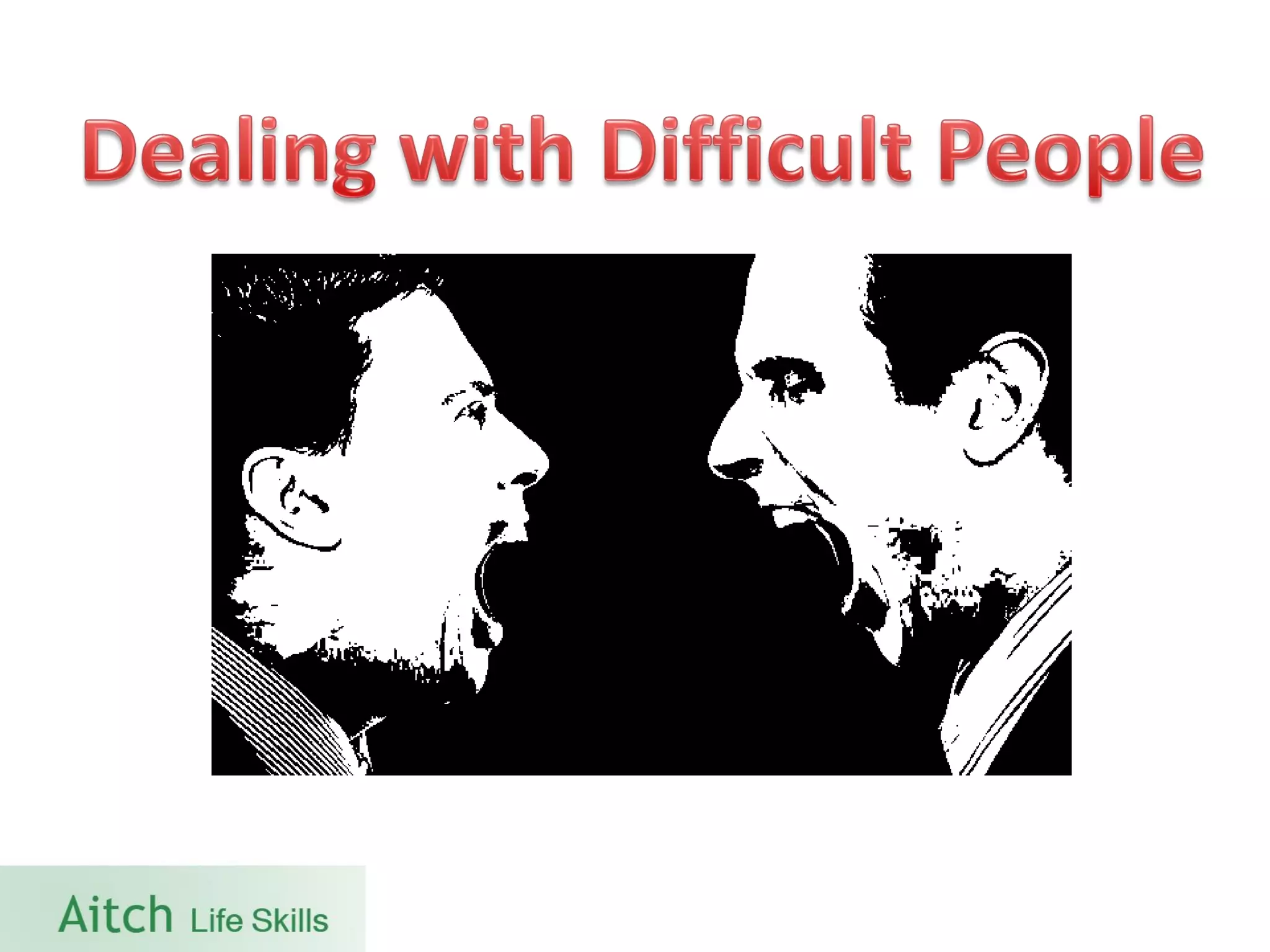
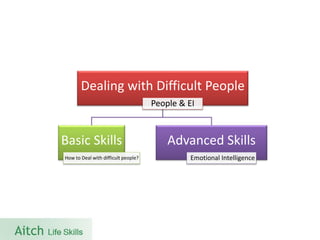
Dealing with Difficult People 
People & EI 
Basic Skills 
How to Deal with difficult people? 
Advanced Skills 
Emotional Intelligence
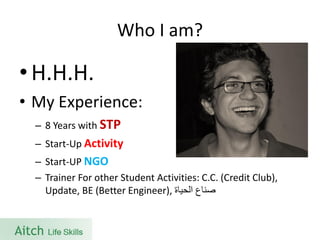
Who I am? 
•H.H.H. 
•My Experience: 
–8 Years with STP 
–Start-Up Activity 
–Start-UP NGO 
–Trainer For other Student Activities: C.C. (Credit Club), Update, BE (Better Engineer), صناع الحياة
•Introduction. 
–What is a Difficult Behavior? 
–The Three Choices we have. 
•Types of Difficult People? 
•How to Deal with Difficult People? 
•Tips to make Life Easier 
•Summary.
Scoring 
•Agree = 2 points 
•Not Sure = 1 points 
•Disagree = 0 points
Results 
•(15-20) Points: 
You feel difficult people are disruptive, waste time, etc... 
(They are a serious issue for you.) 
•(10-14) Points : 
Not sure whether difficult people are a problem for you, other people, or the organization as a whole. 
(You have thick skin or are in denial) 
•(0-9) Points : 
Not convinced they are problematic. You are either correct or oblivious to what’s going on around you 
(You may be the difficult person!)
•Introduction. 
–What is a Difficult Behavior? 
–The Three Choices we have. 
•Types of Difficult People? 
•How to Deal with Difficult People? 
•Tips to make Life Easier 
•Summary.
Introduction 
} وَكَانَ الإِنْسَانُ أَكْثَرَ شَيْءٍ جَدَ لا { 
]الكهف: 54 ]
Definition of Conflict
Activity 
A & B
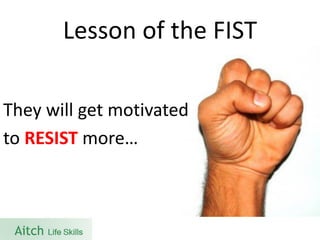
Lesson of the FIST 
They will get motivated 
to RESISTmore…
Introduction 
•Conflict: 
“Exists when one person has a need of another and that need is not being met.” 
“A serious disagreement or argument, typically a protracted one.” 
15
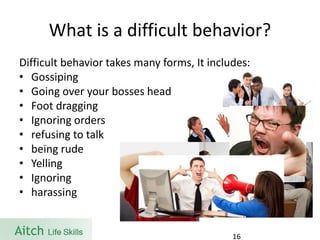
What is a difficult behavior? 
Difficult behavior takes many forms, It includes: 
•Gossiping 
•Going over your bosses head 
•Foot dragging 
•Ignoring orders 
•refusing to talk 
•being rude 
•Yelling 
•Ignoring 
•harassing 
16
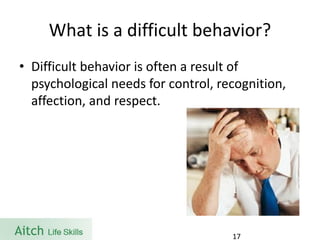
What is a difficult behavior? 
•Difficult behavior is often a result of psychological needs for control, recognition, affection, and respect. 
17
Exercise 1 
Behaviors YOUMet
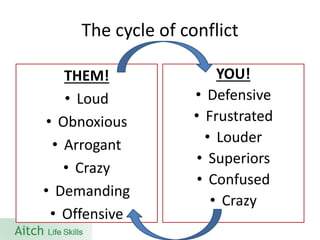
The cycle of conflict 
THEM! 
•Loud 
•Obnoxious 
•Arrogant 
•Crazy 
•Demanding 
•Offensive 
YOU! 
•Defensive 
•Frustrated 
•Louder 
•Superiors 
•Confused 
•Crazy
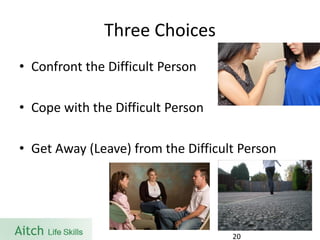
Three Choices 
•Confront the Difficult Person 
•Cope with the Difficult Person 
•Get Away (Leave) from the Difficult Person 
20
Coping with difficult Situations 
•Am I dealing with a difficult person or a difficult situation? 
•What am I willing to accept about this person or situation? 
•Should I put some distance between me and the person or situation? 
21
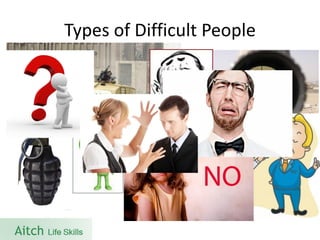
Types of Difficult People
Types of Difficult People 
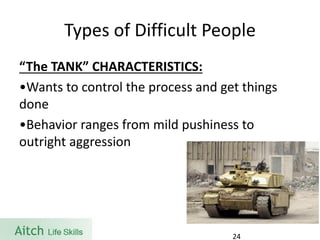
“The TANK” CHARACTERISTICS: 
•Wants to control the process and get things done 
•Behavior ranges from mild pushiness to outright aggression 
24
Types of Difficult People 
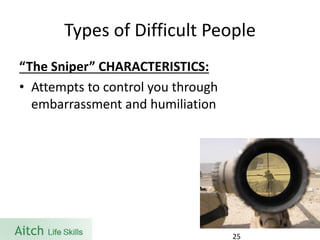
“The Sniper” CHARACTERISTICS: 
•Attempts to control you through embarrassment and humiliation 
25
Types of Difficult People 
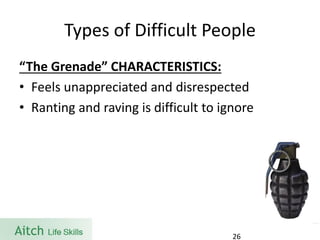
“The Grenade” CHARACTERISTICS: 
•Feels unappreciated and disrespected 
•Ranting and raving is difficult to ignore 
26
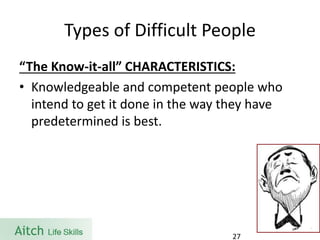
Types of Difficult People“The Know-it-all” CHARACTERISTICS: 
•Knowledgeable and competent people who intend to get it done in the way they have predetermined is best. 
27
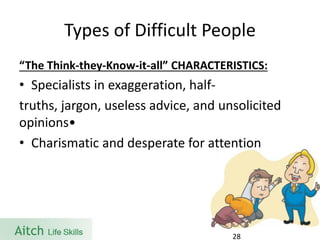
Types of Difficult People“The Think-they-Know-it-all” CHARACTERISTICS: 
•Specialists in exaggeration, half- 
truths, jargon, useless advice, and unsolicited opinions• 
•Charismatic and desperate for attention 
28
Types of Difficult People 
“The YES Person” CHARACTERISTICS: 
•Gets along but can easily over commit 
•Doesn’t understand the true nature of the task they have accepted. 
29
Types of Difficult People 
“The Maybe Person” CHARACTERISTICS: 
•The downside of each option blinds them 
30
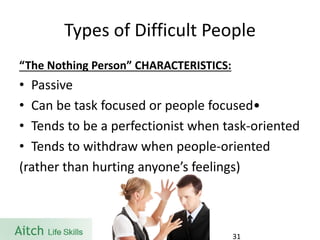
Types of Difficult People 
“The Nothing Person” CHARACTERISTICS: 
•Passive 
•Can be task focused or people focused• 
•Tends to be a perfectionist when task-oriented 
•Tends to withdraw when people-oriented 
(rather than hurting anyone’s feelings) 
31
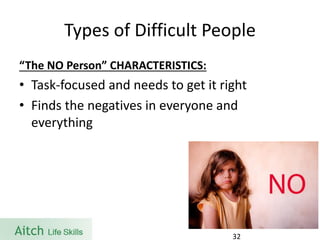
Types of Difficult People 
“The NO Person” CHARACTERISTICS: 
•Task-focused and needs to get it right 
•Finds the negatives in everyone and everything 
32
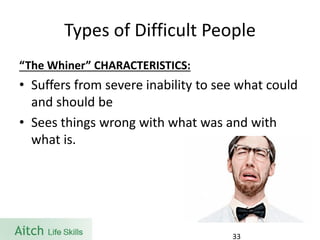
Types of Difficult People 
“The Whiner” CHARACTERISTICS: 
•Suffers from severe inability to see what could and should be 
•Sees things wrong with what was and with what is. 
33
Exercise 2 
The Right Matrix 
& 
The Aggressiveness Matrix
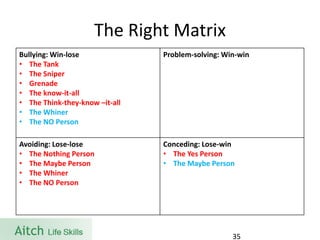
The Right Matrix 
Bullying: Win-lose 
•The Tank 
•The Sniper 
•Grenade 
•The know-it-all 
•The Think-they-know –it-all 
•The Whiner 
•The NOPerson 
Problem-solving: Win-win 
Avoiding: Lose-lose 
•The Nothing Person 
•The Maybe Person 
•The Whiner 
•The NOPerson 
Conceding: Lose-win 
•TheYes Person 
•The Maybe Person 
35
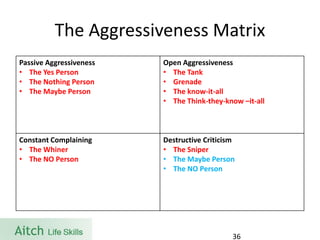
The Aggressiveness Matrix 
PassiveAggressiveness 
•TheYes Person 
•The Nothing Person 
•The Maybe Person 
Open Aggressiveness 
•The Tank 
•Grenade 
•The know-it-all 
•The Think-they-know –it-all 
Constant Complaining 
•The Whiner 
•The NOPerson 
DestructiveCriticism 
•The Sniper 
•The Maybe Person 
•The NOPerson 
36
Practice 
Brain Storming of Solutions
Challenges of each Type 
The Tank: 
38
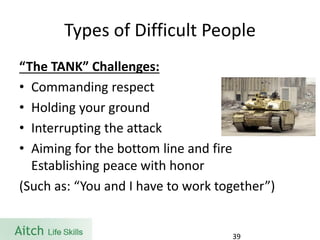
Types of Difficult People 
“The TANK” Challenges: 
•Commanding respect 
•Holding your ground 
•Interrupting the attack 
•Aiming for the bottom line and fire Establishing peace with honor 
(Such as: “You and I have to work together”) 
39
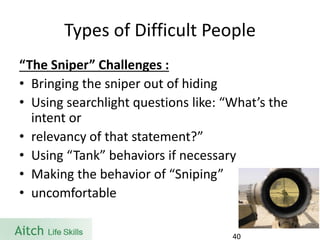
Types of Difficult People 
“The Sniper” Challenges : 
•Bringing the sniper out of hiding 
•Using searchlight questions like: “What’s the intent or 
•relevancy of that statement?” 
•Using “Tank” behaviors if necessary 
•Making the behavior of “Sniping” 
•uncomfortable 
40
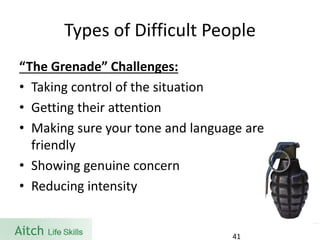
Types of Difficult People 
“The Grenade” Challenges: 
•Taking control of the situation 
•Getting their attention 
•Making sure your tone and language are friendly 
•Showing genuine concern 
•Reducing intensity 
41
Types of Difficult People“The Know-it-all” Challenges : 
•Opening them up to new ideas 
•Being prepared and knowing your stuff 
•Blending with their doubts and desires 
•Presenting your views indirectly 
•Turning them into mentors 
•Recognizing their expertise 
42
Types of Difficult People“The Think-they-Know-it-all” Challenges : 
•Finding an acceptable way to disavow their unworkable ideas 
•Providing them a little attention 
•Getting clarification for specifics 
•Being patient 
•Gently confronting them with the consequences of their negative behavior 
•Crediting the things they do right 
43
Types of Difficult People 
“The YES Person” Challenges : 
•Getting commitments you can count on 
•Making it safe to be honest 
•Talking openly and acknowledging their honesty 
•Helping them learn to better plan 
•Getting their word and summarizing their commitment 
•Ensuring understanding of negative consequences 
•Strengthening the relationship 
44
Types of Difficult People 
“The Maybe Person” Challenges : 
•Helping them to think decisively 
•Establishing and maintaining a comfort zone 
•Surfacing conflicts and clarifying issues 
•Using a decision-making system 
•Reassuring and then ensuring follow through 
•Strengthening the relationship 
45
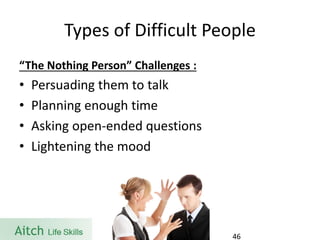
Types of Difficult People 
“The Nothing Person” Challenges : 
•Persuading them to talk 
•Planning enough time 
•Asking open-ended questions 
•Lightening the mood 
46
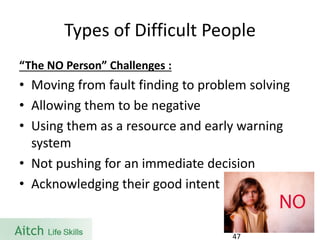
Types of Difficult People 
“The NO Person” Challenges : 
•Moving from fault finding to problem solving 
•Allowing them to be negative 
•Using them as a resource and early warning system 
•Not pushing for an immediate decision 
•Acknowledging their good intent 
47
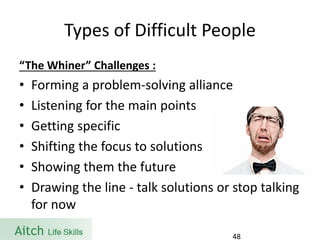
Types of Difficult People 
“The Whiner” Challenges : 
•Forming a problem-solving alliance 
•Listening for the main points 
•Getting specific 
•Shifting the focus to solutions 
•Showing them the future 
•Drawing the line -talk solutions or stop talking for now 
48
How to Deal with Difficult People? 
•Stay Centered 
•Reality check 
•Focus on behavior 
•Listen 
•Give Feedback 
49
Listening 
50 
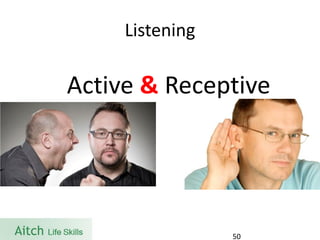
Active &Receptive
Reasons get them difficult 
1-They have a need to tellus something
•Listen 
•“Key of cooperation” 
Confirm the listening 
1-They have a need to tellus something
Reasons get them difficult 
2-They are afraid we don’t understand the seriousnessof their problem
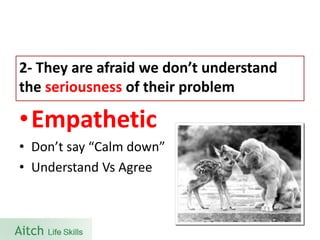
•Empathetic 
•Don’t say “Calm down” 
•Understand VsAgree 
2-They are afraid we don’t understand the seriousnessof their problem
•Ask Them 
•What are your ideas 
About the problem? 
3-they don’t believe we valuetheir inputs & ideas
•Listening 
•Empathetic 
•Ask them 
All Receptive Skills
Reasons get them difficult 
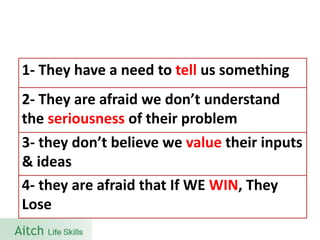
4-they are afraid that If WE WIN, They Lose
•Problem Solving 
•Taking the “active” role 
by mixing their ideas with 
yours 
4-they are afraid that If WE WIN, They Lose
4-they are afraid that If WE WIN, They Lose 
3-they don’t believe we valuetheir inputs & ideas 
2-They are afraid we don’t understand the seriousnessof their problem 
1-They have a need to tellus something
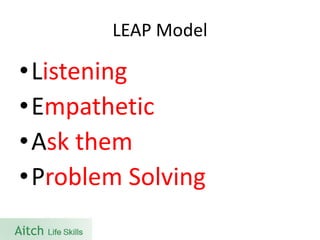
•Listening 
•Empathetic 
•Ask them 
•Problem Solving 
LEAP Model
…………...……BUT………….……… 
…………...……And………….………
Reasons get them difficult 
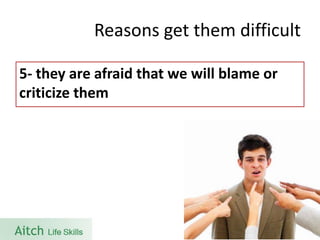
5-they are afraid that we will blame or criticize them
•You stupid idiot RULE 
•Speak in a way that don’t put them on the defensive position 
5-they are afraid that we will blame or criticize them
•Problem Solving 
•Listening 
•Empathetic 
•Ask them 
•Speak “not Blame” 
LEAPS Model
Controlling OUR Behaviors 
65
1. Forgive: 
•Ask yourself, “What is it about this situation or 
person that I can seek to understand and forgive?” 
2. Wait it Out 
•Wait until you’ve cooled off before responding, if you choose to respond at all.
3. “Does it really matter if I am right?: 
If you find yourself arguing for the sake of being 
right, ask “Does it matter if I am right?” 
•If yes, then ask “Why do I need to be right? 
What will I gain?”
4. Don’t Respond: 
Many times when a person initiates a negative message or difficult attitude, they are trying to trigger a response from you. When we react, we are actually giving them what they want.
5. Stop talking about it: 
The more we talk about how much we dislike a 
person, the more hate we will feel towards them and the more we’ll notice things about them that we dislike.
6. Look for the lesson: 
No situation is ever lost if we can take away from it some lessons that will help us grow and become a better person. 
7. Choose to Eliminate the People in your Life: 
Negative people can be a source of energy drain. Cut them out by avoiding interactions with them as much as possible.
Funny Conflict
Summary 
•Introduction. 
•What is an Difficult Behavior? 
•Types of Difficult People. 
•How to Deal with Difficult People? 
•Tips to make Life Easier.
Thank YOU

Dealing with difficult people

  • 2.
    Dealing with DifficultPeople People & EI Basic Skills How to Deal with difficult people? Advanced Skills Emotional Intelligence
  • 3.
    Who I am? •H.H.H. •My Experience: –8 Years with STP –Start-Up Activity –Start-UP NGO –Trainer For other Student Activities: C.C. (Credit Club), Update, BE (Better Engineer), صناع الحياة
  • 6.
    •Introduction. –What isa Difficult Behavior? –The Three Choices we have. •Types of Difficult People? •How to Deal with Difficult People? •Tips to make Life Easier •Summary.
  • 8.
    Scoring •Agree =2 points •Not Sure = 1 points •Disagree = 0 points
  • 9.
    Results •(15-20) Points: You feel difficult people are disruptive, waste time, etc... (They are a serious issue for you.) •(10-14) Points : Not sure whether difficult people are a problem for you, other people, or the organization as a whole. (You have thick skin or are in denial) •(0-9) Points : Not convinced they are problematic. You are either correct or oblivious to what’s going on around you (You may be the difficult person!)
  • 10.
    •Introduction. –What isa Difficult Behavior? –The Three Choices we have. •Types of Difficult People? •How to Deal with Difficult People? •Tips to make Life Easier •Summary.
  • 11.
    Introduction } وَكَانَالإِنْسَانُ أَكْثَرَ شَيْءٍ جَدَ لا { ]الكهف: 54 ]
  • 12.
  • 13.
  • 14.
    Lesson of theFIST They will get motivated to RESISTmore…
  • 15.
    Introduction •Conflict: “Existswhen one person has a need of another and that need is not being met.” “A serious disagreement or argument, typically a protracted one.” 15
  • 16.
    What is adifficult behavior? Difficult behavior takes many forms, It includes: •Gossiping •Going over your bosses head •Foot dragging •Ignoring orders •refusing to talk •being rude •Yelling •Ignoring •harassing 16
  • 17.
    What is adifficult behavior? •Difficult behavior is often a result of psychological needs for control, recognition, affection, and respect. 17
  • 18.
  • 19.
    The cycle ofconflict THEM! •Loud •Obnoxious •Arrogant •Crazy •Demanding •Offensive YOU! •Defensive •Frustrated •Louder •Superiors •Confused •Crazy
  • 20.
    Three Choices •Confrontthe Difficult Person •Cope with the Difficult Person •Get Away (Leave) from the Difficult Person 20
  • 21.
    Coping with difficultSituations •Am I dealing with a difficult person or a difficult situation? •What am I willing to accept about this person or situation? •Should I put some distance between me and the person or situation? 21
  • 23.
  • 24.
    Types of DifficultPeople “The TANK” CHARACTERISTICS: •Wants to control the process and get things done •Behavior ranges from mild pushiness to outright aggression 24
  • 25.
    Types of DifficultPeople “The Sniper” CHARACTERISTICS: •Attempts to control you through embarrassment and humiliation 25
  • 26.
    Types of DifficultPeople “The Grenade” CHARACTERISTICS: •Feels unappreciated and disrespected •Ranting and raving is difficult to ignore 26
  • 27.
    Types of DifficultPeople“The Know-it-all” CHARACTERISTICS: •Knowledgeable and competent people who intend to get it done in the way they have predetermined is best. 27
  • 28.
    Types of DifficultPeople“The Think-they-Know-it-all” CHARACTERISTICS: •Specialists in exaggeration, half- truths, jargon, useless advice, and unsolicited opinions• •Charismatic and desperate for attention 28
  • 29.
    Types of DifficultPeople “The YES Person” CHARACTERISTICS: •Gets along but can easily over commit •Doesn’t understand the true nature of the task they have accepted. 29
  • 30.
    Types of DifficultPeople “The Maybe Person” CHARACTERISTICS: •The downside of each option blinds them 30
  • 31.
    Types of DifficultPeople “The Nothing Person” CHARACTERISTICS: •Passive •Can be task focused or people focused• •Tends to be a perfectionist when task-oriented •Tends to withdraw when people-oriented (rather than hurting anyone’s feelings) 31
  • 32.
    Types of DifficultPeople “The NO Person” CHARACTERISTICS: •Task-focused and needs to get it right •Finds the negatives in everyone and everything 32
  • 33.
    Types of DifficultPeople “The Whiner” CHARACTERISTICS: •Suffers from severe inability to see what could and should be •Sees things wrong with what was and with what is. 33
  • 34.
    Exercise 2 TheRight Matrix & The Aggressiveness Matrix
  • 35.
    The Right Matrix Bullying: Win-lose •The Tank •The Sniper •Grenade •The know-it-all •The Think-they-know –it-all •The Whiner •The NOPerson Problem-solving: Win-win Avoiding: Lose-lose •The Nothing Person •The Maybe Person •The Whiner •The NOPerson Conceding: Lose-win •TheYes Person •The Maybe Person 35
  • 36.
    The Aggressiveness Matrix PassiveAggressiveness •TheYes Person •The Nothing Person •The Maybe Person Open Aggressiveness •The Tank •Grenade •The know-it-all •The Think-they-know –it-all Constant Complaining •The Whiner •The NOPerson DestructiveCriticism •The Sniper •The Maybe Person •The NOPerson 36
  • 37.
  • 38.
    Challenges of eachType The Tank: 38
  • 39.
    Types of DifficultPeople “The TANK” Challenges: •Commanding respect •Holding your ground •Interrupting the attack •Aiming for the bottom line and fire Establishing peace with honor (Such as: “You and I have to work together”) 39
  • 40.
    Types of DifficultPeople “The Sniper” Challenges : •Bringing the sniper out of hiding •Using searchlight questions like: “What’s the intent or •relevancy of that statement?” •Using “Tank” behaviors if necessary •Making the behavior of “Sniping” •uncomfortable 40
  • 41.
    Types of DifficultPeople “The Grenade” Challenges: •Taking control of the situation •Getting their attention •Making sure your tone and language are friendly •Showing genuine concern •Reducing intensity 41
  • 42.
    Types of DifficultPeople“The Know-it-all” Challenges : •Opening them up to new ideas •Being prepared and knowing your stuff •Blending with their doubts and desires •Presenting your views indirectly •Turning them into mentors •Recognizing their expertise 42
  • 43.
    Types of DifficultPeople“The Think-they-Know-it-all” Challenges : •Finding an acceptable way to disavow their unworkable ideas •Providing them a little attention •Getting clarification for specifics •Being patient •Gently confronting them with the consequences of their negative behavior •Crediting the things they do right 43
  • 44.
    Types of DifficultPeople “The YES Person” Challenges : •Getting commitments you can count on •Making it safe to be honest •Talking openly and acknowledging their honesty •Helping them learn to better plan •Getting their word and summarizing their commitment •Ensuring understanding of negative consequences •Strengthening the relationship 44
  • 45.
    Types of DifficultPeople “The Maybe Person” Challenges : •Helping them to think decisively •Establishing and maintaining a comfort zone •Surfacing conflicts and clarifying issues •Using a decision-making system •Reassuring and then ensuring follow through •Strengthening the relationship 45
  • 46.
    Types of DifficultPeople “The Nothing Person” Challenges : •Persuading them to talk •Planning enough time •Asking open-ended questions •Lightening the mood 46
  • 47.
    Types of DifficultPeople “The NO Person” Challenges : •Moving from fault finding to problem solving •Allowing them to be negative •Using them as a resource and early warning system •Not pushing for an immediate decision •Acknowledging their good intent 47
  • 48.
    Types of DifficultPeople “The Whiner” Challenges : •Forming a problem-solving alliance •Listening for the main points •Getting specific •Shifting the focus to solutions •Showing them the future •Drawing the line -talk solutions or stop talking for now 48
  • 49.
    How to Dealwith Difficult People? •Stay Centered •Reality check •Focus on behavior •Listen •Give Feedback 49
  • 50.
  • 51.
    Reasons get themdifficult 1-They have a need to tellus something
  • 52.
    •Listen •“Key ofcooperation” Confirm the listening 1-They have a need to tellus something
  • 53.
    Reasons get themdifficult 2-They are afraid we don’t understand the seriousnessof their problem
  • 54.
    •Empathetic •Don’t say“Calm down” •Understand VsAgree 2-They are afraid we don’t understand the seriousnessof their problem
  • 55.
    •Ask Them •Whatare your ideas About the problem? 3-they don’t believe we valuetheir inputs & ideas
  • 56.
    •Listening •Empathetic •Askthem All Receptive Skills
  • 57.
    Reasons get themdifficult 4-they are afraid that If WE WIN, They Lose
  • 58.
    •Problem Solving •Takingthe “active” role by mixing their ideas with yours 4-they are afraid that If WE WIN, They Lose
  • 59.
    4-they are afraidthat If WE WIN, They Lose 3-they don’t believe we valuetheir inputs & ideas 2-They are afraid we don’t understand the seriousnessof their problem 1-They have a need to tellus something
  • 60.
    •Listening •Empathetic •Askthem •Problem Solving LEAP Model
  • 61.
  • 62.
    Reasons get themdifficult 5-they are afraid that we will blame or criticize them
  • 63.
    •You stupid idiotRULE •Speak in a way that don’t put them on the defensive position 5-they are afraid that we will blame or criticize them
  • 64.
    •Problem Solving •Listening •Empathetic •Ask them •Speak “not Blame” LEAPS Model
  • 65.
  • 66.
    1. Forgive: •Askyourself, “What is it about this situation or person that I can seek to understand and forgive?” 2. Wait it Out •Wait until you’ve cooled off before responding, if you choose to respond at all.
  • 67.
    3. “Does itreally matter if I am right?: If you find yourself arguing for the sake of being right, ask “Does it matter if I am right?” •If yes, then ask “Why do I need to be right? What will I gain?”
  • 68.
    4. Don’t Respond: Many times when a person initiates a negative message or difficult attitude, they are trying to trigger a response from you. When we react, we are actually giving them what they want.
  • 69.
    5. Stop talkingabout it: The more we talk about how much we dislike a person, the more hate we will feel towards them and the more we’ll notice things about them that we dislike.
  • 70.
    6. Look forthe lesson: No situation is ever lost if we can take away from it some lessons that will help us grow and become a better person. 7. Choose to Eliminate the People in your Life: Negative people can be a source of energy drain. Cut them out by avoiding interactions with them as much as possible.
  • 71.
  • 72.
    Summary •Introduction. •Whatis an Difficult Behavior? •Types of Difficult People. •How to Deal with Difficult People? •Tips to make Life Easier.
  • 73.