Tuesday, January 7, 2020
Bemidji State University
Verbal De-escalation
Mr. Tracy Worsley, MA
Security and Emergency Preparedness
Specialist
2
What Will Be Discussed
• Techniques to calm a distressed individual
• Techniques to maintain a safe environment
• Increased self-awareness of body language and vocal
tone
• How to display empathy
• Techniques to avoid escalating
3
What Will Not Be Discussed
• Hostage negotiation skills
• How to break-up fights
• Physical intervention techniques
• Judo take-downs
• Techniques for use with out of control or violent
students
4
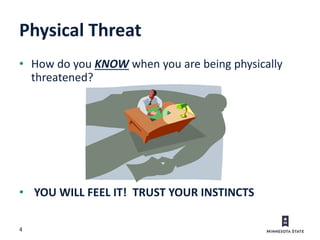
Physical Threat
• How do you KNOW when you are being physically
threatened?
• YOU WILL FEEL IT! TRUST YOUR INSTINCTS
5
What is Verbal De-escalation
• It’s what we do during a potentially dangerous, or
threatening, situation in an attempt to prevent a
person from causing harm to us, themselves, or
others
• Without specialized training, we should never
consider the use of physical force.
• Verbal De-escalation consists of tactics to help limit
the number of staff who might be injured on the job.
6
Basic De-escalation
• Goal- De-escalation of anger by reducing the excitability of the
individual, enabling discussion
• Self-Assessment- Am I in the right mindset to perform an
intervention?
• We are driven by fight, flight, or freeze when scared. In de-
escalation we must appear centered and calm when terrified.
• De-escalation practices must be practiced so that they can become
“second nature” to us in a potentially volatile situation.
7
Basic De-escalation
• Simple Listening- Listening attentively without speaking and
providing “encouragers”.
• Active Listening- Process of attempting to hear, acknowledge, and
understand what a person is saying.
• This includes empathizing with the other person, giving choices,
and setting limits. Make sure that you are not doing anything other
than listening. Multi-tasking is not listening!
• Acknowledgment- Occurs when you legitimately understand the
individual’s angry emotion.
8
Effective De-escalation
• To verbally de-escalate another person, you must open as
many clear lines of communication as possible.
• Both you and the other person must listen to each other and
have no barriers.
• Barriers to communication are the things that keep the
meaning of what is being said from what is being heard.
9
Barriers to Effective De-escalation
• Pre-judging
• Non-listening
• Criticizing
• Name-calling
• Engaging in power struggles
• Ordering
• Threatening
• Minimizing
• Arguing
10
Positive De-escalation
• Use positive and helpful statements such as:
“I want to help you.”
“Please tell me more so that I can better understand how to help you.”
“Let’s call Mr. Smith… I know he would be able to help with this…”
“Dr. Jones handles this for our college; let’s ask him what he thinks
about this Situation… He is always willing to help!”
• Place yourself on his/her side in finding a solution to the problem
11
Positive De-escalation
• Remember that safety is your primary concern.
• Do not attempt to interpret the individual’s feelings in an
analytical way.
• Empathize with the feelings, but not the behavior
• Do not argue or try to convince the individual
• Do not answer abusive or insulting questions
12
Positive De-escalation
• Don’t be judgmental
• Do NOT ignore the person or pretend to be
paying attention
• Listen to what the person is really saying
• Re-state the message
• Clarify the message
• Validate- “I understand why… “)Not in
agreement with…)
• Try to establish rapport with the other person
13
Body Language Basics
• 80-90% of our conversation is non-verbal. It is very important
to be able to identify exactly what we are communicating to
others non-verbally.
• In your efforts to de-escalate the situation, your body
language could indicate a willingness to get physical.
• It is just as important to recognize the “non- verbals” of the
person we are dealing with
14
Body Language 101
• When people are angry, they don’t always “listen” to the
words being said but react to what you are “saying” with your
body.
• Remember the difference between “hearing” and “listening”.
• You must always be careful with the message you are sending.
How you behave is just as important as what you say in a
threatening situation.
15
Body Language 201
• Finger pointing may be perceived as accusing or threatening.
Minimize “talking” with your hands.
• Shoulder shrugging could be perceived as uncaring or unknowing
• Rigid walking may seem challenging
• Clenched teeth could be perceived as closed minded and/or not
willing to listen to his/her story
• A natural smile is good. A fake smile can aggravate the situation.
• Use slow or deliberate movements- quick actions might alarm the
other person
16
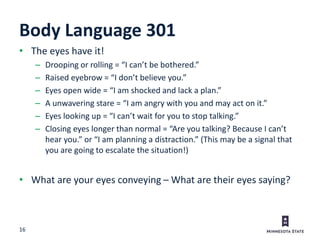
Body Language 301
• The eyes have it!
– Drooping or rolling = “I can’t be bothered.”
– Raised eyebrow = “I don’t believe you.”
– Eyes open wide = “I am shocked and lack a plan.”
– A unwavering stare = “I am angry with you and may act on it.”
– Eyes looking up = “I can’t wait for you to stop talking.”
– Closing eyes longer than normal = “Are you talking? Because I can’t
hear you.” or “I am planning a distraction.” (This may be a signal that
you are going to escalate the situation!)
• What are your eyes conveying – What are their eyes saying?
17
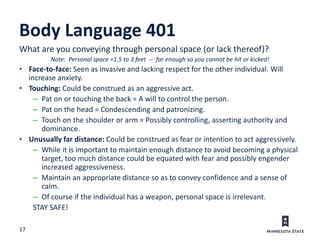
Body Language 401
What are you conveying through personal space (or lack thereof)?
Note: Personal space =1.5 to 3 feet -- far enough so you cannot be hit or kicked!
• Face-to-face: Seen as invasive and lacking respect for the other individual. Will
increase anxiety.
• Touching: Could be construed as an aggressive act.
– Pat on or touching the back = A will to control the person.
– Pat on the head = Condescending and patronizing.
– Touch on the shoulder or arm = Possibly controlling, asserting authority and
dominance.
• Unusually far distance: Could be construed as fear or intention to act aggressively.
– While it is important to maintain enough distance to avoid becoming a physical
target, too much distance could be equated with fear and possibly engender
increased aggressiveness.
– Maintain an appropriate distance so as to convey confidence and a sense of
calm.
– Of course if the individual has a weapon, personal space is irrelevant.
STAY SAFE!
18
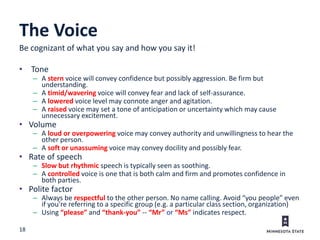
The Voice
Be cognizant of what you say and how you say it!
• Tone
– A stern voice will convey confidence but possibly aggression. Be firm but
understanding.
– A timid/wavering voice will convey fear and lack of self-assurance.
– A lowered voice level may connote anger and agitation.
– A raised voice may set a tone of anticipation or uncertainty which may cause
unnecessary excitement.
• Volume
– A loud or overpowering voice may convey authority and unwillingness to hear the
other person.
– A soft or unassuming voice may convey docility and possibly fear.
• Rate of speech
– Slow but rhythmic speech is typically seen as soothing.
– A controlled voice is one that is both calm and firm and promotes confidence in
both parties.
• Polite factor
– Always be respectful to the other person. No name calling. Avoid “you people” even
if you’re referring to a specific group (e.g. a particular class section, organization)
– Using “please” and “thank-you” -- “Mr” or “Ms” indicates respect.
19
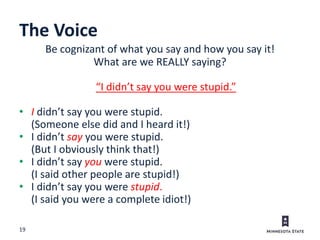
The Voice
Be cognizant of what you say and how you say it!
What are we REALLY saying?
“I didn’t say you were stupid.”
• I didn’t say you were stupid.
(Someone else did and I heard it!)
• I didn’t say you were stupid.
(But I obviously think that!)
• I didn’t say you were stupid.
(I said other people are stupid!)
• I didn’t say you were stupid.
(I said you were a complete idiot!)
20
Boil It Down
• Listen –
– Really listen so that you can understand what is at the heart of the conflict!
• Show that you Listened by Validating -
– “I understand why you might be upset.” (This does not indicate that you agree with them.)
– Often validation of feelings is what the irritated individual is looking to receive.
• Remain Calm –
– Avoid overreaction in what you say and how you say it.
– Be cognizant of body language.
• Maintain a Sense of Order-
– Remove onlookers -- or relocate to a safer place. (Onlookers can sometimes take up the role of
“cheerleaders” or become additional victims.)
– Send an onlooker for help or speed dial the police/security if you can!
– Sometimes having an audience will place pressure on the aggressor to “save face” and “win”
the dispute.
• Anticipate Problems-
– Watch for non-verbal cues or threats.
– Recognize possible signs of drug influence.
• Get Help!
– Bring in another trained person to assist whenever possible.
– Two individuals working together to calm an aggressor is better than one. An aggressor may
loosen his/her stance if outnumbered.
– Don’t forget to speed dial the police/security!
21
One More Thing – Call for HELP!
• This workshop is designed to help you to de-escalate a
potentially dangerous situation NOT intervene in an
altercation. You should always…
– Alert someone else as soon as possible. (No help will arrive until
someone else knows your situation. If you can’t get to your phone, yell
or raise your voice so someone will know that this is not a normal
conversation.
– We do not advise that you take the opportunity to practice your attack
skills. This opens the door for injury to you, the aggressor, or innocent
bystanders, as well as potential legal troubles. You should, however,
protect yourself if physically threatened or assaulted.
• REMEMBER:
– There is safety in numbers.
– It will be beneficial to have a witness, if the situation worsens and
someone is injured.
22
One More Thing – Follow-Up
 Report the situation (even if minor), both verbally and in
writing, to your superior as soon as possible.
 Minor situations can be a “cry for help”
 Minor situations could also be a warning for future problems or
potentially major situations.
 Documentation will be crucial when evaluating “patterned” events.
 After any confrontation, (and once the dust has settled) gently
advise or direct the person to counseling, if possible.
 Behavioral problems that are indicative of distress should also
be reported to the EGC Behavior Intervention Team, HR,
supervisor, security, co-workers, etc.
23
What NOT TO DO
• Avoid becoming emotionally involved or taking accusations or name calling personally.
– The aggressor is TRYING to get under your skin. Recognize this and control your
emotions at all times.
• Avoid engaging in power struggles.
– Often people become agitated because they feel powerless. Throwing your power in
his/her face could escalate the aggression.
• Avoid becoming rigid in your process.
– Be flexible and understanding. Treat the person as an individual.
• Avoid telling the other person that you “know how he or she feels.”
– Remember the person wants validation not a patronizing, let’s-get-this-over-with
attitude.
– Save your relatable stories for another time but DO offer advice when appropriate.
• Avoid raising your voice, cussing, making threats, and giving ultimatums or demands.
– Fight-or-flight, which is our body’s natural response to any threat, may lead you to
respond in-kind to the threatening person. Resist this urge so that you avoid an
escalation of the problem.
• Do not attempt to intimidate a hostile person.
– This includes intimidation in your words, how you speak, or body language.
24
Discussion Questions
(1) “A female student in a LS class who often comes in 10 minutes late or often
doesn’t come at all. Student came to class tardy, sat down, and began to text
someone in class. The instructor observed the texting and reminded her that using
a cell phone in class is against the rules. The student responded by saying that she
was texting her husband who is in Iraq. The teacher responded by saying that she
understood that she wanted to communicate with him, but not during class. The
student continued to text for a while and the instructor proceeded with the lecture.
The student got up and “stormed” out of class. What would you do?”
(2) “A disruptive student who is asked to leave class. What is the best way to
address this? What do you do if the student causes a scene or resists?”
(3) “Two students begin a verbal argument during class that appeared as though it
would turn physical within seconds. As the instructor how would you intervene?”
25
• Explosive
• Antisocial
• Passive Aggressive
• Narcissistic
• Paranoid
• Litigious
• Compulsive
SEVEN STUDENTS
26
• Characteristics
– Shouting
– Use profanity
– Engage in bullying
– Make veiled or explicit threats
– Interrupt lectures with loud and abusive remarks
• Response
– Safety First
– Ask student to quiet down, return to seat, or leave
– If student persists, dismiss class and contact security/police
– Document Incident and send to designated dean or judicial affairs
office/BIT Team
– Prior warning required by due process
EXPLOSIVE STUDENT
27
• Characteristics
– Engages in cheating, stealing, forging documents, exploiting
other people or physically hurting others or worse
– Exploit your good qualities as weaknesses and vulnerabilities
– Seung-Hui Cho
• Response
– Employ honor codes
– Define ‘plagiarism” and behavioral expectations in syllabus
– Make penalties proportionate and apply them to all students in
equal measure
– Document Incident and send to designated dean or judicial
affairs office/BIT Team
– Prior warning required by due process
ANTISOCIAL STUDENT
28
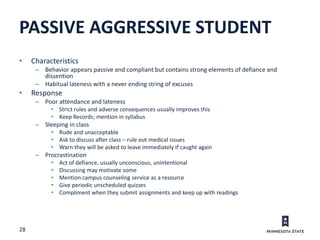
• Characteristics
– Behavior appears passive and compliant but contains strong elements of defiance and
dissention
– Habitual lateness with a never ending string of excuses
• Response
– Poor attendance and lateness
• Strict rules and adverse consequences usually improves this
• Keep Records; mention in syllabus
– Sleeping in class
• Rude and unacceptable
• Ask to discuss after class – rule out medical issues
• Warn they will be asked to leave immediately if caught again
– Procrastination
• Act of defiance, usually unconscious, unintentional
• Discussing may motivate some
• Mention campus counseling service as a resource
• Give periodic unscheduled quizzes
• Compliment when they submit assignments and keep up with readings
PASSIVE AGGRESSIVE STUDENT
29
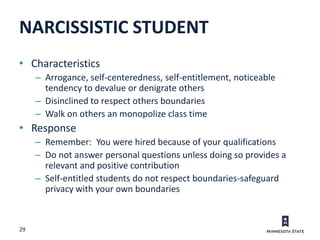
• Characteristics
– Arrogance, self-centeredness, self-entitlement, noticeable
tendency to devalue or denigrate others
– Disinclined to respect others boundaries
– Walk on others an monopolize class time
• Response
– Remember: You were hired because of your qualifications
– Do not answer personal questions unless doing so provides a
relevant and positive contribution
– Self-entitled students do not respect boundaries-safeguard
privacy with your own boundaries
NARCISSISTIC STUDENT
30
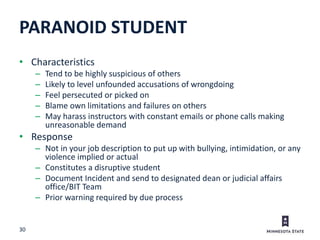
• Characteristics
– Tend to be highly suspicious of others
– Likely to level unfounded accusations of wrongdoing
– Feel persecuted or picked on
– Blame own limitations and failures on others
– May harass instructors with constant emails or phone calls making
unreasonable demand
• Response
– Not in your job description to put up with bullying, intimidation, or any
violence implied or actual
– Constitutes a disruptive student
– Document Incident and send to designated dean or judicial affairs
office/BIT Team
– Prior warning required by due process
PARANOID STUDENT
31
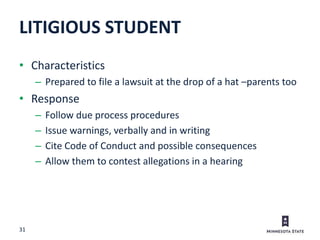
• Characteristics
– Prepared to file a lawsuit at the drop of a hat –parents too
• Response
– Follow due process procedures
– Issue warnings, verbally and in writing
– Cite Code of Conduct and possible consequences
– Allow them to contest allegations in a hearing
LITIGIOUS STUDENT
32
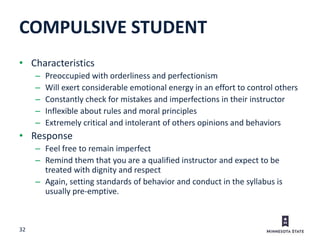
• Characteristics
– Preoccupied with orderliness and perfectionism
– Will exert considerable emotional energy in an effort to control others
– Constantly check for mistakes and imperfections in their instructor
– Inflexible about rules and moral principles
– Extremely critical and intolerant of others opinions and behaviors
• Response
– Feel free to remain imperfect
– Remind them that you are a qualified instructor and expect to be
treated with dignity and respect
– Again, setting standards of behavior and conduct in the syllabus is
usually pre-emptive.
COMPULSIVE STUDENT
33
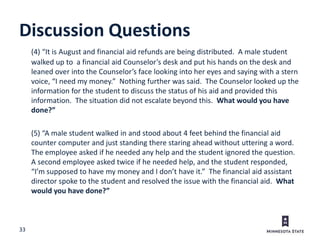
Discussion Questions
(4) “It is August and financial aid refunds are being distributed. A male student
walked up to a financial aid Counselor’s desk and put his hands on the desk and
leaned over into the Counselor’s face looking into her eyes and saying with a stern
voice, “I need my money.” Nothing further was said. The Counselor looked up the
information for the student to discuss the status of his aid and provided this
information. The situation did not escalate beyond this. What would you have
done?”
(5) “A male student walked in and stood about 4 feet behind the financial aid
counter computer and just standing there staring ahead without uttering a word.
The employee asked if he needed any help and the student ignored the question.
A second employee asked twice if he needed help, and the student responded,
“I’m supposed to have my money and I don’t have it.” The financial aid assistant
director spoke to the student and resolved the issue with the financial aid. What
would you have done?”
34
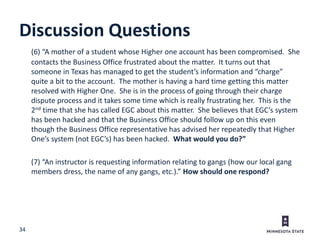
Discussion Questions
(6) “A mother of a student whose Higher one account has been compromised. She
contacts the Business Office frustrated about the matter. It turns out that
someone in Texas has managed to get the student’s information and “charge”
quite a bit to the account. The mother is having a hard time getting this matter
resolved with Higher One. She is in the process of going through their charge
dispute process and it takes some time which is really frustrating her. This is the
2nd time that she has called EGC about this matter. She believes that EGC’s system
has been hacked and that the Business Office should follow up on this even
though the Business Office representative has advised her repeatedly that Higher
One’s system (not EGC’s) has been hacked. What would you do?”
(7) “An instructor is requesting information relating to gangs (how our local gang
members dress, the name of any gangs, etc.).” How should one respond?
35
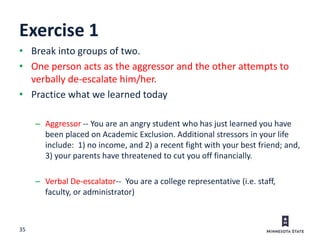
Exercise 1
• Break into groups of two.
• One person acts as the aggressor and the other attempts to
verbally de-escalate him/her.
• Practice what we learned today
– Aggressor -- You are an angry student who has just learned you have
been placed on Academic Exclusion. Additional stressors in your life
include: 1) no income, and 2) a recent fight with your best friend; and,
3) your parents have threatened to cut you off financially.
– Verbal De-escalator-- You are a college representative (i.e. staff,
faculty, or administrator)
36
Exercise 2
• Break into groups of two.
• One person acts as the aggressor and the other attempts to
verbally de-escalate him/her.
• Practice what we learned today.
– Aggressor -- You are a student-athlete who just flunked your mid-term
exam and became “ineligible.”
– Verbal De-escalator-- You are the faculty member who gave the failing
grade.
37
Final Thoughts
• Do pursue medical treatment for any physical
injuries.
• Do pursue counseling for post-traumatic stress and
fear resulting from the incident.
• Do discuss the situation with involved faculty/staff to
brainstorm ways to avoid or address similar
situations in the future.
• Steps must be taken to prevent other similar
situations from occurring. This may include the
adoption of new policies and/or an action plan.
• This will also help with regaining a sense of control.
38
THANK YOU
30 East 7th Street
St. Paul, MN 55101
651-201-1800
888-667-2848
MINNESOTA STATE IS AN EQUAL OPPORTUNITY EMPLOYER AND EDUCATOR

2019 de-escalation training

  • 1.
    Tuesday, January 7,2020 Bemidji State University Verbal De-escalation Mr. Tracy Worsley, MA Security and Emergency Preparedness Specialist
  • 2.
    2 What Will BeDiscussed • Techniques to calm a distressed individual • Techniques to maintain a safe environment • Increased self-awareness of body language and vocal tone • How to display empathy • Techniques to avoid escalating
  • 3.
    3 What Will NotBe Discussed • Hostage negotiation skills • How to break-up fights • Physical intervention techniques • Judo take-downs • Techniques for use with out of control or violent students
  • 4.
    4 Physical Threat • Howdo you KNOW when you are being physically threatened? • YOU WILL FEEL IT! TRUST YOUR INSTINCTS
  • 5.
    5 What is VerbalDe-escalation • It’s what we do during a potentially dangerous, or threatening, situation in an attempt to prevent a person from causing harm to us, themselves, or others • Without specialized training, we should never consider the use of physical force. • Verbal De-escalation consists of tactics to help limit the number of staff who might be injured on the job.
  • 6.
    6 Basic De-escalation • Goal-De-escalation of anger by reducing the excitability of the individual, enabling discussion • Self-Assessment- Am I in the right mindset to perform an intervention? • We are driven by fight, flight, or freeze when scared. In de- escalation we must appear centered and calm when terrified. • De-escalation practices must be practiced so that they can become “second nature” to us in a potentially volatile situation.
  • 7.
    7 Basic De-escalation • SimpleListening- Listening attentively without speaking and providing “encouragers”. • Active Listening- Process of attempting to hear, acknowledge, and understand what a person is saying. • This includes empathizing with the other person, giving choices, and setting limits. Make sure that you are not doing anything other than listening. Multi-tasking is not listening! • Acknowledgment- Occurs when you legitimately understand the individual’s angry emotion.
  • 8.
    8 Effective De-escalation • Toverbally de-escalate another person, you must open as many clear lines of communication as possible. • Both you and the other person must listen to each other and have no barriers. • Barriers to communication are the things that keep the meaning of what is being said from what is being heard.
  • 9.
    9 Barriers to EffectiveDe-escalation • Pre-judging • Non-listening • Criticizing • Name-calling • Engaging in power struggles • Ordering • Threatening • Minimizing • Arguing
  • 10.
    10 Positive De-escalation • Usepositive and helpful statements such as: “I want to help you.” “Please tell me more so that I can better understand how to help you.” “Let’s call Mr. Smith… I know he would be able to help with this…” “Dr. Jones handles this for our college; let’s ask him what he thinks about this Situation… He is always willing to help!” • Place yourself on his/her side in finding a solution to the problem
  • 11.
    11 Positive De-escalation • Rememberthat safety is your primary concern. • Do not attempt to interpret the individual’s feelings in an analytical way. • Empathize with the feelings, but not the behavior • Do not argue or try to convince the individual • Do not answer abusive or insulting questions
  • 12.
    12 Positive De-escalation • Don’tbe judgmental • Do NOT ignore the person or pretend to be paying attention • Listen to what the person is really saying • Re-state the message • Clarify the message • Validate- “I understand why… “)Not in agreement with…) • Try to establish rapport with the other person
  • 13.
    13 Body Language Basics •80-90% of our conversation is non-verbal. It is very important to be able to identify exactly what we are communicating to others non-verbally. • In your efforts to de-escalate the situation, your body language could indicate a willingness to get physical. • It is just as important to recognize the “non- verbals” of the person we are dealing with
  • 14.
    14 Body Language 101 •When people are angry, they don’t always “listen” to the words being said but react to what you are “saying” with your body. • Remember the difference between “hearing” and “listening”. • You must always be careful with the message you are sending. How you behave is just as important as what you say in a threatening situation.
  • 15.
    15 Body Language 201 •Finger pointing may be perceived as accusing or threatening. Minimize “talking” with your hands. • Shoulder shrugging could be perceived as uncaring or unknowing • Rigid walking may seem challenging • Clenched teeth could be perceived as closed minded and/or not willing to listen to his/her story • A natural smile is good. A fake smile can aggravate the situation. • Use slow or deliberate movements- quick actions might alarm the other person
  • 16.
    16 Body Language 301 •The eyes have it! – Drooping or rolling = “I can’t be bothered.” – Raised eyebrow = “I don’t believe you.” – Eyes open wide = “I am shocked and lack a plan.” – A unwavering stare = “I am angry with you and may act on it.” – Eyes looking up = “I can’t wait for you to stop talking.” – Closing eyes longer than normal = “Are you talking? Because I can’t hear you.” or “I am planning a distraction.” (This may be a signal that you are going to escalate the situation!) • What are your eyes conveying – What are their eyes saying?
  • 17.
    17 Body Language 401 Whatare you conveying through personal space (or lack thereof)? Note: Personal space =1.5 to 3 feet -- far enough so you cannot be hit or kicked! • Face-to-face: Seen as invasive and lacking respect for the other individual. Will increase anxiety. • Touching: Could be construed as an aggressive act. – Pat on or touching the back = A will to control the person. – Pat on the head = Condescending and patronizing. – Touch on the shoulder or arm = Possibly controlling, asserting authority and dominance. • Unusually far distance: Could be construed as fear or intention to act aggressively. – While it is important to maintain enough distance to avoid becoming a physical target, too much distance could be equated with fear and possibly engender increased aggressiveness. – Maintain an appropriate distance so as to convey confidence and a sense of calm. – Of course if the individual has a weapon, personal space is irrelevant. STAY SAFE!
  • 18.
    18 The Voice Be cognizantof what you say and how you say it! • Tone – A stern voice will convey confidence but possibly aggression. Be firm but understanding. – A timid/wavering voice will convey fear and lack of self-assurance. – A lowered voice level may connote anger and agitation. – A raised voice may set a tone of anticipation or uncertainty which may cause unnecessary excitement. • Volume – A loud or overpowering voice may convey authority and unwillingness to hear the other person. – A soft or unassuming voice may convey docility and possibly fear. • Rate of speech – Slow but rhythmic speech is typically seen as soothing. – A controlled voice is one that is both calm and firm and promotes confidence in both parties. • Polite factor – Always be respectful to the other person. No name calling. Avoid “you people” even if you’re referring to a specific group (e.g. a particular class section, organization) – Using “please” and “thank-you” -- “Mr” or “Ms” indicates respect.
  • 19.
    19 The Voice Be cognizantof what you say and how you say it! What are we REALLY saying? “I didn’t say you were stupid.” • I didn’t say you were stupid. (Someone else did and I heard it!) • I didn’t say you were stupid. (But I obviously think that!) • I didn’t say you were stupid. (I said other people are stupid!) • I didn’t say you were stupid. (I said you were a complete idiot!)
  • 20.
    20 Boil It Down •Listen – – Really listen so that you can understand what is at the heart of the conflict! • Show that you Listened by Validating - – “I understand why you might be upset.” (This does not indicate that you agree with them.) – Often validation of feelings is what the irritated individual is looking to receive. • Remain Calm – – Avoid overreaction in what you say and how you say it. – Be cognizant of body language. • Maintain a Sense of Order- – Remove onlookers -- or relocate to a safer place. (Onlookers can sometimes take up the role of “cheerleaders” or become additional victims.) – Send an onlooker for help or speed dial the police/security if you can! – Sometimes having an audience will place pressure on the aggressor to “save face” and “win” the dispute. • Anticipate Problems- – Watch for non-verbal cues or threats. – Recognize possible signs of drug influence. • Get Help! – Bring in another trained person to assist whenever possible. – Two individuals working together to calm an aggressor is better than one. An aggressor may loosen his/her stance if outnumbered. – Don’t forget to speed dial the police/security!
  • 21.
    21 One More Thing– Call for HELP! • This workshop is designed to help you to de-escalate a potentially dangerous situation NOT intervene in an altercation. You should always… – Alert someone else as soon as possible. (No help will arrive until someone else knows your situation. If you can’t get to your phone, yell or raise your voice so someone will know that this is not a normal conversation. – We do not advise that you take the opportunity to practice your attack skills. This opens the door for injury to you, the aggressor, or innocent bystanders, as well as potential legal troubles. You should, however, protect yourself if physically threatened or assaulted. • REMEMBER: – There is safety in numbers. – It will be beneficial to have a witness, if the situation worsens and someone is injured.
  • 22.
    22 One More Thing– Follow-Up  Report the situation (even if minor), both verbally and in writing, to your superior as soon as possible.  Minor situations can be a “cry for help”  Minor situations could also be a warning for future problems or potentially major situations.  Documentation will be crucial when evaluating “patterned” events.  After any confrontation, (and once the dust has settled) gently advise or direct the person to counseling, if possible.  Behavioral problems that are indicative of distress should also be reported to the EGC Behavior Intervention Team, HR, supervisor, security, co-workers, etc.
  • 23.
    23 What NOT TODO • Avoid becoming emotionally involved or taking accusations or name calling personally. – The aggressor is TRYING to get under your skin. Recognize this and control your emotions at all times. • Avoid engaging in power struggles. – Often people become agitated because they feel powerless. Throwing your power in his/her face could escalate the aggression. • Avoid becoming rigid in your process. – Be flexible and understanding. Treat the person as an individual. • Avoid telling the other person that you “know how he or she feels.” – Remember the person wants validation not a patronizing, let’s-get-this-over-with attitude. – Save your relatable stories for another time but DO offer advice when appropriate. • Avoid raising your voice, cussing, making threats, and giving ultimatums or demands. – Fight-or-flight, which is our body’s natural response to any threat, may lead you to respond in-kind to the threatening person. Resist this urge so that you avoid an escalation of the problem. • Do not attempt to intimidate a hostile person. – This includes intimidation in your words, how you speak, or body language.
  • 24.
    24 Discussion Questions (1) “Afemale student in a LS class who often comes in 10 minutes late or often doesn’t come at all. Student came to class tardy, sat down, and began to text someone in class. The instructor observed the texting and reminded her that using a cell phone in class is against the rules. The student responded by saying that she was texting her husband who is in Iraq. The teacher responded by saying that she understood that she wanted to communicate with him, but not during class. The student continued to text for a while and the instructor proceeded with the lecture. The student got up and “stormed” out of class. What would you do?” (2) “A disruptive student who is asked to leave class. What is the best way to address this? What do you do if the student causes a scene or resists?” (3) “Two students begin a verbal argument during class that appeared as though it would turn physical within seconds. As the instructor how would you intervene?”
  • 25.
    25 • Explosive • Antisocial •Passive Aggressive • Narcissistic • Paranoid • Litigious • Compulsive SEVEN STUDENTS
  • 26.
    26 • Characteristics – Shouting –Use profanity – Engage in bullying – Make veiled or explicit threats – Interrupt lectures with loud and abusive remarks • Response – Safety First – Ask student to quiet down, return to seat, or leave – If student persists, dismiss class and contact security/police – Document Incident and send to designated dean or judicial affairs office/BIT Team – Prior warning required by due process EXPLOSIVE STUDENT
  • 27.
    27 • Characteristics – Engagesin cheating, stealing, forging documents, exploiting other people or physically hurting others or worse – Exploit your good qualities as weaknesses and vulnerabilities – Seung-Hui Cho • Response – Employ honor codes – Define ‘plagiarism” and behavioral expectations in syllabus – Make penalties proportionate and apply them to all students in equal measure – Document Incident and send to designated dean or judicial affairs office/BIT Team – Prior warning required by due process ANTISOCIAL STUDENT
  • 28.
    28 • Characteristics – Behaviorappears passive and compliant but contains strong elements of defiance and dissention – Habitual lateness with a never ending string of excuses • Response – Poor attendance and lateness • Strict rules and adverse consequences usually improves this • Keep Records; mention in syllabus – Sleeping in class • Rude and unacceptable • Ask to discuss after class – rule out medical issues • Warn they will be asked to leave immediately if caught again – Procrastination • Act of defiance, usually unconscious, unintentional • Discussing may motivate some • Mention campus counseling service as a resource • Give periodic unscheduled quizzes • Compliment when they submit assignments and keep up with readings PASSIVE AGGRESSIVE STUDENT
  • 29.
    29 • Characteristics – Arrogance,self-centeredness, self-entitlement, noticeable tendency to devalue or denigrate others – Disinclined to respect others boundaries – Walk on others an monopolize class time • Response – Remember: You were hired because of your qualifications – Do not answer personal questions unless doing so provides a relevant and positive contribution – Self-entitled students do not respect boundaries-safeguard privacy with your own boundaries NARCISSISTIC STUDENT
  • 30.
    30 • Characteristics – Tendto be highly suspicious of others – Likely to level unfounded accusations of wrongdoing – Feel persecuted or picked on – Blame own limitations and failures on others – May harass instructors with constant emails or phone calls making unreasonable demand • Response – Not in your job description to put up with bullying, intimidation, or any violence implied or actual – Constitutes a disruptive student – Document Incident and send to designated dean or judicial affairs office/BIT Team – Prior warning required by due process PARANOID STUDENT
  • 31.
    31 • Characteristics – Preparedto file a lawsuit at the drop of a hat –parents too • Response – Follow due process procedures – Issue warnings, verbally and in writing – Cite Code of Conduct and possible consequences – Allow them to contest allegations in a hearing LITIGIOUS STUDENT
  • 32.
    32 • Characteristics – Preoccupiedwith orderliness and perfectionism – Will exert considerable emotional energy in an effort to control others – Constantly check for mistakes and imperfections in their instructor – Inflexible about rules and moral principles – Extremely critical and intolerant of others opinions and behaviors • Response – Feel free to remain imperfect – Remind them that you are a qualified instructor and expect to be treated with dignity and respect – Again, setting standards of behavior and conduct in the syllabus is usually pre-emptive. COMPULSIVE STUDENT
  • 33.
    33 Discussion Questions (4) “Itis August and financial aid refunds are being distributed. A male student walked up to a financial aid Counselor’s desk and put his hands on the desk and leaned over into the Counselor’s face looking into her eyes and saying with a stern voice, “I need my money.” Nothing further was said. The Counselor looked up the information for the student to discuss the status of his aid and provided this information. The situation did not escalate beyond this. What would you have done?” (5) “A male student walked in and stood about 4 feet behind the financial aid counter computer and just standing there staring ahead without uttering a word. The employee asked if he needed any help and the student ignored the question. A second employee asked twice if he needed help, and the student responded, “I’m supposed to have my money and I don’t have it.” The financial aid assistant director spoke to the student and resolved the issue with the financial aid. What would you have done?”
  • 34.
    34 Discussion Questions (6) “Amother of a student whose Higher one account has been compromised. She contacts the Business Office frustrated about the matter. It turns out that someone in Texas has managed to get the student’s information and “charge” quite a bit to the account. The mother is having a hard time getting this matter resolved with Higher One. She is in the process of going through their charge dispute process and it takes some time which is really frustrating her. This is the 2nd time that she has called EGC about this matter. She believes that EGC’s system has been hacked and that the Business Office should follow up on this even though the Business Office representative has advised her repeatedly that Higher One’s system (not EGC’s) has been hacked. What would you do?” (7) “An instructor is requesting information relating to gangs (how our local gang members dress, the name of any gangs, etc.).” How should one respond?
  • 35.
    35 Exercise 1 • Breakinto groups of two. • One person acts as the aggressor and the other attempts to verbally de-escalate him/her. • Practice what we learned today – Aggressor -- You are an angry student who has just learned you have been placed on Academic Exclusion. Additional stressors in your life include: 1) no income, and 2) a recent fight with your best friend; and, 3) your parents have threatened to cut you off financially. – Verbal De-escalator-- You are a college representative (i.e. staff, faculty, or administrator)
  • 36.
    36 Exercise 2 • Breakinto groups of two. • One person acts as the aggressor and the other attempts to verbally de-escalate him/her. • Practice what we learned today. – Aggressor -- You are a student-athlete who just flunked your mid-term exam and became “ineligible.” – Verbal De-escalator-- You are the faculty member who gave the failing grade.
  • 37.
    37 Final Thoughts • Dopursue medical treatment for any physical injuries. • Do pursue counseling for post-traumatic stress and fear resulting from the incident. • Do discuss the situation with involved faculty/staff to brainstorm ways to avoid or address similar situations in the future. • Steps must be taken to prevent other similar situations from occurring. This may include the adoption of new policies and/or an action plan. • This will also help with regaining a sense of control.
  • 38.
    38 THANK YOU 30 East7th Street St. Paul, MN 55101 651-201-1800 888-667-2848 MINNESOTA STATE IS AN EQUAL OPPORTUNITY EMPLOYER AND EDUCATOR