Dealing Positively with  Difficult People DeAnne Heersche The Service Center at ClearWater
Who are these difficult people and why are they attacking me? They may be behaving this way because they feel victimized (unfairness, mistreatment, misunderstandings) They may believe the world is bad and thus make concerted efforts to prove everyone else is unfair – including YOU May be insensitive to the feelings of others It is NOT just YOU!!!!!!
Mental States Child – immature individuals of any age, dependent on others for rescue, assistance, and direction. Parent – willing to give advice, rescue the child, or provide direction (to child or school) Persecutor – finds fault with every solution as a method of retaining control over the situation
Appropriate Mental State Adult – a dispassionate analytic facilitator.  Works with the parent and the child to find direction and resolution.
Ten Management Options Ignore the negative behavior Give in Separate yourself Try to understand the other viewpoint Sympathize
Ten Management Options 6.  Make personal changes Make system changes Stay detached emotionally Discussion/Mediation Maintain personal dignity
Being Right Does it really matter who is right? Can you know you are right without having to prove it to someone else?  Or everyone else?
Why Bother Controlling Our Emotions? Holding a grudge only hurts ourselves It’s not about you – it’s about them Battle of the ego Anger feeds anger
Why Bother Controlling Our Emotions? Anger is a waste of energy Negativity spreads Everyone has the right to Freedom of Speech – but not everyone has the ability for eloquent expression
Be the Honey Pot People will come to you to calm down rather than to heat up Your reputation as a good listener will spread You’ll learn a whole lot more!
Listening Skills The Listening Cycle 1.  Hear the message 2.  Think about the message 3.  Respond to the message
Listening Skills Listen to the speaker’s words How not to hear a speaker’s message Listen beyond the words Think about the speaker’s message Respond to the speaker’s message How not to respond to a speaker’s message Use active listening
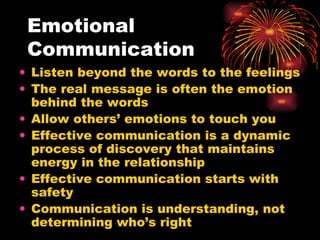
Emotional Communication Listen beyond the words to the feelings The real message is often the emotion behind the words Allow others’ emotions to touch you Effective communication is a dynamic process of discovery that maintains energy in the relationship Effective communication starts with safety Communication is understanding, not determining who’s right
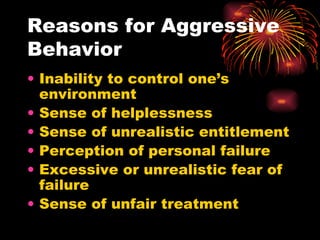
Reasons for Aggressive Behavior Inability to control one’s environment Sense of helplessness Sense of unrealistic entitlement Perception of personal failure Excessive or unrealistic fear of failure Sense of unfair treatment
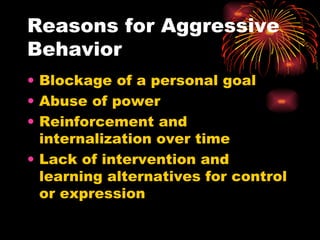
Reasons for Aggressive Behavior Blockage of a personal goal Abuse of power Reinforcement and internalization over time Lack of intervention and learning alternatives for control or expression
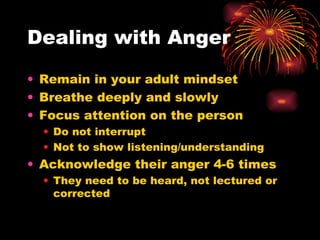
Dealing with Anger Remain in your adult mindset Breathe deeply and slowly Focus attention on the person Do not interrupt Not to show listening/understanding Acknowledge their anger 4-6 times They need to be heard, not lectured or corrected
Dealing with Anger Lower your voice.  Speak slowly and reduce the volume Don’t say “I understand how you feel.”  Instead, say that you understand he/she is angry Get them to explain the concern Watch for escalation of anger Remember – you did not cause this behavior
Signs of Escalating Emotion Behavior Scattered thinking Swearing Belligerence
Signs of Escalating Emotion Body Language Little eye contact or staring Head down Eyebrow frown Drying mouth Clenched teeth Sweating Breathing is shallow and fast Face red with anger
Signs of Escalating Emotion Verbal Questioning Refusal Verbal Release Intimidation
In a Dangerous Situation Demonstrate a sense of respect and interest in their needs Paraphrase or repeat statements Ask for clarification Nod and demonstrate understanding Take notes Show interest – not judgment Read the notes aloud to ensure accuracy
In a Dangerous Situation Ask for further detail Summarize from time to time Show empathy (If that happened to me, I’d be angry, too)
Other Reactive Behaviors Maintain a pleasant, courteous demeanor and interaction style Acknowledge anger but do not reply in kind Show interest and concern Choose responses carefully.  Avoid criticism.
Other Reactive Behaviors Challenge within a comfort zone.  Focus on the behavior and not the position the individual has taken. Recognize the resistance to change and indicate you understand the reasons for it. Lose the Battle – Win the War – Listen to all of the reasons for resistance.  Ascertain whether there is any point of agreement. Be patient.  Maintain dignity.
Things You Could Say “ You might want to back up.  If I breathe on you, you’ll be sick for a month.” “ Thank you for sharing your concerns with me.” “ I don’t have the answer to that, but I will get the information for you.” “ We made a mistake; I apologize.  What can we do to put it right?”
Things You Could Say “ What can we do to work this out together?” “ What do you think should be done?” “ I’m not here to add to your concerns, I want to be part of the solution.” “ Your idea is an excellent one so let’s do it your way.” “ Her is what I can do…”
Things to Avoid Correcting minor factual errors Interrupting unless to clarify – wait for a break in the conversation Changing subjects without notice or permission Focusing on things that cannot be changed
Things to Avoid Complaining about your agenda Showing your own anger Starting to answer before the person is finished.
School Behaviors that Might  Lead to Aggression Failure to communicate concerning policies, regulations, and procedures Failure to respond to complaints or issues in a timely manner Failure to tell the truth when a staff member is wrong
School Behaviors that Might  Lead to Aggression Failure to apologize when a staff member is wrong Treating parents or students in a condescending manner Unprofessional treatment or discussion of children
Three Really Useful Attitudes Enthusiasm Curiosity Humility
Three Really Useless Attitudes Sarcasm Arrogance Embarrassment
Personal Reflection What steps will I take the next time I am involved in a difficult situation? How can I help diffuse a potential situation? What will I do to keep from creating difficult situations?
The Importance  of Attitude The longer I live, the more I realize the impact of attitude on life. Attitude is more important than the past, than education, than money, than circumstances, than failures, than successes, than what other people think or say or do.
The Importance  of Attitude It is more important than appearance, giftedness, or skill.  It will make or break a company . . . a church . . . a home.  The remarkable thing is we have a choice every day regarding the attitude we embrace for the day.
The Importance  of Attitude We cannot change our past . . . we cannot change the fact that people will act a certain way.  We cannot change the inevitable.  The only thing we can do is play the one string we have, and that is our attitude.
The Importance  of Attitude I am convinced that life is 10% what happens to me and 90% how I react to it.  And so it is with you . . . we are in charge of our attitude. Charles Swindoll

Dealing with Difficult People

  • 1.
    Dealing Positively with Difficult People DeAnne Heersche The Service Center at ClearWater
  • 2.
    Who are thesedifficult people and why are they attacking me? They may be behaving this way because they feel victimized (unfairness, mistreatment, misunderstandings) They may believe the world is bad and thus make concerted efforts to prove everyone else is unfair – including YOU May be insensitive to the feelings of others It is NOT just YOU!!!!!!
  • 3.
    Mental States Child– immature individuals of any age, dependent on others for rescue, assistance, and direction. Parent – willing to give advice, rescue the child, or provide direction (to child or school) Persecutor – finds fault with every solution as a method of retaining control over the situation
  • 4.
    Appropriate Mental StateAdult – a dispassionate analytic facilitator. Works with the parent and the child to find direction and resolution.
  • 5.
    Ten Management OptionsIgnore the negative behavior Give in Separate yourself Try to understand the other viewpoint Sympathize
  • 6.
    Ten Management Options6. Make personal changes Make system changes Stay detached emotionally Discussion/Mediation Maintain personal dignity
  • 7.
    Being Right Doesit really matter who is right? Can you know you are right without having to prove it to someone else? Or everyone else?
  • 8.
    Why Bother ControllingOur Emotions? Holding a grudge only hurts ourselves It’s not about you – it’s about them Battle of the ego Anger feeds anger
  • 9.
    Why Bother ControllingOur Emotions? Anger is a waste of energy Negativity spreads Everyone has the right to Freedom of Speech – but not everyone has the ability for eloquent expression
  • 10.
    Be the HoneyPot People will come to you to calm down rather than to heat up Your reputation as a good listener will spread You’ll learn a whole lot more!
  • 11.
    Listening Skills TheListening Cycle 1. Hear the message 2. Think about the message 3. Respond to the message
  • 12.
    Listening Skills Listento the speaker’s words How not to hear a speaker’s message Listen beyond the words Think about the speaker’s message Respond to the speaker’s message How not to respond to a speaker’s message Use active listening
  • 13.
    Emotional Communication Listenbeyond the words to the feelings The real message is often the emotion behind the words Allow others’ emotions to touch you Effective communication is a dynamic process of discovery that maintains energy in the relationship Effective communication starts with safety Communication is understanding, not determining who’s right
  • 14.
    Reasons for AggressiveBehavior Inability to control one’s environment Sense of helplessness Sense of unrealistic entitlement Perception of personal failure Excessive or unrealistic fear of failure Sense of unfair treatment
  • 15.
    Reasons for AggressiveBehavior Blockage of a personal goal Abuse of power Reinforcement and internalization over time Lack of intervention and learning alternatives for control or expression
  • 16.
    Dealing with AngerRemain in your adult mindset Breathe deeply and slowly Focus attention on the person Do not interrupt Not to show listening/understanding Acknowledge their anger 4-6 times They need to be heard, not lectured or corrected
  • 17.
    Dealing with AngerLower your voice. Speak slowly and reduce the volume Don’t say “I understand how you feel.” Instead, say that you understand he/she is angry Get them to explain the concern Watch for escalation of anger Remember – you did not cause this behavior
  • 18.
    Signs of EscalatingEmotion Behavior Scattered thinking Swearing Belligerence
  • 19.
    Signs of EscalatingEmotion Body Language Little eye contact or staring Head down Eyebrow frown Drying mouth Clenched teeth Sweating Breathing is shallow and fast Face red with anger
  • 20.
    Signs of EscalatingEmotion Verbal Questioning Refusal Verbal Release Intimidation
  • 21.
    In a DangerousSituation Demonstrate a sense of respect and interest in their needs Paraphrase or repeat statements Ask for clarification Nod and demonstrate understanding Take notes Show interest – not judgment Read the notes aloud to ensure accuracy
  • 22.
    In a DangerousSituation Ask for further detail Summarize from time to time Show empathy (If that happened to me, I’d be angry, too)
  • 23.
    Other Reactive BehaviorsMaintain a pleasant, courteous demeanor and interaction style Acknowledge anger but do not reply in kind Show interest and concern Choose responses carefully. Avoid criticism.
  • 24.
    Other Reactive BehaviorsChallenge within a comfort zone. Focus on the behavior and not the position the individual has taken. Recognize the resistance to change and indicate you understand the reasons for it. Lose the Battle – Win the War – Listen to all of the reasons for resistance. Ascertain whether there is any point of agreement. Be patient. Maintain dignity.
  • 25.
    Things You CouldSay “ You might want to back up. If I breathe on you, you’ll be sick for a month.” “ Thank you for sharing your concerns with me.” “ I don’t have the answer to that, but I will get the information for you.” “ We made a mistake; I apologize. What can we do to put it right?”
  • 26.
    Things You CouldSay “ What can we do to work this out together?” “ What do you think should be done?” “ I’m not here to add to your concerns, I want to be part of the solution.” “ Your idea is an excellent one so let’s do it your way.” “ Her is what I can do…”
  • 27.
    Things to AvoidCorrecting minor factual errors Interrupting unless to clarify – wait for a break in the conversation Changing subjects without notice or permission Focusing on things that cannot be changed
  • 28.
    Things to AvoidComplaining about your agenda Showing your own anger Starting to answer before the person is finished.
  • 29.
    School Behaviors thatMight Lead to Aggression Failure to communicate concerning policies, regulations, and procedures Failure to respond to complaints or issues in a timely manner Failure to tell the truth when a staff member is wrong
  • 30.
    School Behaviors thatMight Lead to Aggression Failure to apologize when a staff member is wrong Treating parents or students in a condescending manner Unprofessional treatment or discussion of children
  • 31.
    Three Really UsefulAttitudes Enthusiasm Curiosity Humility
  • 32.
    Three Really UselessAttitudes Sarcasm Arrogance Embarrassment
  • 33.
    Personal Reflection Whatsteps will I take the next time I am involved in a difficult situation? How can I help diffuse a potential situation? What will I do to keep from creating difficult situations?
  • 34.
    The Importance of Attitude The longer I live, the more I realize the impact of attitude on life. Attitude is more important than the past, than education, than money, than circumstances, than failures, than successes, than what other people think or say or do.
  • 35.
    The Importance of Attitude It is more important than appearance, giftedness, or skill. It will make or break a company . . . a church . . . a home. The remarkable thing is we have a choice every day regarding the attitude we embrace for the day.
  • 36.
    The Importance of Attitude We cannot change our past . . . we cannot change the fact that people will act a certain way. We cannot change the inevitable. The only thing we can do is play the one string we have, and that is our attitude.
  • 37.
    The Importance of Attitude I am convinced that life is 10% what happens to me and 90% how I react to it. And so it is with you . . . we are in charge of our attitude. Charles Swindoll