Who’s Lying? Detecting
Deception Using the
Cognitive Interview in
Workplace
Investigations
Michael W. Johnson, J.D.
Clear Law Institute
mjohnson@ClearLawInstitute.com
(703) 372-0550
www.ClearLawInstitute.com
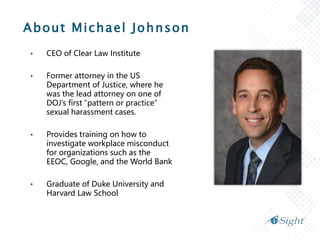
About Michael Johnson
• CEO of Clear Law Institute
• Former attorney in the US
Department of Justice, where he
was the lead attorney on one of
DOJ’s first “pattern or practice”
sexual harassment cases.
• Provides training on how to
investigate workplace misconduct
for organizations such as the
EEOC, Google, and the World Bank
• Graduate of Duke University and
Harvard Law School
Overview
• Research relating cues to deception
• What scientist have found are the best ways to
interview witnesses to ensure that you:
 Gather the most information, and
 Best assess credibility
Assessing Credibility
How good are you at detecting
deception and truthfulness?
I believe I can correctly identify if a person is lying
or telling the truth the following percentage of time:
a. 25%
b. 50%
c. 75%
d. 90%
e. 100%
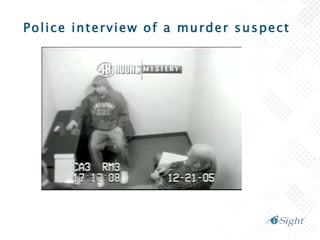
Police interview of a murder suspect
Select all that apply—On average,
liars are more likely than truth
tellers to:
a. Avoid eye contact
b. Become fidgety
c. Increase their blink rate
d. Look up and to the right
Examining “cues to deception”
• We tend to pay attention to “cues to deception” that
have not been scientifically validated and are not
reliable predictors of lying
• Three factors that impact how people may behave
when lying
 Emotion
 Cognitive effort
 Attempted impression management
Liars are NOT more likely than
truth tellers to:
a. Avoid eye contact (DePaulo 2003, Mann 2012 and
2013)
b. Become fidgety (Mann 2002)
c. Increase their blink rate (Leal & Vrij, 2008)
d. Look up and to the right (Porter 2012)
How well does the average person
spot lies?
• The average person can correctly spot what
percentage of lies? (Bond & DePaulo 2006)
• Average person does better at spotting lies by
just hearing the person or by both hearing and
seeing the person’s face? (Leach 2016)
• Observers tend to focus on demeanor, but it’s a
poor predictor of truthfulness (Levine 2011)
• Focus on listening instead of looking
Difference when lying versus telling
the truth
• Length of time speaking
• Level of detail
• Use of passive voice
• Use of pronouns
• Equivocations/Qualifiers
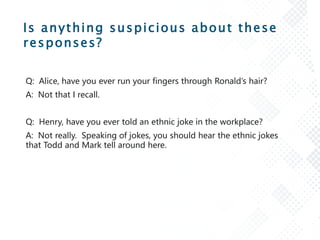
Q: Alice, have you ever run your fingers through Ronald’s hair?
A: Not that I recall.
Q: Henry, have you ever told an ethnic joke in the workplace?
A: Not really. Speaking of jokes, you should hear the ethnic jokes
that Todd and Mark tell around here.
Is anything suspicious about these
responses?
Interviewing Strategies
Interviewing Style
• Primary goal is to get the person to talk
• Journalist, not a prosecutor at trial
• Be suspicious, but don’t show your suspicion
Cognitive Interview (“CI”)
• The CI is the most widely researched investigative
interviewing technique in the world
• Obtains around 50% more detail than standard interview
techniques
• Shown to make it easier to spot deception
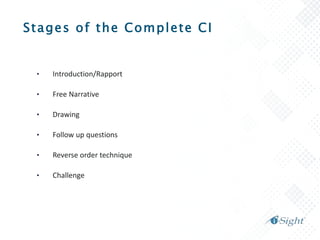
Stages of the Complete CI
• Introduction/Rapport
• Free Narrative
• Drawing
• Follow up questions
• Reverse order technique
• Challenge
Introduction/rapport building
• Start with casual conversation on non-
threatening topics
Free Narrative
• “Please tell me everything you can and give me as
much detail as possible.”
Length of Response and Amount of
Detail
• In response to a request for a narrative answer, liars tend
to provide a bare-bones account with little detail (Colwell
2007)
Request for drawing
• “Now that you’ve told me what happened, I’d like you
to draw the event. Drawing the event can give you
another opportunity to recall details that you may have
forgotten. It can also help me get a better
understanding of exactly what happened.”
Drawings can be hard for those who
are being deceptive
• Drawings give truth tellers another opportunity to tell
the story and display what occurred, which often results
in additional details
• Compared to truth-tellers, liars tend to:
 Provide few, if any, additional details in the
drawing
 Have greater difficulty in making the drawing
 Display more inconsistencies between their
previously provided verbal free narrative and
the drawing (Vrij 2009)
Follow-up questioning
• Ask for clarification and elaboration
 Liars typically do not elaborate or offer
additional details (Colwell 2007)
Sensorial Details
• Can ask about sensorial details, which are more difficult
for liars to make up
 “Take a moment and think about the event
again. Is there anything else you may have
seen, heard, or felt during this experience?”
• Liars provide fewer perceptual details that can be
verified than truth tellers (Nahari 2014).
Reverse-order technique
• “We are going to try something that sometimes
helps people remember more details. I’d like you
to tell me what happened, but this time start
from the end and go to the beginning.”
• Truth tellers provide more detail
Reverse-order technique
• Research shows that deceptive persons have
unusual difficulty telling their fabricated stories
backwards
• Studies have shown that people are better able to
spot deception when person is required to tell
story in reverse order (Evans 2013)
Reverse order study
• Half of participants instructed to tell what they did in
reverse order
• % of lies accurately detected
 Control: 18%
 Reverse order: 75%
Try to ask unexpected questions
• If you ask an unexpected question and the
person is lying, the person will have to make up a
story on the spot.
• Come back to the topic later in the interview
• Unexpected questions can be useful where you
have two people giving a joint alibi and they are
being interviewed separately (Vrij 2009)
• Look especially for inconsistencies relating to
time and space
Results from a study with two
people giving a joint alibi
• On the basis of consistency of the answers to:
 Spatial questions, 80% of liars could be
correctly classified
 Drawings, 75% of liars could be correctly
classified (Vrij 2009)
Other credibility issues to address
• Motive to lie
• Corroboration
Challenge Stage
• Don’t challenge the person until the very end
• Remain respectful, even soft-spoken
Direct Challenge at the very end
• Example: “I think that you have not been truthful with
me”
• Liars tend to not provide additional information. Instead,
they may deflect an answer with responses like, “I’m sorry
you don’t believe me” or “Why would I lie?” (Geiselman
2012)
• Most truthful subjects will give a firm denial and then offer
additional information to support their story (Geiselman
2012)
Study of CI’s
Effectiveness
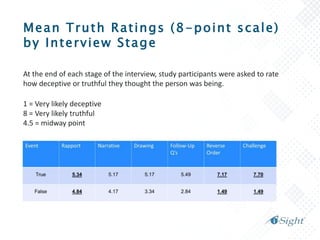
Mean Truth Ratings (8-point scale)
by Interview Stage
At the end of each stage of the interview, study participants were asked to rate
how deceptive or truthful they thought the person was being.
1 = Very likely deceptive
8 = Very likely truthful
4.5 = midway point
Summary
• Listen instead of look
• Require witness to do most of talking
• Use some or all elements of the Cognitive
Interview
About Clear Law Institute
• Online compliance training and learning
games for thousands of employers
 Sexual Harassment Training
 Workplace Violence Prevention and
Active Shooter Training
 Numerous other ethics and
compliance topics
 Cybersecurity training, monthly
microlearning modules, and
phishing tests
• Workplace investigations training for
individuals and teams
Questions?
Michael W. Johnson, J.D.
Clear Law Institute
mjohnson@ClearLawInstitute.com
(703) 372-0550
www.ClearLawInstitute.com
T h a n k Y o u f o r
P a r t i c i p a t i n g
Find more free webinars:
www.i-
sight.com/resources/webinars
@isightsoftware
C o n t a c t
M i c h a e l J o h n s o n , J . D .
C o n t a c t
i - S i g h t
webinars@i-sight.com
mjohnson@ClearLawInstitute.com
(703) 372-0550
www.ClearLawInstitute.com

Who's Lying? Using the Cognitive Interview to Assess Credibility in Workplace Investigations

  • 1.
    Who’s Lying? Detecting DeceptionUsing the Cognitive Interview in Workplace Investigations Michael W. Johnson, J.D. Clear Law Institute mjohnson@ClearLawInstitute.com (703) 372-0550 www.ClearLawInstitute.com
  • 2.
    About Michael Johnson •CEO of Clear Law Institute • Former attorney in the US Department of Justice, where he was the lead attorney on one of DOJ’s first “pattern or practice” sexual harassment cases. • Provides training on how to investigate workplace misconduct for organizations such as the EEOC, Google, and the World Bank • Graduate of Duke University and Harvard Law School
  • 3.
    Overview • Research relatingcues to deception • What scientist have found are the best ways to interview witnesses to ensure that you:  Gather the most information, and  Best assess credibility
  • 4.
  • 5.
    How good areyou at detecting deception and truthfulness? I believe I can correctly identify if a person is lying or telling the truth the following percentage of time: a. 25% b. 50% c. 75% d. 90% e. 100%
  • 6.
    Police interview ofa murder suspect
  • 7.
    Select all thatapply—On average, liars are more likely than truth tellers to: a. Avoid eye contact b. Become fidgety c. Increase their blink rate d. Look up and to the right
  • 8.
    Examining “cues todeception” • We tend to pay attention to “cues to deception” that have not been scientifically validated and are not reliable predictors of lying • Three factors that impact how people may behave when lying  Emotion  Cognitive effort  Attempted impression management
  • 9.
    Liars are NOTmore likely than truth tellers to: a. Avoid eye contact (DePaulo 2003, Mann 2012 and 2013) b. Become fidgety (Mann 2002) c. Increase their blink rate (Leal & Vrij, 2008) d. Look up and to the right (Porter 2012)
  • 10.
    How well doesthe average person spot lies? • The average person can correctly spot what percentage of lies? (Bond & DePaulo 2006) • Average person does better at spotting lies by just hearing the person or by both hearing and seeing the person’s face? (Leach 2016) • Observers tend to focus on demeanor, but it’s a poor predictor of truthfulness (Levine 2011) • Focus on listening instead of looking
  • 11.
    Difference when lyingversus telling the truth • Length of time speaking • Level of detail • Use of passive voice • Use of pronouns • Equivocations/Qualifiers
  • 12.
    Q: Alice, haveyou ever run your fingers through Ronald’s hair? A: Not that I recall. Q: Henry, have you ever told an ethnic joke in the workplace? A: Not really. Speaking of jokes, you should hear the ethnic jokes that Todd and Mark tell around here. Is anything suspicious about these responses?
  • 13.
  • 14.
    Interviewing Style • Primarygoal is to get the person to talk • Journalist, not a prosecutor at trial • Be suspicious, but don’t show your suspicion
  • 15.
    Cognitive Interview (“CI”) •The CI is the most widely researched investigative interviewing technique in the world • Obtains around 50% more detail than standard interview techniques • Shown to make it easier to spot deception
  • 16.
    Stages of theComplete CI • Introduction/Rapport • Free Narrative • Drawing • Follow up questions • Reverse order technique • Challenge
  • 17.
    Introduction/rapport building • Startwith casual conversation on non- threatening topics
  • 18.
    Free Narrative • “Pleasetell me everything you can and give me as much detail as possible.”
  • 19.
    Length of Responseand Amount of Detail • In response to a request for a narrative answer, liars tend to provide a bare-bones account with little detail (Colwell 2007)
  • 20.
    Request for drawing •“Now that you’ve told me what happened, I’d like you to draw the event. Drawing the event can give you another opportunity to recall details that you may have forgotten. It can also help me get a better understanding of exactly what happened.”
  • 21.
    Drawings can behard for those who are being deceptive • Drawings give truth tellers another opportunity to tell the story and display what occurred, which often results in additional details • Compared to truth-tellers, liars tend to:  Provide few, if any, additional details in the drawing  Have greater difficulty in making the drawing  Display more inconsistencies between their previously provided verbal free narrative and the drawing (Vrij 2009)
  • 22.
    Follow-up questioning • Askfor clarification and elaboration  Liars typically do not elaborate or offer additional details (Colwell 2007)
  • 23.
    Sensorial Details • Canask about sensorial details, which are more difficult for liars to make up  “Take a moment and think about the event again. Is there anything else you may have seen, heard, or felt during this experience?” • Liars provide fewer perceptual details that can be verified than truth tellers (Nahari 2014).
  • 24.
    Reverse-order technique • “Weare going to try something that sometimes helps people remember more details. I’d like you to tell me what happened, but this time start from the end and go to the beginning.” • Truth tellers provide more detail
  • 25.
    Reverse-order technique • Researchshows that deceptive persons have unusual difficulty telling their fabricated stories backwards • Studies have shown that people are better able to spot deception when person is required to tell story in reverse order (Evans 2013)
  • 26.
    Reverse order study •Half of participants instructed to tell what they did in reverse order • % of lies accurately detected  Control: 18%  Reverse order: 75%
  • 27.
    Try to askunexpected questions • If you ask an unexpected question and the person is lying, the person will have to make up a story on the spot. • Come back to the topic later in the interview • Unexpected questions can be useful where you have two people giving a joint alibi and they are being interviewed separately (Vrij 2009) • Look especially for inconsistencies relating to time and space
  • 28.
    Results from astudy with two people giving a joint alibi • On the basis of consistency of the answers to:  Spatial questions, 80% of liars could be correctly classified  Drawings, 75% of liars could be correctly classified (Vrij 2009)
  • 29.
    Other credibility issuesto address • Motive to lie • Corroboration
  • 30.
    Challenge Stage • Don’tchallenge the person until the very end • Remain respectful, even soft-spoken
  • 31.
    Direct Challenge atthe very end • Example: “I think that you have not been truthful with me” • Liars tend to not provide additional information. Instead, they may deflect an answer with responses like, “I’m sorry you don’t believe me” or “Why would I lie?” (Geiselman 2012) • Most truthful subjects will give a firm denial and then offer additional information to support their story (Geiselman 2012)
  • 32.
  • 33.
    Mean Truth Ratings(8-point scale) by Interview Stage At the end of each stage of the interview, study participants were asked to rate how deceptive or truthful they thought the person was being. 1 = Very likely deceptive 8 = Very likely truthful 4.5 = midway point
  • 34.
    Summary • Listen insteadof look • Require witness to do most of talking • Use some or all elements of the Cognitive Interview
  • 35.
    About Clear LawInstitute • Online compliance training and learning games for thousands of employers  Sexual Harassment Training  Workplace Violence Prevention and Active Shooter Training  Numerous other ethics and compliance topics  Cybersecurity training, monthly microlearning modules, and phishing tests • Workplace investigations training for individuals and teams
  • 36.
    Questions? Michael W. Johnson,J.D. Clear Law Institute mjohnson@ClearLawInstitute.com (703) 372-0550 www.ClearLawInstitute.com
  • 37.
    T h an k Y o u f o r P a r t i c i p a t i n g Find more free webinars: www.i- sight.com/resources/webinars @isightsoftware C o n t a c t M i c h a e l J o h n s o n , J . D . C o n t a c t i - S i g h t webinars@i-sight.com mjohnson@ClearLawInstitute.com (703) 372-0550 www.ClearLawInstitute.com