Coping With
Challenging Behaviour
Diane Hanna Snr, Consult Psych
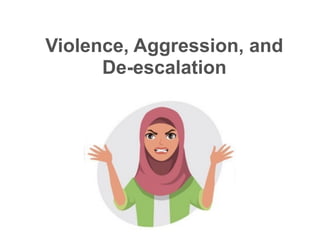
Violence, Aggression, and
De-escalation
Video
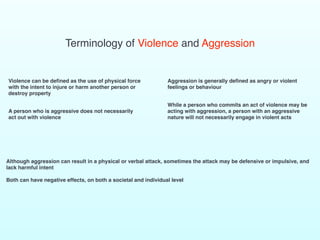
Terminology of Violence and Aggression
Violence can be defined as the use of physical force
with the intent to injure or harm another person or
destroy property
A person who is aggressive does not necessarily
act out with violence
Aggression is generally defined as angry or violent
feelings or behaviour
While a person who commits an act of violence may be
acting with aggression, a person with an aggressive
nature will not necessarily engage in violent acts
Although aggression can result in a physical or verbal attack, sometimes the attack may be defensive or impulsive, and
lack harmful intent
Both can have negative effects, on both a societal and individual level
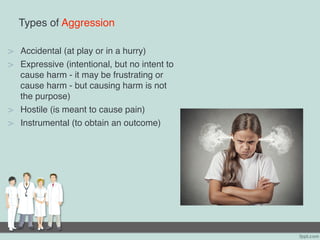
Types of Aggression
> Accidental (at play or in a hurry)
> Expressive (intentional, but no intent to
cause harm - it may be frustrating or
cause harm - but causing harm is not
the purpose)
> Hostile (is meant to cause pain)
> Instrumental (to obtain an outcome)
The role of anger in
aggression and violence:
A N G E R
Anger: an emotion
characterised by
antagonism toward
someone or something
you feel has deliberately
done you wrong (Kazdin,
A.E, 2000)
It is normal to feel angry, or
frustrated when you have
been let down or betrayed,
but anger and frustration do
not justify violent action.
Anger is a strong emotion
that can be difficult to keep
in check.
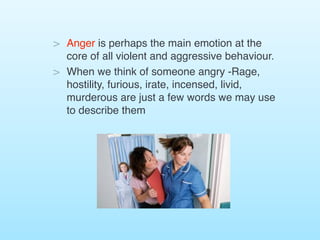
> Anger is perhaps the main emotion at the
core of all violent and aggressive behaviour.
> When we think of someone angry -Rage,
hostility, furious, irate, incensed, livid,
murderous are just a few words we may use
to describe them
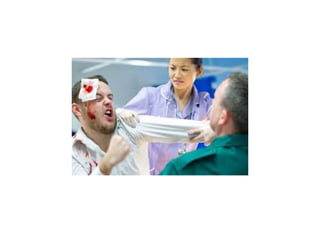
Violence is an extreme form of
aggression, such as assault, rape, or
murder.
Violence
Reasons for Violence
Expression
As a release for anger
and frustration. Some
people believe there
are no answers to their
problems and use
violence to express
their out of control
emotions.
Manipulation
Violence is a way to
control others, or used
by certain individuals as
a way to get something
they want.
Reasons people use violence:
> Retaliation
> Violence is used to
retaliate against
those who have
hurt them or
someone they care
about
> Violence is a
learned behaviour
> Like all other
learned behaviour,
it can be changed.
This is not easy. No
single cause/no
single solution.
Warning signs/help
Factors in Violence
> Static Signs
> Hx of violent/
aggressive
behaviour
> Young age at first
violent incident
> Having been a
victim of bullying
> Hx of discipline
problems/authority
problems
> Early childhood
abuse/neglect
> Having witnessed
violence at home
> Family/parent
condones use of
violence
> Hx of cruelty to
animals
> Having a major
mental illness
> Lack of
empathy for
others
> Hx of
vandalism or
property
damage
Other signs present over time/may escalate
or contribute:
Serious drug/
alcohol abuse
Gang membership/
desire to join gang
Access to or
fascination with
weapons, esp guns
Trouble controlling
feelings of anger
Withdrawal from
friends and usual
activities
Regularly feeling
rejected or alone
Feeling constantly
disrespected
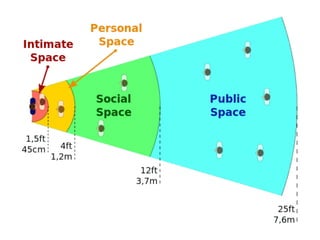
Personal space/
facial expression
New OR Active Signs:
Increased loss of temper
Frequent physical fighting
Increased use of alcohol or
drugs
Increased risk-taking behaviour/
s
Declining school performance
Acute episode of major mental
illness
Planning how to commit acts of
violence
Announcing plans/threats to hurt
others
Obtaining or carrying a weapon
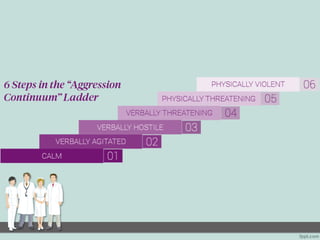
Escalation
What is it?
and what
causes it…?
VIDEO
https://youtu.be/b85Dw0R4ipg
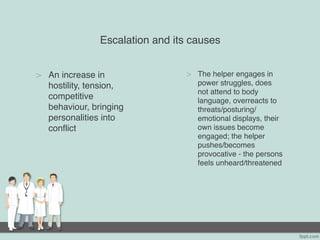
Escalation and its causes
> An increase in
hostility, tension,
competitive
behaviour, bringing
personalities into
conflict
> The helper engages in
power struggles, does
not attend to body
language, overreacts to
threats/posturing/
emotional displays, their
own issues become
engaged; the helper
pushes/becomes
provocative - the persons
feels unheard/threatened
What else could
escalate matters?
Anything else?
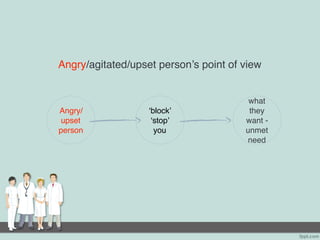
Angry/agitated/upset person’s point of view
Angry/
upset
person
‘block’
‘stop’
you
what
they
want -
unmet
need
Behavioural
Crisis
Why and when we do De-escalation
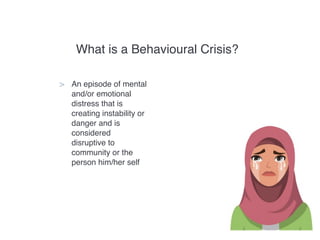
What is a Behavioural Crisis?
> An episode of mental
and/or emotional
distress that is
creating instability or
danger and is
considered
disruptive to
community or the
person him/her self
Recognising & Responding
> Mental (mental
illness? Are they
anxious? Paranoid?
Angry/confused?)
> Medical ( is there a
medical issue? Are
they hurt/injured?)
> Alcohol and or other
drugs (are they
under the influence?)
> Situational stress
(relationship/
marriage breakdown/
$/job loss/gender of
baby)
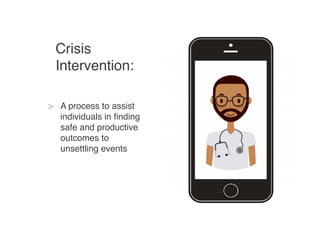
Crisis
Intervention:
> A process to assist
individuals in finding
safe and productive
outcomes to
unsettling events
De-escalation
Reduction In The Level Of
Conflict
The goal of de escalation is to
build rapid rapport and a sense of
connectedness with an agitated
person to reduce the likelihood of
escalation to physical violence.
This sense of connectedness is
established via specific verbal,
psych, and non verbal techniques
that emphasise control over ones
own emotional response to threat
while guiding communication.
De-escalation
> The 3 As of De-escalation:
> Awareness, Assessment, and Action.
> Awareness and Action = the total sum of
all info collected about the nature,
circumstances, stages, and dynamics of
various forms of escalation
> Action = Verbal and Non Verbal behaviour +
strategies we use to guide communication,
de escalation techniques used to resolve
the crisis without the use of force.
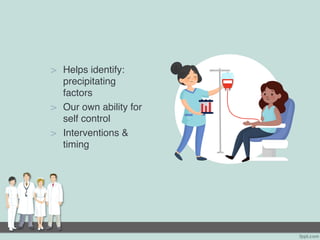
> Helps identify:
precipitating
factors
> Our own ability for
self control
> Interventions &
timing
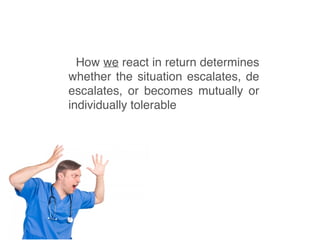
How we react in return determines
whether the situation escalates, de
escalates, or becomes mutually or
individually tolerable
Before we De-
escalate:
Know Thyself
What Are Your Hot Buttons?
> Need to be right?
> People pleasing?
> Control issues? (power struggle)
> Burn Out?
> Personalising? (it’s not about you)
> Tendency to compete? (power struggle)
> Tendency to blame? (arguing)
> Response to threat/s (tell your boss/report you)
Your Physiological Reactions
> Increased
heart rate
> Adrenaline
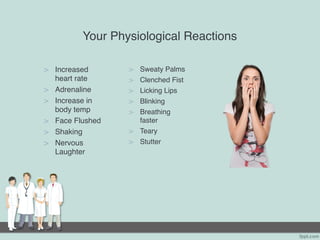
> Increase in
body temp
> Face Flushed
> Shaking
> Nervous
Laughter
> Sweaty Palms
> Clenched Fist
> Licking Lips
> Blinking
> Breathing
faster
> Teary
> Stutter
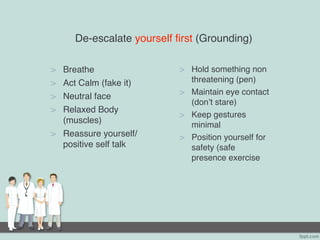
De-escalate yourself first (Grounding)
> Breathe
> Act Calm (fake it)
> Neutral face
> Relaxed Body
(muscles)
> Reassure yourself/
positive self talk
> Hold something non
threatening (pen)
> Maintain eye contact
(don’t stare)
> Keep gestures
minimal
> Position yourself for
safety (safe
presence exercise
Telephone Call (Admin)
> Pitch, pace, tone of your voice
> Focus, on their tone, pace
> Ask information questions?
> LISTEN, CHECK, REPEAT, WRITE DOWN
> Reassure, no power struggle
> If very aggressive, try signal staff member
> Direct threat TOWARDS YOU - hang up and alert
security
> Threats to self harm/kill themselves or others try to stay
on the line and get another relevant staff member, take
notes, call police if necessary
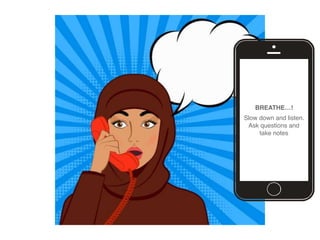
BREATHE…!
Slow down and listen.
Ask questions and
take notes
Reception Area (Admin)
> Counter height/glass screen/situational
Awareness
> Potential objects to be thrown
> Keep sharps - scissors/letter openers in drawers
> LISTEN, LOOK UP, CHECK FOR SIGNS,
INFORM
> If escalating, call staff member and/or security
> Direct threat TOWARDS YOU - exit area as best
you can
> If there is a weapon, try and remain calm
3 As Awareness, Assessment, Action
> Individual
> Risk Factors for Violence
> Action: NVB first, followed by VB
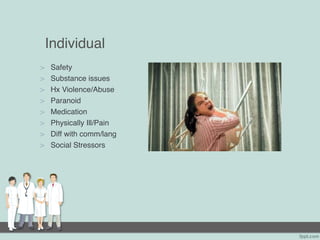
Individual
> Safety
> Substance issues
> Hx Violence/Abuse
> Paranoid
> Medication
> Physically Ill/Pain
> Diff with comm/lang
> Social Stressors
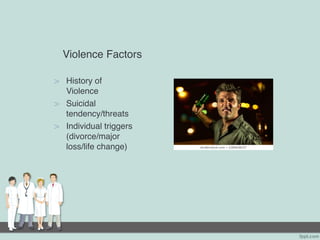
Violence Factors
> History of
Violence
> Suicidal
tendency/threats
> Individual triggers
(divorce/major
loss/life change)
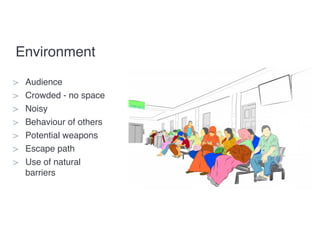
Environment
> Audience
> Crowded - no space
> Noisy
> Behaviour of others
> Potential weapons
> Escape path
> Use of natural
barriers
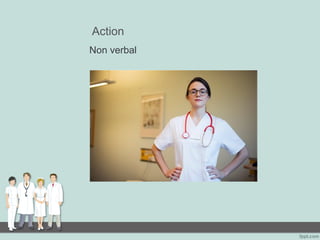
Action
Non verbal
Action - Non Verbal
> Appearance:
> Calm (even if you don’t feel like it)
> Centered/self-assured (anxiety is
transferred)
> Maintain eye contact (loss of leads to
misinterpretation as lack of interest/
respect or fear - too much can be seen
as a threat or challenge
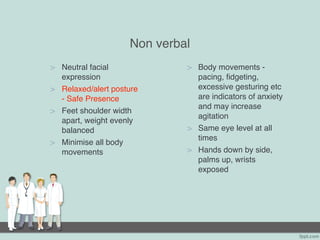
Non verbal
> Neutral facial
expression
> Relaxed/alert posture
- Safe Presence
> Feet shoulder width
apart, weight evenly
balanced
> Minimise all body
movements
> Body movements -
pacing, fidgeting,
excessive gesturing etc
are indicators of anxiety
and may increase
agitation
> Same eye level at all
times
> Hands down by side,
palms up, wrists
exposed
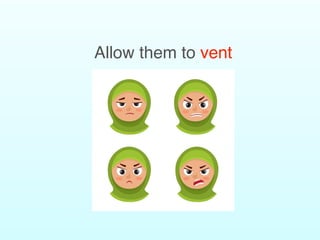
Allow them to vent
> De-escalation
Process:
> Active listening
> Empathy
> Rapport
> Provide info/
support
> Follow up/Staff
Debrief
Before ANY Verbal Action
> LISTEN: 3 Main Skills
> Attending - physical/mental attention to
other person
> Following - use eye contact to engage,
nod, saying ‘ok’, ask infrequent question
> Reflecting - paraphrase/reflect using
feelings of the other person
Empathic Listening
> Do NOT be judgemental
> Do NOT ignore the person/pretend to listen
> Listen to what is being said
> Restate the message
> Clarify the message
> Repeat the message
> BE EMPATHIC…! Validate their feelings
Phrases for Miscommunication
> Ordering: You must…you have to…
> Threatening: If you don’t…then…
> Preaching: You really should…
> Lecturing: Heres why you are wrong…
> Judging: You’re lazy…you’ll never change
> Excusing: It’s not so bad…
> Labelling: Well, you’re just being unrealistic…
Other unhelpful Phrases
> Calm Down…!
> Chill Out…!
> Not this again…
> Whataboutism…
> How dare you…!
> We don’t want your rudeness here…!
Approaching the Person
> Use their name to address them (admin
phone)
> Introduce yourself - Hello I am….the….
> Explain your intentions/convey your
expectations clearly
> Any requests simple/specific
> Be an active and reflective listener
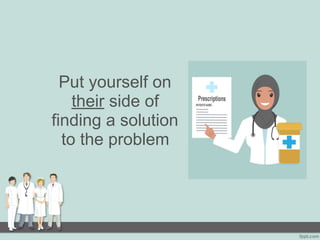
Put yourself on
their side of
finding a solution
to the problem
VIDEO CLIP
McD
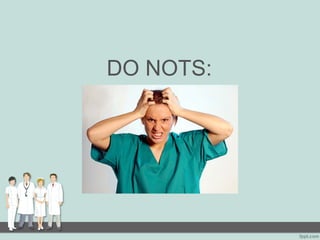
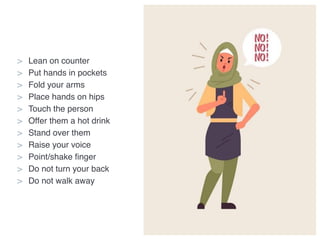
DO NOTS:
> Lean on counter
> Put hands in pockets
> Fold your arms
> Place hands on hips
> Touch the person
> Offer them a hot drink
> Stand over them
> Raise your voice
> Point/shake finger
> Do not turn your back
> Do not walk away
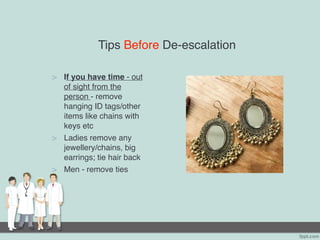
Tips Before De-escalation
> If you have time - out
of sight from the
person - remove
hanging ID tags/other
items like chains with
keys etc
> Ladies remove any
jewellery/chains, big
earrings; tie hair back
> Men - remove ties
Your aim is to
bring the level
of arousal
down to a
safer place
Action
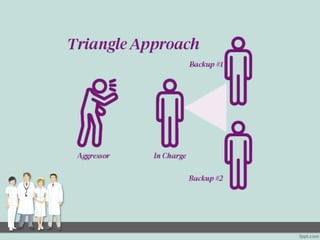
> Align yourself with person (Triangle)
> Redirect attention
> Feedback (only if not highly agitated)
> Change the immediate environment
> Ask them to sit down/offer water
> Be careful of using humour
Action continued DO NOTS
> Do Not be defensive
> Be assertive but do NOT justify/defend
> Do not try to argue or convince
> Use modulated monotones, lower voice
> (Voice tightens and sounds higher when
scared)
> Do NOT get loud or try to yell over the other
person - wait for a breath then speak
Group Exercise
Role Play
Action continued
> Speak calmly/average volume
> Be respectful when limit setting or calling
for help - the agitated person is sensitive
to feeling shamed and disrespected as
already on the defensive
> They need to know we treat everyone
with dignity and respect
Respond Selectively
> Answer
information
seeking
questions only
- NOT abusive
ones
“Why do I have to
fill out these stupid
forms…”??
“Why are all
nurses such
idiots…?”
Continued
> Be honest - DO NOT lie, as tempting as it
may be - the consequences could be fatal
> Do not give out information which may
further upset the person (if you came
yesterday it would have been free…)
> Explain the limits/rules respectfully, give
choices where possible (continue calmly or
come back later when things can be more
relaxed)
Continued
> Empathise with feelings but NOT the
behaviour - I understand your anger but it
is not ok to threaten our staff
> Trust your instincts…!!! If you sense that
the process is not working - STOP! Get
help (be creative if you need to be)
Group Exercise
Role Play
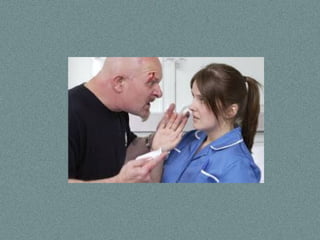
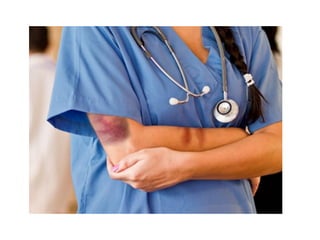
Physically Threatening/Physically Violent
> If physically threatened - discreetly get
into defensive stance/weaker side
> If they physically attack you or another
person, your response changes to a
self-defence/survival mode
> Protect yourself - goal is not to fight, but
to control the situation
It is important to remember
your responsibility to the
safety of others in the area
and to also keep yourself
safe -
RETREAT, IF YOU NEED
TO…!
> Summary:
> Align with person
> Redirect Attention
> Communicate
Clearly
> Be Honest/
Responsible
> Trust Your
Instincts
Learn to Practice
Self - Care
> Healthy balance home/work life style - it
is ok to cry and de-stress, take some time
- 10-20 mins just for you to release
tension and stress (hobby, interests)
> Engage with friends, get rest, exercise,
plenty of fluids, and take meal breaks -
you are not a robot…!
Questions and
Discussion
Thank You

Challenging Behaviour at Work by Diane Hanna

  • 1.
  • 2.
  • 3.
  • 4.
    Terminology of Violenceand Aggression Violence can be defined as the use of physical force with the intent to injure or harm another person or destroy property A person who is aggressive does not necessarily act out with violence Aggression is generally defined as angry or violent feelings or behaviour While a person who commits an act of violence may be acting with aggression, a person with an aggressive nature will not necessarily engage in violent acts Although aggression can result in a physical or verbal attack, sometimes the attack may be defensive or impulsive, and lack harmful intent Both can have negative effects, on both a societal and individual level
  • 5.
    Types of Aggression >Accidental (at play or in a hurry) > Expressive (intentional, but no intent to cause harm - it may be frustrating or cause harm - but causing harm is not the purpose) > Hostile (is meant to cause pain) > Instrumental (to obtain an outcome)
  • 6.
    The role ofanger in aggression and violence: A N G E R
  • 8.
    Anger: an emotion characterisedby antagonism toward someone or something you feel has deliberately done you wrong (Kazdin, A.E, 2000)
  • 9.
    It is normalto feel angry, or frustrated when you have been let down or betrayed, but anger and frustration do not justify violent action. Anger is a strong emotion that can be difficult to keep in check.
  • 10.
    > Anger isperhaps the main emotion at the core of all violent and aggressive behaviour. > When we think of someone angry -Rage, hostility, furious, irate, incensed, livid, murderous are just a few words we may use to describe them
  • 11.
    Violence is anextreme form of aggression, such as assault, rape, or murder. Violence
  • 13.
    Reasons for Violence Expression Asa release for anger and frustration. Some people believe there are no answers to their problems and use violence to express their out of control emotions. Manipulation Violence is a way to control others, or used by certain individuals as a way to get something they want.
  • 14.
    Reasons people useviolence: > Retaliation > Violence is used to retaliate against those who have hurt them or someone they care about > Violence is a learned behaviour > Like all other learned behaviour, it can be changed. This is not easy. No single cause/no single solution. Warning signs/help
  • 15.
    Factors in Violence >Static Signs > Hx of violent/ aggressive behaviour > Young age at first violent incident > Having been a victim of bullying > Hx of discipline problems/authority problems > Early childhood abuse/neglect > Having witnessed violence at home > Family/parent condones use of violence > Hx of cruelty to animals > Having a major mental illness > Lack of empathy for others > Hx of vandalism or property damage
  • 17.
    Other signs presentover time/may escalate or contribute: Serious drug/ alcohol abuse Gang membership/ desire to join gang Access to or fascination with weapons, esp guns Trouble controlling feelings of anger Withdrawal from friends and usual activities Regularly feeling rejected or alone Feeling constantly disrespected Personal space/ facial expression New OR Active Signs: Increased loss of temper Frequent physical fighting Increased use of alcohol or drugs Increased risk-taking behaviour/ s Declining school performance Acute episode of major mental illness Planning how to commit acts of violence Announcing plans/threats to hurt others Obtaining or carrying a weapon
  • 18.
    Escalation What is it? andwhat causes it…?
  • 19.
  • 20.
    Escalation and itscauses > An increase in hostility, tension, competitive behaviour, bringing personalities into conflict > The helper engages in power struggles, does not attend to body language, overreacts to threats/posturing/ emotional displays, their own issues become engaged; the helper pushes/becomes provocative - the persons feels unheard/threatened
  • 21.
    What else could escalatematters? Anything else?
  • 22.
    Angry/agitated/upset person’s pointof view Angry/ upset person ‘block’ ‘stop’ you what they want - unmet need
  • 23.
  • 24.
    What is aBehavioural Crisis? > An episode of mental and/or emotional distress that is creating instability or danger and is considered disruptive to community or the person him/her self
  • 25.
    Recognising & Responding >Mental (mental illness? Are they anxious? Paranoid? Angry/confused?) > Medical ( is there a medical issue? Are they hurt/injured?) > Alcohol and or other drugs (are they under the influence?) > Situational stress (relationship/ marriage breakdown/ $/job loss/gender of baby)
  • 26.
    Crisis Intervention: > A processto assist individuals in finding safe and productive outcomes to unsettling events
  • 27.
  • 28.
    The goal ofde escalation is to build rapid rapport and a sense of connectedness with an agitated person to reduce the likelihood of escalation to physical violence. This sense of connectedness is established via specific verbal, psych, and non verbal techniques that emphasise control over ones own emotional response to threat while guiding communication.
  • 29.
    De-escalation > The 3As of De-escalation: > Awareness, Assessment, and Action. > Awareness and Action = the total sum of all info collected about the nature, circumstances, stages, and dynamics of various forms of escalation
  • 30.
    > Action =Verbal and Non Verbal behaviour + strategies we use to guide communication, de escalation techniques used to resolve the crisis without the use of force.
  • 31.
    > Helps identify: precipitating factors >Our own ability for self control > Interventions & timing
  • 32.
    How we reactin return determines whether the situation escalates, de escalates, or becomes mutually or individually tolerable
  • 33.
  • 34.
    What Are YourHot Buttons? > Need to be right? > People pleasing? > Control issues? (power struggle) > Burn Out? > Personalising? (it’s not about you) > Tendency to compete? (power struggle) > Tendency to blame? (arguing) > Response to threat/s (tell your boss/report you)
  • 36.
    Your Physiological Reactions >Increased heart rate > Adrenaline > Increase in body temp > Face Flushed > Shaking > Nervous Laughter > Sweaty Palms > Clenched Fist > Licking Lips > Blinking > Breathing faster > Teary > Stutter
  • 37.
    De-escalate yourself first(Grounding) > Breathe > Act Calm (fake it) > Neutral face > Relaxed Body (muscles) > Reassure yourself/ positive self talk > Hold something non threatening (pen) > Maintain eye contact (don’t stare) > Keep gestures minimal > Position yourself for safety (safe presence exercise
  • 38.
    Telephone Call (Admin) >Pitch, pace, tone of your voice > Focus, on their tone, pace > Ask information questions? > LISTEN, CHECK, REPEAT, WRITE DOWN > Reassure, no power struggle > If very aggressive, try signal staff member > Direct threat TOWARDS YOU - hang up and alert security > Threats to self harm/kill themselves or others try to stay on the line and get another relevant staff member, take notes, call police if necessary
  • 39.
    BREATHE…! Slow down andlisten. Ask questions and take notes
  • 40.
    Reception Area (Admin) >Counter height/glass screen/situational Awareness > Potential objects to be thrown > Keep sharps - scissors/letter openers in drawers > LISTEN, LOOK UP, CHECK FOR SIGNS, INFORM > If escalating, call staff member and/or security > Direct threat TOWARDS YOU - exit area as best you can > If there is a weapon, try and remain calm
  • 41.
    3 As Awareness,Assessment, Action > Individual > Risk Factors for Violence > Action: NVB first, followed by VB
  • 42.
    Individual > Safety > Substanceissues > Hx Violence/Abuse > Paranoid > Medication > Physically Ill/Pain > Diff with comm/lang > Social Stressors
  • 43.
    Violence Factors > Historyof Violence > Suicidal tendency/threats > Individual triggers (divorce/major loss/life change)
  • 44.
    Environment > Audience > Crowded- no space > Noisy > Behaviour of others > Potential weapons > Escape path > Use of natural barriers
  • 45.
  • 46.
    Action - NonVerbal > Appearance: > Calm (even if you don’t feel like it) > Centered/self-assured (anxiety is transferred) > Maintain eye contact (loss of leads to misinterpretation as lack of interest/ respect or fear - too much can be seen as a threat or challenge
  • 47.
    Non verbal > Neutralfacial expression > Relaxed/alert posture - Safe Presence > Feet shoulder width apart, weight evenly balanced > Minimise all body movements > Body movements - pacing, fidgeting, excessive gesturing etc are indicators of anxiety and may increase agitation > Same eye level at all times > Hands down by side, palms up, wrists exposed
  • 49.
  • 50.
    > De-escalation Process: > Activelistening > Empathy > Rapport > Provide info/ support > Follow up/Staff Debrief
  • 51.
    Before ANY VerbalAction > LISTEN: 3 Main Skills > Attending - physical/mental attention to other person > Following - use eye contact to engage, nod, saying ‘ok’, ask infrequent question > Reflecting - paraphrase/reflect using feelings of the other person
  • 52.
    Empathic Listening > DoNOT be judgemental > Do NOT ignore the person/pretend to listen > Listen to what is being said > Restate the message > Clarify the message > Repeat the message > BE EMPATHIC…! Validate their feelings
  • 54.
    Phrases for Miscommunication >Ordering: You must…you have to… > Threatening: If you don’t…then… > Preaching: You really should… > Lecturing: Heres why you are wrong… > Judging: You’re lazy…you’ll never change > Excusing: It’s not so bad… > Labelling: Well, you’re just being unrealistic…
  • 55.
    Other unhelpful Phrases >Calm Down…! > Chill Out…! > Not this again… > Whataboutism… > How dare you…! > We don’t want your rudeness here…!
  • 56.
    Approaching the Person >Use their name to address them (admin phone) > Introduce yourself - Hello I am….the…. > Explain your intentions/convey your expectations clearly > Any requests simple/specific > Be an active and reflective listener
  • 57.
    Put yourself on theirside of finding a solution to the problem
  • 58.
  • 59.
  • 60.
    > Lean oncounter > Put hands in pockets > Fold your arms > Place hands on hips > Touch the person > Offer them a hot drink > Stand over them > Raise your voice > Point/shake finger > Do not turn your back > Do not walk away
  • 61.
    Tips Before De-escalation >If you have time - out of sight from the person - remove hanging ID tags/other items like chains with keys etc > Ladies remove any jewellery/chains, big earrings; tie hair back > Men - remove ties
  • 62.
    Your aim isto bring the level of arousal down to a safer place
  • 63.
    Action > Align yourselfwith person (Triangle) > Redirect attention > Feedback (only if not highly agitated) > Change the immediate environment > Ask them to sit down/offer water > Be careful of using humour
  • 64.
    Action continued DONOTS > Do Not be defensive > Be assertive but do NOT justify/defend > Do not try to argue or convince > Use modulated monotones, lower voice > (Voice tightens and sounds higher when scared) > Do NOT get loud or try to yell over the other person - wait for a breath then speak
  • 65.
  • 67.
    Action continued > Speakcalmly/average volume > Be respectful when limit setting or calling for help - the agitated person is sensitive to feeling shamed and disrespected as already on the defensive > They need to know we treat everyone with dignity and respect
  • 68.
  • 69.
    “Why do Ihave to fill out these stupid forms…”??
  • 70.
    “Why are all nursessuch idiots…?”
  • 71.
    Continued > Be honest- DO NOT lie, as tempting as it may be - the consequences could be fatal > Do not give out information which may further upset the person (if you came yesterday it would have been free…) > Explain the limits/rules respectfully, give choices where possible (continue calmly or come back later when things can be more relaxed)
  • 72.
    Continued > Empathise withfeelings but NOT the behaviour - I understand your anger but it is not ok to threaten our staff > Trust your instincts…!!! If you sense that the process is not working - STOP! Get help (be creative if you need to be)
  • 74.
  • 75.
    Physically Threatening/Physically Violent >If physically threatened - discreetly get into defensive stance/weaker side > If they physically attack you or another person, your response changes to a self-defence/survival mode > Protect yourself - goal is not to fight, but to control the situation
  • 76.
    It is importantto remember your responsibility to the safety of others in the area and to also keep yourself safe - RETREAT, IF YOU NEED TO…!
  • 77.
    > Summary: > Alignwith person > Redirect Attention > Communicate Clearly > Be Honest/ Responsible > Trust Your Instincts
  • 78.
    Learn to Practice Self- Care > Healthy balance home/work life style - it is ok to cry and de-stress, take some time - 10-20 mins just for you to release tension and stress (hobby, interests) > Engage with friends, get rest, exercise, plenty of fluids, and take meal breaks - you are not a robot…!
  • 79.
  • 80.