ECOLOGY The study of living organisms and their interaction with the nonliving environment
Historical Background Ecology Eco  = “house”  ology  = “study of”  BIOTIC ABIOTIC
Realms of Ecology Organisms Populations Communities Ecosystems Biome Biosphere
 
What Ecologists Study Concerned with levels of organization  ABOVE  population
The Biosphere The portion of the earth where living organisms exist If the earth were an apple, the biosphere would be no thicker than the skin
Atmosphere The troposphere Surface to 17 km (11 miles) up Contains most of the oxygen and nitrogen The stratosphere 17 to 48 km up Contains most of the O 3 Screens out all UV-C Screens out most UV-B Screens out some UV-A
Hydrosphere All the water on the earth Liquid water Surface underground Ice Polar ice Icebergs Ice in frozen soil Water vapor in the atmosphere
Lithosphere Crust and upper mantle Contains all fossil fuels Contains all usable minerals Contains all nutrients for plant life
What Sustains Life on Earth? Life on Earth depends on three interconnecting factors One way flow of energy From the sun Through plants and animals Cycling of matter All nutrients must be recycled repeatedly Gravity Allows the planet to hold its atmosphere Causes downward movement of chemicals in cycles
How the Sun Helps Sustain Life Lights and warms the planet Supports photosynthesis Powers matter cycling Drives climate and weather systems
How the Sun Helps Sustain Life Lights and warms the planet Earth receives about 1/1,000,000,000 of the suns energy output 34% reflected back into space The remaining 66% Warms the troposphere and land Evaporates water Generates winds
How the Sun Helps Sustain Life Supports photosynthesis Creates carbohydrates  Creates oxygen Speeds decomposition
How the Sun Helps Sustain Life Powers matter cycling Carbon cycle Nitrogen cycle Water cycle Oxygen cycle Phosphorous cycle
How the Sun Helps Sustain Life Drives climate and weather systems Distributes heat Distributes fresh water
Natural Greenhouse Effect Most solar radiation is degraded into heat Greenhouse gasses keep the heat around the planet Water vapor Carbon dioxide Methane Nitrous oxide ozone Without the greenhouse effect, Earth would be as cold as Mars
Ecosystem Concepts Biomes  – large regions of land characterized by a distinct climate and specific animal and especially plant species Forests Desserts Grasslands Jungles


Ecosystem Concepts Biomes   - consist of two components abiotic  Water Air Solar energy nutrients Biotic (biota) Animals Plants microorganisms
Ecosystem Concepts Ecotones  – biomes do not have clear-cut edges.  They blend into one another Ecotones contain a mixture of organisms from each biome and frequently species found nowhere else Ecotones are more biologically diverse than either of the bordering biomes
Deciduous Forest/River Ecotone
Aquatic/Marine life Zones Fresh water life zones Lakes & ponds Streams & rivers Marine life zones Estuaries Coastlines Coral reefs Deep oceans
Abiotic Limitations Abiotic Water – how much or how little Solar energy – shade or sun Nutrients – rich or poor
Range of Tolerance There is an optimum range of each abiotic component of a biome for each species Individuals in a population may have slightly different tolerances
 
Law of Tolerance The levels, abundance and distribution of a species in an ecosystem are determined by whether the levels of one or more physical or chemical factors fall within the ranger tolerated by that species. Translation: Don’t expect to find polar bears in Tahiti
Limiting Factor Principle Too much or too little of any abiotic factor can limit or prevent growth of a population, even if all other factors are at or near the optimum range of tolerance. Translation: If the restaurant serves really spicy food, don’t look for Anglos
Limiting Factor Principle Too much of a particular abiotic factor can also be a limiting factor Limiting factors can change
Limiting Factor Principle Aquatic or marine life zones also have limiting factors Sunlight Dissolved oxygen Nutrient availability Salinity
Living Components of the Biome Metabolism  – all living creatures capture and transform matter and energy from their environment to supply their needs for survival, growth and reproduction
Living Components of the Biome All living things are divided into two groups Producers  – make their own food from components obtained from the environment Consumers  – obtain nutrients and energy by consuming other organisms or their remains
Producers Autotrophs Most producers capture sunlight and abiotic nutrients to produce carbohydrates (such as glucose (C 6 H 12 O 6 ) in a process called  Photosynthesis
 
Photosynthesis Carbon dioxide + water +  solar energy     glucose + oxygen CO 2   + 6 H 2 O +  solar energy     C 6 H 12 O 6 + 6 O 2
Chemosynthesis Hydrogen sulfide + carbon dioxide +  geothermal heat     nutrients H 2 S +  CO 2  +  geothermal heat     nutrients
 
Consumers Heterotrophs Obtain their energy and nutrients by consuming other organisms or their remains
Consumers Heterotrophs All these organisms consume living prey Herbivores   – (primary consumers)  feed directly on producers Carnivores  –   ( meat eaters)  feed on other consumers Secondary consumers  – feed only on primary consumers Tertiary consumers  – ( higher level consumers) feed on other carnivores Omnivores  – feed on both plants and animals
Herbivores Primary Consumers
Carnivores Secondary Consumers
Heterotrophs some feed on the dead or dying Scavengers  – feed on dead animal carcasses Detritivores  – feed on waste, parts of carcasses or cast off parts Detritus feeders  – feed on partially decomposed organic matter Decomposers  – (mostly bacteria and fungi) break down dead organic materials to simpler inorganic compounds
Aerobic Respiration and Photosynthesis Photosynthesis Energy  +  Carbon Dioxide + water    glucose + oxygen sunlight  +   CO 2   +  H 2 O    C 6 H 12 O 6  + O 2 Aerobic Respiration glucose + oxygen    carbon dioxide + water +  Energy   C 6 H 12 O 6  +  O 2     CO 2  + H 2 O  +  Energy
Energy Cycling Solar energy is collected by plants  (producers) Most of the energy from the sun is lost as heat Primary consumers  (herbivores)  eat the plants Most of the energy is lost as heat Secondary consumers  (carnivores)   eat the primary consumers Most of the energy is lost as heat
Energy Cycling Tertiary consumers eat the secondary consumers Most of the energy is lost as heat Detritivores consume the dead and dying Most of the energy is lost as heat
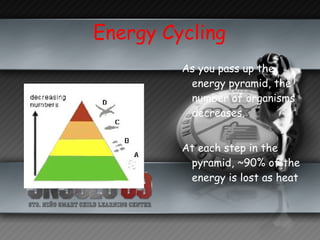
Energy Cycling As you pass up the energy pyramid, the number of organisms decreases. At each step in the pyramid, ~90% of the energy is lost as heat
Food Chains Simplified constructs used to show energy flow in the ecosystem Food chains do not exist in nature
Food Webs Food webs are more realistic representations of nature Organisms rarely feed at only one trophic level
Available Energy How many trophic levels are present depends on how much energy is available in an ecosystem There are rarely more than four or five trophic levels in an ecosystem The amount of energy an ecosystem produces is called the  Net Primary Productivity Measured in  kcal/m 2 /yr  or  g/m 2 /yr
Net Primary Productivity Equals Rate at which producers  store chemical energy  as biomass   Minus (produced by photosynthesis) Rate at which producers use chemical energy stored as biomass (through aerobic respiration)
Net Primary Productivity
Different Ecosystems Produce Different Biomass Most Productive Estuaries Swamps/marshes Tropical rainforests Least Productive Open ocean Tundra Desert
Human Biomass Usage Humans have taken over, disturbed or degraded  ~73%  of the earths’ land surface Humans use, waste or destroy  ~27%  of the earths’ total potential net primary productivity and  ~40%  of the total potential net primary productivity of terrestrial ecosystems
Matter Cycling Energy is an open system Energy enters the system as sunlight (low entropy) and is degraded and dispersed (high entropy) as organisms use it Matter is a closed system All matter is recycled in one of three ways
Matter Cycles There are three major types of nutrient recycling Hydraulic  cycle (ex. Water cycle) Atmospheric cycle (ex. Carbon cycle) Sedimentary cycle ( ex.  Phosphorous)
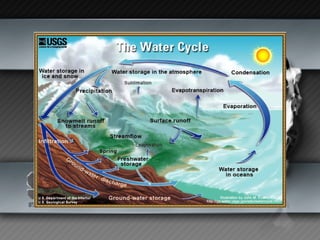
Hydraulic Cycle Water evaporates and cycles through the biosphere Local Regional global
 
Atmospheric Cycle A large portion of the nutrient exist in the atmosphere and cycle rapidly through soil, organisms and back to the atmosphere Local Regional Global
 
Sedimentary Cycle Earths’ crust is the main storehouse.  Elements move from the land to the seabed then back to land through geological uplift and volcanic action global
 

Ecology

  • 1.
  • 2.
    ECOLOGY The studyof living organisms and their interaction with the nonliving environment
  • 3.
    Historical Background EcologyEco = “house” ology = “study of” BIOTIC ABIOTIC
  • 4.
    Realms of EcologyOrganisms Populations Communities Ecosystems Biome Biosphere
  • 5.
  • 6.
    What Ecologists StudyConcerned with levels of organization ABOVE population
  • 7.
    The Biosphere Theportion of the earth where living organisms exist If the earth were an apple, the biosphere would be no thicker than the skin
  • 8.
    Atmosphere The troposphereSurface to 17 km (11 miles) up Contains most of the oxygen and nitrogen The stratosphere 17 to 48 km up Contains most of the O 3 Screens out all UV-C Screens out most UV-B Screens out some UV-A
  • 9.
    Hydrosphere All thewater on the earth Liquid water Surface underground Ice Polar ice Icebergs Ice in frozen soil Water vapor in the atmosphere
  • 10.
    Lithosphere Crust andupper mantle Contains all fossil fuels Contains all usable minerals Contains all nutrients for plant life
  • 11.
    What Sustains Lifeon Earth? Life on Earth depends on three interconnecting factors One way flow of energy From the sun Through plants and animals Cycling of matter All nutrients must be recycled repeatedly Gravity Allows the planet to hold its atmosphere Causes downward movement of chemicals in cycles
  • 12.
    How the SunHelps Sustain Life Lights and warms the planet Supports photosynthesis Powers matter cycling Drives climate and weather systems
  • 13.
    How the SunHelps Sustain Life Lights and warms the planet Earth receives about 1/1,000,000,000 of the suns energy output 34% reflected back into space The remaining 66% Warms the troposphere and land Evaporates water Generates winds
  • 14.
    How the SunHelps Sustain Life Supports photosynthesis Creates carbohydrates Creates oxygen Speeds decomposition
  • 15.
    How the SunHelps Sustain Life Powers matter cycling Carbon cycle Nitrogen cycle Water cycle Oxygen cycle Phosphorous cycle
  • 16.
    How the SunHelps Sustain Life Drives climate and weather systems Distributes heat Distributes fresh water
  • 17.
    Natural Greenhouse EffectMost solar radiation is degraded into heat Greenhouse gasses keep the heat around the planet Water vapor Carbon dioxide Methane Nitrous oxide ozone Without the greenhouse effect, Earth would be as cold as Mars
  • 18.
    Ecosystem Concepts Biomes – large regions of land characterized by a distinct climate and specific animal and especially plant species Forests Desserts Grasslands Jungles
  • 19.
  • 20.
  • 21.
  • 22.
    Ecosystem Concepts Biomes - consist of two components abiotic Water Air Solar energy nutrients Biotic (biota) Animals Plants microorganisms
  • 23.
    Ecosystem Concepts Ecotones – biomes do not have clear-cut edges. They blend into one another Ecotones contain a mixture of organisms from each biome and frequently species found nowhere else Ecotones are more biologically diverse than either of the bordering biomes
  • 24.
    Ecosystem Concepts Ecotones – biomes do not have clear-cut edges. They blend into one another Ecotones contain a mixture of organisms from each biome and frequently species found nowhere else Ecotones are more biologically diverse than either of the bordering biomes
  • 25.
  • 26.
    Aquatic/Marine life ZonesFresh water life zones Lakes & ponds Streams & rivers Marine life zones Estuaries Coastlines Coral reefs Deep oceans
  • 27.
    Abiotic Limitations AbioticWater – how much or how little Solar energy – shade or sun Nutrients – rich or poor
  • 28.
    Range of ToleranceThere is an optimum range of each abiotic component of a biome for each species Individuals in a population may have slightly different tolerances
  • 29.
  • 30.
    Law of ToleranceThe levels, abundance and distribution of a species in an ecosystem are determined by whether the levels of one or more physical or chemical factors fall within the ranger tolerated by that species. Translation: Don’t expect to find polar bears in Tahiti
  • 31.
    Limiting Factor PrincipleToo much or too little of any abiotic factor can limit or prevent growth of a population, even if all other factors are at or near the optimum range of tolerance. Translation: If the restaurant serves really spicy food, don’t look for Anglos
  • 32.
    Limiting Factor PrincipleToo much of a particular abiotic factor can also be a limiting factor Limiting factors can change
  • 33.
    Limiting Factor PrincipleAquatic or marine life zones also have limiting factors Sunlight Dissolved oxygen Nutrient availability Salinity
  • 34.
    Living Components ofthe Biome Metabolism – all living creatures capture and transform matter and energy from their environment to supply their needs for survival, growth and reproduction
  • 35.
    Living Components ofthe Biome All living things are divided into two groups Producers – make their own food from components obtained from the environment Consumers – obtain nutrients and energy by consuming other organisms or their remains
  • 36.
    Producers Autotrophs Mostproducers capture sunlight and abiotic nutrients to produce carbohydrates (such as glucose (C 6 H 12 O 6 ) in a process called Photosynthesis
  • 37.
  • 38.
    Photosynthesis Carbon dioxide+ water + solar energy  glucose + oxygen CO 2 + 6 H 2 O + solar energy  C 6 H 12 O 6 + 6 O 2
  • 39.
    Chemosynthesis Hydrogen sulfide+ carbon dioxide + geothermal heat  nutrients H 2 S + CO 2 + geothermal heat  nutrients
  • 40.
  • 41.
    Consumers Heterotrophs Obtaintheir energy and nutrients by consuming other organisms or their remains
  • 42.
    Consumers Heterotrophs Allthese organisms consume living prey Herbivores – (primary consumers) feed directly on producers Carnivores – ( meat eaters) feed on other consumers Secondary consumers – feed only on primary consumers Tertiary consumers – ( higher level consumers) feed on other carnivores Omnivores – feed on both plants and animals
  • 43.
  • 44.
  • 45.
    Heterotrophs some feedon the dead or dying Scavengers – feed on dead animal carcasses Detritivores – feed on waste, parts of carcasses or cast off parts Detritus feeders – feed on partially decomposed organic matter Decomposers – (mostly bacteria and fungi) break down dead organic materials to simpler inorganic compounds
  • 46.
    Aerobic Respiration andPhotosynthesis Photosynthesis Energy + Carbon Dioxide + water  glucose + oxygen sunlight + CO 2 + H 2 O  C 6 H 12 O 6 + O 2 Aerobic Respiration glucose + oxygen  carbon dioxide + water + Energy C 6 H 12 O 6 + O 2  CO 2 + H 2 O + Energy
  • 47.
    Energy Cycling Solarenergy is collected by plants (producers) Most of the energy from the sun is lost as heat Primary consumers (herbivores) eat the plants Most of the energy is lost as heat Secondary consumers (carnivores) eat the primary consumers Most of the energy is lost as heat
  • 48.
    Energy Cycling Tertiaryconsumers eat the secondary consumers Most of the energy is lost as heat Detritivores consume the dead and dying Most of the energy is lost as heat
  • 49.
    Energy Cycling Asyou pass up the energy pyramid, the number of organisms decreases. At each step in the pyramid, ~90% of the energy is lost as heat
  • 50.
    Food Chains Simplifiedconstructs used to show energy flow in the ecosystem Food chains do not exist in nature
  • 51.
    Food Webs Foodwebs are more realistic representations of nature Organisms rarely feed at only one trophic level
  • 52.
    Available Energy Howmany trophic levels are present depends on how much energy is available in an ecosystem There are rarely more than four or five trophic levels in an ecosystem The amount of energy an ecosystem produces is called the Net Primary Productivity Measured in kcal/m 2 /yr or g/m 2 /yr
  • 53.
    Net Primary ProductivityEquals Rate at which producers store chemical energy as biomass Minus (produced by photosynthesis) Rate at which producers use chemical energy stored as biomass (through aerobic respiration)
  • 54.
  • 55.
    Different Ecosystems ProduceDifferent Biomass Most Productive Estuaries Swamps/marshes Tropical rainforests Least Productive Open ocean Tundra Desert
  • 56.
    Human Biomass UsageHumans have taken over, disturbed or degraded ~73% of the earths’ land surface Humans use, waste or destroy ~27% of the earths’ total potential net primary productivity and ~40% of the total potential net primary productivity of terrestrial ecosystems
  • 57.
    Matter Cycling Energyis an open system Energy enters the system as sunlight (low entropy) and is degraded and dispersed (high entropy) as organisms use it Matter is a closed system All matter is recycled in one of three ways
  • 58.
    Matter Cycles Thereare three major types of nutrient recycling Hydraulic cycle (ex. Water cycle) Atmospheric cycle (ex. Carbon cycle) Sedimentary cycle ( ex. Phosphorous)
  • 59.
    Hydraulic Cycle Waterevaporates and cycles through the biosphere Local Regional global
  • 60.
  • 61.
    Atmospheric Cycle Alarge portion of the nutrient exist in the atmosphere and cycle rapidly through soil, organisms and back to the atmosphere Local Regional Global
  • 62.
  • 63.
    Sedimentary Cycle Earths’crust is the main storehouse. Elements move from the land to the seabed then back to land through geological uplift and volcanic action global
  • 64.