Ecosystems
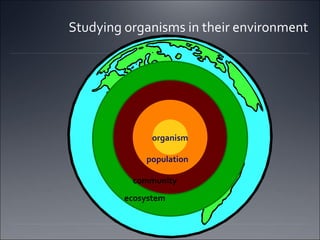
Studying organisms in their environment biosphere ecosystem community population organism
Essential questions What limits the production in ecosystems? How do nutrients move in the ecosystem? How does energy move through the ecosystem?
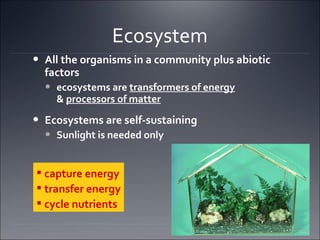
Ecosystem All the organisms in a community plus abiotic factors ecosystems are  transformers of energy   &  processors of matter Ecosystems are self-sustaining Sunlight is needed only capture energy transfer energy cycle nutrients
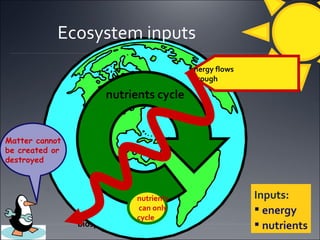
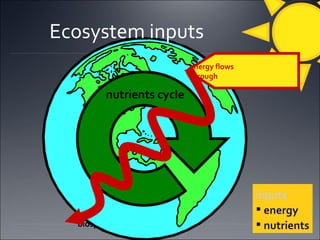
Ecosystem inputs biosphere constant input of energy energy flows through nutrients cycle nutrients  can only  cycle Inputs: energy nutrients Don’t forget the laws of  Physics!  Matter cannot be created or destroyed
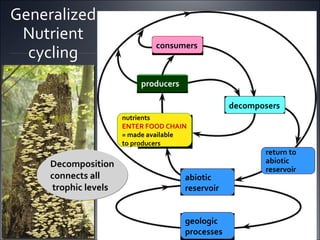
Generalized Nutrient cycling consumers decomposers abiotic reservoir nutrients made available to producers geologic processes consumers consumers producers decomposers abiotic reservoir nutrients ENTER FOOD CHAIN = made available to producers geologic processes return to abiotic reservoir Decomposition connects all  trophic levels
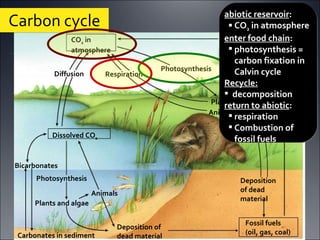
Carbon cycle abiotic reservoir : CO 2  in atmosphere enter food chain : photosynthesis = carbon fixation in Calvin cycle Recycle: decomposition return to abiotic : respiration Combustion of fossil fuels CO 2  in atmosphere Diffusion Respiration Photosynthesis Photosynthesis Plants and algae Plants Animals Industry and home Combustion of fuels Animals Carbonates in sediment Bicarbonates Deposition of dead material Deposition of dead material Fossil fuels (oil, gas, coal) Dissolved CO 2
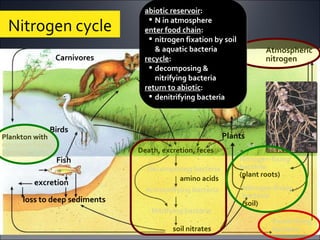
Nitrogen cycle Birds Herbivores Plants amino acids Carnivores Atmospheric nitrogen loss to deep sediments Fish Plankton with nitrogen-fixing bacteria Nitrogen-fixing bacteria (plant roots) Nitrogen-fixing bacteria   (soil) Denitrifying bacteria Death, excretion, feces Nitrifying bacteria soil nitrates excretion Decomposing bacteria Ammonifying bacteria abiotic reservoir : N in atmosphere enter food chain : nitrogen fixation by soil & aquatic bacteria recycle : decomposing & nitrifying bacteria return to abiotic : denitrifying bacteria
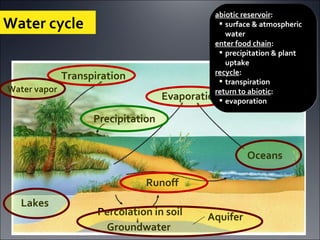
Lakes Runoff Percolation in soil Evaporation Transpiration Precipitation Oceans Solar energy Aquifer Groundwater Water cycle Water vapor abiotic reservoir : surface & atmospheric water enter food chain : precipitation & plant uptake recycle : transpiration return to abiotic : evaporation  & runoff
Ecosystem inputs biosphere energy flows through nutrients cycle inputs energy nutrients
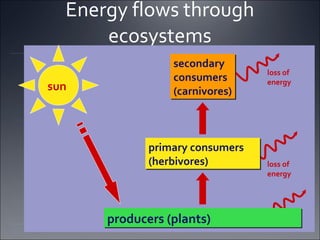
Energy flows through ecosystems sun producers (plants) secondary  consumers (carnivores) primary consumers (herbivores) loss of  energy loss of  energy
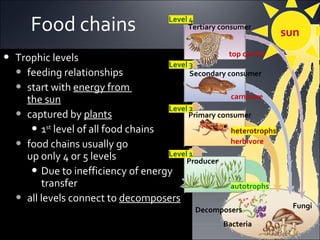
Food chains Trophic levels feeding relationships start with  energy from  the sun   captured by  plants 1 st  level of all food chains food chains usually go  up only 4 or 5 levels Due to inefficiency of energy transfer all levels connect to  decomposers   Fungi Level 4 Level 3 Level 2 Level 1 Decomposers Producer Primary consumer Secondary consumer Tertiary consumer top carnivore carnivore herbivore Bacteria autotrophs heterotrophs sun
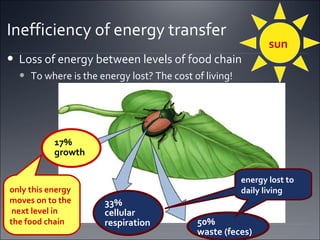
Inefficiency of energy transfer Loss of energy between levels of food chain To where is the energy lost? The cost of living! only this energy moves on to the  next level in  the food chain 17% growth 50% waste (feces) 33% cellular respiration sun energy lost to daily living energy lost to daily living
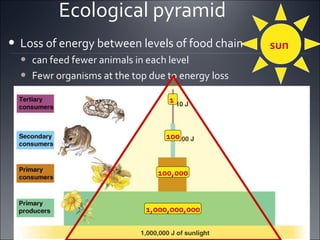
Ecological pyramid Loss of energy between levels of food chain can feed fewer animals in each level Fewr organisms at the top due to energy loss 1,000,000,000 100,000 100 1 sun
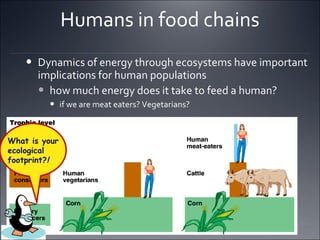
Humans in food chains Dynamics of energy through ecosystems have important implications for human populations how much energy does it take to feed a human? if we are meat eaters? Vegetarians? What is your ecological  footprint? !
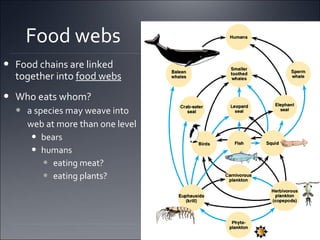
Food webs Food chains are linked together into  food webs Who eats whom? a species may weave into  web at more than one level bears humans eating meat? eating plants?

Ecosystems

  • 1.
  • 2.
    Studying organisms intheir environment biosphere ecosystem community population organism
  • 3.
    Essential questions Whatlimits the production in ecosystems? How do nutrients move in the ecosystem? How does energy move through the ecosystem?
  • 4.
    Ecosystem All theorganisms in a community plus abiotic factors ecosystems are transformers of energy & processors of matter Ecosystems are self-sustaining Sunlight is needed only capture energy transfer energy cycle nutrients
  • 5.
    Ecosystem inputs biosphereconstant input of energy energy flows through nutrients cycle nutrients can only cycle Inputs: energy nutrients Don’t forget the laws of Physics! Matter cannot be created or destroyed
  • 6.
    Generalized Nutrient cyclingconsumers decomposers abiotic reservoir nutrients made available to producers geologic processes consumers consumers producers decomposers abiotic reservoir nutrients ENTER FOOD CHAIN = made available to producers geologic processes return to abiotic reservoir Decomposition connects all trophic levels
  • 7.
    Carbon cycle abioticreservoir : CO 2 in atmosphere enter food chain : photosynthesis = carbon fixation in Calvin cycle Recycle: decomposition return to abiotic : respiration Combustion of fossil fuels CO 2 in atmosphere Diffusion Respiration Photosynthesis Photosynthesis Plants and algae Plants Animals Industry and home Combustion of fuels Animals Carbonates in sediment Bicarbonates Deposition of dead material Deposition of dead material Fossil fuels (oil, gas, coal) Dissolved CO 2
  • 8.
    Nitrogen cycle BirdsHerbivores Plants amino acids Carnivores Atmospheric nitrogen loss to deep sediments Fish Plankton with nitrogen-fixing bacteria Nitrogen-fixing bacteria (plant roots) Nitrogen-fixing bacteria (soil) Denitrifying bacteria Death, excretion, feces Nitrifying bacteria soil nitrates excretion Decomposing bacteria Ammonifying bacteria abiotic reservoir : N in atmosphere enter food chain : nitrogen fixation by soil & aquatic bacteria recycle : decomposing & nitrifying bacteria return to abiotic : denitrifying bacteria
  • 9.
    Lakes Runoff Percolationin soil Evaporation Transpiration Precipitation Oceans Solar energy Aquifer Groundwater Water cycle Water vapor abiotic reservoir : surface & atmospheric water enter food chain : precipitation & plant uptake recycle : transpiration return to abiotic : evaporation & runoff
  • 10.
    Ecosystem inputs biosphereenergy flows through nutrients cycle inputs energy nutrients
  • 11.
    Energy flows throughecosystems sun producers (plants) secondary consumers (carnivores) primary consumers (herbivores) loss of energy loss of energy
  • 12.
    Food chains Trophiclevels feeding relationships start with energy from the sun captured by plants 1 st level of all food chains food chains usually go up only 4 or 5 levels Due to inefficiency of energy transfer all levels connect to decomposers Fungi Level 4 Level 3 Level 2 Level 1 Decomposers Producer Primary consumer Secondary consumer Tertiary consumer top carnivore carnivore herbivore Bacteria autotrophs heterotrophs sun
  • 13.
    Inefficiency of energytransfer Loss of energy between levels of food chain To where is the energy lost? The cost of living! only this energy moves on to the next level in the food chain 17% growth 50% waste (feces) 33% cellular respiration sun energy lost to daily living energy lost to daily living
  • 14.
    Ecological pyramid Lossof energy between levels of food chain can feed fewer animals in each level Fewr organisms at the top due to energy loss 1,000,000,000 100,000 100 1 sun
  • 15.
    Humans in foodchains Dynamics of energy through ecosystems have important implications for human populations how much energy does it take to feed a human? if we are meat eaters? Vegetarians? What is your ecological footprint? !
  • 16.
    Food webs Foodchains are linked together into food webs Who eats whom? a species may weave into web at more than one level bears humans eating meat? eating plants?