Ecosystem and Ecological Succession
By
Dr. Abanti Pradhan
Assistant Professor
Dept. of Chemistry, ITER, Bhubaneswar
SOA [ deemed to be University]
Env. Science Lecture series
CHM-1002
• Ecosystem –An ecosystem is a self sufficient,
natural functional ecological unit comprising
of living organisms ( biotic community) and
their non living ( abiotic or physical and
chemical) environment that interact to form a
stable self sufficient system.
• Example: A Pond, a grassland, forest, desert
etc.
• The interaction results in continuous
production, consumption and exchange of
materials between the living and nonliving
component of the environment following
cyclic process.
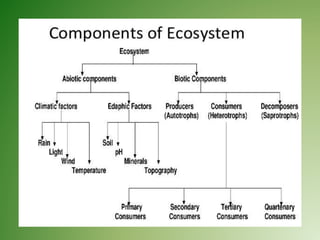
Structure of Ecosystem:
Ecosystem has two main components
Biotic components
Abiotic components
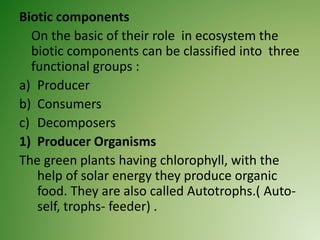
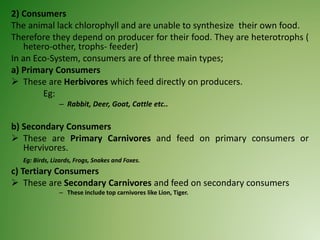
Biotic components
On the basic of their role in ecosystem the
biotic components can be classified into three
functional groups :
a) Producer
b) Consumers
c) Decomposers
1) Producer Organisms
The green plants having chlorophyll, with the
help of solar energy they produce organic
food. They are also called Autotrophs.( Auto-
self, trophs- feeder) .
2) Consumers
The animal lack chlorophyll and are unable to synthesize their own food.
Therefore they depend on producer for their food. They are heterotrophs (
hetero-other, trophs- feeder)
In an Eco-System, consumers are of three main types;
a) Primary Consumers
 These are Herbivores which feed directly on producers.
Eg:
– Rabbit, Deer, Goat, Cattle etc..
b) Secondary Consumers
 These are Primary Carnivores and feed on primary consumers or
Hervivores.
Eg: Birds, Lizards, Frogs, Snakes and Foxes.
c) Tertiary Consumers
 These are Secondary Carnivores and feed on secondary consumers
– These include top carnivores like Lion, Tiger.
3) Decomposers
These include wide variety of saprotrophic
micro- organism like;
• Bacteria (Bacillus Sp., Clostridium sp.,
pseudomonas.
• Fungi (Aspergillus sp., Ganoderma sp.,
Fusarium.
• Actinomycetes (Streptomyces).
They attract the dead or decayed bodies of
organisms & thus decomposition takes place.
Therefore, nutrients are released for reuse.
II. Abiotic components
The non living part of Eco-system, which have
a strong influence on the structure,
distribution, behavior and inter-relationship of
Organisms.
• Climatic Factor : Rain, Temperature, Light,
wind, Humidity etc..
• Edaphic Factor : Soil, pH, Topography, Minerals
etc.. And Inorganic component which involve
in Bio-Geo Chemical Cycle.
Function of Eco System
• Energy Flow
• Food Chain
• Food Web
• Nutrient cycles
• Ecological pyramid
Energy Flow in Ecosystem:
• All organisms must obtain a supply of energy and nutrients
from their environment in order to survive.
• The transformations of energy in an ecosystem begin first
with the input of energy from the sun.
• Photosynthesis -- Chemical reaction where green plants
use water & carbon dioxide to store the sun’s energy in
glucose.
• Because, it is the first step in the production of energy for
living things, it is called “Primary production”.
• Gross Primary Production (GPP) – The total amount of
chemical energy stored by plants/unit area/unit time.
• Net Primary Production (NPP) – Amount of energy stored
after respiratory loss. NPP can be utilized for growth and
reproduction of plant.
NPP = GPP - R
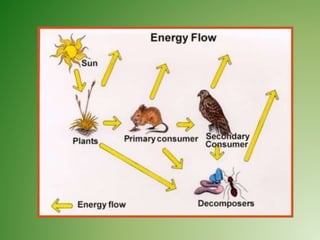
• ENERGY is stored in glucose.
• Glucose is stored as starch in plants
• The majority of autotrophs are photoautotrophs that
harness the energy of the sun and pass some of this
energy onto consumers through feeding pathways.
• The energy contained within producers and consumers is
ultimately passed to the decomposers that are
responsible for the constant recycling of nutrients.
• Thus, there is a one-way flow of energy through the
biotic community and a cycling of nutrients between the
biotic and abiotic components of the ecosystem
• Energy flow cannot occur in reverse direction.
• Starts from autotrophs (the producer level, i.e., first trophic
level) to Heterotrophs including plant eaters or Herbivores
(second trophic level) and so on.
• The amount of energy decreases with successive trophic
levels.
• Only About 1% of energy from the sun is used by green plants
& rest remains unutilized.
• 10% of Energy transfer from one Trophic level to another and
90% lost in each trophic level. This is called 10% Rule of
Energy flow.
• Similarly, there is loss of energy in each trophic level.
• The transfer of food energy between the organisms in an
ecosystem can be tracked by constructing food chains, food
webs, pyramids of numbers, biomass and energy and energy
flow diagrams.
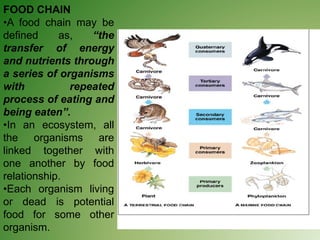
FOOD CHAIN
•A food chain may be
defined as, “the
transfer of energy
and nutrients through
a series of organisms
with repeated
process of eating and
being eaten”.
•In an ecosystem, all
the organisms are
linked together with
one another by food
relationship.
•Each organism living
or dead is potential
food for some other
organism.
Depending on the types of food and
consumer, there are Three types of food
chain.
• Predator or Grazing
GRASS >> DEER >> LION >> DECOMPOSER
• Saprophytic or Detritus
DEAD ORGANISM >> MICRO ORGANISM >>
EARTHWORM >> BIRD >> WOLF >>
DECOMPOSER
• Parasitic
ANIMAL(Host) >> TICK/APHID >> BIRD >>
EAGLE / WOLF >> DECOMPOSER
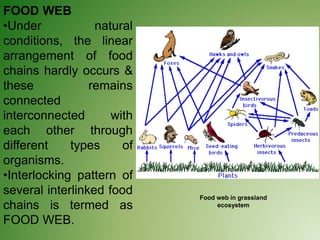
FOOD WEB
•Under natural
conditions, the linear
arrangement of food
chains hardly occurs &
these remains
connected
interconnected with
each other through
different types of
organisms.
•Interlocking pattern of
several interlinked food
chains is termed as
FOOD WEB.
Food web in grassland
ecosystem
ECOLOGICAL PYRAMIDS
•An ”Ecological pyramid” is a graphical
representation that shows the relative amounts
of energy or matter contained within each tropic
level in a food chain or food web.
•An ecological pyramid shows the relationship
between consumers and producers at different
tropic levels in an ecosystem
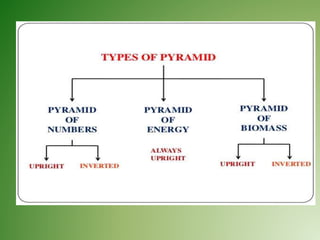
•There are three ecological pyramids
recognized by ecologists:
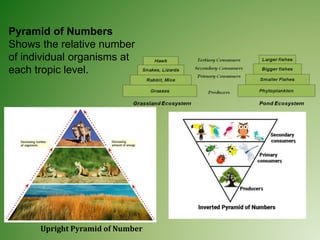
Pyramid of Numbers
Shows the relative number
of individual organisms at
each tropic level.
Upright Pyramid of Number
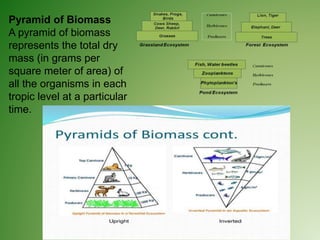
Pyramid of Biomass
A pyramid of biomass
represents the total dry
mass (in grams per
square meter of area) of
all the organisms in each
tropic level at a particular
time.
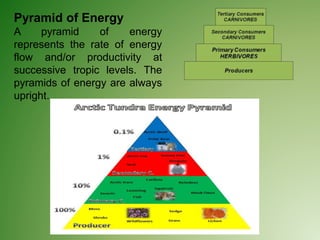
Pyramid of Energy
A pyramid of energy
represents the rate of energy
flow and/or productivity at
successive tropic levels. The
pyramids of energy are always
upright.
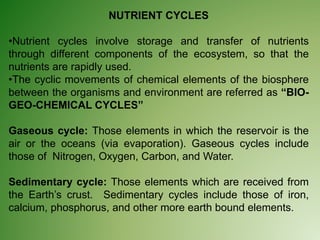
NUTRIENT CYCLES
•Nutrient cycles involve storage and transfer of nutrients
through different components of the ecosystem, so that the
nutrients are rapidly used.
•The cyclic movements of chemical elements of the biosphere
between the organisms and environment are referred as “BIO-
GEO-CHEMICAL CYCLES”
Gaseous cycle: Those elements in which the reservoir is the
air or the oceans (via evaporation). Gaseous cycles include
those of Nitrogen, Oxygen, Carbon, and Water.
Sedimentary cycle: Those elements which are received from
the Earth’s crust. Sedimentary cycles include those of iron,
calcium, phosphorus, and other more earth bound elements.
NITROGEN CYCLE
 Nitrogen is crucial for all organisms
Nucleic acids
Proteins
Chlorophyll
 Nitrogen- 78% in Atmosphere
 N2 is very stable and must be broken apart by
organisms, combined with other atoms into a usable
form.
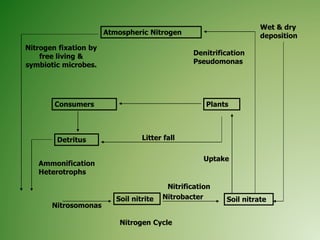
 Nitrogen cycle completes in 5 steps:
Consumers
Detritus
Atmospheric Nitrogen
Plants
Soil nitrite Soil nitrateNitrobacter
Nitrosomonas
Ammonification
Heterotrophs
Litter fall
Uptake
Denitrification
Pseudomonas
Wet & dry
deposition
Nitrogen Cycle
Nitrogen fixation by
free living &
symbiotic microbes.
Nitrification
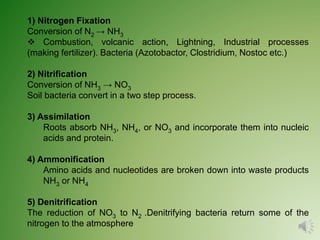
1) Nitrogen Fixation
Conversion of N2 → NH3
 Combustion, volcanic action, Lightning, Industrial processes
(making fertilizer). Bacteria (Azotobactor, Clostridium, Nostoc etc.)
2) Nitrification
Conversion of NH3 → NO3
Soil bacteria convert in a two step process.
3) Assimilation
Roots absorb NH3, NH4, or NO3 and incorporate them into nucleic
acids and protein.
4) Ammonification
Amino acids and nucleotides are broken down into waste products
NH3 or NH4
5) Denitrification
The reduction of NO3 to N2 .Denitrifying bacteria return some of the
nitrogen to the atmosphere
CARBON CYCLE
Carbon enters plants, etc., as CO2
Bacteria process carbon in a fashion that allows it
to be recycled.
Obtain energy from the molecules, and convert
carbohydrates to carbon dioxide as a result of
respiration.
Photosynthesis removes carbon from the abiotic
environment (fixes carbon into organic molecules)
Carbon moves through food chain through
consumption of one organisms by another
Cellular respiration, combustion, and erosion of
limestone return carbon to the atmosphere, water and
abiotic environment.
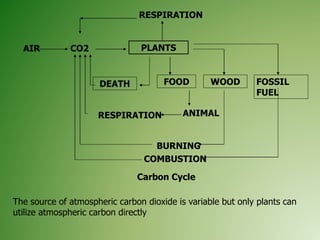
DEATH FOOD
BURNING
COMBUSTION
RESPIRATION
AIR CO2 PLANTS
ANIMALRESPIRATION
WOOD FOSSIL
FUEL
The source of atmospheric carbon dioxide is variable but only plants can
utilize atmospheric carbon directly
Carbon Cycle
PHOSPHOROUS CYCLE
The only cycle that does not have a gaseous state
Inorganic phosphate PO4
3- is released from rocks and
sediments through the action of erosion.
Soil PO4
3- is absorbed by plants and incorporated into
nucleic acids, phospholipids and ATP.
Animals obtain most of their PO4
3- by consumption of other
animals and from water.
PO4
3- is released to the soil again by decomposers.
Dissolved PO4
3- gets absorbed by algae and aquatic plants
Decomposers break down waste and returns PO4
3- to
sediments on the seabed.
Some returns to terrestrial environment through geologic
processes and via seabirds.
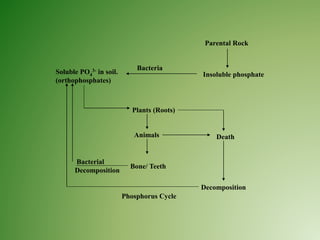
Parental Rock
Soluble PO4
3- in soil.
(orthophosphates)
Bacteria
Insoluble phosphate
Plants (Roots)
Animals Death
Bone/ Teeth
Decomposition
Bacterial
Decomposition
Phosphorus Cycle
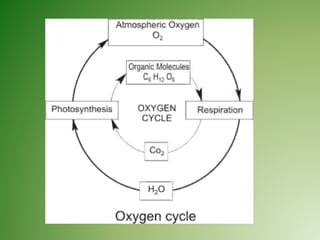
OXYGEN CYCLE
• Oxygen is the most important component of all
living organisms.
• Oxygen is present at about 20.94% by volume in
the atmosphere and in dissolved stte in water
• It also present in combined state with CO2,CO3
2-,
HCO3
-
• Plants, Animals and Human Beings use Oxygen
from the surrounding for aerobic respiration and
release Oxygen in the form of CO2 and water.
• Green plant use CO2 during photosynthesis and
release Oxygen to atmosphere.
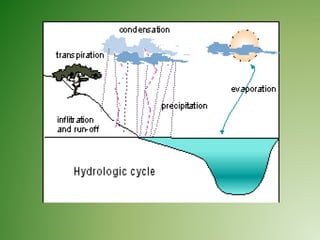
HYDROLOGICAL / WATER CYCLE
• The cyclic movement of water from the
Biosphere through atmosphere, hydrosphere
and lithosphere and back to living organisms
on the earth’s surface is called Hydrological or
Water Cycle.
• The hydrology processes (water cycle) are
influenced by the factors like weather,
temperature, wind, cloud, humidity and
atmospheric condition.
ECOLOGICAL SUCCESSION
•Ecological succession is defined as, “A change in the
community in which new populations of organisms gradually
replace existing ones”.
•There are two types of ecological succession:
1) Primary Succession
2) Secondary Succession
1) Primary Succession
•Occurs where there is no soil, e.g. after a
volcanic eruption or a glacial retreat.
•“Pioneer organisms”
• Simple plants first – no or shallow roots.
• Gradual influx of more complicated and larger
plants as the habitat changes
•Unfavorable for life at first.
•Ends with a “climax community” – ecosystem
stays constant, provided there are no changes in
abiotic influences.
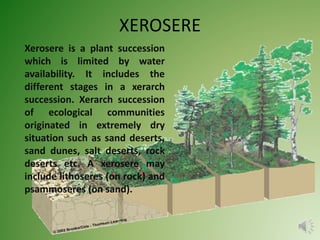
XEROSERE
Xerosere is a plant succession
which is limited by water
availability. It includes the
different stages in a xerarch
succession. Xerarch succession
of ecological communities
originated in extremely dry
situation such as sand deserts,
sand dunes, salt deserts, rock
deserts etc. A xerosere may
include lithoseres (on rock) and
psammoseres (on sand).
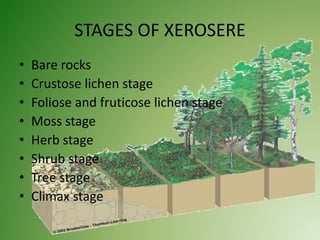
STAGES OF XEROSERE
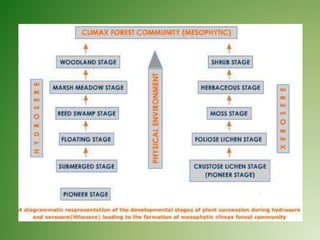
• Bare rocks
• Crustose lichen stage
• Foliose and fruticose lichen stage
• Moss stage
• Herb stage
• Shrub stage
• Tree stage
• Climax stage
2) Secondary Succession
•Community development in
the areas that were
previously occupied by a
other community.
•Occurs after a disturbance.
E.g., loss of trees after
disease, Fire or wind,
deforestation etc.
•Conditions are favorable for
as soil and nutrients are
already present.
•More rapid than primary
succession
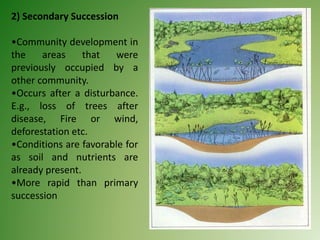
HYDROSERE
• A Hydrosere is a plant succession which occurs in an
area of fresh water, be it an oxbow lake, kettle lake etc.
In time, an area of open freshwater will naturally dry
out, ultimately becoming woodland. During this
change, a range of different land types such as swamp
and marsh will succeed each other.
• The succession from open water to climax woodland
takes centuries or millennia. Some intermediate stages
will last a shorter time than others. For example,
swamp may change to marsh within a decade or less.
How long it takes will depend largely on the amount of
siltation occurring in the area of open water.
STAGES OF HYDROSERE
1. Phytoplankton stage
2. Submerged stage
3. Floating stage
4. Reed swamp stage
5. Sedge-meadow stage
6. Woodland stage
7. Climax stage
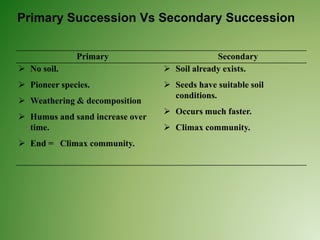
Primary Secondary
 No soil.
 Pioneer species.
 Weathering & decomposition
 Humus and sand increase over
time.
 End = Climax community.
 Soil already exists.
 Seeds have suitable soil
conditions.
 Occurs much faster.
 Climax community.
Primary Succession Vs Secondary Succession
Thank you

Ecosystem and Ecological succession

  • 1.
    Ecosystem and EcologicalSuccession By Dr. Abanti Pradhan Assistant Professor Dept. of Chemistry, ITER, Bhubaneswar SOA [ deemed to be University] Env. Science Lecture series CHM-1002
  • 2.
    • Ecosystem –Anecosystem is a self sufficient, natural functional ecological unit comprising of living organisms ( biotic community) and their non living ( abiotic or physical and chemical) environment that interact to form a stable self sufficient system. • Example: A Pond, a grassland, forest, desert etc. • The interaction results in continuous production, consumption and exchange of materials between the living and nonliving component of the environment following cyclic process.
  • 6.
    Structure of Ecosystem: Ecosystemhas two main components Biotic components Abiotic components
  • 8.
    Biotic components On thebasic of their role in ecosystem the biotic components can be classified into three functional groups : a) Producer b) Consumers c) Decomposers 1) Producer Organisms The green plants having chlorophyll, with the help of solar energy they produce organic food. They are also called Autotrophs.( Auto- self, trophs- feeder) .
  • 9.
    2) Consumers The animallack chlorophyll and are unable to synthesize their own food. Therefore they depend on producer for their food. They are heterotrophs ( hetero-other, trophs- feeder) In an Eco-System, consumers are of three main types; a) Primary Consumers  These are Herbivores which feed directly on producers. Eg: – Rabbit, Deer, Goat, Cattle etc.. b) Secondary Consumers  These are Primary Carnivores and feed on primary consumers or Hervivores. Eg: Birds, Lizards, Frogs, Snakes and Foxes. c) Tertiary Consumers  These are Secondary Carnivores and feed on secondary consumers – These include top carnivores like Lion, Tiger.
  • 10.
    3) Decomposers These includewide variety of saprotrophic micro- organism like; • Bacteria (Bacillus Sp., Clostridium sp., pseudomonas. • Fungi (Aspergillus sp., Ganoderma sp., Fusarium. • Actinomycetes (Streptomyces). They attract the dead or decayed bodies of organisms & thus decomposition takes place. Therefore, nutrients are released for reuse.
  • 11.
    II. Abiotic components Thenon living part of Eco-system, which have a strong influence on the structure, distribution, behavior and inter-relationship of Organisms. • Climatic Factor : Rain, Temperature, Light, wind, Humidity etc.. • Edaphic Factor : Soil, pH, Topography, Minerals etc.. And Inorganic component which involve in Bio-Geo Chemical Cycle.
  • 12.
    Function of EcoSystem • Energy Flow • Food Chain • Food Web • Nutrient cycles • Ecological pyramid
  • 13.
    Energy Flow inEcosystem: • All organisms must obtain a supply of energy and nutrients from their environment in order to survive. • The transformations of energy in an ecosystem begin first with the input of energy from the sun. • Photosynthesis -- Chemical reaction where green plants use water & carbon dioxide to store the sun’s energy in glucose. • Because, it is the first step in the production of energy for living things, it is called “Primary production”. • Gross Primary Production (GPP) – The total amount of chemical energy stored by plants/unit area/unit time. • Net Primary Production (NPP) – Amount of energy stored after respiratory loss. NPP can be utilized for growth and reproduction of plant. NPP = GPP - R
  • 14.
    • ENERGY isstored in glucose. • Glucose is stored as starch in plants • The majority of autotrophs are photoautotrophs that harness the energy of the sun and pass some of this energy onto consumers through feeding pathways. • The energy contained within producers and consumers is ultimately passed to the decomposers that are responsible for the constant recycling of nutrients. • Thus, there is a one-way flow of energy through the biotic community and a cycling of nutrients between the biotic and abiotic components of the ecosystem • Energy flow cannot occur in reverse direction.
  • 15.
    • Starts fromautotrophs (the producer level, i.e., first trophic level) to Heterotrophs including plant eaters or Herbivores (second trophic level) and so on. • The amount of energy decreases with successive trophic levels. • Only About 1% of energy from the sun is used by green plants & rest remains unutilized. • 10% of Energy transfer from one Trophic level to another and 90% lost in each trophic level. This is called 10% Rule of Energy flow. • Similarly, there is loss of energy in each trophic level. • The transfer of food energy between the organisms in an ecosystem can be tracked by constructing food chains, food webs, pyramids of numbers, biomass and energy and energy flow diagrams.
  • 17.
    FOOD CHAIN •A foodchain may be defined as, “the transfer of energy and nutrients through a series of organisms with repeated process of eating and being eaten”. •In an ecosystem, all the organisms are linked together with one another by food relationship. •Each organism living or dead is potential food for some other organism.
  • 18.
    Depending on thetypes of food and consumer, there are Three types of food chain. • Predator or Grazing GRASS >> DEER >> LION >> DECOMPOSER • Saprophytic or Detritus DEAD ORGANISM >> MICRO ORGANISM >> EARTHWORM >> BIRD >> WOLF >> DECOMPOSER • Parasitic ANIMAL(Host) >> TICK/APHID >> BIRD >> EAGLE / WOLF >> DECOMPOSER
  • 19.
    FOOD WEB •Under natural conditions,the linear arrangement of food chains hardly occurs & these remains connected interconnected with each other through different types of organisms. •Interlocking pattern of several interlinked food chains is termed as FOOD WEB. Food web in grassland ecosystem
  • 21.
    ECOLOGICAL PYRAMIDS •An ”Ecologicalpyramid” is a graphical representation that shows the relative amounts of energy or matter contained within each tropic level in a food chain or food web. •An ecological pyramid shows the relationship between consumers and producers at different tropic levels in an ecosystem •There are three ecological pyramids recognized by ecologists:
  • 23.
    Pyramid of Numbers Showsthe relative number of individual organisms at each tropic level. Upright Pyramid of Number
  • 24.
    Pyramid of Biomass Apyramid of biomass represents the total dry mass (in grams per square meter of area) of all the organisms in each tropic level at a particular time.
  • 25.
    Pyramid of Energy Apyramid of energy represents the rate of energy flow and/or productivity at successive tropic levels. The pyramids of energy are always upright.
  • 26.
    NUTRIENT CYCLES •Nutrient cyclesinvolve storage and transfer of nutrients through different components of the ecosystem, so that the nutrients are rapidly used. •The cyclic movements of chemical elements of the biosphere between the organisms and environment are referred as “BIO- GEO-CHEMICAL CYCLES” Gaseous cycle: Those elements in which the reservoir is the air or the oceans (via evaporation). Gaseous cycles include those of Nitrogen, Oxygen, Carbon, and Water. Sedimentary cycle: Those elements which are received from the Earth’s crust. Sedimentary cycles include those of iron, calcium, phosphorus, and other more earth bound elements.
  • 27.
    NITROGEN CYCLE  Nitrogenis crucial for all organisms Nucleic acids Proteins Chlorophyll  Nitrogen- 78% in Atmosphere  N2 is very stable and must be broken apart by organisms, combined with other atoms into a usable form.  Nitrogen cycle completes in 5 steps:
  • 28.
    Consumers Detritus Atmospheric Nitrogen Plants Soil nitriteSoil nitrateNitrobacter Nitrosomonas Ammonification Heterotrophs Litter fall Uptake Denitrification Pseudomonas Wet & dry deposition Nitrogen Cycle Nitrogen fixation by free living & symbiotic microbes. Nitrification
  • 29.
    1) Nitrogen Fixation Conversionof N2 → NH3  Combustion, volcanic action, Lightning, Industrial processes (making fertilizer). Bacteria (Azotobactor, Clostridium, Nostoc etc.) 2) Nitrification Conversion of NH3 → NO3 Soil bacteria convert in a two step process. 3) Assimilation Roots absorb NH3, NH4, or NO3 and incorporate them into nucleic acids and protein. 4) Ammonification Amino acids and nucleotides are broken down into waste products NH3 or NH4 5) Denitrification The reduction of NO3 to N2 .Denitrifying bacteria return some of the nitrogen to the atmosphere
  • 30.
    CARBON CYCLE Carbon entersplants, etc., as CO2 Bacteria process carbon in a fashion that allows it to be recycled. Obtain energy from the molecules, and convert carbohydrates to carbon dioxide as a result of respiration. Photosynthesis removes carbon from the abiotic environment (fixes carbon into organic molecules) Carbon moves through food chain through consumption of one organisms by another Cellular respiration, combustion, and erosion of limestone return carbon to the atmosphere, water and abiotic environment.
  • 31.
    DEATH FOOD BURNING COMBUSTION RESPIRATION AIR CO2PLANTS ANIMALRESPIRATION WOOD FOSSIL FUEL The source of atmospheric carbon dioxide is variable but only plants can utilize atmospheric carbon directly Carbon Cycle
  • 32.
    PHOSPHOROUS CYCLE The onlycycle that does not have a gaseous state Inorganic phosphate PO4 3- is released from rocks and sediments through the action of erosion. Soil PO4 3- is absorbed by plants and incorporated into nucleic acids, phospholipids and ATP. Animals obtain most of their PO4 3- by consumption of other animals and from water. PO4 3- is released to the soil again by decomposers. Dissolved PO4 3- gets absorbed by algae and aquatic plants Decomposers break down waste and returns PO4 3- to sediments on the seabed. Some returns to terrestrial environment through geologic processes and via seabirds.
  • 33.
    Parental Rock Soluble PO4 3-in soil. (orthophosphates) Bacteria Insoluble phosphate Plants (Roots) Animals Death Bone/ Teeth Decomposition Bacterial Decomposition Phosphorus Cycle
  • 34.
    OXYGEN CYCLE • Oxygenis the most important component of all living organisms. • Oxygen is present at about 20.94% by volume in the atmosphere and in dissolved stte in water • It also present in combined state with CO2,CO3 2-, HCO3 - • Plants, Animals and Human Beings use Oxygen from the surrounding for aerobic respiration and release Oxygen in the form of CO2 and water. • Green plant use CO2 during photosynthesis and release Oxygen to atmosphere.
  • 36.
    HYDROLOGICAL / WATERCYCLE • The cyclic movement of water from the Biosphere through atmosphere, hydrosphere and lithosphere and back to living organisms on the earth’s surface is called Hydrological or Water Cycle. • The hydrology processes (water cycle) are influenced by the factors like weather, temperature, wind, cloud, humidity and atmospheric condition.
  • 38.
    ECOLOGICAL SUCCESSION •Ecological successionis defined as, “A change in the community in which new populations of organisms gradually replace existing ones”. •There are two types of ecological succession: 1) Primary Succession 2) Secondary Succession
  • 39.
    1) Primary Succession •Occurswhere there is no soil, e.g. after a volcanic eruption or a glacial retreat. •“Pioneer organisms” • Simple plants first – no or shallow roots. • Gradual influx of more complicated and larger plants as the habitat changes •Unfavorable for life at first. •Ends with a “climax community” – ecosystem stays constant, provided there are no changes in abiotic influences.
  • 40.
    XEROSERE Xerosere is aplant succession which is limited by water availability. It includes the different stages in a xerarch succession. Xerarch succession of ecological communities originated in extremely dry situation such as sand deserts, sand dunes, salt deserts, rock deserts etc. A xerosere may include lithoseres (on rock) and psammoseres (on sand).
  • 41.
    STAGES OF XEROSERE •Bare rocks • Crustose lichen stage • Foliose and fruticose lichen stage • Moss stage • Herb stage • Shrub stage • Tree stage • Climax stage
  • 42.
    2) Secondary Succession •Communitydevelopment in the areas that were previously occupied by a other community. •Occurs after a disturbance. E.g., loss of trees after disease, Fire or wind, deforestation etc. •Conditions are favorable for as soil and nutrients are already present. •More rapid than primary succession
  • 43.
    HYDROSERE • A Hydrosereis a plant succession which occurs in an area of fresh water, be it an oxbow lake, kettle lake etc. In time, an area of open freshwater will naturally dry out, ultimately becoming woodland. During this change, a range of different land types such as swamp and marsh will succeed each other. • The succession from open water to climax woodland takes centuries or millennia. Some intermediate stages will last a shorter time than others. For example, swamp may change to marsh within a decade or less. How long it takes will depend largely on the amount of siltation occurring in the area of open water.
  • 44.
    STAGES OF HYDROSERE 1.Phytoplankton stage 2. Submerged stage 3. Floating stage 4. Reed swamp stage 5. Sedge-meadow stage 6. Woodland stage 7. Climax stage
  • 45.
    Primary Secondary  Nosoil.  Pioneer species.  Weathering & decomposition  Humus and sand increase over time.  End = Climax community.  Soil already exists.  Seeds have suitable soil conditions.  Occurs much faster.  Climax community. Primary Succession Vs Secondary Succession
  • 47.