The document defines environment and describes its various components. It provides details on the composition and layers of the atmosphere, structure of the lithosphere including the core, mantle and crust, as well as information on the hydrosphere and biotic components of forests and wildlife that make up the biosphere.
In this document
Powered by AI
The environment comprises physical, biological, and manmade components, influencing life and development.
Focuses on the physical components of atmosphere, its composition, layers, and various gases present.
Describes lithosphere, core, mantle, and crust with details on composition, density, and structure.
Covers the hydrosphere, emphasizing water's role, distribution, and its importance to life.
Highlights India's biotic components, types of vegetation, and diverse faunal variety with species counts.
Summarizes the definition, types of environment, aspects of atmosphere, lithosphere, hydrosphere, and biosphere.
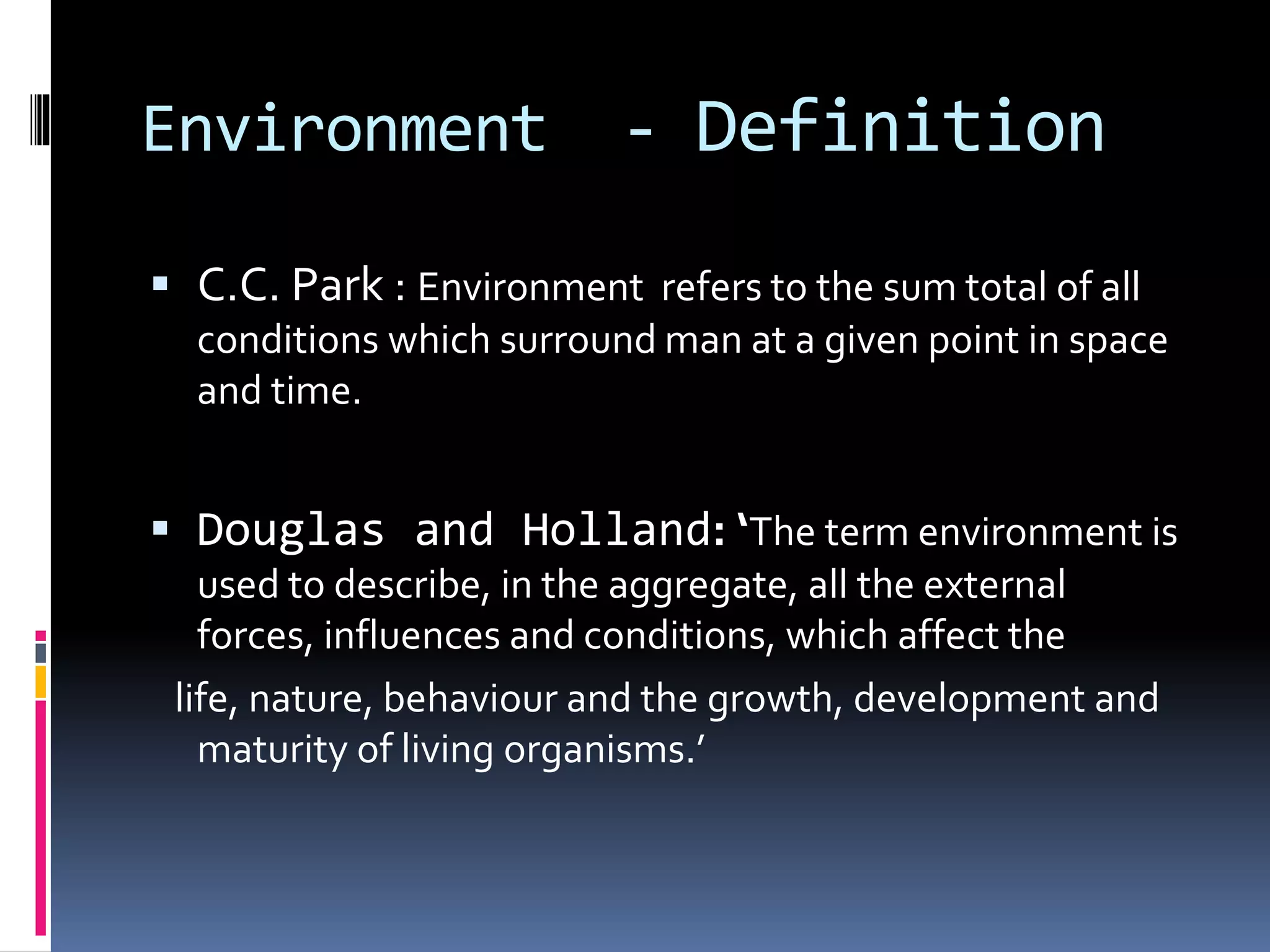
Environment - Definition
C.C. Park : Environment refers to the sum total of all
conditions which surround man at a given point in space
and time.
Douglas and Holland: ‘The term environment is
used to describe, in the aggregate, all the external
forces, influences and conditions, which affect the
life, nature, behaviour and the growth, development and
maturity of living organisms.’
2.
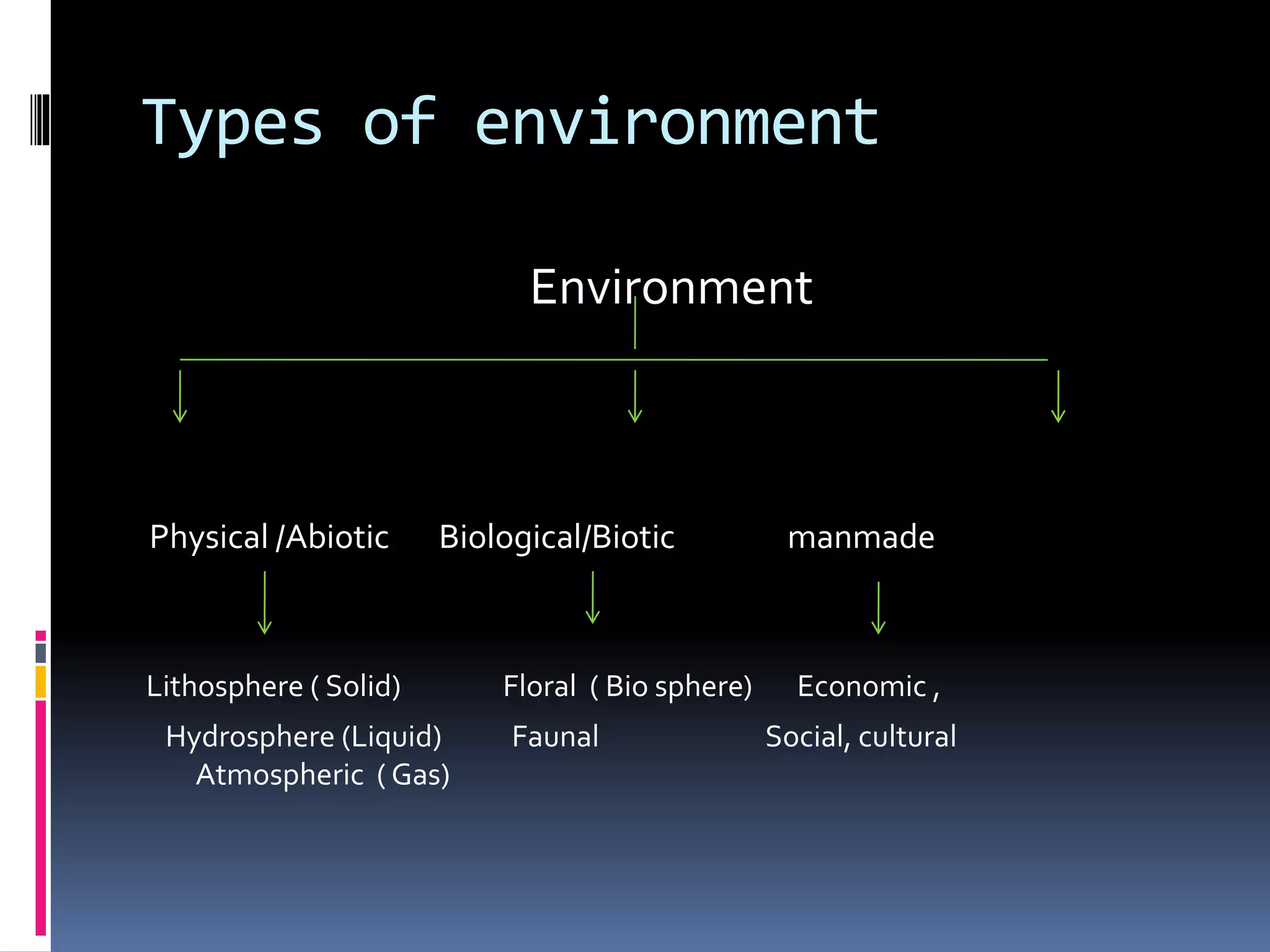
Types of environment
Environment
Physical/Abiotic Biological/Biotic manmade
Lithosphere ( Solid) Floral ( Bio sphere) Economic ,
Hydrosphere (Liquid) Faunal Social, cultural
Atmospheric ( Gas)
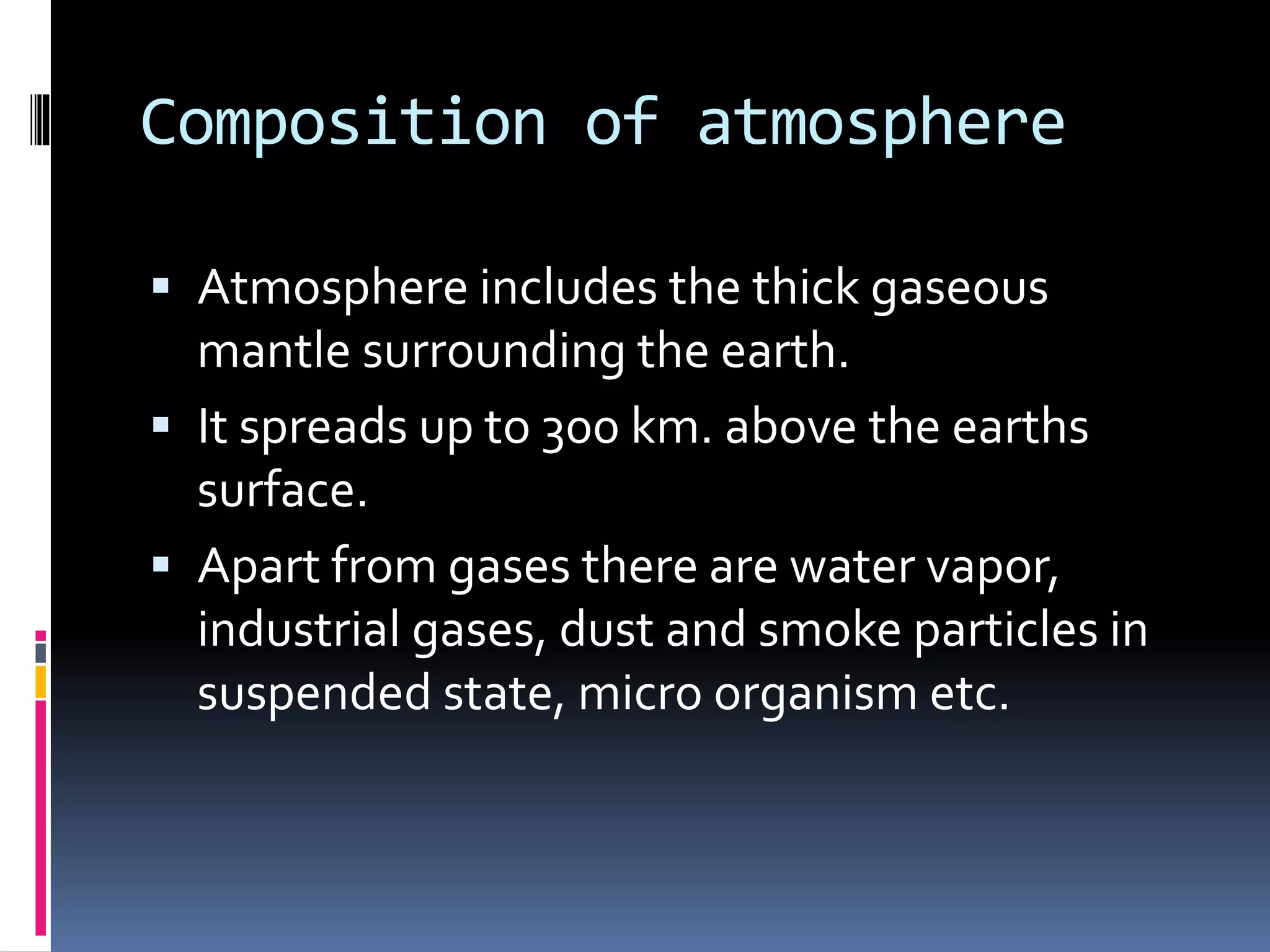
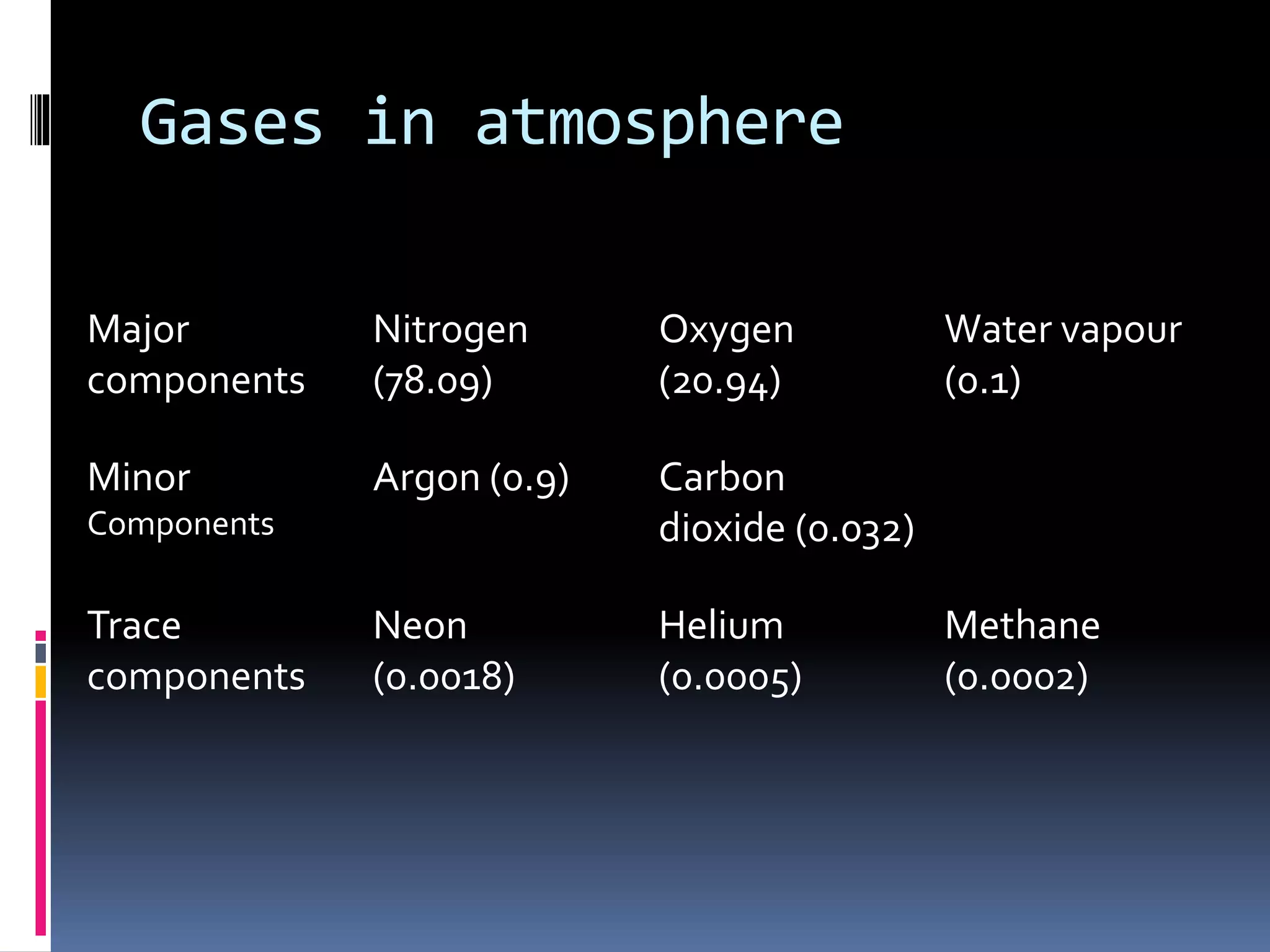
Composition of atmosphere
Atmosphere includes the thick gaseous
mantle surrounding the earth.
It spreads up to 300 km. above the earths
surface.
Apart from gases there are water vapor,
industrial gases, dust and smoke particles in
suspended state, micro organism etc.
5.
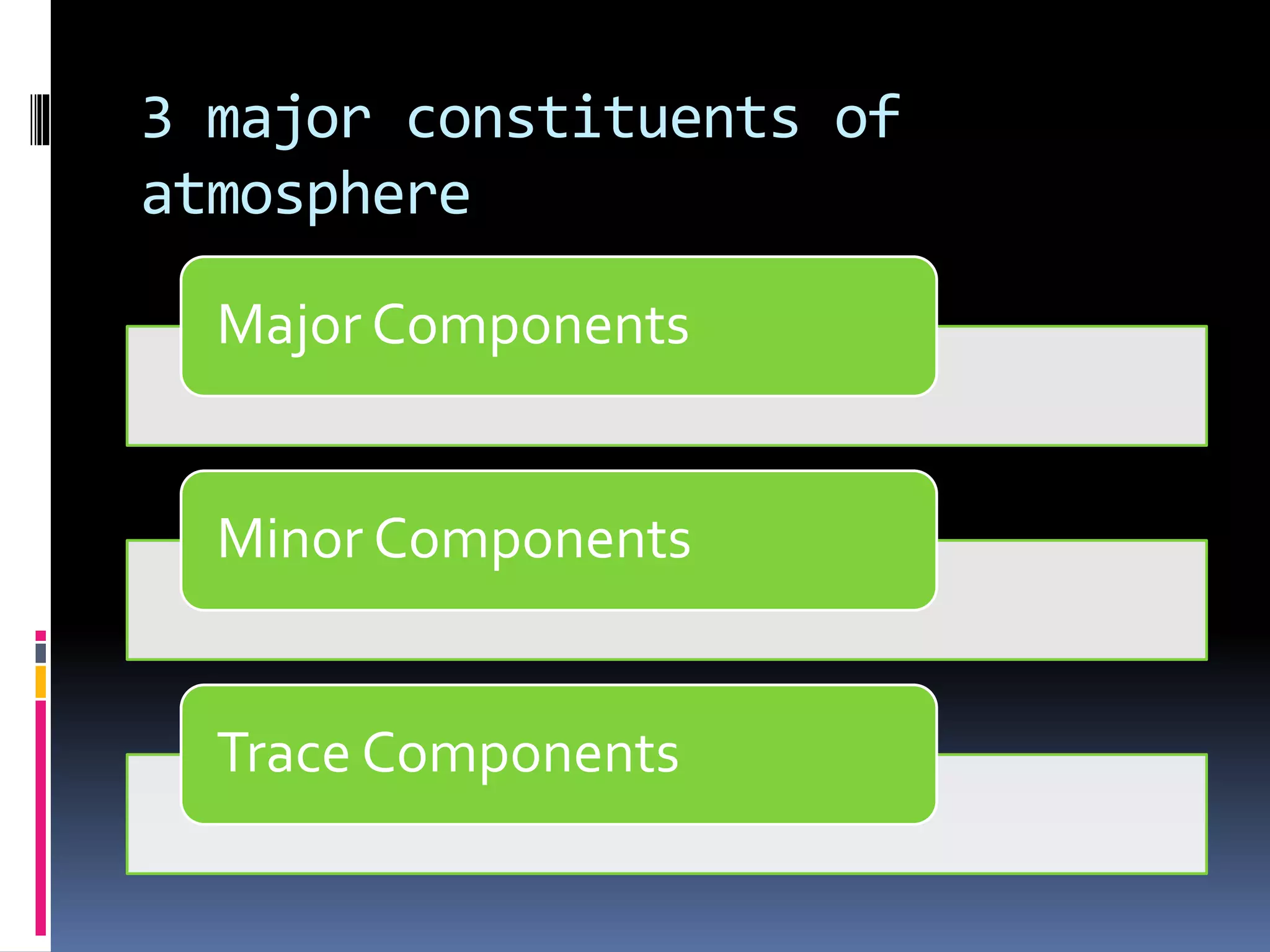
3 major constituentsof
atmosphere
Major Components
Minor Components
Trace Components
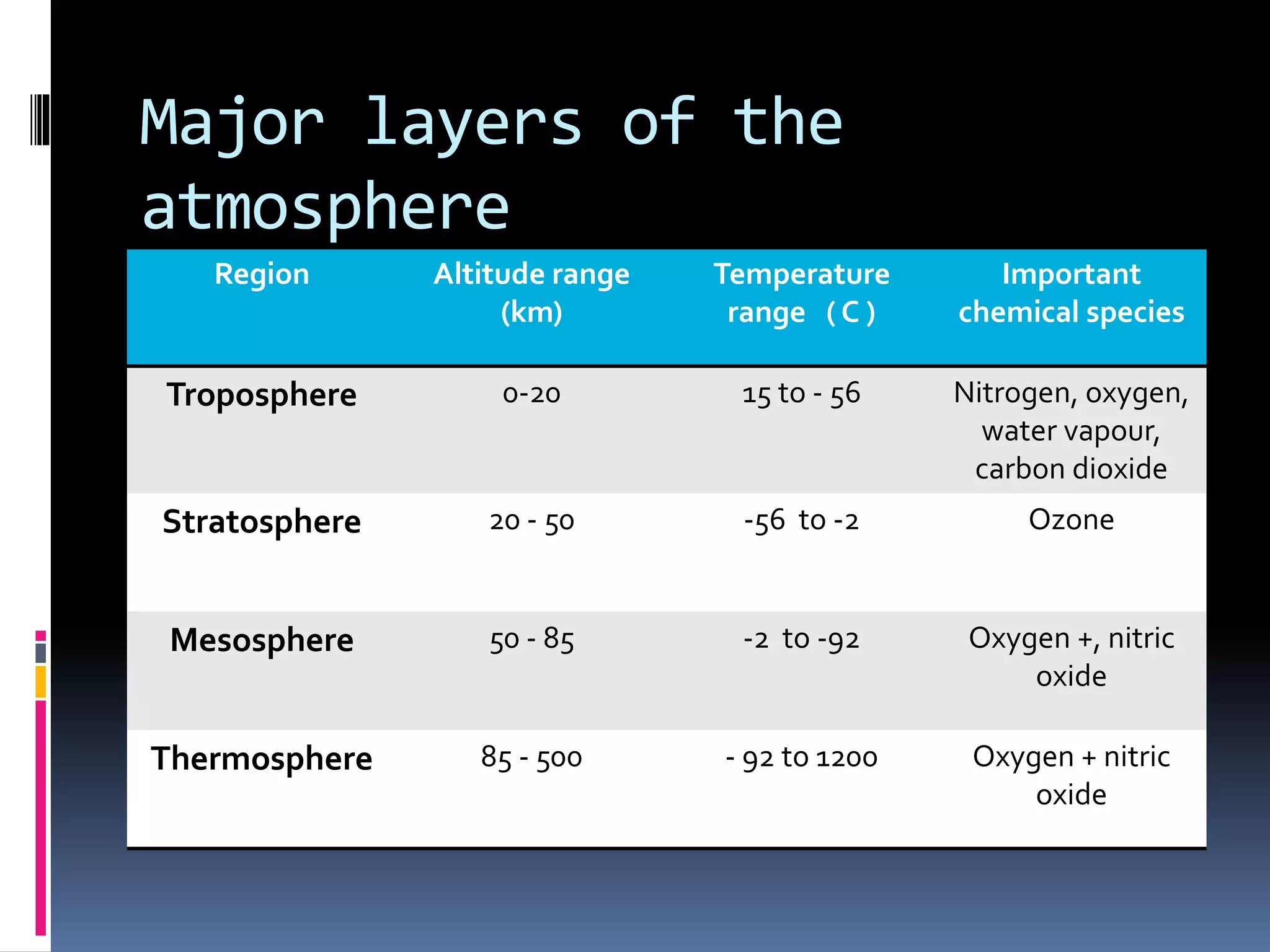
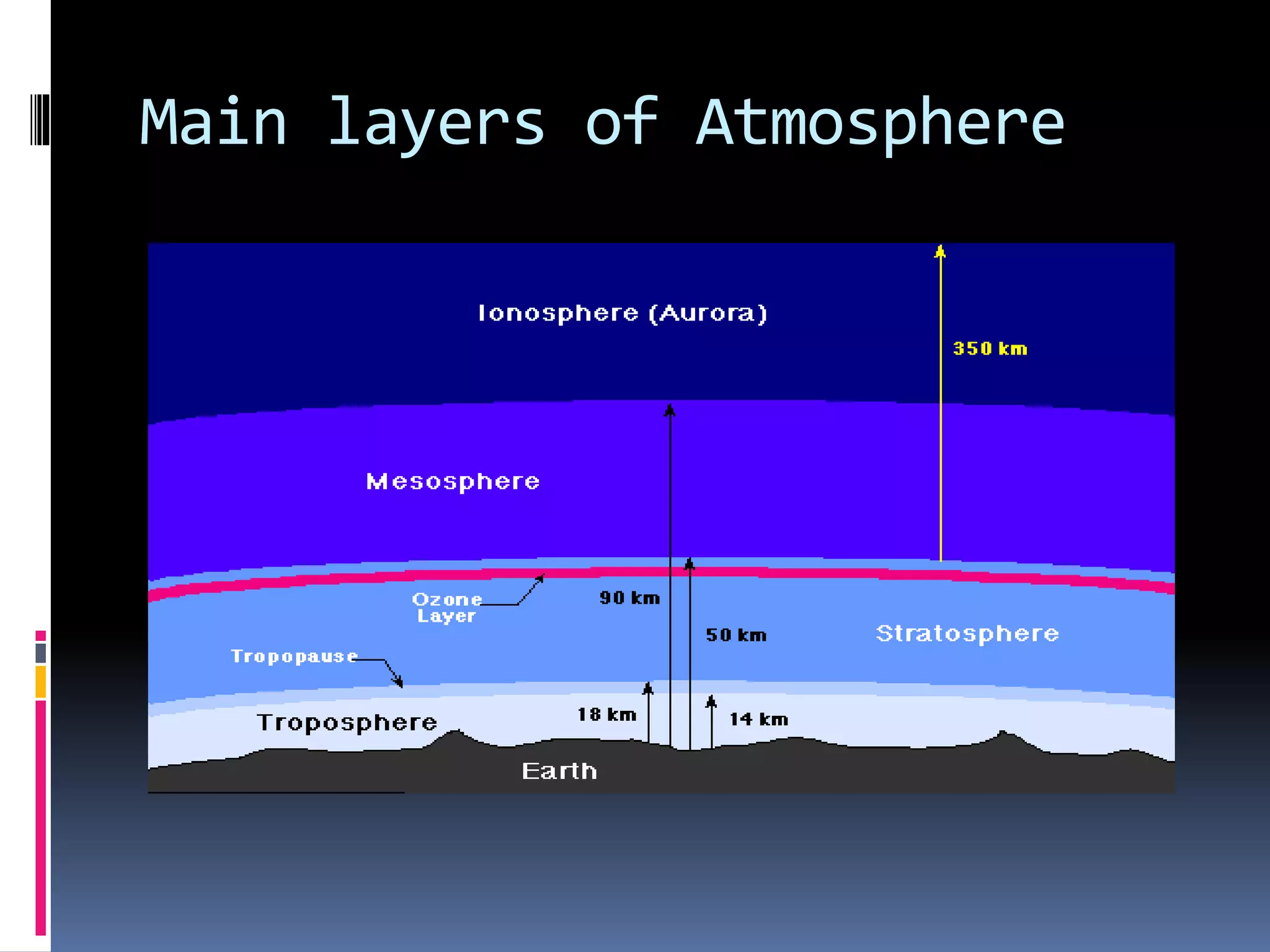
Major layers ofthe
atmosphere
Region Altitude range
(km)
Temperature
range ( C )
Important
chemical species
Troposphere 0-20 15 to - 56 Nitrogen, oxygen,
water vapour,
carbon dioxide
Stratosphere 20 - 50 -56 to -2 Ozone
Mesosphere 50 - 85 -2 to -92 Oxygen +, nitric
oxide
Thermosphere 85 - 500 - 92 to 1200 Oxygen + nitric
oxide
8.
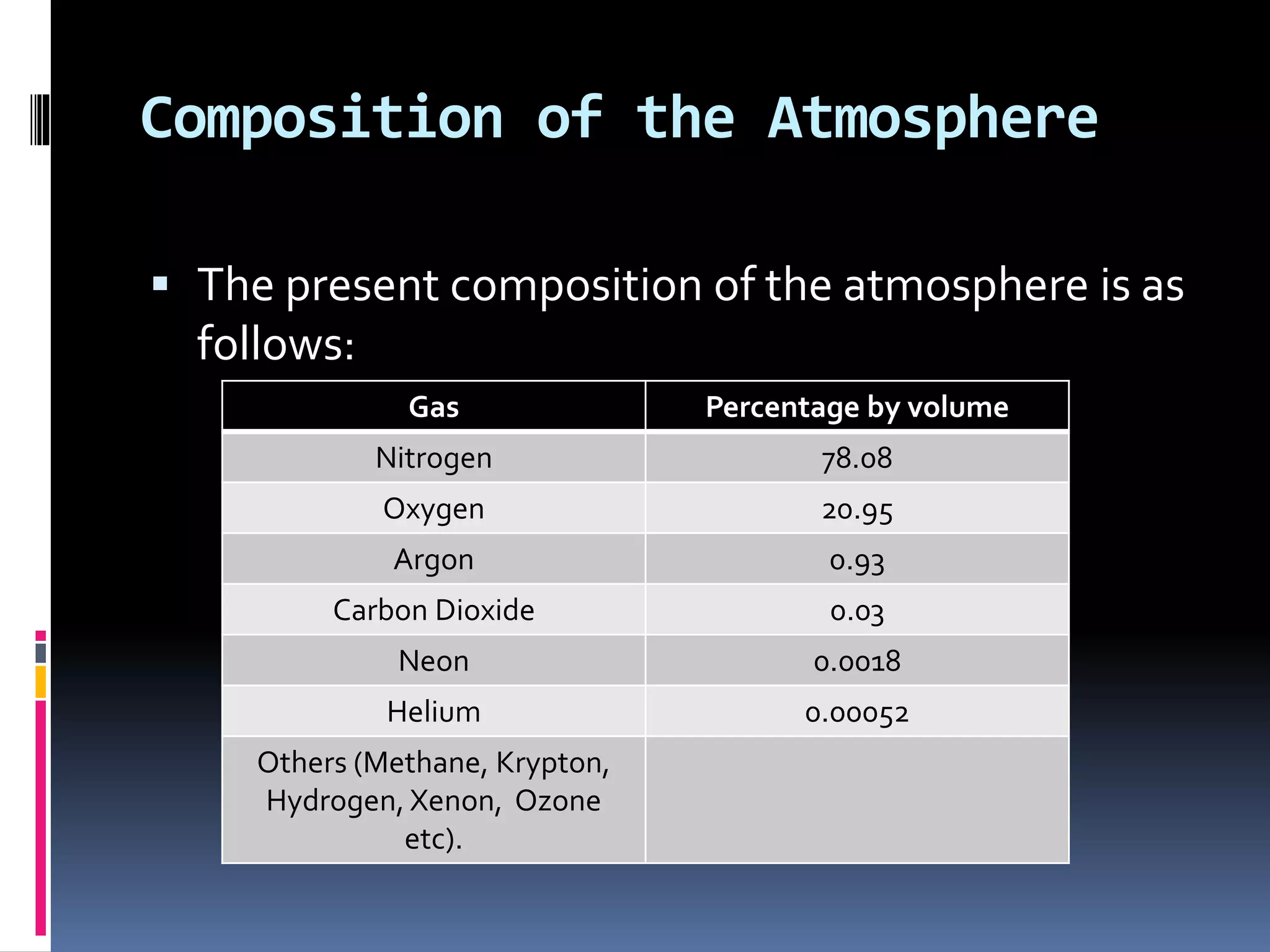
Composition of theAtmosphere
The present composition of the atmosphere is as
follows:
Gas Percentage by volume
Nitrogen 78.08
Oxygen 20.95
Argon 0.93
Carbon Dioxide 0.03
Neon 0.0018
Helium 0.00052
Others (Methane, Krypton,
Hydrogen, Xenon, Ozone
etc).
9.
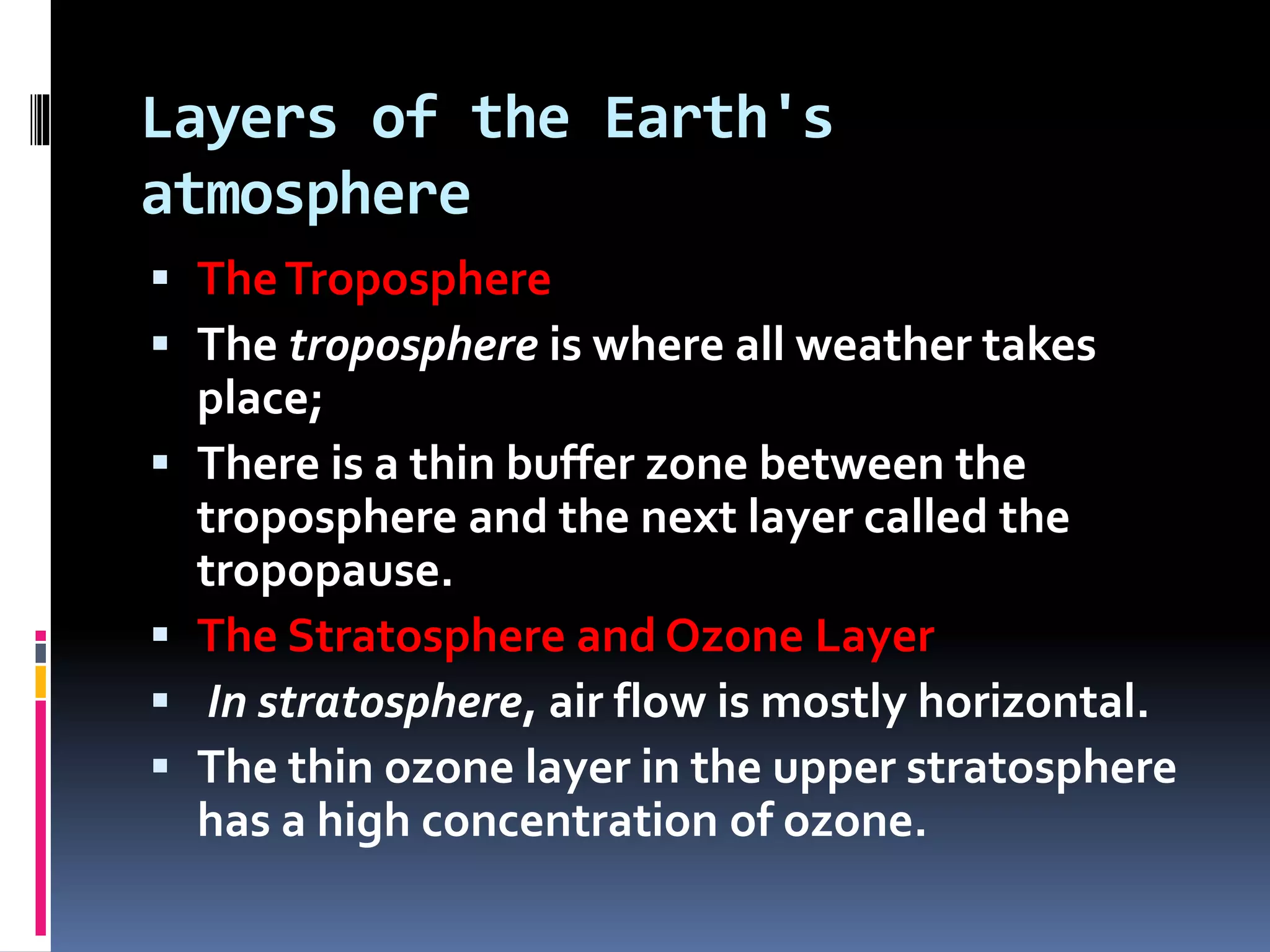
Layers of theEarth's
atmosphere
TheTroposphere
The troposphere is where all weather takes
place;
There is a thin buffer zone between the
troposphere and the next layer called the
tropopause.
The Stratosphere and Ozone Layer
In stratosphere, air flow is mostly horizontal.
The thin ozone layer in the upper stratosphere
has a high concentration of ozone.
10.
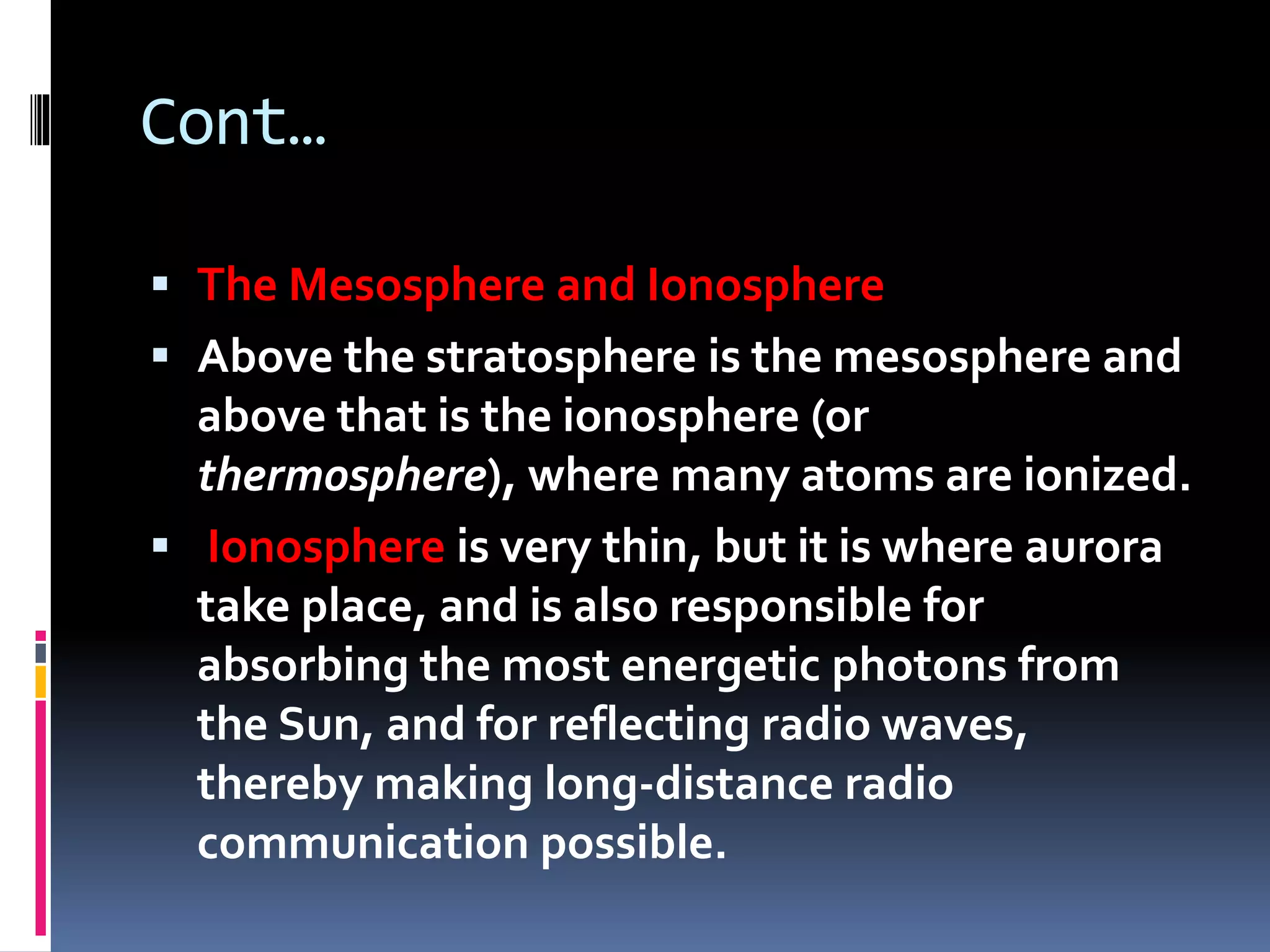
Cont…
The Mesosphereand Ionosphere
Above the stratosphere is the mesosphere and
above that is the ionosphere (or
thermosphere), where many atoms are ionized.
Ionosphere is very thin, but it is where aurora
take place, and is also responsible for
absorbing the most energetic photons from
the Sun, and for reflecting radio waves,
thereby making long-distance radio
communication possible.
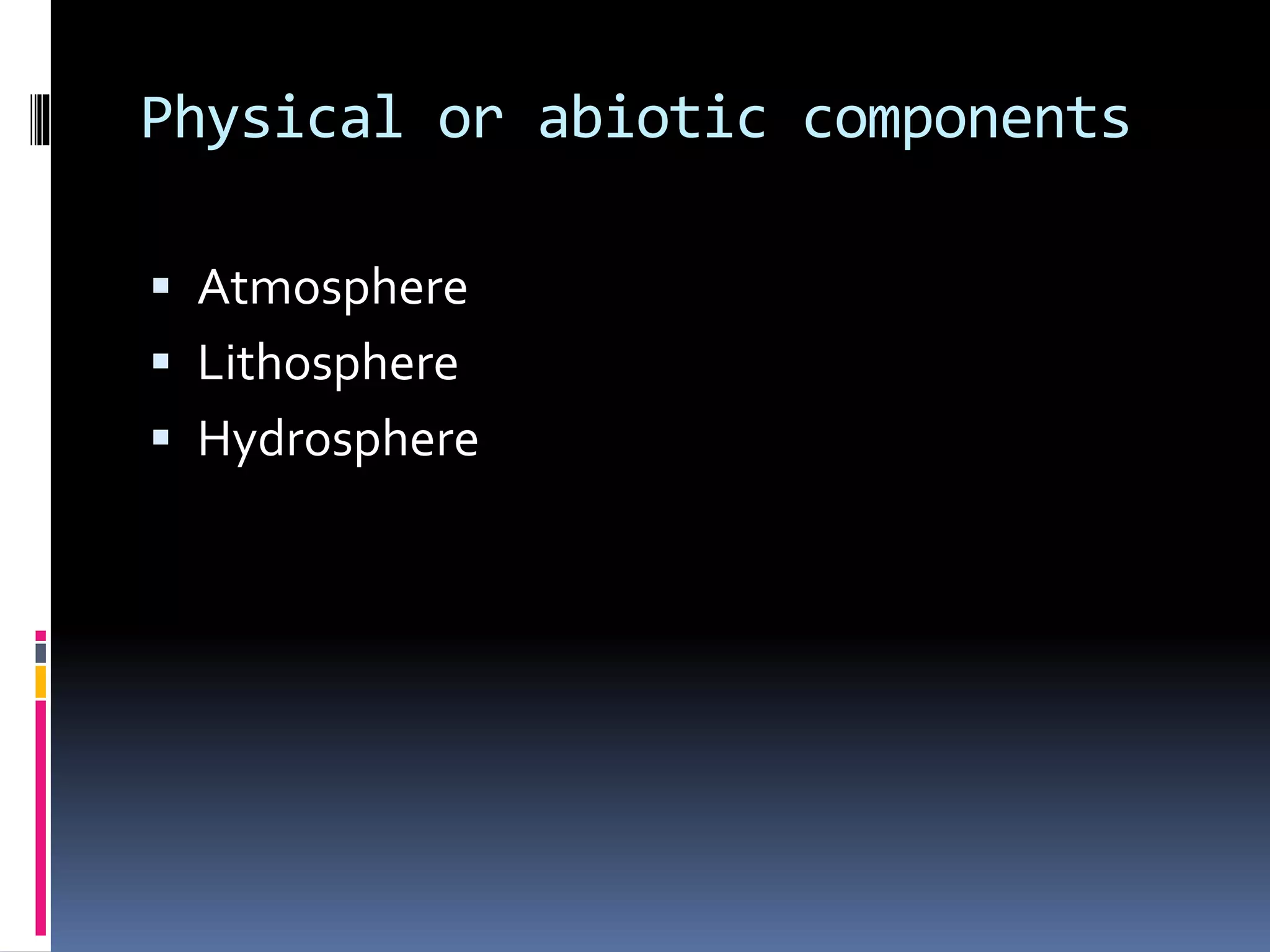
Lithosphere
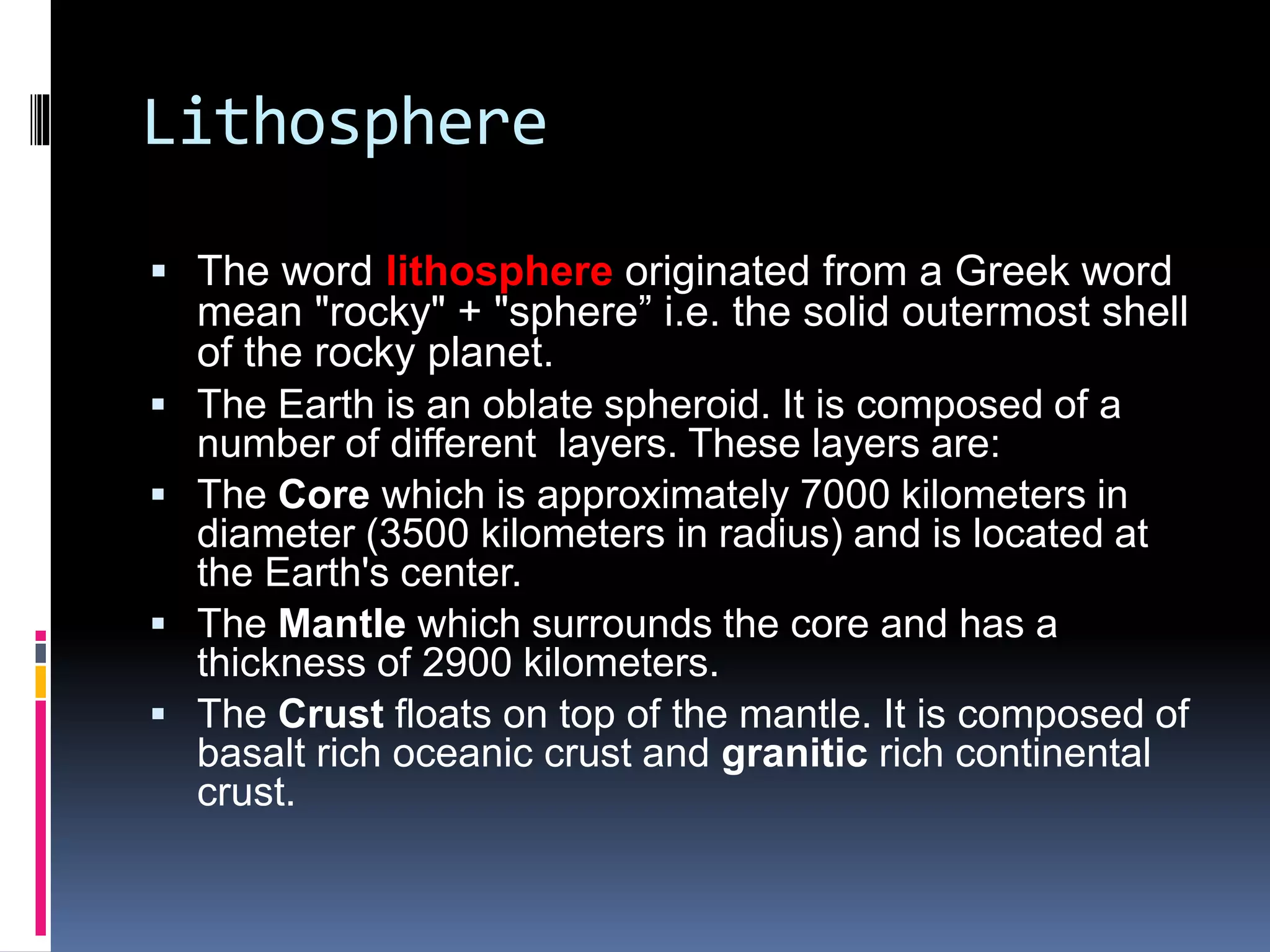
The wordlithosphere originated from a Greek word
mean "rocky" + "sphere” i.e. the solid outermost shell
of the rocky planet.
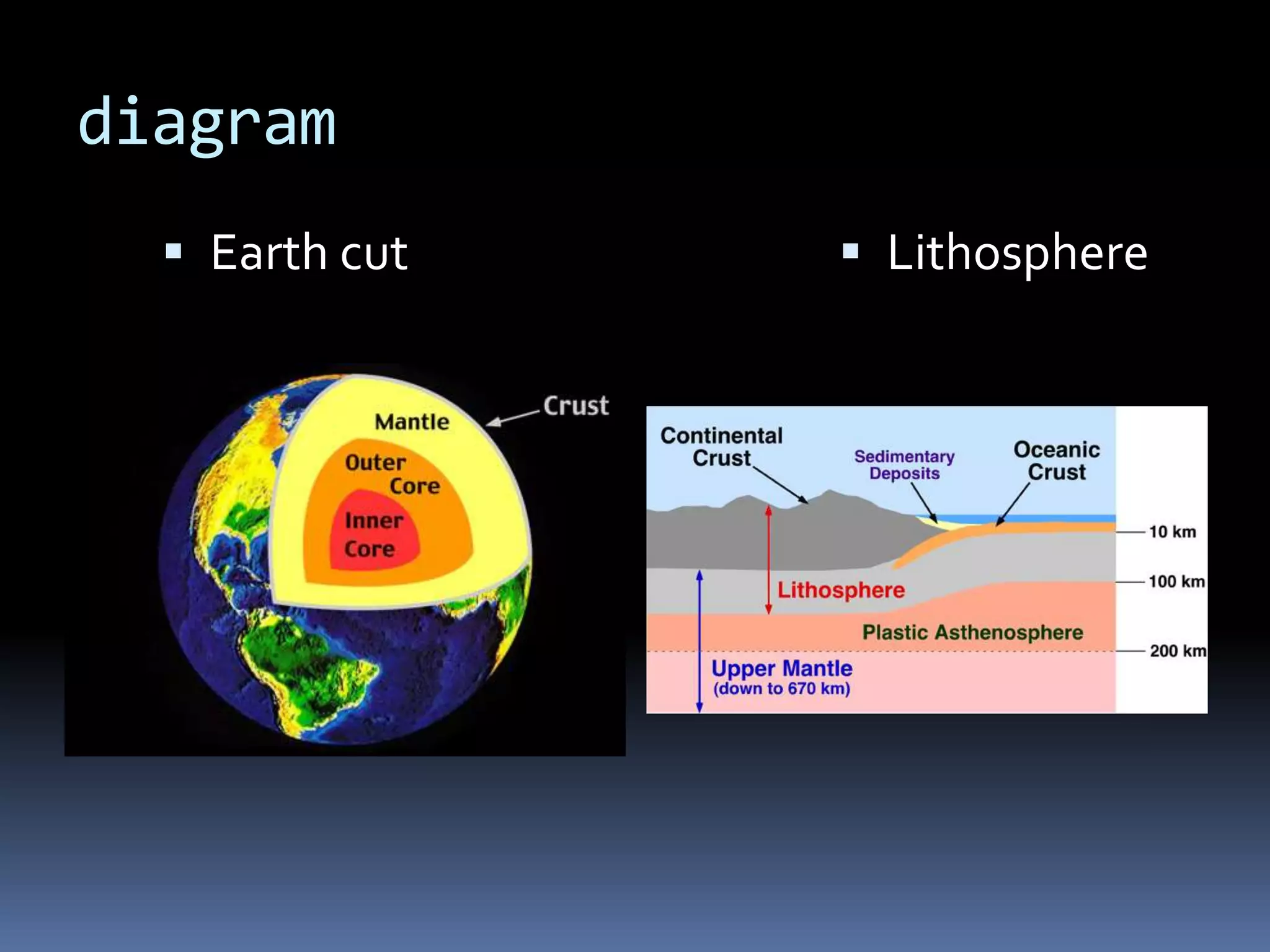
The Earth is an oblate spheroid. It is composed of a
number of different layers. These layers are:
The Core which is approximately 7000 kilometers in
diameter (3500 kilometers in radius) and is located at
the Earth's center.
The Mantle which surrounds the core and has a
thickness of 2900 kilometers.
The Crust floats on top of the mantle. It is composed of
basalt rich oceanic crust and granitic rich continental
crust.
Core
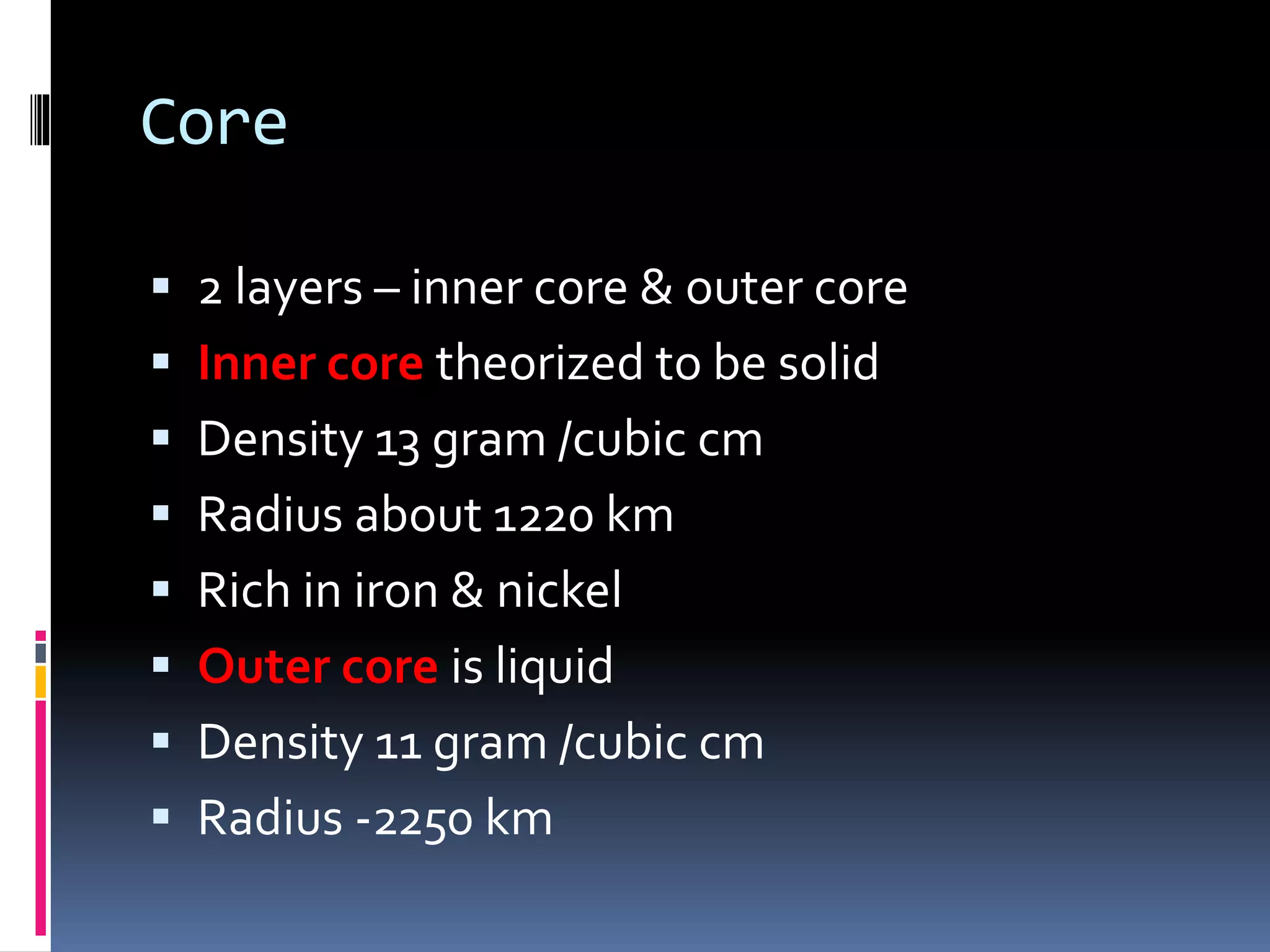
2 layers– inner core & outer core
Inner core theorized to be solid
Density 13 gram /cubic cm
Radius about 1220 km
Rich in iron & nickel
Outer core is liquid
Density 11 gram /cubic cm
Radius -2250 km
15.
MANTLE
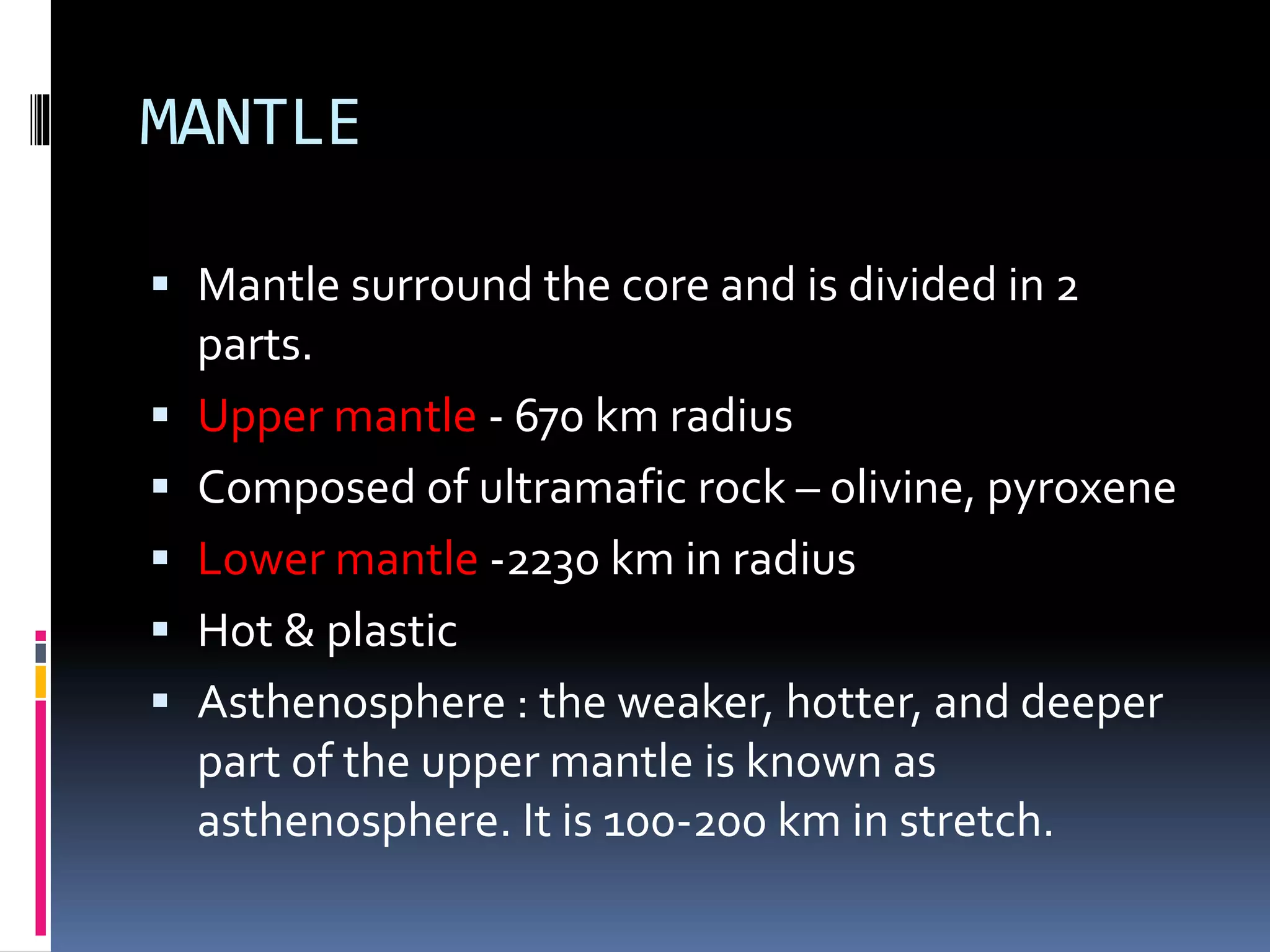
Mantle surroundthe core and is divided in 2
parts.
Upper mantle - 670 km radius
Composed of ultramafic rock – olivine, pyroxene
Lower mantle -2230 km in radius
Hot & plastic
Asthenosphere : the weaker, hotter, and deeper
part of the upper mantle is known as
asthenosphere. It is 100-200 km in stretch.
16.
Crust
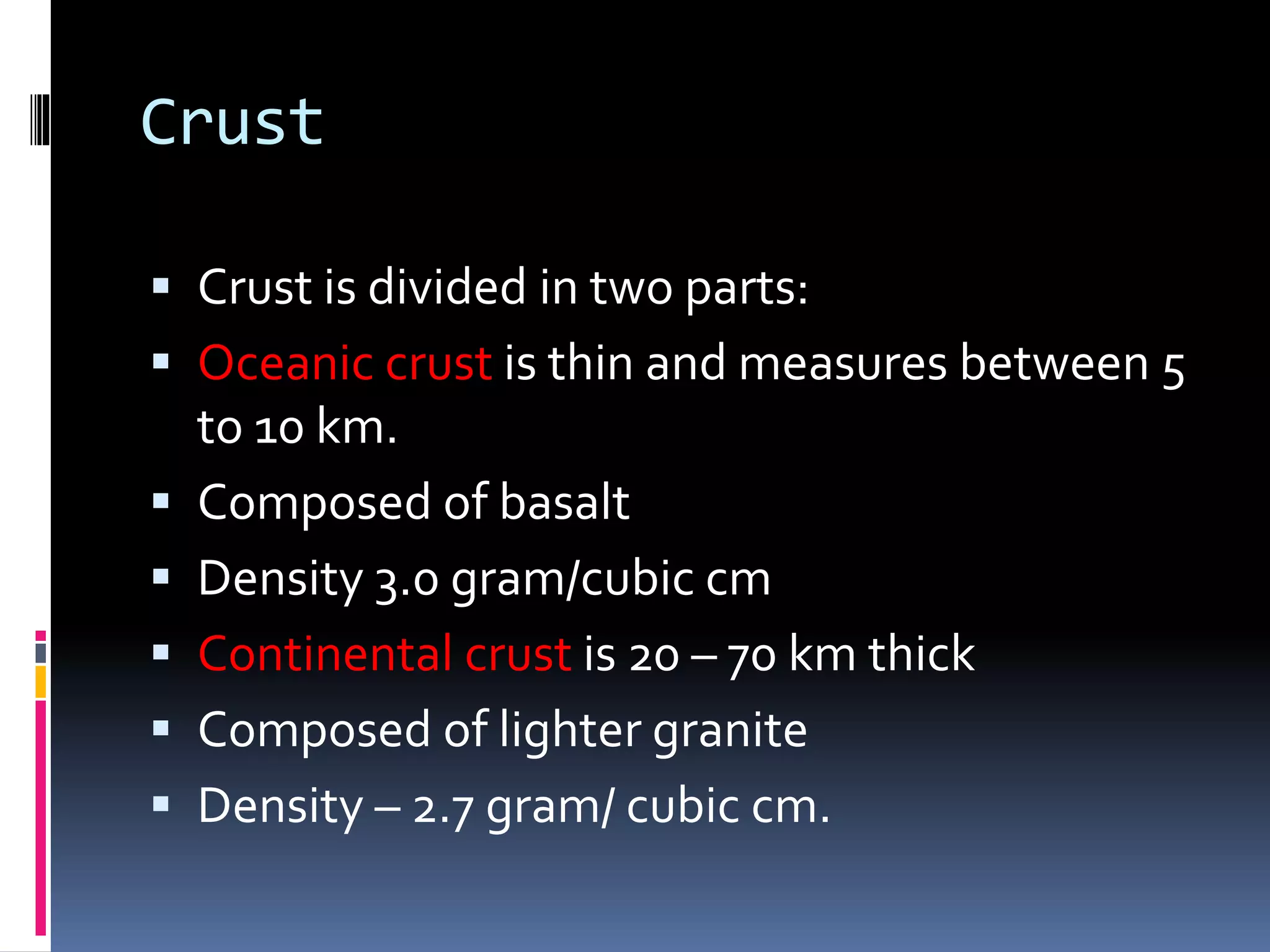
Crust isdivided in two parts:
Oceanic crust is thin and measures between 5
to 10 km.
Composed of basalt
Density 3.0 gram/cubic cm
Continental crust is 20 – 70 km thick
Composed of lighter granite
Density – 2.7 gram/ cubic cm.
17.
Hydrosphere
The hydrosphereincludes all water on Earth.
71% of the earth is covered by water and only 29% is
terra firma.
The range of surface temperatures and pressures of
our planet permit water to exist in all three states:
solid (ice), liquid (water), and gas (water vapor).
Most of the water is contained in the oceans.
It buffers the Earth surface from large temperature
changes such as those observed on the moon.
Water is the universal solvent and the basis of all life
on our Planet.
18.
Biotic component ofEnvironment
Forest and Wildlife are necessary biotic
component.
3 basic Biomes of India are-
a. Tropical humid forest
b. Tropical dry and deciduous forest
c. Warm desert and dry desert.
In India total forest area 63.73 mha (19.39% of
the total land area).
19.
Types of vegetation
Forest and Grassland are 2 types of
vegetation found in India.
4 main types of forest found in India are
1) Tropical
2) Montane sub tropical
3) Temperate
4) Alpine
20.
Grassland
3 majortypes of grassland are found
1) Xerophilous
2) Mesophilous
3) Hygrophilous
21.
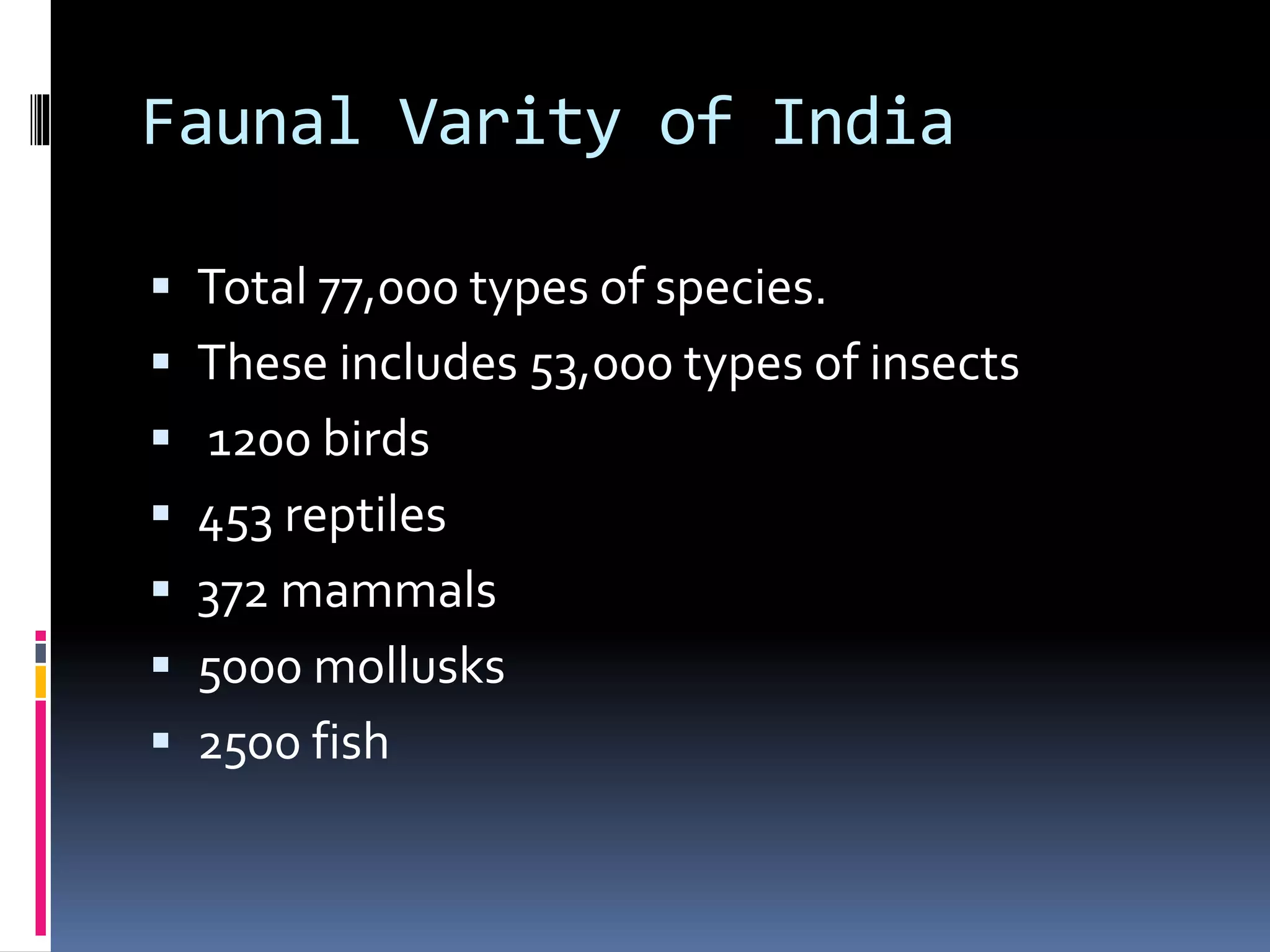
Faunal Varity ofIndia
Total 77,000 types of species.
These includes 53,000 types of insects
1200 birds
453 reptiles
372 mammals
5000 mollusks
2500 fish
22.
Synopsis
Definition &types of environment
A brief of atmosphere , its composition &
layers
A brief of lithosphere , core , mantle and crust
A brief of hydrosphere and biosphere


![Globalization[1]](https://cdn.slidesharecdn.com/ss_thumbnails/globalization1-141116104336-conversion-gate02-thumbnail.jpg?width=640&height=640&fit=bounds)


