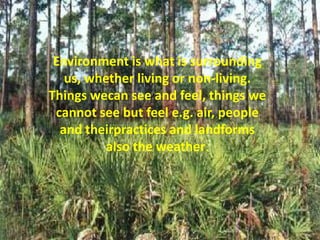
Environment is what is surrounding
us, whether living or non-living.
Things wecan see and feel, things we
cannot see but feel e.g. air, people
and theirpractices and landforms
also the weather.
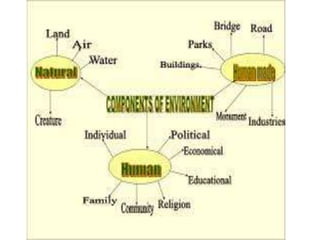
The components of the environment:The
components of the environment are
Bioticcomponents and Abiotic
components:Abiotic components: Water,
air, soil, rocksetc.....Biotic components:
Human beings, plants, animals and micro-
organisms.TheAbiotic component consists
of hydrosphere, atmosphere, biosphere,
Lithosphere.The biotic component
consists of consumers, DE-composer.
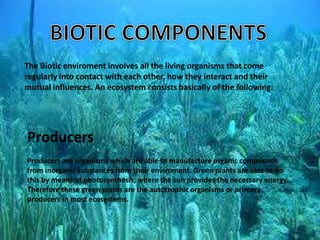
The Biotic enviroment involves all the living organisms that come
regularly into contact with each other, how they interact and their
mutual influences. An ecosystem consists basically of the following:
Producers
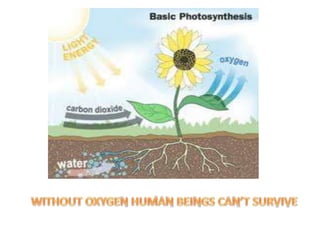
Producers are organisms which are able to manufacture organic compounds
from inorganic substances from their enviroment. Green plants are able to do
this by means of photosynthesis, where the sun provides the necessary energy.
Therefore these green plants are the autotrophic organisms or primary
producers in most ecosystems.
Consumers
This component is made up of organisms which cannot make organic compounds from
inorganic substances. They are dependant upon autotrophic oraganisms and are the
consumers or heterotrophic organisms in an ecosystem. The consumers are further
subdivided according to their diet, into:
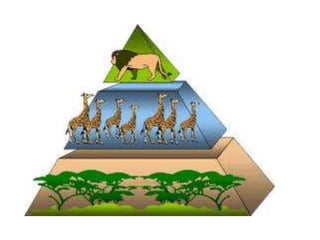
herbivores or plant eaters which are the primary consumers eg. cows, giraffes,
elephants, etc;
carnivores or meat eaters which are the secondary consumers; some carnivores are
called predators (eg. lions, leopard, fish eagle, etc) which catch their prey, kill it and
then eat it; others are called scavengers ( eg. vultures) which usually eat what is left by
the predators;
omnivores eat plant and animal material and can be primary, secondary and tertiary
consumers simutaneously; a human beings is a good example of an omnivore.
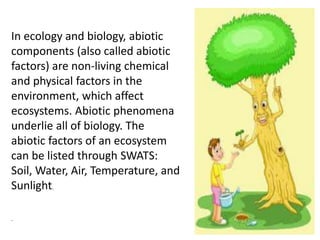
In ecology and biology, abiotic
components (also called abiotic
factors) are non-living chemical
and physical factors in the
environment, which affect
ecosystems. Abiotic phenomena
underlie all of biology. The
abiotic factors of an ecosystem
can be listed through SWATS:
Soil, Water, Air, Temperature, and
Sunlight.
.
In biology, abiotic factors can include soil
acidity, light, radiation, temperature, water,
atmospheric gases, and soil. The
macroscopic climate often influences each
of the above. Pressure and sound waves
may also be considered in the context of
marine or sub-terrestrial environments.
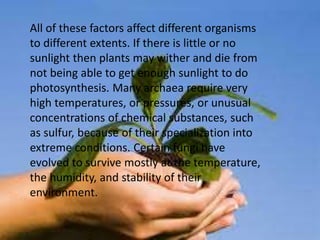
All of these factors affect different organisms
to different extents. If there is little or no
sunlight then plants may wither and die from
not being able to get enough sunlight to do
photosynthesis. Many archaea require very
high temperatures, or pressures, or unusual
concentrations of chemical substances, such
as sulfur, because of their specialization into
extreme conditions. Certain fungi have
evolved to survive mostly at the temperature,
the humidity, and stability of their
environment.
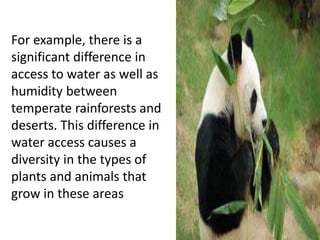
For example, there is a
significant difference in
access to water as well as
humidity between
temperate rainforests and
deserts. This difference in
water access causes a
diversity in the types of
plants and animals that
grow in these areas
ENVIRONMENT: MEANING AND ITS COMPONENTS

ENVIRONMENT: MEANING AND ITS COMPONENTS

  • 2.
    Environment is whatis surrounding us, whether living or non-living. Things wecan see and feel, things we cannot see but feel e.g. air, people and theirpractices and landforms also the weather.
  • 3.
    The components ofthe environment:The components of the environment are Bioticcomponents and Abiotic components:Abiotic components: Water, air, soil, rocksetc.....Biotic components: Human beings, plants, animals and micro- organisms.TheAbiotic component consists of hydrosphere, atmosphere, biosphere, Lithosphere.The biotic component consists of consumers, DE-composer.
  • 5.
    The Biotic enviromentinvolves all the living organisms that come regularly into contact with each other, how they interact and their mutual influences. An ecosystem consists basically of the following: Producers Producers are organisms which are able to manufacture organic compounds from inorganic substances from their enviroment. Green plants are able to do this by means of photosynthesis, where the sun provides the necessary energy. Therefore these green plants are the autotrophic organisms or primary producers in most ecosystems.
  • 6.
    Consumers This component ismade up of organisms which cannot make organic compounds from inorganic substances. They are dependant upon autotrophic oraganisms and are the consumers or heterotrophic organisms in an ecosystem. The consumers are further subdivided according to their diet, into: herbivores or plant eaters which are the primary consumers eg. cows, giraffes, elephants, etc; carnivores or meat eaters which are the secondary consumers; some carnivores are called predators (eg. lions, leopard, fish eagle, etc) which catch their prey, kill it and then eat it; others are called scavengers ( eg. vultures) which usually eat what is left by the predators; omnivores eat plant and animal material and can be primary, secondary and tertiary consumers simutaneously; a human beings is a good example of an omnivore.
  • 8.
    In ecology andbiology, abiotic components (also called abiotic factors) are non-living chemical and physical factors in the environment, which affect ecosystems. Abiotic phenomena underlie all of biology. The abiotic factors of an ecosystem can be listed through SWATS: Soil, Water, Air, Temperature, and Sunlight. .
  • 9.
    In biology, abioticfactors can include soil acidity, light, radiation, temperature, water, atmospheric gases, and soil. The macroscopic climate often influences each of the above. Pressure and sound waves may also be considered in the context of marine or sub-terrestrial environments.
  • 10.
    All of thesefactors affect different organisms to different extents. If there is little or no sunlight then plants may wither and die from not being able to get enough sunlight to do photosynthesis. Many archaea require very high temperatures, or pressures, or unusual concentrations of chemical substances, such as sulfur, because of their specialization into extreme conditions. Certain fungi have evolved to survive mostly at the temperature, the humidity, and stability of their environment.
  • 11.
    For example, thereis a significant difference in access to water as well as humidity between temperate rainforests and deserts. This difference in water access causes a diversity in the types of plants and animals that grow in these areas