How can an Instructional
Designer help ?
Inge de Waard
Who produces world renowned documentaries?
You are the Expert
The teacher is the Expert
• Expert in your field/s
• Experienced with (online) learning
• Comfort, capacity & content
So what can an Instructional Designer do for you?
Introducing the Instructional
Designer
• Valuable member of the interdisciplinary MOOC team
• Expert in online learning and differentiating pedagogy
• Reducing your workload
• Enhancing your course quality
Support the overall goal: additional pedagogical brain &
production manager.
Reducing workload①
• Additional pedagogically sound brain
• Support EdTech options
• Translating your ideas into pedagogical solutions
① after an initial workload rush
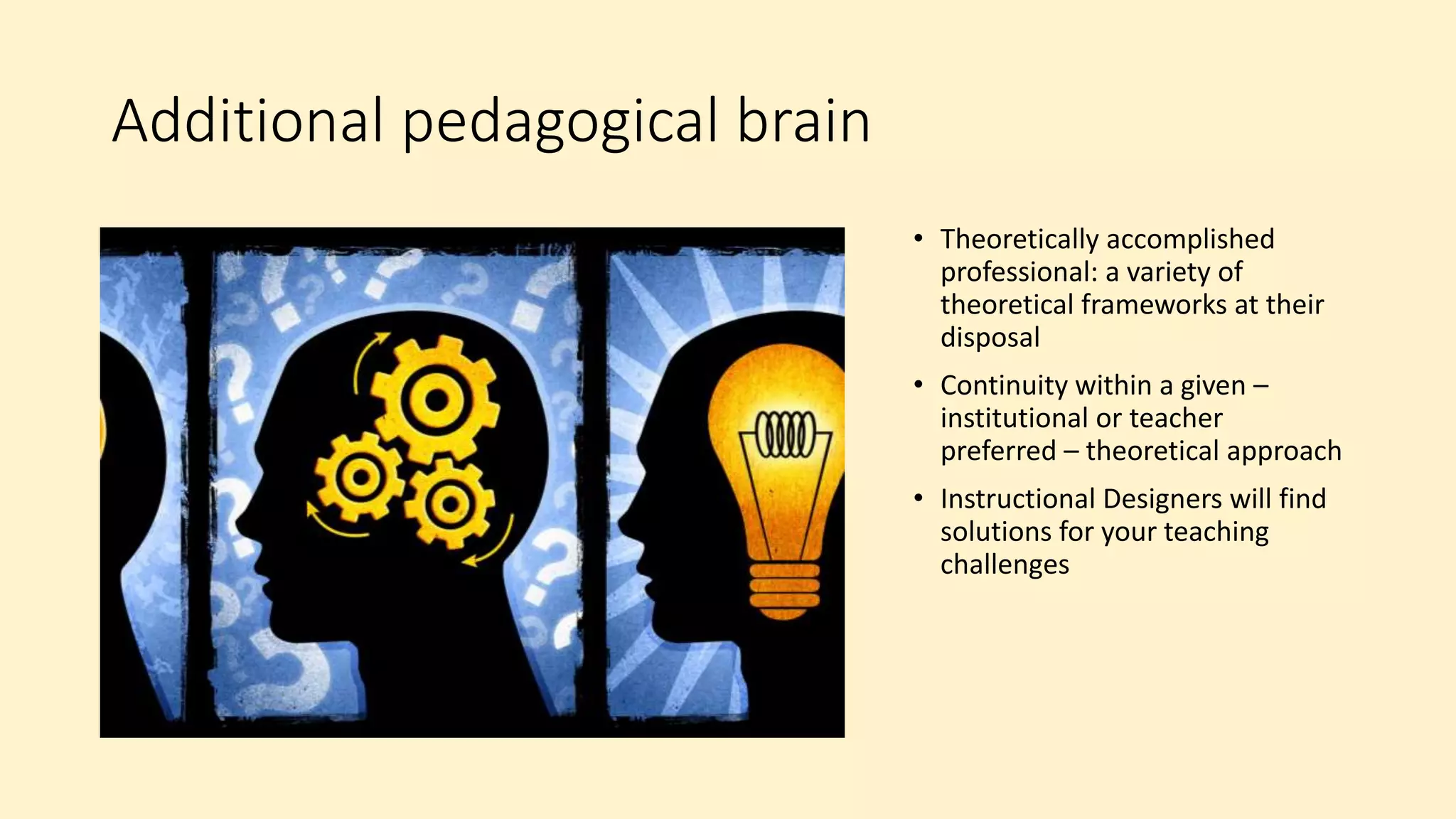
Additional pedagogical brain
• Theoretically accomplished
professional: a variety of
theoretical frameworks at their
disposal
• Continuity within a given –
institutional or teacher
preferred – theoretical approach
• Instructional Designers will find
solutions for your teaching
challenges
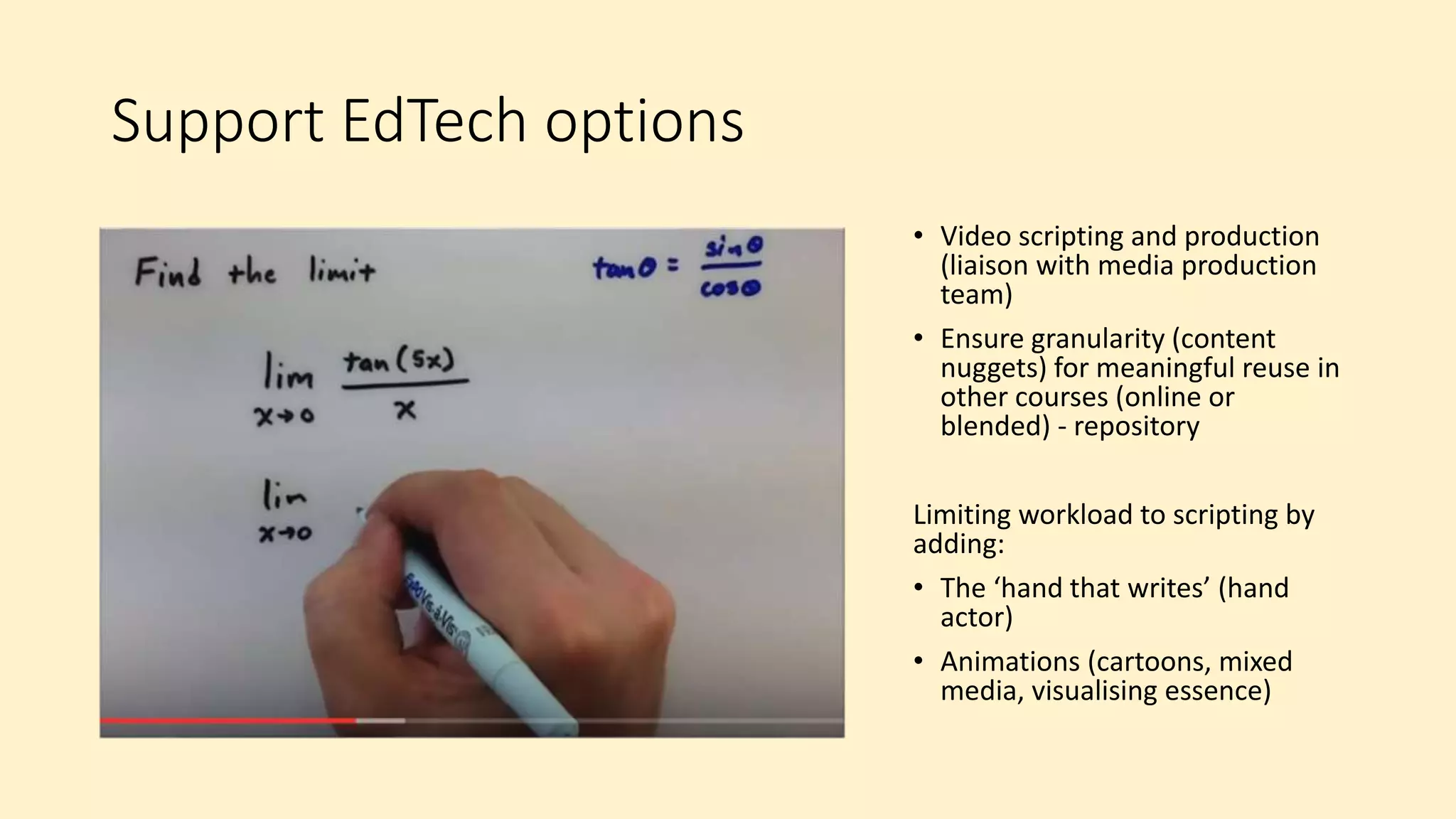
Support EdTech options
• Video scripting and production
(liaison with media production
team)
• Ensure granularity (content
nuggets) for meaningful reuse in
other courses (online or
blended) - repository
Limiting workload to scripting by
adding:
• The ‘hand that writes’ (hand
actor)
• Animations (cartoons, mixed
media, visualising essence)
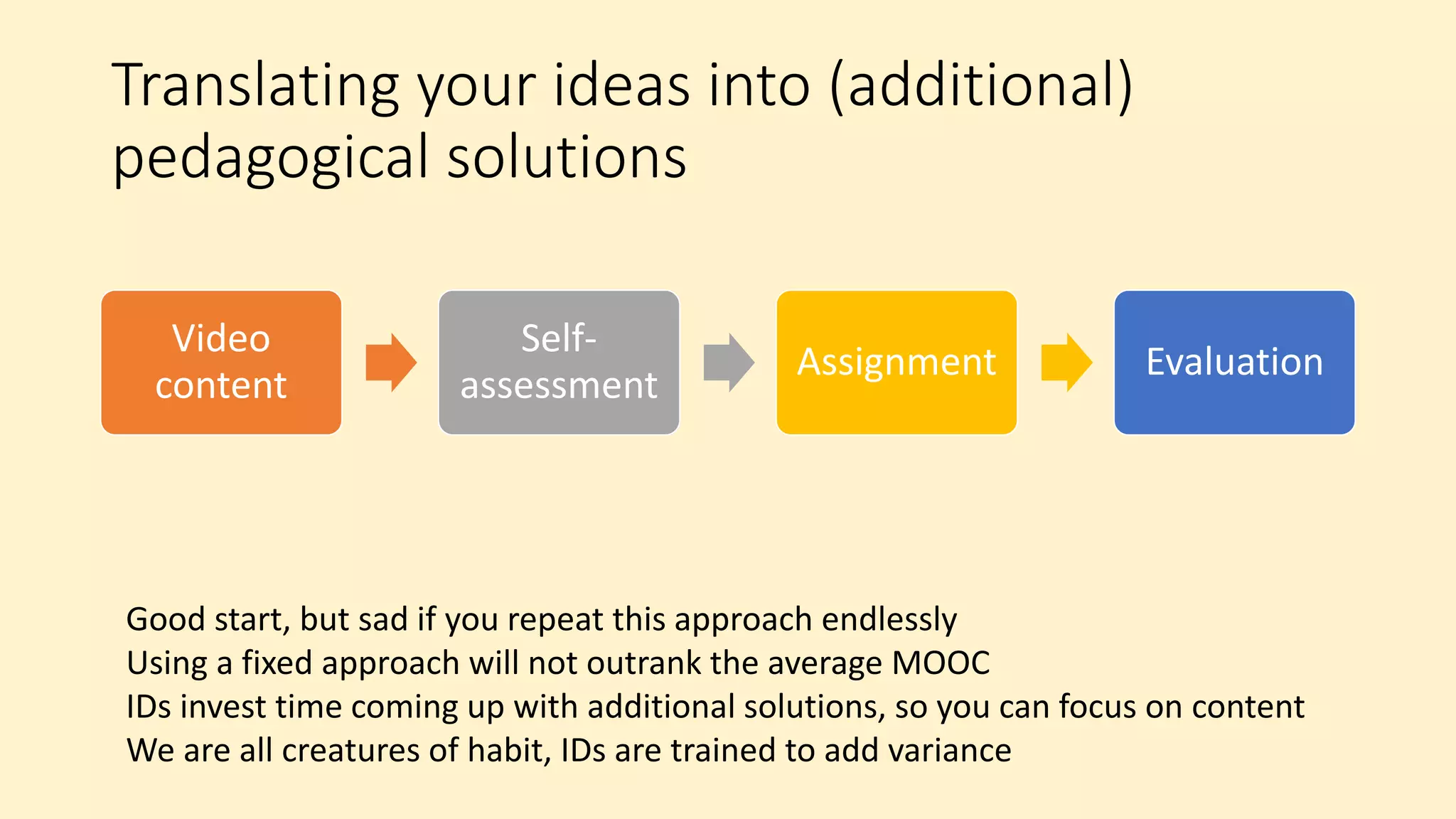
Translating your ideas into (additional)
pedagogical solutions
Video
content
Self-
assessment
Assignment Evaluation
Good start, but sad if you repeat this approach endlessly
Using a fixed approach will not outrank the average MOOC
IDs invest time coming up with additional solutions, so you can focus on content
We are all creatures of habit, IDs are trained to add variance
Evaluation • Learning analytics analysis and recommendations
• Learning / teaching evaluation
• Developing process
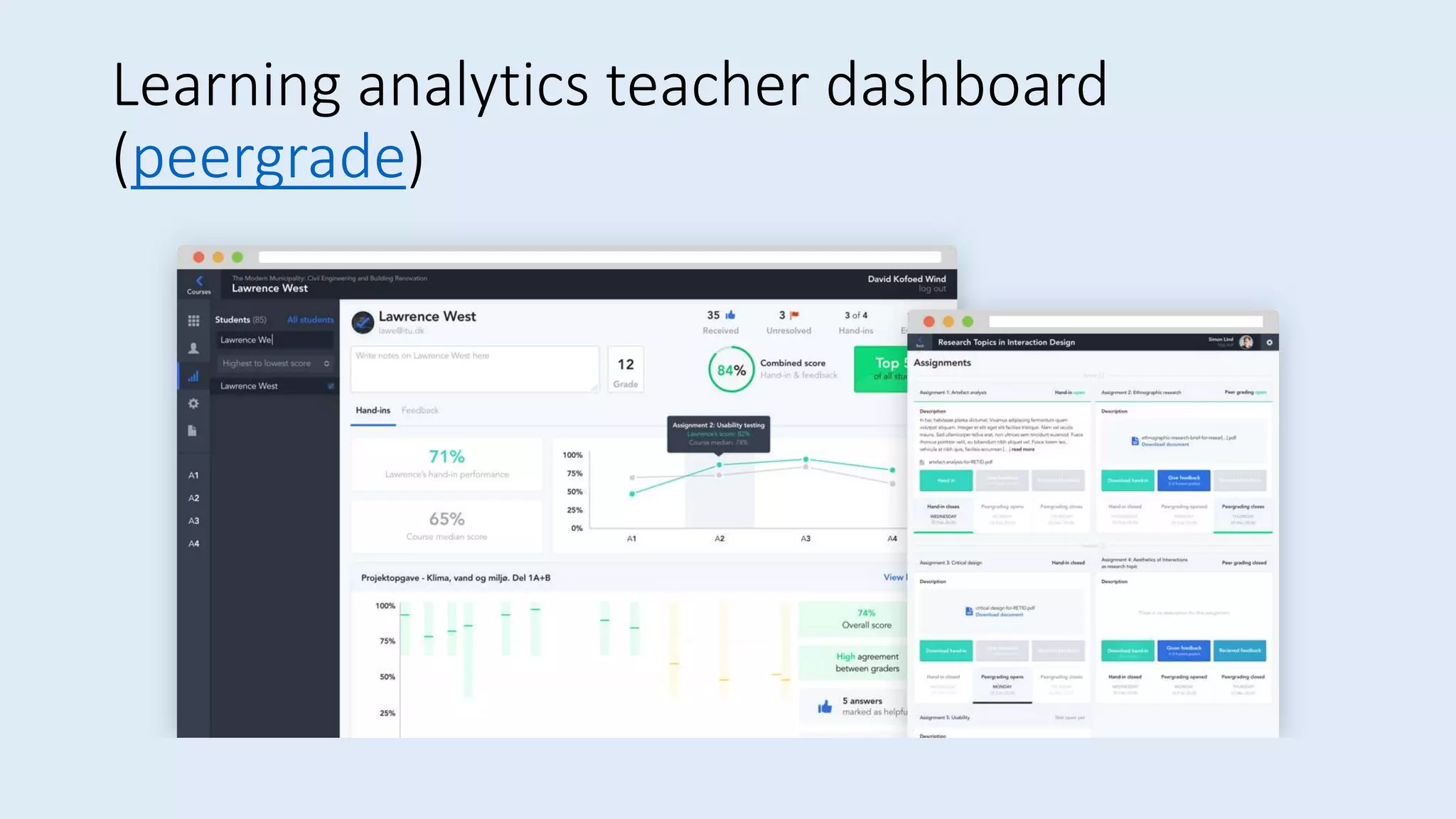
Learning analytics teacher dashboard
(peergrade)
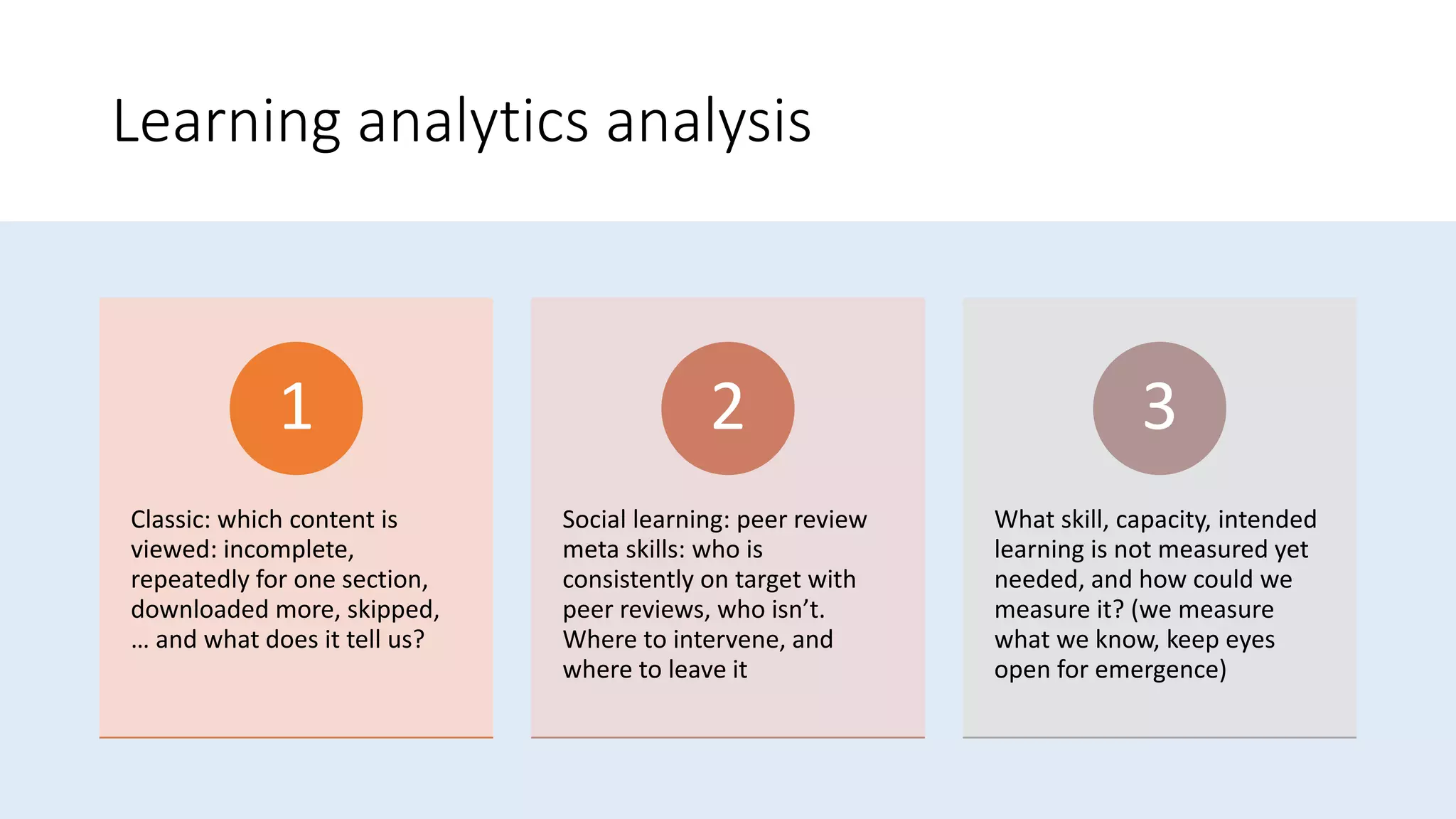
Learning analytics analysis
Classic: which content is
viewed: incomplete,
repeatedly for one section,
downloaded more, skipped,
… and what does it tell us?
1
Social learning: peer review
meta skills: who is
consistently on target with
peer reviews, who isn’t.
Where to intervene, and
where to leave it
2
What skill, capacity, intended
learning is not measured yet
needed, and how could we
measure it? (we measure
what we know, keep eyes
open for emergence)
3
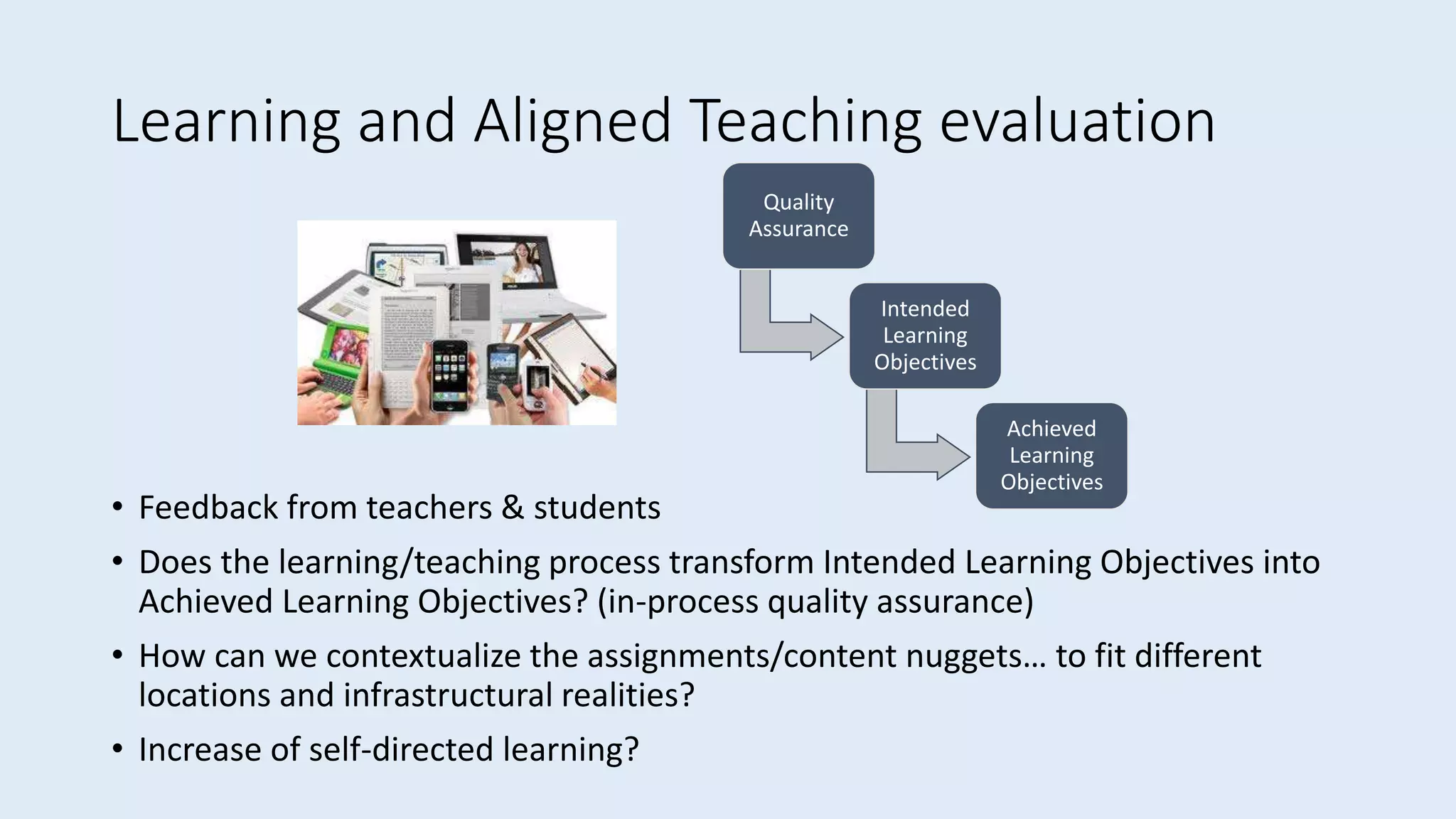
Learning and Aligned Teaching evaluation
• Feedback from teachers & students
• Does the learning/teaching process transform Intended Learning Objectives into
Achieved Learning Objectives? (in-process quality assurance)
• How can we contextualize the assignments/content nuggets… to fit different
locations and infrastructural realities?
• Increase of self-directed learning?
Quality
Assurance
Intended
Learning
Objectives
Achieved
Learning
Objectives
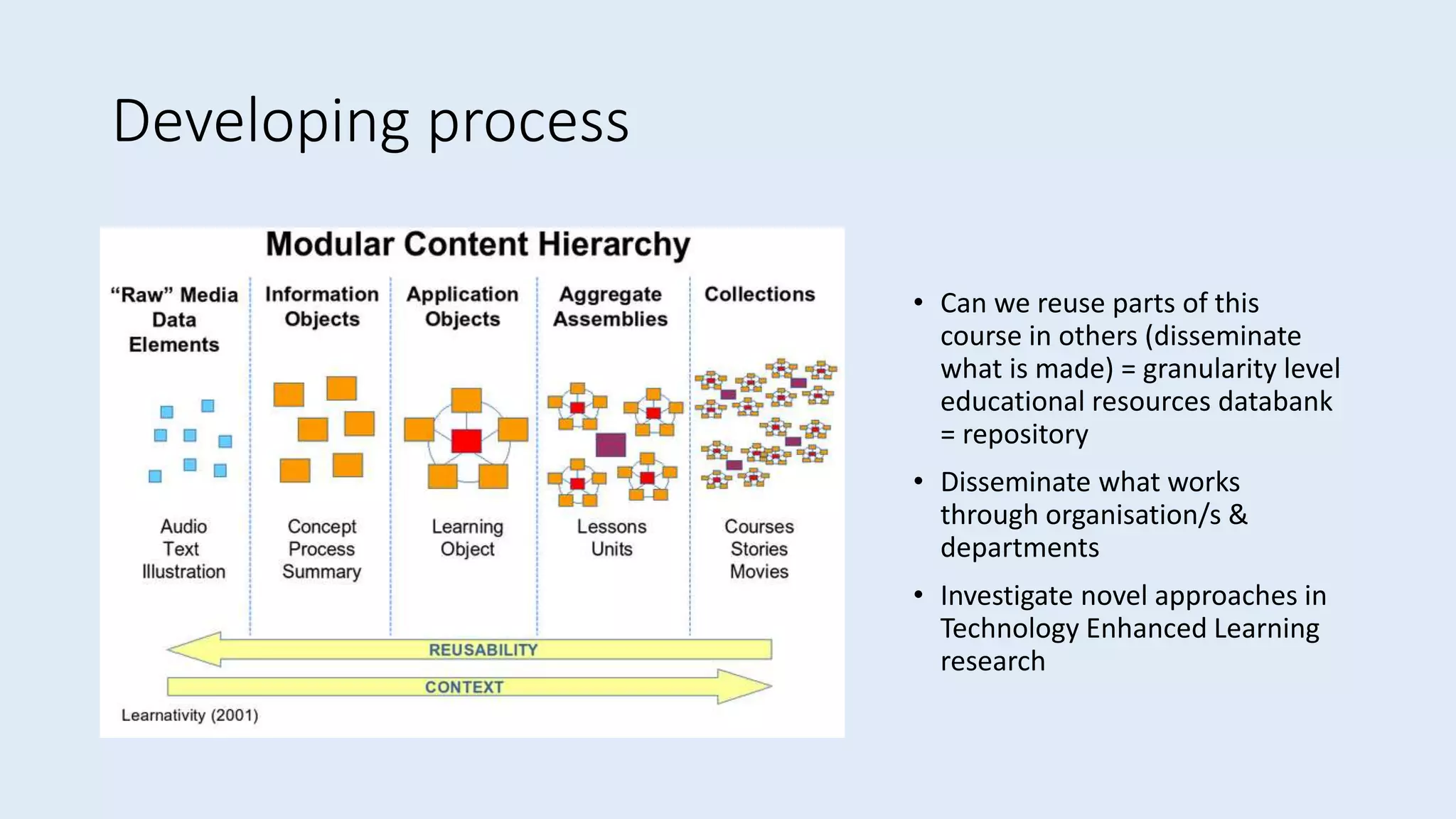
Developing process
• Can we reuse parts of this
course in others (disseminate
what is made) = granularity level
educational resources databank
= repository
• Disseminate what works
through organisation/s &
departments
• Investigate novel approaches in
Technology Enhanced Learning
research
Instructional Design
Variation
• Simple to complex
• Variation within opposing learning
parameters
• Innovative (research-based) approaches
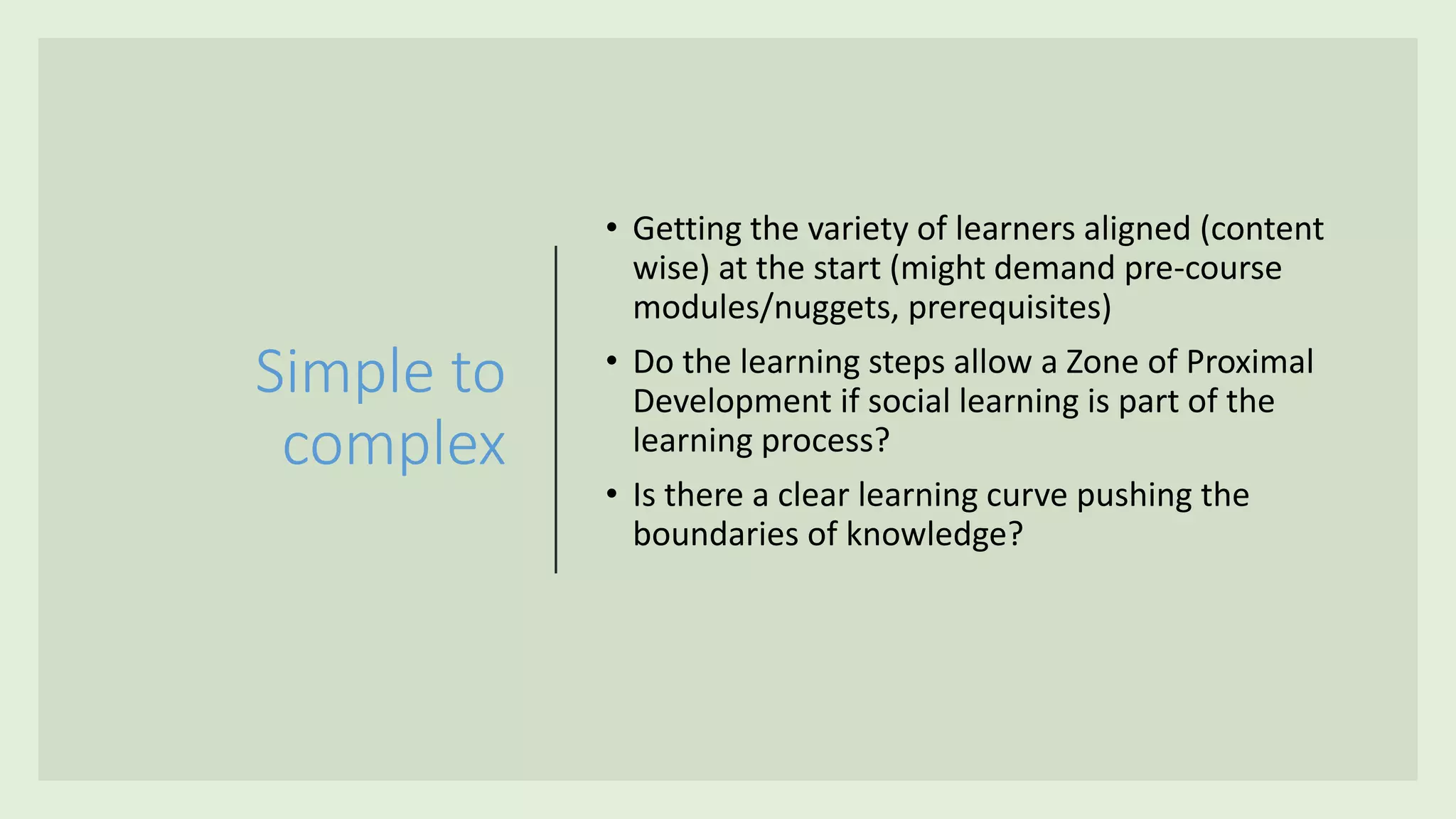
Simple to
complex
• Getting the variety of learners aligned (content
wise) at the start (might demand pre-course
modules/nuggets, prerequisites)
• Do the learning steps allow a Zone of Proximal
Development if social learning is part of the
learning process?
• Is there a clear learning curve pushing the
boundaries of knowledge?
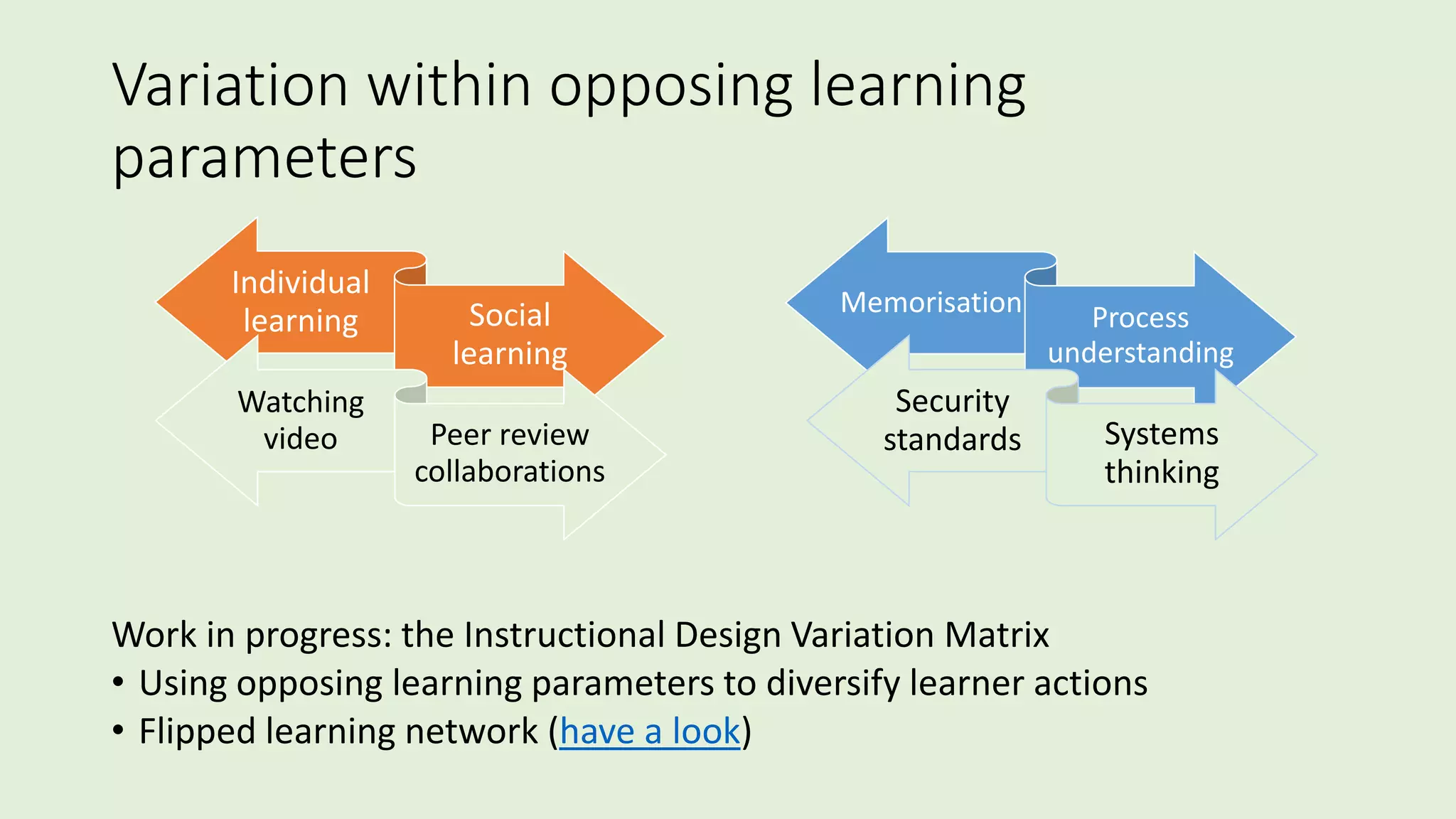
Variation within opposing learning
parameters
Work in progress: the Instructional Design Variation Matrix
• Using opposing learning parameters to diversify learner actions
• Flipped learning network (have a look)
Individual
learning Social
learning
Memorisation Process
understanding
Watching
video Peer review
collaborations
Security
standards Systems
thinking
Innovative (research-based) approaches
Innovation with a well-founded
pedagogical reason
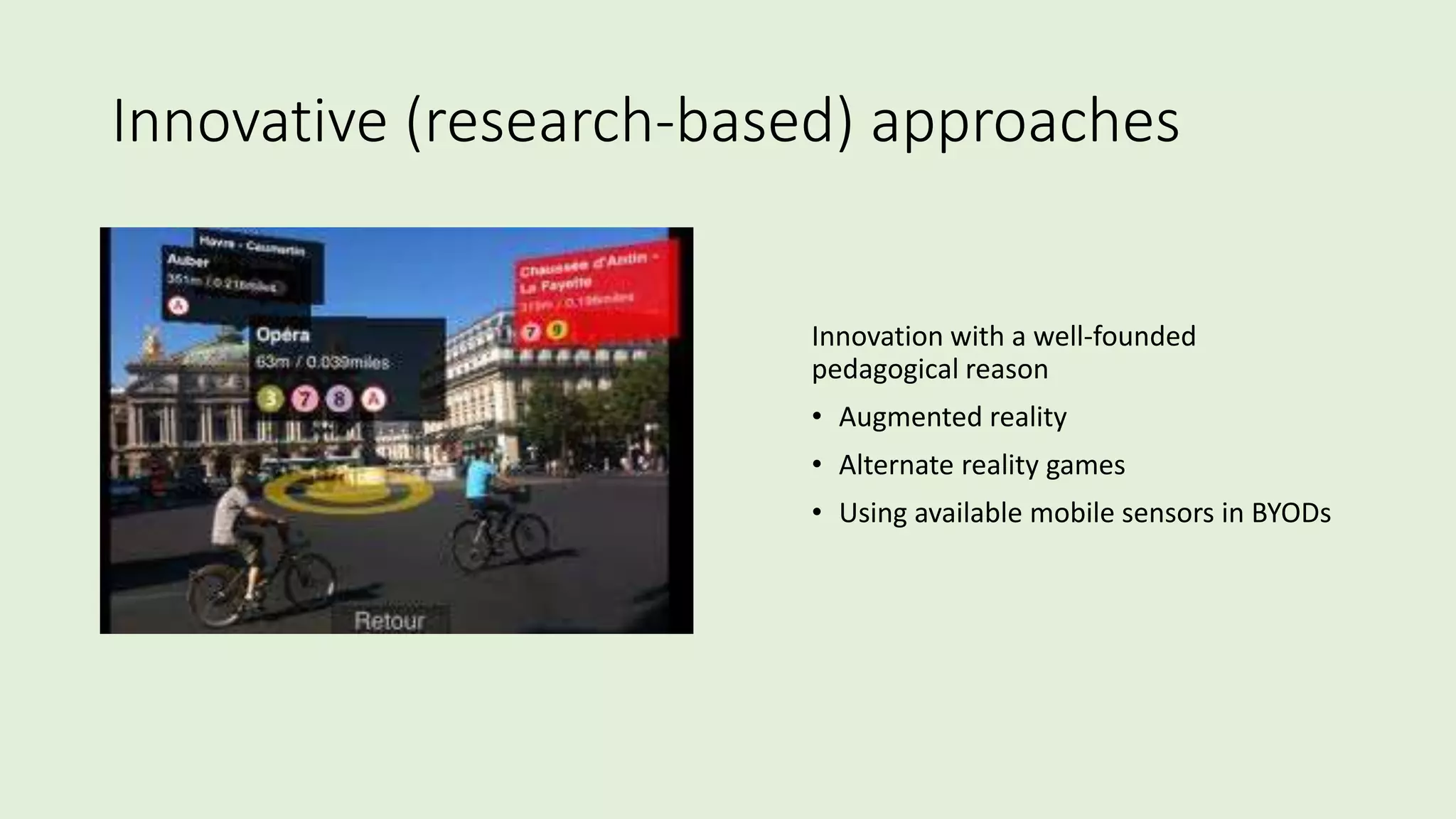
• Augmented reality
• Alternate reality games
• Using available mobile sensors in BYODs
Process
overview
• Continuity and context
• Reflect global classroom in media & content
• Creativity and other meta-skills
Continuity & context
• Continuity and context relevance throughout
the course
• Is there continuity in the theoretical
framework for education that is currently
used?
• Considering a variety of contexts (challenge
driven ed): do the learning actions allow these
contexts to be integrated in the solutions?
• Intellectual Property Rights and Copyrights per
country/region
Reflect the global
classroom in media &
content
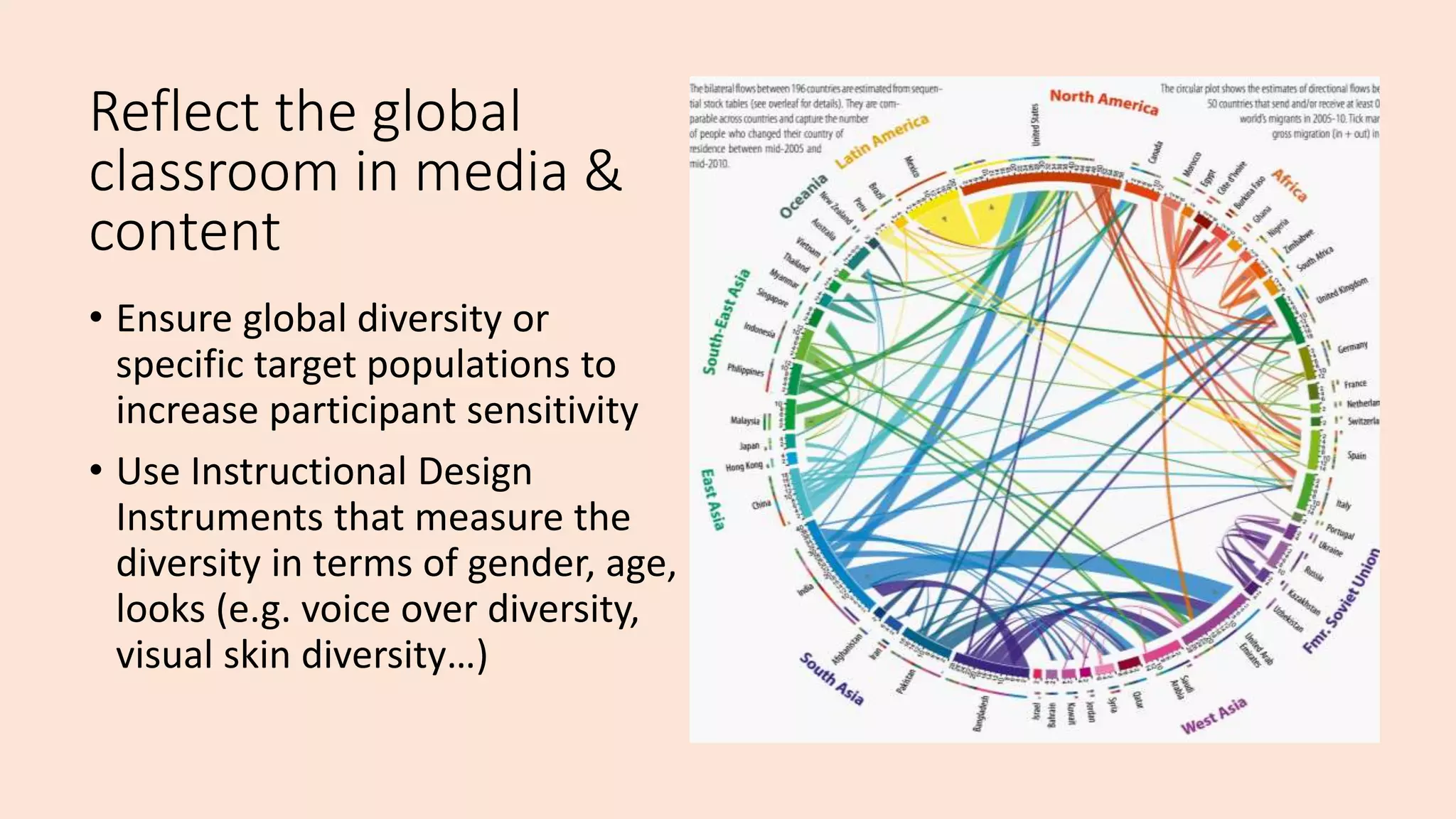
• Ensure global diversity or
specific target populations to
increase participant sensitivity
• Use Instructional Design
Instruments that measure the
diversity in terms of gender, age,
looks (e.g. voice over diversity,
visual skin diversity…)
Creativity & unmeasured meta-skills
• Creativity and other meta-skills:
meta knowledge: situate it & train it
• Instructional designers use
neurobiological findings: e.g.
increase conscious theta-wave use,
spaced learning…
Instructional design =
multiple purposes
• Support your expertise (interdisciplinary team, teacher
leads)
• Ensure high quality content and design (adding
instructional and pedagogical expertise)
• Reduce workload (in the longrun)
• Instructional Designers embrace your content ideas and
fill in possible gaps
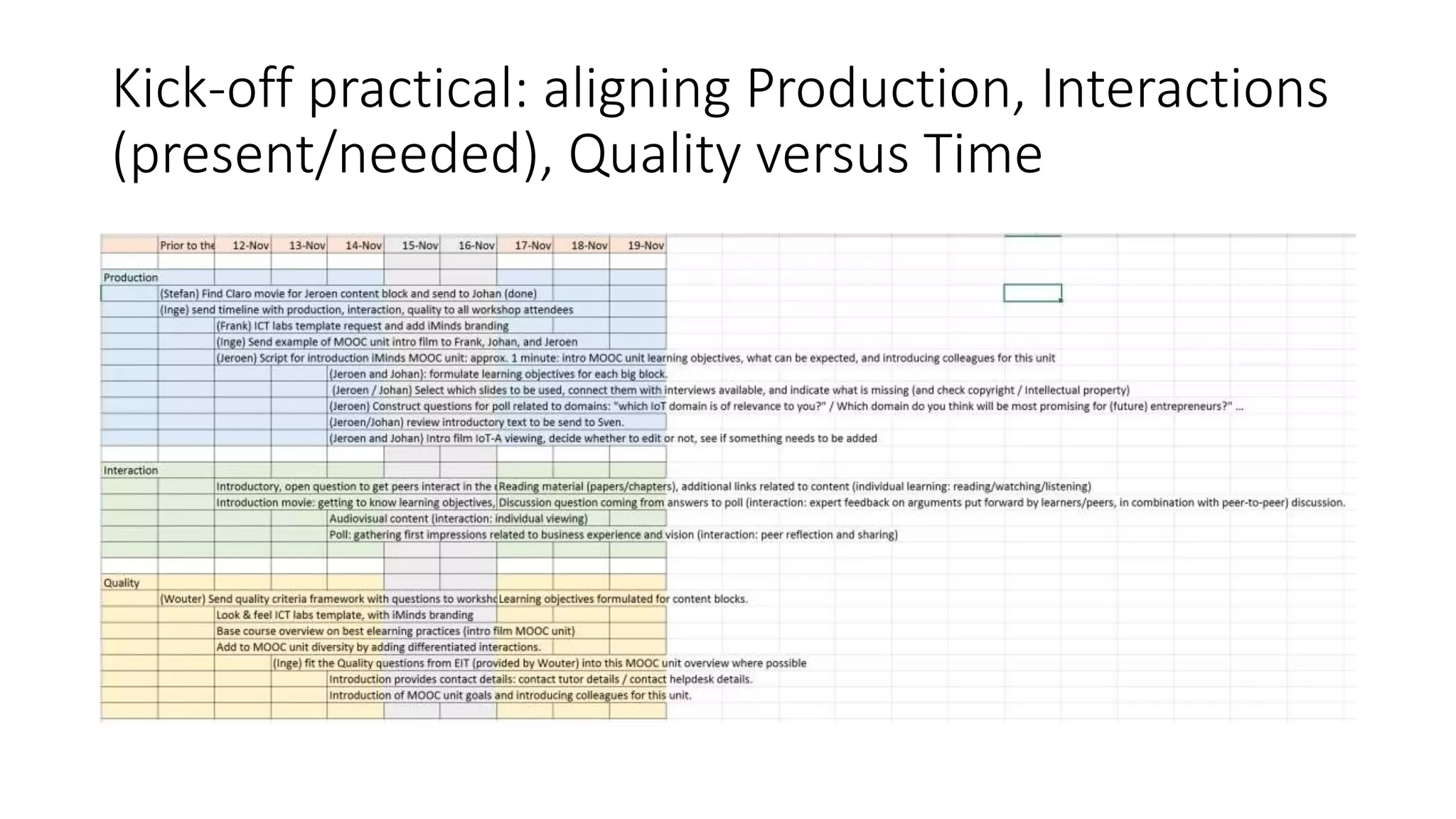
Kick-off practical: aligning Production, Interactions
(present/needed), Quality versus Time
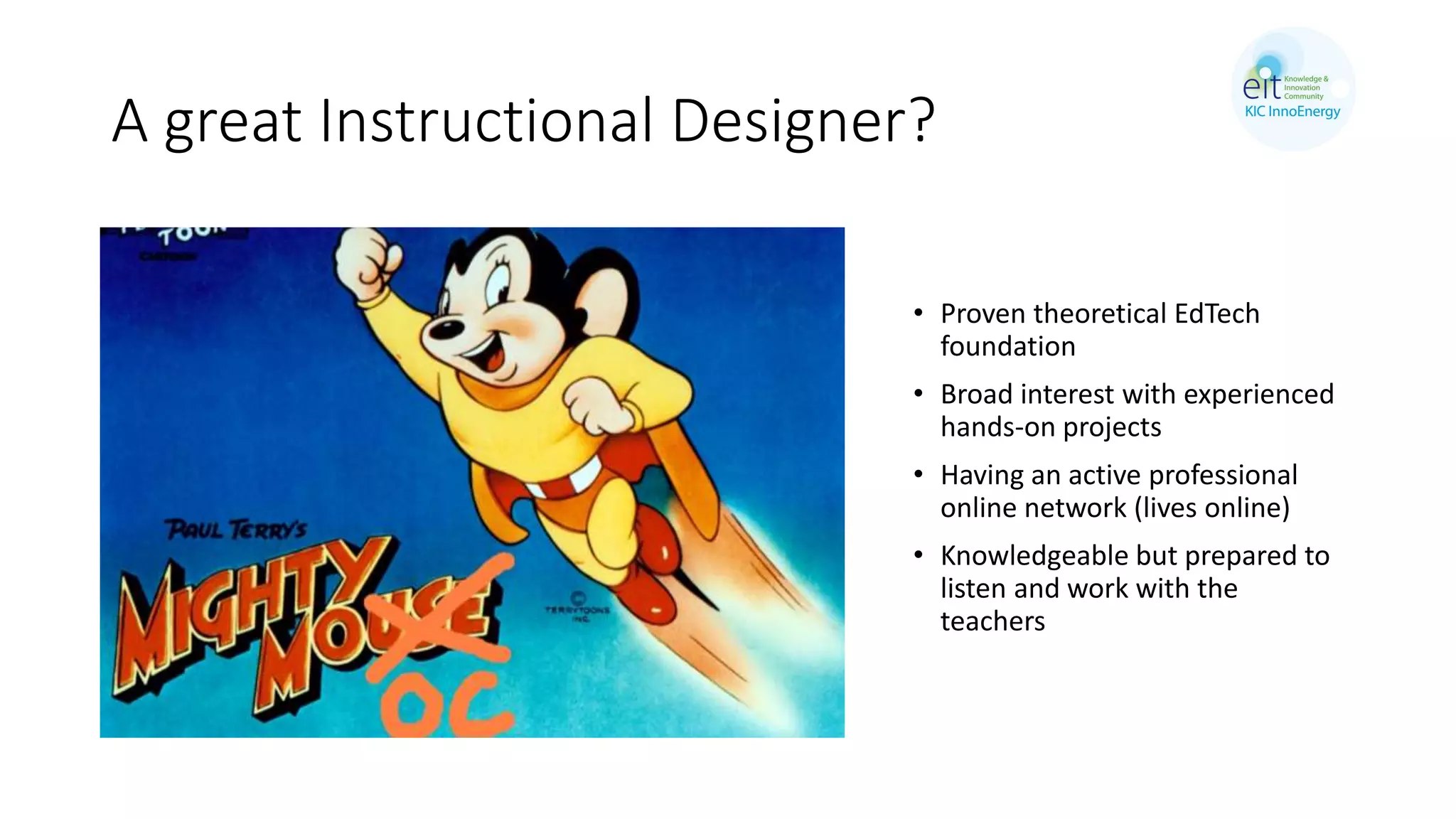
A great Instructional Designer?
• Proven theoretical EdTech
foundation
• Broad interest with experienced
hands-on projects
• Having an active professional
online network (lives online)
• Knowledgeable but prepared to
listen and work with the
teachers
Contact me here or later
25
E-mail: ingedewaard (at) gmail.com
Blog: ignatiawebs.blogspot.com
Twitter: http://twitter.com/Ignatia
Publicaties:
http://www.ingedewaard.net/pubconsulpres.htm
Presentaties: http://www.slideshare.net/ignatia
LinkedIn: http://www.linkedin.com/in/ingedewaard

How can an Instructional Designer help?

  • 1.
    How can anInstructional Designer help ? Inge de Waard
  • 2.
    Who produces worldrenowned documentaries?
  • 3.
    You are theExpert The teacher is the Expert • Expert in your field/s • Experienced with (online) learning • Comfort, capacity & content So what can an Instructional Designer do for you?
  • 4.
    Introducing the Instructional Designer •Valuable member of the interdisciplinary MOOC team • Expert in online learning and differentiating pedagogy • Reducing your workload • Enhancing your course quality Support the overall goal: additional pedagogical brain & production manager.
  • 5.
    Reducing workload① • Additionalpedagogically sound brain • Support EdTech options • Translating your ideas into pedagogical solutions ① after an initial workload rush
  • 6.
    Additional pedagogical brain •Theoretically accomplished professional: a variety of theoretical frameworks at their disposal • Continuity within a given – institutional or teacher preferred – theoretical approach • Instructional Designers will find solutions for your teaching challenges
  • 7.
    Support EdTech options •Video scripting and production (liaison with media production team) • Ensure granularity (content nuggets) for meaningful reuse in other courses (online or blended) - repository Limiting workload to scripting by adding: • The ‘hand that writes’ (hand actor) • Animations (cartoons, mixed media, visualising essence)
  • 8.
    Translating your ideasinto (additional) pedagogical solutions Video content Self- assessment Assignment Evaluation Good start, but sad if you repeat this approach endlessly Using a fixed approach will not outrank the average MOOC IDs invest time coming up with additional solutions, so you can focus on content We are all creatures of habit, IDs are trained to add variance
  • 9.
    Evaluation • Learninganalytics analysis and recommendations • Learning / teaching evaluation • Developing process
  • 10.
    Learning analytics teacherdashboard (peergrade)
  • 11.
    Learning analytics analysis Classic:which content is viewed: incomplete, repeatedly for one section, downloaded more, skipped, … and what does it tell us? 1 Social learning: peer review meta skills: who is consistently on target with peer reviews, who isn’t. Where to intervene, and where to leave it 2 What skill, capacity, intended learning is not measured yet needed, and how could we measure it? (we measure what we know, keep eyes open for emergence) 3
  • 12.
    Learning and AlignedTeaching evaluation • Feedback from teachers & students • Does the learning/teaching process transform Intended Learning Objectives into Achieved Learning Objectives? (in-process quality assurance) • How can we contextualize the assignments/content nuggets… to fit different locations and infrastructural realities? • Increase of self-directed learning? Quality Assurance Intended Learning Objectives Achieved Learning Objectives
  • 13.
    Developing process • Canwe reuse parts of this course in others (disseminate what is made) = granularity level educational resources databank = repository • Disseminate what works through organisation/s & departments • Investigate novel approaches in Technology Enhanced Learning research
  • 14.
    Instructional Design Variation • Simpleto complex • Variation within opposing learning parameters • Innovative (research-based) approaches
  • 15.
    Simple to complex • Gettingthe variety of learners aligned (content wise) at the start (might demand pre-course modules/nuggets, prerequisites) • Do the learning steps allow a Zone of Proximal Development if social learning is part of the learning process? • Is there a clear learning curve pushing the boundaries of knowledge?
  • 16.
    Variation within opposinglearning parameters Work in progress: the Instructional Design Variation Matrix • Using opposing learning parameters to diversify learner actions • Flipped learning network (have a look) Individual learning Social learning Memorisation Process understanding Watching video Peer review collaborations Security standards Systems thinking
  • 17.
    Innovative (research-based) approaches Innovationwith a well-founded pedagogical reason • Augmented reality • Alternate reality games • Using available mobile sensors in BYODs
  • 18.
    Process overview • Continuity andcontext • Reflect global classroom in media & content • Creativity and other meta-skills
  • 19.
    Continuity & context •Continuity and context relevance throughout the course • Is there continuity in the theoretical framework for education that is currently used? • Considering a variety of contexts (challenge driven ed): do the learning actions allow these contexts to be integrated in the solutions? • Intellectual Property Rights and Copyrights per country/region
  • 20.
    Reflect the global classroomin media & content • Ensure global diversity or specific target populations to increase participant sensitivity • Use Instructional Design Instruments that measure the diversity in terms of gender, age, looks (e.g. voice over diversity, visual skin diversity…)
  • 21.
    Creativity & unmeasuredmeta-skills • Creativity and other meta-skills: meta knowledge: situate it & train it • Instructional designers use neurobiological findings: e.g. increase conscious theta-wave use, spaced learning…
  • 22.
    Instructional design = multiplepurposes • Support your expertise (interdisciplinary team, teacher leads) • Ensure high quality content and design (adding instructional and pedagogical expertise) • Reduce workload (in the longrun) • Instructional Designers embrace your content ideas and fill in possible gaps
  • 23.
    Kick-off practical: aligningProduction, Interactions (present/needed), Quality versus Time
  • 24.
    A great InstructionalDesigner? • Proven theoretical EdTech foundation • Broad interest with experienced hands-on projects • Having an active professional online network (lives online) • Knowledgeable but prepared to listen and work with the teachers
  • 25.
    Contact me hereor later 25 E-mail: ingedewaard (at) gmail.com Blog: ignatiawebs.blogspot.com Twitter: http://twitter.com/Ignatia Publicaties: http://www.ingedewaard.net/pubconsulpres.htm Presentaties: http://www.slideshare.net/ignatia LinkedIn: http://www.linkedin.com/in/ingedewaard