LEARNING DESIGNS: 
INNOVATIONS AND APPROACHES 
LeRoy Hill, PhD 
Director, Humanities & Education 
Anguilla Community College 
INNOVATIVE LEARNING 
SEMINARS 
NOVEMBER 25 2014
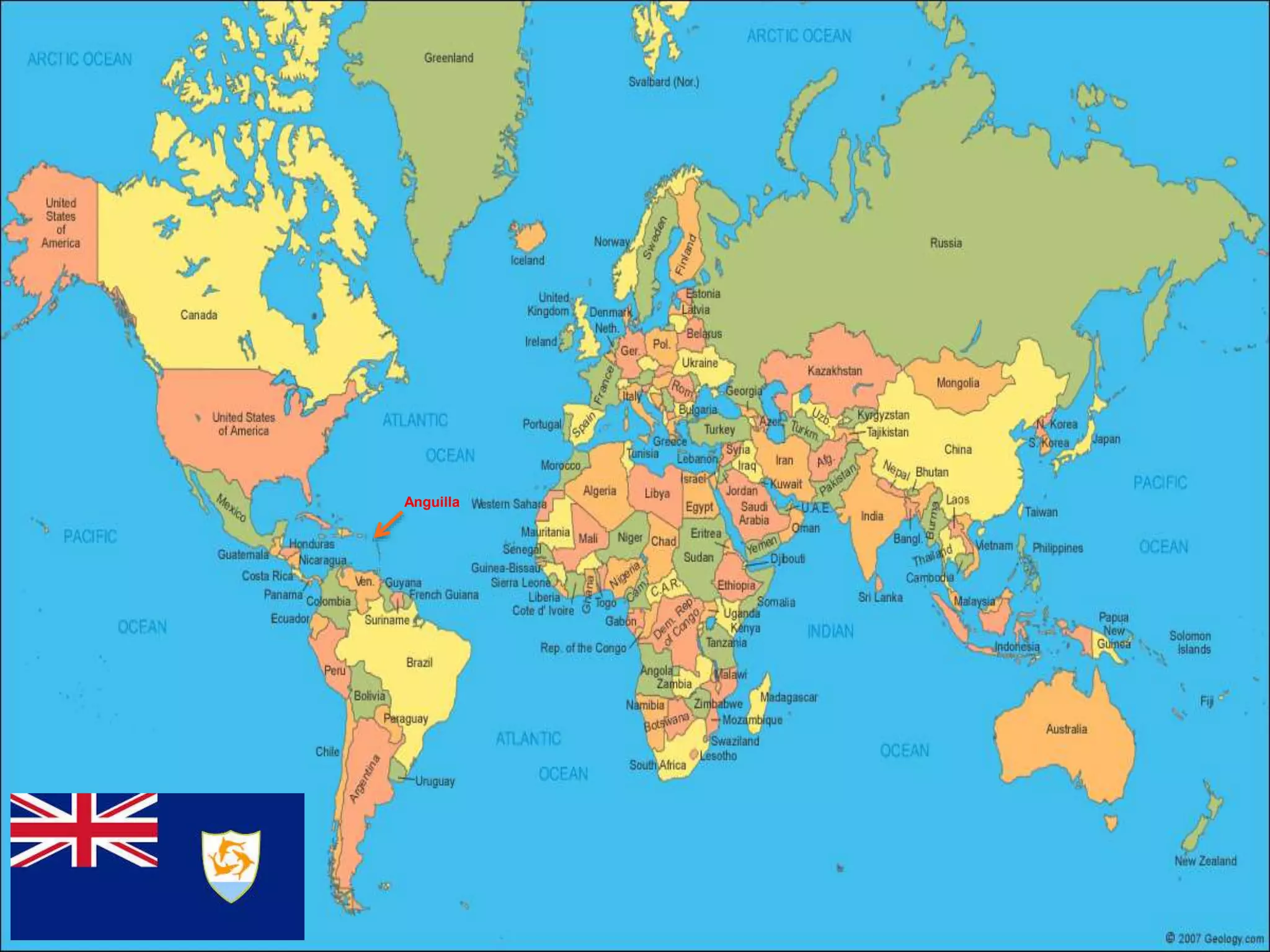
Anguilla
“the process of designing, planning and orchestrating 
learning activities as part of a learning session or 
programme” (JISC, 2006) 
“ the process by which teachers – and others involved in the 
support of learning - arrive at a plan or structure or 
design for a learning situation” (Beetham and Sharpe, 
2007) 
“the different ways in which learning experiences can be 
structured including the sequencing of activities and 
interaction” (Oliver, 1999) 
WORKING DEFINITIONS
A methodology for enabling teachers/designers to make 
more informed decisions in how they go about designing, 
which is pedagogically informed and makes effective use 
of appropriate resources and technologies. This includes 
the design of resources and individual learning activities 
right up to whole curriculum level design. A key principle 
is to help make the design process more explicit and 
shareable. Learning design as an area of research and 
development includes both gathering empirical evidence 
to better understand the design process as well as the 
development of a range of resource, tools and activities. 
(Conole 2010, p.483) 
WORKING DEFINITIONS
…the systematic process by which instructional 
materials are designed, developed, and 
delivered. The terms instructional design, 
instructional technology, educational technology, 
curriculum design, and instructional systems 
design (ISD), are often used interchangeably. 
http://www.instructionaldesigncentral.com/htm/IDC_instructionaldesigndefinitions.htm 
The process by which instruction is improved through the 
analysis of learning needs and systematic development of 
learning materials. Instructional designers often use 
technology and multimedia as tools to enhance instruction. http://www.instructionaldesign.org/ 
INSTRUCTIONAL DESIGN
Educational technology is the study and ethical 
practice of facilitating learning and improving 
performance by creating, using and managing 
appropriate technological processes and resources." 
The term educational technology is often associated 
with, and encompasses, instructional theory and 
learning theory . While instructional technology is "the 
theory and practice of design, development, 
utilization, management, and evaluation of processes 
and resources for learning 
http://www.instructionaldesigncentral.com/htm/IDC_instructionaldesigndefinitions.htm#sthash.0Oxz44V4.dpuf 
EDUCATIONAL TECHNOLOGY
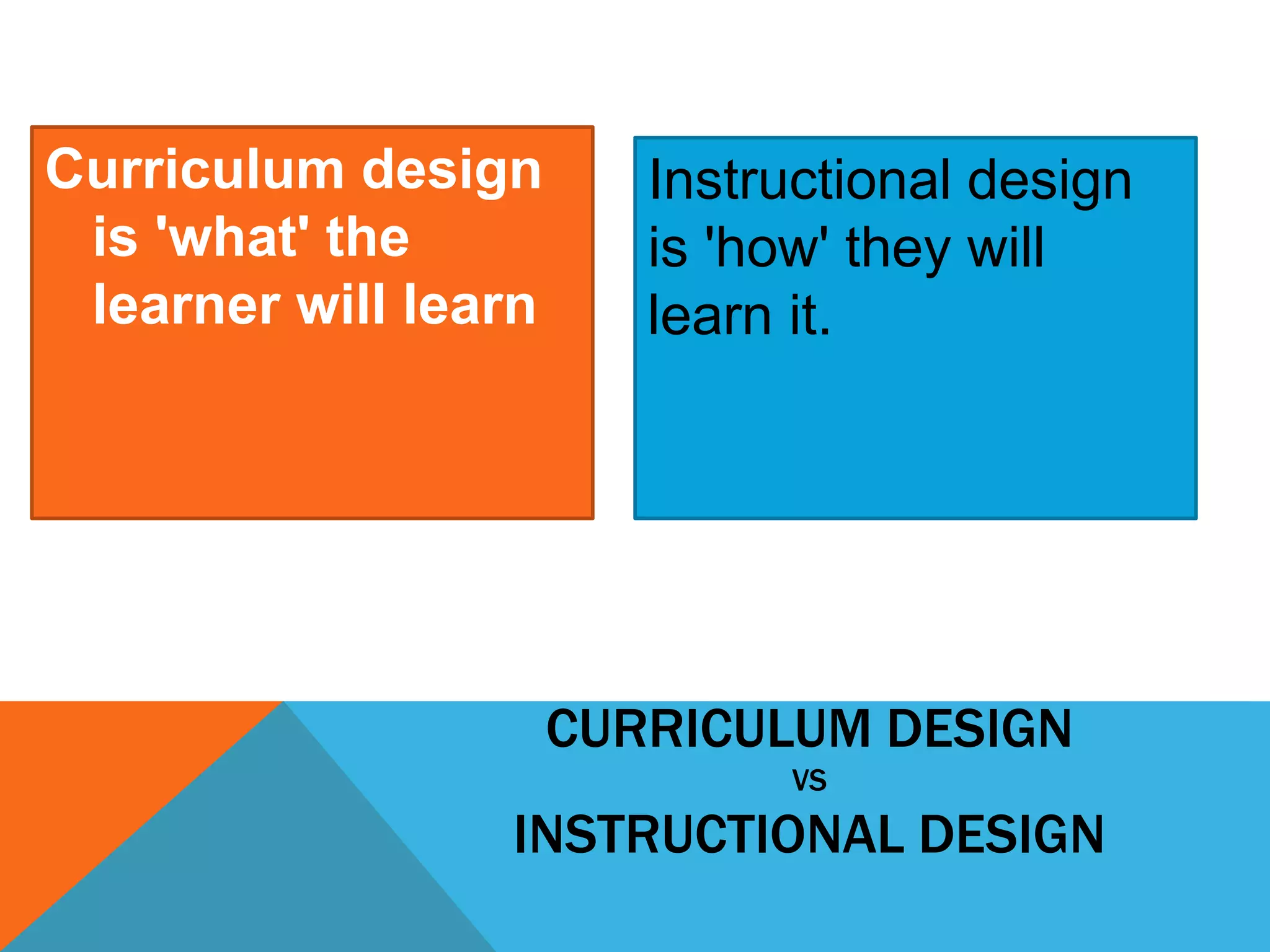
Instructional design 
is 'how' they will 
learn it. 
CURRICULUM DESIGN 
VS 
Curriculum design 
is 'what' the 
learner will learn 
INSTRUCTIONAL DESIGN
“Learning design is broader than 
instructional design - its about the whole 
suite of tools, resources and methods that 
might be used to support the design 
process. Instructional design has a very 
specific history and associated research 
field. In Europe the term lower case 
learning design has emerged in the last 
ten years ago.” 
Source: Gráinne Conole comments (2009) 
http://cloudworks.ac.uk/cloud/view/2536 
INSTRUCTIONAL DESIGN 
VS 
LEARNING DESIGN
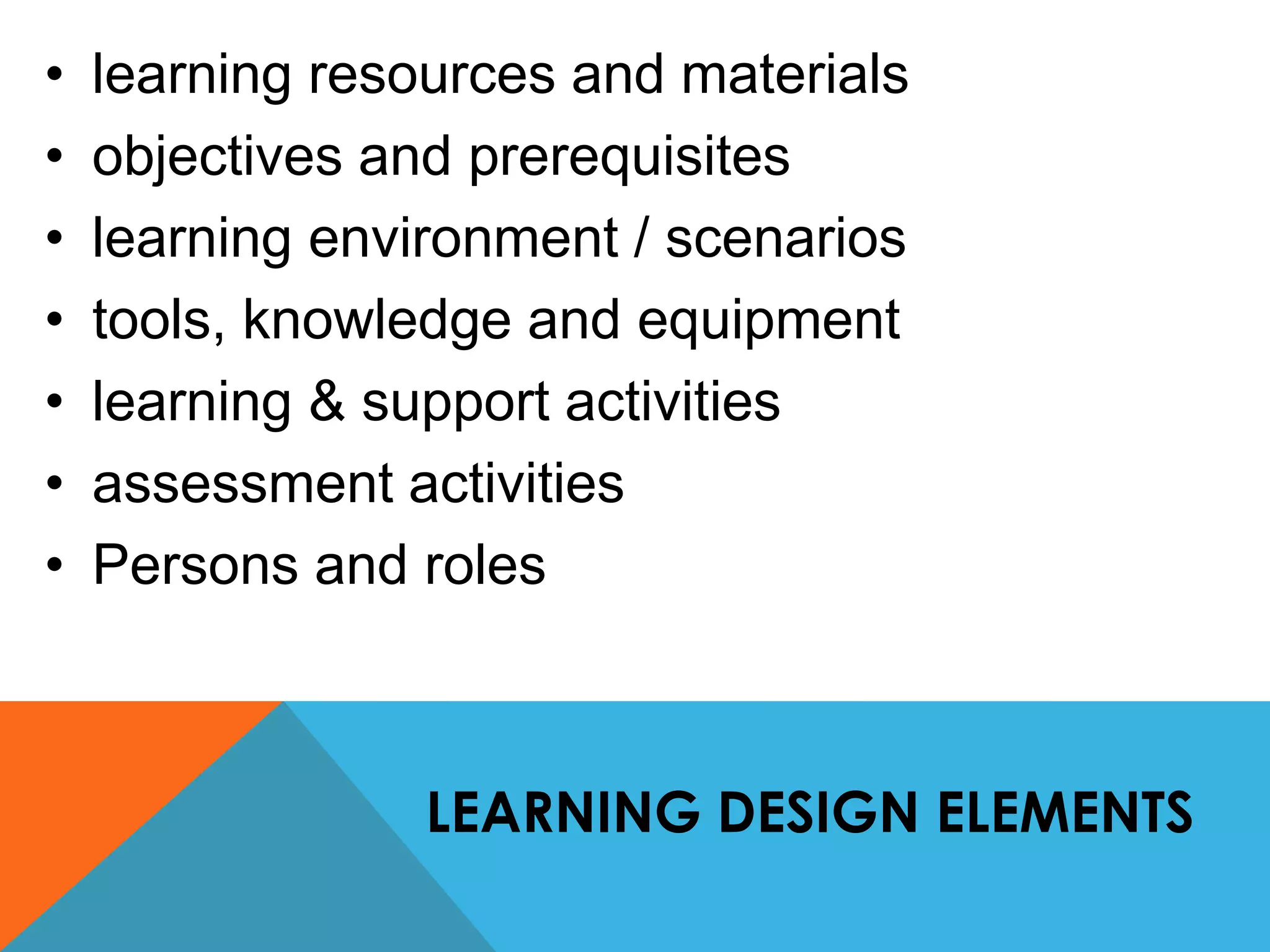
• learning resources and materials 
• objectives and prerequisites 
• learning environment / scenarios 
• tools, knowledge and equipment 
• learning & support activities 
• assessment activities 
• Persons and roles 
LEARNING DESIGN ELEMENTS
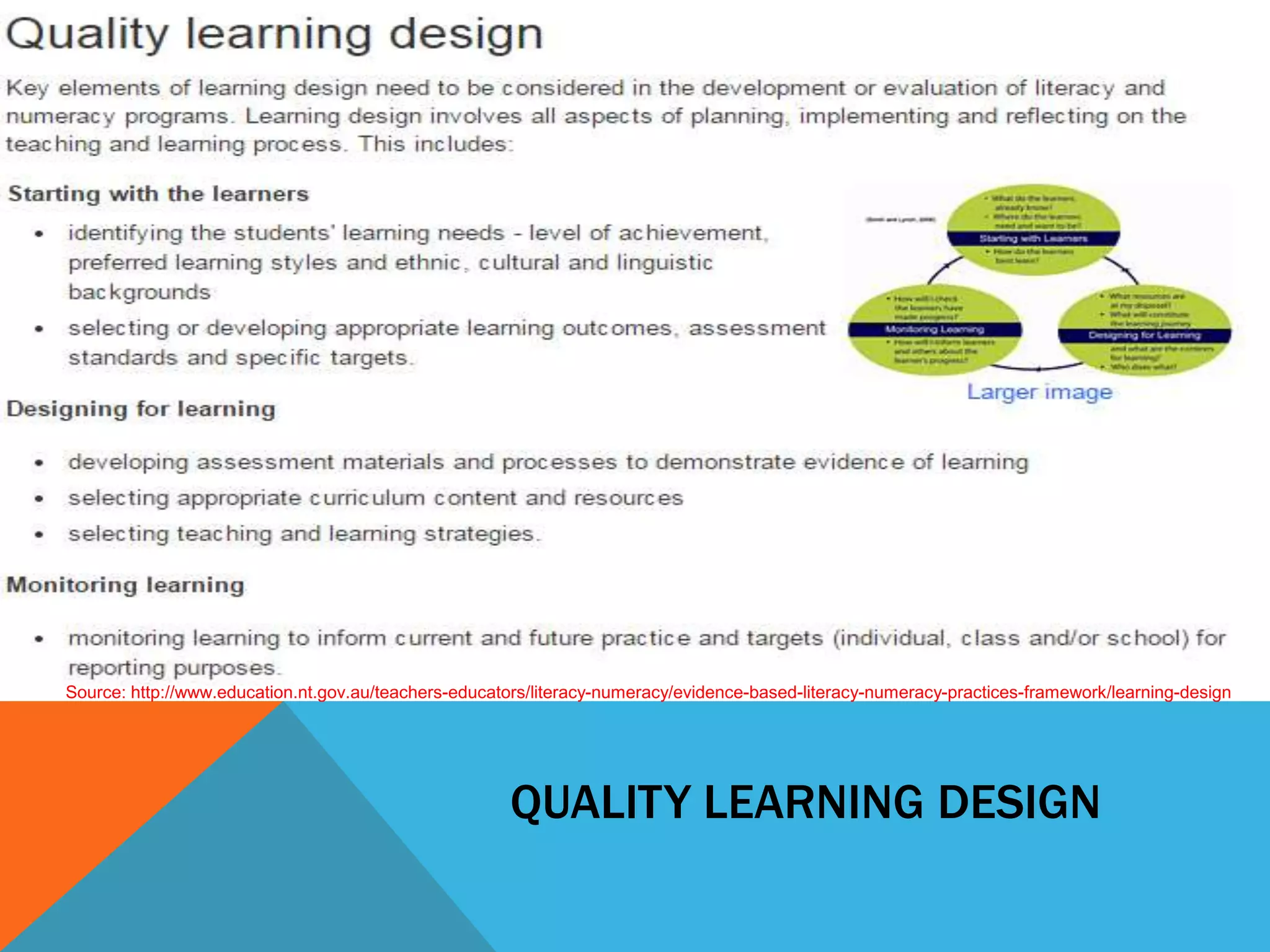
Source: http://www.education.nt.gov.au/teachers-educators/literacy-numeracy/evidence-based-literacy-numeracy-practices-framework/learning-design 
QUALITY LEARNING DESIGN
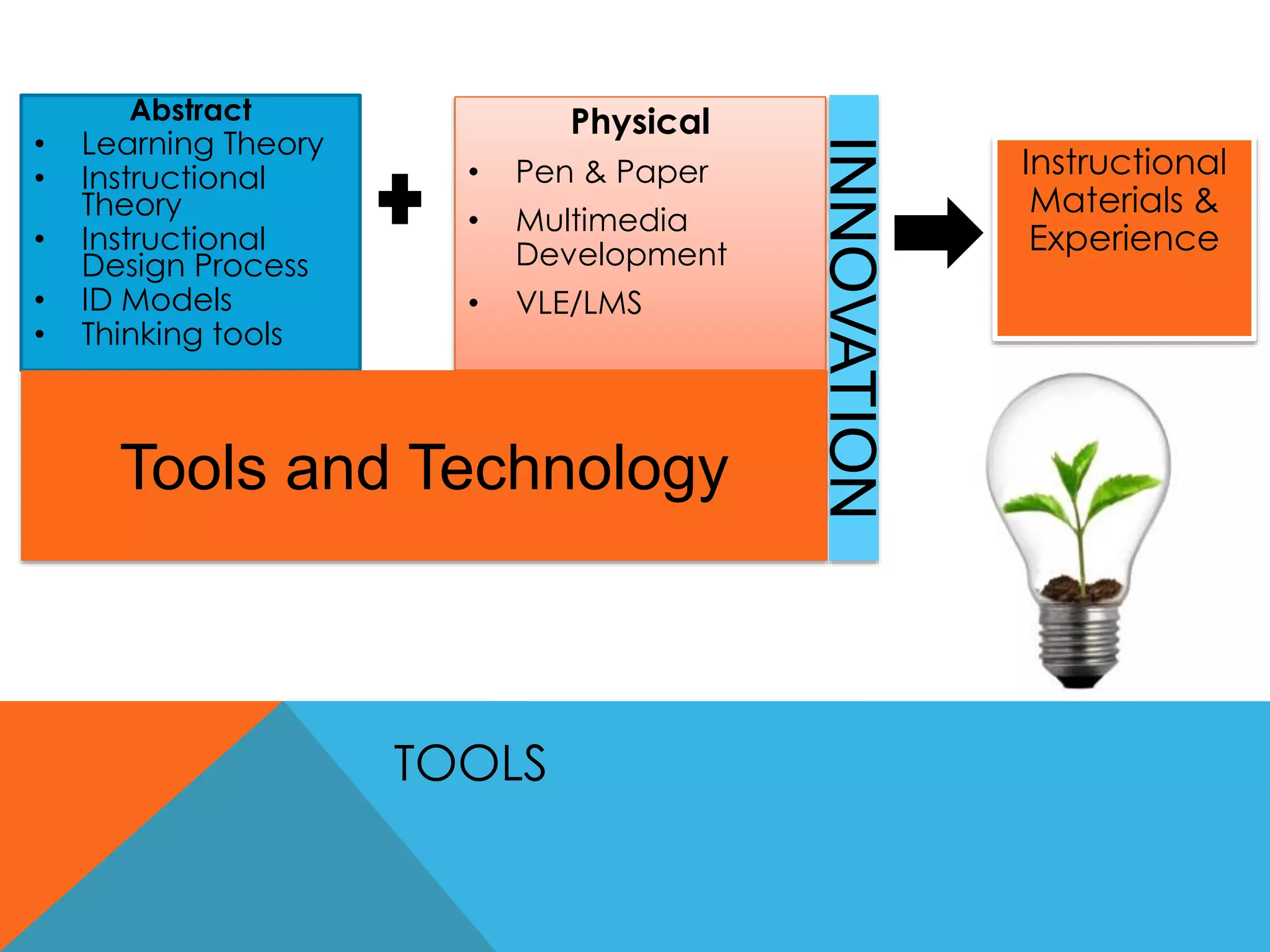
TOOLS 
Physical 
• Pen & Paper 
• Multimedia 
Development 
• VLE/LMS 
Abstract 
• Learning Theory 
• Instructional 
Theory 
• Instructional 
Design Process 
• ID Models 
• Thinking tools 
Tools and Technology 
Instructional 
Materials & 
Experience 
INNOVATION
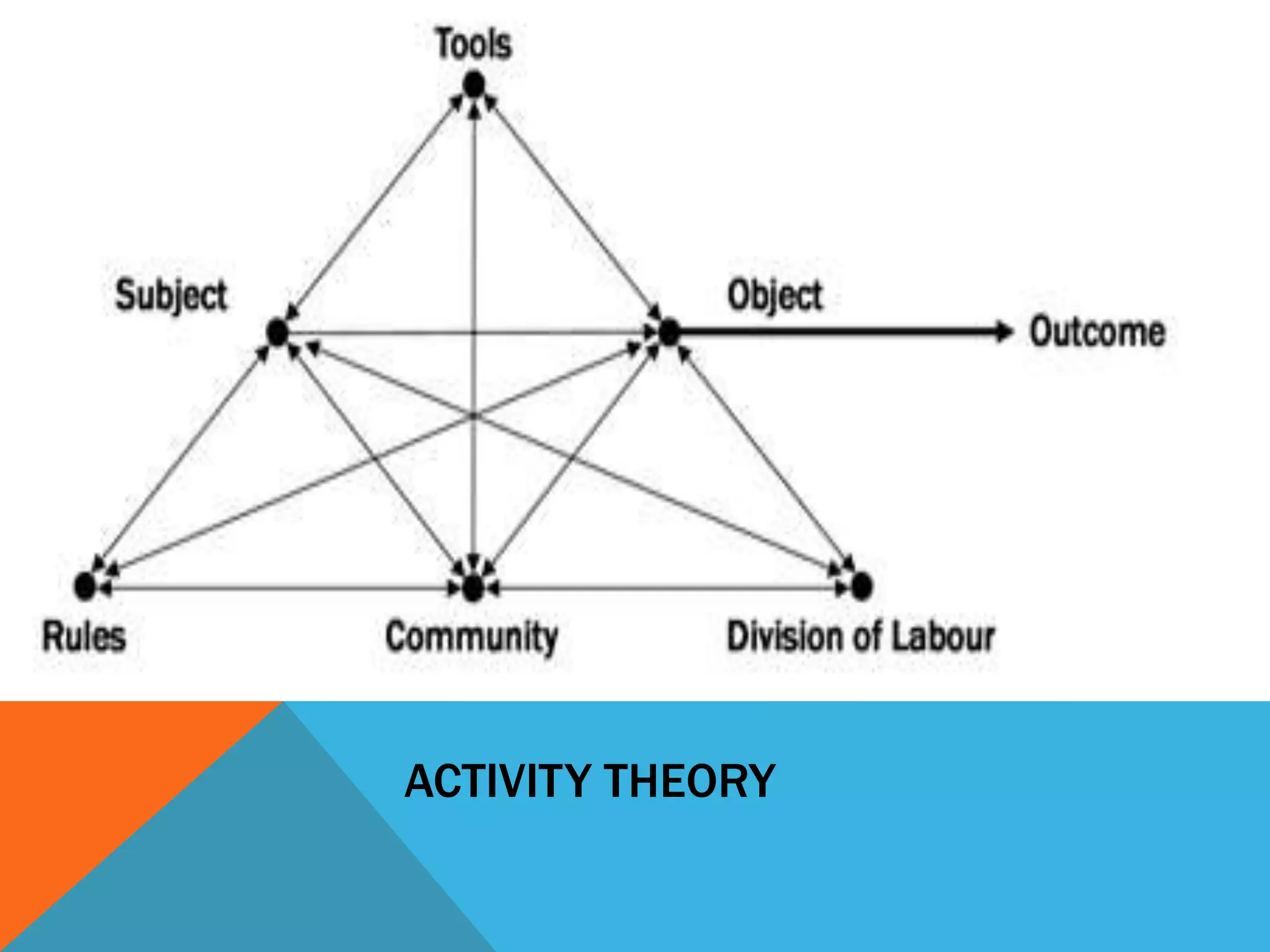
ACTIVITY THEORY
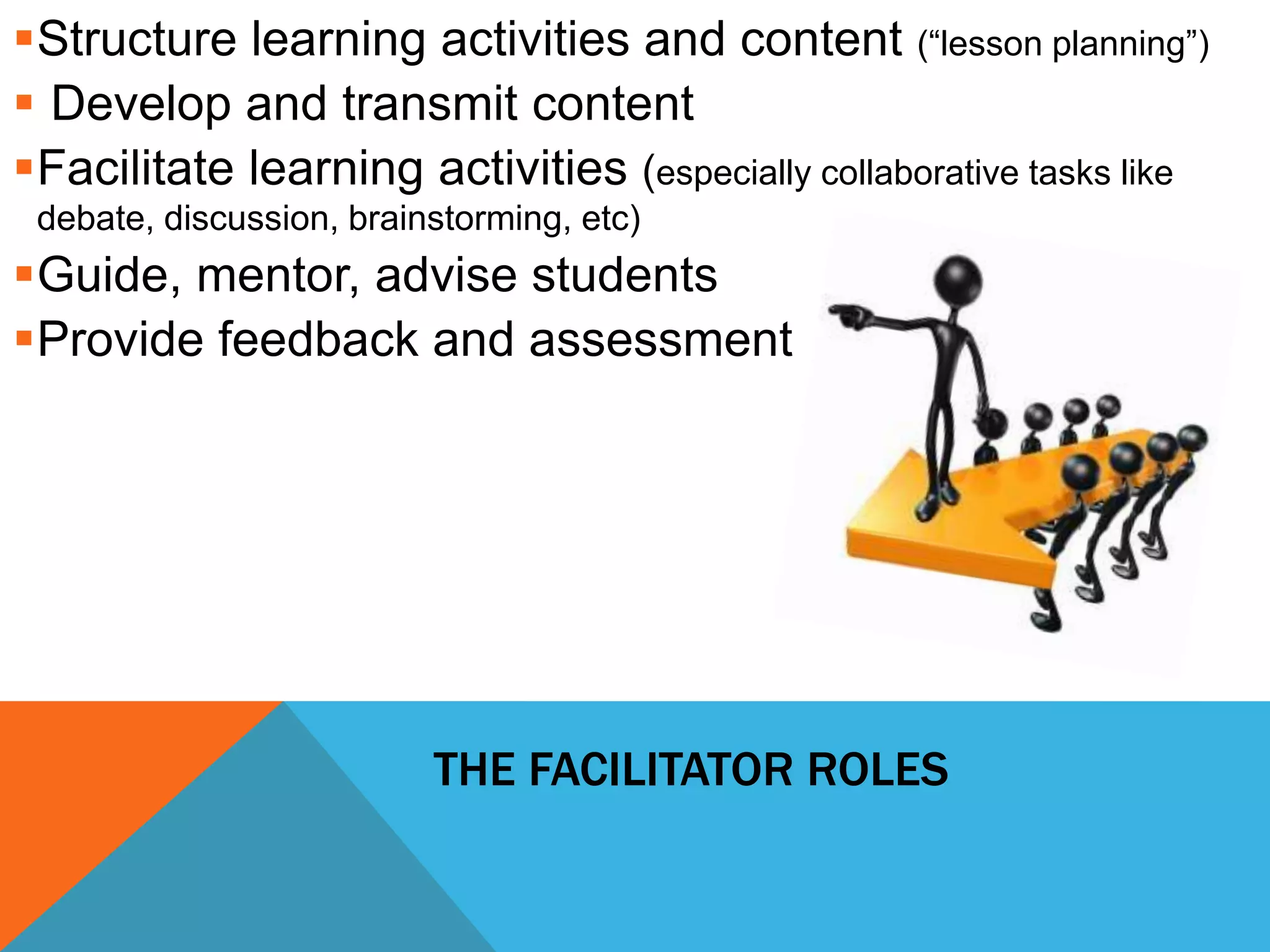
Structure learning activities and content (“lesson planning”) 
 Develop and transmit content 
Facilitate learning activities (especially collaborative tasks like 
debate, discussion, brainstorming, etc) 
Guide, mentor, advise students 
Provide feedback and assessment 
THE FACILITATOR ROLES
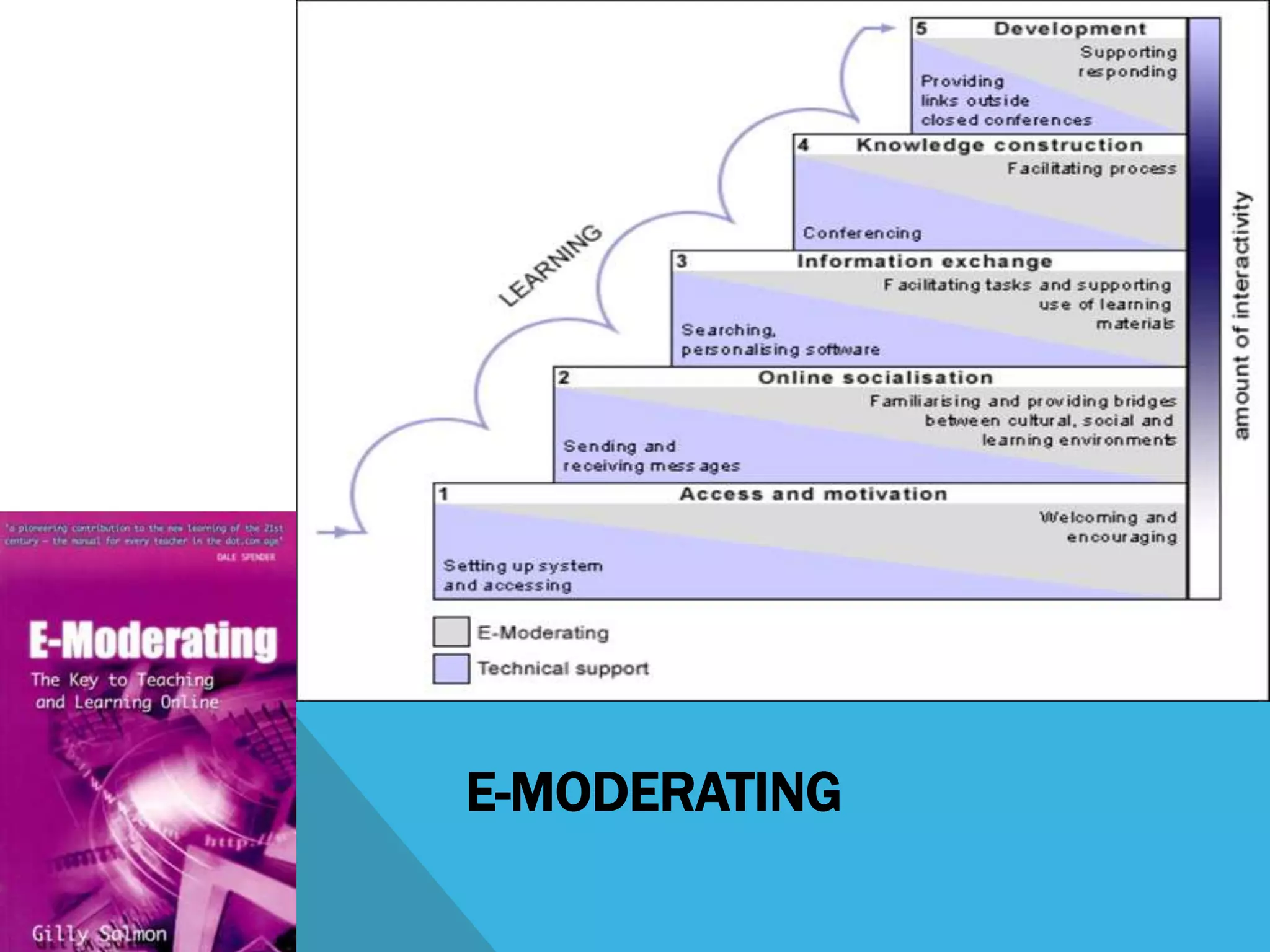
E-MODERATING
Active engagement by students (not just 
passive absorption) 
Collaborative activities 
Construction of understanding and meaning 
Structured “flows” of tasks that build towards 
educational objectives 
Timely feedback and authentic assessment 
THE ENVIRONMENT
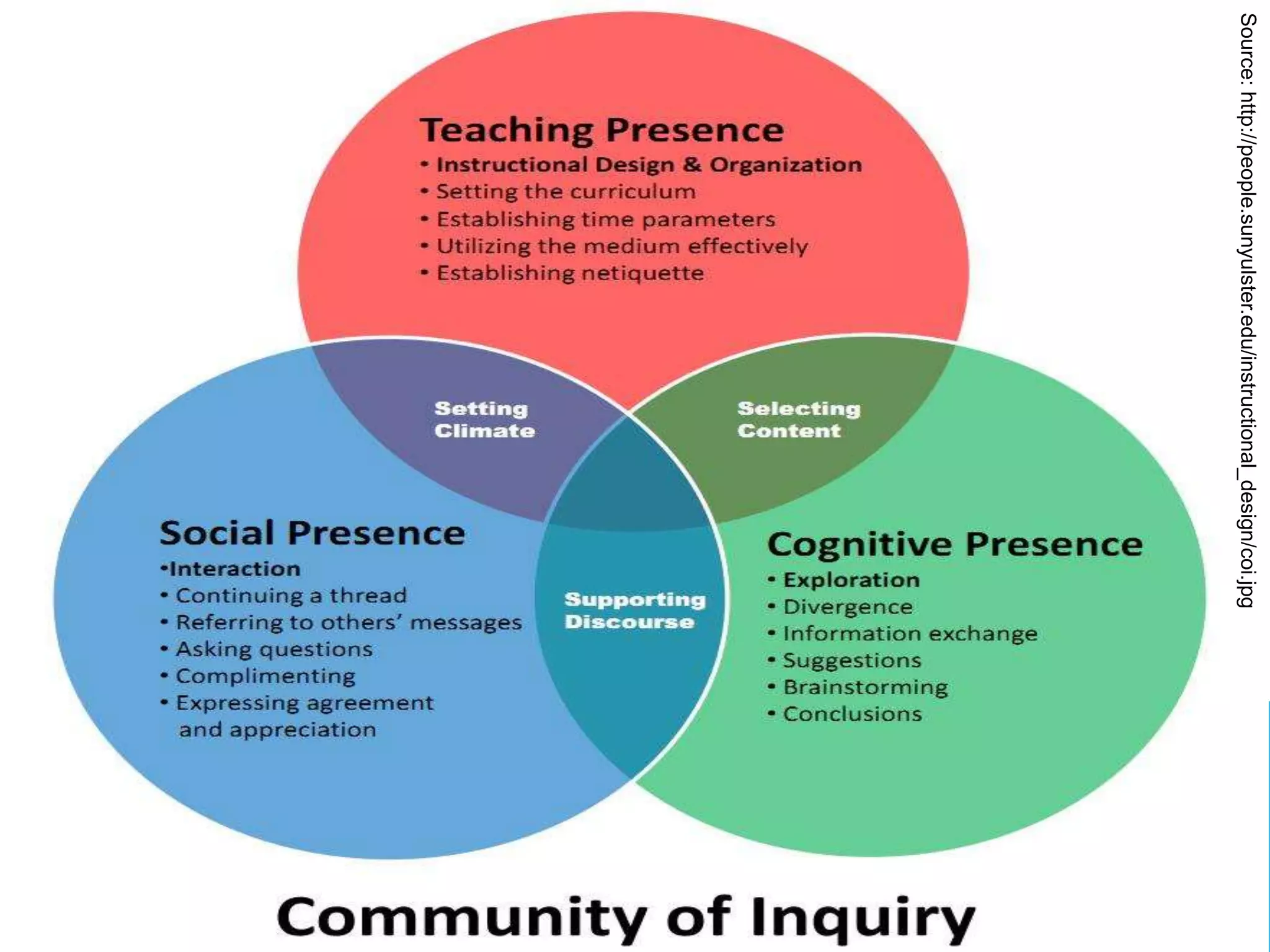
COMMUNITY OF INQUIRY 
Source: http://people.sunyulster.edu/instructional_design/coi.jpg
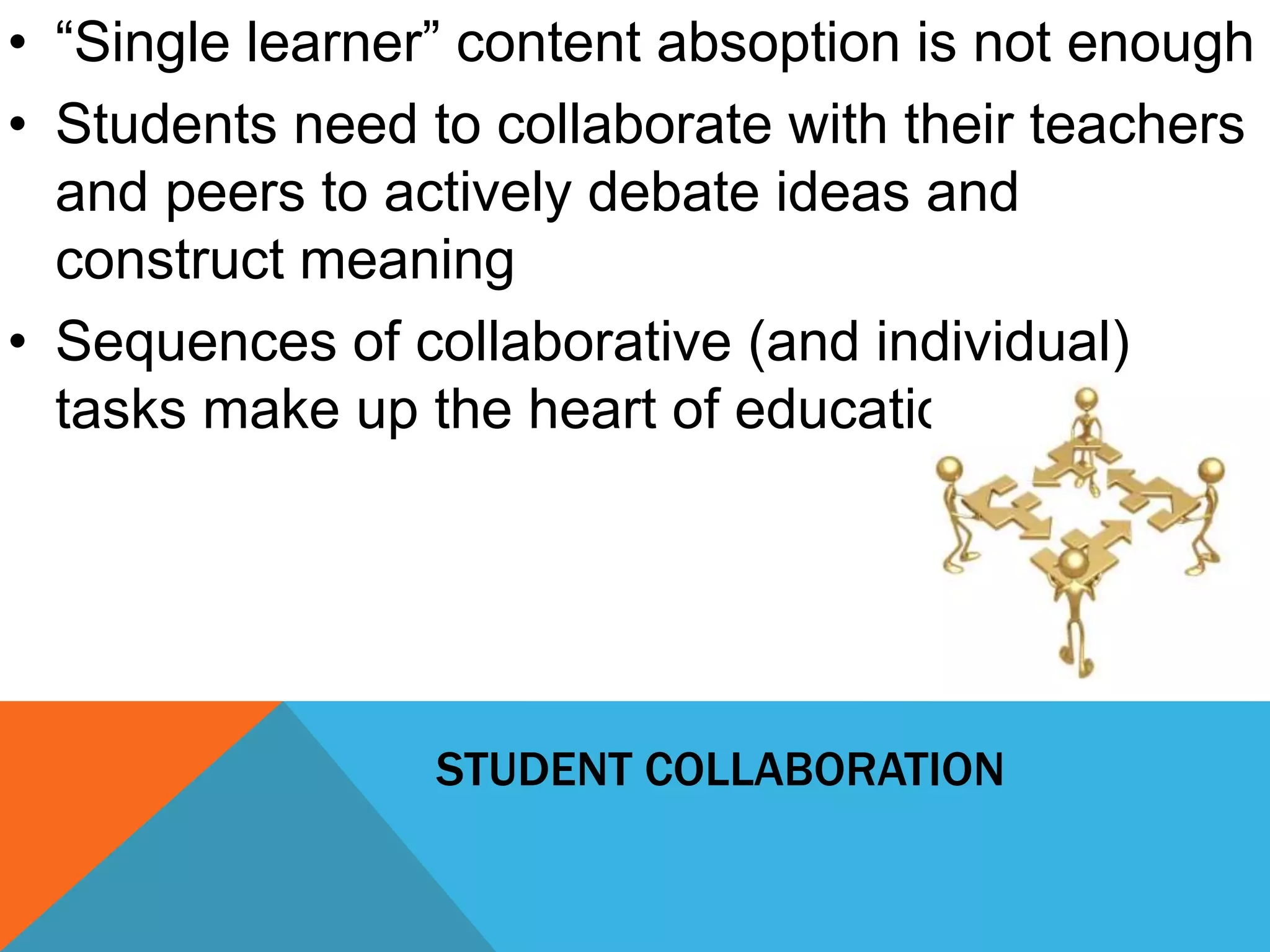
• “Single learner” content absoption is not enough 
• Students need to collaborate with their teachers 
and peers to actively debate ideas and 
construct meaning 
• Sequences of collaborative (and individual) 
tasks make up the heart of education 
STUDENT COLLABORATION
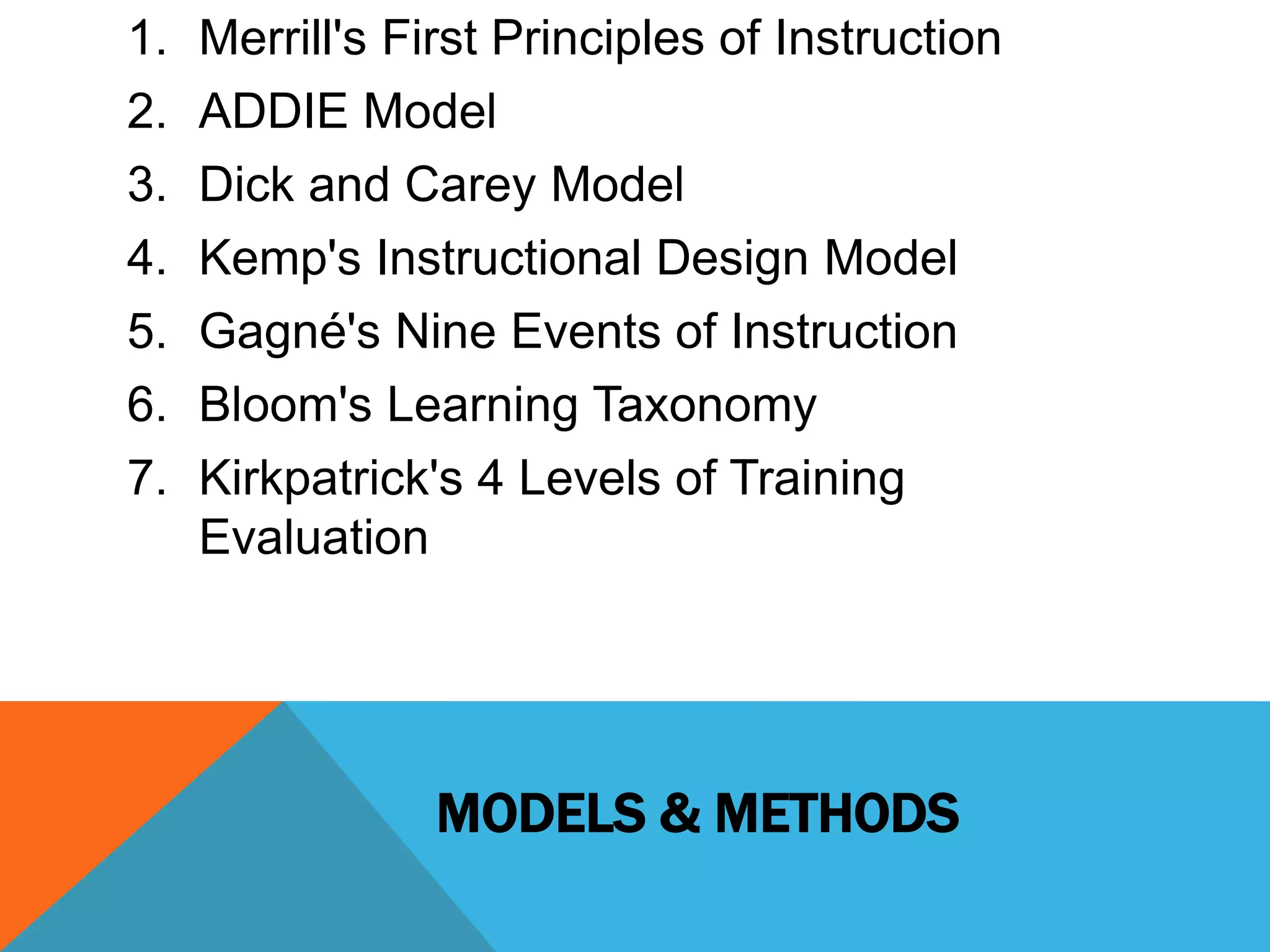
1. Merrill's First Principles of Instruction 
2. ADDIE Model 
3. Dick and Carey Model 
4. Kemp's Instructional Design Model 
5. Gagné's Nine Events of Instruction 
6. Bloom's Learning Taxonomy 
7. Kirkpatrick's 4 Levels of Training 
MODELS & METHODS 
Evaluation
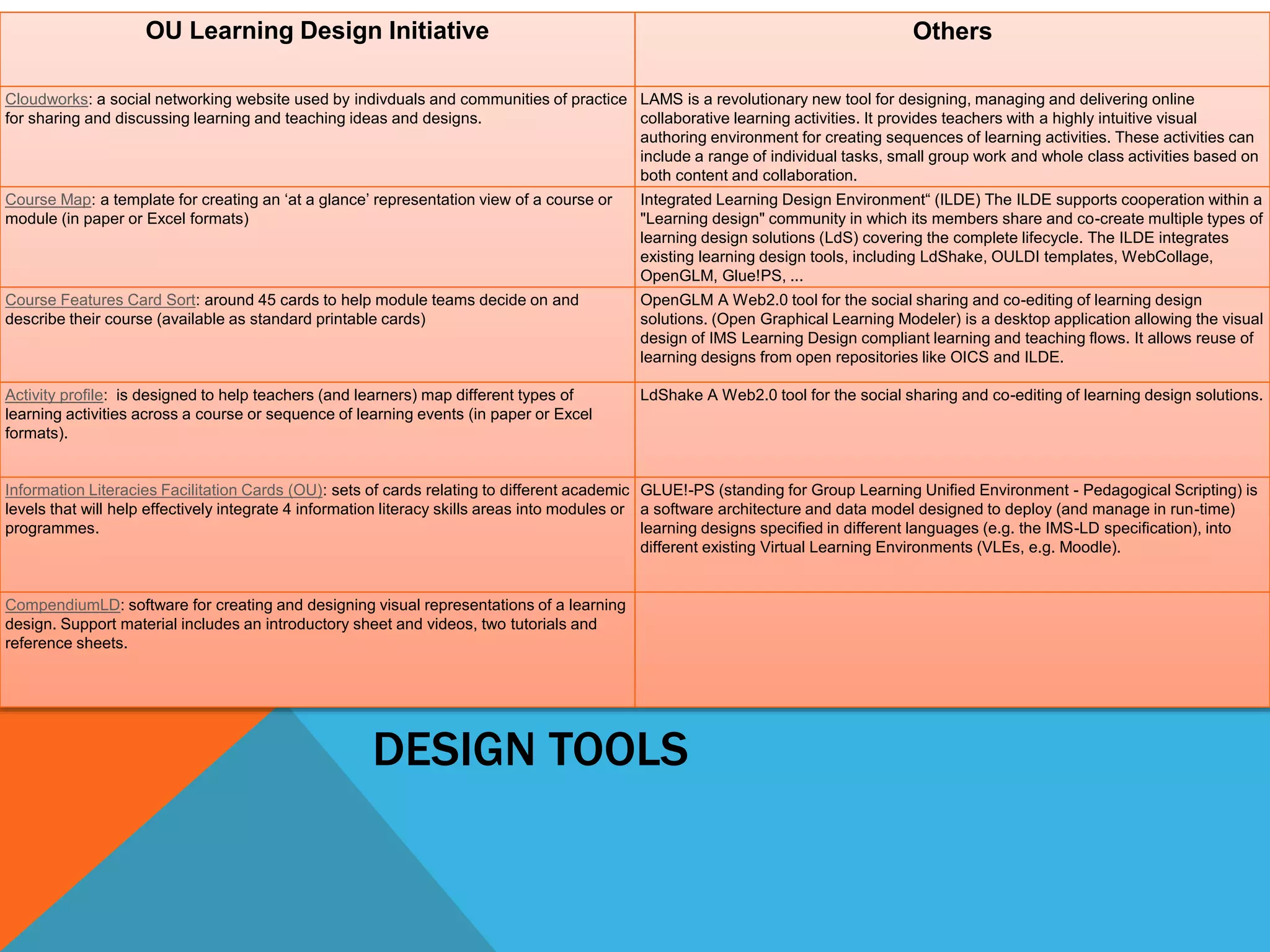
OU Learning Design Initiative Others 
Cloudworks: a social networking website used by indivduals and communities of practice 
for sharing and discussing learning and teaching ideas and designs. 
LAMS is a revolutionary new tool for designing, managing and delivering online 
collaborative learning activities. It provides teachers with a highly intuitive visual 
authoring environment for creating sequences of learning activities. These activities can 
include a range of individual tasks, small group work and whole class activities based on 
both content and collaboration. 
Course Map: a template for creating an ‘at a glance’ representation view of a course or 
module (in paper or Excel formats) 
Integrated Learning Design Environment“ (ILDE) The ILDE supports cooperation within a 
"Learning design" community in which its members share and co-create multiple types of 
learning design solutions (LdS) covering the complete lifecycle. The ILDE integrates 
existing learning design tools, including LdShake, OULDI templates, WebCollage, 
OpenGLM, Glue!PS, ... 
Course Features Card Sort: around 45 cards to help module teams decide on and 
describe their course (available as standard printable cards) 
OpenGLM A Web2.0 tool for the social sharing and co-editing of learning design 
solutions. (Open Graphical Learning Modeler) is a desktop application allowing the visual 
design of IMS Learning Design compliant learning and teaching flows. It allows reuse of 
learning designs from open repositories like OICS and ILDE. 
Activity profile: is designed to help teachers (and learners) map different types of 
learning activities across a course or sequence of learning events (in paper or Excel 
formats). 
LdShake A Web2.0 tool for the social sharing and co-editing of learning design solutions. 
Information Literacies Facilitation Cards (OU): sets of cards relating to different academic 
levels that will help effectively integrate 4 information literacy skills areas into modules or 
programmes. 
GLUE!-PS (standing for Group Learning Unified Environment - Pedagogical Scripting) is 
a software architecture and data model designed to deploy (and manage in run-time) 
learning designs specified in different languages (e.g. the IMS-LD specification), into 
different existing Virtual Learning Environments (VLEs, e.g. Moodle). 
CompendiumLD: software for creating and designing visual representations of a learning 
design. Support material includes an introductory sheet and videos, two tutorials and 
reference sheets. 
DESIGN TOOLS
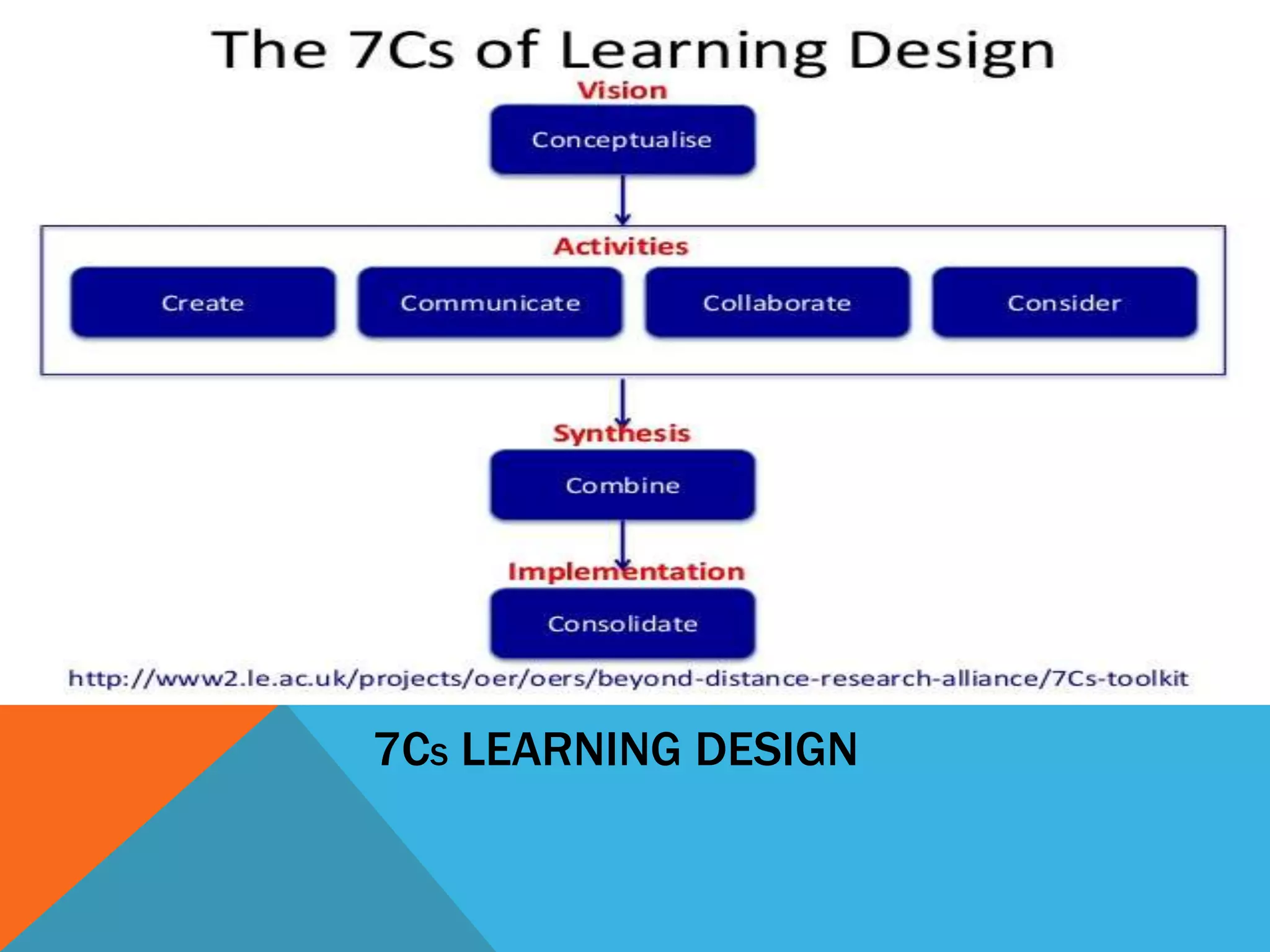
7CS LEARNING DESIGN
• Learning can be designed 
• Learning is individual 
• Learning is a product that can be delivered 
• Learning is separate from any other dimension of 
human activity 
• Learning design puts information in front of people 
• Using technology can significantly increase learning 
• Instructional designers should create materials that 
address as many learning styles as possible 
SOME MYTHS …
Bartolucci, S. et al 2003. E-LEN project: Working towards an e-learning design pattern 
language. In Learning Technology, October 2003. 
http://lttf.ieee.org/learn_tech/issues.html 
Beetham, H. 2004. Review of developing e-learning models for the JISC practitioner 
communities version 2.1. http://www.jisc.ac.uk/elearning_pedagogy.html 
Conole, G, et al 2003. Use and reuse of digital images. In Reusing Online Resources: a 
sustainable approach to e-learning. Ed. Littlejohn, A. Kogan Page, London 
Koper, R. 2003. Combining reusable learning resources and services with pedagogical 
purposeful units of learning. In Reusing Online Resources: a sustainable approach to e-learning. 
Ed. Littlejohn, A. Kogan Page, London. 
Littlejohn, A 2003. An incremental approach to staff development in the reuse of learning 
resources. In Reusing Online Resources: a sustainable approach to e-learning. Ed. 
Littlejohn, A. Kogan Page, London. 
Salmon, Gilly. E-moderating: The key to teaching and learning online. Psychology Press, 
2004. 
Stahl, Gerry. Group cognition: Computer support for building collaborative knowledge. 
Cambridge, MA: MIT Press, 2006. 
REFERENCES

Learnin design roehampton

  • 1.
    LEARNING DESIGNS: INNOVATIONSAND APPROACHES LeRoy Hill, PhD Director, Humanities & Education Anguilla Community College INNOVATIVE LEARNING SEMINARS NOVEMBER 25 2014
  • 2.
  • 3.
    “the process ofdesigning, planning and orchestrating learning activities as part of a learning session or programme” (JISC, 2006) “ the process by which teachers – and others involved in the support of learning - arrive at a plan or structure or design for a learning situation” (Beetham and Sharpe, 2007) “the different ways in which learning experiences can be structured including the sequencing of activities and interaction” (Oliver, 1999) WORKING DEFINITIONS
  • 4.
    A methodology forenabling teachers/designers to make more informed decisions in how they go about designing, which is pedagogically informed and makes effective use of appropriate resources and technologies. This includes the design of resources and individual learning activities right up to whole curriculum level design. A key principle is to help make the design process more explicit and shareable. Learning design as an area of research and development includes both gathering empirical evidence to better understand the design process as well as the development of a range of resource, tools and activities. (Conole 2010, p.483) WORKING DEFINITIONS
  • 5.
    …the systematic processby which instructional materials are designed, developed, and delivered. The terms instructional design, instructional technology, educational technology, curriculum design, and instructional systems design (ISD), are often used interchangeably. http://www.instructionaldesigncentral.com/htm/IDC_instructionaldesigndefinitions.htm The process by which instruction is improved through the analysis of learning needs and systematic development of learning materials. Instructional designers often use technology and multimedia as tools to enhance instruction. http://www.instructionaldesign.org/ INSTRUCTIONAL DESIGN
  • 6.
    Educational technology isthe study and ethical practice of facilitating learning and improving performance by creating, using and managing appropriate technological processes and resources." The term educational technology is often associated with, and encompasses, instructional theory and learning theory . While instructional technology is "the theory and practice of design, development, utilization, management, and evaluation of processes and resources for learning http://www.instructionaldesigncentral.com/htm/IDC_instructionaldesigndefinitions.htm#sthash.0Oxz44V4.dpuf EDUCATIONAL TECHNOLOGY
  • 7.
    Instructional design is'how' they will learn it. CURRICULUM DESIGN VS Curriculum design is 'what' the learner will learn INSTRUCTIONAL DESIGN
  • 8.
    “Learning design isbroader than instructional design - its about the whole suite of tools, resources and methods that might be used to support the design process. Instructional design has a very specific history and associated research field. In Europe the term lower case learning design has emerged in the last ten years ago.” Source: Gráinne Conole comments (2009) http://cloudworks.ac.uk/cloud/view/2536 INSTRUCTIONAL DESIGN VS LEARNING DESIGN
  • 9.
    • learning resourcesand materials • objectives and prerequisites • learning environment / scenarios • tools, knowledge and equipment • learning & support activities • assessment activities • Persons and roles LEARNING DESIGN ELEMENTS
  • 10.
  • 11.
    TOOLS Physical •Pen & Paper • Multimedia Development • VLE/LMS Abstract • Learning Theory • Instructional Theory • Instructional Design Process • ID Models • Thinking tools Tools and Technology Instructional Materials & Experience INNOVATION
  • 12.
  • 13.
    Structure learning activitiesand content (“lesson planning”)  Develop and transmit content Facilitate learning activities (especially collaborative tasks like debate, discussion, brainstorming, etc) Guide, mentor, advise students Provide feedback and assessment THE FACILITATOR ROLES
  • 14.
  • 15.
    Active engagement bystudents (not just passive absorption) Collaborative activities Construction of understanding and meaning Structured “flows” of tasks that build towards educational objectives Timely feedback and authentic assessment THE ENVIRONMENT
  • 16.
    COMMUNITY OF INQUIRY Source: http://people.sunyulster.edu/instructional_design/coi.jpg
  • 17.
    • “Single learner”content absoption is not enough • Students need to collaborate with their teachers and peers to actively debate ideas and construct meaning • Sequences of collaborative (and individual) tasks make up the heart of education STUDENT COLLABORATION
  • 18.
    1. Merrill's FirstPrinciples of Instruction 2. ADDIE Model 3. Dick and Carey Model 4. Kemp's Instructional Design Model 5. Gagné's Nine Events of Instruction 6. Bloom's Learning Taxonomy 7. Kirkpatrick's 4 Levels of Training MODELS & METHODS Evaluation
  • 19.
    OU Learning DesignInitiative Others Cloudworks: a social networking website used by indivduals and communities of practice for sharing and discussing learning and teaching ideas and designs. LAMS is a revolutionary new tool for designing, managing and delivering online collaborative learning activities. It provides teachers with a highly intuitive visual authoring environment for creating sequences of learning activities. These activities can include a range of individual tasks, small group work and whole class activities based on both content and collaboration. Course Map: a template for creating an ‘at a glance’ representation view of a course or module (in paper or Excel formats) Integrated Learning Design Environment“ (ILDE) The ILDE supports cooperation within a "Learning design" community in which its members share and co-create multiple types of learning design solutions (LdS) covering the complete lifecycle. The ILDE integrates existing learning design tools, including LdShake, OULDI templates, WebCollage, OpenGLM, Glue!PS, ... Course Features Card Sort: around 45 cards to help module teams decide on and describe their course (available as standard printable cards) OpenGLM A Web2.0 tool for the social sharing and co-editing of learning design solutions. (Open Graphical Learning Modeler) is a desktop application allowing the visual design of IMS Learning Design compliant learning and teaching flows. It allows reuse of learning designs from open repositories like OICS and ILDE. Activity profile: is designed to help teachers (and learners) map different types of learning activities across a course or sequence of learning events (in paper or Excel formats). LdShake A Web2.0 tool for the social sharing and co-editing of learning design solutions. Information Literacies Facilitation Cards (OU): sets of cards relating to different academic levels that will help effectively integrate 4 information literacy skills areas into modules or programmes. GLUE!-PS (standing for Group Learning Unified Environment - Pedagogical Scripting) is a software architecture and data model designed to deploy (and manage in run-time) learning designs specified in different languages (e.g. the IMS-LD specification), into different existing Virtual Learning Environments (VLEs, e.g. Moodle). CompendiumLD: software for creating and designing visual representations of a learning design. Support material includes an introductory sheet and videos, two tutorials and reference sheets. DESIGN TOOLS
  • 20.
  • 21.
    • Learning canbe designed • Learning is individual • Learning is a product that can be delivered • Learning is separate from any other dimension of human activity • Learning design puts information in front of people • Using technology can significantly increase learning • Instructional designers should create materials that address as many learning styles as possible SOME MYTHS …
  • 22.
    Bartolucci, S. etal 2003. E-LEN project: Working towards an e-learning design pattern language. In Learning Technology, October 2003. http://lttf.ieee.org/learn_tech/issues.html Beetham, H. 2004. Review of developing e-learning models for the JISC practitioner communities version 2.1. http://www.jisc.ac.uk/elearning_pedagogy.html Conole, G, et al 2003. Use and reuse of digital images. In Reusing Online Resources: a sustainable approach to e-learning. Ed. Littlejohn, A. Kogan Page, London Koper, R. 2003. Combining reusable learning resources and services with pedagogical purposeful units of learning. In Reusing Online Resources: a sustainable approach to e-learning. Ed. Littlejohn, A. Kogan Page, London. Littlejohn, A 2003. An incremental approach to staff development in the reuse of learning resources. In Reusing Online Resources: a sustainable approach to e-learning. Ed. Littlejohn, A. Kogan Page, London. Salmon, Gilly. E-moderating: The key to teaching and learning online. Psychology Press, 2004. Stahl, Gerry. Group cognition: Computer support for building collaborative knowledge. Cambridge, MA: MIT Press, 2006. REFERENCES

Editor's Notes

  • #4 Design is sometimes intentionally referred to as a theory when it offers “explicit guidance on how to better help people learn and develop” (Reigeluth 1999, p.5). Education Design – Peter Goodyear
  • #5 Compared with notiion of interaction design Interaction design comprises “all efforts to understand human engagement with digital technology and all efforts to use that knowledge to design more useful and pleasing artefacts” (Kaptelinin & Nardi 2006, p.5). Learning Design advocates a process of ‘design for learning’ by which one arrives at a plan, structure or design for a learning situation, where support is realised through tools that support the process
  • #6 What does an Instructional Designer do? by Joel Gardner http://www.youtube.com/watch?v=f2q-SYS2Kbc
  • #9 http://cloudworks.ac.uk/cloud/view/2536
  • #11 http://www.education.nt.gov.au/teachers-educators/literacy-numeracy/evidence-based-literacy-numeracy-practices-framework/learning-design
  • #17 http://people.sunyulster.edu/instructional_design/coi.jpg
  • #18 Reference to Group cognition, communities of practice, situated learning Learning Design = Sequence of Collaborative Learning Activities Learning Designs can incorporate single learner content, but also collaborative tasks such as discussion, voting, small group debate, etc Learning Designs can be stored, re-used, customised
  • #19 http://www.instructionaldesigncentral.com/htm/IDC_instructionaldesignmodels.htm http://www.instructionaldesign.org/models/index.html http://lamsfoundation.org/
  • #20 http://www.open.ac.uk/blogs/OULDI/
  • #22 1. "Instructional design puts information in front of people". Not really! Instead, it makes sense of it! 2. According to Nguyen and Klein (2007), the above mentioned statement is only true if you create an eLearning environment that will closely mimic the real life learning and working environment. Otherwise people will not engage in your course as effectively as you would want them. Remember the role of the instructional designer is to help learners take the maximum and guide them through the process. Simply posting online videos and resources, without providing people with a critical overview and explanation on how to make use of these resources will not get them anywhere. 3. "Instructional designers should create materials that address as many learning styles as possible" Remember when I pointed that the role of the instructional designer is to research, analyze and identify the learning needs of a target audience and the existing gaps in terms of knowledge and skills? This is by far not the same as designing course materials that suit as many learning styles as possible. This means to research carefully your target audience and to bridge the gap in their knowledge by addressing the cognitive commonality of the group and mainly to allow people to progress at their own speed. http://elearningindustry.com/what-an-instructional-designer-do-3-myths-revealed