isa.jahnke@umu.se
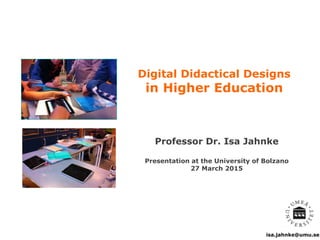
Digital Didactical Designs
in Higher Education
Professor Dr. Isa Jahnke
Presentation at the University of Bolzano
27 March 2015
isa.jahnke@umu.se
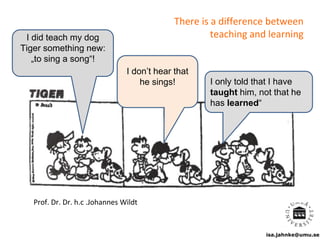
I only told that I have
taught him, not that he
has learned“
I did teach my dog
Tiger something new:
„to sing a song“!
I don’t hear that
he sings!
There is a difference between
teaching and learning
Prof. Dr. Dr. h.c .Johannes Wildt
isa.jahnke@umu.se
Datum Sidfot 3
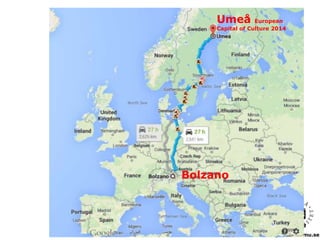
Bolzano
Umeå European
Capital of Culture 2014
isa.jahnke@umu.se
Umeå – European Capital of Culture 2014
isa.jahnke@umu.se
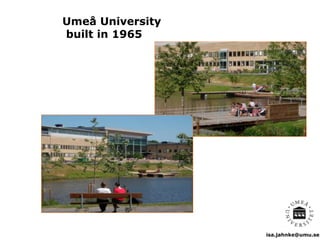
Umeå University
built in 1965
isa.jahnke@umu.se
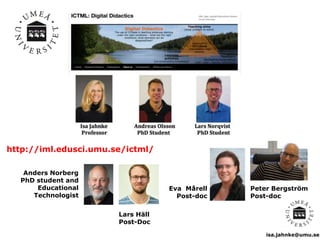
http://iml.edusci.umu.se/ictml/
Eva Mårell
Post-doc
Peter Bergström
Post-doc
Anders Norberg
PhD student and
Educational
Technologist
Lars Häll
Post-Doc
isa.jahnke@umu.se
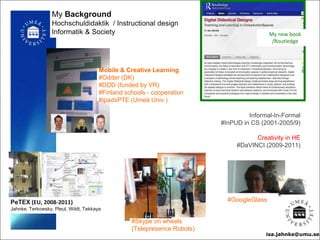
My Background
Hochschuldidaktik / Instructional design
Informatik & Society
#Skype on wheels
(Telepresence Robots)
#GoogleGlass
Mobile & Creative Learning
#Odder (DK)
#DDD (funded by VR)
#Finland schools - cooperation
#ipadsPTE (Umeå Univ.)
PeTEX (EU, 2008-2011)
Jahnke, Terkowsky, Pleul, Wildt, Tekkaya
Informal-In-Formal
#InPUD in CS (2001-2005/9)
Creativity in HE
#DaVINCI (2009-2011)
isa.jahnke@umu.se
My new book
/Routledge
isa.jahnke@umu.se
What is your background in terms of
“discipline”, “field” or “department”?
ANSWER HERE
http://PollEv.com/isaja
Poll Every Where . com
isa.jahnke@umu.se
Outline
• An alternative view
on our digital world today --- CrossActionSpaces
• What does this mean for teaching and learning in
higher education? (understanding learning in such a digital world)
= Characteristics of Learning in the Digital Age
• What designs for teaching and learning are needed
under such new conditions?
• Examples
isa.jahnke@umu.se
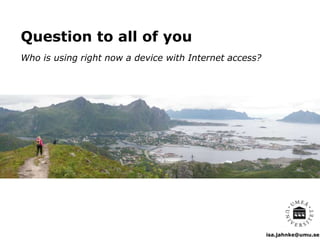
Question to all of you
Who is using right now a device with Internet access?
lofoten picture
isa.jahnke@umu.se
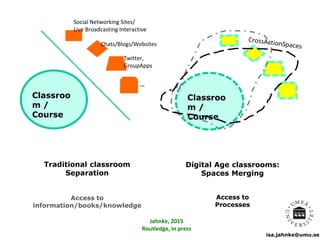
Classroo
m /
Course
Classroo
m /
Course
Digital Age classrooms:
Spaces Merging
Access to
Processes
Twitter,
GroupApps
Chats/Blogs/Websites
Social Networking Sites/
Live Broadcasting Interactive
…
Traditional classroom
Separation
Access to
information/books/knowledge
Jahnke, 2015
Routledge, in press
isa.jahnke@umu.se
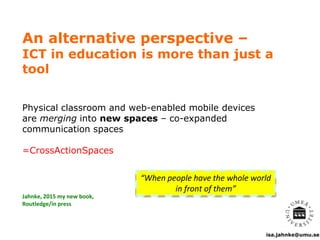
An alternative perspective –
ICT in education is more than just a
tool
Physical classroom and web-enabled mobile devices
are merging into new spaces – co-expanded
communication spaces
=CrossActionSpaces
Jahnke, 2015 my new book,
Routledge/in press
“When people have the whole world
in front of them”
isa.jahnke@umu.se
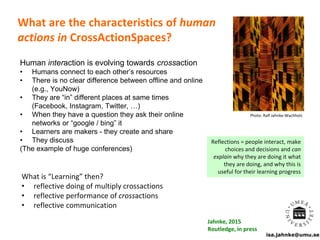
What are the characteristics of human
actions in CrossActionSpaces?
Human interaction is evolving towards crossaction
• Humans connect to each other’s resources
• There is no clear difference between offline and online
(e.g., YouNow)
• They are “in” different places at same times
(Facebook, Instagram, Twitter, …)
• When they have a question they ask their online
networks or “google / bing” it
• Learners are makers - they create and share
• They discuss
(The example of huge conferences)
Photo: Ralf Jahnke-Wachholz
Reflections = people interact, make
choices and decisions and can
explain why they are doing it what
they are doing, and why this is
useful for their learning progress
What is “Learning” then?
• reflective doing of multiply crossactions
• reflective performance of crossactions
• reflective communication
Jahnke, 2015
Routledge, in press
isa.jahnke@umu.se
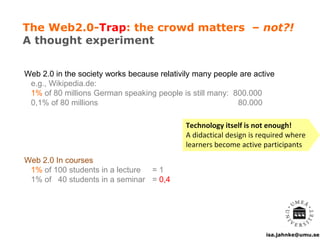
The Web2.0-Trap: the crowd matters – not?!
A thought experiment
Web 2.0 in the society works because relativily many people are active
e.g., Wikipedia.de:
1% of 80 millions German speaking people is still many: 800.000
0,1% of 80 millions 80.000
Web 2.0 In courses
1% of 100 students in a lecture = 1
1% of 40 students in a seminar = 0,4
Technology itself is not enough!
A didactical design is required where
learners become active participants
isa.jahnke@umu.se
What is a) learning in
your course, and how
do you define b)
teaching?
Go to
TodaysMeet.com
• https://todaysmeet.com/Bolzano
and write your answer there
Use keywords or short phrases
(ca. 10 mins)
isa.jahnke@umu.se
Theoretical lens
Design is the act of giving a form to something
Teaching is the ’design act’ of creating conditions for
learning; more specific, it is the act of modelling
sociotechnical-pedagogical processes to enable
student learning
Designs for Learning
--Bonderup-Dohn & Hansen, 2014
--Jahnke, Norqvist, & Olsson, 2014
isa.jahnke@umu.se
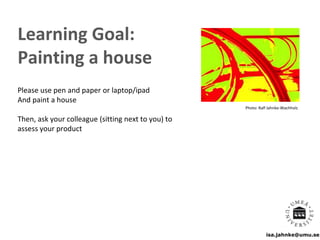
Learning Goal:
Painting a house
Please use pen and paper or laptop/ipad
And paint a house
Then, ask your colleague (sitting next to you) to
assess your product
Photo: Ralf Jahnke-Wachholz
isa.jahnke@umu.se
• Set learning goals
• Set criteria
• Create learning processes
isa.jahnke@umu.se
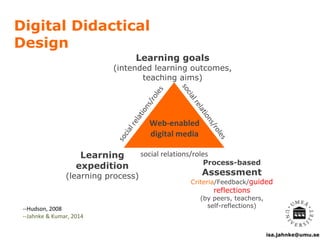
Learning goals
(intended learning outcomes,
teaching aims)
Learning
expedition
(learning process)
Process-based
Assessment
Criteria/Feedback/guided
reflections
(by peers, teachers,
self-reflections)
social relations/roles
Web-enabled
digital media
Digital Didactical
Design
--Hudson, 2008
--Jahnke & Kumar, 2014
isa.jahnke@umu.se
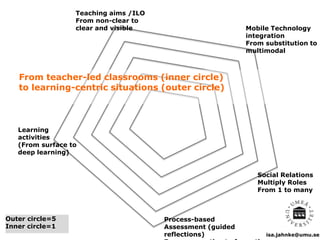
Social Relations
Multiply Roles
From 1 to many
Learning
activities
(From surface to
deep learning)
Teaching aims /ILO
From non-clear to
clear and visible
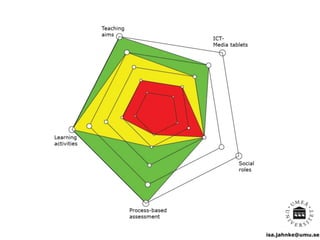
Outer circle=5
Inner circle=1
From teacher-led classrooms (inner circle)
to learning-centric situations (outer circle)
Mobile Technology
integration
From substitution to
multimodal
Process-based
Assessment (guided
reflections)
isa.jahnke@umu.se
isa.jahnke@umu.se
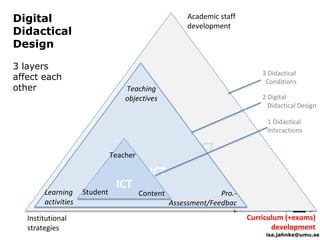
Digital
Didactical
Design
3 layers
affect each
other
ICT ICT
ICT
ICT
Student
Teacher
Content
Teaching
objectives
Pro.-
Assessment/Feedbac
k
Learning
activities
Academic staff
development
Curriculum (+exams)
development
Institutional
strategies
1 Didactical
Interactions
2 Digital
Didactical Design
3 Didactical
Conditions
22
isa.jahnke@umu.se
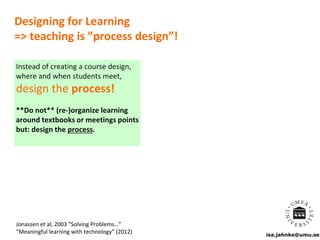
Designing for Learning
=> teaching is ”process design”!
Jonassen et al, 2003 “Solving Problems…”
“Meaningful learning with technology” (2012)
Instead of creating a course design,
where and when students meet,
design the process!
**Do not** (re-)organize learning
around textbooks or meetings points
but: design the process.
isa.jahnke@umu.se
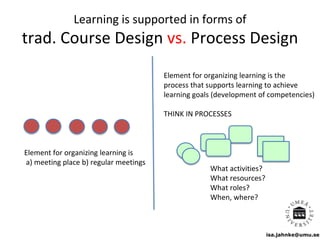
Learning is supported in forms of
trad. Course Design vs. Process Design
Element for organizing learning is
a) meeting place b) regular meetings
Element for organizing learning is the
process that supports learning to achieve
learning goals (development of competencies)
THINK IN PROCESSES
What activities?
What resources?
What roles?
When, where?
isa.jahnke@umu.se
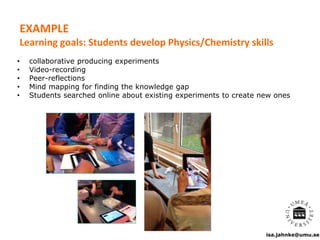
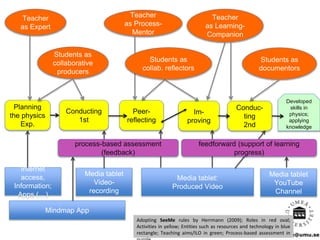
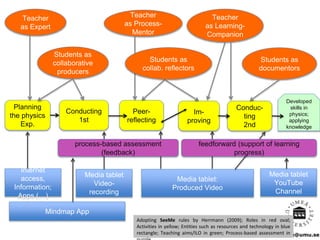
• collaborative producing experiments
• Video-recording
• Peer-reflections
• Mind mapping for finding the knowledge gap
• Students searched online about existing experiments to create new ones
EXAMPLE
Learning goals: Students develop Physics/Chemistry skills
isa.jahnke@umu.se
Planning
the physics
Exp.
Conducting
1st
Peer-
reflecting
Im-
proving
Conduc-
ting
2nd
Teacher
as Expert
Students as
collaborative
producers
Teacher
as Process-
Mentor
Teacher
as Learning-
Companion
Students as
documentors
Internet
access,
Information;
Apps (…)
Media tablet
Video-
recording
Media tablet
YouTube
Channel
Media tablet:
Produced Video
Mindmap App
Students as
collab. reflectors
process-based assessment
(feedback)
Developed
skills in
physics;
applying
knowledge
feedforward (support of learning
progress)
Adopting SeeMe rules by Herrmann (2009); Roles in red oval;
Activities in yellow; Entities such as resources and technology in blue
rectangle; Teaching aims/ILO in green; Process-based assessment in
isa.jahnke@umu.se
Planning
the physics
Exp.
Conducting
1st
Peer-
reflecting
Im-
proving
Conduc-
ting
2nd
Teacher
as Expert
Students as
collaborative
producers
Teacher
as Process-
Mentor
Teacher
as Learning-
Companion
Students as
documentors
Students as
collab. reflectors
Internet
access,
Information;
Apps (…)
Media tablet
Video-
recording
Media tablet
YouTube
Channel
Media tablet:
Produced Video
Mindmap App
process-based assessment
(feedback)
Developed
skills in
physics;
applying
knowledge
feedforward (support of learning
progress)
Adopting SeeMe rules by Herrmann (2009); Roles in red oval;
Activities in yellow; Entities such as resources and technology in blue
rectangle; Teaching aims/ILO in green; Process-based assessment in
isa.jahnke@umu.se
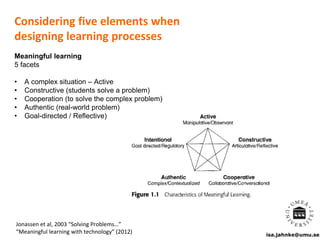
Considering five elements when
designing learning processes
Meaningful learning
5 facets
• A complex situation – Active
• Constructive (students solve a problem)
• Cooperation (to solve the complex problem)
• Authentic (real-world problem)
• Goal-directed / Reflective)
Jonassen et al, 2003 “Solving Problems…”
“Meaningful learning with technology” (2012)
isa.jahnke@umu.se
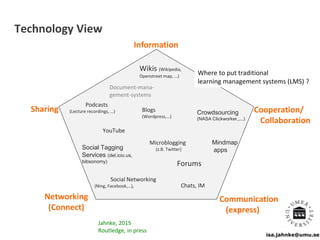
Communication
(express)
Information
Networking
(Connect)
Cooperation/
Collaboration
Sharing
Social Tagging
Services (del.icio.us,
bibsonomy)
Forums
Blogs
(Wordpress,…)
Wikis (Wikipedia,
Openstreet map, …)
Microblogging
(z.B. Twitter)
Where to put traditional
learning management systems (LMS) ?
Social Networking
(Ning, Facebook,…),
YouTube
Podcasts
(Lecture recordings, …) Crowdsourcing
(NASA Clickworker,,...)
Chats, IM
Mindmap
apps
Document-mana-
gement-systems
Jahnke, 2015
Routledge, in press
Technology View
isa.jahnke@umu.se
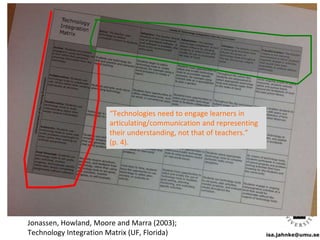
Jonassen, Howland, Moore and Marra (2003);
Technology Integration Matrix (UF, Florida)
“Technologies need to engage learners in
articulating/communication and representing
their understanding, not that of teachers.”
(p. 4).
isa.jahnke@umu.se
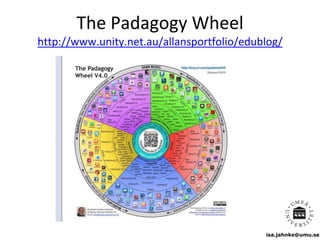
The Padagogy Wheel
http://www.unity.net.au/allansportfolio/edublog/
isa.jahnke@umu.se
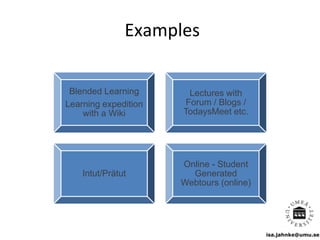
Examples
Blended Learning
Learning expedition
with a Wiki
Lectures with
Forum / Blogs /
TodaysMeet etc.
Intut/Prätut
Online - Student
Generated
Webtours (online)
isa.jahnke@umu.se
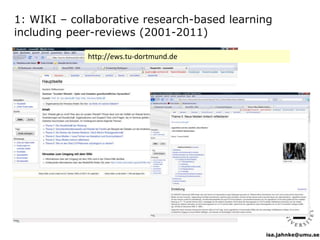
1: WIKI – collaborative research-based learning
including peer-reviews (2001-2011)
http://ews.tu-dortmund.de
isa.jahnke@umu.se
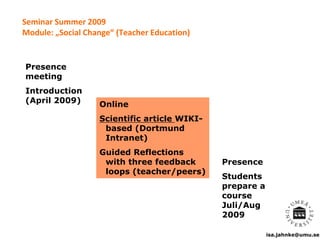
Seminar Summer 2009
Module: „Social Change“ (Teacher Education)
Presence
meeting
Introduction
(April 2009) Online
Scientific article WIKI-
based (Dortmund
Intranet)
Guided Reflections
with three feedback
loops (teacher/peers)
Presence
Students
prepare a
course
Juli/Aug
2009
isa.jahnke@umu.se
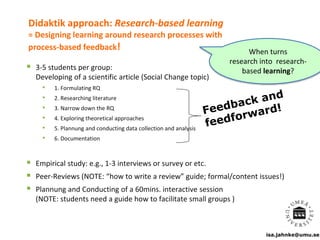
Didaktik approach: Research-based learning
= Designing learning around research processes with
process-based feedback!
 3-5 students per group:
Developing of a scientific article (Social Change topic)
• 1. Formulating RQ
• 2. Researching literature
• 3. Narrow down the RQ
• 4. Exploring theoretical approaches
• 5. Plannung and conducting data collection and analysis
• 6. Documentation
 Empirical study: e.g., 1-3 interviews or survey or etc.
 Peer-Reviews (NOTE: “how to write a review” guide; formal/content issues!)
 Plannung and Conducting of a 60mins. interactive session
(NOTE: students need a guide how to facilitate small groups )
When turns
research into research-
based learning?
isa.jahnke@umu.se
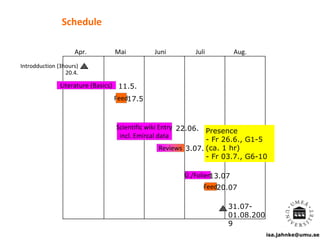
11.5.Literature (Basics)
17.5Feed
22.06.Scientific wiki Entry
incl. Emircal data
Reviews 3.07.
Ü./Folien13.07
Feed20.07
Introdduction (3hours)
20.4.
Apr. Mai Juni Juli Aug.
31.07-
01.08.200
9
Schedule
Presence
- Fr 26.6., G1-5
(ca. 1 hr)
- Fr 03.7., G6-10
isa.jahnke@umu.se
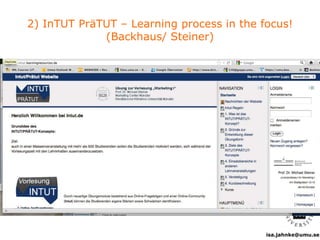
2) InTUT PräTUT – Learning process in the focus!
(Backhaus/ Steiner)
isa.jahnke@umu.se
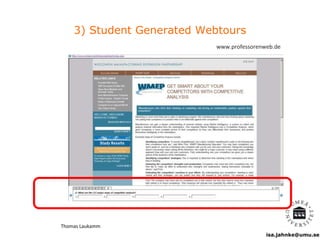
3) Student Generated Webtours
www.professorenweb.de
Thomas Laukamm
isa.jahnke@umu.se
4) Traditional lectures/seminars
with ICT support
• TodaysMeet.com
• Polleverywhere.com
• …
Give every student a voice and activate her
participation through your design for learning
- but don’t say “it is optional” (BIG MISTAKE 
isa.jahnke@umu.se
What have the examples in common?
”Maker Movement in Education” , Maker Pedagogy
Learning through Reflective Making – Learners express themselves in different ways
1. Activating student engagement (motivation) through
producing and (reflective) making
2. More than one correct answer or strategy is possible
3. Documenting learning steps,
= "students express themselves in different ways"
4. choices of learning activities;
= "different ways are possible to build a product”
5. Connecting the learning process to a real audience,
bringing the real world into the university = real world problems
6. combining traditional resources (books, pen, whiteboard...)
and different apps/technology; => technology will not
substitute all other great resources; it is just another way of
designing for learning while using different resources
Maker Movement
Hatch, 2013
Jahnke, 2015,
Routledge/in press
isa.jahnke@umu.se
CrossActionSpaces
"require teachers to undertake more complex reasoning than before
in their planning and practice" (Webb & Coxx, 2007)
Traditional teaching was a routine activity, it is
moving. Teaching using innovative pedagogy
(Didaktik) turns into a
design project in teacher teams
Teachers are learners at the workplace
(Goggins, Jahnke, Wulf, 2014)
Learners become not only pro-sumers/ producers
but
**reflective** makers in groups
Making or producing
is not enough!
Criteria and guided
reflections are required
for supporting the
learning process for a
progress
isa.jahnke@umu.se
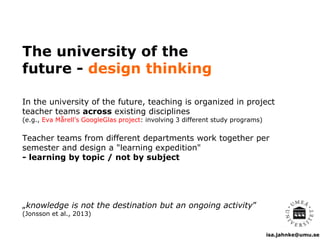
The university of the
future - design thinking
In the university of the future, teaching is organized in project
teacher teams across existing disciplines
(e.g., Eva Mårell’s GoogleGlas project: involving 3 different study programs)
Teacher teams from different departments work together per
semester and design a "learning expedition"
- learning by topic / not by subject
„knowledge is not the destination but an ongoing activity”
(Jonsson et al., 2013)
isa.jahnke@umu.se
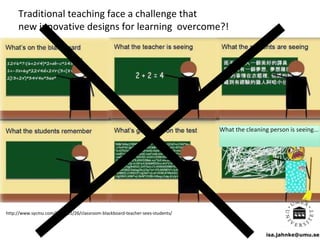
What the cleaning person is seeing...
http://www.sycmu.com/2012/11/26/classroom-blackboard-teacher-sees-students/
Traditional teaching face a challenge that
new innovative designs for learning overcome?!
isa.jahnke@umu.se
Thanks!
Professor Dr. Isa Jahnke
ICT, media and learning
Umeå University
Dep of Applied Educational Sciences
Email
isa.jahnke@gmail.com
Website
http://www.isa-jahnke.com
Facebook and Twitter
@isaja
isa.jahnke@umu.se
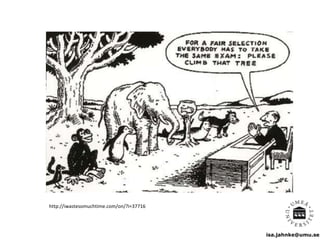
http://iwastesomuchtime.com/on/?i=37716

2015 03-27-bozen-v3ij

  • 1.
    isa.jahnke@umu.se Digital Didactical Designs inHigher Education Professor Dr. Isa Jahnke Presentation at the University of Bolzano 27 March 2015
  • 2.
    isa.jahnke@umu.se I only toldthat I have taught him, not that he has learned“ I did teach my dog Tiger something new: „to sing a song“! I don’t hear that he sings! There is a difference between teaching and learning Prof. Dr. Dr. h.c .Johannes Wildt
  • 3.
    isa.jahnke@umu.se Datum Sidfot 3 Bolzano UmeåEuropean Capital of Culture 2014
  • 4.
    isa.jahnke@umu.se Umeå – EuropeanCapital of Culture 2014
  • 5.
  • 6.
    isa.jahnke@umu.se http://iml.edusci.umu.se/ictml/ Eva Mårell Post-doc Peter Bergström Post-doc AndersNorberg PhD student and Educational Technologist Lars Häll Post-Doc
  • 7.
    isa.jahnke@umu.se My Background Hochschuldidaktik /Instructional design Informatik & Society #Skype on wheels (Telepresence Robots) #GoogleGlass Mobile & Creative Learning #Odder (DK) #DDD (funded by VR) #Finland schools - cooperation #ipadsPTE (Umeå Univ.) PeTEX (EU, 2008-2011) Jahnke, Terkowsky, Pleul, Wildt, Tekkaya Informal-In-Formal #InPUD in CS (2001-2005/9) Creativity in HE #DaVINCI (2009-2011) isa.jahnke@umu.se My new book /Routledge
  • 8.
    isa.jahnke@umu.se What is yourbackground in terms of “discipline”, “field” or “department”? ANSWER HERE http://PollEv.com/isaja Poll Every Where . com
  • 9.
    isa.jahnke@umu.se Outline • An alternativeview on our digital world today --- CrossActionSpaces • What does this mean for teaching and learning in higher education? (understanding learning in such a digital world) = Characteristics of Learning in the Digital Age • What designs for teaching and learning are needed under such new conditions? • Examples
  • 10.
    isa.jahnke@umu.se Question to allof you Who is using right now a device with Internet access? lofoten picture
  • 11.
    isa.jahnke@umu.se Classroo m / Course Classroo m / Course DigitalAge classrooms: Spaces Merging Access to Processes Twitter, GroupApps Chats/Blogs/Websites Social Networking Sites/ Live Broadcasting Interactive … Traditional classroom Separation Access to information/books/knowledge Jahnke, 2015 Routledge, in press
  • 12.
    isa.jahnke@umu.se An alternative perspective– ICT in education is more than just a tool Physical classroom and web-enabled mobile devices are merging into new spaces – co-expanded communication spaces =CrossActionSpaces Jahnke, 2015 my new book, Routledge/in press “When people have the whole world in front of them”
  • 13.
    isa.jahnke@umu.se What are thecharacteristics of human actions in CrossActionSpaces? Human interaction is evolving towards crossaction • Humans connect to each other’s resources • There is no clear difference between offline and online (e.g., YouNow) • They are “in” different places at same times (Facebook, Instagram, Twitter, …) • When they have a question they ask their online networks or “google / bing” it • Learners are makers - they create and share • They discuss (The example of huge conferences) Photo: Ralf Jahnke-Wachholz Reflections = people interact, make choices and decisions and can explain why they are doing it what they are doing, and why this is useful for their learning progress What is “Learning” then? • reflective doing of multiply crossactions • reflective performance of crossactions • reflective communication Jahnke, 2015 Routledge, in press
  • 14.
    isa.jahnke@umu.se The Web2.0-Trap: thecrowd matters – not?! A thought experiment Web 2.0 in the society works because relativily many people are active e.g., Wikipedia.de: 1% of 80 millions German speaking people is still many: 800.000 0,1% of 80 millions 80.000 Web 2.0 In courses 1% of 100 students in a lecture = 1 1% of 40 students in a seminar = 0,4 Technology itself is not enough! A didactical design is required where learners become active participants
  • 15.
    isa.jahnke@umu.se What is a)learning in your course, and how do you define b) teaching? Go to TodaysMeet.com • https://todaysmeet.com/Bolzano and write your answer there Use keywords or short phrases (ca. 10 mins)
  • 16.
    isa.jahnke@umu.se Theoretical lens Design isthe act of giving a form to something Teaching is the ’design act’ of creating conditions for learning; more specific, it is the act of modelling sociotechnical-pedagogical processes to enable student learning Designs for Learning --Bonderup-Dohn & Hansen, 2014 --Jahnke, Norqvist, & Olsson, 2014
  • 17.
    isa.jahnke@umu.se Learning Goal: Painting ahouse Please use pen and paper or laptop/ipad And paint a house Then, ask your colleague (sitting next to you) to assess your product Photo: Ralf Jahnke-Wachholz
  • 18.
    isa.jahnke@umu.se • Set learninggoals • Set criteria • Create learning processes
  • 19.
    isa.jahnke@umu.se Learning goals (intended learningoutcomes, teaching aims) Learning expedition (learning process) Process-based Assessment Criteria/Feedback/guided reflections (by peers, teachers, self-reflections) social relations/roles Web-enabled digital media Digital Didactical Design --Hudson, 2008 --Jahnke & Kumar, 2014
  • 20.
    isa.jahnke@umu.se Social Relations Multiply Roles From1 to many Learning activities (From surface to deep learning) Teaching aims /ILO From non-clear to clear and visible Outer circle=5 Inner circle=1 From teacher-led classrooms (inner circle) to learning-centric situations (outer circle) Mobile Technology integration From substitution to multimodal Process-based Assessment (guided reflections)
  • 21.
  • 22.
    isa.jahnke@umu.se Digital Didactical Design 3 layers affect each other ICTICT ICT ICT Student Teacher Content Teaching objectives Pro.- Assessment/Feedbac k Learning activities Academic staff development Curriculum (+exams) development Institutional strategies 1 Didactical Interactions 2 Digital Didactical Design 3 Didactical Conditions 22
  • 23.
    isa.jahnke@umu.se Designing for Learning =>teaching is ”process design”! Jonassen et al, 2003 “Solving Problems…” “Meaningful learning with technology” (2012) Instead of creating a course design, where and when students meet, design the process! **Do not** (re-)organize learning around textbooks or meetings points but: design the process.
  • 24.
    isa.jahnke@umu.se Learning is supportedin forms of trad. Course Design vs. Process Design Element for organizing learning is a) meeting place b) regular meetings Element for organizing learning is the process that supports learning to achieve learning goals (development of competencies) THINK IN PROCESSES What activities? What resources? What roles? When, where?
  • 25.
    isa.jahnke@umu.se • collaborative producingexperiments • Video-recording • Peer-reflections • Mind mapping for finding the knowledge gap • Students searched online about existing experiments to create new ones EXAMPLE Learning goals: Students develop Physics/Chemistry skills
  • 26.
    isa.jahnke@umu.se Planning the physics Exp. Conducting 1st Peer- reflecting Im- proving Conduc- ting 2nd Teacher as Expert Studentsas collaborative producers Teacher as Process- Mentor Teacher as Learning- Companion Students as documentors Internet access, Information; Apps (…) Media tablet Video- recording Media tablet YouTube Channel Media tablet: Produced Video Mindmap App Students as collab. reflectors process-based assessment (feedback) Developed skills in physics; applying knowledge feedforward (support of learning progress) Adopting SeeMe rules by Herrmann (2009); Roles in red oval; Activities in yellow; Entities such as resources and technology in blue rectangle; Teaching aims/ILO in green; Process-based assessment in
  • 27.
    isa.jahnke@umu.se Planning the physics Exp. Conducting 1st Peer- reflecting Im- proving Conduc- ting 2nd Teacher as Expert Studentsas collaborative producers Teacher as Process- Mentor Teacher as Learning- Companion Students as documentors Students as collab. reflectors Internet access, Information; Apps (…) Media tablet Video- recording Media tablet YouTube Channel Media tablet: Produced Video Mindmap App process-based assessment (feedback) Developed skills in physics; applying knowledge feedforward (support of learning progress) Adopting SeeMe rules by Herrmann (2009); Roles in red oval; Activities in yellow; Entities such as resources and technology in blue rectangle; Teaching aims/ILO in green; Process-based assessment in
  • 28.
    isa.jahnke@umu.se Considering five elementswhen designing learning processes Meaningful learning 5 facets • A complex situation – Active • Constructive (students solve a problem) • Cooperation (to solve the complex problem) • Authentic (real-world problem) • Goal-directed / Reflective) Jonassen et al, 2003 “Solving Problems…” “Meaningful learning with technology” (2012)
  • 29.
    isa.jahnke@umu.se Communication (express) Information Networking (Connect) Cooperation/ Collaboration Sharing Social Tagging Services (del.icio.us, bibsonomy) Forums Blogs (Wordpress,…) Wikis(Wikipedia, Openstreet map, …) Microblogging (z.B. Twitter) Where to put traditional learning management systems (LMS) ? Social Networking (Ning, Facebook,…), YouTube Podcasts (Lecture recordings, …) Crowdsourcing (NASA Clickworker,,...) Chats, IM Mindmap apps Document-mana- gement-systems Jahnke, 2015 Routledge, in press Technology View
  • 30.
    isa.jahnke@umu.se Jonassen, Howland, Mooreand Marra (2003); Technology Integration Matrix (UF, Florida) “Technologies need to engage learners in articulating/communication and representing their understanding, not that of teachers.” (p. 4).
  • 31.
  • 32.
    isa.jahnke@umu.se Examples Blended Learning Learning expedition witha Wiki Lectures with Forum / Blogs / TodaysMeet etc. Intut/Prätut Online - Student Generated Webtours (online)
  • 33.
    isa.jahnke@umu.se 1: WIKI –collaborative research-based learning including peer-reviews (2001-2011) http://ews.tu-dortmund.de
  • 34.
    isa.jahnke@umu.se Seminar Summer 2009 Module:„Social Change“ (Teacher Education) Presence meeting Introduction (April 2009) Online Scientific article WIKI- based (Dortmund Intranet) Guided Reflections with three feedback loops (teacher/peers) Presence Students prepare a course Juli/Aug 2009
  • 35.
    isa.jahnke@umu.se Didaktik approach: Research-basedlearning = Designing learning around research processes with process-based feedback!  3-5 students per group: Developing of a scientific article (Social Change topic) • 1. Formulating RQ • 2. Researching literature • 3. Narrow down the RQ • 4. Exploring theoretical approaches • 5. Plannung and conducting data collection and analysis • 6. Documentation  Empirical study: e.g., 1-3 interviews or survey or etc.  Peer-Reviews (NOTE: “how to write a review” guide; formal/content issues!)  Plannung and Conducting of a 60mins. interactive session (NOTE: students need a guide how to facilitate small groups ) When turns research into research- based learning?
  • 36.
    isa.jahnke@umu.se 11.5.Literature (Basics) 17.5Feed 22.06.Scientific wikiEntry incl. Emircal data Reviews 3.07. Ü./Folien13.07 Feed20.07 Introdduction (3hours) 20.4. Apr. Mai Juni Juli Aug. 31.07- 01.08.200 9 Schedule Presence - Fr 26.6., G1-5 (ca. 1 hr) - Fr 03.7., G6-10
  • 37.
    isa.jahnke@umu.se 2) InTUT PräTUT– Learning process in the focus! (Backhaus/ Steiner)
  • 38.
    isa.jahnke@umu.se 3) Student GeneratedWebtours www.professorenweb.de Thomas Laukamm
  • 39.
    isa.jahnke@umu.se 4) Traditional lectures/seminars withICT support • TodaysMeet.com • Polleverywhere.com • … Give every student a voice and activate her participation through your design for learning - but don’t say “it is optional” (BIG MISTAKE 
  • 40.
    isa.jahnke@umu.se What have theexamples in common? ”Maker Movement in Education” , Maker Pedagogy Learning through Reflective Making – Learners express themselves in different ways 1. Activating student engagement (motivation) through producing and (reflective) making 2. More than one correct answer or strategy is possible 3. Documenting learning steps, = "students express themselves in different ways" 4. choices of learning activities; = "different ways are possible to build a product” 5. Connecting the learning process to a real audience, bringing the real world into the university = real world problems 6. combining traditional resources (books, pen, whiteboard...) and different apps/technology; => technology will not substitute all other great resources; it is just another way of designing for learning while using different resources Maker Movement Hatch, 2013 Jahnke, 2015, Routledge/in press
  • 41.
    isa.jahnke@umu.se CrossActionSpaces "require teachers toundertake more complex reasoning than before in their planning and practice" (Webb & Coxx, 2007) Traditional teaching was a routine activity, it is moving. Teaching using innovative pedagogy (Didaktik) turns into a design project in teacher teams Teachers are learners at the workplace (Goggins, Jahnke, Wulf, 2014) Learners become not only pro-sumers/ producers but **reflective** makers in groups Making or producing is not enough! Criteria and guided reflections are required for supporting the learning process for a progress
  • 42.
    isa.jahnke@umu.se The university ofthe future - design thinking In the university of the future, teaching is organized in project teacher teams across existing disciplines (e.g., Eva Mårell’s GoogleGlas project: involving 3 different study programs) Teacher teams from different departments work together per semester and design a "learning expedition" - learning by topic / not by subject „knowledge is not the destination but an ongoing activity” (Jonsson et al., 2013)
  • 43.
    isa.jahnke@umu.se What the cleaningperson is seeing... http://www.sycmu.com/2012/11/26/classroom-blackboard-teacher-sees-students/ Traditional teaching face a challenge that new innovative designs for learning overcome?!
  • 44.
    isa.jahnke@umu.se Thanks! Professor Dr. IsaJahnke ICT, media and learning Umeå University Dep of Applied Educational Sciences Email isa.jahnke@gmail.com Website http://www.isa-jahnke.com Facebook and Twitter @isaja
  • 45.