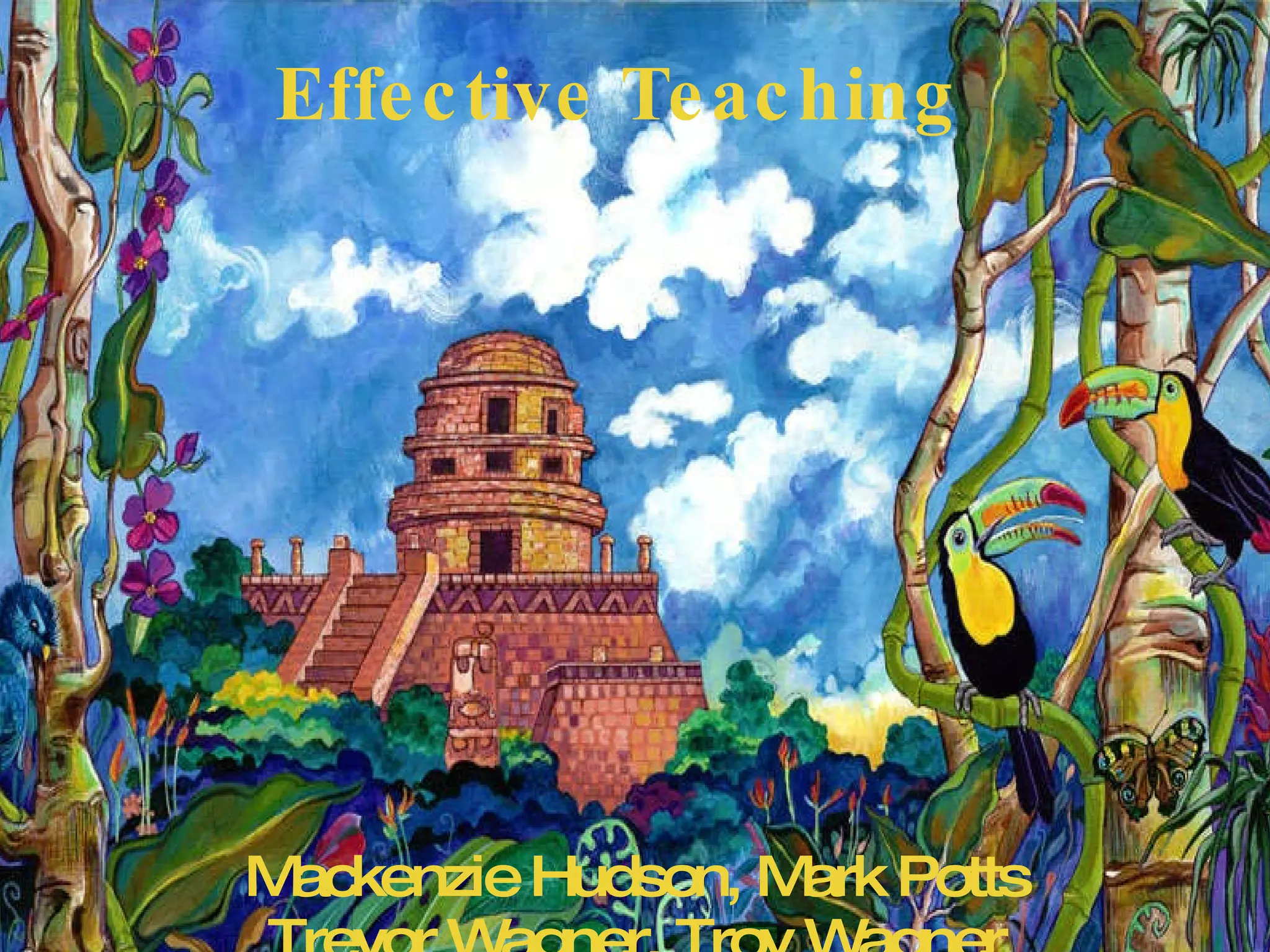
Effective Teaching Mackenzie Hudson, Mark Potts Trevor Wagner, Troy Wagner
Essential Question What characteristics of lesson planning make teaching effective?
Goals Demonstrate knowledge of characteristics of effective teaching Understand importance of working positively in collaborative groups
Objectives List 5 of the 11 Assignments That Matter characteristics Define effective teaching Deconstruct an effective lesson plan and describe its successful components
Involves technology integration Keeps students motivated and engaged Uses teaching style that benefits every student   Uses the characteristics of Assignments That Matter   Effective Teaching
Assignments That Matter Characteristics Collaborative Authentic Allow for feedback Allow for interactive learning Engaging Encourage higher-thinking skills Have clear and illustrative examples Give students choices Encourage creativity Reinforce instruction Encourage students to be proactive
El Misterio de los Mayas Students create an answer to the essential question while learning about the scientific method, the Mayan culture and history and develop conclusions about civilizations, past and present. Essential Question :
What brings about the rise and fall of great civilizations?
Sequence of Events 1. Present Essential Question 2. Hold group discussion about Content Questions 3. Ask Gauging Student Needs questions and instructional time 4. Presentation of Maya instructions handout 5. Teach about scientific method 6. Individual research on specific topic 7. Work in small groups to form hypotheses explaining the collapse of the Mayans 8. Group must test and quantify their thesis statements and come to conclusions 9. Presentations 10. Wrap-up discussion 11. Concluding essay
Theorist Constructivism Student-driven lessons Hypothesis leads to research Critique & Revision
Use of Constructivism Mayan decline study provides insights of current cultural experiences Lesson starts with questions meant to build meaning Promotes using prior knowledge Interpreting and predict information (hypothesis through Scientific Method) Dialogue among students
Noted Theorists’ Ideas Jean Piaget    child is a scientist, knowledge of relationships along events (e.g. Mayan decline vs. current culture) B.F. Skinner    important to see consequences of Mayan culture and understand the causes Lev Vygotsky    stressed the importance of past experiences and connecting them to the present Jerome Bruner    student selects information to form a hypothesis to enhance meaning John Dewey    social learning makes knowledge applicable to life
Psychologist Incorporates Left Brain and Right Brain Students Left Brain Students Independent research Individual reflection essay  Right Brain Students  Group work  Presentation
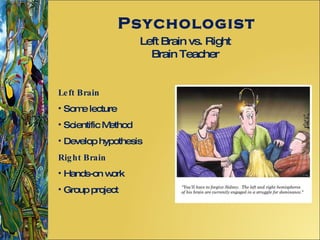
Psychologist Left Brain Some lecture Scientific Method Develop hypothesis  Right   Brain   Hands-on work  Group project Left Brain vs. Right Brain Teacher
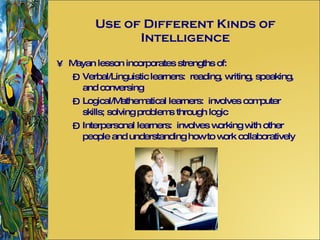
Use of Different Kinds of Intelligence Mayan lesson incorporates strengths of: Verbal/Linguistic learners:  reading, writing, speaking, and conversing Logical/Mathematical learners:  involves computer skills; solving problems through logic Interpersonal learners:  involves working with other people and understanding how to work collaboratively
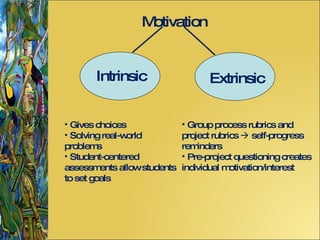
Intrinsic Motivation Extrinsic Gives choices Solving real-world problems Student-centered assessments allow students to set goals Group process rubrics and project rubrics    self-progress reminders Pre-project questioning creates individual motivation/interest
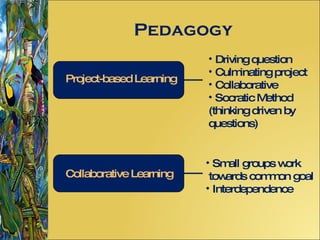
Pedagogy Project-based Learning Collaborative Learning Driving question Culminating project Collaborative Socratic Method (thinking driven by questions) Small groups work  towards common goal Interdependence
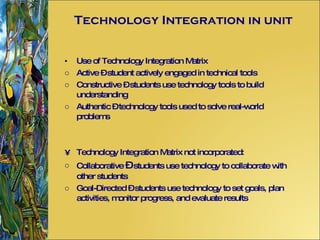
Technology Integration in unit Use of Technology Integration Matrix Active – student actively engaged in technical tools Constructive – students use technology tools to build understanding Authentic – technology tools used to solve real-world problems Technology Integration Matrix not incorporated: Collaborative  –  students use technology to collaborate with other students Goal-Directed – students use technology to set goals, plan activities, monitor progress, and evaluate results
Technology Integration in unit The levels that are  not  used in the Mayan project include: Entry/Adoption – technology not used to deliver instructions or direct students toward use of tools Adaptation – all students use slideshows to present; students cannot choose other possible tools for presentations
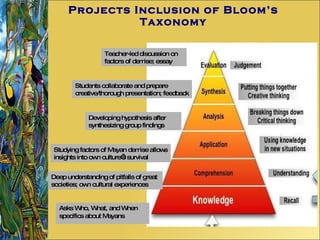
Projects Inclusion of Bloom’s Taxonomy Asks Who, What, and When specifics about Mayans Deep understanding of pitfalls of great societies; own cultural experiences Studying factors of Mayan demise allows insights into own culture’s survival Developing hypothesis after synthesizing group findings Students collaborate and prepare creative/thorough presentation; feedback Teacher-led discussion on factors of demise; essay
Instructional Designer Assessment Timeline: Break it down Pre-project  Gauge student needs; class questioning Determine prior knowledge Create interest (engage students) Promote critical thinking & monitor understanding During Project  Conferences; peer feedback; group collaboration rubric Students aware of expectations for group Students assess their collaboration Conferences help students progress and stay on track Post Project  Reflection essay; group process rubric Students summarize thoughts  Students are aware of how they were assessed
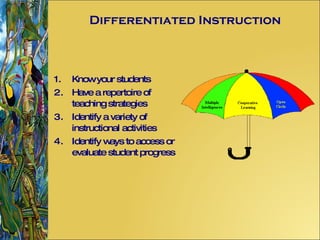
Differentiated Instruction Know your students Have a repertoire of teaching strategies Identify a variety of instructional activities Identify ways to access or evaluate student progress
Lesson Execution of Differentiated Instruction Special Needs Students Provide guidance for finding sources Hold additional conferences to help organize data Provide the English project rubric Gifted/Talented Students Expand research components to accommodate the student’s interests and ability level Nonnative Speaker Provide guidance for locating resources Hold additional conferences to help organize data Use an appropriate language version Internet Encyclopedia for research Provide the English project rubric if the student’s first language is not Spanish
NETS Standards Compliance Collaboration Real-world issues Pursue individual curiosities Reflection  Multiple assessments Learner-centered strategies Fluency in technology systems
Pros ¡ Project focused on technology use ! ¡ Requires synthesis and evaluation ! ¡ Rubrics and assessments are clear and concise ! ¡ Driven by student results ! ¡  Active learning ! ¡  Multidisciplinary!
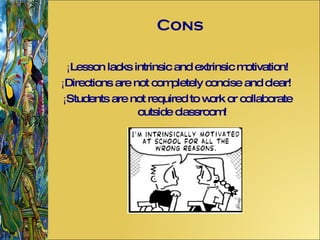
Cons ¡ Lesson lacks intrinsic and extrinsic motivation! ¡ Directions are not completely concise and clear! ¡ Students are not required to work or collaborate outside classroom!
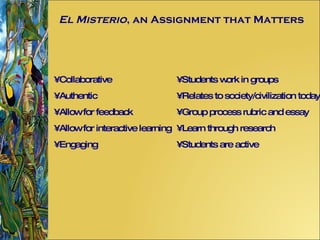
El Misterio , an Assignment that Matters Collaborative Authentic Allow for feedback Allow for interactive learning Engaging Students work in groups Relates to society/civilization today Group process rubric and essay Learn through research Students are active
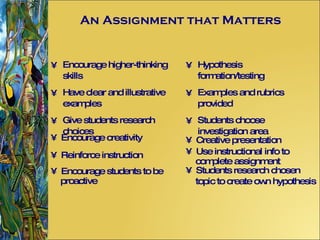
An Assignment that Matters Encourage higher-thinking skills Have clear and illustrative examples Give students research choices Hypothesis formation/testing Examples and rubrics provided Students choose investigation area Encourage creativity Reinforce instruction Creative presentation Encourage students to be  proactive Students research chosen  topic to create own hypothesis Use instructional info to  complete assignment

Effective Teaching Final

  • 1.
    Effective Teaching MackenzieHudson, Mark Potts Trevor Wagner, Troy Wagner
  • 2.
    Essential Question Whatcharacteristics of lesson planning make teaching effective?
  • 3.
    Goals Demonstrate knowledgeof characteristics of effective teaching Understand importance of working positively in collaborative groups
  • 4.
    Objectives List 5of the 11 Assignments That Matter characteristics Define effective teaching Deconstruct an effective lesson plan and describe its successful components
  • 5.
    Involves technology integrationKeeps students motivated and engaged Uses teaching style that benefits every student Uses the characteristics of Assignments That Matter Effective Teaching
  • 6.
    Assignments That MatterCharacteristics Collaborative Authentic Allow for feedback Allow for interactive learning Engaging Encourage higher-thinking skills Have clear and illustrative examples Give students choices Encourage creativity Reinforce instruction Encourage students to be proactive
  • 7.
    El Misterio delos Mayas Students create an answer to the essential question while learning about the scientific method, the Mayan culture and history and develop conclusions about civilizations, past and present. Essential Question :
What brings about the rise and fall of great civilizations?
  • 8.
    Sequence of Events1. Present Essential Question 2. Hold group discussion about Content Questions 3. Ask Gauging Student Needs questions and instructional time 4. Presentation of Maya instructions handout 5. Teach about scientific method 6. Individual research on specific topic 7. Work in small groups to form hypotheses explaining the collapse of the Mayans 8. Group must test and quantify their thesis statements and come to conclusions 9. Presentations 10. Wrap-up discussion 11. Concluding essay
  • 9.
    Theorist Constructivism Student-drivenlessons Hypothesis leads to research Critique & Revision
  • 10.
    Use of ConstructivismMayan decline study provides insights of current cultural experiences Lesson starts with questions meant to build meaning Promotes using prior knowledge Interpreting and predict information (hypothesis through Scientific Method) Dialogue among students
  • 11.
    Noted Theorists’ IdeasJean Piaget  child is a scientist, knowledge of relationships along events (e.g. Mayan decline vs. current culture) B.F. Skinner  important to see consequences of Mayan culture and understand the causes Lev Vygotsky  stressed the importance of past experiences and connecting them to the present Jerome Bruner  student selects information to form a hypothesis to enhance meaning John Dewey  social learning makes knowledge applicable to life
  • 12.
    Psychologist Incorporates LeftBrain and Right Brain Students Left Brain Students Independent research Individual reflection essay Right Brain Students Group work Presentation
  • 13.
    Psychologist Left BrainSome lecture Scientific Method Develop hypothesis Right Brain Hands-on work Group project Left Brain vs. Right Brain Teacher
  • 14.
    Use of DifferentKinds of Intelligence Mayan lesson incorporates strengths of: Verbal/Linguistic learners: reading, writing, speaking, and conversing Logical/Mathematical learners: involves computer skills; solving problems through logic Interpersonal learners: involves working with other people and understanding how to work collaboratively
  • 15.
    Intrinsic Motivation ExtrinsicGives choices Solving real-world problems Student-centered assessments allow students to set goals Group process rubrics and project rubrics  self-progress reminders Pre-project questioning creates individual motivation/interest
  • 16.
    Pedagogy Project-based LearningCollaborative Learning Driving question Culminating project Collaborative Socratic Method (thinking driven by questions) Small groups work towards common goal Interdependence
  • 17.
    Technology Integration inunit Use of Technology Integration Matrix Active – student actively engaged in technical tools Constructive – students use technology tools to build understanding Authentic – technology tools used to solve real-world problems Technology Integration Matrix not incorporated: Collaborative – students use technology to collaborate with other students Goal-Directed – students use technology to set goals, plan activities, monitor progress, and evaluate results
  • 18.
    Technology Integration inunit The levels that are not used in the Mayan project include: Entry/Adoption – technology not used to deliver instructions or direct students toward use of tools Adaptation – all students use slideshows to present; students cannot choose other possible tools for presentations
  • 19.
    Projects Inclusion ofBloom’s Taxonomy Asks Who, What, and When specifics about Mayans Deep understanding of pitfalls of great societies; own cultural experiences Studying factors of Mayan demise allows insights into own culture’s survival Developing hypothesis after synthesizing group findings Students collaborate and prepare creative/thorough presentation; feedback Teacher-led discussion on factors of demise; essay
  • 20.
    Instructional Designer AssessmentTimeline: Break it down Pre-project Gauge student needs; class questioning Determine prior knowledge Create interest (engage students) Promote critical thinking & monitor understanding During Project Conferences; peer feedback; group collaboration rubric Students aware of expectations for group Students assess their collaboration Conferences help students progress and stay on track Post Project Reflection essay; group process rubric Students summarize thoughts Students are aware of how they were assessed
  • 21.
    Differentiated Instruction Knowyour students Have a repertoire of teaching strategies Identify a variety of instructional activities Identify ways to access or evaluate student progress
  • 22.
    Lesson Execution ofDifferentiated Instruction Special Needs Students Provide guidance for finding sources Hold additional conferences to help organize data Provide the English project rubric Gifted/Talented Students Expand research components to accommodate the student’s interests and ability level Nonnative Speaker Provide guidance for locating resources Hold additional conferences to help organize data Use an appropriate language version Internet Encyclopedia for research Provide the English project rubric if the student’s first language is not Spanish
  • 23.
    NETS Standards ComplianceCollaboration Real-world issues Pursue individual curiosities Reflection Multiple assessments Learner-centered strategies Fluency in technology systems
  • 24.
    Pros ¡ Projectfocused on technology use ! ¡ Requires synthesis and evaluation ! ¡ Rubrics and assessments are clear and concise ! ¡ Driven by student results ! ¡ Active learning ! ¡ Multidisciplinary!
  • 25.
    Cons ¡ Lessonlacks intrinsic and extrinsic motivation! ¡ Directions are not completely concise and clear! ¡ Students are not required to work or collaborate outside classroom!
  • 26.
    El Misterio ,an Assignment that Matters Collaborative Authentic Allow for feedback Allow for interactive learning Engaging Students work in groups Relates to society/civilization today Group process rubric and essay Learn through research Students are active
  • 27.
    An Assignment thatMatters Encourage higher-thinking skills Have clear and illustrative examples Give students research choices Hypothesis formation/testing Examples and rubrics provided Students choose investigation area Encourage creativity Reinforce instruction Creative presentation Encourage students to be proactive Students research chosen topic to create own hypothesis Use instructional info to complete assignment