Educational Media &
Technology
:Design Process And Practice
The Instructional Design Process

                      Dr Joe Nicholls
A Traditional Approach To
 Instructional Design
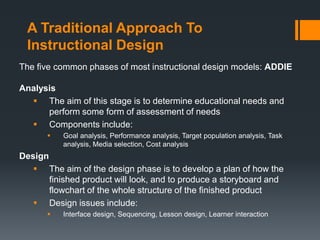
The five common phases of most instructional design models: ADDIE

Analysis
   The aim of this stage is to determine educational needs and
      perform some form of assessment of needs
   Components include:
         Goal analysis, Performance analysis, Target population analysis, Task
          analysis, Media selection, Cost analysis
Design
    The aim of the design phase is to develop a plan of how the
       finished product will look, and to produce a storyboard and
       flowchart of the whole structure of the finished product
    Design issues include:
         Interface design, Sequencing, Lesson design, Learner interaction
A Traditional Approach To
 Instructional Design
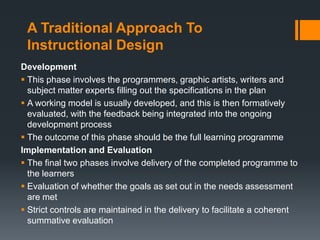
Development
 This phase involves the programmers, graphic artists, writers and
  subject matter experts filling out the specifications in the plan
 A working model is usually developed, and this is then formatively
  evaluated, with the feedback being integrated into the ongoing
  development process
 The outcome of this phase should be the full learning programme
Implementation and Evaluation
 The final two phases involve delivery of the completed programme to
  the learners
 Evaluation of whether the goals as set out in the needs assessment
  are met
 Strict controls are maintained in the delivery to facilitate a coherent
  summative evaluation
Problems With The Traditional
 Approach
 Rational versus creative approaches to design
 Rational
   typical of engineering not education
   emphasis on the need for clearly defined concepts and skills
   prescribes a systematic method for approaching problems
 Creative
   flexible, creative solutions to situations which are seen as unique
   a more creative methodology is necessary in education
Gagne - Systematic Instructional
 Design
 Analysing learners and course goals to make objectives, sequence
  instructional experiences, set the medium for instruction, and assess
  student performance and the course
 Nine instructional events that make up the specific needs and methods
  in media based learning:
1. Gaining attention
2. Stating lesson objective
3. Referring to prior learning or knowledge
4. Presenting stimuli with distinctive features
5. Guiding learning
6. Eliciting performance
7. Providing feedback
8. Assessing performance
9. Retention and learning transfer
Instructional Systems Design (ISD)

    Conduct                            Conduct
                   Established
     Needs                              Task
                   Overall Goal
   Assessment                          Analysis


                     Develop
                                       Specify
  Select media     Assessment
                                      Objectives
                    Strategies


                     Conduct           Conduct
    Produce
                    Formative         Summative
    Materials
                    Evaluation        Evaluation
                 Revise as required
Criticism Of ISD

 Even though ISD provides a planning basis there is a need
  to be cautious
 ISD is oriented to prescriptive procedural sequences
 ISD does not cater for learning that is often more an
  idiosyncratic and even unsystematic experienced based
  construction
 Often not determined by instructional sequence
 ISD can lead to over prescriptive and mechanical
The ASSURE Model
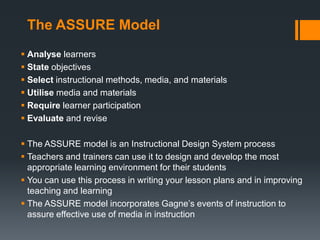
 Analyse learners
 State objectives
 Select instructional methods, media, and materials
 Utilise media and materials
 Require learner participation
 Evaluate and revise

 The ASSURE model is an Instructional Design System process
 Teachers and trainers can use it to design and develop the most
  appropriate learning environment for their students
 You can use this process in writing your lesson plans and in improving
  teaching and learning
 The ASSURE model incorporates Gagne’s events of instruction to
  assure effective use of media in instruction
Analyse Learners

Before you can begin, you must know your target
 audience (your learners)
You need to find out the following information:
  General characteristics - grade, age, ethnic group, sex,
   mental, emotional, physical, or social problems,
   socioeconomic level, and so on
  Specific entry competencies - prior knowledge, skills,
   and attitudes
  Learning styles - verbal, logical, visual, musical,
   structured, and so on
State Objectives

 Once you know your students, you can begin writing the
  objectives of the learning activity. Objectives are the
  learning outcomes, that is, what will the student get out of
  engaging in the activity

 The ABCD's of writing objectives are:
   Audience (who are your learners?)
   Behaviour to be demonstrated
   Conditions under which the behaviour will be observed
   Degree to which the learned skills are to be mastered
Select Instructional Methods, Media
 and Technologies
Once you know your students and have a clear
 idea of what they should get out of the
 lesson, then you are ready to select the:
  Instructional method that you feel is most appropriate to
   meet the objectives for these particular learners
  Media, materials, resources and technologies that would
   be best suited to work with your instructional method, the
   objectives, and your students
Utilise Media And Technology

 Offer the learning activity and use the media and
  technology that you have selected or design and
  developed
 You should always trial (pilot) the finished products before
  using them in a real learning session
 Make sure that your instructional media and technology
  are suitable and working in the given context / environment
Require Learner Participation

 N.B. people learn best when they are actively involved in
  the learning
 The passive learner has more trouble learning whatever
  learning opportunity they are presented with
 Whatever your teaching strategy, you can incorporate
  questions and answers, discussions, group work, hands-
  on activities, and other ways of getting people actively
  involved to meet the learning outcomes
 Educators should create opportunities for everyone to
  participate in the learning activities
Evaluate And Revise
 Anyone can develop a lesson and deliver it, but the last stage is the
  most important one, but often neglected
 Good educators must reflect upon the learning activity, the stated
  objectives, the instructional strategy, the instructional materials, and
  the assessment and determine if these aspects of the lesson were
  effective
   The media/technologies used might not have been appropriate for the type
    of learner or the content might not have been very interesting/motivating
   The instructional strategy might not have got students interesting in
    participation or the strategy might have been difficult to implement
   The assessment you used might have shown that students didn't learn what
    you tested for
 Poor learning will continue to result if the educator doesn’t reflect upon
  the instruction given and work on revising it until students become
  successful learners
Usability Is Key To Good Design
 Central concept but hard to define:
   How well does the system meet the learner’s requirements
 Poor design can:
     create unacceptable user-interface learning times
     create unacceptable error levels
     increase learner frustration
     make intended learning outcomes more difficult to achieve
     lead to rejection of the learning activity by the learner
 Usability can be built in:
     good design practice – derived from instructional theory
     involving learners in the design process
     drawing on past experience (e.g. design rules and guidelines)
     evaluation (especially learner centred evaluation)
Design Is A Collaborative Activity
 Design is NOT a solitary activity – you can’t do everything!
 Designers collaborate with:
   each other, programmers, photographers, artists, content writers,
    technicians, subject specialists, students, teachers…anyone
 Design:
     is conscious
     keeps concerns about people at the centre (or should do)
     is an interchange with media and materials
     is creative
     is communication
     has social consequences
 Good and consistent communication between all people involved –
  especially with learners! – is essential

The Instructional Design Process

  • 1.
    Educational Media & Technology :DesignProcess And Practice The Instructional Design Process Dr Joe Nicholls
  • 2.
    A Traditional ApproachTo Instructional Design The five common phases of most instructional design models: ADDIE Analysis  The aim of this stage is to determine educational needs and perform some form of assessment of needs  Components include:  Goal analysis, Performance analysis, Target population analysis, Task analysis, Media selection, Cost analysis Design  The aim of the design phase is to develop a plan of how the finished product will look, and to produce a storyboard and flowchart of the whole structure of the finished product  Design issues include:  Interface design, Sequencing, Lesson design, Learner interaction
  • 3.
    A Traditional ApproachTo Instructional Design Development  This phase involves the programmers, graphic artists, writers and subject matter experts filling out the specifications in the plan  A working model is usually developed, and this is then formatively evaluated, with the feedback being integrated into the ongoing development process  The outcome of this phase should be the full learning programme Implementation and Evaluation  The final two phases involve delivery of the completed programme to the learners  Evaluation of whether the goals as set out in the needs assessment are met  Strict controls are maintained in the delivery to facilitate a coherent summative evaluation
  • 4.
    Problems With TheTraditional Approach  Rational versus creative approaches to design  Rational  typical of engineering not education  emphasis on the need for clearly defined concepts and skills  prescribes a systematic method for approaching problems  Creative  flexible, creative solutions to situations which are seen as unique  a more creative methodology is necessary in education
  • 5.
    Gagne - SystematicInstructional Design  Analysing learners and course goals to make objectives, sequence instructional experiences, set the medium for instruction, and assess student performance and the course  Nine instructional events that make up the specific needs and methods in media based learning: 1. Gaining attention 2. Stating lesson objective 3. Referring to prior learning or knowledge 4. Presenting stimuli with distinctive features 5. Guiding learning 6. Eliciting performance 7. Providing feedback 8. Assessing performance 9. Retention and learning transfer
  • 6.
    Instructional Systems Design(ISD) Conduct Conduct Established Needs Task Overall Goal Assessment Analysis Develop Specify Select media Assessment Objectives Strategies Conduct Conduct Produce Formative Summative Materials Evaluation Evaluation Revise as required
  • 7.
    Criticism Of ISD Even though ISD provides a planning basis there is a need to be cautious  ISD is oriented to prescriptive procedural sequences  ISD does not cater for learning that is often more an idiosyncratic and even unsystematic experienced based construction  Often not determined by instructional sequence  ISD can lead to over prescriptive and mechanical
  • 8.
    The ASSURE Model Analyse learners  State objectives  Select instructional methods, media, and materials  Utilise media and materials  Require learner participation  Evaluate and revise  The ASSURE model is an Instructional Design System process  Teachers and trainers can use it to design and develop the most appropriate learning environment for their students  You can use this process in writing your lesson plans and in improving teaching and learning  The ASSURE model incorporates Gagne’s events of instruction to assure effective use of media in instruction
  • 9.
    Analyse Learners Before youcan begin, you must know your target audience (your learners) You need to find out the following information:  General characteristics - grade, age, ethnic group, sex, mental, emotional, physical, or social problems, socioeconomic level, and so on  Specific entry competencies - prior knowledge, skills, and attitudes  Learning styles - verbal, logical, visual, musical, structured, and so on
  • 10.
    State Objectives  Onceyou know your students, you can begin writing the objectives of the learning activity. Objectives are the learning outcomes, that is, what will the student get out of engaging in the activity  The ABCD's of writing objectives are:  Audience (who are your learners?)  Behaviour to be demonstrated  Conditions under which the behaviour will be observed  Degree to which the learned skills are to be mastered
  • 11.
    Select Instructional Methods,Media and Technologies Once you know your students and have a clear idea of what they should get out of the lesson, then you are ready to select the:  Instructional method that you feel is most appropriate to meet the objectives for these particular learners  Media, materials, resources and technologies that would be best suited to work with your instructional method, the objectives, and your students
  • 12.
    Utilise Media AndTechnology  Offer the learning activity and use the media and technology that you have selected or design and developed  You should always trial (pilot) the finished products before using them in a real learning session  Make sure that your instructional media and technology are suitable and working in the given context / environment
  • 13.
    Require Learner Participation N.B. people learn best when they are actively involved in the learning  The passive learner has more trouble learning whatever learning opportunity they are presented with  Whatever your teaching strategy, you can incorporate questions and answers, discussions, group work, hands- on activities, and other ways of getting people actively involved to meet the learning outcomes  Educators should create opportunities for everyone to participate in the learning activities
  • 14.
    Evaluate And Revise Anyone can develop a lesson and deliver it, but the last stage is the most important one, but often neglected  Good educators must reflect upon the learning activity, the stated objectives, the instructional strategy, the instructional materials, and the assessment and determine if these aspects of the lesson were effective  The media/technologies used might not have been appropriate for the type of learner or the content might not have been very interesting/motivating  The instructional strategy might not have got students interesting in participation or the strategy might have been difficult to implement  The assessment you used might have shown that students didn't learn what you tested for  Poor learning will continue to result if the educator doesn’t reflect upon the instruction given and work on revising it until students become successful learners
  • 15.
    Usability Is KeyTo Good Design  Central concept but hard to define:  How well does the system meet the learner’s requirements  Poor design can:  create unacceptable user-interface learning times  create unacceptable error levels  increase learner frustration  make intended learning outcomes more difficult to achieve  lead to rejection of the learning activity by the learner  Usability can be built in:  good design practice – derived from instructional theory  involving learners in the design process  drawing on past experience (e.g. design rules and guidelines)  evaluation (especially learner centred evaluation)
  • 16.
    Design Is ACollaborative Activity  Design is NOT a solitary activity – you can’t do everything!  Designers collaborate with:  each other, programmers, photographers, artists, content writers, technicians, subject specialists, students, teachers…anyone  Design:  is conscious  keeps concerns about people at the centre (or should do)  is an interchange with media and materials  is creative  is communication  has social consequences  Good and consistent communication between all people involved – especially with learners! – is essential