Keynote at the European Distance and E-Learning Network Research Workshop
Oldenburg, October 2016
A Scholarly Life Online
George Veletsianos, PhD
Canada Research Chair & Associate Professor
Royal Roads University
Victoria, BC
Canada
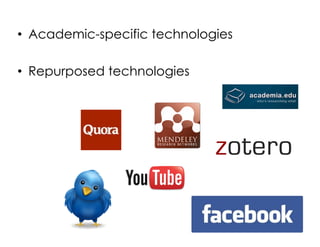
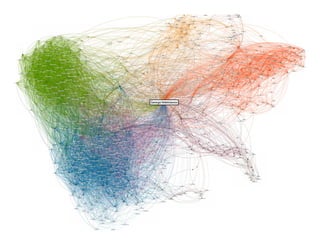
•  Academic-specific technologies
•  Repurposed technologies
Conceptual framework:
Networked Scholarship
Networked Scholarship, or
Networked Participatory Scholarship:
“scholars’ use of participatory technologies
and online social networks to share, reflect
upon, critique, improve, validate, and further
their scholarship” (Veletsianos & Kimmons,
2012)
Conceptual framework:
Networked Scholarship
Open/Social/Digital Scholarship
These focus on a fragment of scholars' online
activities and have ignored other aspects of
online presence.
White & Le Cornu (2011):
Digital Residents & Visitors
Conceptual framework:
Networked Scholarship
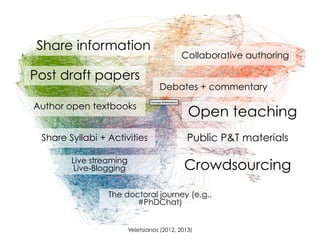
Post draft papers
Author open textbooks
Share Syllabi + Activities
Live streaming
Live-Blogging
Collaborative authoring
Debates + commentary
Open teaching
Public P&T materials
The doctoral journey (e.g.,
#PhDChat)
Crowdsourcing
Share information
Veletsianos (2012, 2013)
What challenges do faculty face on
social media?
•  Social media activities are rife with tensions,
dilemmas, and conundrums.
–  Time demands
–  Surveillance ( à High-profile cases e.g., Salaita, Kansas
Board of regents)
–  Maintaining appropriate and meaningful connections
–  Gender and socioeconomic issues
– Establishing personal-professional boundaries
What challenges do faculty face on
social media?
•  Social media activities are rife with tensions,
dilemmas, and conundrums.
“I made it [Facebook] this hybrid space ... and
sometimes it's really annoying. … I keep thinking I should
be writing or looking at data, [but instead I am
managing the different groups of people that are my
Facebook friends] … I think that I created the
conundrum that I live in now.”
What is the conundrum around
expressing academic identity online?
Acceptable Identity Fragments = how
academics express themselves online
(Kimmons & Veletsianos, 2015)
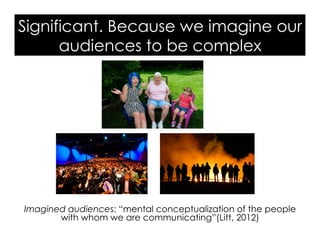
Significant. Because we imagine our
audiences to be complex
Imagined audiences: “mental conceptualization of the people
with whom we are communicating”(Litt, 2012)
Disclosures might have deeper roots
•  Disclosures might be tactical
– Political
– Encourage reflection
(Veletsianos & Stewart, 2016)
So, when institutions view social media
with a functional perspective…
•  They become part of an “audit
culture” and “a complex data
assemblage that confronts the
individual academic” (Burrows, 2012)
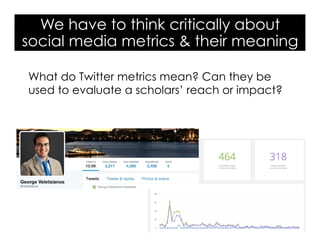
What do Twitter metrics mean? Can they be
used to evaluate a scholars’ reach or impact?
We have to think critically about
social media metrics & their meaning
(R2 = .83, F[4,459] = 571.42, p < .001).
From Veletsianos & Kimmons (2016)
To close…
In creating policies that govern online participation,
recognize that scholars participating online are not
merely disembodied personas aiming to amass
citations and followers and that social media
metrics may not mean what you think they mean.
Thank you!
Research available at:
http://www.veletsianos/
publications
This presentation:
www.slideshare.com/
veletsianos
Contact:
veletsianos@gmail.com
@veletsianos on Twitter

A scholarly life online

  • 1.
    Keynote at theEuropean Distance and E-Learning Network Research Workshop Oldenburg, October 2016 A Scholarly Life Online George Veletsianos, PhD Canada Research Chair & Associate Professor Royal Roads University Victoria, BC Canada
  • 9.
  • 10.
  • 11.
    Networked Scholarship, or NetworkedParticipatory Scholarship: “scholars’ use of participatory technologies and online social networks to share, reflect upon, critique, improve, validate, and further their scholarship” (Veletsianos & Kimmons, 2012) Conceptual framework: Networked Scholarship
  • 12.
    Open/Social/Digital Scholarship These focuson a fragment of scholars' online activities and have ignored other aspects of online presence. White & Le Cornu (2011): Digital Residents & Visitors Conceptual framework: Networked Scholarship
  • 13.
    Post draft papers Authoropen textbooks Share Syllabi + Activities Live streaming Live-Blogging Collaborative authoring Debates + commentary Open teaching Public P&T materials The doctoral journey (e.g., #PhDChat) Crowdsourcing Share information Veletsianos (2012, 2013)
  • 15.
    What challenges dofaculty face on social media? •  Social media activities are rife with tensions, dilemmas, and conundrums. –  Time demands –  Surveillance ( à High-profile cases e.g., Salaita, Kansas Board of regents) –  Maintaining appropriate and meaningful connections –  Gender and socioeconomic issues – Establishing personal-professional boundaries
  • 16.
    What challenges dofaculty face on social media? •  Social media activities are rife with tensions, dilemmas, and conundrums. “I made it [Facebook] this hybrid space ... and sometimes it's really annoying. … I keep thinking I should be writing or looking at data, [but instead I am managing the different groups of people that are my Facebook friends] … I think that I created the conundrum that I live in now.”
  • 17.
    What is theconundrum around expressing academic identity online? Acceptable Identity Fragments = how academics express themselves online (Kimmons & Veletsianos, 2015)
  • 18.
    Significant. Because weimagine our audiences to be complex Imagined audiences: “mental conceptualization of the people with whom we are communicating”(Litt, 2012)
  • 19.
    Disclosures might havedeeper roots •  Disclosures might be tactical – Political – Encourage reflection (Veletsianos & Stewart, 2016)
  • 20.
    So, when institutionsview social media with a functional perspective… •  They become part of an “audit culture” and “a complex data assemblage that confronts the individual academic” (Burrows, 2012)
  • 21.
    What do Twittermetrics mean? Can they be used to evaluate a scholars’ reach or impact? We have to think critically about social media metrics & their meaning
  • 22.
    (R2 = .83,F[4,459] = 571.42, p < .001). From Veletsianos & Kimmons (2016)
  • 23.
    To close… In creatingpolicies that govern online participation, recognize that scholars participating online are not merely disembodied personas aiming to amass citations and followers and that social media metrics may not mean what you think they mean.
  • 24.
    Thank you! Research availableat: http://www.veletsianos/ publications This presentation: www.slideshare.com/ veletsianos Contact: veletsianos@gmail.com @veletsianos on Twitter