Designing Instruction
Based on Student Needs

   Karen Vignare Michigan State University
Agenda
•   Objectives
•   Introduction
•   Definitions
•   Discussion
•   Summary
•   References
Objectives
•   Understand the purpose of Instructional Design
•   Recognize different design processes
•   Apply Instructional Design to your Learners
•   Use technology or templates to help with
    Instructional Design
Instructional Design
• Instructional design is defined as the systematic
  process of trying to make instruction more effective,
  efficient and appealing
• Any instructor can practice it but there are experts
  and it is a growing field of employment
• It requires focusing more on the learner’s needs to
  determine how to effectively instruct
Instructional Design Methods
• ADDIE
  • Analysis
  • Design
  • Development
  • Implement
  • Evaluate
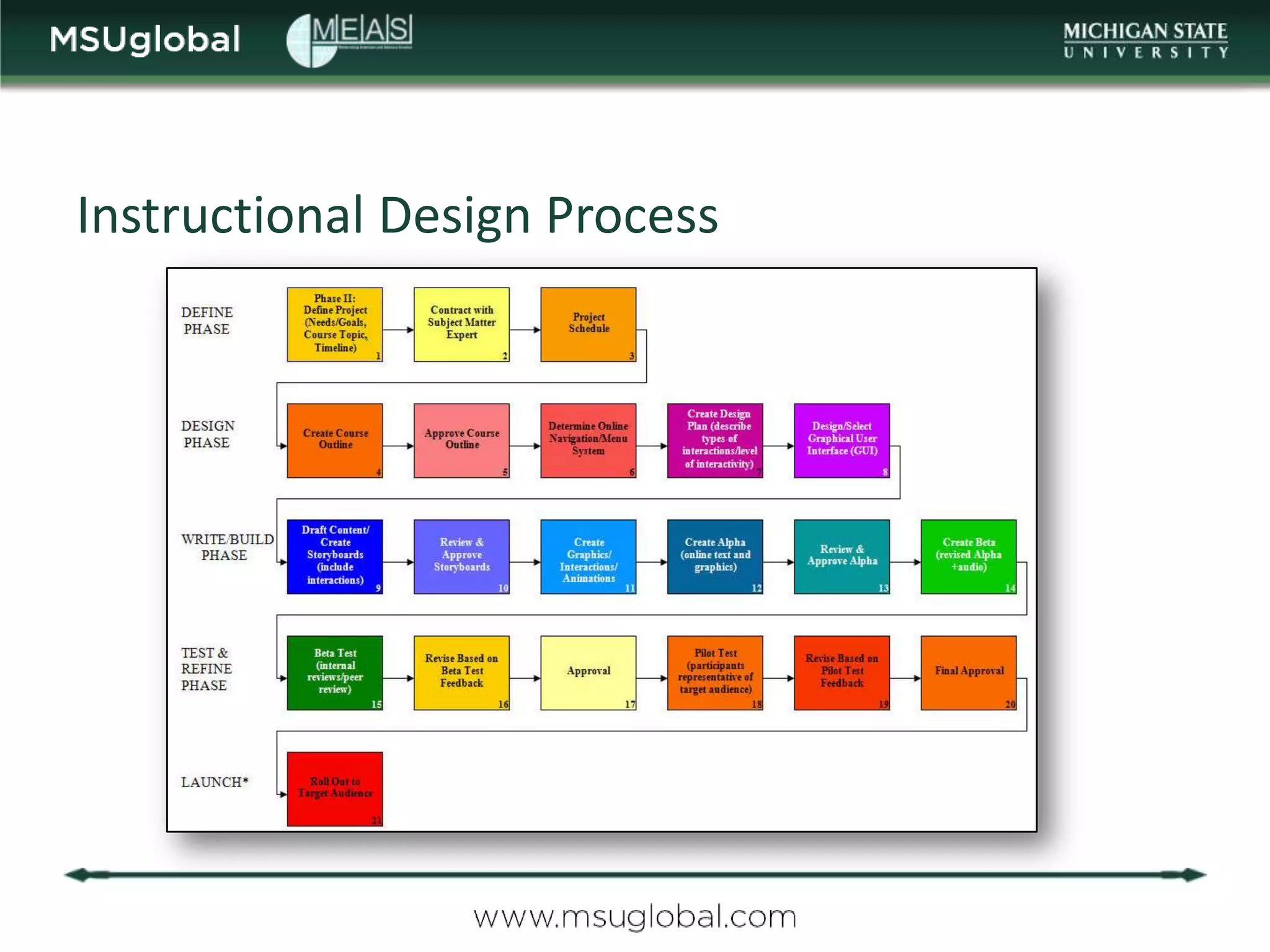
Instructional Design Process
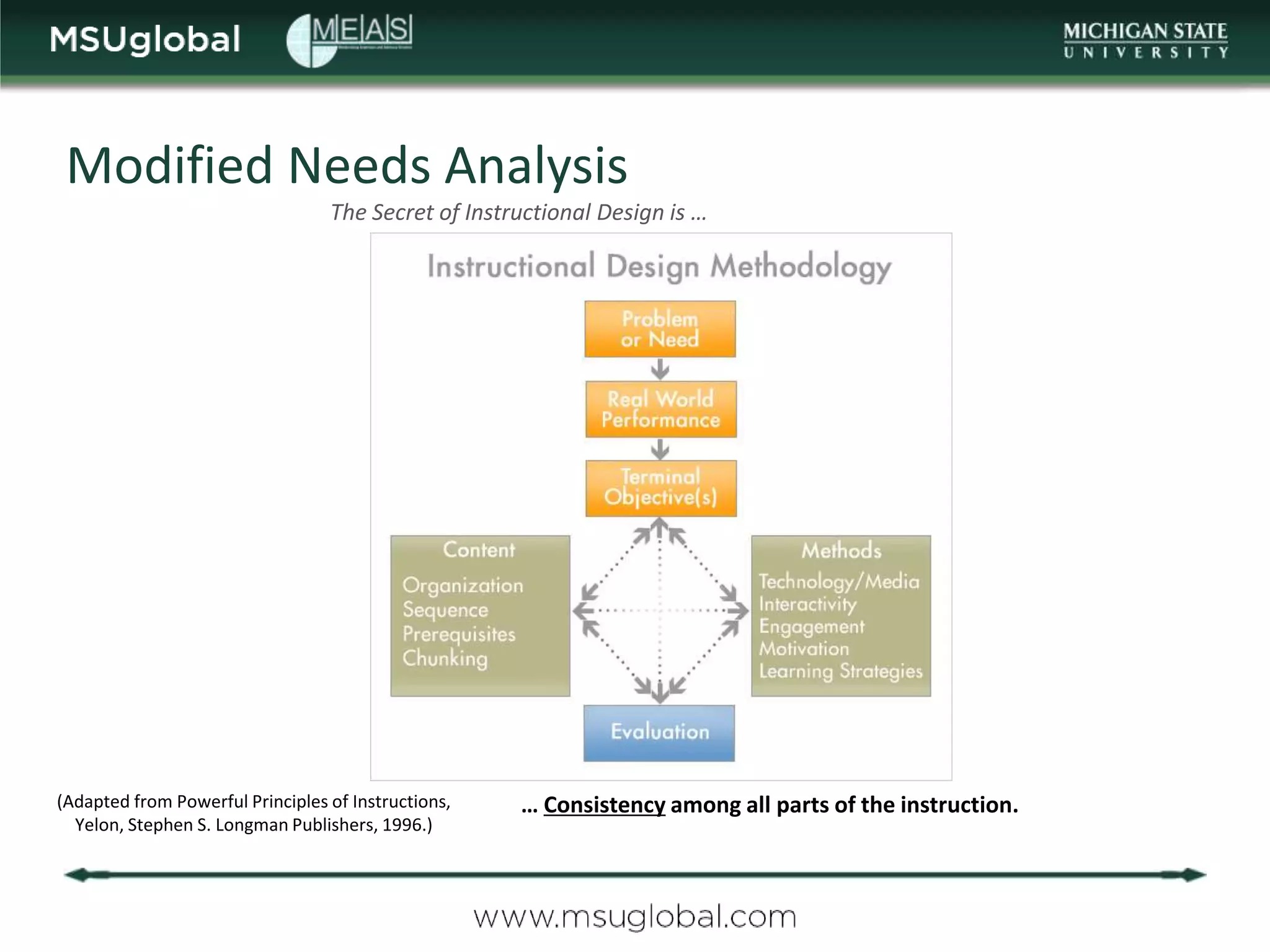
Modified Needs Analysis
                                  The Secret of Instructional Design is …


(Adapted from Powerful Principles of Instructions,   … Consistency among all parts of the instruction.
  Yelon, Stephen S. Longman Publishers, 1996.)
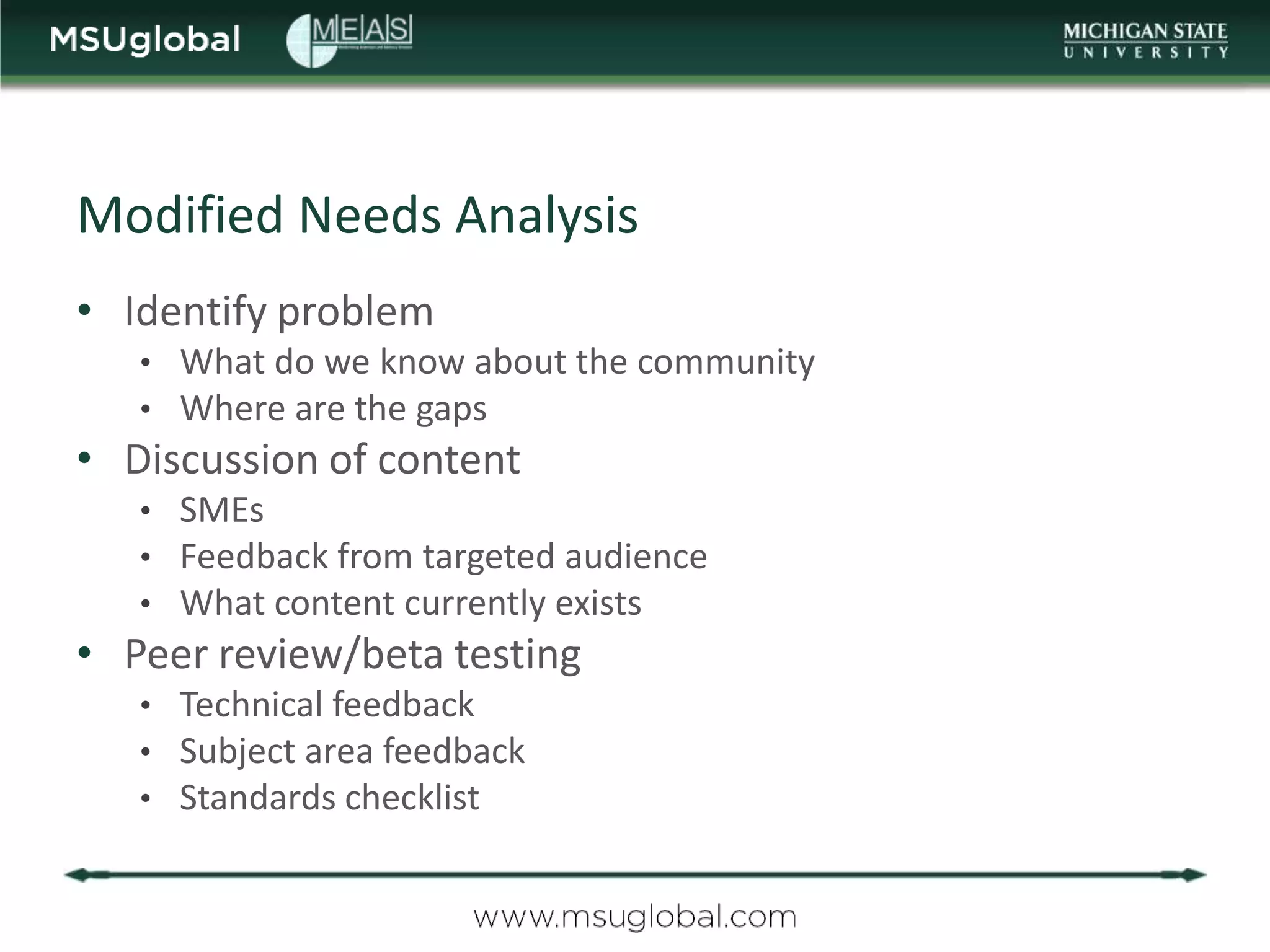
Modified Needs Analysis
• Identify problem
   • What do we know about the community
   • Where are the gaps
• Discussion of content
   • SMEs
   • Feedback from targeted audience
   • What content currently exists
• Peer review/beta testing
   • Technical feedback
   • Subject area feedback
   • Standards checklist
Instructional Design and Learning Theories
• Learning theories study how people learn
   • Behaviorism—structured behavior resembles linear
     learning
   • Constructivism –learning is created from previous
     knowledge and new instructional processes
   • Cognitive Science provides more information about
     appropriate scaffolding for learners
   • Social Learning (Constructivism)—Learning is social activity
     and team based approaches are best
Tying Learning and Design Together
• Most instructional design is based on a learning
  theory
• Online design is often driven by technology but often
  by pedagogy
• Recognizing the learning environment is complex and
  interrelated is often difficult
• Theories like Community of Inquiry try to pull these
  elements together
Client Designs
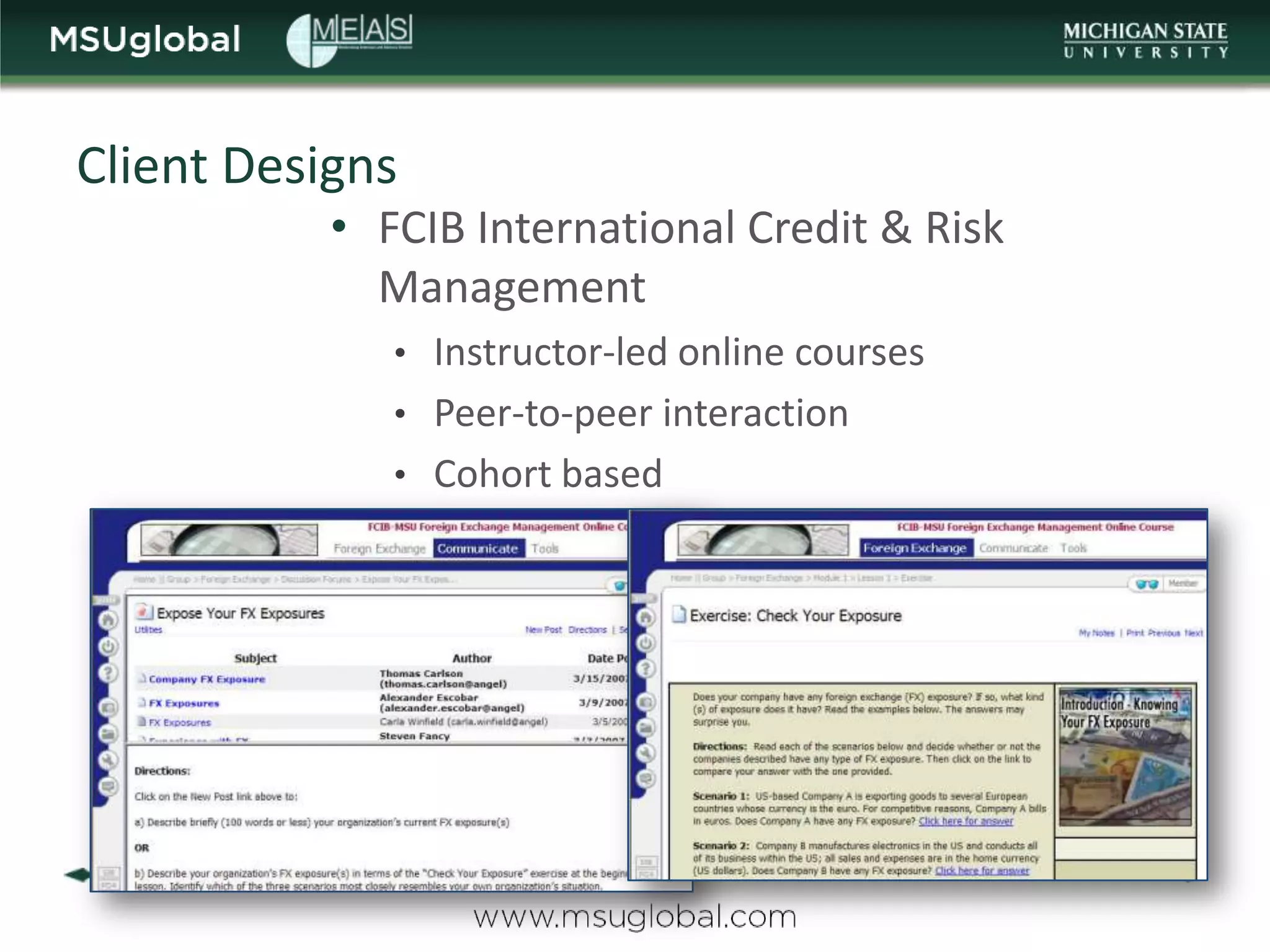
           • FCIB International Credit & Risk
             Management
              • Instructor-led online courses
              • Peer-to-peer interaction
              • Cohort based
Client Designs
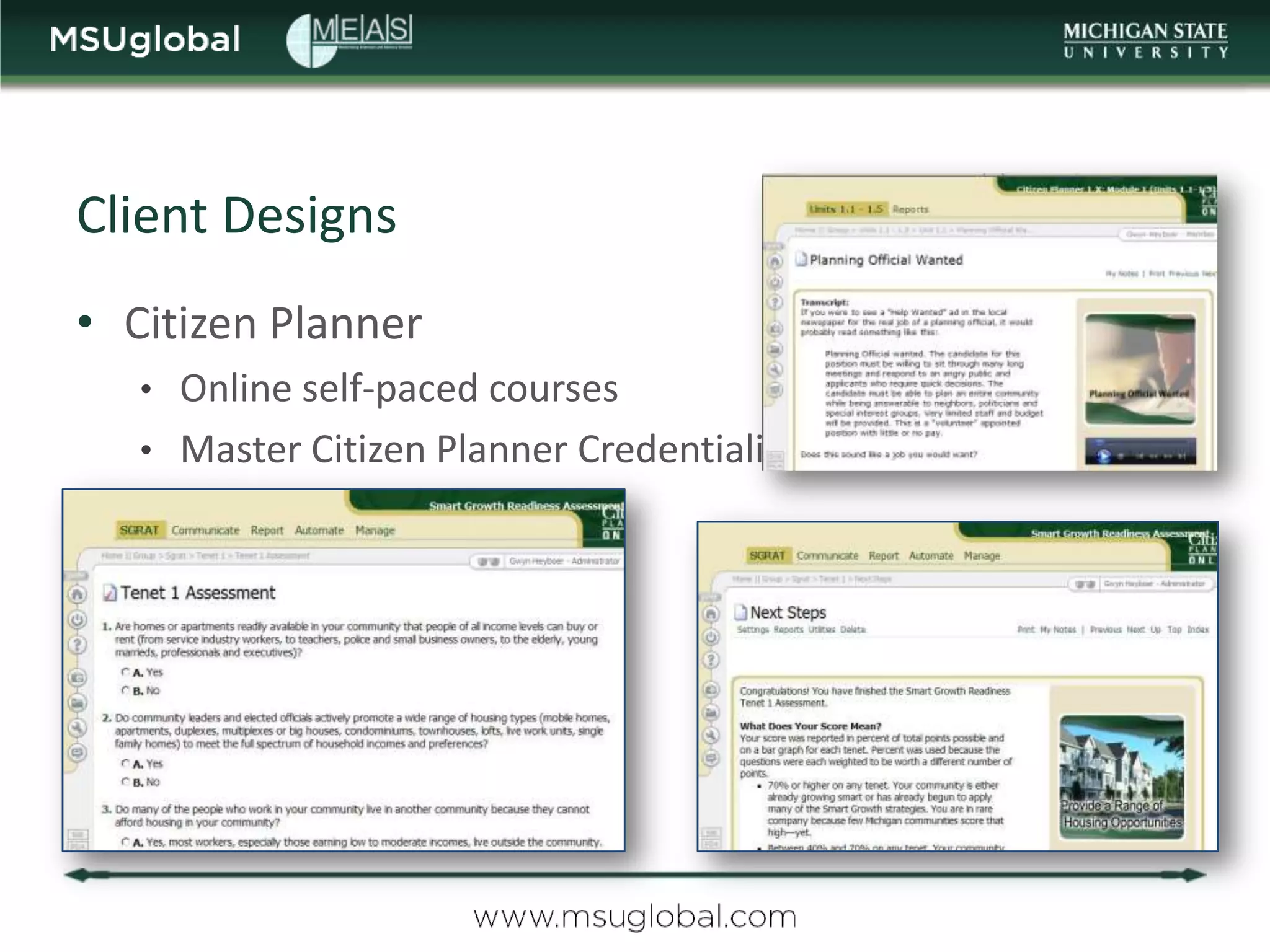
• Citizen Planner
   • Online self-paced courses
   • Master Citizen Planner Credentialing Exam
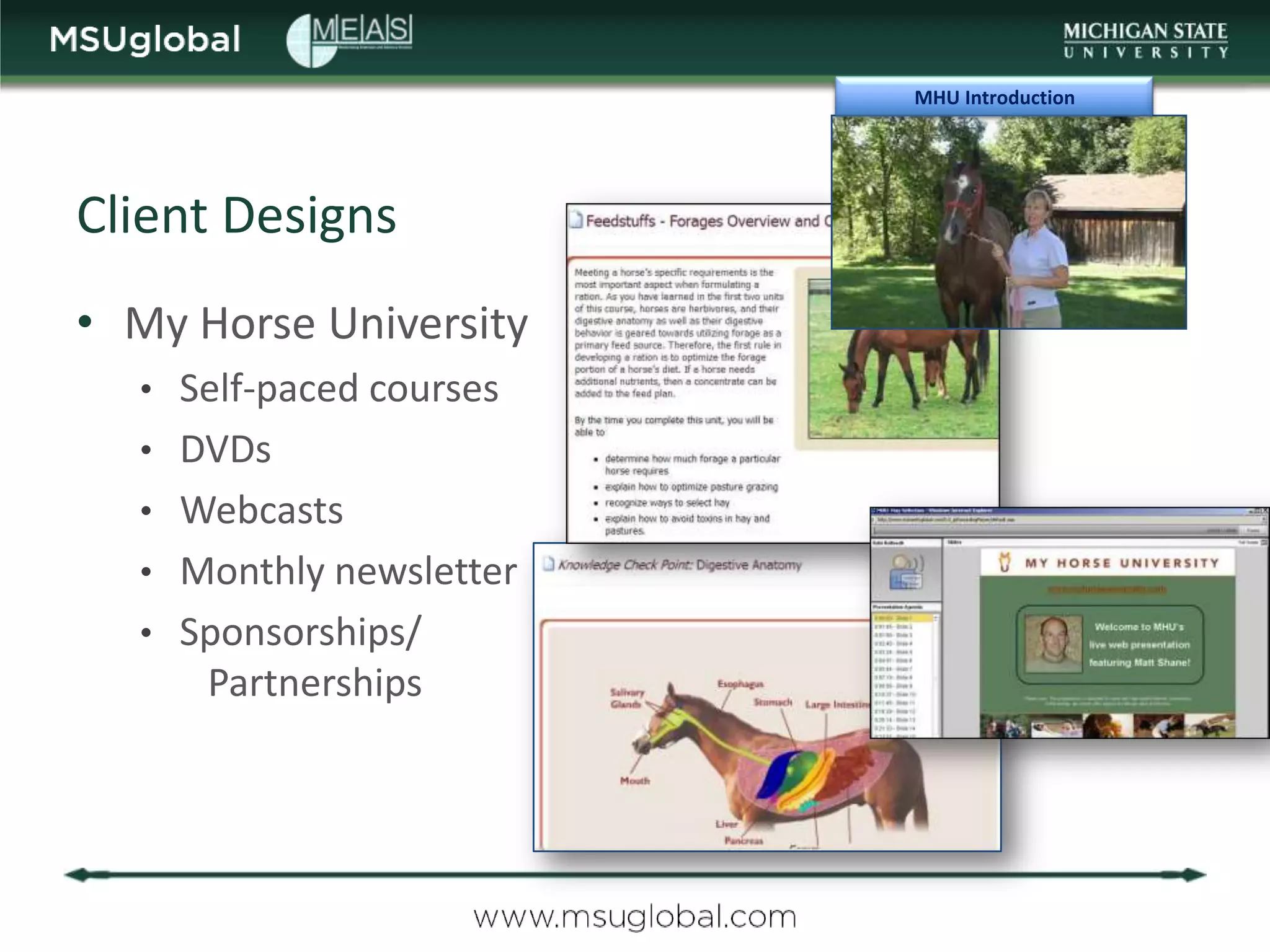
MHU Introduction


Client Designs
• My Horse University
  • Self-paced courses
  • DVDs
  • Webcasts
  • Monthly newsletter
  • Sponsorships/
      Partnerships
Customizations
• The RIGHT Experience
  • Technology
  • Interactivity
  • Learning strategy/process/consistency
  • Organizing around a need
  • Making content reusable
Technology and Templates
• http://wikieducator.org/Main_Page
YOUR Turn
• Design a lesson/module/week of instruction
• Define your students—examples, include full-time,
  live on or near campus, have no previous knowledge
• What are the objectives of the instruction?
• What resources will you have?
• What will you need to assess?
• What should students be able to do as a result of the
  instruction
Discussion
• How is using instructional design different than
  normal preparation for courses?
Summary
•   Introduced Instructional Design
•   Shared several types of Design methods
•   Applied instructional design to a course
•   Used technology or templates to help with
    Instructional Design
References
• Bransford, John. How People Learn: Bridging
  Research and Practice
• Gagné, Robert, Nine Events of Instruction
• Vygotsky, Lev, Social constructivism
• http://www.instructionaldesign.org/
Terms of Use


       © Karen Vignare, Michigan State University, MEAS project.
               This work is licensed under a
    Creative Commons Attribution 3.0 Unported License.

Users are free:
 • to Share — to copy, distribute and transmit the work
 • to Remix — to adapt the work

Under the following conditions:
 • Attribution — Users must attribute the work to the
   author(s)/institution (but not in any way that suggests that the authors/
    institution endorse the user or the user’s use of the work).
Disclaimer

This presentation was made possible by the
generous support of the American people
through the United States Agency for
International Development, USAID. The
contents are the responsibility of the
author(s) and do not necessarily reflect the
views of USAID or the United States
Government.

MEAS Course on E-learning: 2 Designing online instruction based on student needs

  • 1.
    Designing Instruction Based onStudent Needs Karen Vignare Michigan State University
  • 2.
    Agenda • Objectives • Introduction • Definitions • Discussion • Summary • References
  • 3.
    Objectives • Understand the purpose of Instructional Design • Recognize different design processes • Apply Instructional Design to your Learners • Use technology or templates to help with Instructional Design
  • 4.
    Instructional Design • Instructionaldesign is defined as the systematic process of trying to make instruction more effective, efficient and appealing • Any instructor can practice it but there are experts and it is a growing field of employment • It requires focusing more on the learner’s needs to determine how to effectively instruct
  • 5.
    Instructional Design Methods •ADDIE • Analysis • Design • Development • Implement • Evaluate
  • 6.
  • 7.
    Modified Needs Analysis The Secret of Instructional Design is … (Adapted from Powerful Principles of Instructions, … Consistency among all parts of the instruction. Yelon, Stephen S. Longman Publishers, 1996.)
  • 8.
    Modified Needs Analysis •Identify problem • What do we know about the community • Where are the gaps • Discussion of content • SMEs • Feedback from targeted audience • What content currently exists • Peer review/beta testing • Technical feedback • Subject area feedback • Standards checklist
  • 9.
    Instructional Design andLearning Theories • Learning theories study how people learn • Behaviorism—structured behavior resembles linear learning • Constructivism –learning is created from previous knowledge and new instructional processes • Cognitive Science provides more information about appropriate scaffolding for learners • Social Learning (Constructivism)—Learning is social activity and team based approaches are best
  • 10.
    Tying Learning andDesign Together • Most instructional design is based on a learning theory • Online design is often driven by technology but often by pedagogy • Recognizing the learning environment is complex and interrelated is often difficult • Theories like Community of Inquiry try to pull these elements together
  • 11.
    Client Designs • FCIB International Credit & Risk Management • Instructor-led online courses • Peer-to-peer interaction • Cohort based
  • 12.
    Client Designs • CitizenPlanner • Online self-paced courses • Master Citizen Planner Credentialing Exam
  • 13.
    MHU Introduction Client Designs •My Horse University • Self-paced courses • DVDs • Webcasts • Monthly newsletter • Sponsorships/ Partnerships
  • 14.
    Customizations • The RIGHTExperience • Technology • Interactivity • Learning strategy/process/consistency • Organizing around a need • Making content reusable
  • 15.
    Technology and Templates •http://wikieducator.org/Main_Page
  • 16.
    YOUR Turn • Designa lesson/module/week of instruction • Define your students—examples, include full-time, live on or near campus, have no previous knowledge • What are the objectives of the instruction? • What resources will you have? • What will you need to assess? • What should students be able to do as a result of the instruction
  • 17.
    Discussion • How isusing instructional design different than normal preparation for courses?
  • 18.
    Summary • Introduced Instructional Design • Shared several types of Design methods • Applied instructional design to a course • Used technology or templates to help with Instructional Design
  • 19.
    References • Bransford, John.How People Learn: Bridging Research and Practice • Gagné, Robert, Nine Events of Instruction • Vygotsky, Lev, Social constructivism • http://www.instructionaldesign.org/
  • 20.
    Terms of Use © Karen Vignare, Michigan State University, MEAS project. This work is licensed under a Creative Commons Attribution 3.0 Unported License. Users are free: • to Share — to copy, distribute and transmit the work • to Remix — to adapt the work Under the following conditions: • Attribution — Users must attribute the work to the author(s)/institution (but not in any way that suggests that the authors/ institution endorse the user or the user’s use of the work).
  • 21.
    Disclaimer This presentation wasmade possible by the generous support of the American people through the United States Agency for International Development, USAID. The contents are the responsibility of the author(s) and do not necessarily reflect the views of USAID or the United States Government.

Editor's Notes

  • #8 The secret of instructional design also implies an order for creating a lesson: Ensure that the performance learned will fulfill a real need.Specify the real-world performance goal.Create the test and describe it in the form of an instructional objective.Produce the essential content.Create the lesson plan, i.e., the method to help students learn.Check to see if all elements are purposefully integrated.Test the lesson to see if it produces learning, transfers to real world performance, and solves the problem.