

























New Learning Paradigms
and Technologies
Prof. dr. Frederik Questier - Vrije Universiteit Brussel
Jimma University, Ethiopia, June 2015
This presentation can be found at
http://questier.com
http://www.slideshare.net/Frederik_Questier
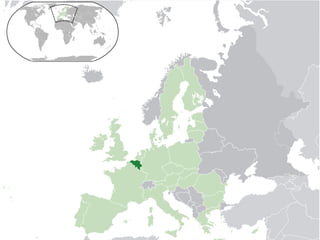
Brussels
Vrije Universiteit Brussel
8
9
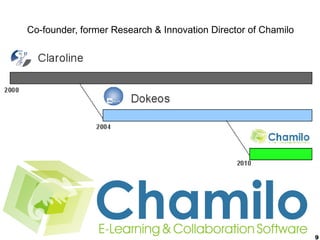
Co-founder, former Research & Innovation Director of Chamilo
10
E-learning workshop
I. New Learning Paradigms and Technologies
III. E-learning experiences from Jimma University
IV. Institutional Strategies for E-learning
V. E-learning priorities and activities for Jimma
University as discussed and voted by the
participants
11
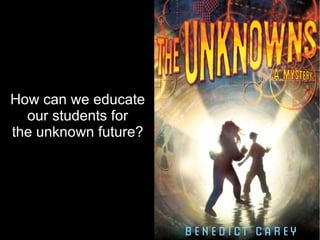
How can we educate
our students for
the unknown future?
12
I ask my students:
What is the biggest change
you expect in your (professional) life?
Most of them are clueless...
13
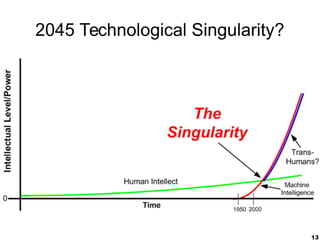
2045 Technological Singularity?
14
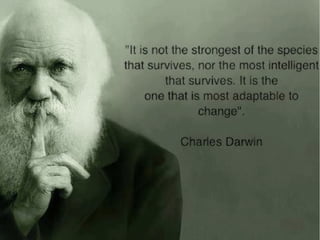
The only constant in life is change
15
16
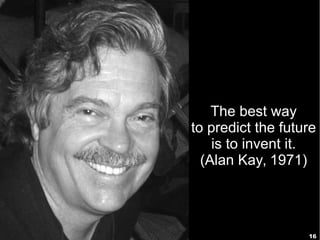
The best way
to predict the future
is to invent it.
(Alan Kay, 1971)
17
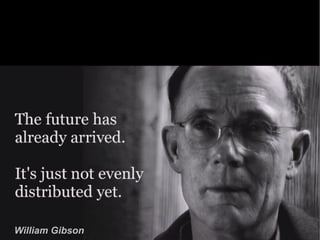
William Gibson
18
Information Society ?
19
Knowledge Society
20
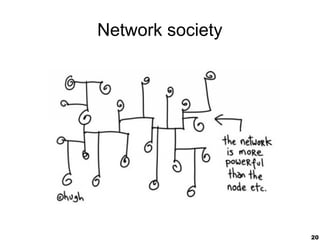
Network society
21
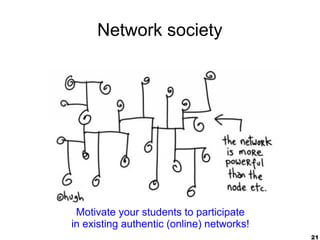
Network society
Motivate your students to participate
in existing authentic (online) networks!
22
Everything
gets connected &
software enhanced
23
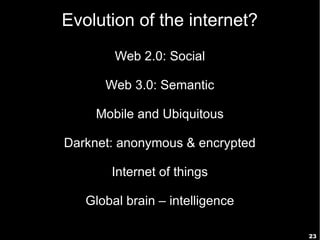
Evolution of the internet?
Web 2.0: Social
Web 3.0: Semantic
Mobile and Ubiquitous
Darknet: anonymous & encrypted
Internet of things
Global brain – intelligence
24
information scarcity → information abundance !
Total information is now doubling every year !
25
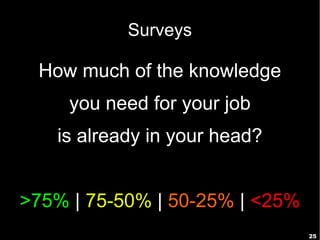
Surveys
How much of the knowledge
you need for your job
is already in your head?
>75% | 75-50% | 50-25% | <25%
26
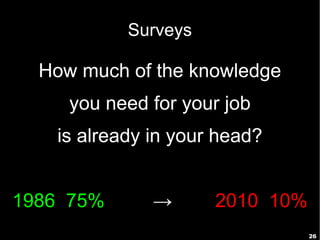
Surveys
How much of the knowledge
you need for your job
is already in your head?
1986 75% → 2010 10%
27
The longer one studies,
the more one comes to realize
how much one does not know
28
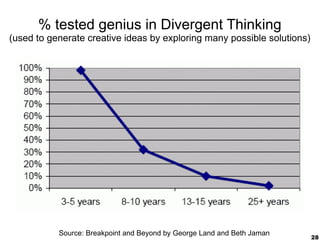
% tested genius in Divergent Thinking
(used to generate creative ideas by exploring many possible solutions)
Source: Breakpoint and Beyond by George Land and Beth Jaman
29
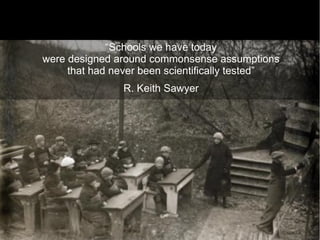
“Schools we have today
were designed around commonsense assumptions
that had never been scientifically tested”
R. Keith Sawyer
30
31
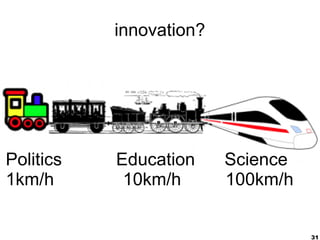
innovation?
Politics Education Science
1km/h 10km/h 100km/h
32
Resistance
Teachers teach as they are taught...
33
34
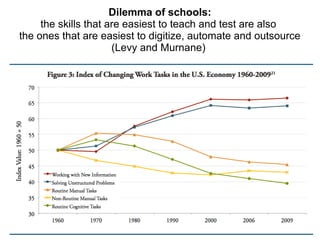
Dilemma of schools:
the skills that are easiest to teach and test are also
the ones that are easiest to digitize, automate and outsource
(Levy and Murnane)
35
Demand for new skills?
➢ Social skills
➢ communicating, networking, teamwork
➢ international, intercultural
➢ Creativity
➢ Entrepeneurship
➢ Information technology skills
➢ Handle information overload
➢ ...
➢
➢ Learning to learn → Life Long Learning!
36
Knowledge → Skills →
Competences
Competences
are the ability to use
➢ knowledge
➢ skills
➢ attitudes
in new, complex, authentic situations
37
?
38
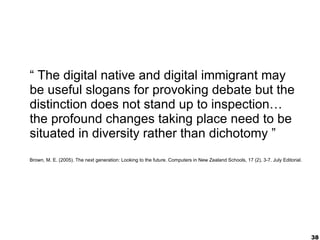
“ The digital native and digital immigrant may
be useful slogans for provoking debate but the
distinction does not stand up to inspection…
the profound changes taking place need to be
situated in diversity rather than dichotomy ”
Brown, M. E. (2005). The next generation: Looking to the future. Computers in New Zealand Schools, 17 (2), 3-7. July Editorial.
39
40
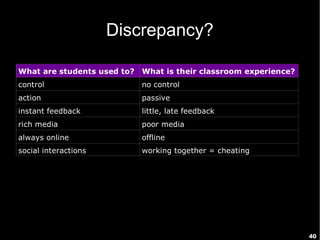
Discrepancy?
What are students used to? What is their classroom experience?
control no control
action passive
instant feedback little, late feedback
rich media poor media
always online offline
social interactions working together = cheating
41
42
43
44
Why change the way
we teach and learn?
We have new scientific knowledge
about teaching and learning
45
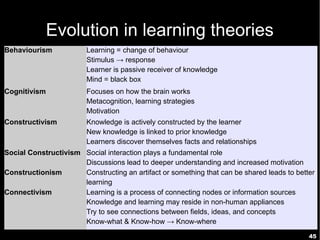
Evolution in learning theories
Behaviourism Learning = change of behaviour
Stimulus → response
Learner is passive receiver of knowledge
Mind = black box
Cognitivism Focuses on how the brain works
Metacognition, learning strategies
Motivation
Constructivism Knowledge is actively constructed by the learner
New knowledge is linked to prior knowledge
Learners discover themselves facts and relationships
Social Constructivism Social interaction plays a fundamental role
Discussions lead to deeper understanding and increased motivation
Constructionism Constructing an artifact or something that can be shared leads to better
learning
Connectivism Learning is a process of connecting nodes or information sources
Knowledge and learning may reside in non-human appliances
Try to see connections between fields, ideas, and concepts
Know-what & Know-how → Know-where
46
CC by Wlonline
47
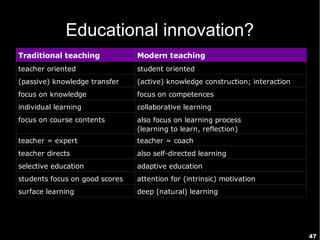
Educational innovation?
Traditional teaching Modern teaching
teacher oriented student oriented
(passive) knowledge transfer (active) knowledge construction; interaction
focus on knowledge focus on competences
individual learning collaborative learning
focus on course contents
teacher = expert teacher = coach
teacher directs also self-directed learning
selective education adaptive education
students focus on good scores attention for (intrinsic) motivation
surface learning deep (natural) learning
also focus on learning process
(learning to learn, reflection)
48
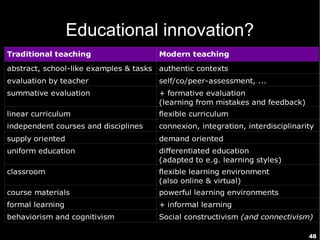
Educational innovation?
Traditional teaching Modern teaching
abstract, school-like examples & tasks authentic contexts
evaluation by teacher self/co/peer-assessment, ...
summative evaluation
linear curriculum flexible curriculum
independent courses and disciplines connexion, integration, interdisciplinarity
supply oriented demand oriented
uniform education
classroom
course materials powerful learning environments
formal learning + informal learning
behaviorism and cognitivism
+ formative evaluation
(learning from mistakes and feedback)
differentiated education
(adapted to e.g. learning styles)
flexible learning environment
(also online & virtual)
Social constructivism (and connectivism)
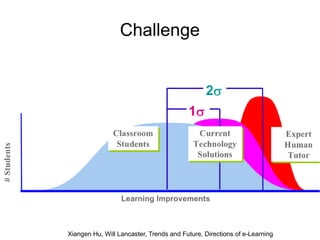
Challenge
Xiangen Hu, Will Lancaster, Trends and Future, Directions of e-Learning
50
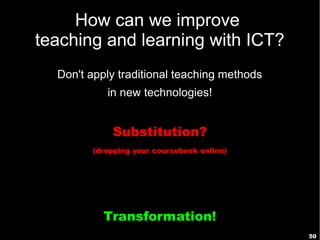
How can we improve
teaching and learning with ICT?
Don't apply traditional teaching methods
in new technologies!
Substitution?
(dropping your coursebook online)
Transformation!
51
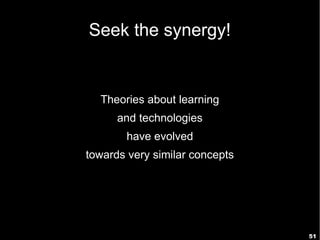
Seek the synergy!
Theories about learning
and technologies
have evolved
towards very similar concepts
52
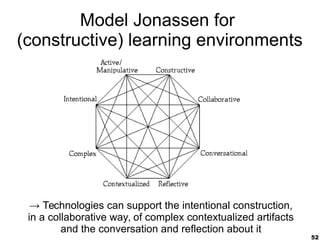
Model Jonassen for
(constructive) learning environments
→ Technologies can support the intentional construction,
in a collaborative way, of complex contextualized artifacts
and the conversation and reflection about it
53
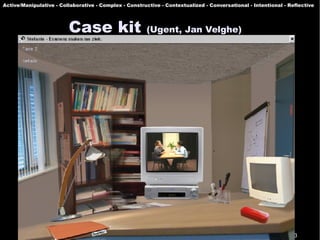
Active/Manipulative - Collaborative - Complex - Constructive - Contextualized - Conversational - Intentional - Reflective
Case kitCase kit (Ugent, Jan Velghe)(Ugent, Jan Velghe)
54
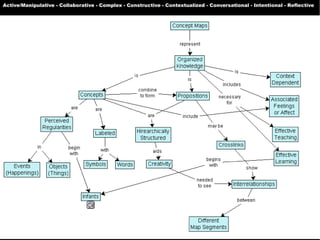
Active/Manipulative - Collaborative - Complex - Constructive - Contextualized - Conversational - Intentional - Reflective
55
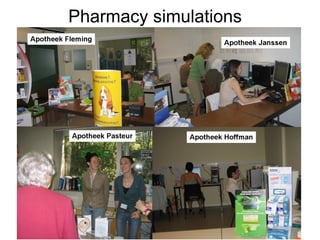
Active/Manipulative - Collaborative - Complex - Constructive - Contextualized - Conversational - Intentional - Reflective
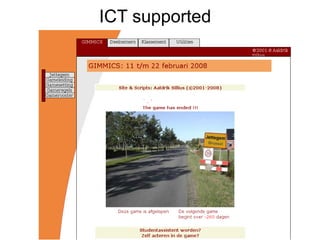
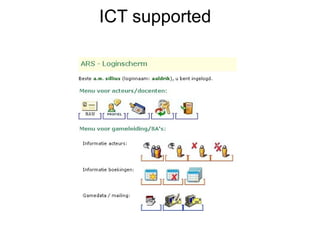
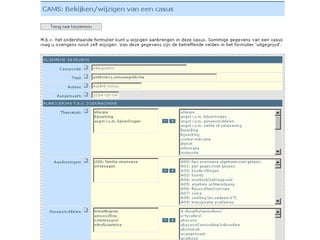
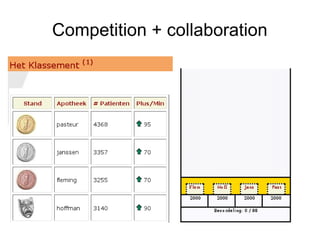
Pharmacy simulations
ICT supported
ICT supported
Competition + collaboration
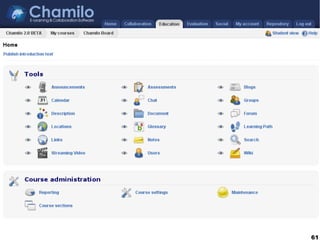
61
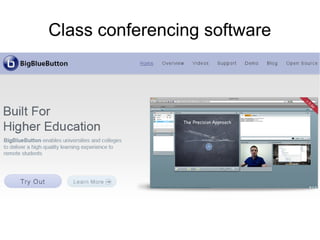
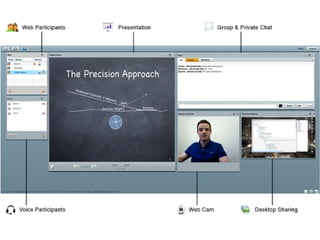
Class conferencing software
66
67
68
71
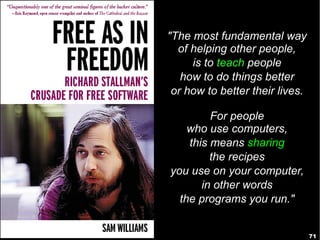
"The most fundamental way
of helping other people,
is to teach people
how to do things better
or how to better their lives.
For people
who use computers,
this means sharing
the recipes
you use on your computer,
in other words
the programs you run."
72
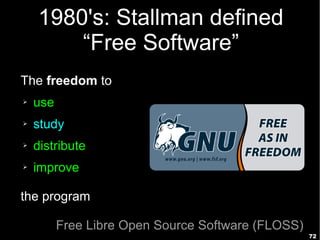
1980's: Stallman defined
“Free Software”
The freedom to
➢ use
➢ study
➢ distribute
➢ improve
the program
Free Libre Open Source Software (FLOSS)
Open educational resources
(OER)
digitised materials
offered freely and openly
for educators, students and self-learners
to use and reuse
for teaching, learning and research
Believing that OER can
widen access to quality education,
particularly when shared by many countries
and higher education institutions,
UNESCO champions OER
as a means of promoting access, equity and quality
in the spirit of the Universal Declaration of Human Rights.
Good teachers know how
to create learning materials
Great teachers know how
to mix and reuse
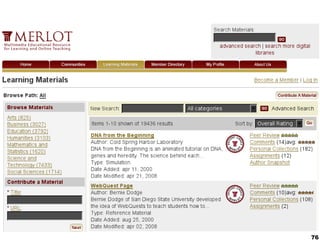
76
77
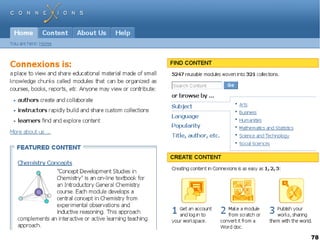
78
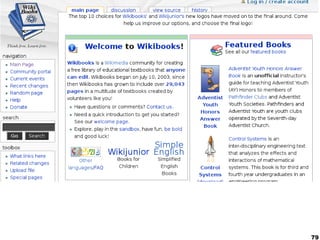
79
80
81
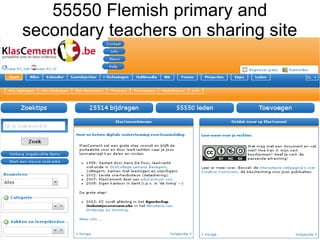
55550 Flemish primary and
secondary teachers on sharing site
82
83
84
85
86
87
88
89
90
91
92
93
94
95
96
Find the right blend!
97
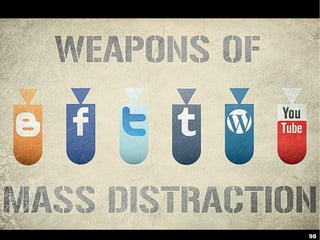
Not all students will like it...
98
99
Foster a community feeling!
100
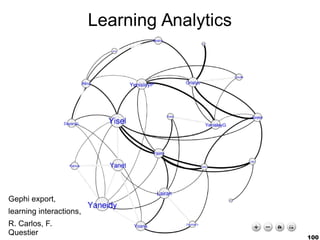
Learning Analytics
Gephi export,
learning interactions,
R. Carlos, F.
Questier
101
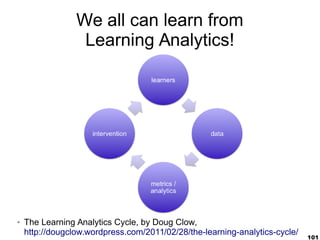
We all can learn from
Learning Analytics!
➢ The Learning Analytics Cycle, by Doug Clow,
http://dougclow.wordpress.com/2011/02/28/the-learning-analytics-cycle/
102
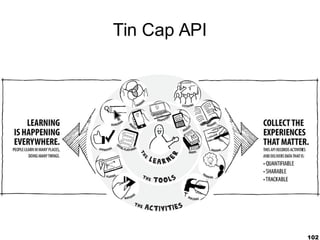
Tin Cap API
103
104
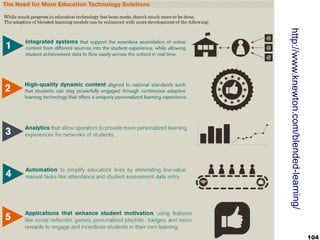
http://www.knewton.com/blended-learning/
105
➢ An individual teacher typically does not have
➢ the competences
➢ the time
➢ the budget
to create one of the most advanced blended
courses
106
The way to do it
Design teams with mixed competences
Extra muros collaboration
Reuse and share
Student centred
Activitating
Motivating
Questier.com
Frederik AT Questier.com
www.linkedin.com/in/fquestie
www.diigo.com/user/frederikquestier
www.slideshare.net/Frederik_Questier
Questions?
Ameseginalehu!
Copyright acknowledgements
➢ Screenshot http://www.chamilo.org/
➢ Figure study CC-by-nc-sa by Tony2 (NOT IN USE!)
➢ Question! CC-by by Stefan Baudy
➢ http://users4.jabry.com/vortex/misc/DivergentThinking.gif
➢ Edupunk: http://blogs.pstcc.edu/drbrown/files/2009/11/Picture-4.png
➢ Flipped-Classroom-CC-BY-NC-SA-2-by-ransomtech
➢ http://cogdogblog.com/2012/07/17/mooc-hysertia/
➢ http://www.onlinecollege.org/2012/08/21/25-tips-make-most-mooc/
➢ Paul Schatzkin, http://www.cohesionarts.com/tag/distractions/
➢ Screenshot http://www.chamilo.org/
➢ OPEN, CC-by-nc-sa by Tom Maglieryr
➢ Share matches CC by-nc-nd by Josh Harper
➢ GNU Head Joseph W. Reiss Free Art License or the GNU GPLv2
109
DARE
TO SHARE

New learning paradigms and technologies

  • 1.
    New Learning Paradigms andTechnologies Prof. dr. Frederik Questier - Vrije Universiteit Brussel Jimma University, Ethiopia, June 2015
  • 2.
    This presentation canbe found at http://questier.com http://www.slideshare.net/Frederik_Questier
  • 4.
  • 5.
  • 6.
  • 7.
    9 Co-founder, former Research& Innovation Director of Chamilo
  • 8.
    10 E-learning workshop I. NewLearning Paradigms and Technologies III. E-learning experiences from Jimma University IV. Institutional Strategies for E-learning V. E-learning priorities and activities for Jimma University as discussed and voted by the participants
  • 9.
    11 How can weeducate our students for the unknown future?
  • 10.
    12 I ask mystudents: What is the biggest change you expect in your (professional) life? Most of them are clueless...
  • 11.
  • 12.
    14 The only constantin life is change
  • 13.
  • 14.
    16 The best way topredict the future is to invent it. (Alan Kay, 1971)
  • 15.
  • 16.
  • 17.
  • 18.
  • 19.
    21 Network society Motivate yourstudents to participate in existing authentic (online) networks!
  • 20.
  • 21.
    23 Evolution of theinternet? Web 2.0: Social Web 3.0: Semantic Mobile and Ubiquitous Darknet: anonymous & encrypted Internet of things Global brain – intelligence
  • 22.
    24 information scarcity →information abundance ! Total information is now doubling every year !
  • 23.
    25 Surveys How much ofthe knowledge you need for your job is already in your head? >75% | 75-50% | 50-25% | <25%
  • 24.
    26 Surveys How much ofthe knowledge you need for your job is already in your head? 1986 75% → 2010 10%
  • 25.
    27 The longer onestudies, the more one comes to realize how much one does not know
  • 26.
    28 % tested geniusin Divergent Thinking (used to generate creative ideas by exploring many possible solutions) Source: Breakpoint and Beyond by George Land and Beth Jaman
  • 27.
    29 “Schools we havetoday were designed around commonsense assumptions that had never been scientifically tested” R. Keith Sawyer
  • 28.
  • 29.
  • 30.
  • 31.
  • 32.
    34 Dilemma of schools: theskills that are easiest to teach and test are also the ones that are easiest to digitize, automate and outsource (Levy and Murnane)
  • 33.
    35 Demand for newskills? ➢ Social skills ➢ communicating, networking, teamwork ➢ international, intercultural ➢ Creativity ➢ Entrepeneurship ➢ Information technology skills ➢ Handle information overload ➢ ... ➢ ➢ Learning to learn → Life Long Learning!
  • 34.
    36 Knowledge → Skills→ Competences Competences are the ability to use ➢ knowledge ➢ skills ➢ attitudes in new, complex, authentic situations
  • 35.
  • 36.
    38 “ The digitalnative and digital immigrant may be useful slogans for provoking debate but the distinction does not stand up to inspection… the profound changes taking place need to be situated in diversity rather than dichotomy ” Brown, M. E. (2005). The next generation: Looking to the future. Computers in New Zealand Schools, 17 (2), 3-7. July Editorial.
  • 37.
  • 38.
    40 Discrepancy? What are studentsused to? What is their classroom experience? control no control action passive instant feedback little, late feedback rich media poor media always online offline social interactions working together = cheating
  • 39.
  • 40.
  • 41.
  • 42.
    44 Why change theway we teach and learn? We have new scientific knowledge about teaching and learning
  • 43.
    45 Evolution in learningtheories Behaviourism Learning = change of behaviour Stimulus → response Learner is passive receiver of knowledge Mind = black box Cognitivism Focuses on how the brain works Metacognition, learning strategies Motivation Constructivism Knowledge is actively constructed by the learner New knowledge is linked to prior knowledge Learners discover themselves facts and relationships Social Constructivism Social interaction plays a fundamental role Discussions lead to deeper understanding and increased motivation Constructionism Constructing an artifact or something that can be shared leads to better learning Connectivism Learning is a process of connecting nodes or information sources Knowledge and learning may reside in non-human appliances Try to see connections between fields, ideas, and concepts Know-what & Know-how → Know-where
  • 44.
  • 45.
    47 Educational innovation? Traditional teachingModern teaching teacher oriented student oriented (passive) knowledge transfer (active) knowledge construction; interaction focus on knowledge focus on competences individual learning collaborative learning focus on course contents teacher = expert teacher = coach teacher directs also self-directed learning selective education adaptive education students focus on good scores attention for (intrinsic) motivation surface learning deep (natural) learning also focus on learning process (learning to learn, reflection)
  • 46.
    48 Educational innovation? Traditional teachingModern teaching abstract, school-like examples & tasks authentic contexts evaluation by teacher self/co/peer-assessment, ... summative evaluation linear curriculum flexible curriculum independent courses and disciplines connexion, integration, interdisciplinarity supply oriented demand oriented uniform education classroom course materials powerful learning environments formal learning + informal learning behaviorism and cognitivism + formative evaluation (learning from mistakes and feedback) differentiated education (adapted to e.g. learning styles) flexible learning environment (also online & virtual) Social constructivism (and connectivism)
  • 47.
    Challenge Xiangen Hu, WillLancaster, Trends and Future, Directions of e-Learning
  • 48.
    50 How can weimprove teaching and learning with ICT? Don't apply traditional teaching methods in new technologies! Substitution? (dropping your coursebook online) Transformation!
  • 49.
    51 Seek the synergy! Theoriesabout learning and technologies have evolved towards very similar concepts
  • 50.
    52 Model Jonassen for (constructive)learning environments → Technologies can support the intentional construction, in a collaborative way, of complex contextualized artifacts and the conversation and reflection about it
  • 51.
    53 Active/Manipulative - Collaborative- Complex - Constructive - Contextualized - Conversational - Intentional - Reflective Case kitCase kit (Ugent, Jan Velghe)(Ugent, Jan Velghe)
  • 52.
    54 Active/Manipulative - Collaborative- Complex - Constructive - Contextualized - Conversational - Intentional - Reflective
  • 53.
    55 Active/Manipulative - Collaborative- Complex - Constructive - Contextualized - Conversational - Intentional - Reflective
  • 54.
  • 55.
  • 56.
  • 58.
  • 59.
  • 60.
  • 63.
  • 64.
  • 65.
  • 68.
    71 "The most fundamentalway of helping other people, is to teach people how to do things better or how to better their lives. For people who use computers, this means sharing the recipes you use on your computer, in other words the programs you run."
  • 69.
    72 1980's: Stallman defined “FreeSoftware” The freedom to ➢ use ➢ study ➢ distribute ➢ improve the program Free Libre Open Source Software (FLOSS)
  • 70.
    Open educational resources (OER) digitisedmaterials offered freely and openly for educators, students and self-learners to use and reuse for teaching, learning and research
  • 71.
    Believing that OERcan widen access to quality education, particularly when shared by many countries and higher education institutions, UNESCO champions OER as a means of promoting access, equity and quality in the spirit of the Universal Declaration of Human Rights.
  • 72.
    Good teachers knowhow to create learning materials Great teachers know how to mix and reuse
  • 73.
  • 74.
  • 75.
  • 76.
  • 77.
  • 78.
    81 55550 Flemish primaryand secondary teachers on sharing site
  • 79.
  • 80.
  • 81.
  • 82.
  • 83.
  • 84.
  • 85.
  • 86.
  • 87.
  • 88.
  • 89.
  • 90.
  • 91.
  • 92.
  • 93.
  • 94.
    97 Not all studentswill like it...
  • 95.
  • 96.
  • 97.
    100 Learning Analytics Gephi export, learninginteractions, R. Carlos, F. Questier
  • 98.
    101 We all canlearn from Learning Analytics! ➢ The Learning Analytics Cycle, by Doug Clow, http://dougclow.wordpress.com/2011/02/28/the-learning-analytics-cycle/
  • 99.
  • 100.
  • 101.
  • 102.
    105 ➢ An individualteacher typically does not have ➢ the competences ➢ the time ➢ the budget to create one of the most advanced blended courses
  • 103.
    106 The way todo it Design teams with mixed competences Extra muros collaboration Reuse and share Student centred Activitating Motivating
  • 104.
  • 105.
    Copyright acknowledgements ➢ Screenshothttp://www.chamilo.org/ ➢ Figure study CC-by-nc-sa by Tony2 (NOT IN USE!) ➢ Question! CC-by by Stefan Baudy ➢ http://users4.jabry.com/vortex/misc/DivergentThinking.gif ➢ Edupunk: http://blogs.pstcc.edu/drbrown/files/2009/11/Picture-4.png ➢ Flipped-Classroom-CC-BY-NC-SA-2-by-ransomtech ➢ http://cogdogblog.com/2012/07/17/mooc-hysertia/ ➢ http://www.onlinecollege.org/2012/08/21/25-tips-make-most-mooc/ ➢ Paul Schatzkin, http://www.cohesionarts.com/tag/distractions/ ➢ Screenshot http://www.chamilo.org/ ➢ OPEN, CC-by-nc-sa by Tom Maglieryr ➢ Share matches CC by-nc-nd by Josh Harper ➢ GNU Head Joseph W. Reiss Free Art License or the GNU GPLv2
  • 106.