Lindsey Colling – Spanish
Lindsay Stephenson – English
Mark Robinson – Chemistry
Wes Allred – Math
Natalie Dreak – Instructional Resource Teacher
• Flipped Learning is a pedagogical approach in which
direct instruction moves from the group learning space to
the individual learning space, and the resulting group
space is transformed into a dynamic, interactive learning
environment where the educator guides students as they
apply concepts and engage creatively in the subject
matter. – Flipped Learning Network
Traditional
• Teacher's Role in class: Stand in
front and instructs students, gives
examples, guides all students at
one time.
• Student's role in class: Sit there,
take notes, pay attention, copy
examples, ask questions in front of
all students.
• Teacher's role at home: nothing
• Student's role at home: Look at
notes from class that day and
complete practice problems
Flipped
• Teacher's Role in class: Support
students, answer questions
individually and in small groups,
reteach students.
• Student's Role in Class: Ask
questions, get help, challenge
themselves at their own pace,
collaborate with peers.
• Teacher's Role at home: Give
examples and explanations via
video lesson
• Student’s role at home: Take
notes, pay attention, process
material, reflect and questions
• Better use of Face-to-Face time
• Increased Student Engagement
• Increased Test Scores
• Timely Student Feedback
• Facilitated Peer Instruction
• Cooperative Learning
• Improved Attitudes
• Increase in Proximity Control
• Flexible Environment
• Physical changes
• Timely Education
• Learning Culture
• Improved attitudes
• Timely Feedback
• Differentiation
• Student centered instruction
The difference, and perhaps a major
benefit, according to Marshall (2013) is
that this instruction is spontaneous,
cannot be planned out, and is relevant for
the learners at that moment.
Students learn more deeply when they
can apply classroom-gathered
knowledge to real-world problems, and
when they take part in projects that
require sustained engagement and
collaboration. (Barron & Darling-
Hammond 2014).
• Intentional Content
• Skill Based
• Individualized Opportunities
• Active Learning Opportunities
• Professional Educator
• Formative Assessments
• Reflection
• Transform
Active-learning practices have a
more significant impact on student
performance than any other
variable, including student
background and prior achievement
(Barron & Darling-Hammond 2014).
Expert or distinguished teaching
focuses on the understandings and
skills of a discipline, what causes
students to wrestle with profound
ideas, calls on students to use what
they learn in important ways, helps
students organize and make sense of
ideas and information, and aids
students in connecting the classroom
with a wider world (Brandt, 1998;
Danielson, 1996; Schlechty, 1997; Wiggins &
How Does A Flipped Classroom
Help All Students?
Fast Learner Students that just
need more time
Students that need
modifications
• Students are able to
move ahead
• Students can skip to
the parts of the videos
that they need, and
bypass information that
they already know.
• Students have
opportunity for
enrichment activities
• Students can pause the
videos for more time to
take notes.
• Students can re-watch
the videos that they
need more help
understanding.
• Students can use class
time to ask the teacher
questions.
• Students that need
modifications can
watch videos at home
with less distraction.
• Students can have
individual instruction in
class, or personal
modifications made to
assignments.
• Maximize your time with your students
• Re-evaluate Your Teaching
• Empower your students by letting go of your power
Even critics acknowledge that the
changeover to the Flipped Learning
model encourages teachers to re-
evaluate their teaching (e.g.,
Stumpenhorst, 2012).
Q and A Form
• Partial Flip
• Full Flip
• Mastery Flip
• Essential Skills to teach
• Which ones have direct
instruction I can remove
from in class and create on
video?
• Which skills/units have
activities I could use more
class time to complete?
• Create a venue to share
your videos, create your
direct instruction videos,
assign your videos
S1 – Full Flip
S2 – Flip Mastery
Full Flip
• Videos are assigned as
homework.
• Modeling Skills
• Giving Notes
• Explaining Examples
• Class time is spent critical
reading, writing, and
student-led discussions,
collaborative activities.
• All grammar and rote
practice outside of class.
(FL)
Mastery Flip
• Students are provided an
entire unit based on 4
essential skills.
• Students are provided with
suggested deadlines and a
firm unit deadline.
• Daily, students will fill out
goal sheets and begin work.
• Teacher works in small
groups and individually with
students during class time.
• Students work in partners or
small groups with students.
• Mastery Preferred • Full Flip Preferred
Why Do Students Like It?
Q and A Form
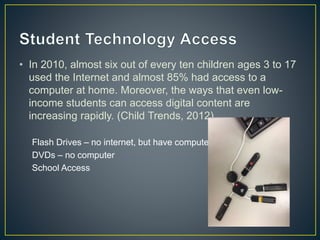
• In 2010, almost six out of every ten children ages 3 to 17
used the Internet and almost 85% had access to a
computer at home. Moreover, the ways that even low-
income students can access digital content are
increasing rapidly. (Child Trends, 2012)
Flash Drives – no internet, but have computer
DVDs – no computer
School Access
• Length
• Brain Research says after 10 minutes of new information, students
need a change of stimulus (Medina 2008).
• Jon Bergmann says 1.5 minutes per grade level
• opsmoodle.olatheschools.com (Every teacher has an
account)
• I like the organization of it.
• A detailed guide can be found at:
departments.olatheschools.com/technology/web-based-
blank-page/moodle-course-websites
• Used for video/audio capture
• Features include: editing, adding multiple clips together,
callouts, audio enhancement, transitions, captions,
quizzing, much more.
• There is a learning curve, but they have excellent
tutorials
• 30-day trial version:
www.techsmith.com/download/camtasia
• These additional items can enhance your videos
• Video camera
• Tablet (Wacom is a good brand)
- Wired helps cut down lag time that shows up when
you use a wireless tablet.
• Edmodo
• Weebly Website
• Edpuzzle – interactive quizzing available
• Flipasaurus – alternative to YouTube
• Sophia.org – video hosting and quizzing available
• Where do I find already-created video
content?
SchoolTube
TeacherTube
YouTube
Ted EDU
Knowmia
Sophia
Khan Academy
Q and A Form
Divide by Content Area
• ELA and Social Sciences – Lindsay Stephenson
• Science – Mark Robinson
• Foreign Language – Lindsey Colling
• Mathematics – Wes Allred
Q and A Form
How to be sure we follow the rules
First Order of Business: Consult your library media
specialist.
Look at resources
You cannot utilize a copyrighted item (in classroom use or
on a video) without the owner’s permission.
If you are not sure if you can use another person’s work. . .
.
a) Assume it copyrighted/usable is until proven otherwise
b) Review to see if it is either in the Public Domain or
eligible for Fair Use guidelines (handouts).
Content YOU Post on YouTube
Options:
• Public
• Unlisted
• Private
• District recommends unlisted videos.
• Fair Use criteria will NOT apply on a link you post
publicly since non-education audience can view it.
• Who is the copyright holder of teacher-created
videos?
Remember:
Consult your
library media
specialist!
Mark Robinson – Camtasia Support Lindsay, Wes, Lindsey – Screen-Cast-
O-Matic
Q and A Form
Flipped teacher panel

Flipped teacher panel

  • 1.
    Lindsey Colling –Spanish Lindsay Stephenson – English Mark Robinson – Chemistry Wes Allred – Math Natalie Dreak – Instructional Resource Teacher
  • 2.
    • Flipped Learningis a pedagogical approach in which direct instruction moves from the group learning space to the individual learning space, and the resulting group space is transformed into a dynamic, interactive learning environment where the educator guides students as they apply concepts and engage creatively in the subject matter. – Flipped Learning Network
  • 5.
    Traditional • Teacher's Rolein class: Stand in front and instructs students, gives examples, guides all students at one time. • Student's role in class: Sit there, take notes, pay attention, copy examples, ask questions in front of all students. • Teacher's role at home: nothing • Student's role at home: Look at notes from class that day and complete practice problems Flipped • Teacher's Role in class: Support students, answer questions individually and in small groups, reteach students. • Student's Role in Class: Ask questions, get help, challenge themselves at their own pace, collaborate with peers. • Teacher's Role at home: Give examples and explanations via video lesson • Student’s role at home: Take notes, pay attention, process material, reflect and questions
  • 6.
    • Better useof Face-to-Face time • Increased Student Engagement • Increased Test Scores • Timely Student Feedback • Facilitated Peer Instruction • Cooperative Learning • Improved Attitudes • Increase in Proximity Control
  • 7.
    • Flexible Environment •Physical changes • Timely Education • Learning Culture • Improved attitudes • Timely Feedback • Differentiation • Student centered instruction The difference, and perhaps a major benefit, according to Marshall (2013) is that this instruction is spontaneous, cannot be planned out, and is relevant for the learners at that moment. Students learn more deeply when they can apply classroom-gathered knowledge to real-world problems, and when they take part in projects that require sustained engagement and collaboration. (Barron & Darling- Hammond 2014).
  • 8.
    • Intentional Content •Skill Based • Individualized Opportunities • Active Learning Opportunities • Professional Educator • Formative Assessments • Reflection • Transform Active-learning practices have a more significant impact on student performance than any other variable, including student background and prior achievement (Barron & Darling-Hammond 2014). Expert or distinguished teaching focuses on the understandings and skills of a discipline, what causes students to wrestle with profound ideas, calls on students to use what they learn in important ways, helps students organize and make sense of ideas and information, and aids students in connecting the classroom with a wider world (Brandt, 1998; Danielson, 1996; Schlechty, 1997; Wiggins &
  • 9.
    How Does AFlipped Classroom Help All Students? Fast Learner Students that just need more time Students that need modifications • Students are able to move ahead • Students can skip to the parts of the videos that they need, and bypass information that they already know. • Students have opportunity for enrichment activities • Students can pause the videos for more time to take notes. • Students can re-watch the videos that they need more help understanding. • Students can use class time to ask the teacher questions. • Students that need modifications can watch videos at home with less distraction. • Students can have individual instruction in class, or personal modifications made to assignments.
  • 10.
    • Maximize yourtime with your students • Re-evaluate Your Teaching • Empower your students by letting go of your power Even critics acknowledge that the changeover to the Flipped Learning model encourages teachers to re- evaluate their teaching (e.g., Stumpenhorst, 2012).
  • 11.
    Q and AForm
  • 14.
    • Partial Flip •Full Flip • Mastery Flip
  • 15.
    • Essential Skillsto teach • Which ones have direct instruction I can remove from in class and create on video? • Which skills/units have activities I could use more class time to complete? • Create a venue to share your videos, create your direct instruction videos, assign your videos S1 – Full Flip S2 – Flip Mastery
  • 16.
    Full Flip • Videosare assigned as homework. • Modeling Skills • Giving Notes • Explaining Examples • Class time is spent critical reading, writing, and student-led discussions, collaborative activities. • All grammar and rote practice outside of class. (FL) Mastery Flip • Students are provided an entire unit based on 4 essential skills. • Students are provided with suggested deadlines and a firm unit deadline. • Daily, students will fill out goal sheets and begin work. • Teacher works in small groups and individually with students during class time. • Students work in partners or small groups with students.
  • 17.
    • Mastery Preferred• Full Flip Preferred Why Do Students Like It?
  • 18.
    Q and AForm
  • 20.
    • In 2010,almost six out of every ten children ages 3 to 17 used the Internet and almost 85% had access to a computer at home. Moreover, the ways that even low- income students can access digital content are increasing rapidly. (Child Trends, 2012) Flash Drives – no internet, but have computer DVDs – no computer School Access
  • 21.
    • Length • BrainResearch says after 10 minutes of new information, students need a change of stimulus (Medina 2008). • Jon Bergmann says 1.5 minutes per grade level
  • 22.
    • opsmoodle.olatheschools.com (Everyteacher has an account) • I like the organization of it. • A detailed guide can be found at: departments.olatheschools.com/technology/web-based- blank-page/moodle-course-websites
  • 23.
    • Used forvideo/audio capture • Features include: editing, adding multiple clips together, callouts, audio enhancement, transitions, captions, quizzing, much more. • There is a learning curve, but they have excellent tutorials • 30-day trial version: www.techsmith.com/download/camtasia
  • 24.
    • These additionalitems can enhance your videos • Video camera • Tablet (Wacom is a good brand) - Wired helps cut down lag time that shows up when you use a wireless tablet.
  • 25.
    • Edmodo • WeeblyWebsite • Edpuzzle – interactive quizzing available • Flipasaurus – alternative to YouTube • Sophia.org – video hosting and quizzing available
  • 26.
    • Where doI find already-created video content? SchoolTube TeacherTube YouTube Ted EDU Knowmia Sophia Khan Academy
  • 27.
    Q and AForm
  • 28.
  • 29.
    • ELA andSocial Sciences – Lindsay Stephenson • Science – Mark Robinson • Foreign Language – Lindsey Colling • Mathematics – Wes Allred
  • 30.
    Q and AForm
  • 31.
    How to besure we follow the rules
  • 32.
    First Order ofBusiness: Consult your library media specialist. Look at resources You cannot utilize a copyrighted item (in classroom use or on a video) without the owner’s permission. If you are not sure if you can use another person’s work. . . . a) Assume it copyrighted/usable is until proven otherwise b) Review to see if it is either in the Public Domain or eligible for Fair Use guidelines (handouts).
  • 33.
    Content YOU Poston YouTube Options: • Public • Unlisted • Private • District recommends unlisted videos. • Fair Use criteria will NOT apply on a link you post publicly since non-education audience can view it. • Who is the copyright holder of teacher-created videos?
  • 34.
  • 35.
    Mark Robinson –Camtasia Support Lindsay, Wes, Lindsey – Screen-Cast- O-Matic
  • 36.
    Q and AForm

Editor's Notes