
























C R E A T I N G E N G A G I N G
E - L E A R N I N G
C A M M Y B E A N , S O L U T I O N S C O N S U L T A N T
S O M A Y B E Y O U ’ R E N E W T O T H E B I Z ?
N O T S U R E W H E R E T O G E T S T A R T E D
W I T H T H I S E - L E A R N I N G T H I N G ?
L E T ’ S L O O K A T W A Y S T O C R E A T E
L E S S O F T H I S …
A N D M O R E O F T H I S …
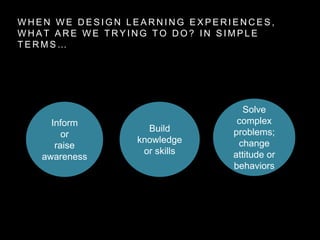
W H E N W E D E S I G N L E A R N I N G E X P E R I E N C E S ,
W H A T A R E W E T R Y I N G T O D O ? I N S I M P L E
T E R M S …
Inform
or
raise
awareness
Build
knowledge
or skills
Solve
complex
problems;
change
attitude or
behaviors
Information and Communication
Models?
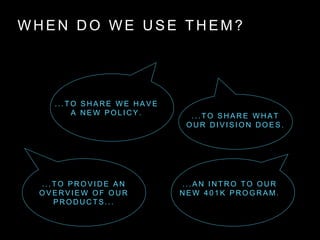
W H E N D O W E U S E T H E M ?
. . . T O S H A R E W E H A V E
A N E W P O L I C Y . . . . T O S H A R E W H A T
O U R D I V I S I O N D O E S .
. . . T O P R O V I D E A N
O V E R V I E W O F O U R
P R O D U C T S . . .
. . . A N I N T R O T O O U R
N E W 4 0 1 K P R O G R A M .
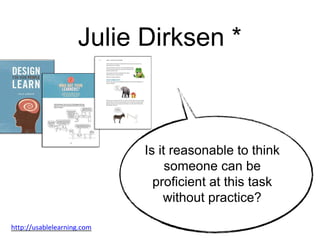
Julie Dirksen *
Is it reasonable to think
someone can be
proficient at this task
without practice?
http://usablelearning.com
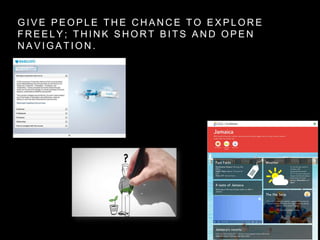
G I V E P E O P L E T H E C H A N C E T O E X P L O R E
F R E E L Y ; T H I N K S H O R T B I T S A N D O P E N
N A V I G A T I O N .
Building
knowledge
and skills?
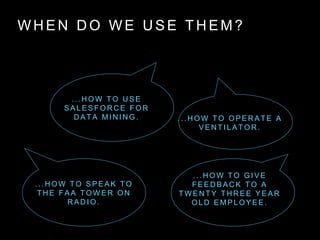
W H E N D O W E U S E T H E M ?
. . . H O W T O U S E
S A L E S F O R C E F O R
D A T A M I N I N G . . . . H O W T O O P E R A T E A
V E N T I L A T O R .
. . . H O W T O S P E A K T O
T H E F A A T O W E R O N
R A D I O .
. . . H O W T O G I V E
F E E D B A C K T O A
T W E N T Y T H R E E Y E A R
O L D E M P L O Y E E .
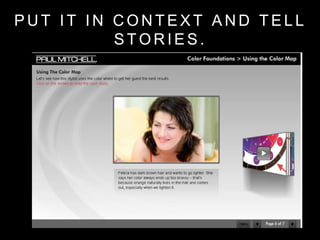
P R E S E N T A T I O N A L S E Q U E N C E SP U T I T I N C O N T E X T A N D T E L L
S T O R I E S .
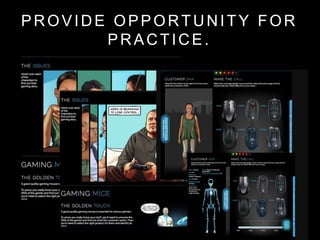
PROVIDE OPPORTUNITY FOR
PRACTICE.
Solving complex
problems and
changing behavior?
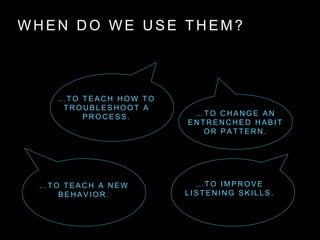
W H E N D O W E U S E T H E M ?
… T O T E A C H H O W T O
T R O U B L E S H O O T A
P R O C E S S . … T O C H A N G E A N
E N T R E N C H E D H A B I T
O R P A T T E R N .
… T O T E A C H A N E W
B E H A V I O R .
… T O I M P R O V E
L I S T E N I N G S K I L L S .
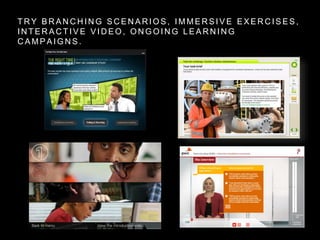
T R Y B R A N C H I N G S C E N A R I O S , I M M E R S I V E E X E R C I S E S ,
I N T E R A C T I V E V I D E O , O N G O I N G L E A R N I N G
C A M P A I G N S .
T I P : F O C U S O N T H E J O U R N E Y A N D
N O T T H E E V E N T .
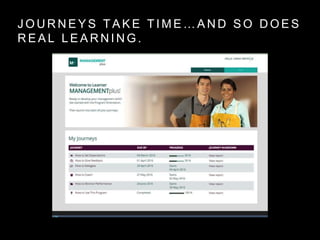
J O U R N E Y S T A K E T I M E … A N D S O D O E S
R E A L L E A R N I N G .
W H A T I S I N T E R A C T I V I T Y ? W H A T
D O E S I N T E R A C T I V E
E - L E A R N I N G M E A N T O Y O U ?
IS THIS WHAT YOU MEAN?
N E X T
INTERACTIVITY, DEFINED.
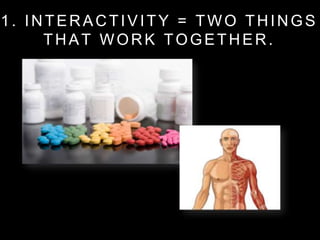
1. INTERACTIVITY = TWO THINGS
THAT WORK TOGETHER.
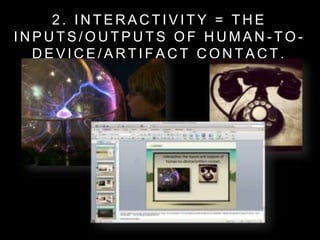
2 . I N T E R A C T I V I T Y = T H E
I N P U T S / O U T P U T S O F H U M A N - T O -
D E V I C E / A R T I F A C T C O N T A C T .
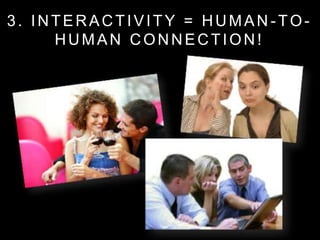
3. INTERACTIVITY = HUMAN -TO-
HUMAN CONNECTION!
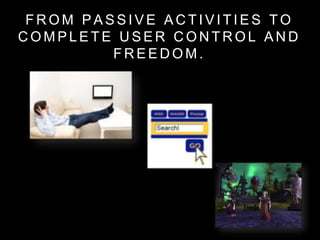
INTERACTIVITY LIVES ON A
SPECTRUM.
F R O M P A S S I V E A C T I V I T I E S T O
C O M P L E T E U S E R C O N T R O L A N D
F R E E D O M .
W H Y D O W E T H I N K W E N E E D I T I N
O U R E - L E A R N I N G ? W H Y D O E S E -
L E A R N I N G N E E D T O B E
I N T E R A C T I V E ?
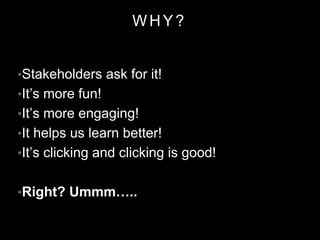
WHY?
•Stakeholders ask for it!
•It’s more fun!
•It’s more engaging!
•It helps us learn better!
•It’s clicking and clicking is good!
•Right? Ummm…..
BUT BEWARE THE DANGERS…
A V O I D T H E L U R E O F S E D U C T I V E D E T A I L S .
A K A T H E “ J A Z Z H A N D S ” O F E L E A R N I N G
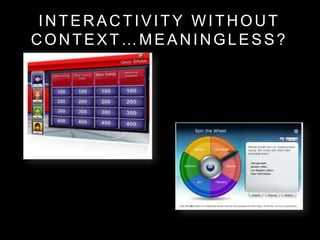
INTERACTIVITY WITHOUT
CONTEXT…MEANINGLESS?
A V O I D I N T E R A C T I V I T Y F O R I N T E R A C T I V I T Y ’ S
S A K E
Fatiguing Distracting
Doesn’t
promote
deeper
understandin
g
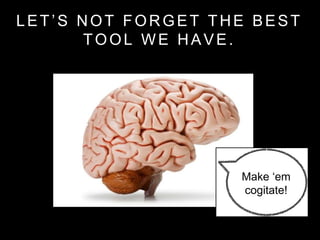
LET’S NOT FORGET THE BEST
TOOL WE HAVE.
Make ‘em
cogitate!
S O W H A T C A N I N T E R A C T I V I T Y
L O O K L I K E ? ( T H E K I N D W E C A N D O
W I T H O U T B L O W I N G O U R
B U D G E T S ? )
LET’S LOOK AT FOUR
PRINCIPLES.
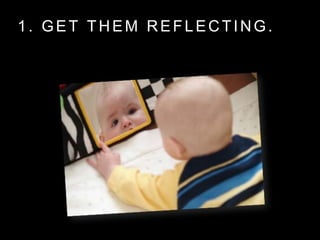
1. GET THEM REFLECTING.
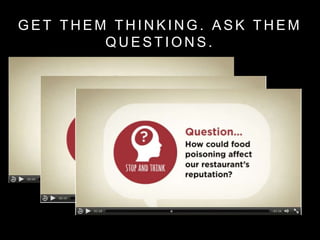
G E T T H E M T H I N K I N G . A S K T H E M
Q U E S T I O N S .
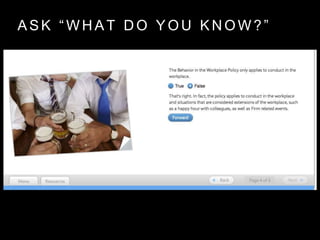
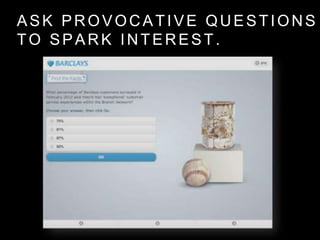
A S K “ W H A T D O Y O U K N O W ? ”
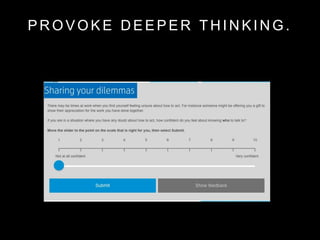
P R O V O K E D E E P E R T H I N K I N G .
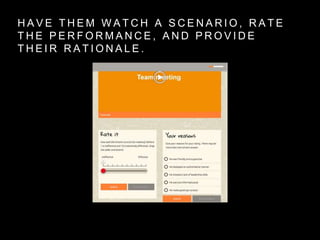
H A V E T H E M W A T C H A S C E N A R I O , R A T E
T H E P E R F O R M A N C E , A N D P R O V I D E
T H E I R R A T I O N A L E .
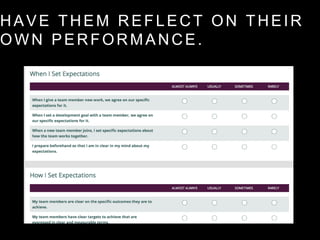
HAVE THEM REFLECT ON THEIR
OWN PERFORMANCE.
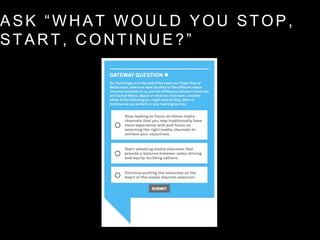
ASK “WHAT WOULD YOU STOP,
START, CONTINUE ?”
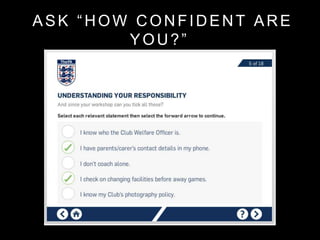
ASK “HOW CONFIDENT ARE
YOU?”
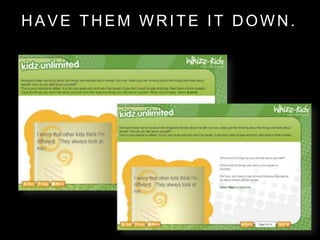
HAVE THEM WRITE IT DOWN.
G E T ‘ E M
R E F L E C T I N G .
S T O P , S T A R T ,
C O N T I N U E ?
2. GET THEM FEELING.
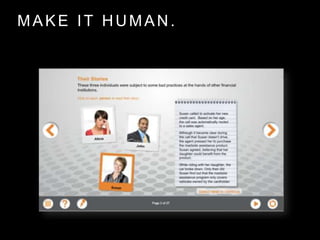
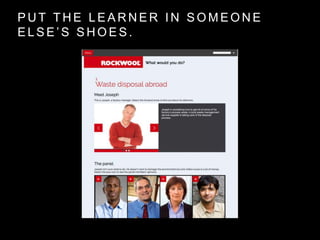
MAKE IT HUMAN.
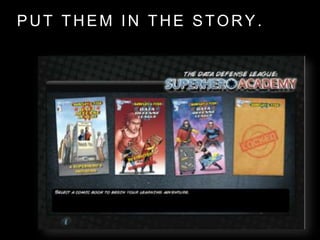
PUT THEM IN THE STORY.
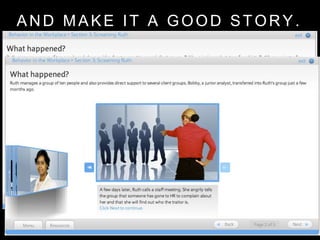
AND MAKE IT A GOOD STORY.
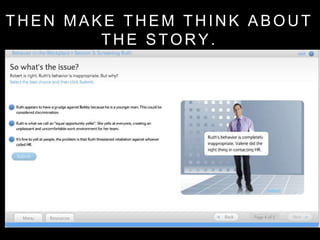
THEN MAKE THEM THINK ABOUT
THE STORY.
P U T T H E L E A R N E R I N S O M E O N E
E L S E ’ S S H O E S .
ASK PROVOCATIVE QUESTIONS
TO SPARK INTEREST.
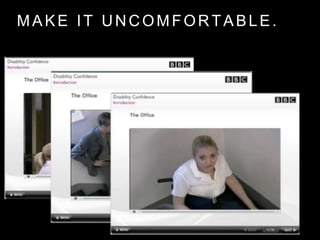
MAKE IT UNCOMFORTABLE.
G E T ‘ E M F E E L I N G .
S T O P , S T A R T ,
C O N T I N U E ?
3. GET THEM ACTING.
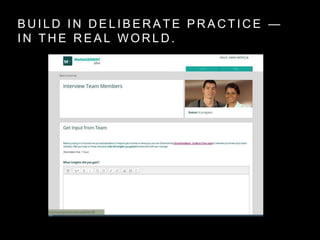
B U I L D I N D E L I B E R A T E P R A C T I C E —
I N T H E R E A L W O R L D .
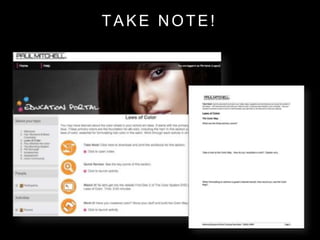
TAKE NOTE!
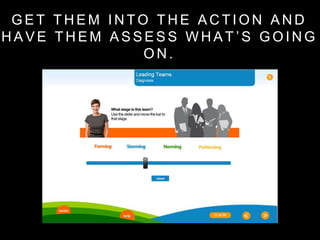
G E T T H E M I N T O T H E A C T I O N A N D
H A V E T H E M A S S E S S W H A T ’ S G O I N G
O N .
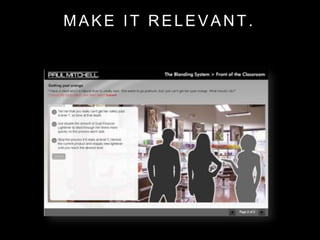
MAKE IT RELEVANT.
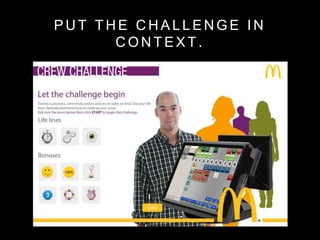
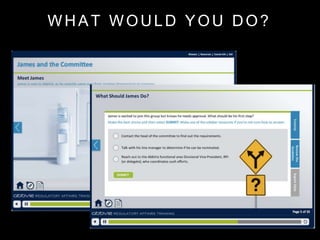
P U T T H E C H A L L E N G E I N
C O N T E X T .
WHAT WOULD YOU DO?
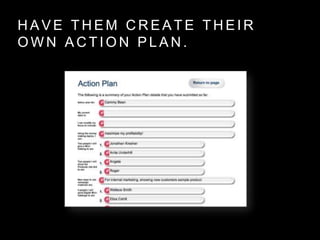
H A V E T H E M C R E A T E T H E I R
O W N A C T I O N P L A N .
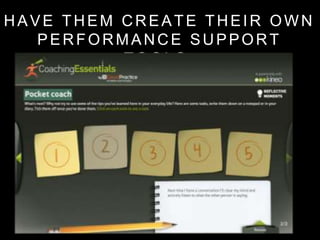
HAVE THEM CREATE THEIR OWN
PERFORMANCE SUPPORT
TOOLS.
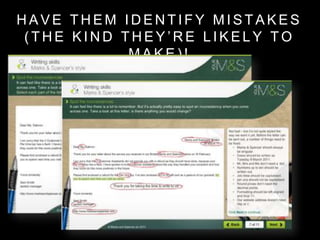
H A V E T H E M I D E N T I F Y M I S T A K E S
( T H E K I N D T H E Y ’ R E L I K E L Y T O
M A K E ) !
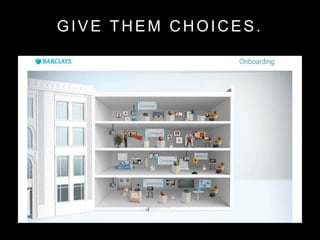
GIVE THEM CHOICES.
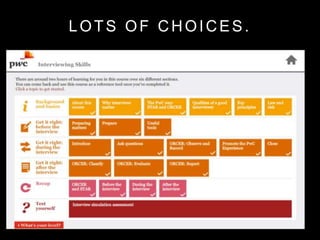
LOTS OF CHOICES.
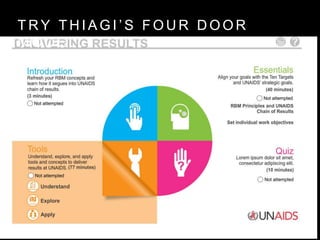
T R Y T H I A G I ’ S F O U R D O O R
M O D E L .
L E T T H E M D E C I D E : L E A R N O R
A P P L Y ?
G E T ‘ E M A C T I N G .
S T O P , S T A R T ,
C O N T I N U E ?
4 . G E T T H E M C O N N E C T I N G .
W I T H O T H E R H U M A N B E I N G S .
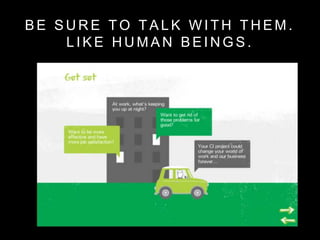
B E S U R E T O T A L K W I T H T H E M .
L I K E H U M A N B E I N G S .
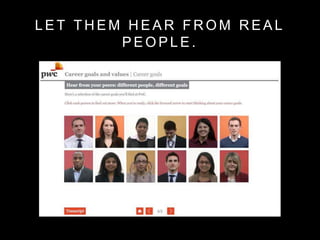
L E T T H E M H E A R F R O M R E A L
P E O P L E .
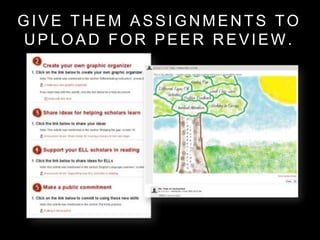
GIVE THEM ASSIGNMENTS TO
UPLOAD FOR PEER REVIEW.
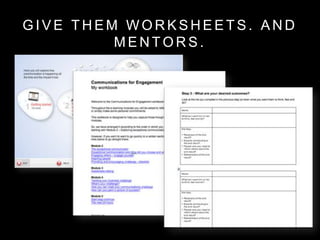
G I V E T H E M W O R K S H E E T S . A N D
M E N T O R S .
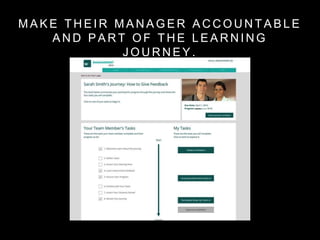
M A K E T H E I R M A N A G E R A C C O U N T A B L E
A N D P A R T O F T H E L E A R N I N G
J O U R N E Y .
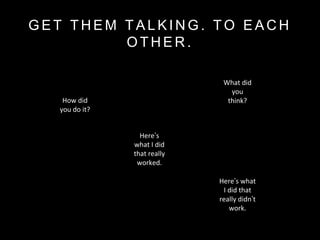
G E T T H E M T A L K I N G . T O E A C H
O T H E R .
What did
you
think?How did
you do it?
Here’s
what I did
that really
worked.
Here’s what
I did that
really didn’t
work.
G E T ‘ E M
C O N N E C T I N G .
S T O P , S T A R T ,
C O N T I N U E ?
GET THEM REFLECTING,
FEELING, ACTING/DOING,
CONNECTING.
questions?
questions
OFFER ENDS OCTOBER 4!
Use Code C4READS to Save 10% at
www.td.org/Core4Reads
Take Your Learning to the Next Level
Cammy Bean
email: cammy.bean@kineo.com
twitter: @cammybean
blog: http://cammybean.kineo.com
References and more:
https://www.diigo.com/list/cammybean/
A N D S O M E B O N U S
M A T E R I A L …
eLearningPie
eLearningPie
Learning & Pedagogy
eLearningPie
Creative
eLearningPie
Technology
eLearningPie
Business
eLearningPie
T H E T R U T H I S , M O S T O F U S A R E
H E R E Q U I T E A C C I D E N T A L L Y .
P O L L : W H A T ’ S Y O U R S W E E T
S P O T ?
• Learning
• Creativity
• Technology
• Business
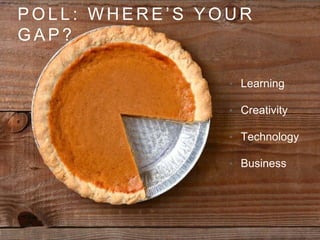
P O L L : W H E R E ’ S Y O U R
G A P ?
• Learning
• Creativity
• Technology
• Business
RoundoutyoureLearningPie

Tips for Better eLearning

  • 1.
    C R EA T I N G E N G A G I N G E - L E A R N I N G C A M M Y B E A N , S O L U T I O N S C O N S U L T A N T
  • 3.
    S O MA Y B E Y O U ’ R E N E W T O T H E B I Z ? N O T S U R E W H E R E T O G E T S T A R T E D W I T H T H I S E - L E A R N I N G T H I N G ?
  • 4.
    L E T’ S L O O K A T W A Y S T O C R E A T E L E S S O F T H I S …
  • 5.
    A N DM O R E O F T H I S …
  • 6.
    W H EN W E D E S I G N L E A R N I N G E X P E R I E N C E S , W H A T A R E W E T R Y I N G T O D O ? I N S I M P L E T E R M S … Inform or raise awareness Build knowledge or skills Solve complex problems; change attitude or behaviors
  • 7.
  • 8.
    W H EN D O W E U S E T H E M ? . . . T O S H A R E W E H A V E A N E W P O L I C Y . . . . T O S H A R E W H A T O U R D I V I S I O N D O E S . . . . T O P R O V I D E A N O V E R V I E W O F O U R P R O D U C T S . . . . . . A N I N T R O T O O U R N E W 4 0 1 K P R O G R A M .
  • 9.
    Julie Dirksen * Isit reasonable to think someone can be proficient at this task without practice? http://usablelearning.com
  • 10.
    G I VE P E O P L E T H E C H A N C E T O E X P L O R E F R E E L Y ; T H I N K S H O R T B I T S A N D O P E N N A V I G A T I O N .
  • 11.
  • 12.
    W H EN D O W E U S E T H E M ? . . . H O W T O U S E S A L E S F O R C E F O R D A T A M I N I N G . . . . H O W T O O P E R A T E A V E N T I L A T O R . . . . H O W T O S P E A K T O T H E F A A T O W E R O N R A D I O . . . . H O W T O G I V E F E E D B A C K T O A T W E N T Y T H R E E Y E A R O L D E M P L O Y E E .
  • 13.
    P R ES E N T A T I O N A L S E Q U E N C E SP U T I T I N C O N T E X T A N D T E L L S T O R I E S .
  • 14.
  • 15.
  • 16.
    W H EN D O W E U S E T H E M ? … T O T E A C H H O W T O T R O U B L E S H O O T A P R O C E S S . … T O C H A N G E A N E N T R E N C H E D H A B I T O R P A T T E R N . … T O T E A C H A N E W B E H A V I O R . … T O I M P R O V E L I S T E N I N G S K I L L S .
  • 17.
    T R YB R A N C H I N G S C E N A R I O S , I M M E R S I V E E X E R C I S E S , I N T E R A C T I V E V I D E O , O N G O I N G L E A R N I N G C A M P A I G N S .
  • 18.
    T I P: F O C U S O N T H E J O U R N E Y A N D N O T T H E E V E N T .
  • 19.
    J O UR N E Y S T A K E T I M E … A N D S O D O E S R E A L L E A R N I N G .
  • 20.
    W H AT I S I N T E R A C T I V I T Y ? W H A T D O E S I N T E R A C T I V E E - L E A R N I N G M E A N T O Y O U ?
  • 21.
    IS THIS WHATYOU MEAN? N E X T
  • 22.
  • 23.
    1. INTERACTIVITY =TWO THINGS THAT WORK TOGETHER.
  • 24.
    2 . IN T E R A C T I V I T Y = T H E I N P U T S / O U T P U T S O F H U M A N - T O - D E V I C E / A R T I F A C T C O N T A C T .
  • 25.
    3. INTERACTIVITY =HUMAN -TO- HUMAN CONNECTION!
  • 26.
  • 27.
    F R OM P A S S I V E A C T I V I T I E S T O C O M P L E T E U S E R C O N T R O L A N D F R E E D O M .
  • 28.
    W H YD O W E T H I N K W E N E E D I T I N O U R E - L E A R N I N G ? W H Y D O E S E - L E A R N I N G N E E D T O B E I N T E R A C T I V E ?
  • 29.
    WHY? •Stakeholders ask forit! •It’s more fun! •It’s more engaging! •It helps us learn better! •It’s clicking and clicking is good! •Right? Ummm…..
  • 30.
    BUT BEWARE THEDANGERS…
  • 31.
    A V OI D T H E L U R E O F S E D U C T I V E D E T A I L S . A K A T H E “ J A Z Z H A N D S ” O F E L E A R N I N G
  • 32.
  • 33.
    A V OI D I N T E R A C T I V I T Y F O R I N T E R A C T I V I T Y ’ S S A K E Fatiguing Distracting Doesn’t promote deeper understandin g
  • 34.
    LET’S NOT FORGETTHE BEST TOOL WE HAVE. Make ‘em cogitate!
  • 35.
    S O WH A T C A N I N T E R A C T I V I T Y L O O K L I K E ? ( T H E K I N D W E C A N D O W I T H O U T B L O W I N G O U R B U D G E T S ? )
  • 36.
    LET’S LOOK ATFOUR PRINCIPLES.
  • 37.
    1. GET THEMREFLECTING.
  • 38.
    G E TT H E M T H I N K I N G . A S K T H E M Q U E S T I O N S .
  • 39.
    A S K“ W H A T D O Y O U K N O W ? ”
  • 40.
    P R OV O K E D E E P E R T H I N K I N G .
  • 41.
    H A VE T H E M W A T C H A S C E N A R I O , R A T E T H E P E R F O R M A N C E , A N D P R O V I D E T H E I R R A T I O N A L E .
  • 42.
    HAVE THEM REFLECTON THEIR OWN PERFORMANCE.
  • 43.
    ASK “WHAT WOULDYOU STOP, START, CONTINUE ?”
  • 44.
  • 45.
  • 46.
    G E T‘ E M R E F L E C T I N G . S T O P , S T A R T , C O N T I N U E ?
  • 47.
    2. GET THEMFEELING.
  • 48.
  • 49.
    PUT THEM INTHE STORY.
  • 50.
    AND MAKE ITA GOOD STORY.
  • 51.
    THEN MAKE THEMTHINK ABOUT THE STORY.
  • 52.
    P U TT H E L E A R N E R I N S O M E O N E E L S E ’ S S H O E S .
  • 53.
  • 54.
  • 55.
    G E T‘ E M F E E L I N G . S T O P , S T A R T , C O N T I N U E ?
  • 56.
    3. GET THEMACTING.
  • 57.
    B U IL D I N D E L I B E R A T E P R A C T I C E — I N T H E R E A L W O R L D .
  • 58.
  • 59.
    G E TT H E M I N T O T H E A C T I O N A N D H A V E T H E M A S S E S S W H A T ’ S G O I N G O N .
  • 60.
  • 61.
    P U TT H E C H A L L E N G E I N C O N T E X T .
  • 62.
  • 63.
    H A VE T H E M C R E A T E T H E I R O W N A C T I O N P L A N .
  • 64.
    HAVE THEM CREATETHEIR OWN PERFORMANCE SUPPORT TOOLS.
  • 65.
    H A VE T H E M I D E N T I F Y M I S T A K E S ( T H E K I N D T H E Y ’ R E L I K E L Y T O M A K E ) !
  • 66.
  • 67.
  • 68.
    T R YT H I A G I ’ S F O U R D O O R M O D E L .
  • 69.
    L E TT H E M D E C I D E : L E A R N O R A P P L Y ?
  • 70.
    G E T‘ E M A C T I N G . S T O P , S T A R T , C O N T I N U E ?
  • 71.
    4 . GE T T H E M C O N N E C T I N G . W I T H O T H E R H U M A N B E I N G S .
  • 72.
    B E SU R E T O T A L K W I T H T H E M . L I K E H U M A N B E I N G S .
  • 73.
    L E TT H E M H E A R F R O M R E A L P E O P L E .
  • 74.
    GIVE THEM ASSIGNMENTSTO UPLOAD FOR PEER REVIEW.
  • 75.
    G I VE T H E M W O R K S H E E T S . A N D M E N T O R S .
  • 76.
    M A KE T H E I R M A N A G E R A C C O U N T A B L E A N D P A R T O F T H E L E A R N I N G J O U R N E Y .
  • 77.
    G E TT H E M T A L K I N G . T O E A C H O T H E R . What did you think?How did you do it? Here’s what I did that really worked. Here’s what I did that really didn’t work.
  • 78.
    G E T‘ E M C O N N E C T I N G . S T O P , S T A R T , C O N T I N U E ?
  • 79.
    GET THEM REFLECTING, FEELING,ACTING/DOING, CONNECTING.
  • 80.
  • 81.
    OFFER ENDS OCTOBER4! Use Code C4READS to Save 10% at www.td.org/Core4Reads Take Your Learning to the Next Level
  • 82.
    Cammy Bean email: cammy.bean@kineo.com twitter:@cammybean blog: http://cammybean.kineo.com References and more: https://www.diigo.com/list/cammybean/
  • 84.
    A N DS O M E B O N U S M A T E R I A L …
  • 85.
  • 86.
  • 87.
  • 88.
  • 89.
  • 90.
  • 91.
    T H ET R U T H I S , M O S T O F U S A R E H E R E Q U I T E A C C I D E N T A L L Y .
  • 92.
    P O LL : W H A T ’ S Y O U R S W E E T S P O T ? • Learning • Creativity • Technology • Business
  • 93.
    P O LL : W H E R E ’ S Y O U R G A P ? • Learning • Creativity • Technology • Business
  • 94.

Editor's Notes

  • #4 So let’s sharpen our ID pencils. Let’s take a look at some strategies and approaches you can use to jumpstart your practice to ensure you and your team are creating less of this….
  • #7 As you begin designing the learning experience, work with your subject matter experts and stakeholders to determine the desired outcomes. My favorite question: What do you want the learner to be able to do after completing this program? Sometimes the answer is surprising: “Oh, I really want them to know who to contact if they think their computer has a virus.” Or “I want them to tick off that box in the LMS so we can show that they looked at the information.” It’s not always straightforward, but it’s important to get the right model that’s fit for purpose. This is back to the standard starting question: What problem are we trying to solve? It’s all too common to see solutions that don’t really fit the problem. Have you ever seen a program that really just needed to raise awareness and communicate some fairly simple information, but where the designer chose a needlessly complex learning model filled with interactive case-based branching scenarios? Or where the desired outcome was a true behavioral change and all the program did was share information? So take care not to over or under-design for the need you’re facing. As you start making design decisions first have these high level learning models in mind. Ask “Is this program mainly about sharing information, building knowledge and skills, solving complex problems or creating a change in attitude or behavior?”
  • #8 Understand and know are somewhat lame learning objectives as they’re hard to assess. As a responsible instructional designer, you should dig deeper to find out if there’s more below the surface here. Is there really a skill-based objective that would require some practice? Or is it really this simple? Presentational and informational models are the right choice when the content is simple to understand and the risk due to errors is relatively low. And be prepared to put your marketing hat on—to think like an ad agency and make content that is compelling and well-presented. Information models work really well in e-learning as the learner gets to decide what they need to know. Go for user driven models where the learner can explore the content at their own pace. Think open, browsable experiences like eMagazines or open menus that allow learners to dive into a process or flow. When to use information and awareness models: When the content is simple and easy to understand When the risk of making mistakes is low When information can be easily accessed through performance support tools like job aids at the moment of need Where true practice isn’t required
  • #9  “They need to know that we have a new policy.” “They need to be aware of the risks of clicking on links in emails.” “We want people to know what our division does.” “We need an overview of our products, no skills taught or assessed.” “It’s an introduction to our new 401K program.”
  • #10 http://usablelearning.com
  • #13 When you want the target audience to improve their knowledge and skills, then the need to check understanding and provide feedback on performance within the program is crucial. Information and communication programs may not have assessable learning objectives, but skill builders definitely do. You need to ensure the learner comprehends the material and also provide them with the mechanisms to retain this knowledge or skill. You might call this practice. The key here is all about application and building skills that the learner can take out to the real-world and perform when it matters.
  • #18 Let people experience the consequences.
  • #22 It’s not about clicking next to continue. It’s about what happens in between.
  • #24 “Two things that interact with each other” – drugs or muscles that work together. Doctors might be concerned with how drugs interact with each other in a patient. inter + act Muscles work together -- they interact to move your leg.
  • #25 Human to artifact: you can touch it and it will respond to your inputs. An interactive electronic device that responds to human touch…. Dialing a telephone (even an old fashioned one – interactivity is not a recent invention!) Using a piece of software This is the behavior of the user interface and what we often think as “interactivity” – software that responds to inputs from humans. Like a word processor… There are typically expected behaviors… Photo credits: Cammy Bean.
  • #26 Human to human communication – when two people interact with each other – we talk, we laugh. We’re in RELATIONSHIP with each other. Social interaction.
  • #27 Interactivity lives on a spectrum of learner control and user freedom.
  • #28 “Passively” watching a video with no controls over audio or video. Although tv watching has increasingly become an interactive exercise as we tweet and post to facebook about the shows we’re watching. And yes, you do have a remote to turn it off and on…or now to even select what on-demand show to watch. Immersive 3D world where you have complete control over what you do and where you go Screen shot: http://us.battle.net/wow/en/media/screenshots/screenshot-of-the-day/cataclysm?view#/cataclysm-ss1310 Cognitive Fidelity: A representation of a complex system that helps users to understand the system. This representation does not necessarily give an exact description of the system's actual working <Brown1986>. Cognitive fidelity should enhance a user's capability to construct a mental model of a system.   http://l3d.cs.colorado.edu/jargon.html Cognitive Fidelity – does it map to the problem-solving process? Contextual Fidelity – does it map to the on-the job performance environment? Potentially novice learners might require more contextual fidelity… Games – exposure games for contextual or cognitive fidelity…create a fantasy game that provides cognitive fidelity (e.g., make a    “I have a few theories about cognitive fidelity (the process by which a game represents the content in high fidelity, but not necessarily the context - and that those might be just as good for transfer...and example might be using the lean six sigma process to build a weapons system that will defend the earth from the impending alien attack...same process that you would follow and therefore high cognitive fidelity, but low contextual fidelity because its not a realistic situation...however in my area where we teach so many multidisciplinary fields (navy, air force, marines) who have their own weapons systems process its hard to build a game that doesn't violate at least one of their rules, so by creating a fantasy environment I bypass their context, and hopefully lead to learning that is more readily transferrable because its context agnostic.) “ ~ Alicia Sanchez Enter search text into a search field, answer an MCQ.
  • #33 Drill and kill is one way to get learners to practice your content. And practice, is good, right? Well, not always. When we force learners to practice without context, they’ve memorized facts but may not be able to apply them correctly in context. This is why Jeopardy Games are for the most part useless as learning tools. Unless you’re a noted game show host, you’re day job isn’t working at a Jeopardy Board. We need to provide more contextual opportunities for drill exercises that will help the learner both retain and apply the knowledge they are practicing. Sebastian Deterding calls this a“disconnected challenge”. “So I have actually used a lot of those types of games (The skiing example) for kill and drill type things. Memorization, vocabulary retention that kind of thing. That is pretty much the limit of their applicability. The types of games that have the most beneficial performance based impacts are experiential games, where the player is allowed to actually participate in the content and make some decisions on their own.” ~ Dr. Alicia Sanchez Jeopardy: http://www.c3softworks.com/products/classroom/bravo-classroom/index.html#4 Spin the wheel: http://www.raptivity.com
  • #35 Think about the interaction –   Relevant clicking should enhance the instruction and helped the learner make real connections
  • #36 It’s not about the mouse and where you click – it’s about engaging someone cognitively, getting them interacting with the content by thinking about it, reflecting on, even doing something with it.
  • #39 Make it cognitive! Reflection counts. Let the learner think about the purpose of the interaction. And remember that interaction happens IN THE BRAIN and not just on the screen. No clicking involved.
  • #43 Build in opportunities for self-assessment and self-reflection.
  • #44 https://clients.kineo.com/pepsico/mod/scorm/player.php?a=11&scoid=34
  • #48 Engage through Emotions: get them feeling.
  • #49 Put a human face to something as dry as financial regulations. When we can connect with the people in the stories, we feel their pain and we can see why this content matters.
  • #50 Tell a story that connects to them emotionally – we remember stories better.
  • #55 http://www.kineo.com/showcase/file.php/140/disability_awareness/Language_and_etiquette/Course/asset/main.html
  • #59 Paul Mitchell had a series of DVD videos. Instead of just having that be a passive experience, we created note sheets for the user to download and write notes on the module. For their audience, this approach worked really well.
  • #61 In this example, what the learner needed to be able to DO at the end of the day – was to answer other hair stylists questions. So we created a classroom scenario where they could work through challenging questions posed by their soon-to-be-students. By keeping the focus on what the learner needs to be able to DO…you make it relevant…which brings us to our next point:
  • #62 This is a game-based approach, good for practicing systems and service skills together
  • #68 21 focused practical resources Most are 5 minutes or shorter Follow the whole interview cycle Work in sequence, or if experienced as dip-in support Variety of interactive approaches: Focus on practice Animations – perception vs reality Videos - good and bad examples and stories Observe and critique scenarios Question structuring practice Candidate rating practice Note taking practice Takeaways and reminders Ongoing occupational psychologist coach to give feedback and support
  • #69 Thiagi’s Four Door Model: Library: content and presentations – videos, elearning tutorials, PDFs Playground: games and activities to provide practice and reinforcement Café: Social learning activities for reflection and integration (wikis, blogs, forums, etc.) Evaluation Center/Torture Chamber: testing and assessment Brandon Carson 2010 eLearning Guild: http://shemp65.typepad.com/eLG-4-DoorModel.pdf
  • #70 This is similar to the full branching simulation approach but the model is designed so that should the learner make a mistake in the scenario they get shown to a discrete relevant section of the tutorials. Once they complete the relevant module they can then return to the choice they got wrong and see if they can continue with the scenario without making further mistakes. The appeal of this approach is that learners have that extra degree of motivation to absorb the learning points, as they have just confronted that particular learning gap.
  • #72 Engage by Connecting: Add in offline human interaction!
  • #73 Well, then, speak to them like human beings. Address them as “you” and have a conversation with them. You might reconnect with whatever human bit is left inside of them…
  • #75 More call to actions...with specific links to take the experience beyond the eLearning event...”beyond the course”
  • #81 Any questions?
  • #92 The truth is, most of us are here quite accidentally. And so the fact that MOST of us aren’t well-rounded in all pieces of the pie is pretty common. Raise your hand if you fell into this field by accident?
  • #93 So what’s your sweet spot? Are you here today because this is your sweet spot and you’re learning more about that part of the pie that you’re already passionate about? Or is this an area of growth for you?
  • #94 And now consider, what’s your gap or weakness? Where do you need to dive more deeply in order to round out your eLearning pie? And what can you do about that?
  • #95 My challenge for you is to aim for a more rounded pie….fill in your gaps, focus on your passions, build out a team that represents that full spectrum (because expecting ONE PERSON to do all of that is a little bit of insanity, isn’t it?)