FLIPPED LEARNING 
Dr. John R. Jenkins
FLIPPED LEARNING Objectives 
There are 6 main objectives for the seminary on Flipped Learning today. 
1. We will briefly define Behaviorism and Constructivism in 
relationship as the background to Flipped Learning. 
2. We will define Flipped Learning and outline the 
advantages of the Flipped Learning approach to 
teaching.
FLIPPED LEARNING Objectives 
3. We will describe what we know about Flipped Learning. 
4. We will also briefly outline a lesson plan for a Flipped 
Learning lesson.
FLIPPED LEARNING Objectives 
5. Next, we will review the latest statistics related to the 
growth of Flipped Learning. 
6. Finally, I will demonstrate how I use Flipped Learning in 
my classrooms via 1know.net.
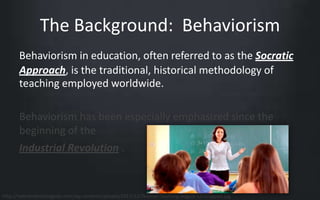
The Background: Behaviorism 
Behaviorism in education, often referred to as the Socratic 
Approach, is the traditional, historical methodology of 
teaching employed worldwide. 
Behaviorism has been especially emphasized since the 
beginning of the 
Industrial Revolution . 
http://vietnamteachingjobs.com/wp-content/uploads/2013/12/Teacher-Teaching-August-12-Cropped.jpg
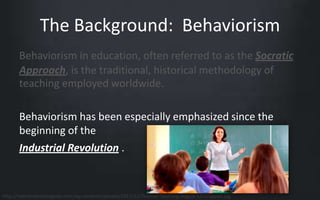
The Background: Behaviorism 
Behaviorism in education, often referred to as the Socratic 
Approach, is the traditional, historical methodology of 
teaching employed worldwide. 
Behaviorism has been especially emphasized since the 
beginning of the 
Industrial Revolution . 
http://vietnamteachingjobs.com/wp-content/uploads/2013/12/Teacher-Teaching-August-12-Cropped.jpg
Industrialized Education 
Ash (2012) even referred to the methodology employed 
during the era as an “Industrialized Education” because 
students were required to memorize facts…, and workers 
were required to develop a specific skill.
Bloom’s Taxonomy 
Unfortunately, the educational sector adopted the 
Socratic approach for education through memorization 
and regurgitation of facts in testing. 
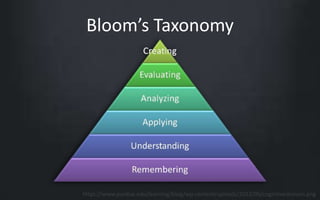
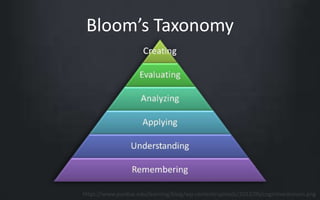
This idea represents the lower levels of Bloom’s 
Taxonomy of remembering, understanding, and applying 
information.
Bloom’s Taxonomy 
Unfortunately, the educational sector adopted the 
Socratic approach for education through memorization 
and regurgitation of facts in testing. 
This idea represents the lower levels of Bloom’s 
Taxonomy of remembering, understanding, and applying 
information.
Bloom’s Taxonomy 
https://www.purdue.edu/learning/blog/wp-content/uploads/2012/05/cognitivedomain.png
Efficiency and Effectiveness 
The Industrial Revolution also introduced a period of 
time where efficiency, effectiveness, and quality 
assurance were primary objectives in the manufacturing 
sector. 
The result of such emphasis was a goal oriented 
philosophy for the training and evaluation of employees 
both in the American and Taiwanese educational systems.
Merit 
This is not to say, however, that the 
Socratic (lecture) methodology is without merit. 
Content is important in the learning process, and the 
lecture is an efficient methodology employed to deliver 
content regardless of its effectiveness in doing so. 
http://www.sheffieldfc.com/sites/default/files/2004.png
Problem Questions 
However, one question to be asked is: 
“How does an individual’s creativity and curiosity suffer 
because of the influence 
of the Socratic philosophy” ? 
Another question that educators must ask is: 
“Does the Socratic method reflect the best use of face-to- 
face time between teachers and students” ? 
http://www.promedcostarica.org/wp-content/uploads/2013/09/question.png
Problem Questions 
However, one question to be asked is: 
“How does an individual’s creativity and curiosity suffer 
because of the influence 
of the Socratic philosophy” ? 
Another question that educators must ask is: 
“Does the Socratic method reflect the best use of face-to- 
face time between teachers and students” ? 
http://www.promedcostarica.org/wp-content/uploads/2013/09/question.png
Constructivism 
These are questions that are directly posed by the Flipped 
Learning approaches to education which is based on the 
concept of Constructivism. 
Constructivism was promoted, as you know, in the work of 
Piaget and Vygotsky.
Constructivism 
Constructivism in education has enjoyed a long history 
with an emphasis upon student involvement, self-directed 
learning, and problem-based learning. 
Basically, the Constructivist ideology refers to engaging 
students in learning activities as opposed to teachers 
appearing as a “Sage on the Stage” of the classroom.
Constructivism 
Constructivism in education has enjoyed a long history 
with an emphasis upon student involvement, self-directed 
learning, and problem-based learning. 
Basically, the Constructivist ideology refers to engaging 
students in learning activities as opposed to teachers 
appearing as a “Sage on the Stage” of the classroom.
Constructivism 
Known through such terms as the “inverted classroom, 
blended learning, discovery learning, problem-based 
learning, self-directed learning, and individualized 
instruction”, the concept of the students’ involvement in 
learning was the goal of Constructivism.
ACTIVE LEARNING 
Constructivism is defined as a theory of knowledge based 
upon one’s experiences in life where learning is “doing”. 
Constructivism previously took the form of active learning, 
cooperative learning, collaborative learning, peer tutoring, 
and peer assisted learning that involved the student actively 
in the learning process.
ACTIVE LEARNING 
Constructivism is defined as a theory of knowledge based 
upon one’s experiences in life where learning is “doing”. 
Constructivism previously took the form of active learning, 
cooperative learning, collaborative learning, peer tutoring, 
and peer assisted learning that involved the student actively 
in the learning process.
Bloom’s Taxonomy 
The theory of Constructivism expresses the idea that no 
one can learn anything for someone else, but learning 
occurs when students are actively engaged in the process. 
This represents the higher levels of Bloom’s Taxonomy 
including the ability to analyze, evaluate, and create.
Bloom’s Taxonomy 
https://www.purdue.edu/learning/blog/wp-content/uploads/2012/05/cognitivedomain.png
MEANING OF CONSTRUCTIVISM 
Essentially then, “Constructivism is basically a theory -- 
based on observation and scientific study about how 
people learn. 
People construct meaning, understanding, and knowledge 
of the world through experience and reflection.
MEANING OF CONSTRUCTIVISM 
You cannot learn to swim unless you get into the water!!! 
http://everydaylife.globalpost.com/DMResize/photos.demandstudios.com/getty/article/171/135/86810526.jpg?w=600&h=600&keep_ratio=1&webp=1
FLIPPED LEARNING 
The result of the introduction of Flipped Learning by 
Bergmann and Sams in 2007 has raised the question of the 
effects of Flipped Learning on student engagement and 
achievement.
The Definition of Flipped Learning 
“Flipped Learning is a pedagogical approach in which direct 
instruction moves from the group learning space to the 
individual learning space, and the resulting group space is 
transformed into a dynamic, interactive learning 
environment where the educator guides students as they 
apply concepts and engage creatively in the subject matter” 
(http://flippedlearning.org/domain/46).
The Definition of Flipped Learning 
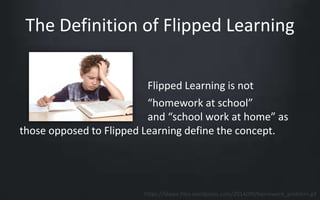
Flipped Learning is not 
“homework at school” 
and “school work at home” as 
those opposed to Flipped Learning define the concept. 
https://ldawe.files.wordpress.com/2014/09/homework_problem.gif
Technology 
What made Flipped Learning model possible was the 
development of technology. 
Technology allows teachers and students to access the 
internet from virtually anywhere in the world. 
Computers, IPads, the Smart Phone, and other such 
devices have put information at our fingertips.
Technology 
Today, you can find any information you seek on 
the Internet using such search engines as 
Google Chrome or Bing. 
But, Flipped Learning is not just E-Learning and 
the use of technology. 
http://www.geek.com/wp-content/uploads/2012/06/chrome-topper-590x312.jpg
FLIPPED LEARNING 
Bergmann and Sams (2012) have even indicated that 
Flipped Learning has existed throughout history, or at the 
very least for the past 200 years. 
They have even suggested that Flipped Learning is an 
extension of the Constructivist ideology of learning by doing. 
The Flipped Learning Network provides the following 
definition of Flipped Learning at the FLN Website referred 
to as The Four Pillars.
FLIPPED LEARNING 
Bergmann and Sams (2012) have even indicated that 
Flipped Learning has existed throughout history, or at the 
very least for the past 200 years. 
They have even suggested that Flipped Learning is an 
extension of the Constructivist ideology of learning by doing. 
The Flipped Learning Network provides the following 
definition of Flipped Learning at the FLN Website referred 
to as The Four Pillars.
The Four Pillars of F-L-I-P (FLN) 
「F」→ FLEXIBLE ENVIRONMENT 
1. Flipped Learning allows for a variety of learning modes; 
educators often physically rearrange their learning 
spaces to accommodate a lesson supporting group work 
or independent study.
The Four Pillars of F-L-I-P (FLN) 
「F」→ FLEXIBLE ENVIRONMENT 
2. They create flexible spaces in which students choose 
when and where they learn. 
3. Furthermore, educators who flip classes have flexible 
expectations of student timelines for learning & in the 
assessments of student learning.
The Four Pillars of F-L-I-P 
「L」→LEARNING CULTURE 
1. In the traditional teacher-centered model, the teacher is 
the primary source of information. 
2. Flipped Learning deliberately shifts instruction to a 
learner-centered approach, where in-class time is 
dedicated to exploring topics in greater depth.
The Four Pillars of F-L-I-P 
「L」→LEARNING CULTURE 
3. As a result, students are actively involved in knowledge 
construction as they participate in and evaluate their 
learning in a manner personally meaningful.
The Four Pillars of F-L-I-P 
「I」→INTENTIONAL CONTENT 
1. Flipped Learning Educators think about how they can 
use the Flipped Learning model to help students 
develop conceptual understanding, as well as 
procedural fluency. 
2. They determine what they need to teach and what 
materials students should explore on their own.
The Four Pillars of F-L-I-P 
「I」→INTENTIONAL CONTENT 
3. Educators use Intentional Content to maximize 
classroom time in order to adopt methods of student-centered, 
active learning strategies, depending on grade 
level & subject matter.
The Four Pillars of F-L-I-P 
「P」→ PROFESSIONAL EDUCATOR 
1. The role of a Professional Educator is even more 
important, and often more demanding, in a Flipped 
Classroom than in a traditional one. 
2. During class time, they continually observe their 
students, providing them with feedback relevant in the 
moment, and assessing student work.
The Four Pillars of F-L-I-P 
「P」→ PROFESSIONAL EDUCATOR 
3. Professional Educators are reflective in their practice, 
connect with each other to improve instruction, accept 
constructive criticism, & tolerate controlled chaos. 
4. While Professional Educators take on less visibly 
prominent roles in a classroom, they remain essential 
to enabling Flipped Learning.
F-L-I-P 
1. In a Flipped Learning environment, students view 
content through videos on the Internet prior to the 
exercises to reinforce the activities prepared by the 
teacher for in-class time.. 
2. In a Flipped Learning environment students can view a 
video as often as they need to do so in order to 
understand the content.
F-L-I-P 
3. In a Flipped Learning environment other content 
oriented activities such as reading, research, and 
exercises can be assigned for out-of class time. 
4. In a Flipped Learning environment using 1know, tests 
can even be constructed to review the work done out-of- 
class.
F-L-I-P 
5. In a Flipped Learning environment it has been my 
experience that teacher-student relationships are 
improved. 
6. In a Flipped Learning environment students can use out-of 
class time to review previously studied content. The 
work on the internet or in 1Know is always available to 
the student for review purposes.
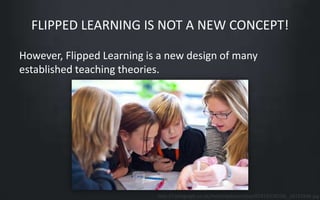
FLIPPED LEARNING IS NOT A NEW CONCEPT! 
However, Flipped Learning is a new design of many 
established teaching theories. 
http://i.telegraph.co.uk/multimedia/archive/02419/C6D58J_2419194b.jpg
Methodologies used in Flipped Learning 
• Group Discussion is a simpler form of Flipped Learning. 
(Peer Assisted) 
• Experimentation in science classes is a more complex 
form of Flipped Learning. (Problem Based Learning) 
• Paired-Reading is another form of Flipped Learning. 
(Collaborative Learning)
Methodologies used in Flipped Learning 
• Mathematics classes have employed the use of student 
tutoring other students in difficult mathematical 
concepts. (Peer Tutoring) 
• Active learning is “any instruction method that engages 
students in the learning process.” (Cooperative Learning)
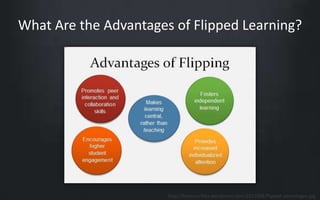
What Are the Advantages of Flipped Learning? 
http://karenzo.files.wordpress.com/2013/04/flipped-advantages.jpg
Kathleen Fulton (2012) Suggests 13 
Advantages from Case Studies 
1. Students move at their own pace. 
2. Activities in-class give the teacher better insight into 
student difficulties. 
http://www.keralaevents.com/eventphotos/1232/class-raising-hands.jpg
Kathleen Fulton (2012) Suggests 13 
Advantages from Case Studies 
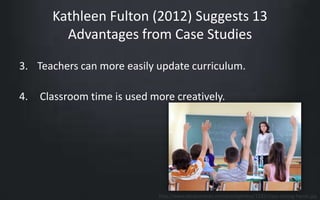
3. Teachers can more easily update curriculum. 
4. Classroom time is used more creatively. 
http://www.keralaevents.com/eventphotos/1232/class-raising-hands.jpg
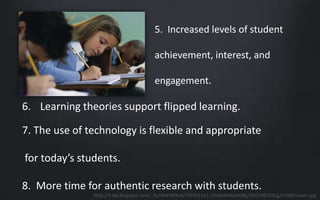
5. Increased levels of student 
achievement, interest, and 
engagement. 
6. Learning theories support flipped learning. 
7. The use of technology is flexible and appropriate 
for today’s students. 
8. More time for authentic research with students. 
http://4.bp.blogspot.com/_KaY4eF4NXLA/TEPm21ILL-I/AAAAAAAAGBg/4EG74D2OlLg/s1600/exam.jpg
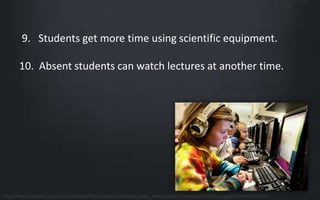
9. Students get more time using scientific equipment. 
10. Absent students can watch lectures at another time. 
http://www.takepart.com/sites/default/files/styles/landscape_main_image/public/computer%20class.jpg?itok=hnVnUCKU
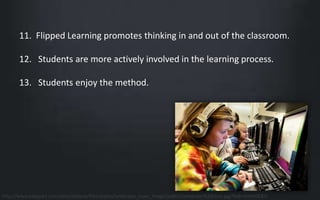
11. Flipped Learning promotes thinking in and out of the classroom. 
12. Students are more actively involved in the learning process. 
13. Students enjoy the method. 
http://www.takepart.com/sites/default/files/styles/landscape_main_image/public/computer%20class.jpg?itok=hnVnUCKU
What We Know About Flipped Learning 
If doing is the secret of learning – telling doesn’t work. well.
What We Know About Flipped Learning 
Feedback from students is more frequent, and research 
shows feedback has the strongest effect size of any 
instructional practice. 
http://www.swrfm.org/wp-content/uploads/2014/08/feedback.png
What We Know About Flipped Learning 
Flipped Learning is about how 
to best use your in-class time 
with students. 
If learning is what is important, students could be allowed 
to retake tests that they do poorly on to show learning has 
occurred. 
http://www.gifted.uconn.edu/nviews/images/exam_a.jpg
What We Know About Flipped Learning 
Flipped Learning IS NOT the same as the Flipped Classroom. 
For a classroom to be a Flipped Learning environment the 
Four Pillars of 
F-L-I-P must be employed. 
Videos allow self-pacing, quizzes, or require students to 
come to class with questions.
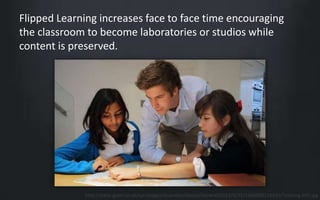
Flipped Learning increases face to face time encouraging 
the classroom to become laboratories or studios while 
content is preserved. 
http://static.guim.co.uk/sys-images/Guardian/About/General/2013/4/25/1366902219930/Tutoring-010.jpg
What We Know About Flipped Learning 
• Students have access to multiple teachers’ expertise. 
• Classroom time is used more effectively and creatively. 
• Teachers learn from one another and have more 
freedom.
What We Know About Flipped Learning 
• Parents have a window into the classroom. 
• Learning theory supports the approach. 
• Student achievement is increased.
What We Know About Flipped Learning 
• Strengthens team-based skills. 
• Offers personalized student guidance. 
• Flipped Learning is about how to best use your in-class 
time with students.
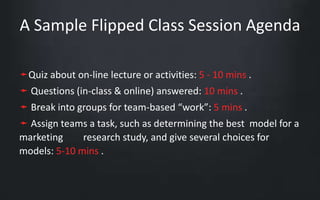
A Sample Flipped Class Session Agenda 
➛Quiz about on-line lecture or activities: 5 - 10 mins . 
➛ Questions (in-class & online) answered: 10 mins . 
➛ Break into groups for team-based “work”: 5 mins . 
➛ Assign teams a task, such as determining the best model for a 
marketing research study, and give several choices for 
models: 5-10 mins .
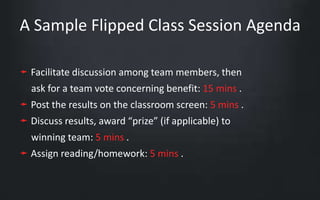
A Sample Flipped Class Session Agenda 
➛ Facilitate discussion among team members, then 
ask for a team vote concerning benefit: 15 mins . 
➛ Post the results on the classroom screen: 5 mins . 
➛ Discuss results, award “prize” (if applicable) to 
winning team: 5 mins . 
➛ Assign reading/homework: 5 mins .
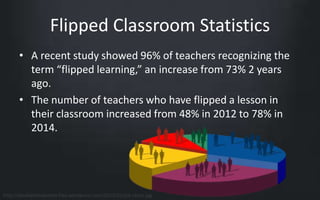
Flipped Classroom Statistics 
• A recent study showed 96% of teachers recognizing the 
term “flipped learning,” an increase from 73% 2 years 
ago. 
• The number of teachers who have flipped a lesson in 
their classroom increased from 48% in 2012 to 78% in 
2014. 
http://doublehelixdotme.files.wordpress.com/2013/03/pie-chart.jpg
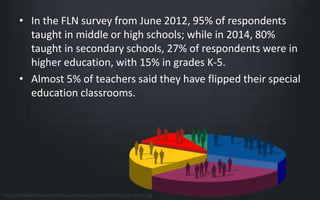
• In the FLN survey from June 2012, 95% of respondents 
taught in middle or high schools; while in 2014, 80% 
taught in secondary schools, 27% of respondents were in 
higher education, with 15% in grades K-5. 
• Almost 5% of teachers said they have flipped their special 
education classrooms. 
http://doublehelixdotme.files.wordpress.com/2013/03/pie-chart.jpg
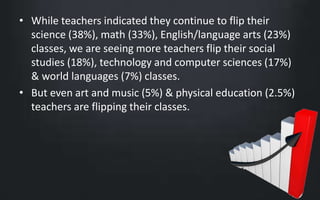
• While teachers indicated they continue to flip their 
science (38%), math (33%), English/language arts (23%) 
classes, we are seeing more teachers flip their social 
studies (18%), technology and computer sciences (17%) 
& world languages (7%) classes. 
• But even art and music (5%) & physical education (2.5%) 
teachers are flipping their classes.
• And over 11% of teachers are receiving their professional 
development via flipped learning. 
• Eight out of ten respondents have been flipping their 
classrooms for less than 2 years, with 18% practicing for 
more than 3 years. 
• However, we see the most experienced educators 
adopting flipped learning with 87% having 6 or more 
years of teaching experience, virtually unchanged from 2 
years ago.
• Almost half of this year’s respondents (42%) have been 
teaching 
• for 16 or more years -- the myth about “older” teachers 
being out of the technology mainstream doesn’t hold up 
in a flipped classroom! 
• Nine out of ten flipped teachers indicated that student 
engagement improved with Flipped Learning. 
• In 2012, the FLN survey found an 80% increase in student 
engagement and the 2012 Sophia survey showed an 85% 
increase.
Question to Ask Before Flipping 
• These modified question come from Cockrum (2014) 
who suggests asking them before flipping a classroom. 
1. Why you are flipping? 
2. What about flipping interests you?
Question to Ask Before Flipping 
• 3. What roadblocks might you encounter? 
• 4. Is the extra work worth the benefits? 
• 5. How will technology improve the class? 
• 6. Where will your inspiration come from?
Books in Print 
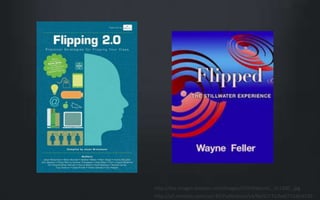
The following 3 slides identify a few books on 
Flipped Learning available through the Eslite 
Bookstores. Some are available in the Chinese 
Language.
http://covers.booktopia.com.au/big/9781564843449/flipped-learning.jpg 
http://www.clemensclassroom.com/uploads/4/6/5/8/4658148/6148128.jpg
http://ecx.images-amazon.com/images/I/91Yti6wzivL._SL1500_.jpg 
http://a3.mzstatic.com/us/r30/Publication/v4/be/67/72/be6772d0-b742-
http://www.amazon.com/Flipping-English-Class-Reach-Learners/dp/0415733154 
http://www.amazon.com/Flipping-English-Class-Reach-Learners/dp/0415733154
Questions Before You Flip 
• Troy Cockrum, in the book Flipping Your English Class 
suggests that teachers ask themselves the following six 
questions before flipping. 
1. “Before you flip, it is imperative to analyze why you 
are flipping.” 
2. “What about flipping is most interesting to you?
Questions Before You Flip 
3. “Is the extra work worth the potential benefits to your 
class?” 
4. “What roadblocks might you encounter in your journey 
to flip?” 
5. “Where can you see the addition of technology 
improving your classroom? 
6. “Where can you find inspiration to take the next 
step?”
Thank you for your Attention 
• Now, I am going to take you to my Flipped Learning 
Courses found on 1know to demonstrate for you the out-of- 
class activities I employ in my classroom. 
• Please note that I connect everyone of the activities you 
will observe on 1know with the textbooks I use in the 
classroom.
Thank you for your Attention 
• I do present instructions, and some content, to students 
in the classroom, and my students work in groups, pairs, 
and sometime individually. 
• I also assist students by circulating through the room to 
answer questions, resolve problems, or respond to the 
needs of the students.
Thank you for your Attention 
• In this way, I have come to know my students more 
personally, and I have become more of a real person to 
my students. 
• So, please let me explain how I use the out-of-class and 
in-class activities and content to improve learning which 
are different for each of the classes I teach.

Flipped Learning

  • 1.
    FLIPPED LEARNING Dr.John R. Jenkins
  • 2.
    FLIPPED LEARNING Objectives There are 6 main objectives for the seminary on Flipped Learning today. 1. We will briefly define Behaviorism and Constructivism in relationship as the background to Flipped Learning. 2. We will define Flipped Learning and outline the advantages of the Flipped Learning approach to teaching.
  • 3.
    FLIPPED LEARNING Objectives 3. We will describe what we know about Flipped Learning. 4. We will also briefly outline a lesson plan for a Flipped Learning lesson.
  • 4.
    FLIPPED LEARNING Objectives 5. Next, we will review the latest statistics related to the growth of Flipped Learning. 6. Finally, I will demonstrate how I use Flipped Learning in my classrooms via 1know.net.
  • 5.
    The Background: Behaviorism Behaviorism in education, often referred to as the Socratic Approach, is the traditional, historical methodology of teaching employed worldwide. Behaviorism has been especially emphasized since the beginning of the Industrial Revolution . http://vietnamteachingjobs.com/wp-content/uploads/2013/12/Teacher-Teaching-August-12-Cropped.jpg
  • 6.
    The Background: Behaviorism Behaviorism in education, often referred to as the Socratic Approach, is the traditional, historical methodology of teaching employed worldwide. Behaviorism has been especially emphasized since the beginning of the Industrial Revolution . http://vietnamteachingjobs.com/wp-content/uploads/2013/12/Teacher-Teaching-August-12-Cropped.jpg
  • 7.
    Industrialized Education Ash(2012) even referred to the methodology employed during the era as an “Industrialized Education” because students were required to memorize facts…, and workers were required to develop a specific skill.
  • 8.
    Bloom’s Taxonomy Unfortunately,the educational sector adopted the Socratic approach for education through memorization and regurgitation of facts in testing. This idea represents the lower levels of Bloom’s Taxonomy of remembering, understanding, and applying information.
  • 9.
    Bloom’s Taxonomy Unfortunately,the educational sector adopted the Socratic approach for education through memorization and regurgitation of facts in testing. This idea represents the lower levels of Bloom’s Taxonomy of remembering, understanding, and applying information.
  • 10.
  • 11.
    Efficiency and Effectiveness The Industrial Revolution also introduced a period of time where efficiency, effectiveness, and quality assurance were primary objectives in the manufacturing sector. The result of such emphasis was a goal oriented philosophy for the training and evaluation of employees both in the American and Taiwanese educational systems.
  • 12.
    Merit This isnot to say, however, that the Socratic (lecture) methodology is without merit. Content is important in the learning process, and the lecture is an efficient methodology employed to deliver content regardless of its effectiveness in doing so. http://www.sheffieldfc.com/sites/default/files/2004.png
  • 13.
    Problem Questions However,one question to be asked is: “How does an individual’s creativity and curiosity suffer because of the influence of the Socratic philosophy” ? Another question that educators must ask is: “Does the Socratic method reflect the best use of face-to- face time between teachers and students” ? http://www.promedcostarica.org/wp-content/uploads/2013/09/question.png
  • 14.
    Problem Questions However,one question to be asked is: “How does an individual’s creativity and curiosity suffer because of the influence of the Socratic philosophy” ? Another question that educators must ask is: “Does the Socratic method reflect the best use of face-to- face time between teachers and students” ? http://www.promedcostarica.org/wp-content/uploads/2013/09/question.png
  • 15.
    Constructivism These arequestions that are directly posed by the Flipped Learning approaches to education which is based on the concept of Constructivism. Constructivism was promoted, as you know, in the work of Piaget and Vygotsky.
  • 16.
    Constructivism Constructivism ineducation has enjoyed a long history with an emphasis upon student involvement, self-directed learning, and problem-based learning. Basically, the Constructivist ideology refers to engaging students in learning activities as opposed to teachers appearing as a “Sage on the Stage” of the classroom.
  • 17.
    Constructivism Constructivism ineducation has enjoyed a long history with an emphasis upon student involvement, self-directed learning, and problem-based learning. Basically, the Constructivist ideology refers to engaging students in learning activities as opposed to teachers appearing as a “Sage on the Stage” of the classroom.
  • 18.
    Constructivism Known throughsuch terms as the “inverted classroom, blended learning, discovery learning, problem-based learning, self-directed learning, and individualized instruction”, the concept of the students’ involvement in learning was the goal of Constructivism.
  • 19.
    ACTIVE LEARNING Constructivismis defined as a theory of knowledge based upon one’s experiences in life where learning is “doing”. Constructivism previously took the form of active learning, cooperative learning, collaborative learning, peer tutoring, and peer assisted learning that involved the student actively in the learning process.
  • 20.
    ACTIVE LEARNING Constructivismis defined as a theory of knowledge based upon one’s experiences in life where learning is “doing”. Constructivism previously took the form of active learning, cooperative learning, collaborative learning, peer tutoring, and peer assisted learning that involved the student actively in the learning process.
  • 21.
    Bloom’s Taxonomy Thetheory of Constructivism expresses the idea that no one can learn anything for someone else, but learning occurs when students are actively engaged in the process. This represents the higher levels of Bloom’s Taxonomy including the ability to analyze, evaluate, and create.
  • 22.
  • 23.
    MEANING OF CONSTRUCTIVISM Essentially then, “Constructivism is basically a theory -- based on observation and scientific study about how people learn. People construct meaning, understanding, and knowledge of the world through experience and reflection.
  • 24.
    MEANING OF CONSTRUCTIVISM You cannot learn to swim unless you get into the water!!! http://everydaylife.globalpost.com/DMResize/photos.demandstudios.com/getty/article/171/135/86810526.jpg?w=600&h=600&keep_ratio=1&webp=1
  • 25.
    FLIPPED LEARNING Theresult of the introduction of Flipped Learning by Bergmann and Sams in 2007 has raised the question of the effects of Flipped Learning on student engagement and achievement.
  • 26.
    The Definition ofFlipped Learning “Flipped Learning is a pedagogical approach in which direct instruction moves from the group learning space to the individual learning space, and the resulting group space is transformed into a dynamic, interactive learning environment where the educator guides students as they apply concepts and engage creatively in the subject matter” (http://flippedlearning.org/domain/46).
  • 27.
    The Definition ofFlipped Learning Flipped Learning is not “homework at school” and “school work at home” as those opposed to Flipped Learning define the concept. https://ldawe.files.wordpress.com/2014/09/homework_problem.gif
  • 28.
    Technology What madeFlipped Learning model possible was the development of technology. Technology allows teachers and students to access the internet from virtually anywhere in the world. Computers, IPads, the Smart Phone, and other such devices have put information at our fingertips.
  • 29.
    Technology Today, youcan find any information you seek on the Internet using such search engines as Google Chrome or Bing. But, Flipped Learning is not just E-Learning and the use of technology. http://www.geek.com/wp-content/uploads/2012/06/chrome-topper-590x312.jpg
  • 30.
    FLIPPED LEARNING Bergmannand Sams (2012) have even indicated that Flipped Learning has existed throughout history, or at the very least for the past 200 years. They have even suggested that Flipped Learning is an extension of the Constructivist ideology of learning by doing. The Flipped Learning Network provides the following definition of Flipped Learning at the FLN Website referred to as The Four Pillars.
  • 31.
    FLIPPED LEARNING Bergmannand Sams (2012) have even indicated that Flipped Learning has existed throughout history, or at the very least for the past 200 years. They have even suggested that Flipped Learning is an extension of the Constructivist ideology of learning by doing. The Flipped Learning Network provides the following definition of Flipped Learning at the FLN Website referred to as The Four Pillars.
  • 32.
    The Four Pillarsof F-L-I-P (FLN) 「F」→ FLEXIBLE ENVIRONMENT 1. Flipped Learning allows for a variety of learning modes; educators often physically rearrange their learning spaces to accommodate a lesson supporting group work or independent study.
  • 33.
    The Four Pillarsof F-L-I-P (FLN) 「F」→ FLEXIBLE ENVIRONMENT 2. They create flexible spaces in which students choose when and where they learn. 3. Furthermore, educators who flip classes have flexible expectations of student timelines for learning & in the assessments of student learning.
  • 34.
    The Four Pillarsof F-L-I-P 「L」→LEARNING CULTURE 1. In the traditional teacher-centered model, the teacher is the primary source of information. 2. Flipped Learning deliberately shifts instruction to a learner-centered approach, where in-class time is dedicated to exploring topics in greater depth.
  • 35.
    The Four Pillarsof F-L-I-P 「L」→LEARNING CULTURE 3. As a result, students are actively involved in knowledge construction as they participate in and evaluate their learning in a manner personally meaningful.
  • 36.
    The Four Pillarsof F-L-I-P 「I」→INTENTIONAL CONTENT 1. Flipped Learning Educators think about how they can use the Flipped Learning model to help students develop conceptual understanding, as well as procedural fluency. 2. They determine what they need to teach and what materials students should explore on their own.
  • 37.
    The Four Pillarsof F-L-I-P 「I」→INTENTIONAL CONTENT 3. Educators use Intentional Content to maximize classroom time in order to adopt methods of student-centered, active learning strategies, depending on grade level & subject matter.
  • 38.
    The Four Pillarsof F-L-I-P 「P」→ PROFESSIONAL EDUCATOR 1. The role of a Professional Educator is even more important, and often more demanding, in a Flipped Classroom than in a traditional one. 2. During class time, they continually observe their students, providing them with feedback relevant in the moment, and assessing student work.
  • 39.
    The Four Pillarsof F-L-I-P 「P」→ PROFESSIONAL EDUCATOR 3. Professional Educators are reflective in their practice, connect with each other to improve instruction, accept constructive criticism, & tolerate controlled chaos. 4. While Professional Educators take on less visibly prominent roles in a classroom, they remain essential to enabling Flipped Learning.
  • 40.
    F-L-I-P 1. Ina Flipped Learning environment, students view content through videos on the Internet prior to the exercises to reinforce the activities prepared by the teacher for in-class time.. 2. In a Flipped Learning environment students can view a video as often as they need to do so in order to understand the content.
  • 41.
    F-L-I-P 3. Ina Flipped Learning environment other content oriented activities such as reading, research, and exercises can be assigned for out-of class time. 4. In a Flipped Learning environment using 1know, tests can even be constructed to review the work done out-of- class.
  • 42.
    F-L-I-P 5. Ina Flipped Learning environment it has been my experience that teacher-student relationships are improved. 6. In a Flipped Learning environment students can use out-of class time to review previously studied content. The work on the internet or in 1Know is always available to the student for review purposes.
  • 43.
    FLIPPED LEARNING ISNOT A NEW CONCEPT! However, Flipped Learning is a new design of many established teaching theories. http://i.telegraph.co.uk/multimedia/archive/02419/C6D58J_2419194b.jpg
  • 44.
    Methodologies used inFlipped Learning • Group Discussion is a simpler form of Flipped Learning. (Peer Assisted) • Experimentation in science classes is a more complex form of Flipped Learning. (Problem Based Learning) • Paired-Reading is another form of Flipped Learning. (Collaborative Learning)
  • 45.
    Methodologies used inFlipped Learning • Mathematics classes have employed the use of student tutoring other students in difficult mathematical concepts. (Peer Tutoring) • Active learning is “any instruction method that engages students in the learning process.” (Cooperative Learning)
  • 46.
    What Are theAdvantages of Flipped Learning? http://karenzo.files.wordpress.com/2013/04/flipped-advantages.jpg
  • 47.
    Kathleen Fulton (2012)Suggests 13 Advantages from Case Studies 1. Students move at their own pace. 2. Activities in-class give the teacher better insight into student difficulties. http://www.keralaevents.com/eventphotos/1232/class-raising-hands.jpg
  • 48.
    Kathleen Fulton (2012)Suggests 13 Advantages from Case Studies 3. Teachers can more easily update curriculum. 4. Classroom time is used more creatively. http://www.keralaevents.com/eventphotos/1232/class-raising-hands.jpg
  • 49.
    5. Increased levelsof student achievement, interest, and engagement. 6. Learning theories support flipped learning. 7. The use of technology is flexible and appropriate for today’s students. 8. More time for authentic research with students. http://4.bp.blogspot.com/_KaY4eF4NXLA/TEPm21ILL-I/AAAAAAAAGBg/4EG74D2OlLg/s1600/exam.jpg
  • 50.
    9. Students getmore time using scientific equipment. 10. Absent students can watch lectures at another time. http://www.takepart.com/sites/default/files/styles/landscape_main_image/public/computer%20class.jpg?itok=hnVnUCKU
  • 51.
    11. Flipped Learningpromotes thinking in and out of the classroom. 12. Students are more actively involved in the learning process. 13. Students enjoy the method. http://www.takepart.com/sites/default/files/styles/landscape_main_image/public/computer%20class.jpg?itok=hnVnUCKU
  • 52.
    What We KnowAbout Flipped Learning If doing is the secret of learning – telling doesn’t work. well.
  • 53.
    What We KnowAbout Flipped Learning Feedback from students is more frequent, and research shows feedback has the strongest effect size of any instructional practice. http://www.swrfm.org/wp-content/uploads/2014/08/feedback.png
  • 54.
    What We KnowAbout Flipped Learning Flipped Learning is about how to best use your in-class time with students. If learning is what is important, students could be allowed to retake tests that they do poorly on to show learning has occurred. http://www.gifted.uconn.edu/nviews/images/exam_a.jpg
  • 55.
    What We KnowAbout Flipped Learning Flipped Learning IS NOT the same as the Flipped Classroom. For a classroom to be a Flipped Learning environment the Four Pillars of F-L-I-P must be employed. Videos allow self-pacing, quizzes, or require students to come to class with questions.
  • 56.
    Flipped Learning increasesface to face time encouraging the classroom to become laboratories or studios while content is preserved. http://static.guim.co.uk/sys-images/Guardian/About/General/2013/4/25/1366902219930/Tutoring-010.jpg
  • 57.
    What We KnowAbout Flipped Learning • Students have access to multiple teachers’ expertise. • Classroom time is used more effectively and creatively. • Teachers learn from one another and have more freedom.
  • 58.
    What We KnowAbout Flipped Learning • Parents have a window into the classroom. • Learning theory supports the approach. • Student achievement is increased.
  • 59.
    What We KnowAbout Flipped Learning • Strengthens team-based skills. • Offers personalized student guidance. • Flipped Learning is about how to best use your in-class time with students.
  • 60.
    A Sample FlippedClass Session Agenda ➛Quiz about on-line lecture or activities: 5 - 10 mins . ➛ Questions (in-class & online) answered: 10 mins . ➛ Break into groups for team-based “work”: 5 mins . ➛ Assign teams a task, such as determining the best model for a marketing research study, and give several choices for models: 5-10 mins .
  • 61.
    A Sample FlippedClass Session Agenda ➛ Facilitate discussion among team members, then ask for a team vote concerning benefit: 15 mins . ➛ Post the results on the classroom screen: 5 mins . ➛ Discuss results, award “prize” (if applicable) to winning team: 5 mins . ➛ Assign reading/homework: 5 mins .
  • 62.
    Flipped Classroom Statistics • A recent study showed 96% of teachers recognizing the term “flipped learning,” an increase from 73% 2 years ago. • The number of teachers who have flipped a lesson in their classroom increased from 48% in 2012 to 78% in 2014. http://doublehelixdotme.files.wordpress.com/2013/03/pie-chart.jpg
  • 63.
    • In theFLN survey from June 2012, 95% of respondents taught in middle or high schools; while in 2014, 80% taught in secondary schools, 27% of respondents were in higher education, with 15% in grades K-5. • Almost 5% of teachers said they have flipped their special education classrooms. http://doublehelixdotme.files.wordpress.com/2013/03/pie-chart.jpg
  • 64.
    • While teachersindicated they continue to flip their science (38%), math (33%), English/language arts (23%) classes, we are seeing more teachers flip their social studies (18%), technology and computer sciences (17%) & world languages (7%) classes. • But even art and music (5%) & physical education (2.5%) teachers are flipping their classes.
  • 65.
    • And over11% of teachers are receiving their professional development via flipped learning. • Eight out of ten respondents have been flipping their classrooms for less than 2 years, with 18% practicing for more than 3 years. • However, we see the most experienced educators adopting flipped learning with 87% having 6 or more years of teaching experience, virtually unchanged from 2 years ago.
  • 66.
    • Almost halfof this year’s respondents (42%) have been teaching • for 16 or more years -- the myth about “older” teachers being out of the technology mainstream doesn’t hold up in a flipped classroom! • Nine out of ten flipped teachers indicated that student engagement improved with Flipped Learning. • In 2012, the FLN survey found an 80% increase in student engagement and the 2012 Sophia survey showed an 85% increase.
  • 67.
    Question to AskBefore Flipping • These modified question come from Cockrum (2014) who suggests asking them before flipping a classroom. 1. Why you are flipping? 2. What about flipping interests you?
  • 68.
    Question to AskBefore Flipping • 3. What roadblocks might you encounter? • 4. Is the extra work worth the benefits? • 5. How will technology improve the class? • 6. Where will your inspiration come from?
  • 69.
    Books in Print The following 3 slides identify a few books on Flipped Learning available through the Eslite Bookstores. Some are available in the Chinese Language.
  • 70.
  • 71.
  • 72.
  • 73.
    Questions Before YouFlip • Troy Cockrum, in the book Flipping Your English Class suggests that teachers ask themselves the following six questions before flipping. 1. “Before you flip, it is imperative to analyze why you are flipping.” 2. “What about flipping is most interesting to you?
  • 74.
    Questions Before YouFlip 3. “Is the extra work worth the potential benefits to your class?” 4. “What roadblocks might you encounter in your journey to flip?” 5. “Where can you see the addition of technology improving your classroom? 6. “Where can you find inspiration to take the next step?”
  • 75.
    Thank you foryour Attention • Now, I am going to take you to my Flipped Learning Courses found on 1know to demonstrate for you the out-of- class activities I employ in my classroom. • Please note that I connect everyone of the activities you will observe on 1know with the textbooks I use in the classroom.
  • 76.
    Thank you foryour Attention • I do present instructions, and some content, to students in the classroom, and my students work in groups, pairs, and sometime individually. • I also assist students by circulating through the room to answer questions, resolve problems, or respond to the needs of the students.
  • 77.
    Thank you foryour Attention • In this way, I have come to know my students more personally, and I have become more of a real person to my students. • So, please let me explain how I use the out-of-class and in-class activities and content to improve learning which are different for each of the classes I teach.