HISTORY AND DEVELOPMENT OF 
IRRIGATION IN INDIA
IRRIGATION 
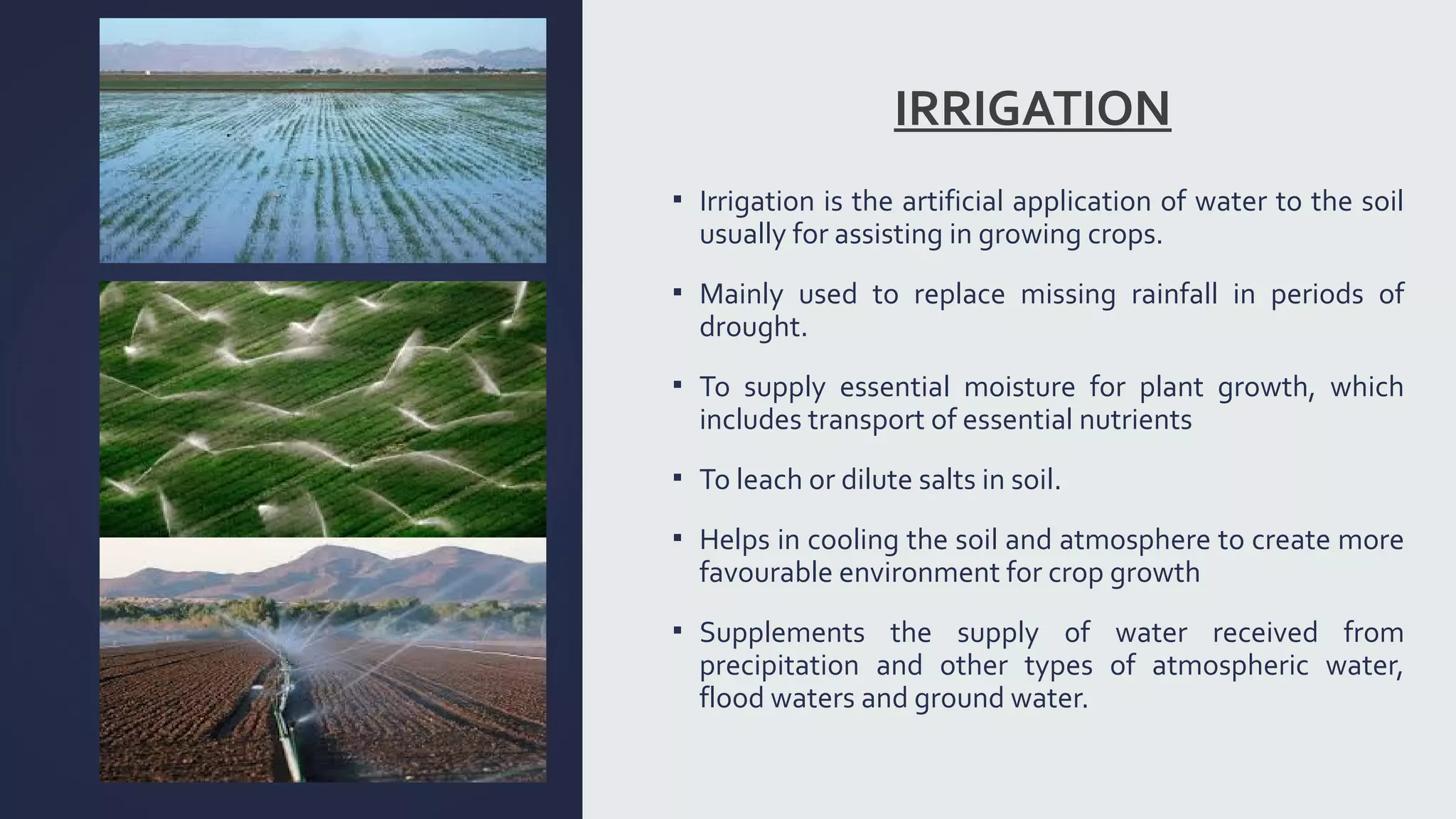
▪ Irrigation is the artificial application of water to the soil 
usually for assisting in growing crops. 
▪ Mainly used to replace missing rainfall in periods of 
drought. 
▪ To supply essential moisture for plant growth, which 
includes transport of essential nutrients 
▪ To leach or dilute salts in soil. 
▪ Helps in cooling the soil and atmosphere to create more 
favourable environment for crop growth 
▪ Supplements the supply of water received from 
precipitation and other types of atmospheric water, 
flood waters and ground water.
History of Irrigation in India 
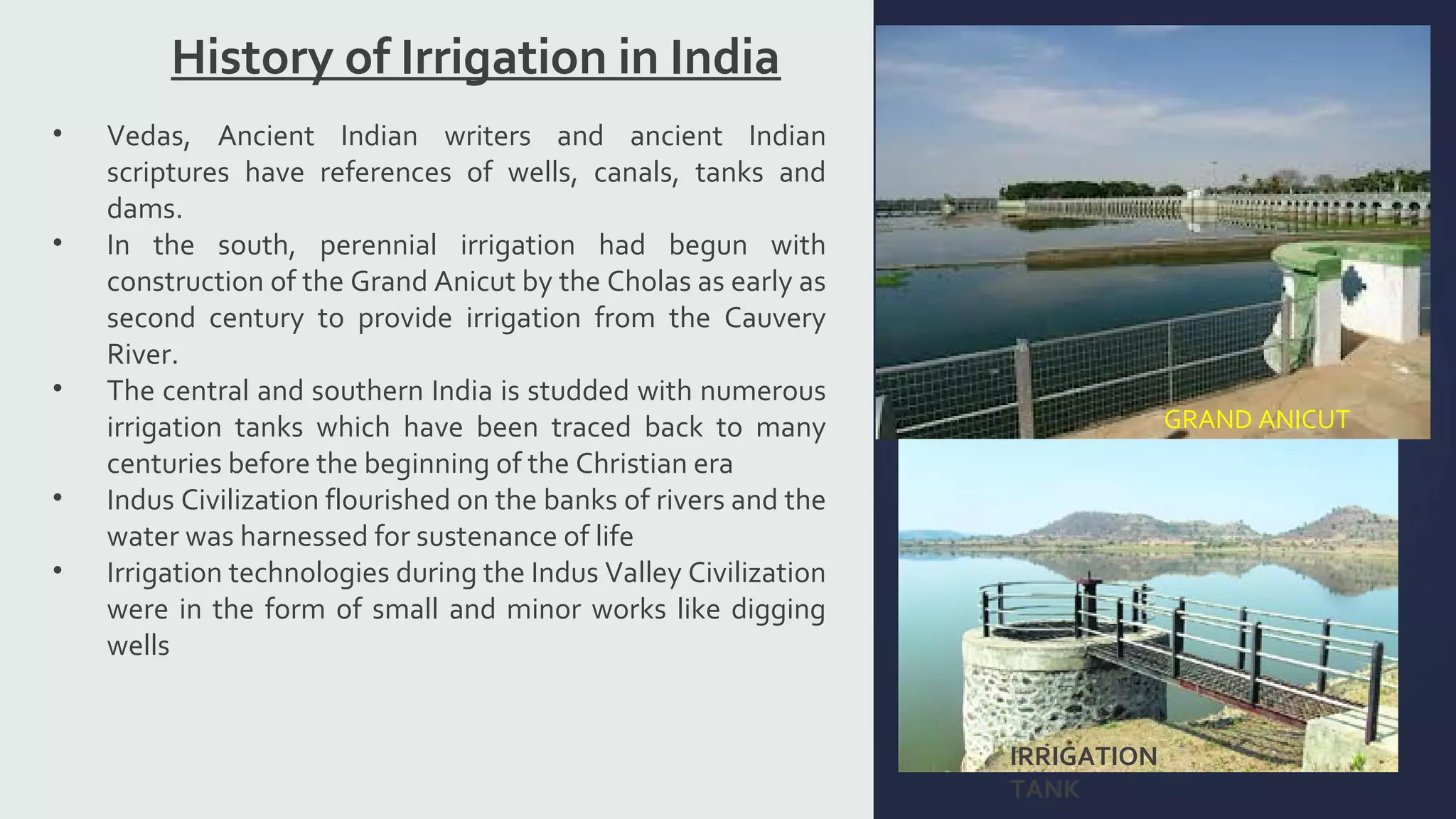
GRAND ANICUT 
IRRIGATION 
TANK 
• Vedas, Ancient Indian writers and ancient Indian 
scriptures have references of wells, canals, tanks and 
dams. 
• In the south, perennial irrigation had begun with 
construction of the Grand Anicut by the Cholas as early as 
second century to provide irrigation from the Cauvery 
River. 
• The central and southern India is studded with numerous 
irrigation tanks which have been traced back to many 
centuries before the beginning of the Christian era 
• Indus Civilization flourished on the banks of rivers and the 
water was harnessed for sustenance of life 
• Irrigation technologies during the Indus Valley Civilization 
were in the form of small and minor works like digging 
wells
Irrigation during Medieval India 
▪ Rapid advances took place in the construction of canals. 
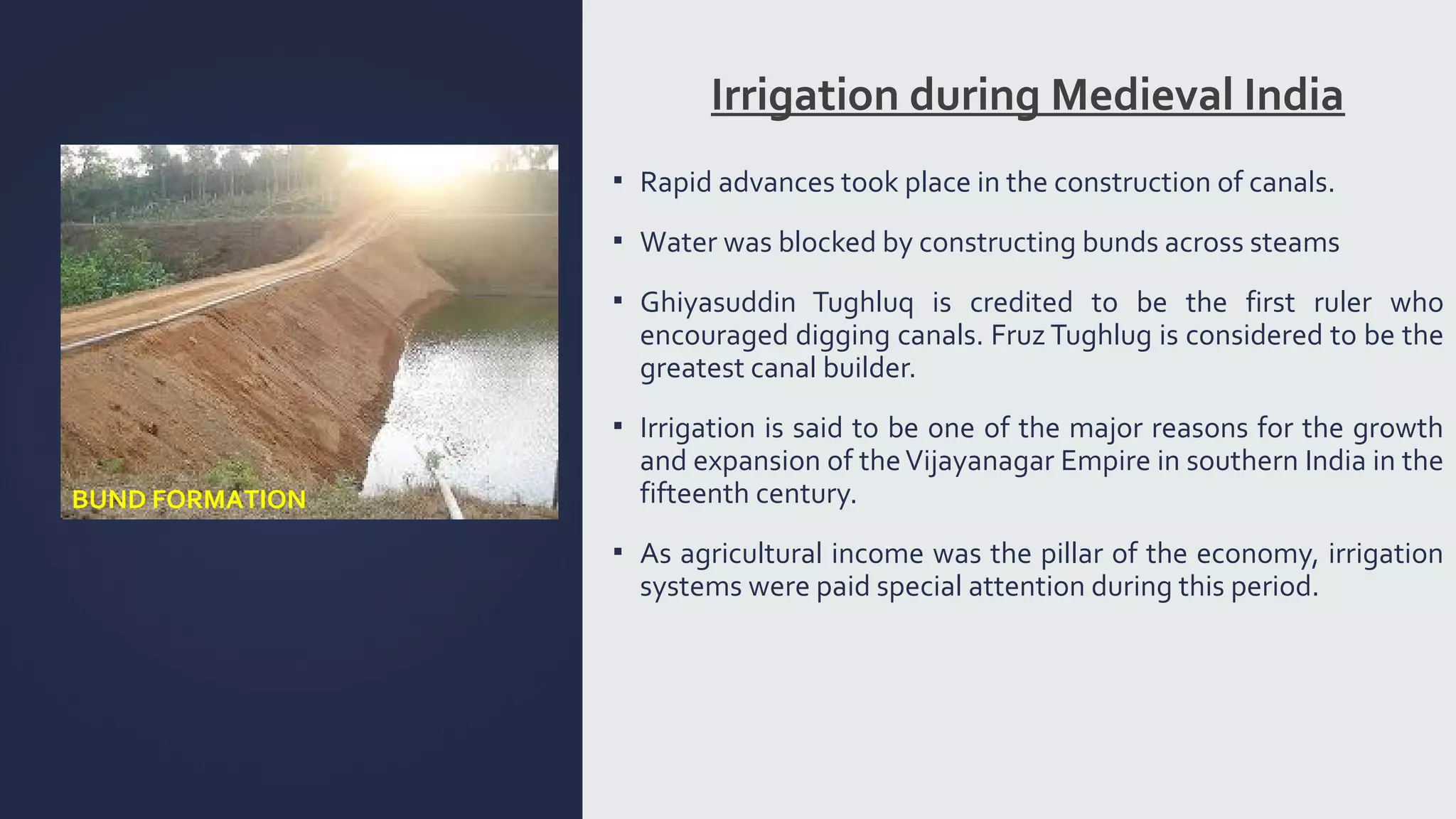
▪ Water was blocked by constructing bunds across steams 
▪ Ghiyasuddin Tughluq is credited to be the first ruler who 
encouraged digging canals. Fruz Tughlug is considered to be the 
greatest canal builder. 
▪ Irrigation is said to be one of the major reasons for the growth 
and expansion of the Vijayanagar Empire in southern India in the 
fifteenth century. 
▪ As agricultural income was the pillar of the economy, irrigation 
systems were paid special attention during this period. 
BUND FORMATION
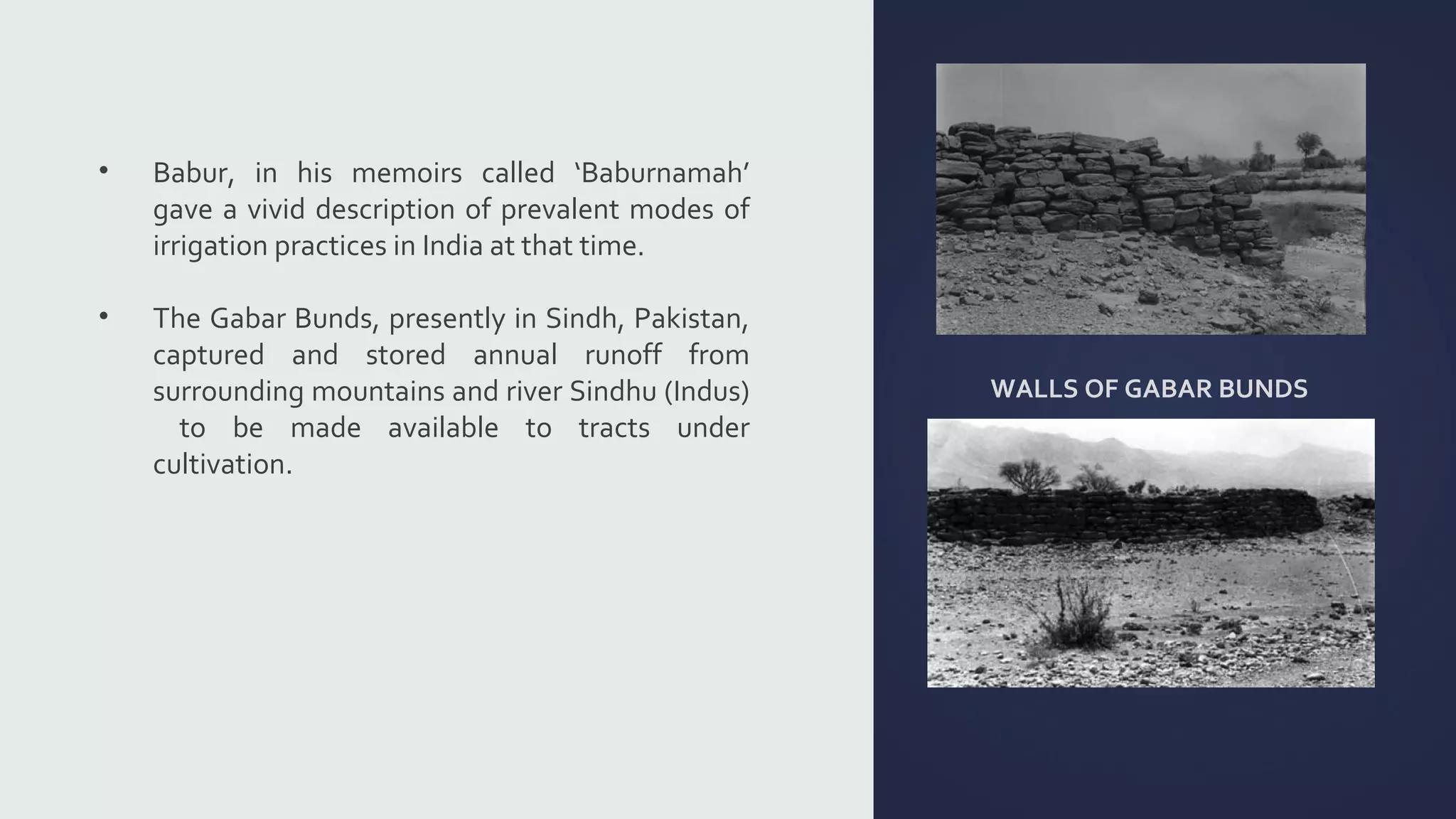
WALLS OF GABAR BUNDS 
• Babur, in his memoirs called ‘Baburnamah’ 
gave a vivid description of prevalent modes of 
irrigation practices in India at that time. 
• The Gabar Bunds, presently in Sindh, Pakistan, 
captured and stored annual runoff from 
surrounding mountains and river Sindhu (Indus) 
to be made available to tracts under 
cultivation.
Irrigation in British India 
 Renovation, improvement and 
extension of existing works. 
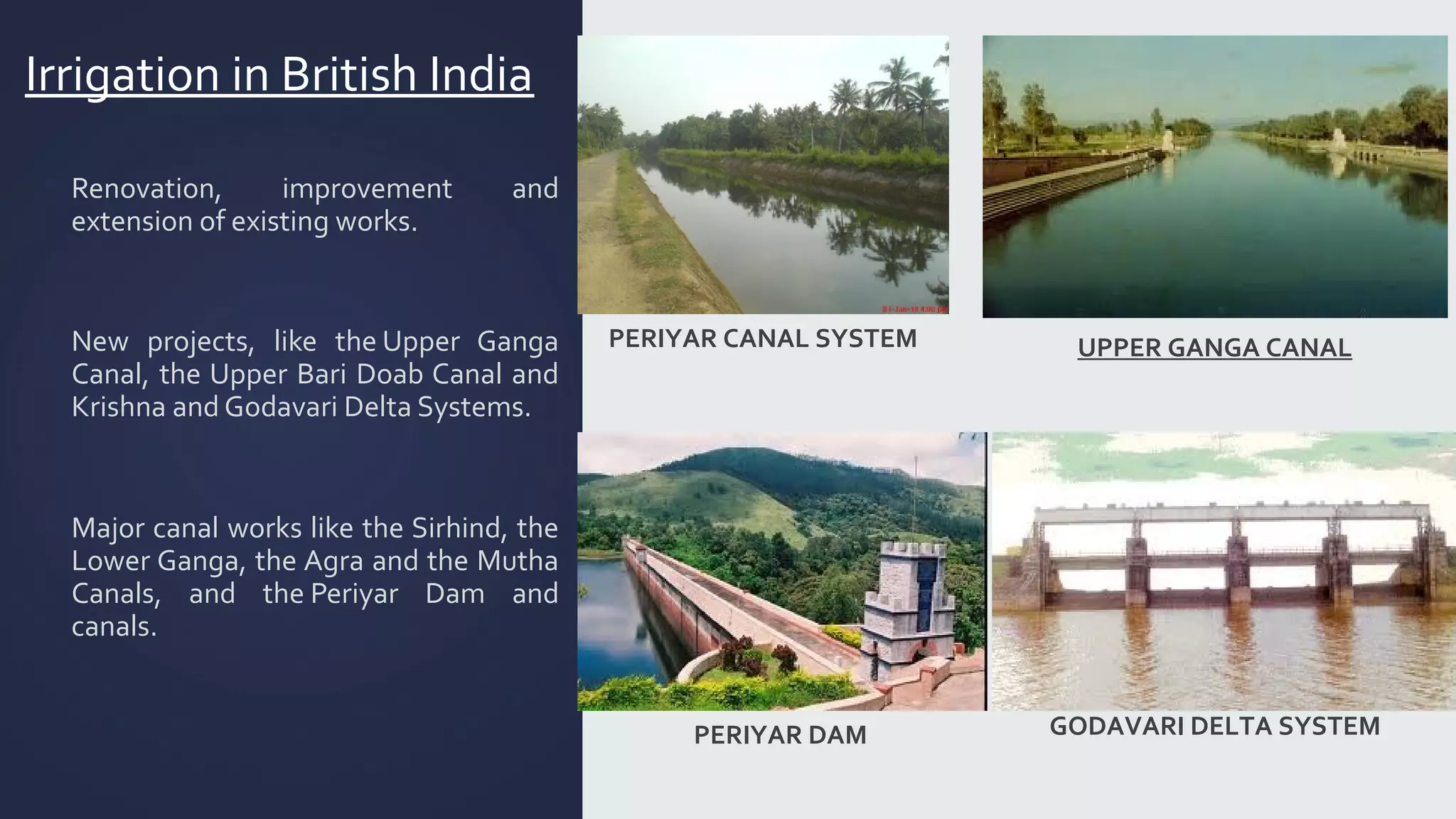
▪ New projects, like the Upper Ganga 
Canal, the Upper Bari Doab Canal and 
Krishna and Godavari Delta Systems. 
▪ Major canal works like the Sirhind, the 
Lower Ganga, the Agra and the Mutha 
Canals, and the Periyar Dam and 
canals. 
UPPER GANGA CANAL 
PERIYAR CANAL SYSTEM 
PERIYAR DAM GODAVARI DELTA SYSTEM
• During this period India witnessed 
few major famines of her entire life 
so better irrigation system became 
mandatory. 
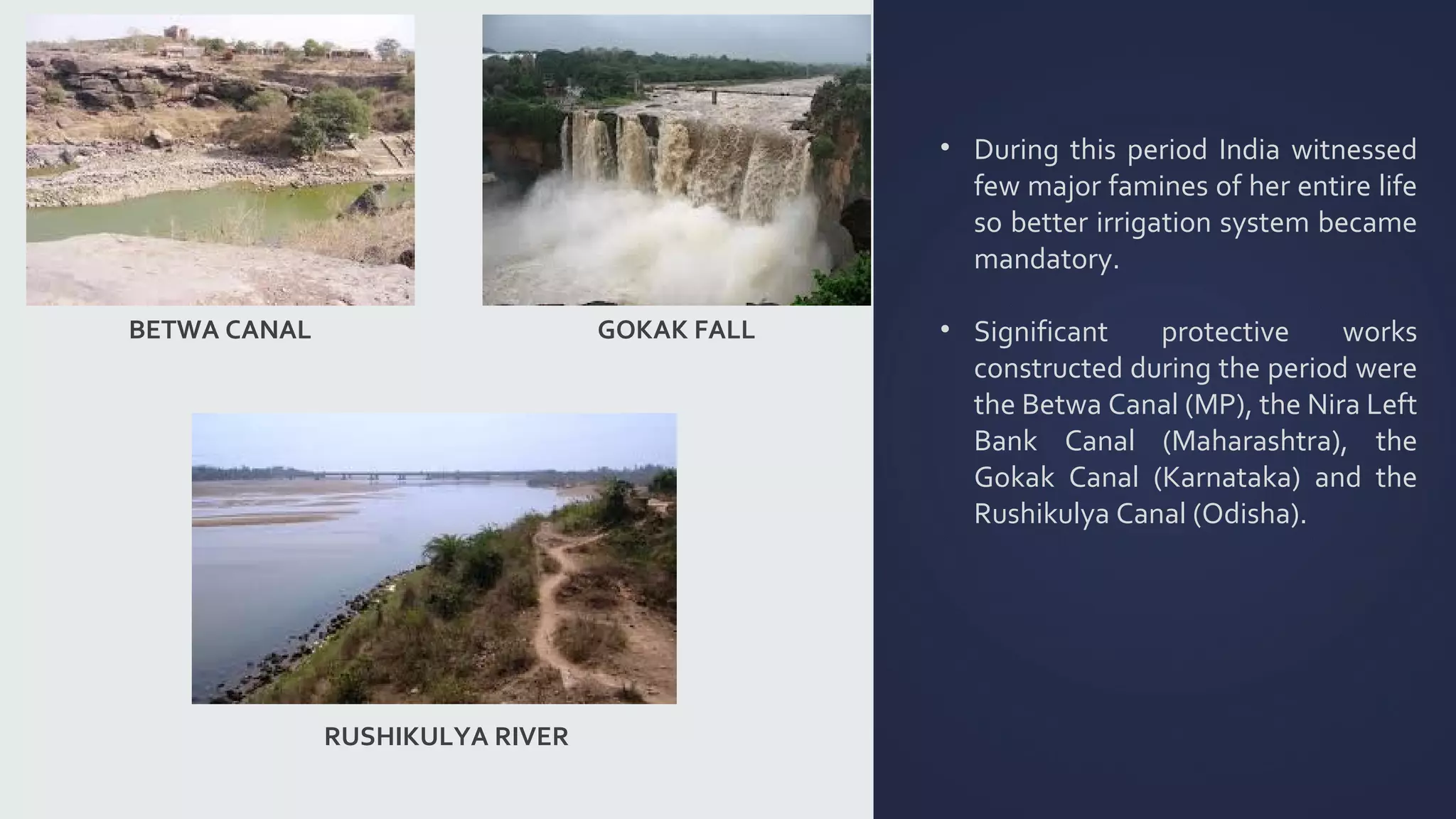
• Significant protective works 
constructed during the period were 
the Betwa Canal (MP), the Nira Left 
Bank Canal (Maharashtra), the 
Gokak Canal (Karnataka) and the 
Rushikulya Canal (Odisha). 
BETWA CANAL 
RUSHIKULYA RIVER 
GOKAK FALL
Irrigation development after Independence 
▪ To achieve set targets of economic development, the responsibility of 
irrigation development was given to the Union Ministry of Water Resources 
▪ It took initiatives from time to time on water resources development and for 
technical assistance to the states on irrigation, multipurpose projects, ground 
water exploration and exploitation, drainage, flood control, water logging, 
sea erosion problems, dam safety and hydraulic structures for navigation and 
hydropower 
▪ Also oversees the regulation and development of inter-State rivers
Irrigation development programs undertaken 
▪ Command Area Development & Water Management (CADWM): 
To provide central assistance for development of infrastructure to facilitate use 
of sprinkler / drip irrigation systems as an alternative to construction of field channels. 
The assistance is limited to construction of stilling tank, pump house and laying of 
conveyance pipes up to farmer’s fields. 
▪ Accelerated Irrigation Benefits Program (AIBP): 
The AIBP was conceived in the year 1996 by the Government of India in order to provide 
financial assistance to States to complete various ongoing projects in the country so 
that envisaged irrigation potential of the project could be created and thereby extend 
irrigation to more areas
Future possibilities of Irrigation Development 
▪ Technological Options (Drip Irrigation, sprinkler etc) - Micro-irrigation methods need to be 
adopted wherever possible. 
▪ Revival of Diverse and Community - Based Irrigation Systems 
▪ Inter basin transfer of water (Interlinking of Rivers) 
▪ Special measures needed to revitalize the tank irrigation 
▪ Gap between potential created and utilized needs to be reduced (Completion of Canal 
Networks) 
▪ Use of Sewage Water for Irrigation 
▪ Drainage Improvements 
▪ Scope for Improving Crop Yields 
▪ Options for Equitable and efficient water distribution need to be evolved. 
▪ Choosing appropriate cropping pattern for sustainable development
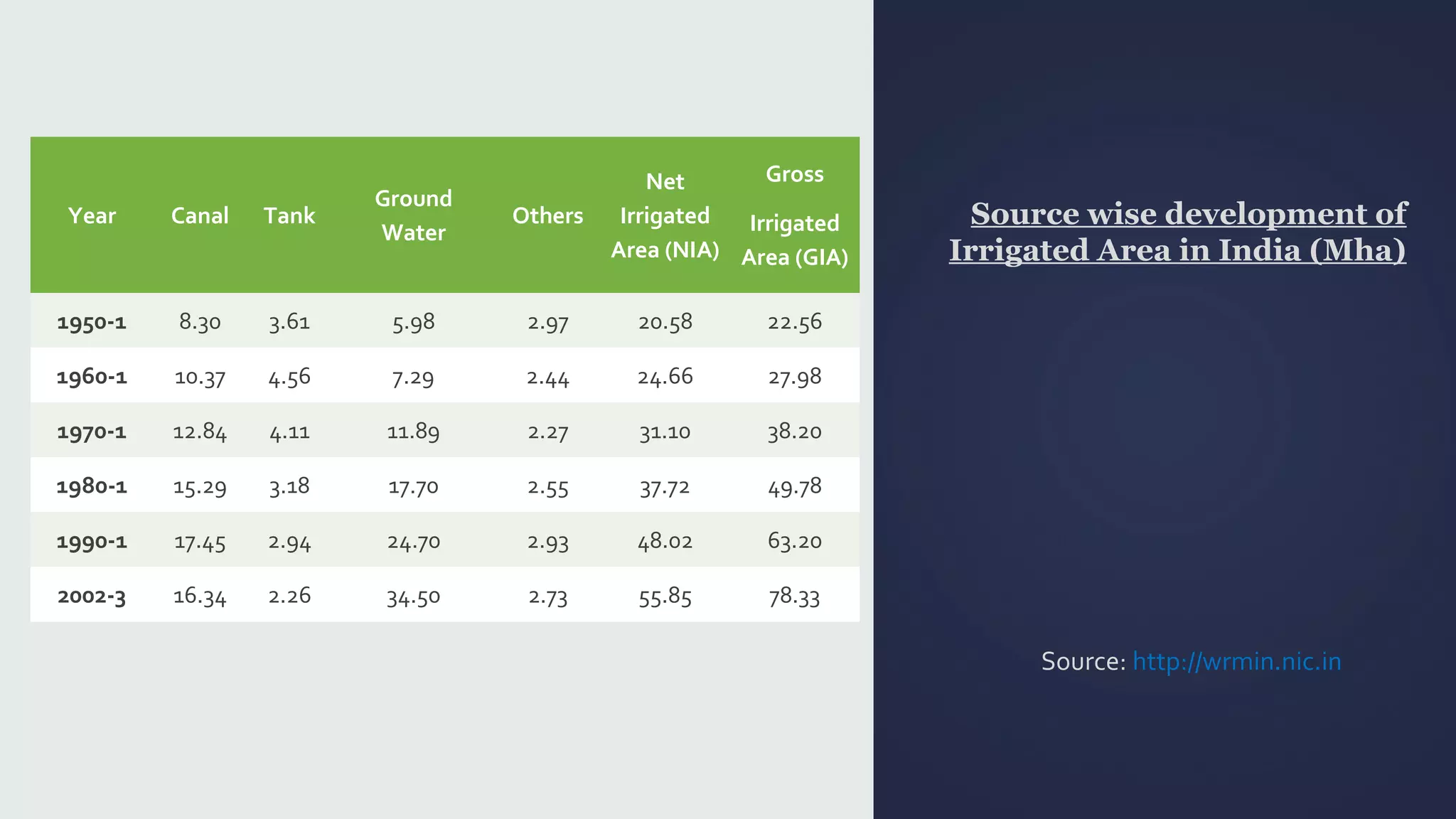
Source wise development of 
Irrigated Area in India (Mha) 
Source: http://wrmin.nic.in 
Year Canal Tank 
Ground 
Water 
Others 
Net 
Irrigated 
Area (NIA) 
Gross 
Irrigated 
Area (GIA) 
1950-1 8.30 3.61 5.98 2.97 20.58 22.56 
1960-1 10.37 4.56 7.29 2.44 24.66 27.98 
1970-1 12.84 4.11 11.89 2.27 31.10 38.20 
1980-1 15.29 3.18 17.70 2.55 37.72 49.78 
1990-1 17.45 2.94 24.70 2.93 48.02 63.20 
2002-3 16.34 2.26 34.50 2.73 55.85 78.33
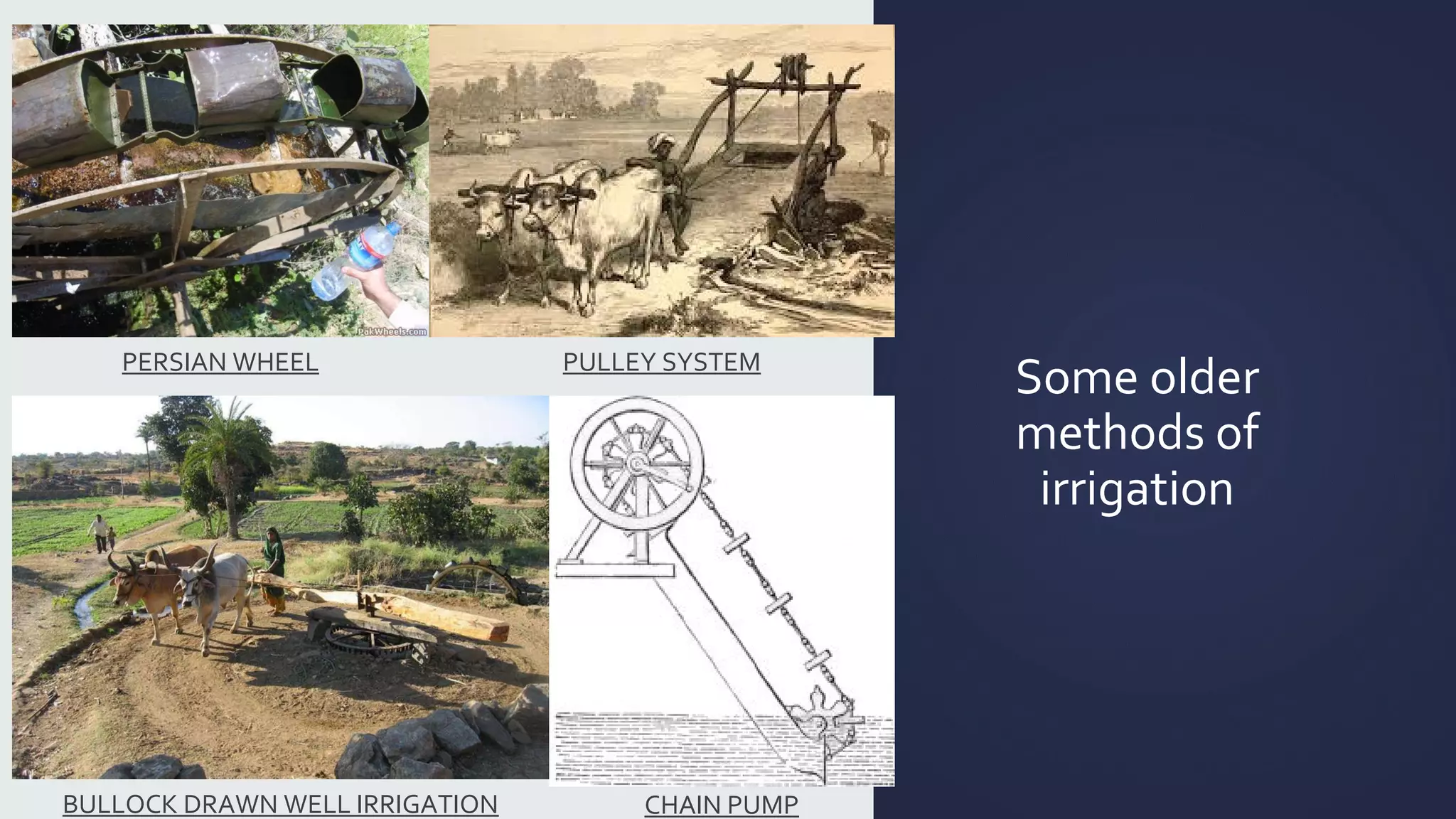
Some older 
methods of 
irrigation 
PERSIAN WHEEL PULLEY SYSTEM 
BULLOCK DRAWN WELL IRRIGATION CHAIN PUMP
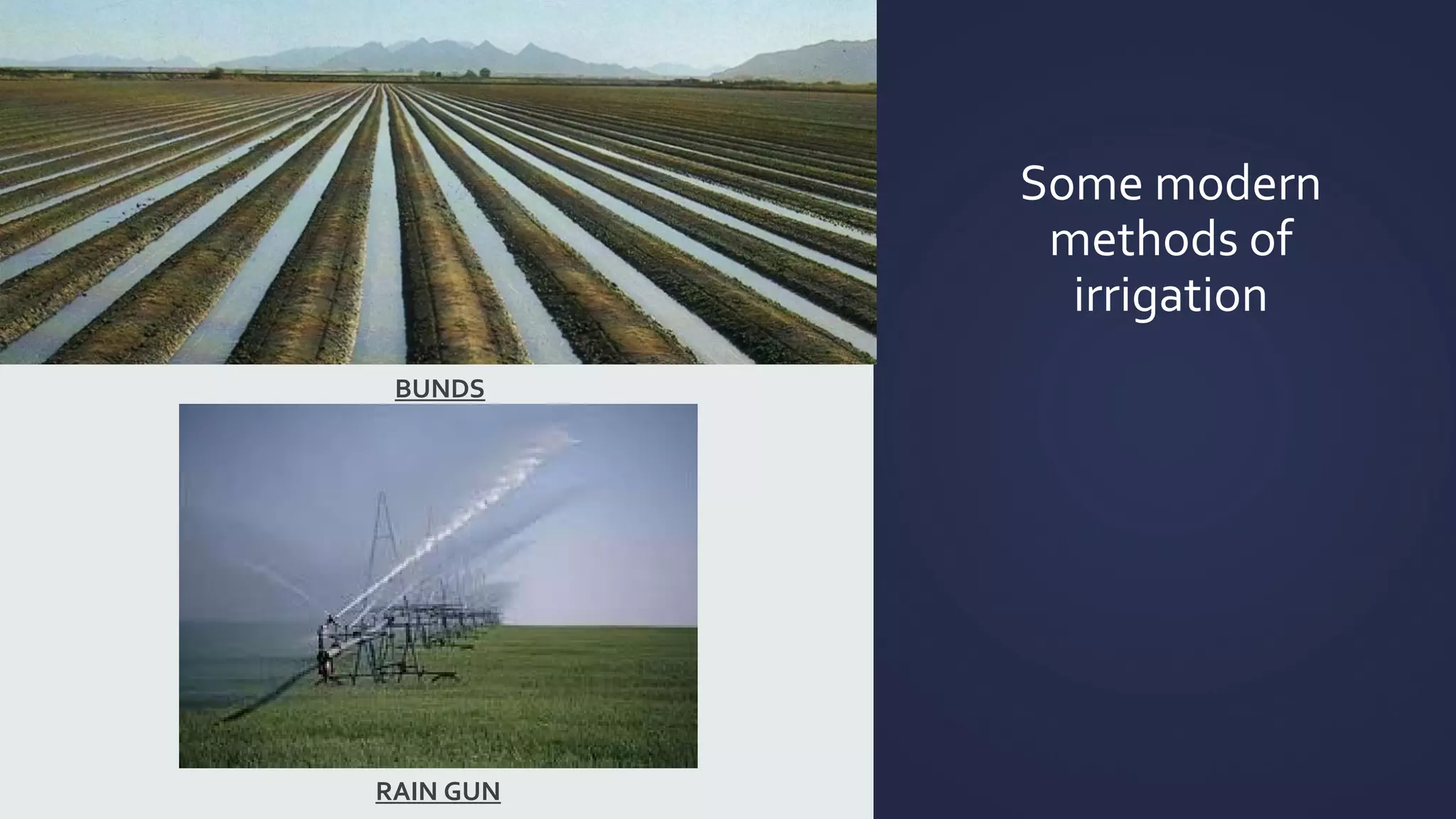
Some modern 
methods of 
irrigation 
BUNDS 
RAIN GUN
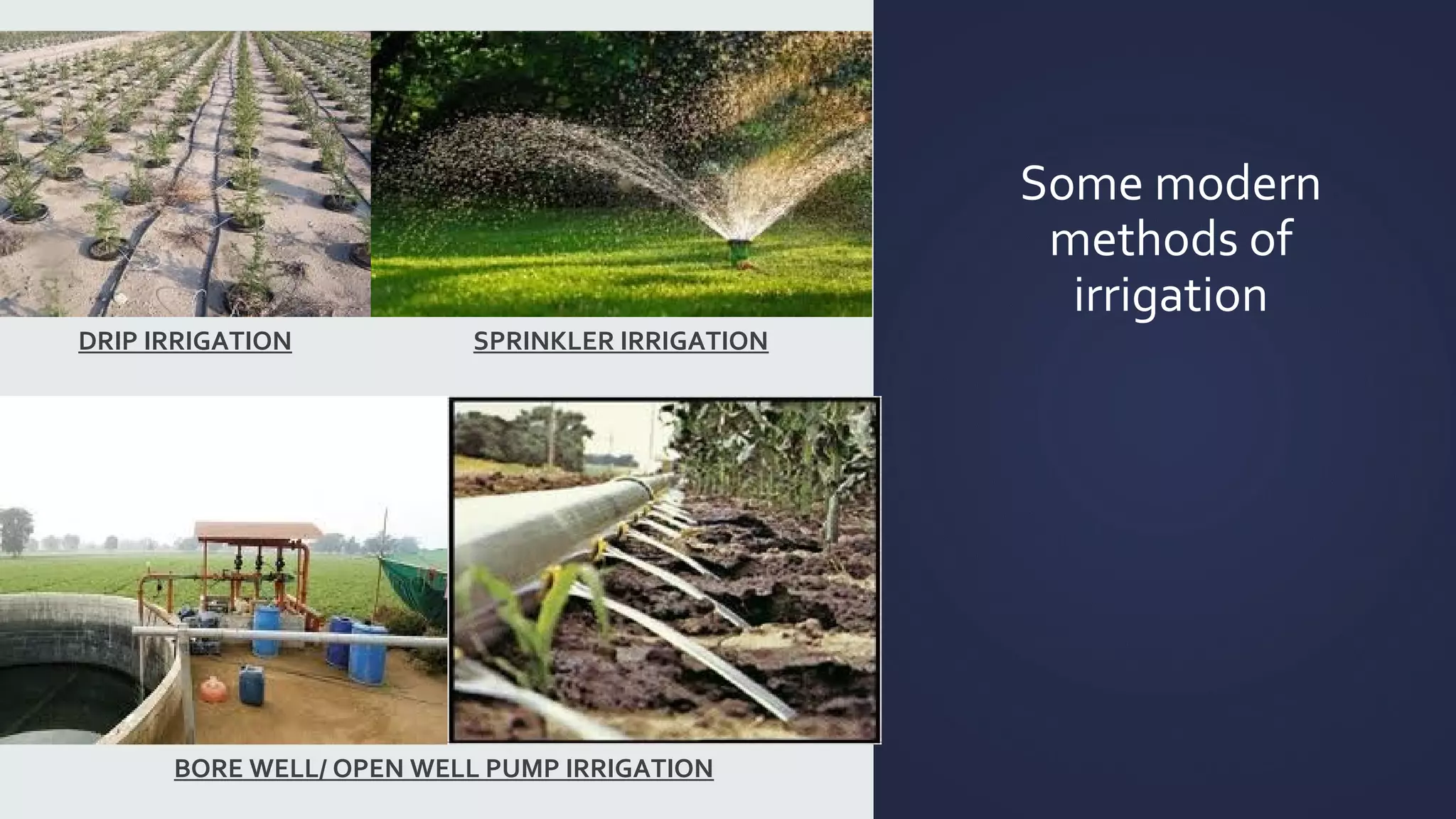
DRIP IRRIGATION SPRINKLER IRRIGATION 
BORE WELL/ OPEN WELL PUMP IRRIGATION 
Some modern 
methods of 
irrigation
THANK YOU

History and development of irrigation in india

  • 1.
    HISTORY AND DEVELOPMENTOF IRRIGATION IN INDIA
  • 2.
    IRRIGATION ▪ Irrigationis the artificial application of water to the soil usually for assisting in growing crops. ▪ Mainly used to replace missing rainfall in periods of drought. ▪ To supply essential moisture for plant growth, which includes transport of essential nutrients ▪ To leach or dilute salts in soil. ▪ Helps in cooling the soil and atmosphere to create more favourable environment for crop growth ▪ Supplements the supply of water received from precipitation and other types of atmospheric water, flood waters and ground water.
  • 3.
    History of Irrigationin India GRAND ANICUT IRRIGATION TANK • Vedas, Ancient Indian writers and ancient Indian scriptures have references of wells, canals, tanks and dams. • In the south, perennial irrigation had begun with construction of the Grand Anicut by the Cholas as early as second century to provide irrigation from the Cauvery River. • The central and southern India is studded with numerous irrigation tanks which have been traced back to many centuries before the beginning of the Christian era • Indus Civilization flourished on the banks of rivers and the water was harnessed for sustenance of life • Irrigation technologies during the Indus Valley Civilization were in the form of small and minor works like digging wells
  • 4.
    Irrigation during MedievalIndia ▪ Rapid advances took place in the construction of canals. ▪ Water was blocked by constructing bunds across steams ▪ Ghiyasuddin Tughluq is credited to be the first ruler who encouraged digging canals. Fruz Tughlug is considered to be the greatest canal builder. ▪ Irrigation is said to be one of the major reasons for the growth and expansion of the Vijayanagar Empire in southern India in the fifteenth century. ▪ As agricultural income was the pillar of the economy, irrigation systems were paid special attention during this period. BUND FORMATION
  • 5.
    WALLS OF GABARBUNDS • Babur, in his memoirs called ‘Baburnamah’ gave a vivid description of prevalent modes of irrigation practices in India at that time. • The Gabar Bunds, presently in Sindh, Pakistan, captured and stored annual runoff from surrounding mountains and river Sindhu (Indus) to be made available to tracts under cultivation.
  • 6.
    Irrigation in BritishIndia  Renovation, improvement and extension of existing works. ▪ New projects, like the Upper Ganga Canal, the Upper Bari Doab Canal and Krishna and Godavari Delta Systems. ▪ Major canal works like the Sirhind, the Lower Ganga, the Agra and the Mutha Canals, and the Periyar Dam and canals. UPPER GANGA CANAL PERIYAR CANAL SYSTEM PERIYAR DAM GODAVARI DELTA SYSTEM
  • 7.
    • During thisperiod India witnessed few major famines of her entire life so better irrigation system became mandatory. • Significant protective works constructed during the period were the Betwa Canal (MP), the Nira Left Bank Canal (Maharashtra), the Gokak Canal (Karnataka) and the Rushikulya Canal (Odisha). BETWA CANAL RUSHIKULYA RIVER GOKAK FALL
  • 8.
    Irrigation development afterIndependence ▪ To achieve set targets of economic development, the responsibility of irrigation development was given to the Union Ministry of Water Resources ▪ It took initiatives from time to time on water resources development and for technical assistance to the states on irrigation, multipurpose projects, ground water exploration and exploitation, drainage, flood control, water logging, sea erosion problems, dam safety and hydraulic structures for navigation and hydropower ▪ Also oversees the regulation and development of inter-State rivers
  • 9.
    Irrigation development programsundertaken ▪ Command Area Development & Water Management (CADWM): To provide central assistance for development of infrastructure to facilitate use of sprinkler / drip irrigation systems as an alternative to construction of field channels. The assistance is limited to construction of stilling tank, pump house and laying of conveyance pipes up to farmer’s fields. ▪ Accelerated Irrigation Benefits Program (AIBP): The AIBP was conceived in the year 1996 by the Government of India in order to provide financial assistance to States to complete various ongoing projects in the country so that envisaged irrigation potential of the project could be created and thereby extend irrigation to more areas
  • 10.
    Future possibilities ofIrrigation Development ▪ Technological Options (Drip Irrigation, sprinkler etc) - Micro-irrigation methods need to be adopted wherever possible. ▪ Revival of Diverse and Community - Based Irrigation Systems ▪ Inter basin transfer of water (Interlinking of Rivers) ▪ Special measures needed to revitalize the tank irrigation ▪ Gap between potential created and utilized needs to be reduced (Completion of Canal Networks) ▪ Use of Sewage Water for Irrigation ▪ Drainage Improvements ▪ Scope for Improving Crop Yields ▪ Options for Equitable and efficient water distribution need to be evolved. ▪ Choosing appropriate cropping pattern for sustainable development
  • 11.
    Source wise developmentof Irrigated Area in India (Mha) Source: http://wrmin.nic.in Year Canal Tank Ground Water Others Net Irrigated Area (NIA) Gross Irrigated Area (GIA) 1950-1 8.30 3.61 5.98 2.97 20.58 22.56 1960-1 10.37 4.56 7.29 2.44 24.66 27.98 1970-1 12.84 4.11 11.89 2.27 31.10 38.20 1980-1 15.29 3.18 17.70 2.55 37.72 49.78 1990-1 17.45 2.94 24.70 2.93 48.02 63.20 2002-3 16.34 2.26 34.50 2.73 55.85 78.33
  • 12.
    Some older methodsof irrigation PERSIAN WHEEL PULLEY SYSTEM BULLOCK DRAWN WELL IRRIGATION CHAIN PUMP
  • 13.
    Some modern methodsof irrigation BUNDS RAIN GUN
  • 14.
    DRIP IRRIGATION SPRINKLERIRRIGATION BORE WELL/ OPEN WELL PUMP IRRIGATION Some modern methods of irrigation
  • 15.