Click here to add text 
Click here to add text. Click here to add text. 
Click here to add text. Click here to add text.
Place logo 
or logotype here, 
otherwise 
delete this. 
WHY WE NEED TO CONTROL 
NEMATODES IN NURSERY 
LEVEL? 
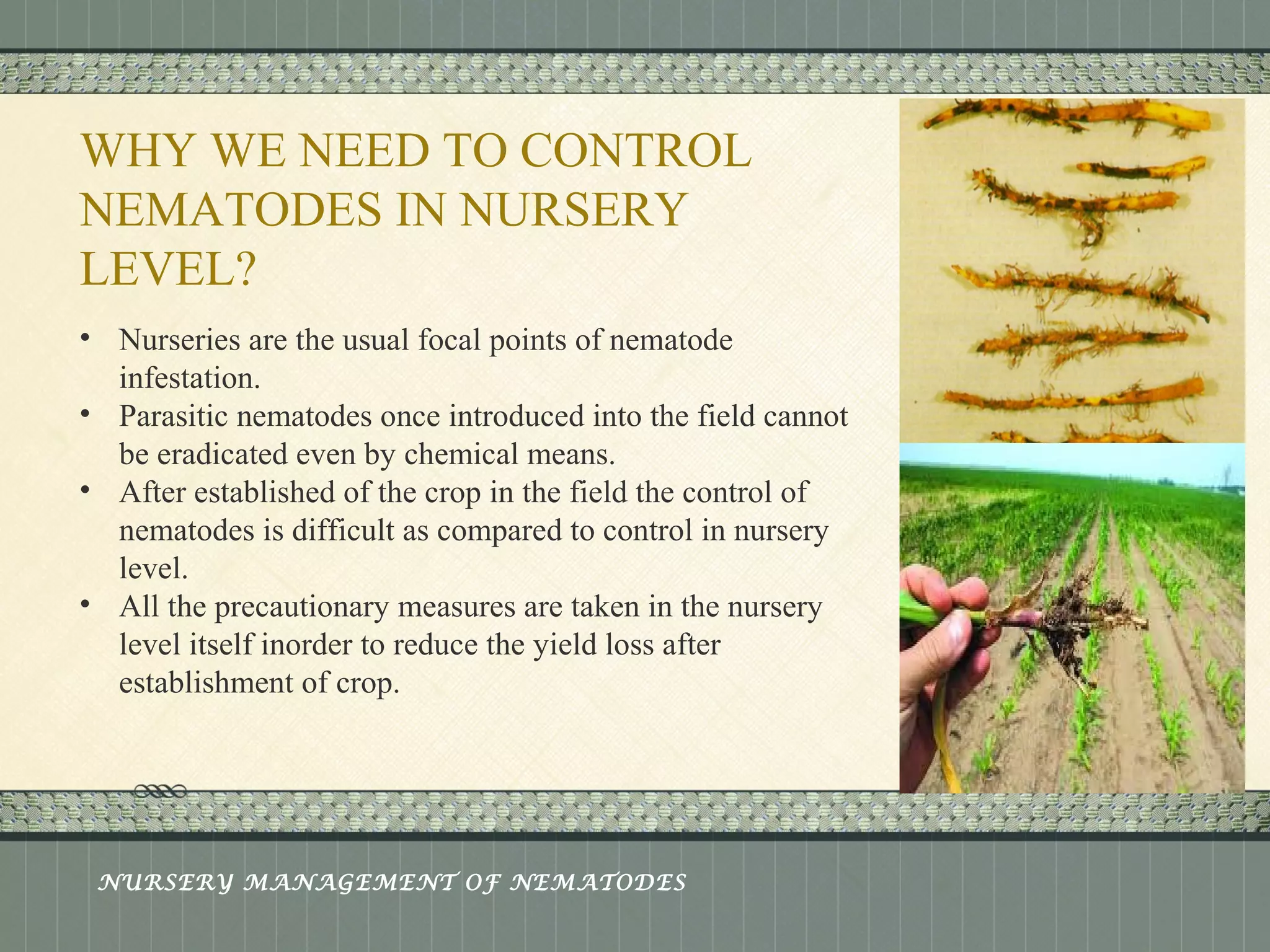
• Nurseries are the usual focal points of nematode 
infestation. 
• Parasitic nematodes once introduced into the field cannot 
be eradicated even by chemical means. 
• After established of the crop in the field the control of 
nematodes is difficult as compared to control in nursery 
level. 
• All the precautionary measures are taken in the nursery 
level itself inorder to reduce the yield loss after 
establishment of crop. 
NURSERY MANAGEMENT OF NEMATODES
Place logo 
or logotype here, 
otherwise 
delete this. 
IMPORTANT NEMATODES WHICH 
INFEST NURSERY ARE? 
• ROOT KNOT(Meloidogyne spp) 
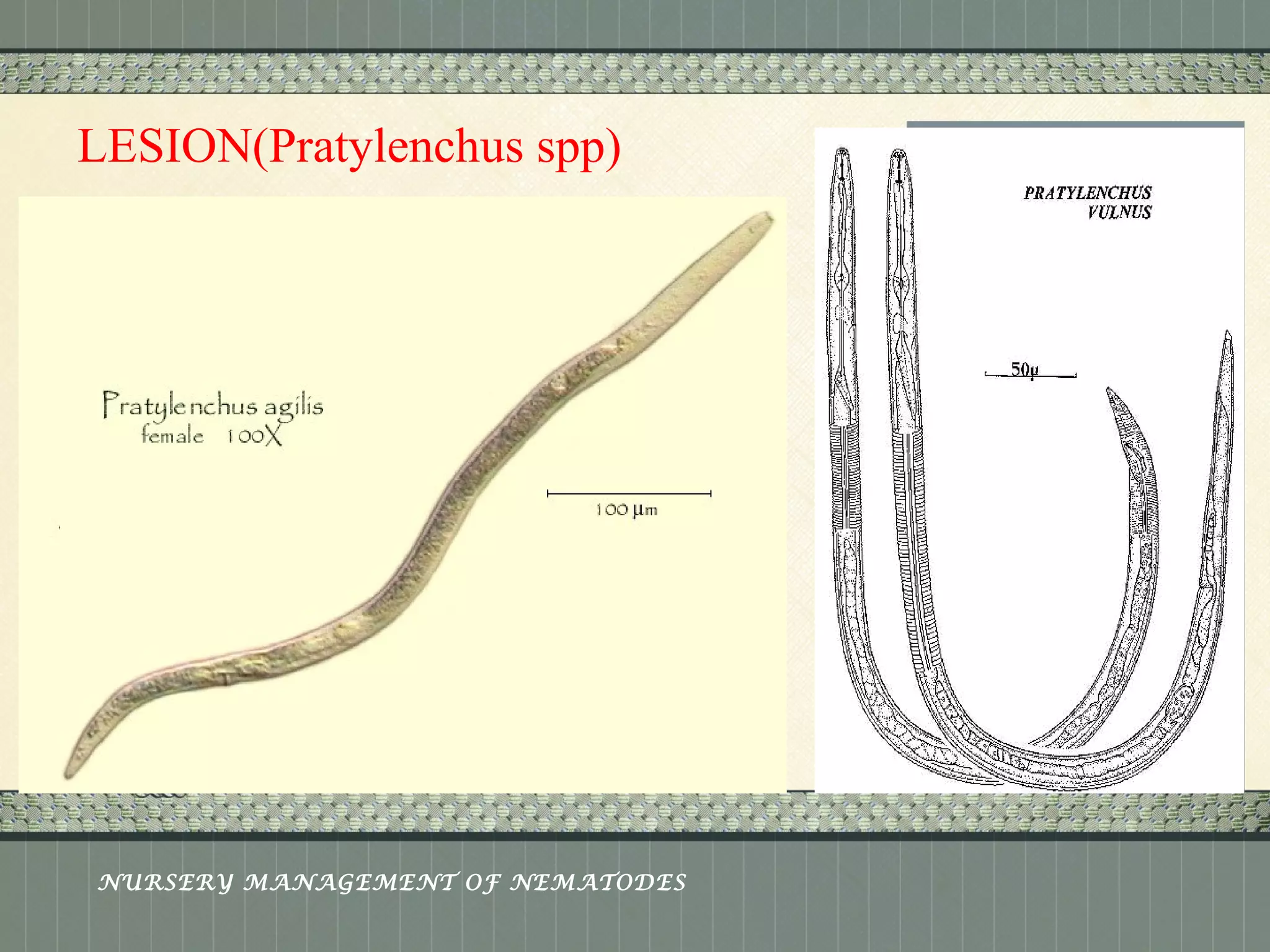
• LESION(Pratylenchus spp) 
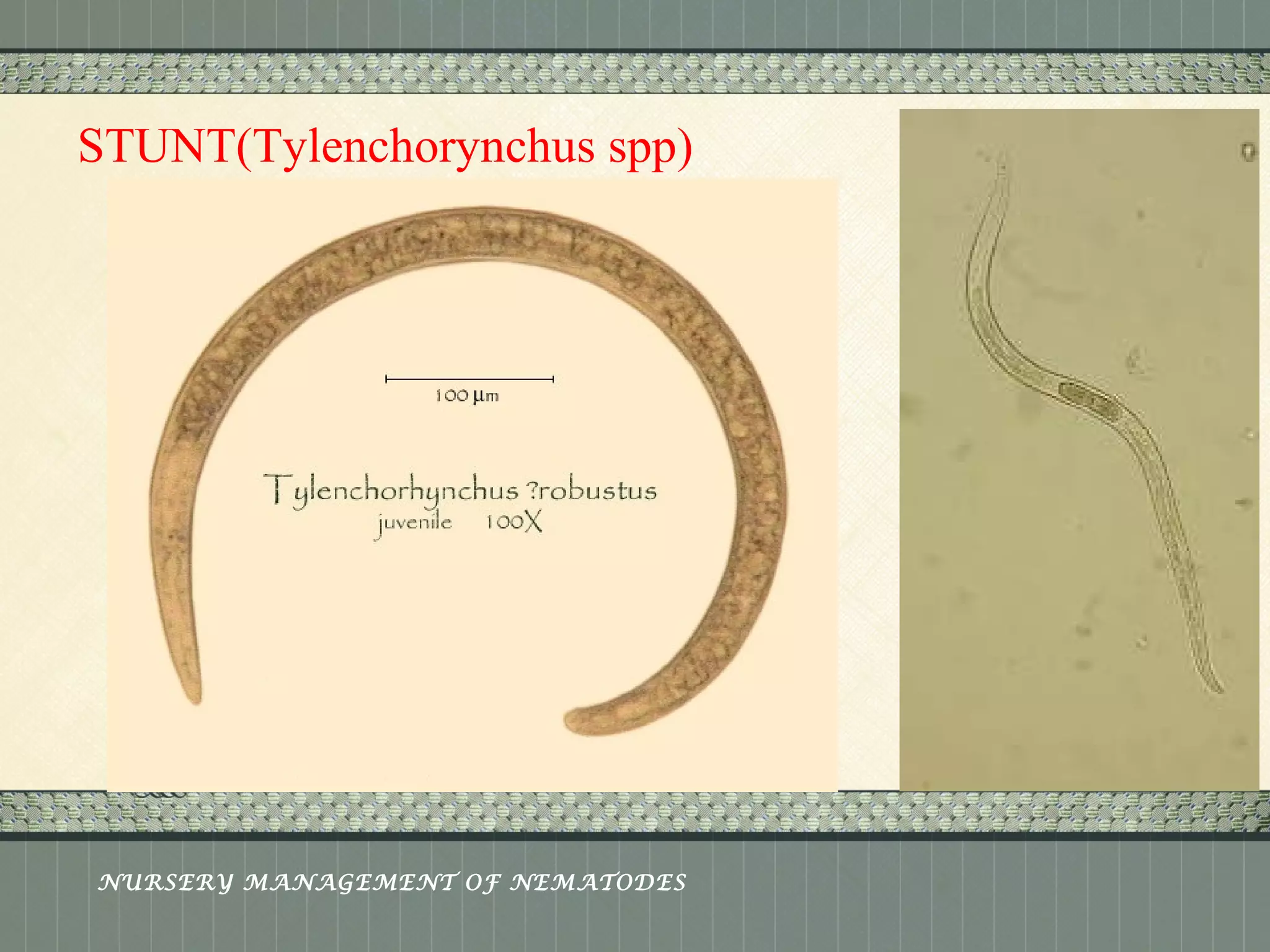
• STUNT(Tylenchorynchus spp) 
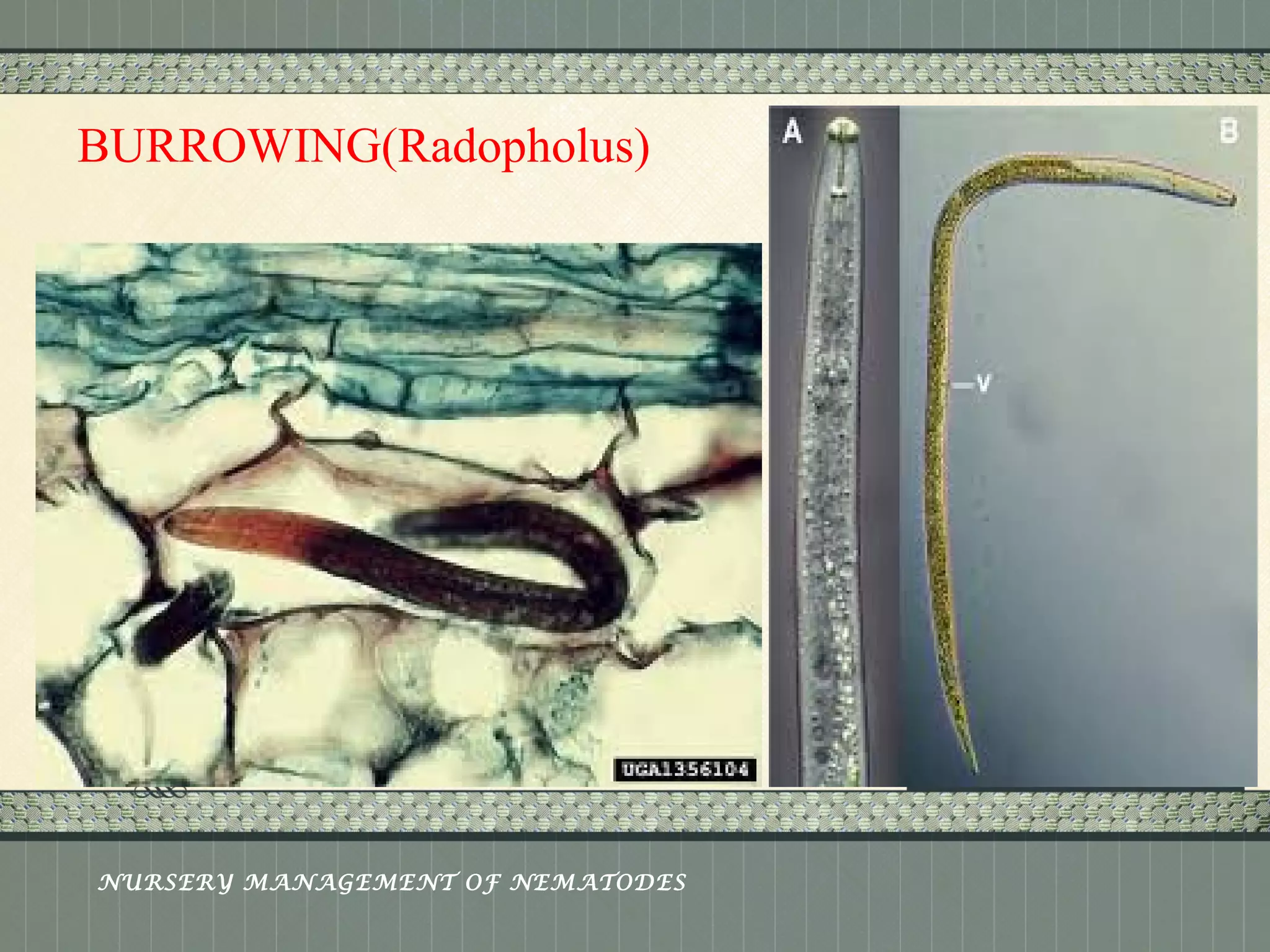
• BURROWING(Radopholus) 
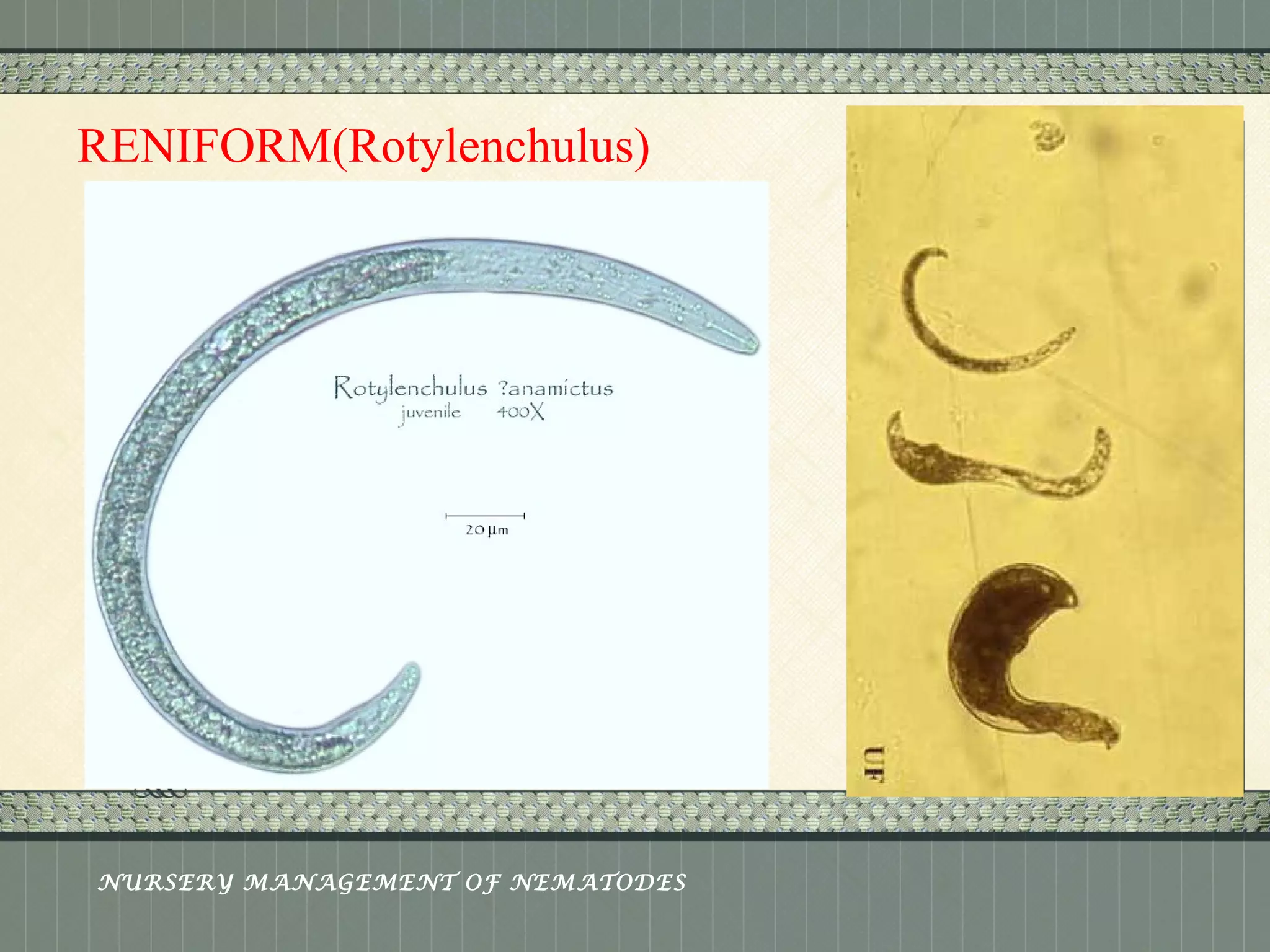
• RENIFORM(Rotylenchulus) 
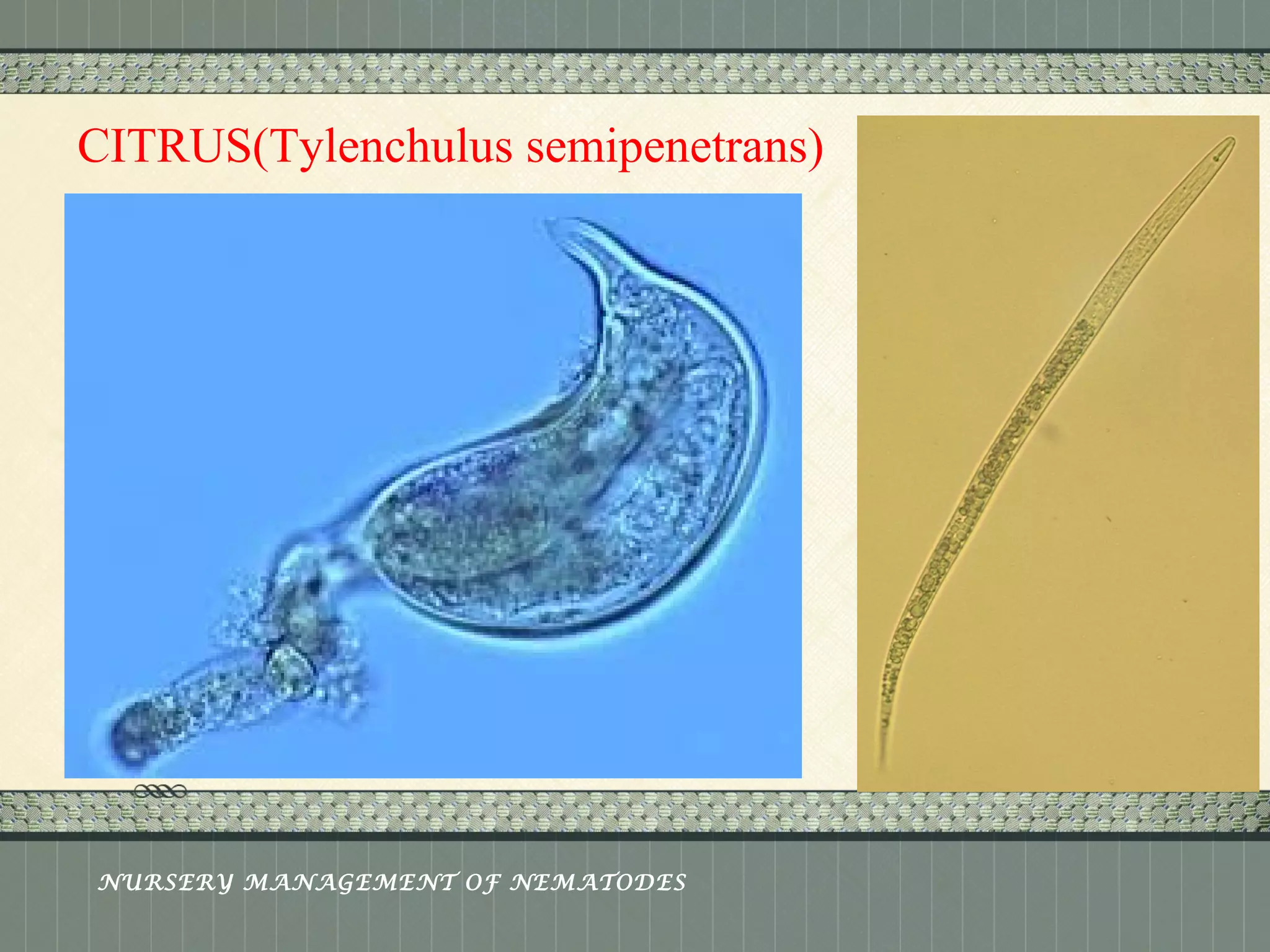
• CITRUS(Tylenchulus semipenetrans) 
NURSERY MANAGEMENT OF NEMATODES
Place logo 
or logotype here, 
otherwise 
delete this. 
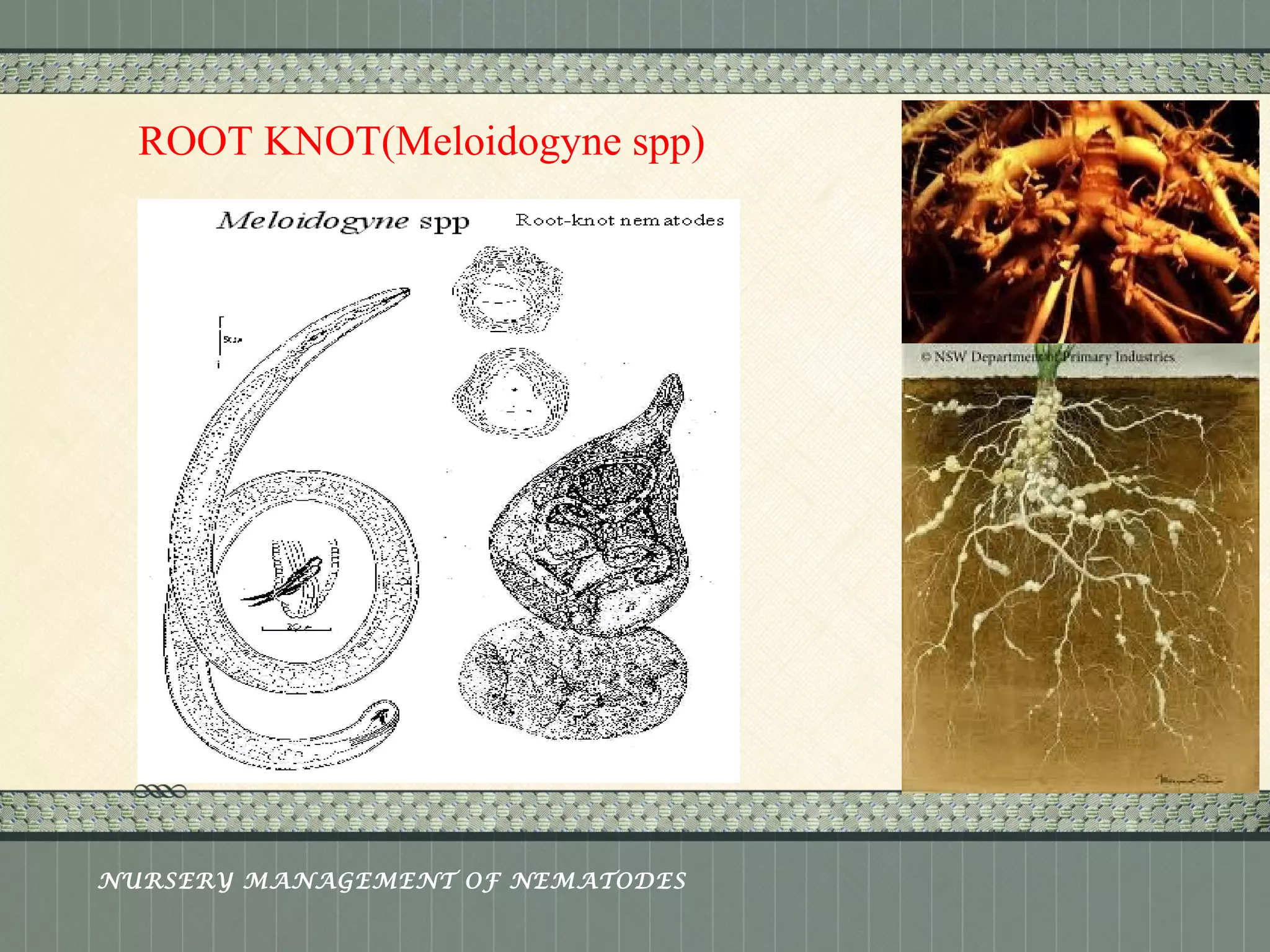
ROOT KNOT(Meloidogyne spp) 
NURSERY MANAGEMENT OF NEMATODES
Place logo 
or logotype here, 
otherwise 
delete this. 
LESION(Pratylenchus spp) 
NURSERY MANAGEMENT OF NEMATODES
Place logo 
or logotype here, 
otherwise 
delete this. 
STUNT(Tylenchorynchus spp) 
NURSERY MANAGEMENT OF NEMATODES
Place logo 
or logotype here, 
otherwise 
delete this. 
BURROWING(Radopholus) 
NURSERY MANAGEMENT OF NEMATODES
Place logo 
or logotype here, 
otherwise 
delete this. 
RENIFORM(Rotylenchulus) 
NURSERY MANAGEMENT OF NEMATODES
Place logo 
or logotype here, 
otherwise 
delete this. 
CITRUS(Tylenchulus semipenetrans) 
NURSERY MANAGEMENT OF NEMATODES
Place logo 
or logotype here, 
otherwise 
delete this. 
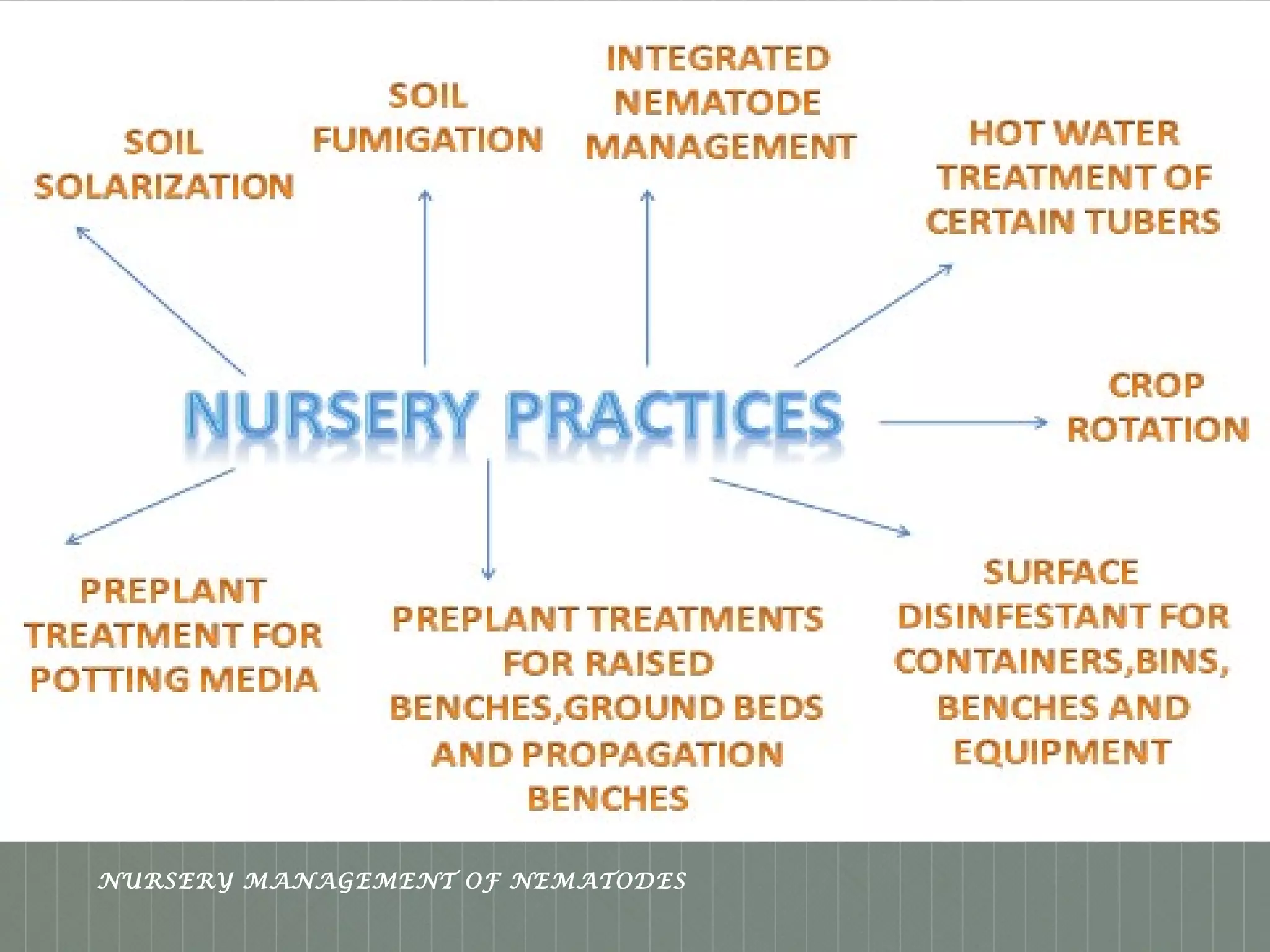
NURSERY MANAGEMENT OF NEMATODES
Place logo 
or logotype here, 
otherwise 
delete this. 
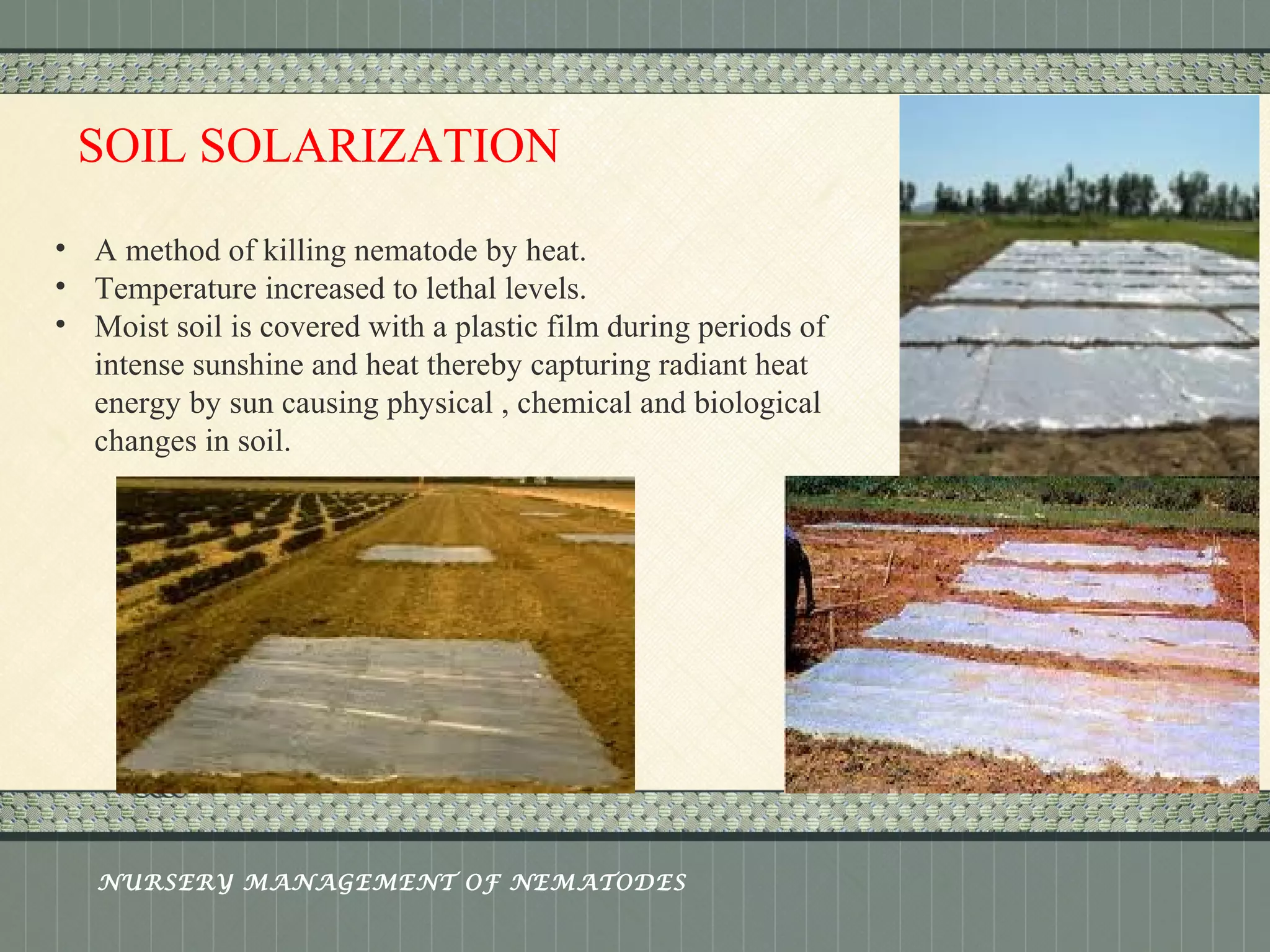
SOIL SOLARIZATION 
• A method of killing nematode by heat. 
• Temperature increased to lethal levels. 
• Moist soil is covered with a plastic film during periods of 
intense sunshine and heat thereby capturing radiant heat 
energy by sun causing physical , chemical and biological 
changes in soil. 
NURSERY MANAGEMENT OF NEMATODES
Place logo 
or logotype here, 
otherwise 
delete this. 
Success stories in different crops… 
• Trapping heat with LLDPE 100 gauge film during summer for 
15 days in tomato nursery gave 66% of reduction of root knot 
nematode(AAU,Gujarat) 
• Use of 400 gauge LDPE for 40-45 days is ideal for pre-sowing 
treatment for controlling nematodes in cardamom nurseries. 
• White PE mulching for 15 days on beds in betelvine reduced 
nematode population.(Shivakumar and marimuthu,1987) 
• TTPE mulches for 6 weeks caused 72.6 &88.5% decrease in 
population densities of Tylenchorynchus vulgaris and 
Hoplolaimus indicus respectively. 
• Application of mahua cake before solarisation causes reduction 
in nematode population.(Kamra and Gaur,1998) 
NURSERY MANAGEMENT OF NEMATODES
Place logo 
or logotype here, 
otherwise 
delete this. 
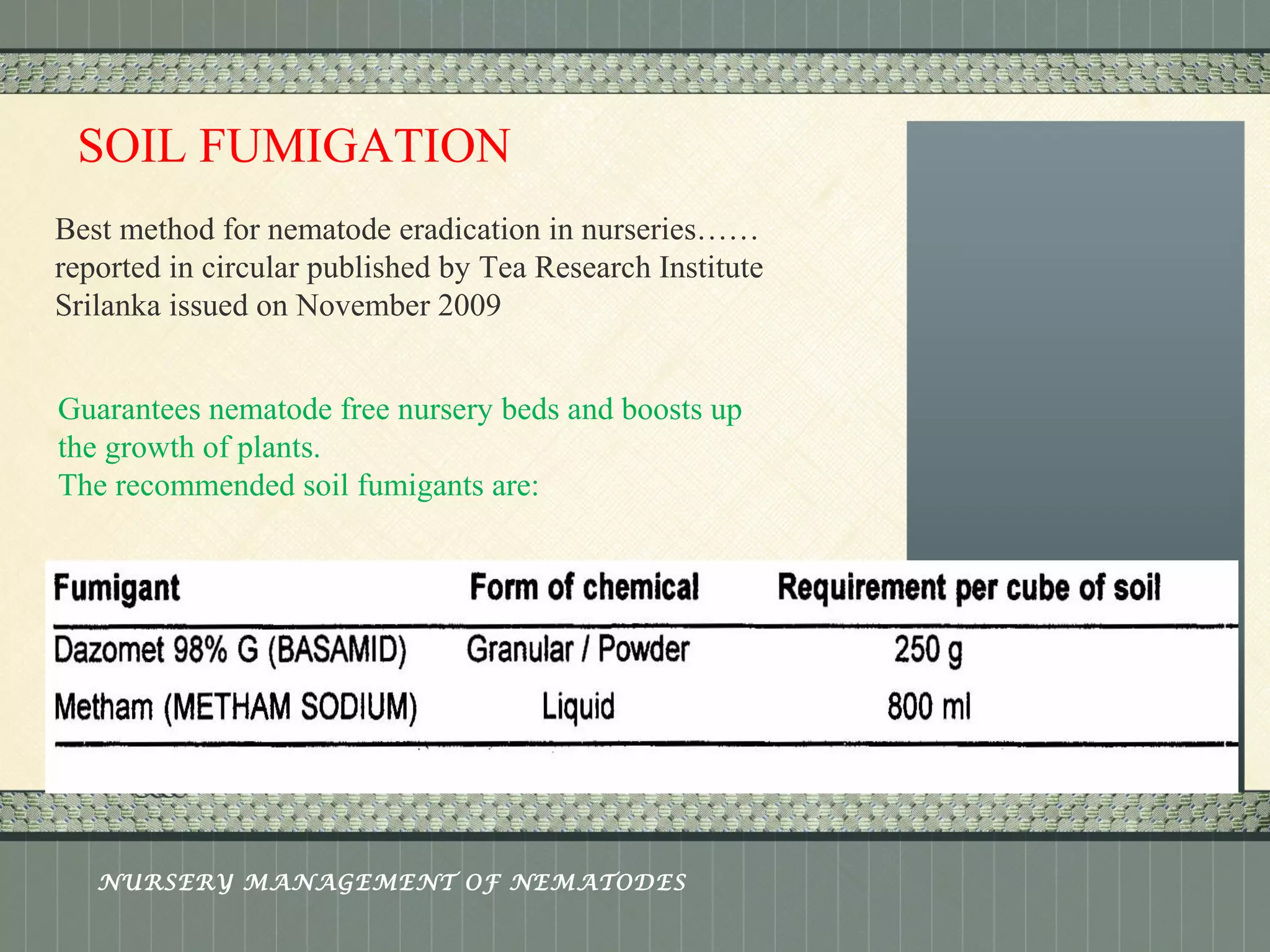
SOIL FUMIGATION 
Best method for nematode eradication in nurseries…… 
reported in circular published by Tea Research Institute 
Srilanka issued on November 2009 
Guarantees nematode free nursery beds and boosts up 
the growth of plants. 
The recommended soil fumigants are: 
NURSERY MANAGEMENT OF NEMATODES
Place logo 
or logotype here, 
otherwise 
delete this. 
…contd… 
• The chemical granule in contact with soil moisture is 
transformed into active compounds mainly methyl 
isothiocyanate which are light in weight and volatile in 
nature. 
• The MITC fumes produced penetrates inside soil 
destroying active soil organisms. 
• Exposure for one week to these fumes completely 
eradicates the nematodes. 
NURSERY MANAGEMENT OF NEMATODES
Place logo 
or logotype here, 
otherwise 
delete this. 
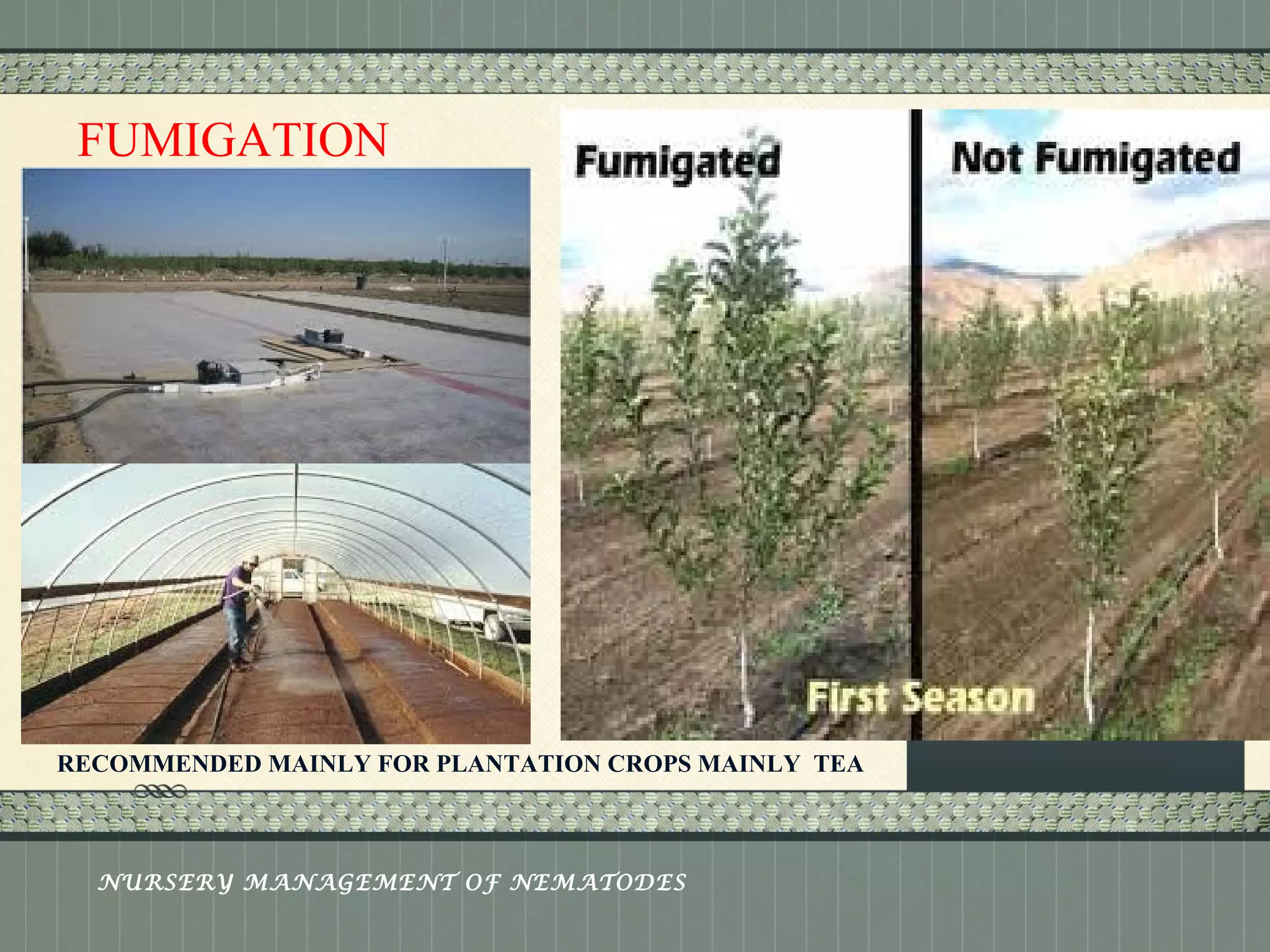
FUMIGATION 
RECOMMENDED MAINLY FOR PLANTATION CROPS MAINLY TEA 
NURSERY MANAGEMENT OF NEMATODES
Place logo 
or logotype here, 
otherwise 
delete this. 
INTEGRATED NEMATODE MANAGEMENT 
• Integrated program of preventive measures ,sanitation and 
nematicides help to reduce losses and injury due to 
nematodes. 
• Sanitation and preventive maintenance include 
• Plant in pest and pathogen free soils. 
• Disinfest all plant containers ,bins ,benches and 
equipments. 
• Restrict transfer of material from infested to uninfested 
areas. 
• Wash hands and disinfest tools regularly. 
• Use nematode free propagating stock. 
• Use raised benches. 
• For greenhouse sanitation reduce the level of wind blown 
soil into the structure. 
NURSERY MANAGEMENT OF NEMATODES
Place logo 
or logotype here, 
otherwise 
delete this. 
…contd… 
• In case of chemicals used ;chlorfenapyr is an active 
ingredient in the nematicide pylon against foliar 
nematodes(Aphelenchoide spp). 
• INM mainly practiced in case of ornamentals and planting 
stock of fruits and nutS (William .T .Crow and 
Robert.A.Dunn,University Of Florida) 
NURSERY MANAGEMENT OF NEMATODES
Place logo 
or logotype here, 
otherwise 
delete this. 
…contd… 
• Preplant treatments of potting media,raised 
benches,ground beds and propagation benches is done by 
application of recommended doses of : 
• Aerated steam 
• Live steam 
• Chloropicrin 
• Methyl bromide 
• Metham-sodium 
• Dazomet 
• Sodium hypochlorite(1 part common bleach in 5 parts of 
water) is used as surface disinfestant for containers ,bins 
and equipments used in nurseries. 
• Hot water at 122 degrees F is used for controlling 
nematodes in caladium tubers. 
NURSERY MANAGEMENT OF NEMATODES
Place logo 
or logotype here, 
otherwise 
delete this. 
In forest nurseries…. 
• Providing alternate host during crop rotation or growing 
same host continuously leads to surface more nematode 
damage . 
• In forest nurseries needle and stunt nematodes causes 
damage to pine seedlings where white oak and cowpea 
was the alternate host respectively. 
• The recent studies proved that several varieties of 
sorghum ,rye and legumes which were used as cover crops 
are good hosts for stunt nematode. 
• Nematodes doesn’t survive in soil for an extended period 
without a suitable host . 
• So use of fallow or alternating hosts with non-hosts can be 
effective against nematodes. 
NURSERY MANAGEMENT OF NEMATODES
Place logo 
or logotype here, 
otherwise 
delete this. 
In Agronomic crops….and 
vegetables…. 
• The practices followed are 
• Soil solarization 
• Crop rotation 
• Nursery treatment with recommended dose of carbofuran 
in cereals. 
• Use of nematode resistant varieties of seeds. 
• Add compost,rotted manure and leaves to soil inorder to 
increase soil fertility and reduces incidence of nematode 
infestation. 
• Use of material that contain chitin which increases the 
population of microorganisms that kill nematodes. 
NURSERY MANAGEMENT OF NEMATODES
Place logo 
or logotype here, 
otherwise 
delete this. 
NURSERY MANAGEMENT OF NEMATODES

Nursery management of nematodes

  • 1.
    Click here toadd text Click here to add text. Click here to add text. Click here to add text. Click here to add text. Click here to add text. Click here to add text.
  • 2.
    Place logo orlogotype here, otherwise delete this. WHY WE NEED TO CONTROL NEMATODES IN NURSERY LEVEL? • Nurseries are the usual focal points of nematode infestation. • Parasitic nematodes once introduced into the field cannot be eradicated even by chemical means. • After established of the crop in the field the control of nematodes is difficult as compared to control in nursery level. • All the precautionary measures are taken in the nursery level itself inorder to reduce the yield loss after establishment of crop. NURSERY MANAGEMENT OF NEMATODES
  • 3.
    Place logo orlogotype here, otherwise delete this. IMPORTANT NEMATODES WHICH INFEST NURSERY ARE? • ROOT KNOT(Meloidogyne spp) • LESION(Pratylenchus spp) • STUNT(Tylenchorynchus spp) • BURROWING(Radopholus) • RENIFORM(Rotylenchulus) • CITRUS(Tylenchulus semipenetrans) NURSERY MANAGEMENT OF NEMATODES
  • 4.
    Place logo orlogotype here, otherwise delete this. ROOT KNOT(Meloidogyne spp) NURSERY MANAGEMENT OF NEMATODES
  • 5.
    Place logo orlogotype here, otherwise delete this. LESION(Pratylenchus spp) NURSERY MANAGEMENT OF NEMATODES
  • 6.
    Place logo orlogotype here, otherwise delete this. STUNT(Tylenchorynchus spp) NURSERY MANAGEMENT OF NEMATODES
  • 7.
    Place logo orlogotype here, otherwise delete this. BURROWING(Radopholus) NURSERY MANAGEMENT OF NEMATODES
  • 8.
    Place logo orlogotype here, otherwise delete this. RENIFORM(Rotylenchulus) NURSERY MANAGEMENT OF NEMATODES
  • 9.
    Place logo orlogotype here, otherwise delete this. CITRUS(Tylenchulus semipenetrans) NURSERY MANAGEMENT OF NEMATODES
  • 10.
    Place logo orlogotype here, otherwise delete this. NURSERY MANAGEMENT OF NEMATODES
  • 11.
    Place logo orlogotype here, otherwise delete this. SOIL SOLARIZATION • A method of killing nematode by heat. • Temperature increased to lethal levels. • Moist soil is covered with a plastic film during periods of intense sunshine and heat thereby capturing radiant heat energy by sun causing physical , chemical and biological changes in soil. NURSERY MANAGEMENT OF NEMATODES
  • 12.
    Place logo orlogotype here, otherwise delete this. Success stories in different crops… • Trapping heat with LLDPE 100 gauge film during summer for 15 days in tomato nursery gave 66% of reduction of root knot nematode(AAU,Gujarat) • Use of 400 gauge LDPE for 40-45 days is ideal for pre-sowing treatment for controlling nematodes in cardamom nurseries. • White PE mulching for 15 days on beds in betelvine reduced nematode population.(Shivakumar and marimuthu,1987) • TTPE mulches for 6 weeks caused 72.6 &88.5% decrease in population densities of Tylenchorynchus vulgaris and Hoplolaimus indicus respectively. • Application of mahua cake before solarisation causes reduction in nematode population.(Kamra and Gaur,1998) NURSERY MANAGEMENT OF NEMATODES
  • 13.
    Place logo orlogotype here, otherwise delete this. SOIL FUMIGATION Best method for nematode eradication in nurseries…… reported in circular published by Tea Research Institute Srilanka issued on November 2009 Guarantees nematode free nursery beds and boosts up the growth of plants. The recommended soil fumigants are: NURSERY MANAGEMENT OF NEMATODES
  • 14.
    Place logo orlogotype here, otherwise delete this. …contd… • The chemical granule in contact with soil moisture is transformed into active compounds mainly methyl isothiocyanate which are light in weight and volatile in nature. • The MITC fumes produced penetrates inside soil destroying active soil organisms. • Exposure for one week to these fumes completely eradicates the nematodes. NURSERY MANAGEMENT OF NEMATODES
  • 15.
    Place logo orlogotype here, otherwise delete this. FUMIGATION RECOMMENDED MAINLY FOR PLANTATION CROPS MAINLY TEA NURSERY MANAGEMENT OF NEMATODES
  • 16.
    Place logo orlogotype here, otherwise delete this. INTEGRATED NEMATODE MANAGEMENT • Integrated program of preventive measures ,sanitation and nematicides help to reduce losses and injury due to nematodes. • Sanitation and preventive maintenance include • Plant in pest and pathogen free soils. • Disinfest all plant containers ,bins ,benches and equipments. • Restrict transfer of material from infested to uninfested areas. • Wash hands and disinfest tools regularly. • Use nematode free propagating stock. • Use raised benches. • For greenhouse sanitation reduce the level of wind blown soil into the structure. NURSERY MANAGEMENT OF NEMATODES
  • 17.
    Place logo orlogotype here, otherwise delete this. …contd… • In case of chemicals used ;chlorfenapyr is an active ingredient in the nematicide pylon against foliar nematodes(Aphelenchoide spp). • INM mainly practiced in case of ornamentals and planting stock of fruits and nutS (William .T .Crow and Robert.A.Dunn,University Of Florida) NURSERY MANAGEMENT OF NEMATODES
  • 18.
    Place logo orlogotype here, otherwise delete this. …contd… • Preplant treatments of potting media,raised benches,ground beds and propagation benches is done by application of recommended doses of : • Aerated steam • Live steam • Chloropicrin • Methyl bromide • Metham-sodium • Dazomet • Sodium hypochlorite(1 part common bleach in 5 parts of water) is used as surface disinfestant for containers ,bins and equipments used in nurseries. • Hot water at 122 degrees F is used for controlling nematodes in caladium tubers. NURSERY MANAGEMENT OF NEMATODES
  • 19.
    Place logo orlogotype here, otherwise delete this. In forest nurseries…. • Providing alternate host during crop rotation or growing same host continuously leads to surface more nematode damage . • In forest nurseries needle and stunt nematodes causes damage to pine seedlings where white oak and cowpea was the alternate host respectively. • The recent studies proved that several varieties of sorghum ,rye and legumes which were used as cover crops are good hosts for stunt nematode. • Nematodes doesn’t survive in soil for an extended period without a suitable host . • So use of fallow or alternating hosts with non-hosts can be effective against nematodes. NURSERY MANAGEMENT OF NEMATODES
  • 20.
    Place logo orlogotype here, otherwise delete this. In Agronomic crops….and vegetables…. • The practices followed are • Soil solarization • Crop rotation • Nursery treatment with recommended dose of carbofuran in cereals. • Use of nematode resistant varieties of seeds. • Add compost,rotted manure and leaves to soil inorder to increase soil fertility and reduces incidence of nematode infestation. • Use of material that contain chitin which increases the population of microorganisms that kill nematodes. NURSERY MANAGEMENT OF NEMATODES
  • 21.
    Place logo orlogotype here, otherwise delete this. NURSERY MANAGEMENT OF NEMATODES