Duty & Delta
Prepared by :
Dushyant Chattrola (140010106004)
Manthan Kevadiya (140010106017)
Parth Kothari (140010106020)
Neel Mistry (140010106024)
A D Patel Institute of Technology
Irrigation Engineering
Guided by:
Prof. Drashti Bhatt
Contents
 IRRIGATION
 DUTY OF WATER AND DELTA
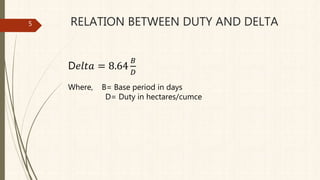
 RELATION BETWEEN DUTY AND DELTA
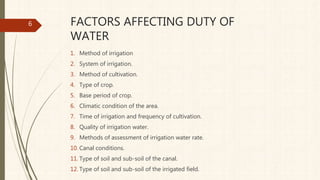
 FACTORS AFFECTING DUTY OF
WATER
2
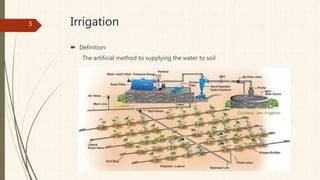
Irrigation
 Definition:
The artificial method to supplying the water to soil
3
DUTY OF WATER AND DELTA
 DUTY:
Duty represents the irrigating capacity of a unit water.
It relation between the area of crop irrigated and the quantity of irrigation
water required during crop growth.
 DELTA:
It is total depth of water required for a crop during the entire period of the crop is
in the field and is denoted by delta( Δ).
4
RELATION BETWEEN DUTY AND DELTA5
D𝑒𝑙𝑡𝑎 = 8.64
𝐵
𝐷
Where, B= Base period in days
D= Duty in hectares/cumce
FACTORS AFFECTING DUTY OF
WATER
1. Method of irrigation
2. System of irrigation.
3. Method of cultivation.
4. Type of crop.
5. Base period of crop.
6. Climatic condition of the area.
7. Time of irrigation and frequency of cultivation.
8. Quality of irrigation water.
9. Methods of assessment of irrigation water rate.
10. Canal conditions.
11. Type of soil and sub-soil of the canal.
12. Type of soil and sub-soil of the irrigated field.
6
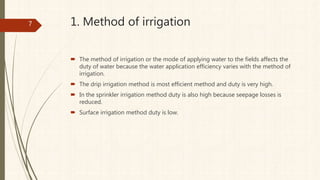
1. Method of irrigation
 The method of irrigation or the mode of applying water to the fields affects the
duty of water because the water application efficiency varies with the method of
irrigation.
 The drip irrigation method is most efficient method and duty is very high.
 In the sprinkler irrigation method duty is also high because seepage losses is
reduced.
 Surface irrigation method duty is low.
7
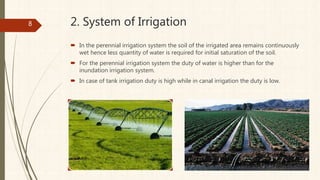
2. System of Irrigation
 In the perennial irrigation system the soil of the irrigated area remains continuously
wet hence less quantity of water is required for initial saturation of the soil.
 For the perennial irrigation system the duty of water is higher than for the
inundation irrigation system.
 In case of tank irrigation duty is high while in canal irrigation the duty is low.
8
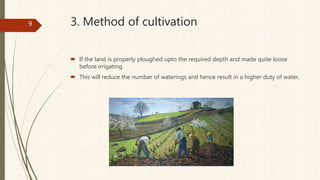
3. Method of cultivation
 If the land is properly ploughed upto the required depth and made quite loose
before irrigating.
 This will reduce the number of waterings and hence result in a higher duty of water.
9
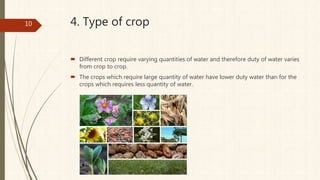
4. Type of crop
 Different crop require varying quantities of water and therefore duty of water varies
from crop to crop.
 The crops which require large quantity of water have lower duty water than for the
crops which requires less quantity of water.
10
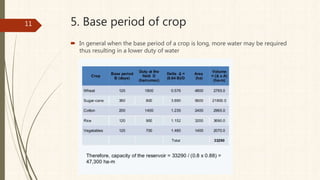
5. Base period of crop
 In general when the base period of a crop is long, more water may be required
thus resulting in a lower duty of water
11
6. Climatic condition of the area
 The water requirement of a crop varies with the climatic
condition of the area and hence it also affects the duty of
water.
 The climatic conditions which affects the duty of water are
I. temperature,
II. wind velocity,
III. Humidity,
IV. Rainfall.
12
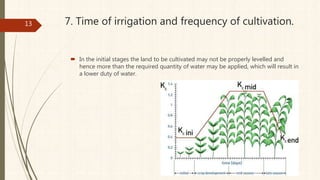
7. Time of irrigation and frequency of cultivation.
 In the initial stages the land to be cultivated may not be properly levelled and
hence more than the required quantity of water may be applied, which will result in
a lower duty of water.
13
8. Quality of irrigation water
 If the irrigation water contains an appreciable amount of
harmful salts and alkalis dissolved in it then it is required to be
applied in large quantity so that the salts are leached off.
14
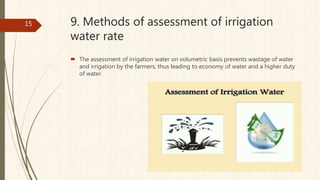
9. Methods of assessment of irrigation
water rate
 The assessment of irrigation water on volumetric basis prevents wastage of water
and irrigation by the farmers, thus leading to economy of water and a higher duty
of water.
15
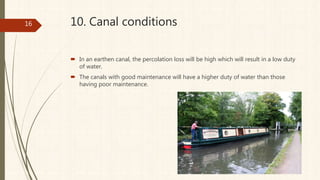
10. Canal conditions
 In an earthen canal, the percolation loss will be high which will result in a low duty
of water.
 The canals with good maintenance will have a higher duty of water than those
having poor maintenance.
16
11. Type of soil and sub-soil of the canal
 If the canal is unlined and it passes through coarse grained
soil then since there will be greater percolation loss the duty
of water will be low.
17
12. Type of soil and sub-soil of the irrigated field
 If the soil and sub-soil of the field to be irrigated is coarse
grained then due to high percolation loss the duty of water
will be low.
18
Thank You
19

Duty And Delta

  • 1.
    Duty & Delta Preparedby : Dushyant Chattrola (140010106004) Manthan Kevadiya (140010106017) Parth Kothari (140010106020) Neel Mistry (140010106024) A D Patel Institute of Technology Irrigation Engineering Guided by: Prof. Drashti Bhatt
  • 2.
    Contents  IRRIGATION  DUTYOF WATER AND DELTA  RELATION BETWEEN DUTY AND DELTA  FACTORS AFFECTING DUTY OF WATER 2
  • 3.
    Irrigation  Definition: The artificialmethod to supplying the water to soil 3
  • 4.
    DUTY OF WATERAND DELTA  DUTY: Duty represents the irrigating capacity of a unit water. It relation between the area of crop irrigated and the quantity of irrigation water required during crop growth.  DELTA: It is total depth of water required for a crop during the entire period of the crop is in the field and is denoted by delta( Δ). 4
  • 5.
    RELATION BETWEEN DUTYAND DELTA5 D𝑒𝑙𝑡𝑎 = 8.64 𝐵 𝐷 Where, B= Base period in days D= Duty in hectares/cumce
  • 6.
    FACTORS AFFECTING DUTYOF WATER 1. Method of irrigation 2. System of irrigation. 3. Method of cultivation. 4. Type of crop. 5. Base period of crop. 6. Climatic condition of the area. 7. Time of irrigation and frequency of cultivation. 8. Quality of irrigation water. 9. Methods of assessment of irrigation water rate. 10. Canal conditions. 11. Type of soil and sub-soil of the canal. 12. Type of soil and sub-soil of the irrigated field. 6
  • 7.
    1. Method ofirrigation  The method of irrigation or the mode of applying water to the fields affects the duty of water because the water application efficiency varies with the method of irrigation.  The drip irrigation method is most efficient method and duty is very high.  In the sprinkler irrigation method duty is also high because seepage losses is reduced.  Surface irrigation method duty is low. 7
  • 8.
    2. System ofIrrigation  In the perennial irrigation system the soil of the irrigated area remains continuously wet hence less quantity of water is required for initial saturation of the soil.  For the perennial irrigation system the duty of water is higher than for the inundation irrigation system.  In case of tank irrigation duty is high while in canal irrigation the duty is low. 8
  • 9.
    3. Method ofcultivation  If the land is properly ploughed upto the required depth and made quite loose before irrigating.  This will reduce the number of waterings and hence result in a higher duty of water. 9
  • 10.
    4. Type ofcrop  Different crop require varying quantities of water and therefore duty of water varies from crop to crop.  The crops which require large quantity of water have lower duty water than for the crops which requires less quantity of water. 10
  • 11.
    5. Base periodof crop  In general when the base period of a crop is long, more water may be required thus resulting in a lower duty of water 11
  • 12.
    6. Climatic conditionof the area  The water requirement of a crop varies with the climatic condition of the area and hence it also affects the duty of water.  The climatic conditions which affects the duty of water are I. temperature, II. wind velocity, III. Humidity, IV. Rainfall. 12
  • 13.
    7. Time ofirrigation and frequency of cultivation.  In the initial stages the land to be cultivated may not be properly levelled and hence more than the required quantity of water may be applied, which will result in a lower duty of water. 13
  • 14.
    8. Quality ofirrigation water  If the irrigation water contains an appreciable amount of harmful salts and alkalis dissolved in it then it is required to be applied in large quantity so that the salts are leached off. 14
  • 15.
    9. Methods ofassessment of irrigation water rate  The assessment of irrigation water on volumetric basis prevents wastage of water and irrigation by the farmers, thus leading to economy of water and a higher duty of water. 15
  • 16.
    10. Canal conditions In an earthen canal, the percolation loss will be high which will result in a low duty of water.  The canals with good maintenance will have a higher duty of water than those having poor maintenance. 16
  • 17.
    11. Type ofsoil and sub-soil of the canal  If the canal is unlined and it passes through coarse grained soil then since there will be greater percolation loss the duty of water will be low. 17
  • 18.
    12. Type ofsoil and sub-soil of the irrigated field  If the soil and sub-soil of the field to be irrigated is coarse grained then due to high percolation loss the duty of water will be low. 18
  • 19.