IRRIGATION
METHODS IN INDIA
 IRRIGATION METHODS
 
 a) Surface Irrigation:  Just flooding water.  About 90% of the 
irrigated areas in the world are by this method.
 b) Sprinkler Irrigation:  Applying water under pressure.  About 
5 % of the irrigated areas are by this method.
 c) Drip or Trickle Irrigation:  Applying water slowly to the soil 
ideally at the same rate with crop consumption.
 d) Sub-Surface Irrigation:  Flooding water underground and 
allowing it to come up by capillarity to crop roots.
SURFACE IRRIGATIONSURFACE IRRIGATION  
 Water is applied to the field in either the controlled or 
uncontrolled manner.
 Controlled:    Water  is  applied  from  the  head  ditch 
and  guided  by  corrugations,  furrows,  borders,  or 
ridges.
 Uncontrolled:  Wild flooding.
 Surface irrigation is entirely practised where water is 
abundant.  The low initial cost of development is later 
offset by high labour cost of applying water.  There 
are deep percolation, runoff and drainage problems
SPRINKLER IRRIGATIONSPRINKLER IRRIGATION
 Introduction: The sprinkler system is ideal in areas
where water is scarce.
 A Sprinkler system conveys water through pipes and
applies it with a minimum amount of losses.
 Water is applied in form of sprays sometimes
simulating natural rainfall.
 The difference is that this rainfall can be controlled in
duration and intensity.
 If well planned, designed and operated, it can be
used in sloping land to reduce erosion where other
systems are not possible.
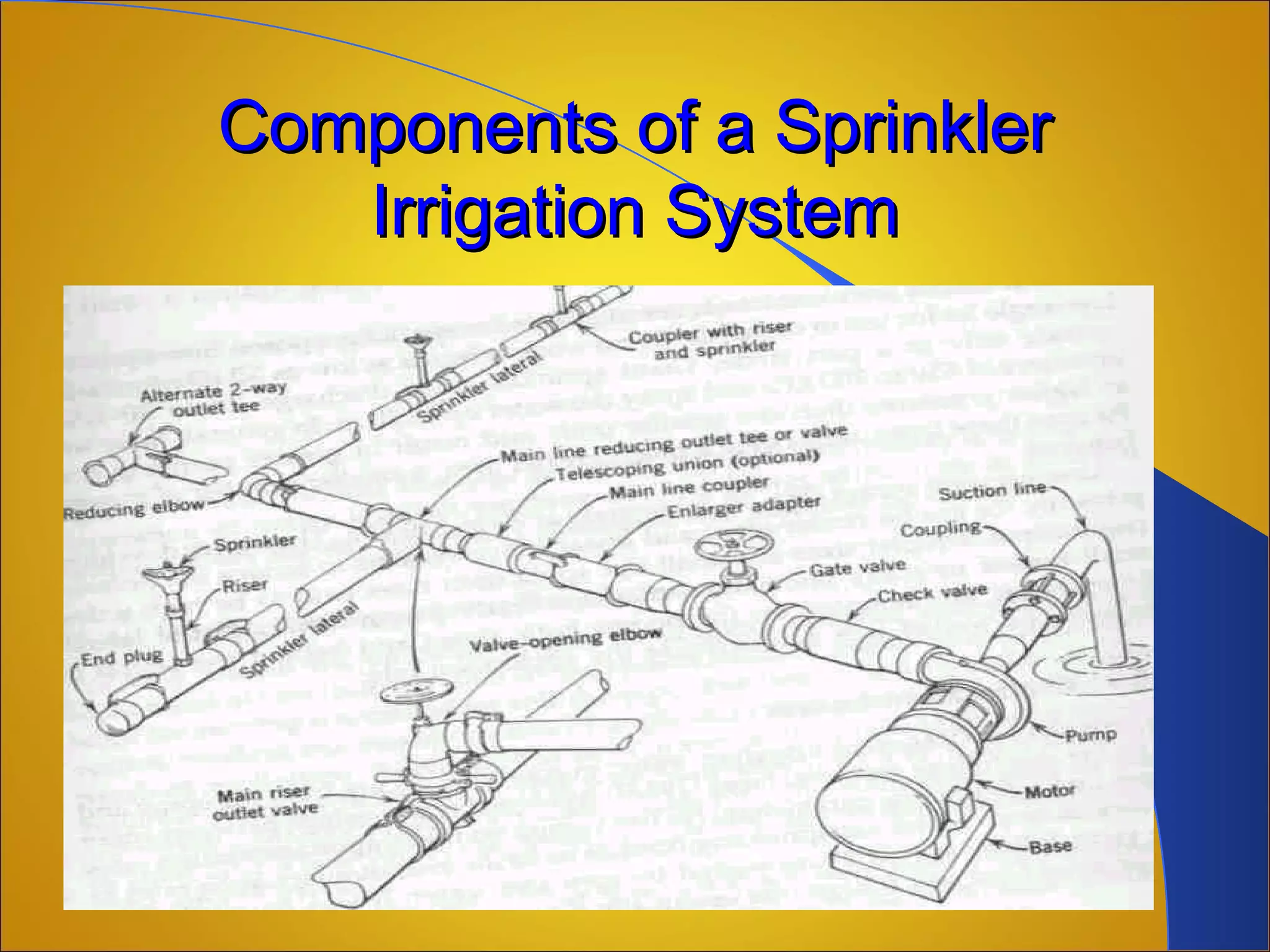
Components of a SprinklerComponents of a Sprinkler
Irrigation SystemIrrigation System
Design of Sprinkler IrrigationDesign of Sprinkler Irrigation
SystemSystem
Objectives and Procedures
Provide Sufficient Flow Capacity to meet
the Irrigation Demand
Ensure that the Least Irrigated Plant
receives adequate Water
Ensure Uniform Distribution of Water.
DRIP OR TRICKLEDRIP OR TRICKLE
IRRIGATIONIRRIGATION
 Introduction: In this irrigation system:
 i) Water is applied directly to the crop ie. entire field
is not wetted.
 ii) Water is conserved
 (iii) Weeds are controlled because only the places
getting water can grow weeds.
 (iv) There is a low pressure system.
 (v) There is a slow rate of water application
somewhat matching the consumptive use.
Application rate can be as low as 1 - 12 l/hr.
 (vi) There is reduced evaporation, only potential
transpiration is considered.
 vii) There is no need for a drainage system.
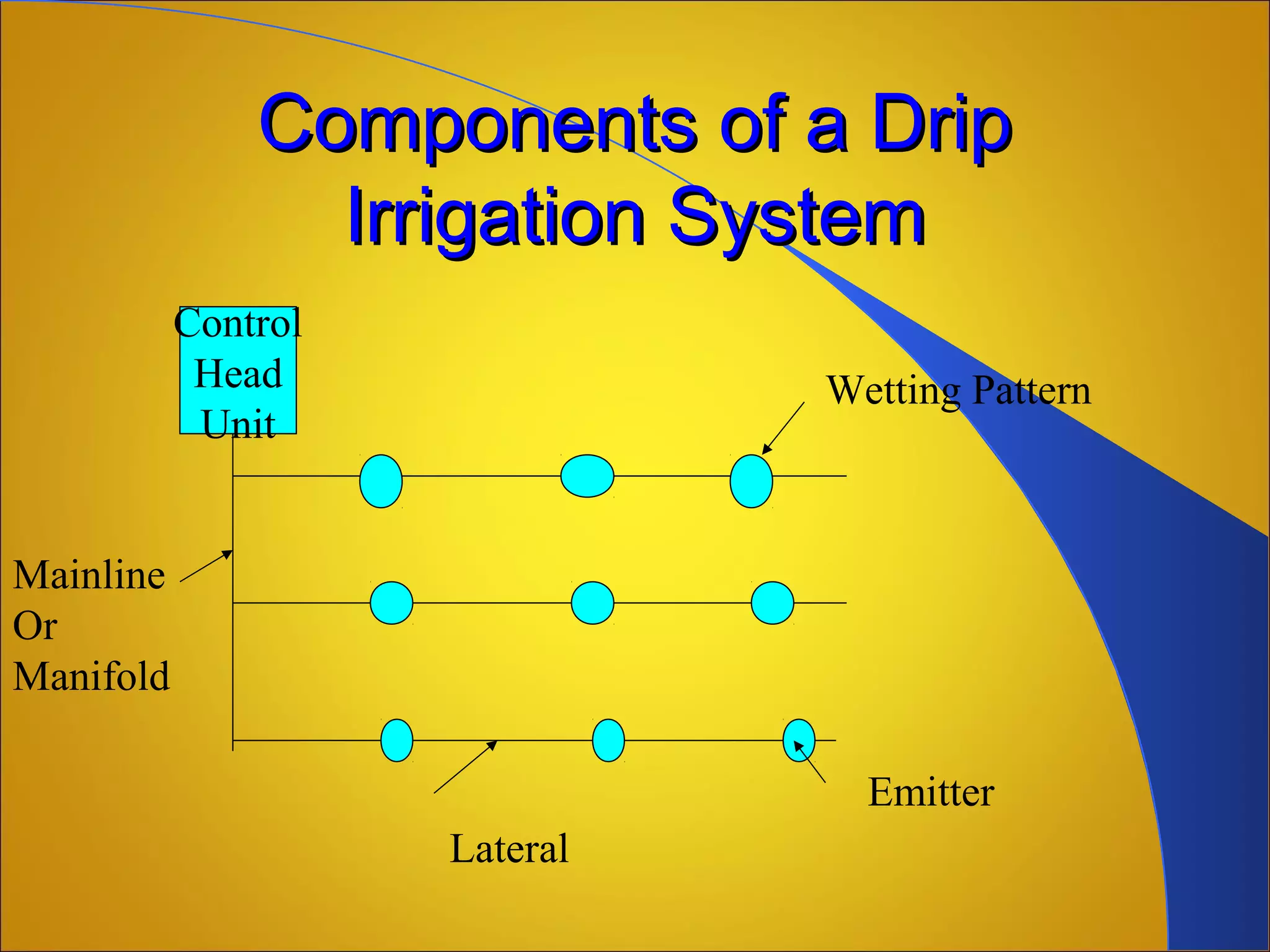
Components of a DripComponents of a Drip
Irrigation SystemIrrigation System
Control
Head
Unit
Wetting Pattern
Emitter
Lateral
Mainline
Or
Manifold
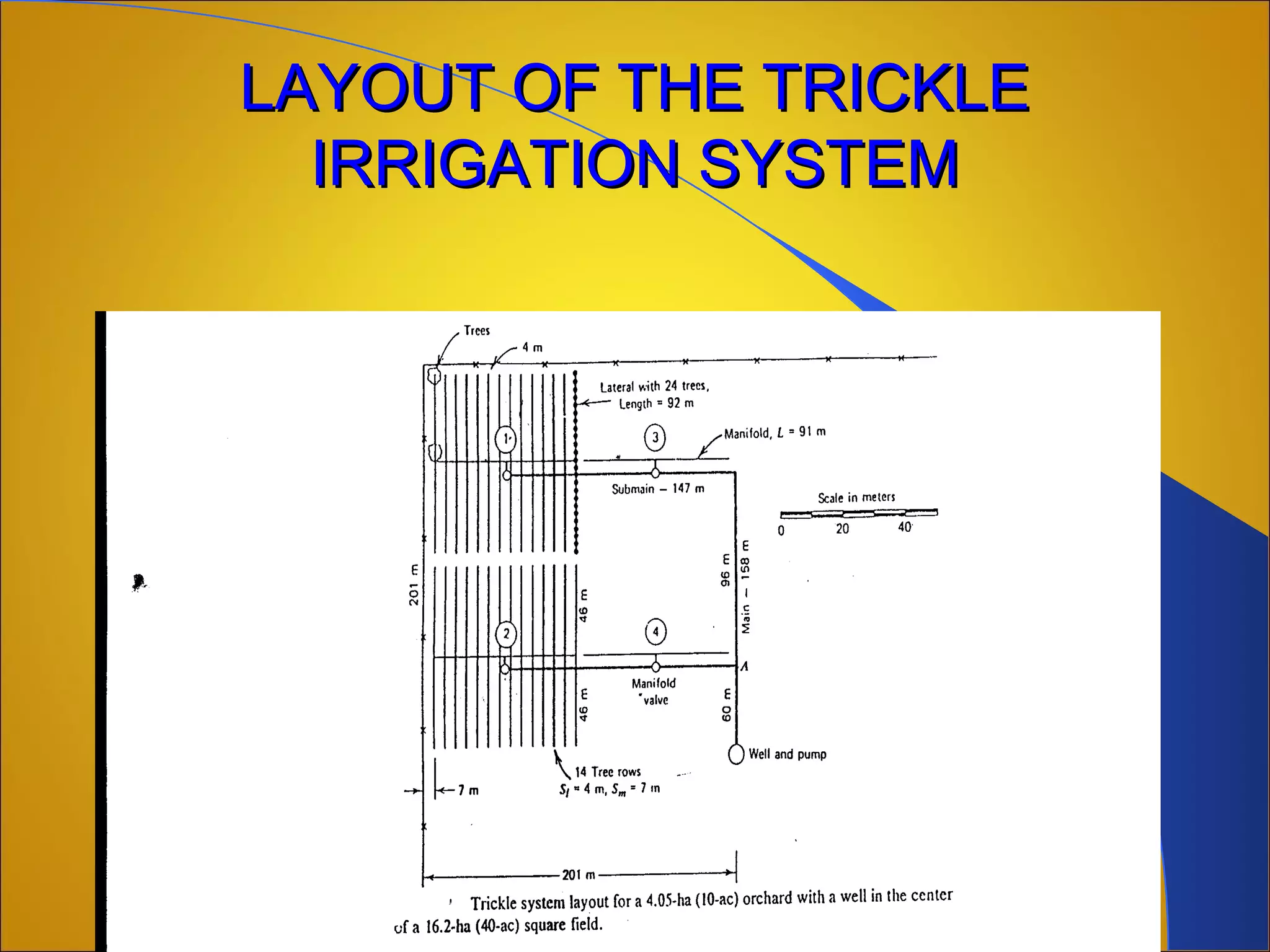
LAYOUT OF THE TRICKLELAYOUT OF THE TRICKLE
IRRIGATION SYSTEMIRRIGATION SYSTEM
SUB-SURFACESUB-SURFACE
IRRIGATIONIRRIGATION
 Applied in places where natural soil and
topographic condition favor water application
to the soil under the surface, a practice called
sub-surface irrigation. These conditions
include:
 a) Impervious layer at 15 cm depth or more
 b) Previous soil underlying
 c) Uniform topographic condition
 d) Moderate slopes.
MADE BY
RITIK SHARMA
CLASS-9th
-D
ROLL NO-7

Irrigation methods in india

  • 1.
  • 2.
     IRRIGATION METHODS   a) Surface Irrigation:  Just flooding water.  About 90% of the  irrigated areas in the world are by this method.  b) Sprinkler Irrigation:  Applying water under pressure.  About  5 % of the irrigated areas are by this method.  c) Drip or Trickle Irrigation:  Applying water slowly to the soil  ideally at the same rate with crop consumption.  d) Sub-Surface Irrigation:  Flooding water underground and  allowing it to come up by capillarity to crop roots.
  • 3.
    SURFACE IRRIGATIONSURFACE IRRIGATION   Water is applied to the field in either the controlled or  uncontrolled manner.  Controlled:    Water  is  applied  from  the  head  ditch  and  guided  by  corrugations,  furrows,  borders,  or  ridges.  Uncontrolled:  Wild flooding.  Surface irrigation is entirely practised where water is  abundant.  The low initial cost of development is later  offset by high labour cost of applying water.  There  are deep percolation, runoff and drainage problems
  • 4.
    SPRINKLER IRRIGATIONSPRINKLER IRRIGATION Introduction: The sprinkler system is ideal in areas where water is scarce.  A Sprinkler system conveys water through pipes and applies it with a minimum amount of losses.  Water is applied in form of sprays sometimes simulating natural rainfall.  The difference is that this rainfall can be controlled in duration and intensity.  If well planned, designed and operated, it can be used in sloping land to reduce erosion where other systems are not possible.
  • 5.
    Components of aSprinklerComponents of a Sprinkler Irrigation SystemIrrigation System
  • 6.
    Design of SprinklerIrrigationDesign of Sprinkler Irrigation SystemSystem Objectives and Procedures Provide Sufficient Flow Capacity to meet the Irrigation Demand Ensure that the Least Irrigated Plant receives adequate Water Ensure Uniform Distribution of Water.
  • 7.
    DRIP OR TRICKLEDRIPOR TRICKLE IRRIGATIONIRRIGATION  Introduction: In this irrigation system:  i) Water is applied directly to the crop ie. entire field is not wetted.  ii) Water is conserved  (iii) Weeds are controlled because only the places getting water can grow weeds.  (iv) There is a low pressure system.  (v) There is a slow rate of water application somewhat matching the consumptive use. Application rate can be as low as 1 - 12 l/hr.  (vi) There is reduced evaporation, only potential transpiration is considered.  vii) There is no need for a drainage system.
  • 8.
    Components of aDripComponents of a Drip Irrigation SystemIrrigation System Control Head Unit Wetting Pattern Emitter Lateral Mainline Or Manifold
  • 9.
    LAYOUT OF THETRICKLELAYOUT OF THE TRICKLE IRRIGATION SYSTEMIRRIGATION SYSTEM
  • 10.
    SUB-SURFACESUB-SURFACE IRRIGATIONIRRIGATION  Applied inplaces where natural soil and topographic condition favor water application to the soil under the surface, a practice called sub-surface irrigation. These conditions include:  a) Impervious layer at 15 cm depth or more  b) Previous soil underlying  c) Uniform topographic condition  d) Moderate slopes.
  • 11.