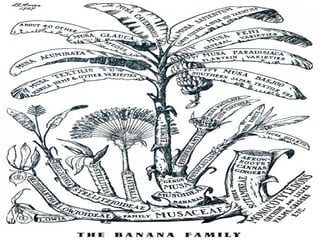
This is a small family of only abouT 40 
species in Two genera (musa and 
enseTe) found in weT Tropical 
lowlands, alThough recenTly one or 
Two species have been found in higher 
laTiTudes. They are grown mainly for 
Their fruiT, The banana, and for Their 
fibres, manila and hemp, used for 
making rope. They are also grown as 
ornamenTal planTs
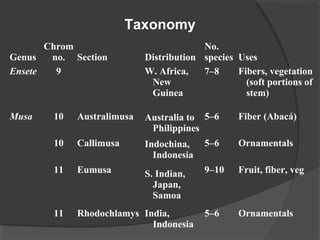
Taxonomy 
Genus 
Chrom 
no. Section Distribution 
No. 
species Uses 
Ensete 9 W. Africa, 
New 
Guinea 
7–8 Fibers, vegetation 
(soft portions of 
stem) 
Musa 10 Australimusa Australia to 
Philippines 
5–6 Fiber (Abacá) 
10 Callimusa Indochina, 
Indonesia 
5–6 Ornamentals 
11 Eumusa S. Indian, 
Japan, 
Samoa 
9–10 Fruit, fiber, veg 
11 Rhodochlamys India, 
Indonesia 
5–6 Ornamentals
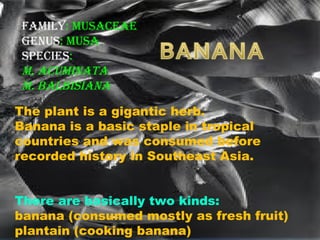
family: musaceae 
genus: musa 
species: 
m. acuminaTa 
m. balbisiana 
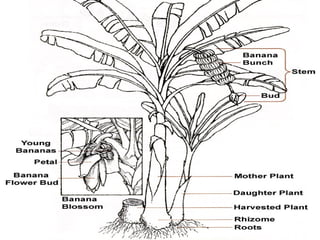
The plant is a gigantic herb. 
Banana is a basic staple in tropical 
countries and was consumed before 
recorded history in Southeast Asia. 
There are basically two kinds: 
banana (consumed mostly as fresh fruit) 
plantain (cooking banana)
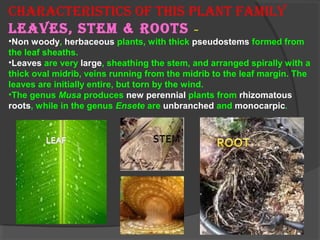
characTerisTics of This planT family 
leaves, sTem & rooTs ~ 
•Non woody, herbaceous plants, with thick pseudostems formed from 
the leaf sheaths. 
•Leaves are very large, sheathing the stem, and arranged spirally with a 
thick oval midrib, veins running from the midrib to the leaf margin. The 
leaves are initially entire, but torn by the wind. 
•The genus Musa produces new perennial plants from rhizomatous 
roots, while in the genus Ensete are unbranched and monocarpic.
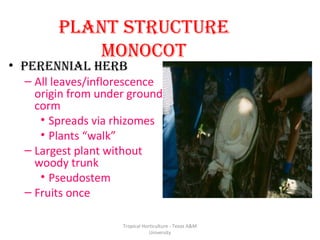
planT sTrucTure 
monocoT 
• perennial herb 
– All leaves/inflorescence 
origin from under ground 
corm 
• Spreads via rhizomes 
• Plants “walk” 
– Largest plant without 
woody trunk 
• Pseudostem 
– Fruits once 
Tropical Horticulture - Texas A&M 
University
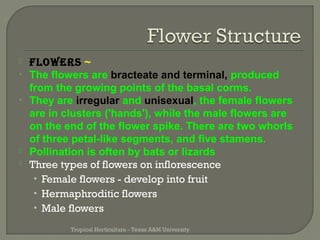
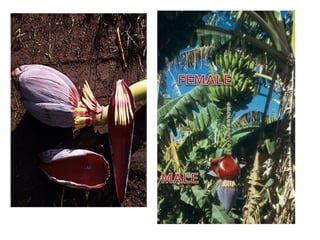
 flowers ~ 
• The flowers are bracteate and terminal, produced 
from the growing points of the basal corms. 
• They are irregular and unisexual, the female flowers 
are in clusters ('hands'), while the male flowers are 
on the end of the flower spike. There are two whorls 
of three petal-like segments, and five stamens. 
 Pollination is often by bats or lizards 
 Three types of flowers on inflorescence 
• Female flowers - develop into fruit 
• Hermaphroditic flowers 
• Male flowers 
Tropical Horticulture - Texas A&M University
Banana flowers
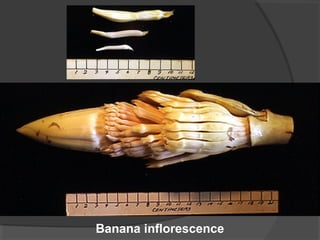
Banana inflorescence
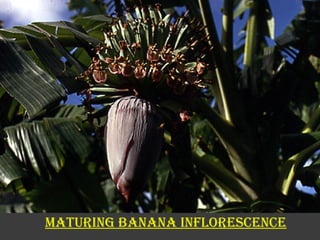
MATURING BANANA INFLORESCENCE
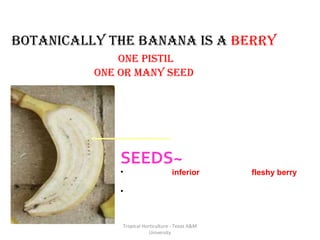
BOTANICALLy ThE BANANA IS A BERRy 
ONE pISTIL 
ONE OR MANy SEEd 
Tropical Horticulture - Texas A&M 
University 
Seed Remnants 
SEEDS~ 
•The ovary is inferior, the fruit is a fleshy berry 
with many stony seeds. 
•The edible Banana is a hybrid and does not 
produce seeds
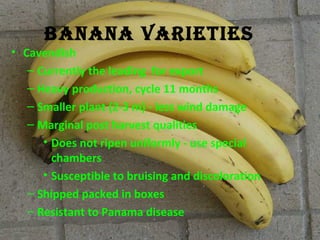
BANANA VARIETIES 
• Cavendish 
– Currently the leading for export 
– Heavy production, cycle 11 months 
– Smaller plant (2-3 m) - less wind damage 
– Marginal post harvest qualities 
• Does not ripen uniformly - use special 
chambers 
• Susceptible to bruising and discoloration 
– Shipped packed in boxes 
– Resistant to Panama disease 
Tropical Horticulture - Texas A&M 
University
Tropical Horticulture - Texas A&M 
 Gros Michel (Big Mike) 
University 
 Leading for 100 years 
 Good production, cycle 13-15 months 
 Tall plants (4-8 m), wind damage 
 Good post harvest qualities 
 Ripened uniformly 
 Resistant to bruising and discoloration 
 Shipped as bunches 
 Susceptible to Panama disease 
 Replaced by Cavendish - resistant to Panama disease
Tissue Culture: 
•This method of propagation is increasing to 
provide disease free stock. 
•The big problem is to reduce off types from 
tissue-culture induced variability. 
•Some variants occur with very high frequency 
and careful control is need to reduce their 
frequency.
Banana
Cultural Practices: 
•Deep planting gives sturdier tree. 
•Planting time is best carried out before wet 
season to give maximum growth unless 
irrigation is available. 
•Dry season, however, gives less disease. 
•Spring planting is the rule in the subtropics. 
•Roots of banana are shallow so tillage should 
be minimum. 
•Use of herbicides allows clean cultivation.
Pruning and Staking: 
•The removal of unwanted suckers is known as 
pruning. 
•These are cut at or below ground level. 
•The critical management problem is to set up the 
follow-up plant to get the desired spread in 
fruiting in relation to market price or weather. 
•It is undesirable to get two plants giving fruit at 
the same time. 
•Staking is used to prevent blowdown. 
•In Taiwan government only compensates staked 
field after blowdown.
Production 
Tropical Horticulture - Texas A&M 
University 
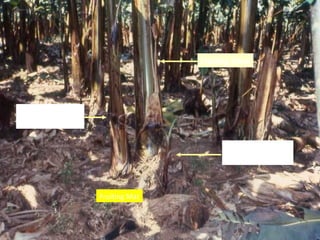
Fruiting Stem 
1st Replacement 
Daughter 
2nd Replacement 
Grand daughter 
Fruiting Mat
Tropical Horticulture - Texas A&M 
University 
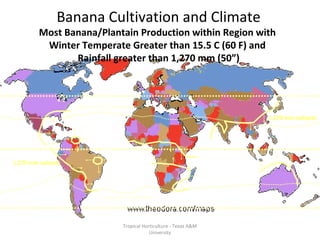
January 15.5 C isotherm 
June 15.5 C isotherm 
1,270 mm isohyets 
1,270 mm isohyets 
Banana Cultivation and Climate 
Most Banana/Plantain Production within Region with 
Winter Temperate Greater than 15.5 C (60 F) and 
Rainfall greater than 1,270 mm (50”) 
(Figure 6.1 from Simmonds, 1966)
Tropical Horticulture - Texas A&M 
University 
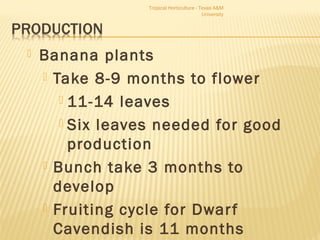
 Banana plants 
 Take 8-9 months to flower 
 11-14 leaves 
 Six leaves needed for good 
production 
 Bunch take 3 months to 
develop 
 Fruiting cycle for Dwar f 
Cavendish is 11 months
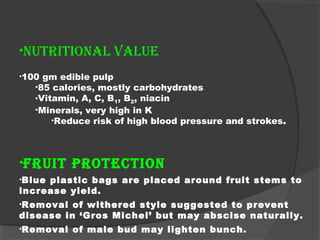
•nutritionAL VALue 
•100 gm edible pulp 
•85 calories, mostly carbohydrates 
•Vitamin, A, C, B1, B2, niacin 
•Minerals, very high in K 
•Reduce risk of high blood pressure and strokes. 
•Fruit Protection 
•Blue plastic bags are placed around fruit stems to 
increase yield. 
•Removal of withered style suggested to prevent 
disease in ‘Gros Michel’ but may abscise naturally. 
•Removal of male bud may lighten bunch.
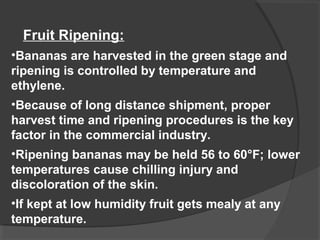
Fruit Ripening: 
•Bananas are harvested in the green stage and 
ripening is controlled by temperature and 
ethylene. 
•Because of long distance shipment, proper 
harvest time and ripening procedures is the key 
factor in the commercial industry. 
•Ripening bananas may be held 56 to 60°F; lower 
temperatures cause chilling injury and 
discoloration of the skin. 
•If kept at low humidity fruit gets mealy at any 
temperature.
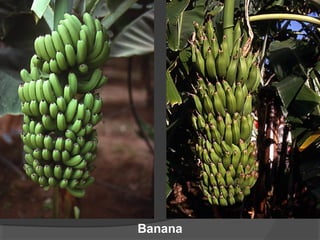
Banana
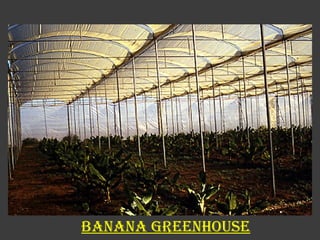
BANANA GREENHOUSE
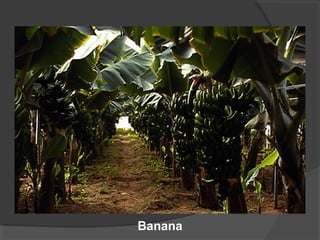
Banana
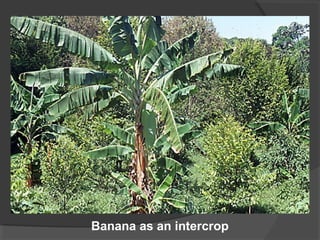
Banana as an intercrop
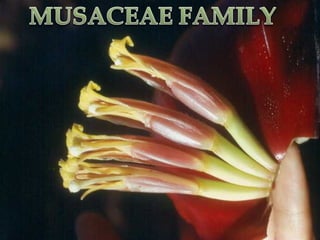
Musaceae family

Musaceae family

  • 2.
    This is asmall family of only abouT 40 species in Two genera (musa and enseTe) found in weT Tropical lowlands, alThough recenTly one or Two species have been found in higher laTiTudes. They are grown mainly for Their fruiT, The banana, and for Their fibres, manila and hemp, used for making rope. They are also grown as ornamenTal planTs
  • 3.
    Taxonomy Genus Chrom no. Section Distribution No. species Uses Ensete 9 W. Africa, New Guinea 7–8 Fibers, vegetation (soft portions of stem) Musa 10 Australimusa Australia to Philippines 5–6 Fiber (Abacá) 10 Callimusa Indochina, Indonesia 5–6 Ornamentals 11 Eumusa S. Indian, Japan, Samoa 9–10 Fruit, fiber, veg 11 Rhodochlamys India, Indonesia 5–6 Ornamentals
  • 4.
    family: musaceae genus:musa species: m. acuminaTa m. balbisiana The plant is a gigantic herb. Banana is a basic staple in tropical countries and was consumed before recorded history in Southeast Asia. There are basically two kinds: banana (consumed mostly as fresh fruit) plantain (cooking banana)
  • 5.
    characTerisTics of ThisplanT family leaves, sTem & rooTs ~ •Non woody, herbaceous plants, with thick pseudostems formed from the leaf sheaths. •Leaves are very large, sheathing the stem, and arranged spirally with a thick oval midrib, veins running from the midrib to the leaf margin. The leaves are initially entire, but torn by the wind. •The genus Musa produces new perennial plants from rhizomatous roots, while in the genus Ensete are unbranched and monocarpic.
  • 6.
    planT sTrucTure monocoT • perennial herb – All leaves/inflorescence origin from under ground corm • Spreads via rhizomes • Plants “walk” – Largest plant without woody trunk • Pseudostem – Fruits once Tropical Horticulture - Texas A&M University
  • 8.
     flowers ~ • The flowers are bracteate and terminal, produced from the growing points of the basal corms. • They are irregular and unisexual, the female flowers are in clusters ('hands'), while the male flowers are on the end of the flower spike. There are two whorls of three petal-like segments, and five stamens.  Pollination is often by bats or lizards  Three types of flowers on inflorescence • Female flowers - develop into fruit • Hermaphroditic flowers • Male flowers Tropical Horticulture - Texas A&M University
  • 9.
  • 10.
  • 11.
  • 12.
    BOTANICALLy ThE BANANAIS A BERRy ONE pISTIL ONE OR MANy SEEd Tropical Horticulture - Texas A&M University Seed Remnants SEEDS~ •The ovary is inferior, the fruit is a fleshy berry with many stony seeds. •The edible Banana is a hybrid and does not produce seeds
  • 13.
    BANANA VARIETIES •Cavendish – Currently the leading for export – Heavy production, cycle 11 months – Smaller plant (2-3 m) - less wind damage – Marginal post harvest qualities • Does not ripen uniformly - use special chambers • Susceptible to bruising and discoloration – Shipped packed in boxes – Resistant to Panama disease Tropical Horticulture - Texas A&M University
  • 14.
    Tropical Horticulture -Texas A&M  Gros Michel (Big Mike) University  Leading for 100 years  Good production, cycle 13-15 months  Tall plants (4-8 m), wind damage  Good post harvest qualities  Ripened uniformly  Resistant to bruising and discoloration  Shipped as bunches  Susceptible to Panama disease  Replaced by Cavendish - resistant to Panama disease
  • 17.
    Tissue Culture: •Thismethod of propagation is increasing to provide disease free stock. •The big problem is to reduce off types from tissue-culture induced variability. •Some variants occur with very high frequency and careful control is need to reduce their frequency.
  • 18.
  • 19.
    Cultural Practices: •Deepplanting gives sturdier tree. •Planting time is best carried out before wet season to give maximum growth unless irrigation is available. •Dry season, however, gives less disease. •Spring planting is the rule in the subtropics. •Roots of banana are shallow so tillage should be minimum. •Use of herbicides allows clean cultivation.
  • 20.
    Pruning and Staking: •The removal of unwanted suckers is known as pruning. •These are cut at or below ground level. •The critical management problem is to set up the follow-up plant to get the desired spread in fruiting in relation to market price or weather. •It is undesirable to get two plants giving fruit at the same time. •Staking is used to prevent blowdown. •In Taiwan government only compensates staked field after blowdown.
  • 21.
    Production Tropical Horticulture- Texas A&M University Fruiting Stem 1st Replacement Daughter 2nd Replacement Grand daughter Fruiting Mat
  • 22.
    Tropical Horticulture -Texas A&M University January 15.5 C isotherm June 15.5 C isotherm 1,270 mm isohyets 1,270 mm isohyets Banana Cultivation and Climate Most Banana/Plantain Production within Region with Winter Temperate Greater than 15.5 C (60 F) and Rainfall greater than 1,270 mm (50”) (Figure 6.1 from Simmonds, 1966)
  • 23.
    Tropical Horticulture -Texas A&M University  Banana plants  Take 8-9 months to flower  11-14 leaves  Six leaves needed for good production  Bunch take 3 months to develop  Fruiting cycle for Dwar f Cavendish is 11 months
  • 24.
    •nutritionAL VALue •100gm edible pulp •85 calories, mostly carbohydrates •Vitamin, A, C, B1, B2, niacin •Minerals, very high in K •Reduce risk of high blood pressure and strokes. •Fruit Protection •Blue plastic bags are placed around fruit stems to increase yield. •Removal of withered style suggested to prevent disease in ‘Gros Michel’ but may abscise naturally. •Removal of male bud may lighten bunch.
  • 25.
    Fruit Ripening: •Bananasare harvested in the green stage and ripening is controlled by temperature and ethylene. •Because of long distance shipment, proper harvest time and ripening procedures is the key factor in the commercial industry. •Ripening bananas may be held 56 to 60°F; lower temperatures cause chilling injury and discoloration of the skin. •If kept at low humidity fruit gets mealy at any temperature.
  • 26.
  • 27.
  • 28.
  • 29.
    Banana as anintercrop

Editor's Notes

  • #7 Gigantic herb largest plant on earth without a woody stem trunk is a pseudostem, consisting of the bases of the leaves all leaves including the fruit inflorescence origin from the under ground corm