CHECK DAMS
Submitted to: Submitted by:
Dr. R.N.Ram Ujjwala Upreti
Head of Department. PhD. II Sem.(41776)
Fisheries Resource Management Aquaculture.
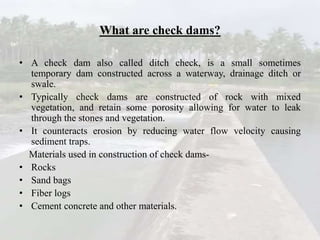
What are check dams?
• A check dam also called ditch check, is a small sometimes
temporary dam constructed across a waterway, drainage ditch or
swale.
• Typically check dams are constructed of rock with mixed
vegetation, and retain some porosity allowing for water to leak
through the stones and vegetation.
• It counteracts erosion by reducing water flow velocity causing
sediment traps.
Materials used in construction of check dams-
• Rocks
• Sand bags
• Fiber logs
• Cement concrete and other materials.
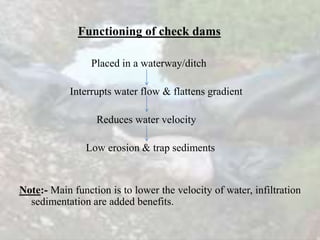
Functioning of check dams
Placed in a waterway/ditch
Interrupts water flow & flattens gradient
Reduces water velocity
Low erosion & trap sediments
Note:- Main function is to lower the velocity of water, infiltration
sedimentation are added benefits.
Types of check dams
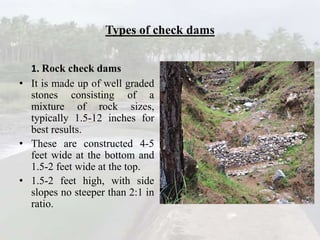
1. Rock check dams
• It is made up of well graded
stones consisting of a
mixture of rock sizes,
typically 1.5-12 inches for
best results.
• These are constructed 4-5
feet wide at the bottom and
1.5-2 feet wide at the top.
• 1.5-2 feet high, with side
slopes no steeper than 2:1 in
ratio.
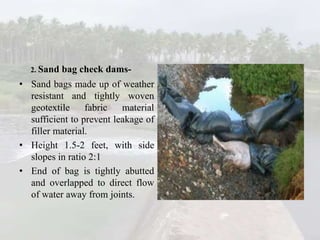
2. Sand bag check dams-
• Sand bags made up of weather
resistant and tightly woven
geotextile fabric material
sufficient to prevent leakage of
filler material.
• Height 1.5-2 feet, with side
slopes in ratio 2:1
• End of bag is tightly abutted
and overlapped to direct flow
of water away from joints.
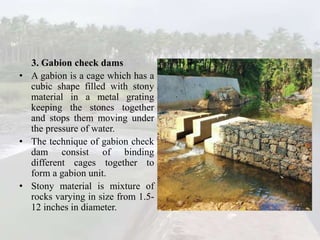
3. Gabion check dams
• A gabion is a cage which has a
cubic shape filled with stony
material in a metal grating
keeping the stones together
and stops them moving under
the pressure of water.
• The technique of gabion check
dam consist of binding
different cages together to
form a gabion unit.
• Stony material is mixture of
rocks varying in size from 1.5-
12 inches in diameter.
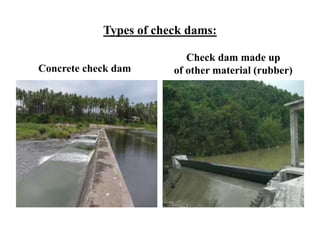
Types of check dams:
Concrete check dam
Check dam made up
of other material (rubber)
Design considerations
Site-
• The drainage area should be less than 10 acres.
• Waterway should be on a slope <50% and a minimum depth to
bedrock of 2 feet.
Size-
• Height of check dam should be 2-3 feet.
• Centre of dam should be at least 6 inches less than its edges.
Spacing-
• Spacing is needed to be done in order to reduce water velocity,
erosion and protect the channel between dams.
• The dams should be spaced such that the toe of the upstream
check dam is equal to the elevation of the down stream's check
dam crest.
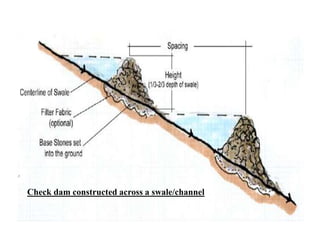
Check dam constructed across a swale/channel
Advantages
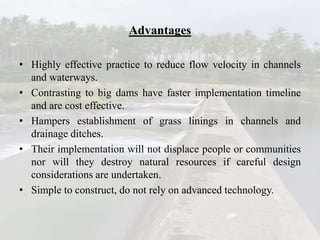
• Highly effective practice to reduce flow velocity in channels
and waterways.
• Contrasting to big dams have faster implementation timeline
and are cost effective.
• Hampers establishment of grass linings in channels and
drainage ditches.
• Their implementation will not displace people or communities
nor will they destroy natural resources if careful design
considerations are undertaken.
• Simple to construct, do not rely on advanced technology.
Limitations
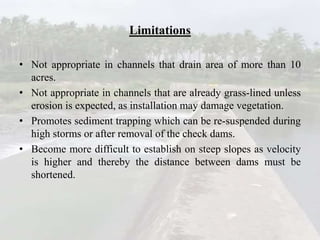
• Not appropriate in channels that drain area of more than 10
acres.
• Not appropriate in channels that are already grass-lined unless
erosion is expected, as installation may damage vegetation.
• Promotes sediment trapping which can be re-suspended during
high storms or after removal of the check dams.
• Become more difficult to establish on steep slopes as velocity
is higher and thereby the distance between dams must be
shortened.
Conclusion
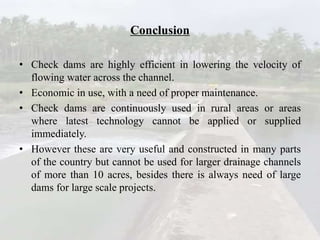
• Check dams are highly efficient in lowering the velocity of
flowing water across the channel.
• Economic in use, with a need of proper maintenance.
• Check dams are continuously used in rural areas or areas
where latest technology cannot be applied or supplied
immediately.
• However these are very useful and constructed in many parts
of the country but cannot be used for larger drainage channels
of more than 10 acres, besides there is always need of large
dams for large scale projects.

Check dams

  • 1.
    CHECK DAMS Submitted to:Submitted by: Dr. R.N.Ram Ujjwala Upreti Head of Department. PhD. II Sem.(41776) Fisheries Resource Management Aquaculture.
  • 2.
    What are checkdams? • A check dam also called ditch check, is a small sometimes temporary dam constructed across a waterway, drainage ditch or swale. • Typically check dams are constructed of rock with mixed vegetation, and retain some porosity allowing for water to leak through the stones and vegetation. • It counteracts erosion by reducing water flow velocity causing sediment traps. Materials used in construction of check dams- • Rocks • Sand bags • Fiber logs • Cement concrete and other materials.
  • 3.
    Functioning of checkdams Placed in a waterway/ditch Interrupts water flow & flattens gradient Reduces water velocity Low erosion & trap sediments Note:- Main function is to lower the velocity of water, infiltration sedimentation are added benefits.
  • 4.
    Types of checkdams 1. Rock check dams • It is made up of well graded stones consisting of a mixture of rock sizes, typically 1.5-12 inches for best results. • These are constructed 4-5 feet wide at the bottom and 1.5-2 feet wide at the top. • 1.5-2 feet high, with side slopes no steeper than 2:1 in ratio.
  • 5.
    2. Sand bagcheck dams- • Sand bags made up of weather resistant and tightly woven geotextile fabric material sufficient to prevent leakage of filler material. • Height 1.5-2 feet, with side slopes in ratio 2:1 • End of bag is tightly abutted and overlapped to direct flow of water away from joints.
  • 6.
    3. Gabion checkdams • A gabion is a cage which has a cubic shape filled with stony material in a metal grating keeping the stones together and stops them moving under the pressure of water. • The technique of gabion check dam consist of binding different cages together to form a gabion unit. • Stony material is mixture of rocks varying in size from 1.5- 12 inches in diameter.
  • 7.
    Types of checkdams: Concrete check dam Check dam made up of other material (rubber)
  • 8.
    Design considerations Site- • Thedrainage area should be less than 10 acres. • Waterway should be on a slope <50% and a minimum depth to bedrock of 2 feet. Size- • Height of check dam should be 2-3 feet. • Centre of dam should be at least 6 inches less than its edges. Spacing- • Spacing is needed to be done in order to reduce water velocity, erosion and protect the channel between dams. • The dams should be spaced such that the toe of the upstream check dam is equal to the elevation of the down stream's check dam crest.
  • 9.
    Check dam constructedacross a swale/channel
  • 10.
    Advantages • Highly effectivepractice to reduce flow velocity in channels and waterways. • Contrasting to big dams have faster implementation timeline and are cost effective. • Hampers establishment of grass linings in channels and drainage ditches. • Their implementation will not displace people or communities nor will they destroy natural resources if careful design considerations are undertaken. • Simple to construct, do not rely on advanced technology.
  • 11.
    Limitations • Not appropriatein channels that drain area of more than 10 acres. • Not appropriate in channels that are already grass-lined unless erosion is expected, as installation may damage vegetation. • Promotes sediment trapping which can be re-suspended during high storms or after removal of the check dams. • Become more difficult to establish on steep slopes as velocity is higher and thereby the distance between dams must be shortened.
  • 12.
    Conclusion • Check damsare highly efficient in lowering the velocity of flowing water across the channel. • Economic in use, with a need of proper maintenance. • Check dams are continuously used in rural areas or areas where latest technology cannot be applied or supplied immediately. • However these are very useful and constructed in many parts of the country but cannot be used for larger drainage channels of more than 10 acres, besides there is always need of large dams for large scale projects.