Water resource management is the activity of
planning, developing, distributing and managing
the optimum use of water resources. It is a sub-
set of water cycle management. Ideally, water
resource management planning has regard to
all the competing demands for water and seeks
to allocate water on an equitable basis to satisfy
all uses and demands.
Cultivated is extremely sensitive to water
shortages. Good water management practices
are needed to keep usage at optimum levels and
to maximize the production.
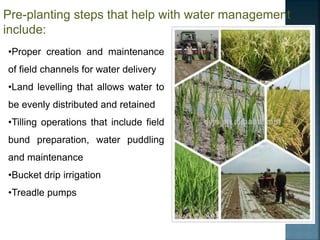
•Proper creation and maintenance
of field channels for water delivery
•Land levelling that allows water to
be evenly distributed and retained
•Tilling operations that include field
bund preparation, water puddling
and maintenance
•Bucket drip irrigation
•Treadle pumps
Pre-planting steps that help with water management
include:
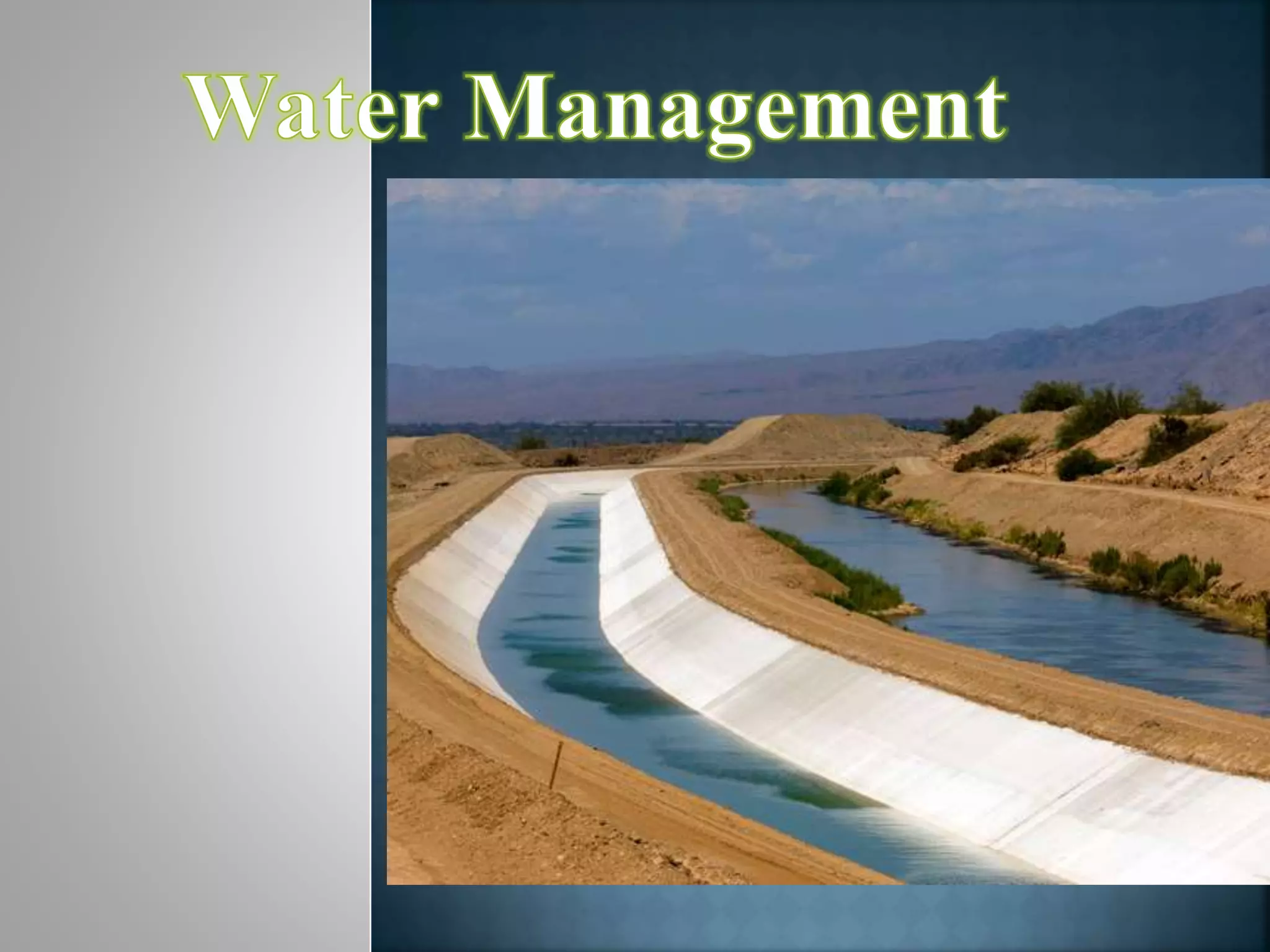
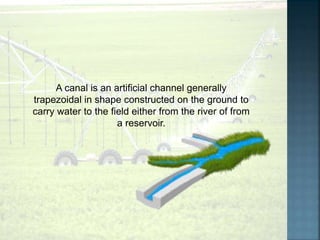
A canal is an artificial channel generally
trapezoidal in shape constructed on the ground to
carry water to the field either from the river of from
a reservoir.
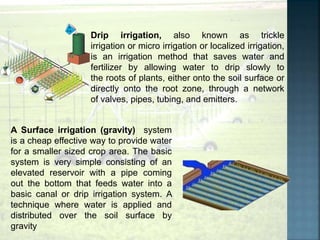
Drip irrigation, also known as trickle
irrigation or micro irrigation or localized irrigation,
is an irrigation method that saves water and
fertilizer by allowing water to drip slowly to
the roots of plants, either onto the soil surface or
directly onto the root zone, through a network
of valves, pipes, tubing, and emitters.
A Surface irrigation (gravity) system
is a cheap effective way to provide water
for a smaller sized crop area. The basic
system is very simple consisting of an
elevated reservoir with a pipe coming
out the bottom that feeds water into a
basic canal or drip irrigation system. A
technique where water is applied and
distributed over the soil surface by
gravity
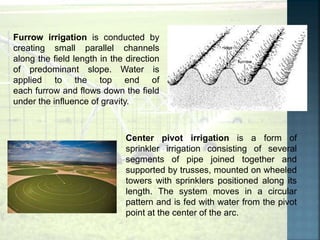
Furrow irrigation is conducted by
creating small parallel channels
along the field length in the direction
of predominant slope. Water is
applied to the top end of
each furrow and flows down the field
under the influence of gravity.
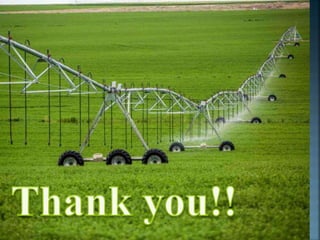
Center pivot irrigation is a form of
sprinkler irrigation consisting of several
segments of pipe joined together and
supported by trusses, mounted on wheeled
towers with sprinklers positioned along its
length. The system moves in a circular
pattern and is fed with water from the pivot
point at the center of the arc.
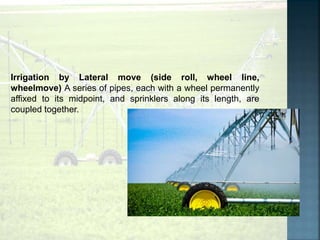
Irrigation by Lateral move (side roll, wheel line,
wheelmove) A series of pipes, each with a wheel permanently
affixed to its midpoint, and sprinklers along its length, are
coupled together.
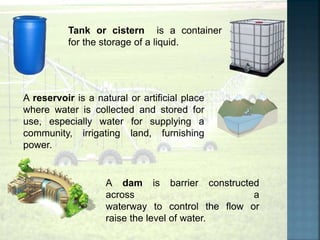
A reservoir is a natural or artificial place
where water is collected and stored for
use, especially water for supplying a
community, irrigating land, furnishing
power.
Tank or cistern is a container
for the storage of a liquid.
A dam is barrier constructed
across a
waterway to control the flow or
raise the level of water.
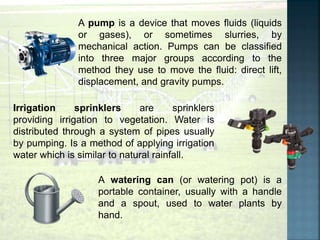
A pump is a device that moves fluids (liquids
or gases), or sometimes slurries, by
mechanical action. Pumps can be classified
into three major groups according to the
method they use to move the fluid: direct lift,
displacement, and gravity pumps.
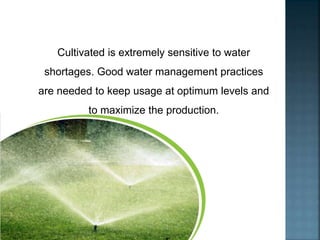
Irrigation sprinklers are sprinklers
providing irrigation to vegetation. Water is
distributed through a system of pipes usually
by pumping. Is a method of applying irrigation
water which is similar to natural rainfall.
A watering can (or watering pot) is a
portable container, usually with a handle
and a spout, used to water plants by
hand.
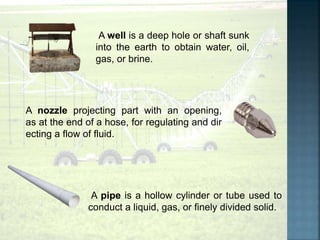
A pipe is a hollow cylinder or tube used to
conduct a liquid, gas, or finely divided solid.
A nozzle projecting part with an opening,
as at the end of a hose, for regulating and dir
ecting a flow of fluid.
A well is a deep hole or shaft sunk
into the earth to obtain water, oil,
gas, or brine.
Water management (Agriculture)

Water management (Agriculture)

  • 2.
    Water resource managementis the activity of planning, developing, distributing and managing the optimum use of water resources. It is a sub- set of water cycle management. Ideally, water resource management planning has regard to all the competing demands for water and seeks to allocate water on an equitable basis to satisfy all uses and demands.
  • 3.
    Cultivated is extremelysensitive to water shortages. Good water management practices are needed to keep usage at optimum levels and to maximize the production.
  • 4.
    •Proper creation andmaintenance of field channels for water delivery •Land levelling that allows water to be evenly distributed and retained •Tilling operations that include field bund preparation, water puddling and maintenance •Bucket drip irrigation •Treadle pumps Pre-planting steps that help with water management include:
  • 6.
    A canal isan artificial channel generally trapezoidal in shape constructed on the ground to carry water to the field either from the river of from a reservoir.
  • 7.
    Drip irrigation, alsoknown as trickle irrigation or micro irrigation or localized irrigation, is an irrigation method that saves water and fertilizer by allowing water to drip slowly to the roots of plants, either onto the soil surface or directly onto the root zone, through a network of valves, pipes, tubing, and emitters. A Surface irrigation (gravity) system is a cheap effective way to provide water for a smaller sized crop area. The basic system is very simple consisting of an elevated reservoir with a pipe coming out the bottom that feeds water into a basic canal or drip irrigation system. A technique where water is applied and distributed over the soil surface by gravity
  • 8.
    Furrow irrigation isconducted by creating small parallel channels along the field length in the direction of predominant slope. Water is applied to the top end of each furrow and flows down the field under the influence of gravity. Center pivot irrigation is a form of sprinkler irrigation consisting of several segments of pipe joined together and supported by trusses, mounted on wheeled towers with sprinklers positioned along its length. The system moves in a circular pattern and is fed with water from the pivot point at the center of the arc.
  • 9.
    Irrigation by Lateralmove (side roll, wheel line, wheelmove) A series of pipes, each with a wheel permanently affixed to its midpoint, and sprinklers along its length, are coupled together.
  • 10.
    A reservoir isa natural or artificial place where water is collected and stored for use, especially water for supplying a community, irrigating land, furnishing power. Tank or cistern is a container for the storage of a liquid. A dam is barrier constructed across a waterway to control the flow or raise the level of water.
  • 11.
    A pump isa device that moves fluids (liquids or gases), or sometimes slurries, by mechanical action. Pumps can be classified into three major groups according to the method they use to move the fluid: direct lift, displacement, and gravity pumps. Irrigation sprinklers are sprinklers providing irrigation to vegetation. Water is distributed through a system of pipes usually by pumping. Is a method of applying irrigation water which is similar to natural rainfall. A watering can (or watering pot) is a portable container, usually with a handle and a spout, used to water plants by hand.
  • 12.
    A pipe isa hollow cylinder or tube used to conduct a liquid, gas, or finely divided solid. A nozzle projecting part with an opening, as at the end of a hose, for regulating and dir ecting a flow of fluid. A well is a deep hole or shaft sunk into the earth to obtain water, oil, gas, or brine.