Welcome
Dr. Karan Verma
Assistant Professor (Agronomy)
MMU, Sadopur, Ambala
Sources of irrigation, Water
resources and irrigation
development in India and
importance of irrigation in
Agriculture
Topic-
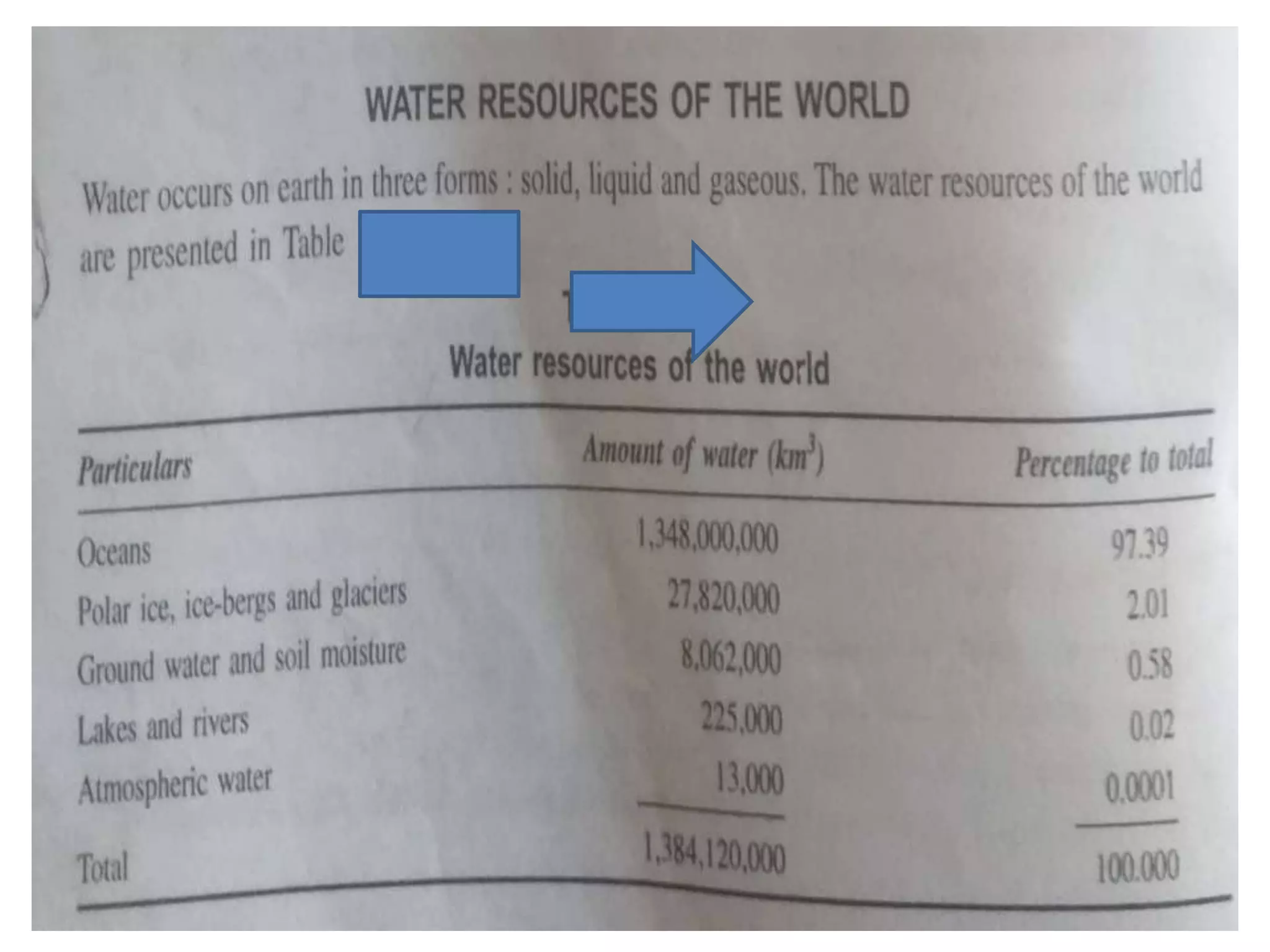
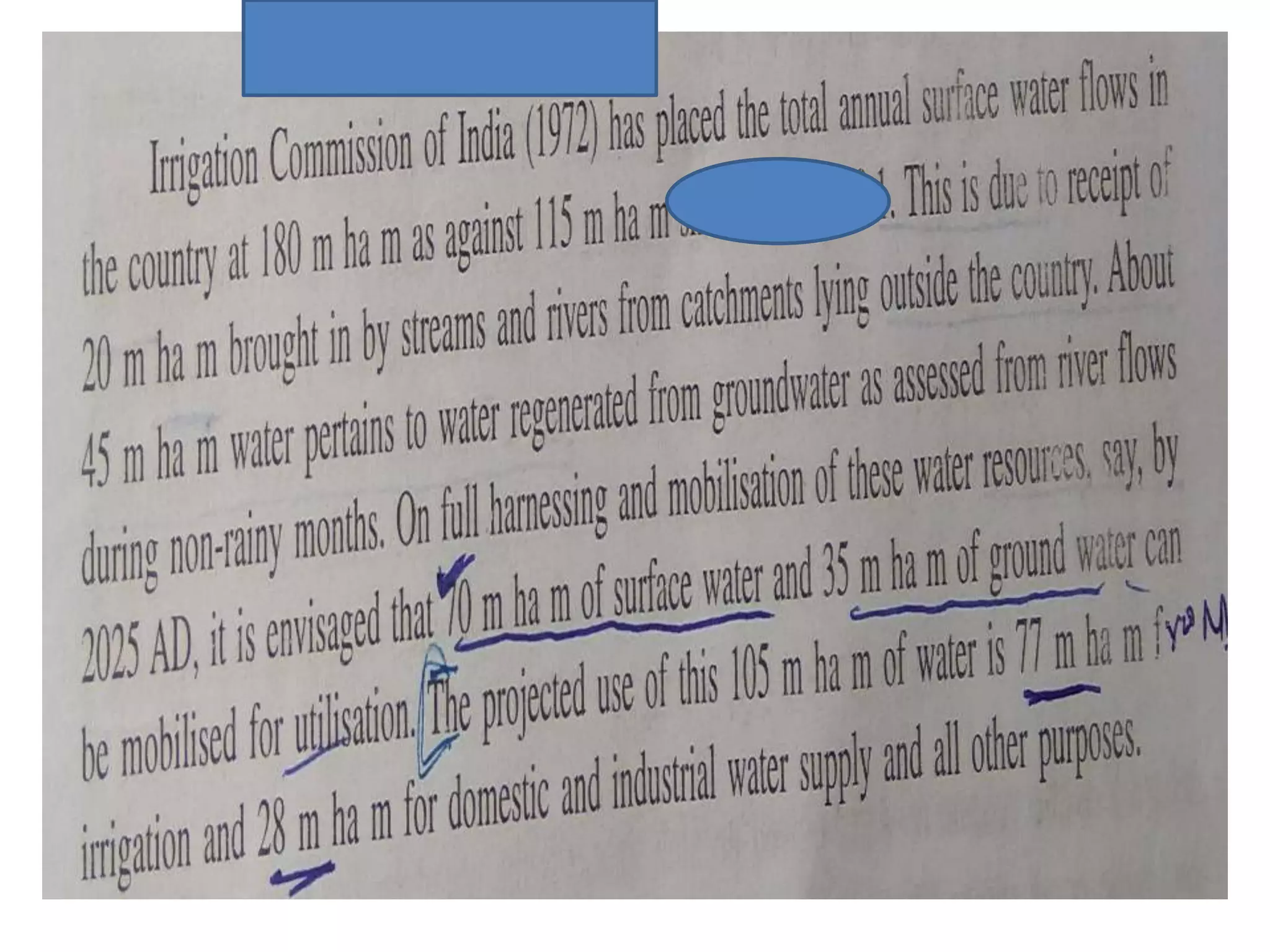
Fig. Flow chart showing the water resources of India
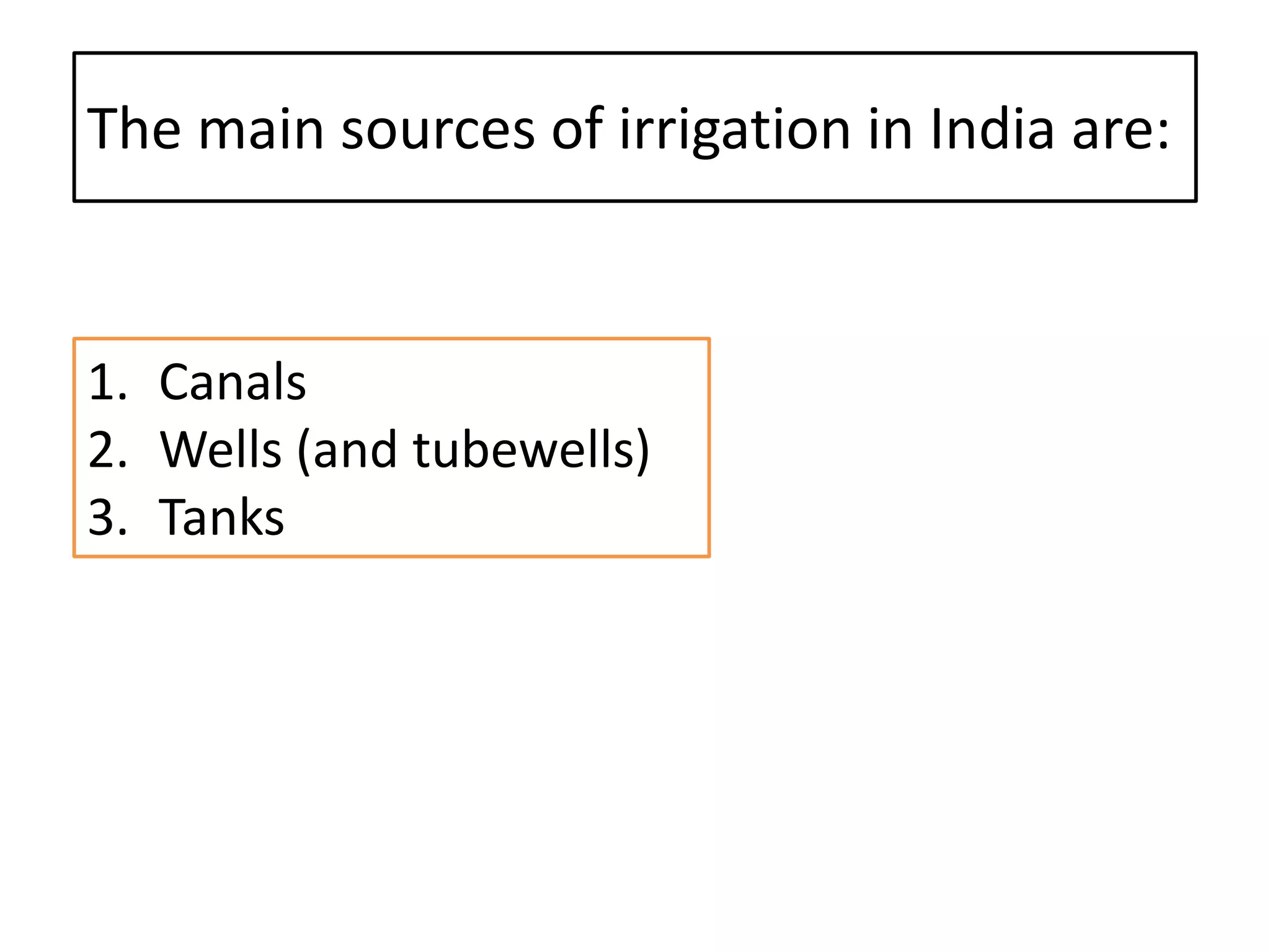
The main sources of irrigation in India are:
1. Canals
2. Wells (and tubewells)
3. Tanks
1. Canal Irrigation:
•A canal is an artificial watercourse constructed for
water supply and irrigation.
Sardar Sarovar Canal in Gujarat
•There are two types of canals:
Inundation Canals – These are taken out from the
rivers without any regulating system like weirs etc at
their head. Such canals are useful only during the
rainy season
Perennial Canals – These are those which are taken
off from perennial rivers by constructing a barrage
across the river. Most of the canals at present in India
are perennial.
•Canals can be an effective source of
irrigation in areas of low relief, deep fertile
soils, perennial source of water and an
extensive command area. Therefore the
main concentration of canal irrigation is in
the northern plains.
•The canals are practically absent from the
peninsular plateau region because of
rocky terrain. However, the coastal and
the delta regions in South India have
some canals for irrigation.
Canal Irrigation in India
•The percentage of canal irrigation area to total irrigated area in the
country has fallen from about 40% in 1950-51 to less than 25% at
present.
•The states UP, Punjab, Haryana, Rajasthan and Bihar account for about
60% of the canal irrigated area in the country.
•Merits of canal irrigation:
Perennial Source
Provides safety from droughts
Brings fertile sediments to the fields
Economical to serve a large area
•Demerits:
 Canal water soaks into the ground and leads to water logging,
increases salinization, and leads to marshy conditions leading to
malaria and flooding
Wastage of water.
2. Wells (and Tube Wells)
•A well is a hole dug in the ground to obtain the subsoil
water. An ordinary well is about 3-5 metres deep but
deeper wells up to 15 metres are also dug.
•This method of irrigation has been used in India from
time immemorial. Various methods are used to lift the
ground water from the well. Some of the widely used
methods are the persian wheel, reht, charas or mot,
and dinghly boat etc.
•A tube well is a deeper well (generally over 15 metres
deep) from which water is lifted with the help of a
pumping set operated by an electric motor or a diesel
engine.
A tubewell
• Well irrigation is gradually giving way to energized tube wells.
But there are many wells still in use where electricity is not
available or the farmers are too poor to afford diesel oil.
• This method of irrigation is popular in those areas where
sufficient sweet ground water is available.
• It is particularly suitable in areas with permeable rock structure
which allows accumulation of ground water through percolation.
Therefore wells are seen more in areas with alluvial soil, regur
soil, etc. and less seen in rocky terrain or mountainous regions.
• These areas include a large part of the great northern
plains, the deltaic regions of the Mahanadi, the Godavari,
the Krishna and the Cauvery, parts of the Narmada and the
Tapi valleys and the weathered layers of the Deccan trap
and crystalline rocks and the sedimentary zones of the
peninsula
•However, the greater part of peninsular India is not suitable
for well irrigation due to rocky structure, uneven surface and
lack of underground water.
•Large dry tracts of Rajasthan, the adjoining parts of Punjab,
Haryana and Gujarat and some parts of Up have brackish
ground water which is not fit for irrigation and human
consumption and hence unsuitable for well irrigation
•At present irrigation from wells and tubewells accounts
for more than 60% of the net irrigated area in the
country.
•UP has the largest area under well irrigation which
accounts for 28% of the well irrigated area of the
country. U.P., Rajasthan, Punjab, Madhya Pradesh,
Gujarat, Bihar and Andhra Pradesh account for about
three-fourths of the total well-irrigated area
• Merits of well irrigation
Simplest
Cheapest
Well is an independent source of irrigation and can be used as
and when the necessity arises. Canal irrigation, on the other
hand, is controlled by other agencies and cannot be used at
will.
Some ground water salts are useful for crops
Does not lead to salinization and flooding problems
There is a limit to the extent of canal irrigation beyond the tail
end of the canal while a well can be dug at any convenient
place.
Demerits
Only limited area can be irrigated. Normally, a well
can irrigate 1 to 8 hectares of land.
Not suitable for dry regions
Overuse may lead to lowering of water table
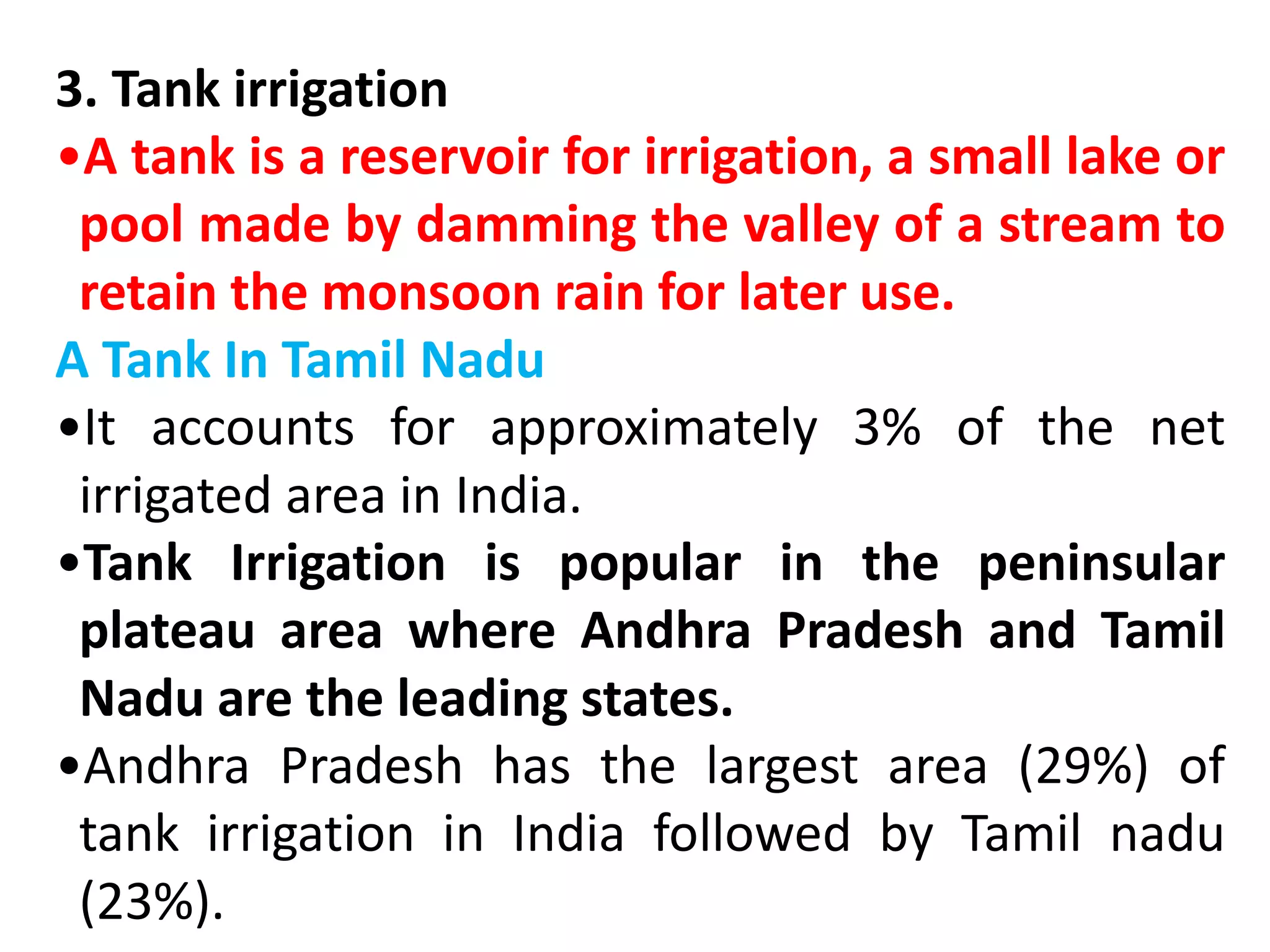
3. Tank irrigation
•A tank is a reservoir for irrigation, a small lake or
pool made by damming the valley of a stream to
retain the monsoon rain for later use.
A Tank In Tamil Nadu
•It accounts for approximately 3% of the net
irrigated area in India.
•Tank Irrigation is popular in the peninsular
plateau area where Andhra Pradesh and Tamil
Nadu are the leading states.
•Andhra Pradesh has the largest area (29%) of
tank irrigation in India followed by Tamil nadu
(23%).
Tank Irrigation in India
• It is practised mainly in the peninsular region due to
the following reasons:
oThe undulating relief and hard rocks make it difficult
to dig canals and wells
oThere is little percolation of water due to hard rock
structure and ground water is not available in large
quantities.
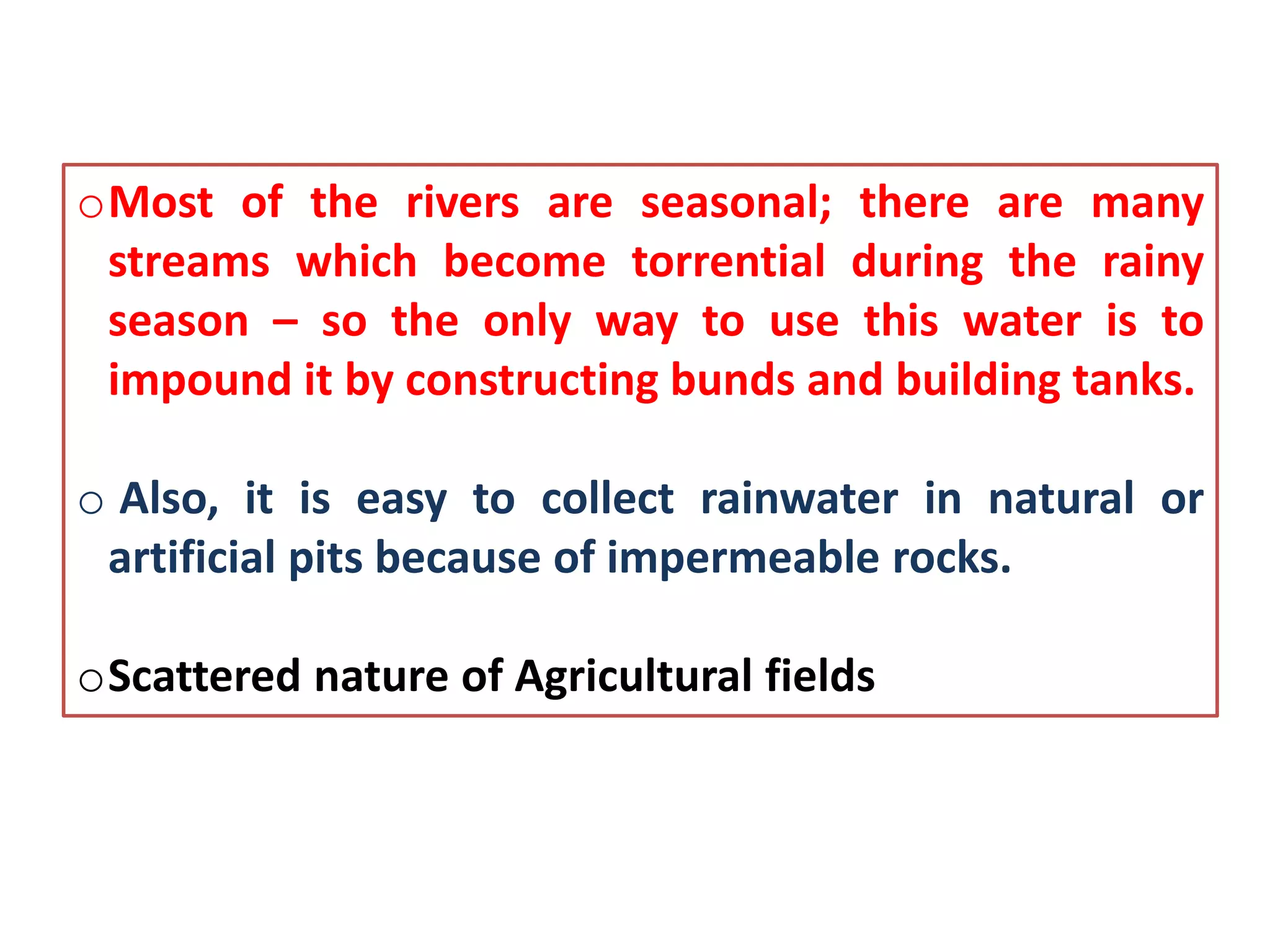
oMost of the rivers are seasonal; there are many
streams which become torrential during the rainy
season – so the only way to use this water is to
impound it by constructing bunds and building tanks.
o Also, it is easy to collect rainwater in natural or
artificial pits because of impermeable rocks.
oScattered nature of Agricultural fields
Merits
 Most of the tanks are natural and do not involve cost for
their construction
 Independent source for an individual farmer or a small
group of farmers
 longer life span
 can be used for fishing also
Demerits
 Depends on rain and these tanks may dry up during the
dry season
 Silting of their beds
 Require large areas
 Evaporation losses
 Sometimes there might be a need to lift the water to take
it to the field
Different Sources of Irrigation
Importance of Irrigation in Agriculture
 Control of drought and Famines, uncertain and irregular rain
causes uncertainty in agriculture.
 Productivity on irrigated land is considerably more than the
productivity on un-irrigated land.
 Since India has a tropical and sub-tropical climate, it has
potentialities to grow crops on a year round basis. However,
since 80 % of the annual rainfall is received in less than four
months, multiple cropping is generally not possible. Provision
of irrigation facilities can make possible the growing of two or
three crops in a year in most areas of the country. This will
considerably enhance agriculture production and productivity .
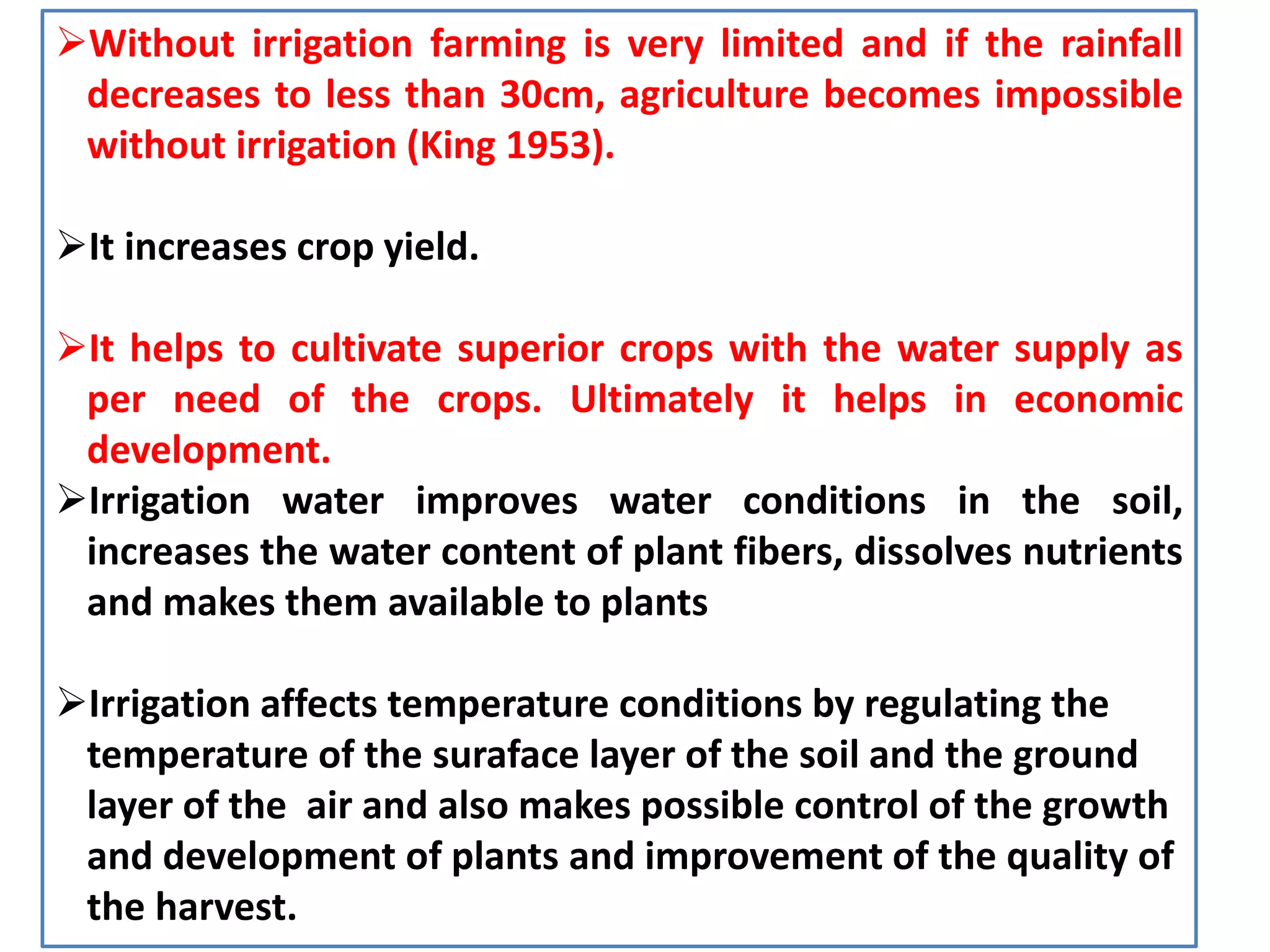
Without irrigation farming is very limited and if the rainfall
decreases to less than 30cm, agriculture becomes impossible
without irrigation (King 1953).
It increases crop yield.
It helps to cultivate superior crops with the water supply as
per need of the crops. Ultimately it helps in economic
development.
Irrigation water improves water conditions in the soil,
increases the water content of plant fibers, dissolves nutrients
and makes them available to plants
Irrigation affects temperature conditions by regulating the
temperature of the suraface layer of the soil and the ground
layer of the air and also makes possible control of the growth
and development of plants and improvement of the quality of
the harvest.
•Irrigation helps in achieving targeted yield
through better plant growth and development
sources of irrigation MMU Ambala

sources of irrigation MMU Ambala

  • 1.
    Welcome Dr. Karan Verma AssistantProfessor (Agronomy) MMU, Sadopur, Ambala
  • 2.
    Sources of irrigation,Water resources and irrigation development in India and importance of irrigation in Agriculture Topic-
  • 6.
    Fig. Flow chartshowing the water resources of India
  • 9.
    The main sourcesof irrigation in India are: 1. Canals 2. Wells (and tubewells) 3. Tanks
  • 10.
    1. Canal Irrigation: •Acanal is an artificial watercourse constructed for water supply and irrigation. Sardar Sarovar Canal in Gujarat •There are two types of canals: Inundation Canals – These are taken out from the rivers without any regulating system like weirs etc at their head. Such canals are useful only during the rainy season Perennial Canals – These are those which are taken off from perennial rivers by constructing a barrage across the river. Most of the canals at present in India are perennial.
  • 11.
    •Canals can bean effective source of irrigation in areas of low relief, deep fertile soils, perennial source of water and an extensive command area. Therefore the main concentration of canal irrigation is in the northern plains. •The canals are practically absent from the peninsular plateau region because of rocky terrain. However, the coastal and the delta regions in South India have some canals for irrigation.
  • 12.
    Canal Irrigation inIndia •The percentage of canal irrigation area to total irrigated area in the country has fallen from about 40% in 1950-51 to less than 25% at present. •The states UP, Punjab, Haryana, Rajasthan and Bihar account for about 60% of the canal irrigated area in the country. •Merits of canal irrigation: Perennial Source Provides safety from droughts Brings fertile sediments to the fields Economical to serve a large area •Demerits:  Canal water soaks into the ground and leads to water logging, increases salinization, and leads to marshy conditions leading to malaria and flooding Wastage of water.
  • 13.
    2. Wells (andTube Wells) •A well is a hole dug in the ground to obtain the subsoil water. An ordinary well is about 3-5 metres deep but deeper wells up to 15 metres are also dug. •This method of irrigation has been used in India from time immemorial. Various methods are used to lift the ground water from the well. Some of the widely used methods are the persian wheel, reht, charas or mot, and dinghly boat etc. •A tube well is a deeper well (generally over 15 metres deep) from which water is lifted with the help of a pumping set operated by an electric motor or a diesel engine.
  • 14.
    A tubewell • Wellirrigation is gradually giving way to energized tube wells. But there are many wells still in use where electricity is not available or the farmers are too poor to afford diesel oil. • This method of irrigation is popular in those areas where sufficient sweet ground water is available. • It is particularly suitable in areas with permeable rock structure which allows accumulation of ground water through percolation. Therefore wells are seen more in areas with alluvial soil, regur soil, etc. and less seen in rocky terrain or mountainous regions.
  • 15.
    • These areasinclude a large part of the great northern plains, the deltaic regions of the Mahanadi, the Godavari, the Krishna and the Cauvery, parts of the Narmada and the Tapi valleys and the weathered layers of the Deccan trap and crystalline rocks and the sedimentary zones of the peninsula •However, the greater part of peninsular India is not suitable for well irrigation due to rocky structure, uneven surface and lack of underground water. •Large dry tracts of Rajasthan, the adjoining parts of Punjab, Haryana and Gujarat and some parts of Up have brackish ground water which is not fit for irrigation and human consumption and hence unsuitable for well irrigation
  • 16.
    •At present irrigationfrom wells and tubewells accounts for more than 60% of the net irrigated area in the country. •UP has the largest area under well irrigation which accounts for 28% of the well irrigated area of the country. U.P., Rajasthan, Punjab, Madhya Pradesh, Gujarat, Bihar and Andhra Pradesh account for about three-fourths of the total well-irrigated area
  • 17.
    • Merits ofwell irrigation Simplest Cheapest Well is an independent source of irrigation and can be used as and when the necessity arises. Canal irrigation, on the other hand, is controlled by other agencies and cannot be used at will. Some ground water salts are useful for crops Does not lead to salinization and flooding problems There is a limit to the extent of canal irrigation beyond the tail end of the canal while a well can be dug at any convenient place.
  • 18.
    Demerits Only limited areacan be irrigated. Normally, a well can irrigate 1 to 8 hectares of land. Not suitable for dry regions Overuse may lead to lowering of water table
  • 19.
    3. Tank irrigation •Atank is a reservoir for irrigation, a small lake or pool made by damming the valley of a stream to retain the monsoon rain for later use. A Tank In Tamil Nadu •It accounts for approximately 3% of the net irrigated area in India. •Tank Irrigation is popular in the peninsular plateau area where Andhra Pradesh and Tamil Nadu are the leading states. •Andhra Pradesh has the largest area (29%) of tank irrigation in India followed by Tamil nadu (23%).
  • 20.
    Tank Irrigation inIndia • It is practised mainly in the peninsular region due to the following reasons: oThe undulating relief and hard rocks make it difficult to dig canals and wells oThere is little percolation of water due to hard rock structure and ground water is not available in large quantities.
  • 21.
    oMost of therivers are seasonal; there are many streams which become torrential during the rainy season – so the only way to use this water is to impound it by constructing bunds and building tanks. o Also, it is easy to collect rainwater in natural or artificial pits because of impermeable rocks. oScattered nature of Agricultural fields
  • 22.
    Merits  Most ofthe tanks are natural and do not involve cost for their construction  Independent source for an individual farmer or a small group of farmers  longer life span  can be used for fishing also Demerits  Depends on rain and these tanks may dry up during the dry season  Silting of their beds  Require large areas  Evaporation losses  Sometimes there might be a need to lift the water to take it to the field
  • 23.
  • 24.
    Importance of Irrigationin Agriculture  Control of drought and Famines, uncertain and irregular rain causes uncertainty in agriculture.  Productivity on irrigated land is considerably more than the productivity on un-irrigated land.  Since India has a tropical and sub-tropical climate, it has potentialities to grow crops on a year round basis. However, since 80 % of the annual rainfall is received in less than four months, multiple cropping is generally not possible. Provision of irrigation facilities can make possible the growing of two or three crops in a year in most areas of the country. This will considerably enhance agriculture production and productivity .
  • 25.
    Without irrigation farmingis very limited and if the rainfall decreases to less than 30cm, agriculture becomes impossible without irrigation (King 1953). It increases crop yield. It helps to cultivate superior crops with the water supply as per need of the crops. Ultimately it helps in economic development. Irrigation water improves water conditions in the soil, increases the water content of plant fibers, dissolves nutrients and makes them available to plants Irrigation affects temperature conditions by regulating the temperature of the suraface layer of the soil and the ground layer of the air and also makes possible control of the growth and development of plants and improvement of the quality of the harvest.
  • 26.
    •Irrigation helps inachieving targeted yield through better plant growth and development

Editor's Notes

  • #2 Dr. Karan Verma Assistant Professor (Agronomy) MMU, Sadopur, Ambala
  • #7 Fig. Flow chart showing the water resources of India
  • #11 Inudation canal are lonf canals taken off large rivers they receive water when the river Is high enoguh and especially when in flood. While pereneial canal are lined to dams and barrages to provide water throgout the year and they irriagte vast are
  • #12 Peninsular plateau it is composed of the old crystalline igneous and metaphorpic rocks The plateu consists of broad and shallow valleys and rounded hills Coastal area means near sea area
  • #13 Sediments sand stones etc Salanization refers to a build up of salts in soil, 3000 to 6000 ppm salts results in trouble for most cultivated plants Salts in soils decreases the osmotic potential of the soil so that plants cant takr up water from it.
  • #14 Immemorail - Old historty
  • #15 Aluvail soil is developed by rivers or khichad soil Regur soil is a black cotton soil rich in iron lime calcium mg carbonates and alumina etc Deccan plateau is a large plateau in western and southern India. Peninsula means water around the soil Sedimentary zones – its formed by cementation or organic particles
  • #18 Corn, oats, yellow musterd etc useful for salt
  • #20 Damming --baand
  • #25 Famine means Akkal