


Historical Evolution of Catheterization & Interventions
Sir James Mackenzie, 1853–1925
• “There are three stages in the history of every medical discovery.
When it is first announced, people say that it is not true. Then, a little
later, when its truth has been borne on them, so that it can no longer
be denied, they say it is not important. After that, if its importance
becomes sufficiently obvious, they say that anyhow it is not new.”
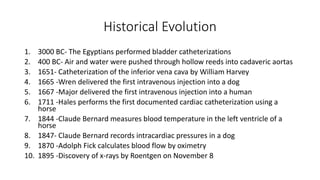
Historical Evolution
1. 3000 BC- The Egyptians performed bladder catheterizations
2. 400 BC- Air and water were pushed through hollow reeds into cadaveric aortas
3. 1651- Catheterization of the inferior vena cava by William Harvey
4. 1665 -Wren delivered the first intravenous injection into a dog
5. 1667 -Major delivered the first intravenous injection into a human
6. 1711 -Hales performs the first documented cardiac catheterization using a
horse
7. 1844 -Claude Bernard measures blood temperature in the left ventricle of a
horse
8. 1847- Claude Bernard records intracardiac pressures in a dog
9. 1870 -Adolph Fick calculates blood flow by oximetry
10. 1895 -Discovery of x-rays by Roentgen on November 8
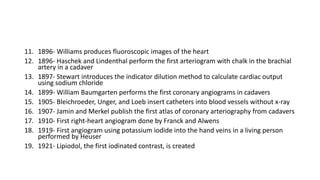
11. 1896- Williams produces fluoroscopic images of the heart
12. 1896- Haschek and Lindenthal perform the first arteriogram with chalk in the brachial
artery in a cadaver
13. 1897- Stewart introduces the indicator dilution method to calculate cardiac output
using sodium chloride
14. 1899- William Baumgarten performs the first coronary angiograms in cadavers
15. 1905- Bleichroeder, Unger, and Loeb insert catheters into blood vessels without x-ray
16. 1907- Jamin and Merkel publish the first atlas of coronary arteriography from cadavers
17. 1910- First right-heart angiogram done by Franck and Alwens
18. 1919- First angiogram using potassium iodide into the hand veins in a living person
performed by Heuser
19. 1921- Lipiodol, the first iodinated contrast, is created
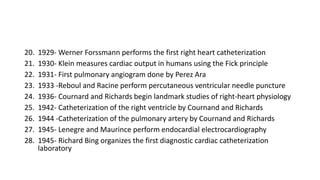
20. 1929- Werner Forssmann performs the first right heart catheterization
21. 1930- Klein measures cardiac output in humans using the Fick principle
22. 1931- First pulmonary angiogram done by Perez Ara
23. 1933 -Reboul and Racine perform percutaneous ventricular needle puncture
24. 1936- Cournard and Richards begin landmark studies of right-heart physiology
25. 1942- Catheterization of the right ventricle by Cournand and Richards
26. 1944 -Catheterization of the pulmonary artery by Cournand and Richards
27. 1945- Lenegre and Maurince perform endocardial electrocardiography
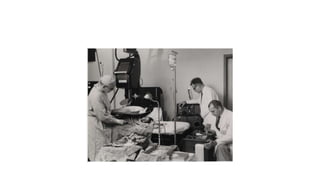
28. 1945- Richard Bing organizes the first diagnostic cardiac catheterization
laboratory
30. 1946–1947 Dexter studies patients with congenital heart disease.
31. 1947- Zimmerman developed a completely intravascular technique for left heart
catheterization
32. 1947 -Bing reports the catheterization of the coronary sinus
33. 1949–1950 Development of cineangiography and imaging intensifier
34. 1951- Dotter creates the first balloon-tipped angiographic catheter
35. 1951- Gorlin and Gorlin develop the formula to calculate stenotic valve areas
36. 1952- Facquet and colleagues develop transbronchial left atrial puncture using a rigid
bronchoscope
37. 1953 -Bjork performs left atrial puncture using the posterior paravertebral approach
38. 1953- Hansen performs left atrial puncture using the suprasternal puncture route
39. 1953- Seldinger develops a percutaneous approach for the introduction of catheters
40. 1956- Forssmann, Cournand, and Richards are awarded the Nobel Prize in physiology
41. 1956- Brock reports the apical approach to left ventricular puncture
42. 1958- Sones develops coronary angiography at the Cleveland Clinic
43. 1959- Ross performs the first transeptal left atrial puncture
44. 1963 -Dotter, by serendipity, recanalizes an occluded right iliac artery
45. 1964 -Dotter and Judkins perform the first intentional transluminal
dilatation in a left popliteal artery
46. 1967- Judkins and Amplatz developed catheters for coronary
angiography
47. 1968- Schoonmaker and King create the multipurpose catheter
48. 1970- The Swan-Ganz catheter is introduced
49. 1976 -Chazov performs intracoronary lysis with streptokinase
50. 1977- Grüntzig and Myler perform the first human coronary
angioplasty during bypass surgery at St. Mary’s Hospital in San
Francisco
51. 1977- On September 16, Gruentzig performs the first coronary
angioplasty in an awake human in Zurich Switzerland
52. 1978- Rentrop performs dislodgement of intracoronary thrombi
with guidewires for the treatment of acute myocardial infarction
53. 1978- Grüntzig reports the first angioplasty of renal artery stenosis
54. 1978 – Myler and Stertzler – 1 st PTCA in the U.S.
55. 1980 – Guiding catheters introduced
56. 1982- Over the wire systems and steerable guide wires.
57. 1986-1st coronary self expanding wall stents
58. Jacques Puel and Ulrick Sigwart Toulose, France
59. IVUS
60. 1989 – Palmaz-Schatz stent developed
61. 1992 -First cath and PCI from the radial approach– Dr Ferdinand
Kiemeneis Driven by an effort to reduce bleeding complications
from femoral access with post procedure anticoagulation
• Date cath lab first opened under the direction of: 1972 Dr. Phillip
Shiner
• First coronary angioplasty: 1985 Dr. Phillip Shiner and Dr. John Starr
• First coronary stent:– 1991
• First rotational atherectomy– 1995
• First pacemaker:
• First ICD: 1995
• First Aflutter Ablation– 1988
Historical evolution of catheterization & interventions

Historical evolution of catheterization & interventions

  • 1.
    Historical Evolution ofCatheterization & Interventions
  • 3.
    Sir James Mackenzie,1853–1925 • “There are three stages in the history of every medical discovery. When it is first announced, people say that it is not true. Then, a little later, when its truth has been borne on them, so that it can no longer be denied, they say it is not important. After that, if its importance becomes sufficiently obvious, they say that anyhow it is not new.”
  • 4.
    Historical Evolution 1. 3000BC- The Egyptians performed bladder catheterizations 2. 400 BC- Air and water were pushed through hollow reeds into cadaveric aortas 3. 1651- Catheterization of the inferior vena cava by William Harvey 4. 1665 -Wren delivered the first intravenous injection into a dog 5. 1667 -Major delivered the first intravenous injection into a human 6. 1711 -Hales performs the first documented cardiac catheterization using a horse 7. 1844 -Claude Bernard measures blood temperature in the left ventricle of a horse 8. 1847- Claude Bernard records intracardiac pressures in a dog 9. 1870 -Adolph Fick calculates blood flow by oximetry 10. 1895 -Discovery of x-rays by Roentgen on November 8
  • 5.
    11. 1896- Williamsproduces fluoroscopic images of the heart 12. 1896- Haschek and Lindenthal perform the first arteriogram with chalk in the brachial artery in a cadaver 13. 1897- Stewart introduces the indicator dilution method to calculate cardiac output using sodium chloride 14. 1899- William Baumgarten performs the first coronary angiograms in cadavers 15. 1905- Bleichroeder, Unger, and Loeb insert catheters into blood vessels without x-ray 16. 1907- Jamin and Merkel publish the first atlas of coronary arteriography from cadavers 17. 1910- First right-heart angiogram done by Franck and Alwens 18. 1919- First angiogram using potassium iodide into the hand veins in a living person performed by Heuser 19. 1921- Lipiodol, the first iodinated contrast, is created
  • 6.
    20. 1929- WernerForssmann performs the first right heart catheterization 21. 1930- Klein measures cardiac output in humans using the Fick principle 22. 1931- First pulmonary angiogram done by Perez Ara 23. 1933 -Reboul and Racine perform percutaneous ventricular needle puncture 24. 1936- Cournard and Richards begin landmark studies of right-heart physiology 25. 1942- Catheterization of the right ventricle by Cournand and Richards 26. 1944 -Catheterization of the pulmonary artery by Cournand and Richards 27. 1945- Lenegre and Maurince perform endocardial electrocardiography 28. 1945- Richard Bing organizes the first diagnostic cardiac catheterization laboratory
  • 7.
    30. 1946–1947 Dexterstudies patients with congenital heart disease. 31. 1947- Zimmerman developed a completely intravascular technique for left heart catheterization 32. 1947 -Bing reports the catheterization of the coronary sinus 33. 1949–1950 Development of cineangiography and imaging intensifier 34. 1951- Dotter creates the first balloon-tipped angiographic catheter 35. 1951- Gorlin and Gorlin develop the formula to calculate stenotic valve areas 36. 1952- Facquet and colleagues develop transbronchial left atrial puncture using a rigid bronchoscope 37. 1953 -Bjork performs left atrial puncture using the posterior paravertebral approach 38. 1953- Hansen performs left atrial puncture using the suprasternal puncture route 39. 1953- Seldinger develops a percutaneous approach for the introduction of catheters 40. 1956- Forssmann, Cournand, and Richards are awarded the Nobel Prize in physiology
  • 8.
    41. 1956- Brockreports the apical approach to left ventricular puncture 42. 1958- Sones develops coronary angiography at the Cleveland Clinic 43. 1959- Ross performs the first transeptal left atrial puncture 44. 1963 -Dotter, by serendipity, recanalizes an occluded right iliac artery 45. 1964 -Dotter and Judkins perform the first intentional transluminal dilatation in a left popliteal artery 46. 1967- Judkins and Amplatz developed catheters for coronary angiography 47. 1968- Schoonmaker and King create the multipurpose catheter 48. 1970- The Swan-Ganz catheter is introduced 49. 1976 -Chazov performs intracoronary lysis with streptokinase
  • 9.
    50. 1977- Grüntzigand Myler perform the first human coronary angioplasty during bypass surgery at St. Mary’s Hospital in San Francisco 51. 1977- On September 16, Gruentzig performs the first coronary angioplasty in an awake human in Zurich Switzerland 52. 1978- Rentrop performs dislodgement of intracoronary thrombi with guidewires for the treatment of acute myocardial infarction 53. 1978- Grüntzig reports the first angioplasty of renal artery stenosis
  • 10.
    54. 1978 –Myler and Stertzler – 1 st PTCA in the U.S. 55. 1980 – Guiding catheters introduced
  • 11.
    56. 1982- Overthe wire systems and steerable guide wires. 57. 1986-1st coronary self expanding wall stents 58. Jacques Puel and Ulrick Sigwart Toulose, France 59. IVUS 60. 1989 – Palmaz-Schatz stent developed 61. 1992 -First cath and PCI from the radial approach– Dr Ferdinand Kiemeneis Driven by an effort to reduce bleeding complications from femoral access with post procedure anticoagulation
  • 12.
    • Date cathlab first opened under the direction of: 1972 Dr. Phillip Shiner • First coronary angioplasty: 1985 Dr. Phillip Shiner and Dr. John Starr • First coronary stent:– 1991 • First rotational atherectomy– 1995 • First pacemaker: • First ICD: 1995 • First Aflutter Ablation– 1988