HISTOTECHNIQUES - PART 2

             Dr Swati Patil
Decalcification
•   Tissue : bones & teeth

•   Criteria for suitable decalcifying agent:
-   Complete removal of Ca salts
-   Lack of distortion of cells & connective tissue
-   Lack of harmful effect on staining reactions
-   Speed for removal of Ca salts
Methods of decalcification:
• Chemical method
  -Acid reagents
    -Nitric acid-                4hrs
    -Trichloracetic acid-        48hrs for small
    -Formic acid-                 12-24hrs
 Chelating agents:
     Ethylene Diamine Tetra acetic acid[EDTA]- 4-40 days
•  Ion–exchange resin method
( ammonium form of sulphonated polysterene resin)

•   Electrophoretic method
Knowing the decalcification end point:
• Chemical test:
 after 6-12 hrs of decalcification,
5ml of decalcifying fluid + 5ml ammonium hydroxide +
                  5ml ammonium oxalate.

-Observation :
Absence of turbidity- complete decalcification
Turbidity appears – specimen is not thoroughly not
   decalcified.
    Change the decalcifying agent, repeat the test.


•    X-ray examination:
Washing after fixation
• To remove excess fixative
• Thorough washing in appropriate fluid after fixation is
  essential for good staining.
   -mercuric chloride, acid fixatives
Is fixation always necessary
ď‚§ Fixation is 1st step towards preparation of histological
  sections.
ď‚§ Certain structures like chitin, cellulose do not require
  fixation
Storage of fixing fluids
• Artefacts after fixation:
   - Extrinsic:
   - Intrinsic:
           primary-
           secondary-
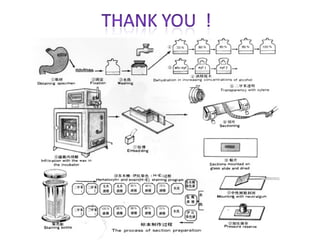
Dehydration
• Definition:
Removal of water & fixative from tissue, & replaced them
  with dehydrating fluid.
-For this purpose alcohols of various strengths are used
-As alcohols are hydrophilic in nature, it drags water from
  tissues by diffusion.
-So the increasing concentrations starting from 50%, 70%,
  90%& two replacements of absolute alcohols are used.
-For delicate tissues like embryos, animal tissue start conc.
  with 30% dilution.
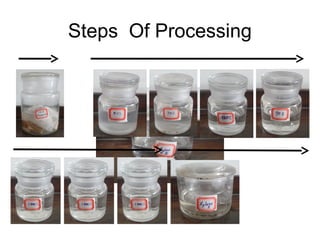
Steps Of Processing
• Time required for dehydration
For tissue thickness <5mm – 2-3 hrs.
Change from one bath to that of another done at hourly
interval.
For absolute alcohol bath - 1-11/2 hr each.

• Volume of dehydrating agent- 10 times that of tissue.
• Dehydrating fluids:
-Ethanol: used in final dehydration steps , to ensure total
   dehydration.
-Industrial methylated spirit: (denatured alcohol)
   ethanol +1% methanol
-Methanol:
-Propanol: isopropyl alcohol: No excised duty. Increasingly
   used in histology labs.
   especially with methods of microwave.
-Acetone: rapid in action, poor penetration, less cost, only
   used for urgent reports.
Anhydrous CuSO4:
- Dehydrating agent as well as Indicator of dehydration
    It is placed in last alcohol bath in automated tissue
    processor.
    It changes to blue color in presence of water.
- Indication for presence of water in last bath of
    alcohol particularly useful for automatic tissue
    processing
-Change of ethanol, from last bath of absolute alcohol.
Discard the first one of 100% ethanol, move down
the others, so that last bath has fresh 100% ethanol
Clearing
• Clearing (Dealcoholisation) :
-clearing agent miscible with both alcohol & paraffin wax.
-have similar refractive index with protein
-clearing agents are liquids whose function is to make
   tissue transparent by raising refractive index of any
   specimen. This makes tissue transparent hence
   procedure called as clearing.
• Clearing in Paraffin wax embedding:

• Clearing in mounting:
• Criteria for suitable clearing agents:
  -Speedy removal of dehydrating agents.
  -Ease of removal of molten paraffin wax.
  -Minimum tissue damage.
  -Flammability
  -Toxicity
  -Cost
• Factors determining the speed of replacement:
  -Boiling point
  -Viscosity
• Clearing agents suitable for general use:
 -Xylene: -used for routine histology schedules < 24 hrs &
  tissue size < 5mm
   -prolonged use overhardens & shrinks tissue
   -inadequate dehydration causes formation of whitish
  emulsion

 -Toluene & benzene: less damages the tissue even if on
  prolonged immersion
   -toluene is less toxic than benzene
-Chloroform:
   -hardening is almost nil as compare to xylene but
   -penetration effect is very slow & transparency is less.
   -non flammable but releases phosgene gas on heating.
- Cedar-wood oil:
   -used to clear both the paraffin & celloidin sections
   -penetration is well, improves section cutting
   -slow in action & less damaging to tissue.
   -traces of oil retained, emersion in xylene is
   necessary prior to paraffin impregnation.
   -expensive
Impregnation
• Definition: Impregnation is process involves placement
  of tissues with medium that will fill all natural cavities,
  spaces, & interstices of tissues, even inter constituent
  space of cell, replaces clearing agent & terminates with
  making of block.
  - Impregnation (paraffin) supports tissue from all sides
  with firmness without producing any injurious effects on
  tissues.
   -It allows cutting of tissues suitably thin sections without
  undue distortion & without alteration of spatial
  relationships of tissue & cellular elements.
• Methods :
-Paraffin embedding:
  -simpler, better for routine use
  -allows thin section to be cut
  -about 10% shrinkage of section on cooling
-Celloidin embedding:
   - suitable for specimens containing large cavities or hollow
  spaces and layers which tend to collapse e.g. eyes, larger
  embryos
   -slow, tedious, does not allow serial sections
   -causes much less shrinkage & distortion
   -require no heat & heavy microtome


• Volume of impregnating medium: at least 25 times of the
Embedding
• After completely impregnation with suitable medium,
  solid block of suitable medium containing impregnated
  tissue is obtained by embedding.
• Done by
- Filling mould of suitable size with molten paraffin wax.
- Orienting specimen in mould to ensure its being cut in
  right plane.
- Cooling mass to promote solidification
• Types of embedding medium:
-Ribboning media:
         eg. paraffin, soap
-Non-ribboning media:
          eg. sugar, gum solution, gelatin

• Methods of embedding:
-Fusion embedding method: eg paraffin embedding

-Evaporation embedding method : eg. Celloidin
  embedding
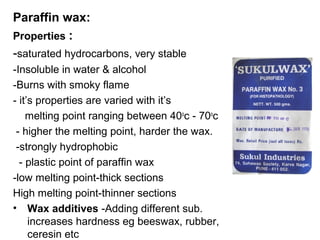
Paraffin wax:
Properties :
-saturated hydrocarbons, very stable
-Insoluble in water & alcohol
-Burns with smoky flame
- it’s properties are varied with it’s
    melting point ranging between 40oc - 70oc
 - higher the melting point, harder the wax.
 -strongly hydrophobic
  - plastic point of paraffin wax
-low melting point-thick sections
High melting point-thinner sections
• Wax additives -Adding different sub.
     increases hardness eg beeswax, rubber,
     ceresin etc
• Other waxes:
Bees wax, candle wax, ester wax, carbowax (polyethylene
  glycol)

• Adv of carbowax:
- It is soluble & miscible in water, hence embedding can be
    done directly by eliminating clearing & dehydration.
-because of this lipids & neutral fats can be demonstrated in
    thin sections.
-technique is good for enzyme histochemistry.
-reduces processing time.
-reduces shrinkage & distortion.
Paraffin Embedding

• Advantages
-Reasonable speed of processing

-Good consistency for serial sectioning

-A wide range of section thickness & durability of block
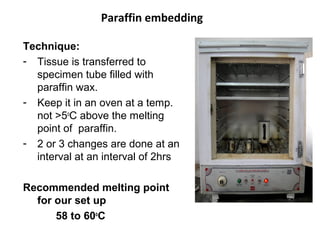
Paraffin embedding

Technique:
- Tissue is transferred to
  specimen tube filled with
  paraffin wax.
- Keep it in an oven at a temp.
  not >5oC above the melting
  point of paraffin.
- 2 or 3 changes are done at an
  interval at an interval of 2hrs

Recommended melting point
  for our set up
      58 to 60oC
• Storage of Paraffin Block:

-Block should be stored in a cool place

- Cut surface should be protected from dust & vermin
Types of Moulds

•   Leuckhart’s L pieces:
•   Glass petri dishes:
•   Metal petri dishes:
•   Paper boats:
•   Test tubes:
•   Plastic embedding rings:
•   Tissue Tek 2 embedding rings:
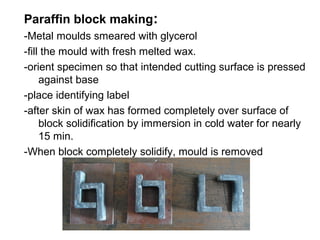
Paraffin block making:
-Metal moulds smeared with glycerol
-fill the mould with fresh melted wax.
-orient specimen so that intended cutting surface is pressed
     against base
-place identifying label
-after skin of wax has formed completely over surface of
     block solidification by immersion in cold water for nearly
     15 min.
-When block completely solidify, mould is removed
Cellulose Nitrate / Low viscosity
              Nitrocellulose
-considerably less shrinkage
-improved cutting qualities of large blocks of dense tissue.
   Eg: tooth, embryos
-facilitate production of sections of brain
-preserving relationships of all tissue layers of different
   consistency. eg: eye
Disadvantages:
- Sections less than 10 mm are not possible.
- Non ribboning media
- Slow process, taking several weeks
Double Embedding

• Combination of celloidin & paraffin embedding
• To get sections with improved cohesion of tissue layers &
  plasticity given by celloidin with facility of cutting ribbons of
  sections from dry durable block which is characteristic of
  paraffin.
• Organs benefited: bone, brain, muscle, large pieces of
  dense fibrous tissue
Vacuum embedding
  -Evaporation of clearing agent
  -Impregnation of paraffin wax
  -Removal of trapped air in specimen
  -Reduce impregnation Time to half.
  -Carried out in vacuum embedding oven.
  -If conti. Bubbles are coming, indicates inadequate
   dehydration & clearing.

Tissues benefited by vacuum impregnation:
   Lungs, muscle, spleen, decalcified bone, skin &
   nervous tissue.
Automatic Tissue Processing
• Principle
Time required for tissue processing may
be considerably reduced when tissue is Suspended in
fluid, Continuously agitated, Moved from one reagent
to another whenever desired, not restricted by working
hours.


• Processors are configured with preset interval for different
  schedules of suspension, agitation, &
   automatic changeover
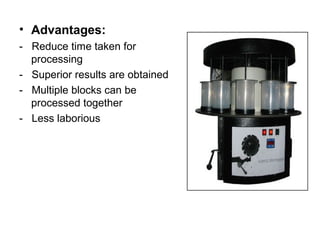
• Advantages:
- Reduce time taken for
  processing
- Superior results are obtained
- Multiple blocks can be
  processed together
- Less laborious
Freeze Drying
• Theoretically only water is removed from tissue because
  of that
- No alteration in arrangement or quantity of any other
  tissue components & enzymes.
- routine steps of tissue processing are avoided

• Use: special procedures like histochemical investigations
  for different enzymes
• Technique:
- Fresh tissue of size 1mm, immediately freeze by
  immersion in isopentane cooled by liquid nitrogen (-
  1500c)
- Transferred to drying chamber (-30 to -60 0c) under
  vacuum,
- Ice is removed by sublimation, & water vapours
  absorbed by phosphorus pentoxide (drying agent)
- Impregnate tissue under reduced pressure in paraffin
  wax /polyethylene glycol wax
- Block is stored in desiccator in cool place
16 histotechniques 2

16 histotechniques 2

  • 1.
    HISTOTECHNIQUES - PART2 Dr Swati Patil
  • 2.
    Decalcification • Tissue : bones & teeth • Criteria for suitable decalcifying agent: - Complete removal of Ca salts - Lack of distortion of cells & connective tissue - Lack of harmful effect on staining reactions - Speed for removal of Ca salts
  • 3.
    Methods of decalcification: •Chemical method -Acid reagents -Nitric acid- 4hrs -Trichloracetic acid- 48hrs for small -Formic acid- 12-24hrs  Chelating agents:  Ethylene Diamine Tetra acetic acid[EDTA]- 4-40 days • Ion–exchange resin method ( ammonium form of sulphonated polysterene resin) • Electrophoretic method
  • 4.
    Knowing the decalcificationend point: • Chemical test: after 6-12 hrs of decalcification, 5ml of decalcifying fluid + 5ml ammonium hydroxide + 5ml ammonium oxalate. -Observation : Absence of turbidity- complete decalcification Turbidity appears – specimen is not thoroughly not decalcified. Change the decalcifying agent, repeat the test. • X-ray examination:
  • 5.
    Washing after fixation •To remove excess fixative • Thorough washing in appropriate fluid after fixation is essential for good staining. -mercuric chloride, acid fixatives Is fixation always necessary  Fixation is 1st step towards preparation of histological sections.  Certain structures like chitin, cellulose do not require fixation Storage of fixing fluids
  • 6.
    • Artefacts afterfixation: - Extrinsic: - Intrinsic: primary- secondary-
  • 7.
    Dehydration • Definition: Removal ofwater & fixative from tissue, & replaced them with dehydrating fluid. -For this purpose alcohols of various strengths are used -As alcohols are hydrophilic in nature, it drags water from tissues by diffusion. -So the increasing concentrations starting from 50%, 70%, 90%& two replacements of absolute alcohols are used. -For delicate tissues like embryos, animal tissue start conc. with 30% dilution.
  • 8.
  • 9.
    • Time requiredfor dehydration For tissue thickness <5mm – 2-3 hrs. Change from one bath to that of another done at hourly interval. For absolute alcohol bath - 1-11/2 hr each. • Volume of dehydrating agent- 10 times that of tissue.
  • 10.
    • Dehydrating fluids: -Ethanol:used in final dehydration steps , to ensure total dehydration. -Industrial methylated spirit: (denatured alcohol) ethanol +1% methanol -Methanol: -Propanol: isopropyl alcohol: No excised duty. Increasingly used in histology labs. especially with methods of microwave. -Acetone: rapid in action, poor penetration, less cost, only used for urgent reports.
  • 11.
    Anhydrous CuSO4: - Dehydratingagent as well as Indicator of dehydration It is placed in last alcohol bath in automated tissue processor. It changes to blue color in presence of water. - Indication for presence of water in last bath of alcohol particularly useful for automatic tissue processing -Change of ethanol, from last bath of absolute alcohol. Discard the first one of 100% ethanol, move down the others, so that last bath has fresh 100% ethanol
  • 12.
    Clearing • Clearing (Dealcoholisation): -clearing agent miscible with both alcohol & paraffin wax. -have similar refractive index with protein -clearing agents are liquids whose function is to make tissue transparent by raising refractive index of any specimen. This makes tissue transparent hence procedure called as clearing. • Clearing in Paraffin wax embedding: • Clearing in mounting:
  • 13.
    • Criteria forsuitable clearing agents: -Speedy removal of dehydrating agents. -Ease of removal of molten paraffin wax. -Minimum tissue damage. -Flammability -Toxicity -Cost • Factors determining the speed of replacement: -Boiling point -Viscosity
  • 14.
    • Clearing agentssuitable for general use: -Xylene: -used for routine histology schedules < 24 hrs & tissue size < 5mm -prolonged use overhardens & shrinks tissue -inadequate dehydration causes formation of whitish emulsion -Toluene & benzene: less damages the tissue even if on prolonged immersion -toluene is less toxic than benzene
  • 15.
    -Chloroform: -hardening is almost nil as compare to xylene but -penetration effect is very slow & transparency is less. -non flammable but releases phosgene gas on heating. - Cedar-wood oil: -used to clear both the paraffin & celloidin sections -penetration is well, improves section cutting -slow in action & less damaging to tissue. -traces of oil retained, emersion in xylene is necessary prior to paraffin impregnation. -expensive
  • 16.
    Impregnation • Definition: Impregnationis process involves placement of tissues with medium that will fill all natural cavities, spaces, & interstices of tissues, even inter constituent space of cell, replaces clearing agent & terminates with making of block. - Impregnation (paraffin) supports tissue from all sides with firmness without producing any injurious effects on tissues. -It allows cutting of tissues suitably thin sections without undue distortion & without alteration of spatial relationships of tissue & cellular elements.
  • 17.
    • Methods : -Paraffinembedding: -simpler, better for routine use -allows thin section to be cut -about 10% shrinkage of section on cooling -Celloidin embedding: - suitable for specimens containing large cavities or hollow spaces and layers which tend to collapse e.g. eyes, larger embryos -slow, tedious, does not allow serial sections -causes much less shrinkage & distortion -require no heat & heavy microtome • Volume of impregnating medium: at least 25 times of the
  • 18.
    Embedding • After completelyimpregnation with suitable medium, solid block of suitable medium containing impregnated tissue is obtained by embedding. • Done by - Filling mould of suitable size with molten paraffin wax. - Orienting specimen in mould to ensure its being cut in right plane. - Cooling mass to promote solidification
  • 19.
    • Types ofembedding medium: -Ribboning media: eg. paraffin, soap -Non-ribboning media: eg. sugar, gum solution, gelatin • Methods of embedding: -Fusion embedding method: eg paraffin embedding -Evaporation embedding method : eg. Celloidin embedding
  • 20.
    Paraffin wax: Properties : -saturatedhydrocarbons, very stable -Insoluble in water & alcohol -Burns with smoky flame - it’s properties are varied with it’s melting point ranging between 40oc - 70oc - higher the melting point, harder the wax. -strongly hydrophobic - plastic point of paraffin wax -low melting point-thick sections High melting point-thinner sections • Wax additives -Adding different sub. increases hardness eg beeswax, rubber, ceresin etc
  • 21.
    • Other waxes: Beeswax, candle wax, ester wax, carbowax (polyethylene glycol) • Adv of carbowax: - It is soluble & miscible in water, hence embedding can be done directly by eliminating clearing & dehydration. -because of this lipids & neutral fats can be demonstrated in thin sections. -technique is good for enzyme histochemistry. -reduces processing time. -reduces shrinkage & distortion.
  • 22.
    Paraffin Embedding • Advantages -Reasonablespeed of processing -Good consistency for serial sectioning -A wide range of section thickness & durability of block
  • 23.
    Paraffin embedding Technique: - Tissueis transferred to specimen tube filled with paraffin wax. - Keep it in an oven at a temp. not >5oC above the melting point of paraffin. - 2 or 3 changes are done at an interval at an interval of 2hrs Recommended melting point for our set up 58 to 60oC
  • 24.
    • Storage ofParaffin Block: -Block should be stored in a cool place - Cut surface should be protected from dust & vermin
  • 25.
    Types of Moulds • Leuckhart’s L pieces: • Glass petri dishes: • Metal petri dishes: • Paper boats: • Test tubes: • Plastic embedding rings: • Tissue Tek 2 embedding rings:
  • 26.
    Paraffin block making: -Metalmoulds smeared with glycerol -fill the mould with fresh melted wax. -orient specimen so that intended cutting surface is pressed against base -place identifying label -after skin of wax has formed completely over surface of block solidification by immersion in cold water for nearly 15 min. -When block completely solidify, mould is removed
  • 27.
    Cellulose Nitrate /Low viscosity Nitrocellulose -considerably less shrinkage -improved cutting qualities of large blocks of dense tissue. Eg: tooth, embryos -facilitate production of sections of brain -preserving relationships of all tissue layers of different consistency. eg: eye Disadvantages: - Sections less than 10 mm are not possible. - Non ribboning media - Slow process, taking several weeks
  • 28.
    Double Embedding • Combinationof celloidin & paraffin embedding • To get sections with improved cohesion of tissue layers & plasticity given by celloidin with facility of cutting ribbons of sections from dry durable block which is characteristic of paraffin. • Organs benefited: bone, brain, muscle, large pieces of dense fibrous tissue
  • 29.
    Vacuum embedding -Evaporation of clearing agent -Impregnation of paraffin wax -Removal of trapped air in specimen -Reduce impregnation Time to half. -Carried out in vacuum embedding oven. -If conti. Bubbles are coming, indicates inadequate dehydration & clearing. Tissues benefited by vacuum impregnation: Lungs, muscle, spleen, decalcified bone, skin & nervous tissue.
  • 30.
    Automatic Tissue Processing •Principle Time required for tissue processing may be considerably reduced when tissue is Suspended in fluid, Continuously agitated, Moved from one reagent to another whenever desired, not restricted by working hours. • Processors are configured with preset interval for different schedules of suspension, agitation, & automatic changeover
  • 31.
    • Advantages: - Reducetime taken for processing - Superior results are obtained - Multiple blocks can be processed together - Less laborious
  • 32.
    Freeze Drying • Theoreticallyonly water is removed from tissue because of that - No alteration in arrangement or quantity of any other tissue components & enzymes. - routine steps of tissue processing are avoided • Use: special procedures like histochemical investigations for different enzymes
  • 33.
    • Technique: - Freshtissue of size 1mm, immediately freeze by immersion in isopentane cooled by liquid nitrogen (- 1500c) - Transferred to drying chamber (-30 to -60 0c) under vacuum, - Ice is removed by sublimation, & water vapours absorbed by phosphorus pentoxide (drying agent) - Impregnate tissue under reduced pressure in paraffin wax /polyethylene glycol wax - Block is stored in desiccator in cool place