It is processing and preparation of the tissue of body in
  such a manner as to satisfactory study of the tissues
  can be done.
Handling of Specimen
Specimen should be transported in glass, plastic or metal
container or in a plastic bag in 10% formalin.

If formalin is not available at hand, place the specimen in
refrigerator at 4oC to slow down autolysis.

fresh material is needed for the following purpose:
1. Frozen section
2. Immunocytochemistry
3. Cytological examination
4. Microbiological sampling before histopathology
5. Chromosome analysis
6. Research purpose
7. Museum display
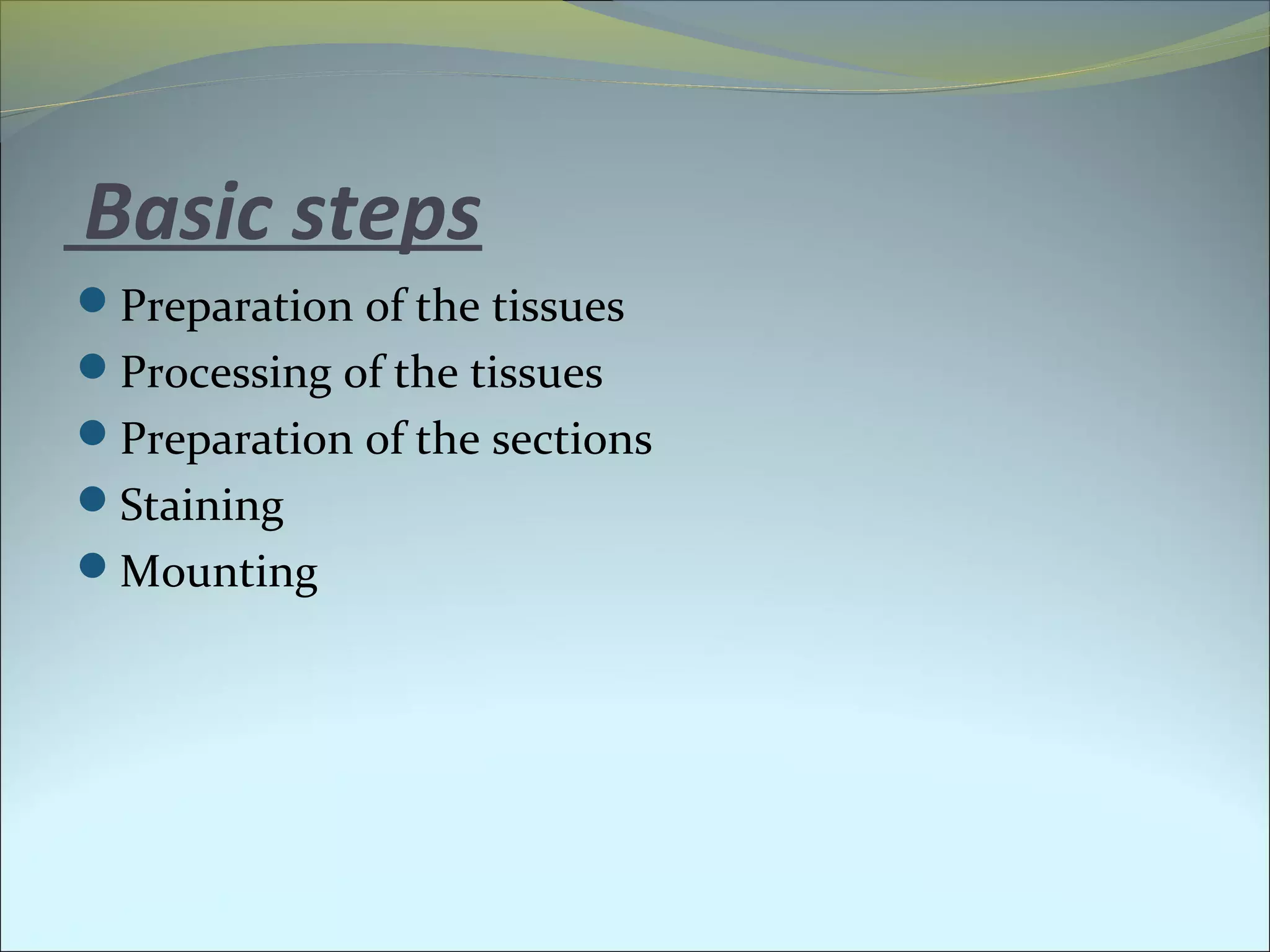
Basic steps
Preparation of the tissues
Processing of the tissues
Preparation of the sections
Staining
Mounting
Specimen
      Histology lab

       Registration

         Fixation

         Grossing

        Labelling

       Dehydration

         Clearing

Infiltration & impregnation
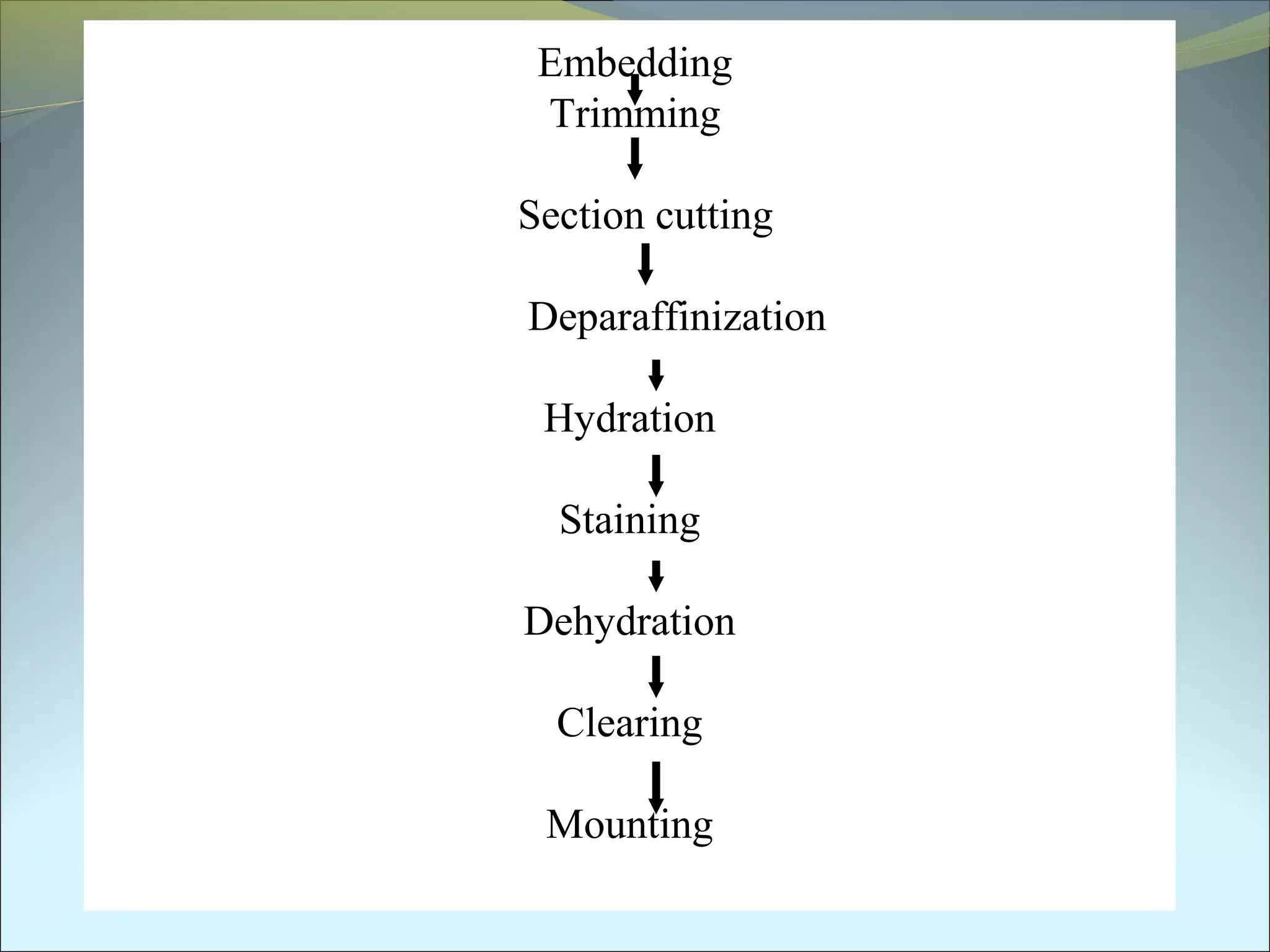
Embedding
 Trimming

Section cutting

Deparaffinization

 Hydration

  Staining

Dehydration

  Clearing

 Mounting
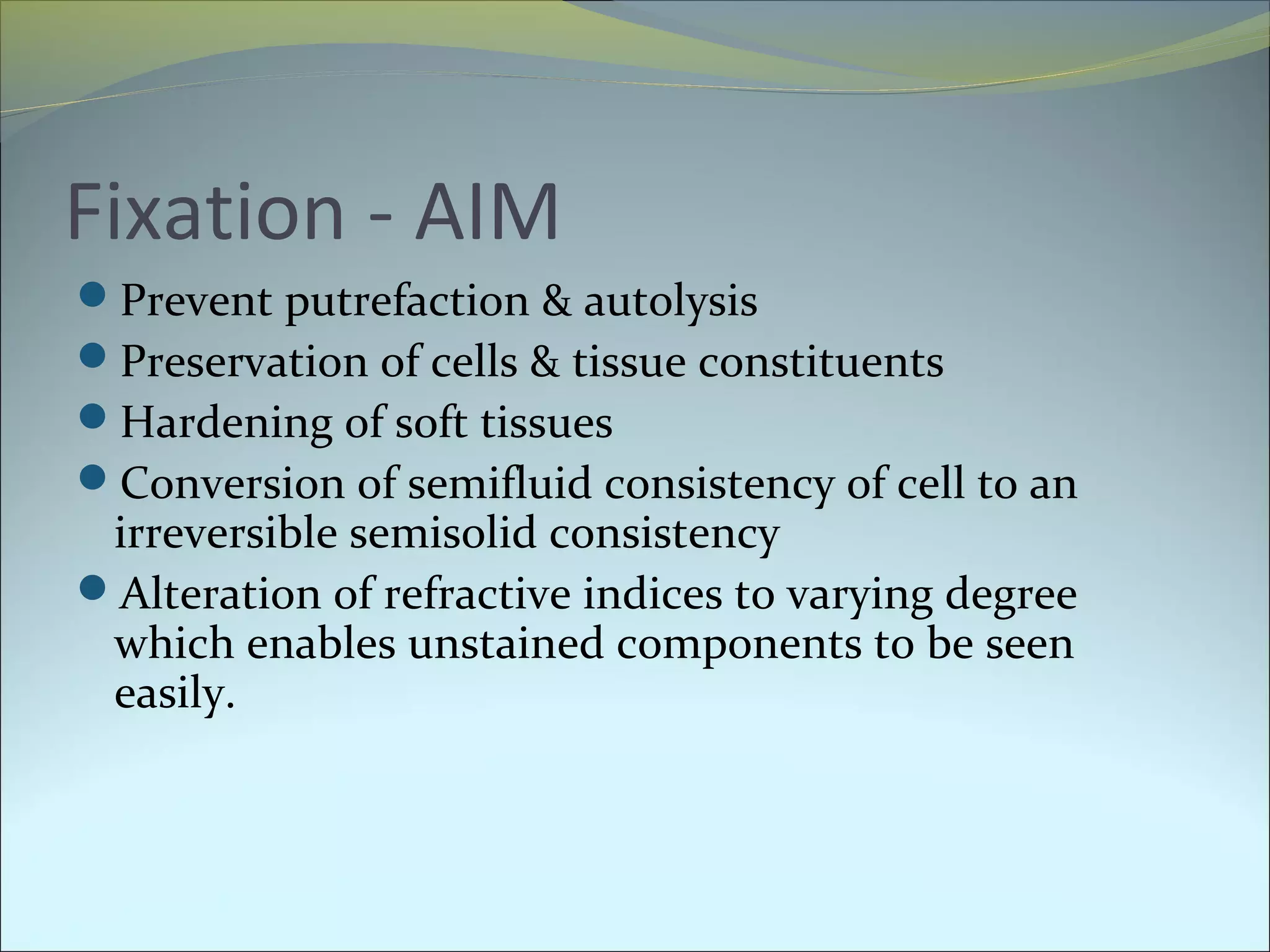
Fixation - AIM
Prevent putrefaction & autolysis
Preservation of cells & tissue constituents
Hardening of soft tissues
Conversion of semifluid consistency of cell to an
 irreversible semisolid consistency
Alteration of refractive indices to varying degree
 which enables unstained components to be seen
 easily.
Ideal fixatives
Cheap & easily available
Stable & easy to handle
Fix quickly
Minimal loss of tissue
Even penetration
Reagents employed as fixatives
Formaldehyde
Mercuric chloride
Potassium dichromate
Picric acid
Ethyl alcohol
Glutaraldehyde
Osmium tetraoxide
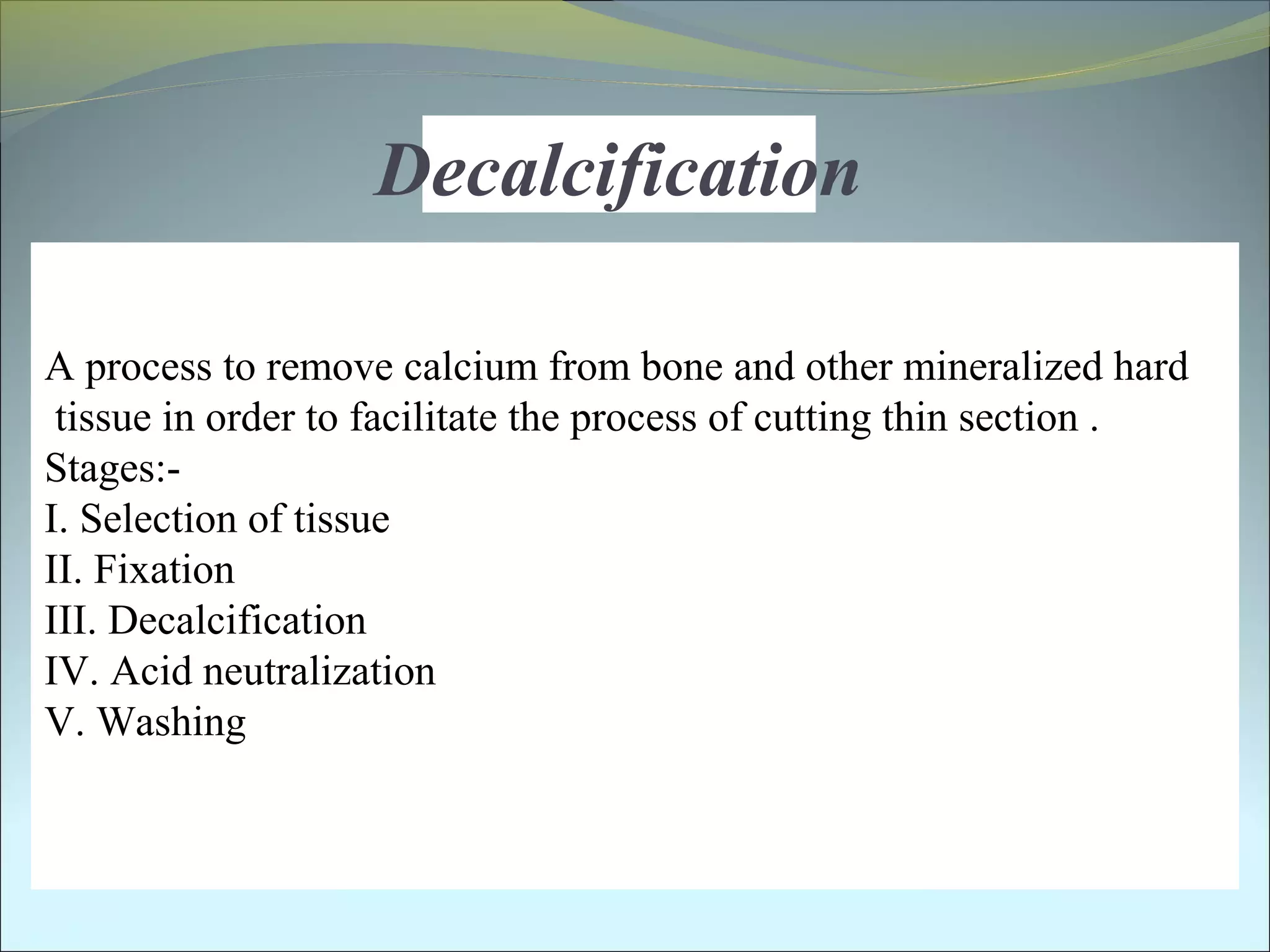
Decalcification

A process to remove calcium from bone and other mineralized hard
 tissue in order to facilitate the process of cutting thin section .
Stages:-
I. Selection of tissue
II. Fixation
III. Decalcification
IV. Acid neutralization
V. Washing
Processing of tissue
 Embed the tissue in a solid medium.
Firm enough to support the tissue and enable thin
 sections to be cut.
Soft enough not to damage the knife of tissue.
There are two kinds of tissue processors:
1- Moving tissue type
2- Moving fluid type.
Histokenette Automatic Tissue Processor
Tissue Cassettes
Tissue Processor With Vacuum And Fume Control
Vacuum Tissue Processor
Linear Tissue Processor With Touch Screen
PROCESSING SCHEDULE
Automated processing schedule
1-Overnight schedule
2-short processing schedule


Manual processing schedule
Over night schedule
1- 10% formaline.   0 hrs
2- 70% alcohol      ½ hrs.
3- 95% alcohol      ½ hrs
4- 100% alcohol     ½ hrs
5- 100% alcohol     1 hrs
6- 100% alcohol     1 hrs
7- 100% alcohol     1 hrs
8- 100% alcohol     ½ hrs
9- xylene           1 hrs
10- xylene          2 hrs
11- wax             2 x1/2 hrs
12- wax             4 hrs
Schedule for processing for small biopsy or for urgent
work
1- 10% formaline.            20 min     vacuum heat
2- 95% alcohol               5 min         y   450c
3- 95% alcohol               5 min
4- 100% alcohol              5 min
5- 100% alcohol              5 min
6- 100% alcohol              5 min
7- 100% alcohol              5 min
8- 100%                      5 min
 alcohol/ethylene             5 min
9- xylene
                              5 min
10- xylene
                              5 min
11- wax
                              5 min
Manual processing schedule
Rapid technique for thin slices of tissue


1- carnoys fluid-         45 min
2- 100% alcohol x 6        15 min each
3-xylene                   10 min
4- xylene                   15 min
5- wax                     20 min
6- wax                     45 min
Manual processing schedule for blockes

1- 70% alcohol             0900 hrs to 1000 hrs
2- 95% alcohol             1000 hrs to 1100 hrs
3- 95% alcohol             1100 hrs to 1300 hrs
4- 100% alcohol            1300 hrs to 1430 hrs
5- 100% alcohol            1430 to 1600 hrs
6- 100% alcohol            1600 to 1730 hrs
7- 100% alcohol            overnight
8- xylene                  0900 to 1000 hrs
9- xylene                  1000 hrs to 1130 hrs
10- wax with vacuume       1130 hrs to 1230 hrs
11- wax with vacuume        1230 hrs to 1400 hrs
12- wax with vacuume       1400hrs to 1600 hrs
Processing of tissue
Important steps of tissue processing by paraffin wax
   technique.
a)Dehydration.
b)Clearing.
c) Infiltration.
d)Embedding.
Factors influencing the rate of processing-

a)Heat ( increase the rate of penetration, but limited to
   45 degree)
b)Agitation (tissue lies on the base of the container ,rate
   of exchange of fluid is much less)
c) Viscosity ( quickness of impregnation due to lower
   viscosity of paraffin in fluid state )
d)Vacuum ( little increase dehydration and clearing but
   reduces the impregnation time)
Dehydration
I. Water is completely removed from the fixed
  tissues.
  II. Tissue blocks are placed in cassettes with the
  identification number.
 III . Passed through increasing concentration of
  alcohol with changes in each concentration.
Dehydration
Dehydrating agents
1-Alcohols- ethenol, methanol, isopropanol,
Polyethylene glycols (PEG) , diaxone


2-Other dehydrants
Acetone , Tetrahydrofuran , 2,2
 dimethoxypropane
Phenol,
Clearing
 1-. It is the process in which water from cell & tissues is
   removed & is replaced by a fluid in which wax is soluble
2- .Most commonly used agent is xylene.
3-. Xylene is miscible in both paraffin wax &
     alcohol.
4-. Replaces alcohol & make room for paraffin.
5- Other clearing agent – toluene , benzene , chloroform
   & cedar wood oil.
Xylene or toluene or benzene :
Advantages – Cheap and rapid in action, can be used
   for almost all tissue, used for both paraffin and
   celloidin embedding, benzene has less hardening
   effect then xylene.
Disadvantages –
a)Make the tissue brittle if kept in the fluid for a longer
   period.
b)Excessive shrinkage for delicate tissue.
c) May cause dermatitis
d)Benzene is more inflammable and toxic and known
   to be carcinogenic.
Infiltration & Impregnation
Infiltration – xylene is eliminated from the tissue by
  diffusion in the surrounding melting wax.

Impregnation – wax diffuses in the tissue by replacing
 the xylene.

It maintain the intra cellular structure during the
   section cutting on microtome.
Embedding
I.Casting or blocking.
II. Infiltrated & impregnated tissue is places in warm
   liquid which forms a firm block after cooling.
III. Enables the tissue to be cut on a microtome.
IV. Most commonly used material is paraffin.
V. Leuckhard embedding box ( consisting of two L
   shaped pieces of heavy metallic material brass)
   arranged on a glass plate.
Ideally an infiltrating and embedding medium should be:
• soluble in processing fluids
• suitable for sectioning and ribboning
• molten between 30°C and 60°C
• translucent or transparent; colorless
• stable
• homogeneous
• capable of flattening after ribboning
• non-toxic
• odorless
• easy to handle
• inexpensive
Paraffin   Melting point   Feature


Commonly      54 c
used
Hard wax      60 c         Hard fibrous
                           tissue
Soft wax      45 c         Fetal &
                           areolar tissue
Celloidin media ( nitrocellulose )
1.Used when it is desired to avoid the use of heat in CNS
2.It is rubbery material.
3.Give better support to tissue like skin, sclera &
  subcutaneous tissues.

Gelatin media – for friable tissues like lung.


Resin , Agar
MICROTOME

Used for cutting paraffin tissue sections of uniform
 thickness. A knob on the machine is used to adjust
 the thickness of section.
A knife is fixed in a clamp . The tissue block is drawn
 across the knife edge, the top and bottom of the block
 should be parallel and horizontal and at least 1 mm of
 paraffin should be present on all side of tissue.
Then ribbon of sections is transferred to warm water.
MICROTOME
Rotary microtome – for paraffin embedding.
Rocking microtome – for paraffin embedding.
Sliding microtome – for celloidin embedding
Freezing microtome – for frozen section
Cold ( cryostat) – for frozen section
Ultramicrotome – for electron microscope
Laser microtome-for contact free slicing
Trimming of the paraffin block.
Attach the block to the microtome.
Cutting of the section.
Fix the section on the slides.
        adhesives – starch paste
                   albumin ( glycerol + white egg
                            + distilled water)
STAINING
      Deparaffinized (2 jars of xylene – each 2 min)

             2 jars of alcohol – each for 2 min.

Rehydrated (90% alcohol – 1min f/b 70% alcohol for 1 min)

                      Rinsed in water

       Stained in harris haematoxylene for 2 – 5min

      Washing in running water till sections turn blue
Differentiation (1% acid alcoholic solution for 10 sec)
Dip in 0.5% hydrochloric acid, nuclear aaper dark purple.
( bluing)
              Rinse in water for 10-15 min

Counterstain (1% aqueous solution of eosin for 1-3 min)

                     Rinse in tap water

                       Dehydrate

                   Clearing in xylene

           Mounting ( DPX / Canada balsam)
Frozen section
Method of sectioning of tissue after making the
 tissue hard by rapid freezing.
Advantages – rapidly prepared,
 Minimum shrinkage of tissue,
 Every method of staining is allowed especially
 suitable for immunochemistry and almost
 obligatory for enzyme study
Essential technique for demonstration of certain
 lipid and enzymes.
Disadvantages –
sections are thick and sometime difficult to interpret properly,

not always possible to maintain the structural element in their
natural position .

it is practically impossible to obtain and correlate serial section
Methods
Freezing microtome with carbon dioxide which is
 popular method.
Freezing microtome with thermoelectric molecules.
Use of refrigerated microtome ( cryostat).
10 % formal saline is most common fixative used,
 fresh unfixed tissue may be used.
Tissue thickness should not exceed 3 mm.
Advances
Use of different type of resins as alternative to wax.
Large block preparation and large sections for study
 of whole pathological region of tissue.
Specimen radiography or thin section
 ultrasonography on freshly removed specimen to be
 sure that the whole pathology has been removed.
Microwaves for quick fixation, processing.
Microwave processing of tissue
Tissue is cut on small pieces ---- tissue block are
 placed in isotonic saline and subjected to microwave
 irradiation for 120 sec. (full power )- ( 50 % power)
 dehydration by 70 % alchohal for 4 min, 100 %
 alchohal for 5 min, chloroform for 5 min then
 impregnation in wax for 5 min---- embedding-
 section cutting.
THANK YOU


 PRESENTED BY – Dr. Narmada Prasad Tiwari
Histokinetic by  dr narmada

Histokinetic by dr narmada

  • 2.
    It is processingand preparation of the tissue of body in such a manner as to satisfactory study of the tissues can be done.
  • 3.
    Handling of Specimen Specimenshould be transported in glass, plastic or metal container or in a plastic bag in 10% formalin. If formalin is not available at hand, place the specimen in refrigerator at 4oC to slow down autolysis. fresh material is needed for the following purpose: 1. Frozen section 2. Immunocytochemistry 3. Cytological examination 4. Microbiological sampling before histopathology 5. Chromosome analysis 6. Research purpose 7. Museum display
  • 4.
    Basic steps Preparation ofthe tissues Processing of the tissues Preparation of the sections Staining Mounting
  • 5.
    Specimen Histology lab Registration Fixation Grossing Labelling Dehydration Clearing Infiltration & impregnation
  • 6.
    Embedding Trimming Section cutting Deparaffinization Hydration Staining Dehydration Clearing Mounting
  • 7.
    Fixation - AIM Preventputrefaction & autolysis Preservation of cells & tissue constituents Hardening of soft tissues Conversion of semifluid consistency of cell to an irreversible semisolid consistency Alteration of refractive indices to varying degree which enables unstained components to be seen easily.
  • 8.
    Ideal fixatives Cheap &easily available Stable & easy to handle Fix quickly Minimal loss of tissue Even penetration
  • 9.
    Reagents employed asfixatives Formaldehyde Mercuric chloride Potassium dichromate Picric acid Ethyl alcohol Glutaraldehyde Osmium tetraoxide
  • 10.
    Decalcification A process toremove calcium from bone and other mineralized hard tissue in order to facilitate the process of cutting thin section . Stages:- I. Selection of tissue II. Fixation III. Decalcification IV. Acid neutralization V. Washing
  • 11.
    Processing of tissue Embed the tissue in a solid medium. Firm enough to support the tissue and enable thin sections to be cut. Soft enough not to damage the knife of tissue.
  • 12.
    There are twokinds of tissue processors: 1- Moving tissue type 2- Moving fluid type.
  • 13.
  • 14.
  • 16.
    Tissue Processor WithVacuum And Fume Control
  • 17.
  • 18.
    Linear Tissue ProcessorWith Touch Screen
  • 19.
    PROCESSING SCHEDULE Automated processingschedule 1-Overnight schedule 2-short processing schedule Manual processing schedule
  • 20.
    Over night schedule 1-10% formaline. 0 hrs 2- 70% alcohol ½ hrs. 3- 95% alcohol ½ hrs 4- 100% alcohol ½ hrs 5- 100% alcohol 1 hrs 6- 100% alcohol 1 hrs 7- 100% alcohol 1 hrs 8- 100% alcohol ½ hrs 9- xylene 1 hrs 10- xylene 2 hrs 11- wax 2 x1/2 hrs 12- wax 4 hrs
  • 21.
    Schedule for processingfor small biopsy or for urgent work 1- 10% formaline. 20 min vacuum heat 2- 95% alcohol 5 min y 450c 3- 95% alcohol 5 min 4- 100% alcohol 5 min 5- 100% alcohol 5 min 6- 100% alcohol 5 min 7- 100% alcohol 5 min 8- 100% 5 min alcohol/ethylene 5 min 9- xylene 5 min 10- xylene 5 min 11- wax 5 min
  • 22.
    Manual processing schedule Rapidtechnique for thin slices of tissue 1- carnoys fluid- 45 min 2- 100% alcohol x 6 15 min each 3-xylene 10 min 4- xylene 15 min 5- wax 20 min 6- wax 45 min
  • 23.
    Manual processing schedulefor blockes 1- 70% alcohol 0900 hrs to 1000 hrs 2- 95% alcohol 1000 hrs to 1100 hrs 3- 95% alcohol 1100 hrs to 1300 hrs 4- 100% alcohol 1300 hrs to 1430 hrs 5- 100% alcohol 1430 to 1600 hrs 6- 100% alcohol 1600 to 1730 hrs 7- 100% alcohol overnight 8- xylene 0900 to 1000 hrs 9- xylene 1000 hrs to 1130 hrs 10- wax with vacuume 1130 hrs to 1230 hrs 11- wax with vacuume  1230 hrs to 1400 hrs 12- wax with vacuume 1400hrs to 1600 hrs
  • 24.
    Processing of tissue Importantsteps of tissue processing by paraffin wax technique. a)Dehydration. b)Clearing. c) Infiltration. d)Embedding.
  • 25.
    Factors influencing therate of processing- a)Heat ( increase the rate of penetration, but limited to 45 degree) b)Agitation (tissue lies on the base of the container ,rate of exchange of fluid is much less) c) Viscosity ( quickness of impregnation due to lower viscosity of paraffin in fluid state ) d)Vacuum ( little increase dehydration and clearing but reduces the impregnation time)
  • 26.
    Dehydration I. Water iscompletely removed from the fixed tissues. II. Tissue blocks are placed in cassettes with the identification number. III . Passed through increasing concentration of alcohol with changes in each concentration.
  • 27.
    Dehydration Dehydrating agents 1-Alcohols- ethenol,methanol, isopropanol, Polyethylene glycols (PEG) , diaxone 2-Other dehydrants Acetone , Tetrahydrofuran , 2,2 dimethoxypropane Phenol,
  • 28.
    Clearing 1-. Itis the process in which water from cell & tissues is removed & is replaced by a fluid in which wax is soluble 2- .Most commonly used agent is xylene. 3-. Xylene is miscible in both paraffin wax & alcohol. 4-. Replaces alcohol & make room for paraffin. 5- Other clearing agent – toluene , benzene , chloroform & cedar wood oil.
  • 29.
    Xylene or tolueneor benzene : Advantages – Cheap and rapid in action, can be used for almost all tissue, used for both paraffin and celloidin embedding, benzene has less hardening effect then xylene. Disadvantages – a)Make the tissue brittle if kept in the fluid for a longer period. b)Excessive shrinkage for delicate tissue. c) May cause dermatitis d)Benzene is more inflammable and toxic and known to be carcinogenic.
  • 30.
    Infiltration & Impregnation Infiltration– xylene is eliminated from the tissue by diffusion in the surrounding melting wax. Impregnation – wax diffuses in the tissue by replacing the xylene. It maintain the intra cellular structure during the section cutting on microtome.
  • 31.
    Embedding I.Casting or blocking. II.Infiltrated & impregnated tissue is places in warm liquid which forms a firm block after cooling. III. Enables the tissue to be cut on a microtome. IV. Most commonly used material is paraffin. V. Leuckhard embedding box ( consisting of two L shaped pieces of heavy metallic material brass) arranged on a glass plate.
  • 32.
    Ideally an infiltratingand embedding medium should be: • soluble in processing fluids • suitable for sectioning and ribboning • molten between 30°C and 60°C • translucent or transparent; colorless • stable • homogeneous • capable of flattening after ribboning • non-toxic • odorless • easy to handle • inexpensive
  • 34.
    Paraffin Melting point Feature Commonly 54 c used Hard wax 60 c Hard fibrous tissue Soft wax 45 c Fetal & areolar tissue
  • 35.
    Celloidin media (nitrocellulose ) 1.Used when it is desired to avoid the use of heat in CNS 2.It is rubbery material. 3.Give better support to tissue like skin, sclera & subcutaneous tissues. Gelatin media – for friable tissues like lung. Resin , Agar
  • 36.
    MICROTOME Used for cuttingparaffin tissue sections of uniform thickness. A knob on the machine is used to adjust the thickness of section. A knife is fixed in a clamp . The tissue block is drawn across the knife edge, the top and bottom of the block should be parallel and horizontal and at least 1 mm of paraffin should be present on all side of tissue. Then ribbon of sections is transferred to warm water.
  • 37.
    MICROTOME Rotary microtome –for paraffin embedding. Rocking microtome – for paraffin embedding. Sliding microtome – for celloidin embedding Freezing microtome – for frozen section Cold ( cryostat) – for frozen section Ultramicrotome – for electron microscope Laser microtome-for contact free slicing
  • 39.
    Trimming of theparaffin block. Attach the block to the microtome. Cutting of the section. Fix the section on the slides. adhesives – starch paste albumin ( glycerol + white egg + distilled water)
  • 41.
    STAINING Deparaffinized (2 jars of xylene – each 2 min) 2 jars of alcohol – each for 2 min. Rehydrated (90% alcohol – 1min f/b 70% alcohol for 1 min) Rinsed in water Stained in harris haematoxylene for 2 – 5min Washing in running water till sections turn blue
  • 42.
    Differentiation (1% acidalcoholic solution for 10 sec) Dip in 0.5% hydrochloric acid, nuclear aaper dark purple. ( bluing) Rinse in water for 10-15 min Counterstain (1% aqueous solution of eosin for 1-3 min) Rinse in tap water Dehydrate Clearing in xylene Mounting ( DPX / Canada balsam)
  • 43.
    Frozen section Method ofsectioning of tissue after making the tissue hard by rapid freezing. Advantages – rapidly prepared,  Minimum shrinkage of tissue,  Every method of staining is allowed especially suitable for immunochemistry and almost obligatory for enzyme study Essential technique for demonstration of certain lipid and enzymes.
  • 44.
    Disadvantages – sections arethick and sometime difficult to interpret properly, not always possible to maintain the structural element in their natural position . it is practically impossible to obtain and correlate serial section
  • 45.
    Methods Freezing microtome withcarbon dioxide which is popular method. Freezing microtome with thermoelectric molecules. Use of refrigerated microtome ( cryostat). 10 % formal saline is most common fixative used, fresh unfixed tissue may be used. Tissue thickness should not exceed 3 mm.
  • 46.
    Advances Use of differenttype of resins as alternative to wax. Large block preparation and large sections for study of whole pathological region of tissue. Specimen radiography or thin section ultrasonography on freshly removed specimen to be sure that the whole pathology has been removed. Microwaves for quick fixation, processing.
  • 47.
    Microwave processing oftissue Tissue is cut on small pieces ---- tissue block are placed in isotonic saline and subjected to microwave irradiation for 120 sec. (full power )- ( 50 % power) dehydration by 70 % alchohal for 4 min, 100 % alchohal for 5 min, chloroform for 5 min then impregnation in wax for 5 min---- embedding- section cutting.
  • 51.
    THANK YOU PRESENTEDBY – Dr. Narmada Prasad Tiwari

Editor's Notes

  • #13 As the name suggests in moving tissue type processors, the tissue is moved from reagent to reagent, on the other hand in moving fluid type, the tissue is kept stationary and different reagents are passed through the tissue one by one using vacuum. Infiltration under vacuum is more effective and produces superior samples.
  • #16 Tissue processor: construction: all exterior parts are powder coated in RAL 9002 12 stations, 10 glass containers, 2 stainless steel containers, 1 transport basket is included, for approx. 110 cassettes, optional twin basket for approx. 220 cassettes lifting mechanism for 1 transport basket rear connection possibility for hose (100 mm diameter), with fan or active carbon filter as option electronical controls with multi power supply 85-264 V. Worldwide operation without power adjustment display and operating panel with programming keys in case of power failure the basket is moved in a programmable