Myelodysplasia  : from marrow failure to malignant transformation Ahmed Elshebiny, MD University of Menoufyia
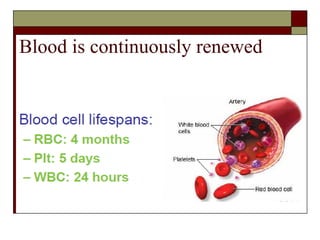
Blood is continuously renewed
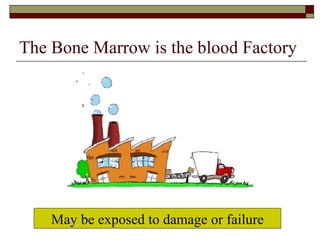
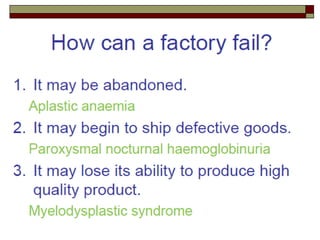
The Bone Marrow is the blood Factory May be exposed to damage or failure
 
 
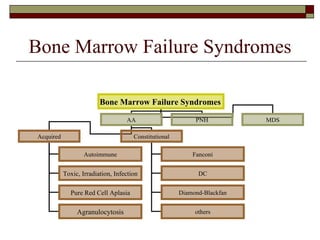
Bone Marrow Failure Syndromes Bone Marrow Failure Syndromes   AA PNH MDS Acquired Constitutional Autoimmune Fanconi DC Diamond-Blackfan others Toxic, Irradiation, Infection Pure Red Cell Aplasia Agranulocytosis
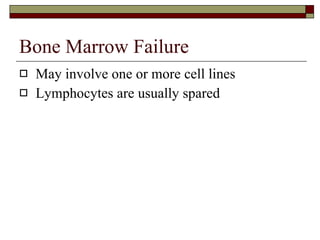
Bone Marrow Failure May involve one or more cell lines Lymphocytes are usually spared
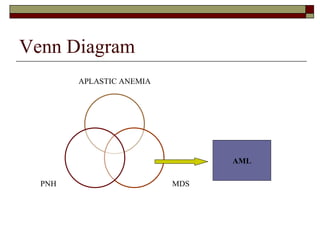
Venn Diagram AML APLASTIC ANEMIA MDS PNH
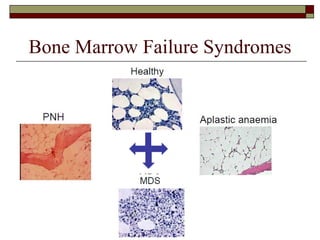
Bone Marrow Failure Syndromes
Hematology lectures Myelodysplasia
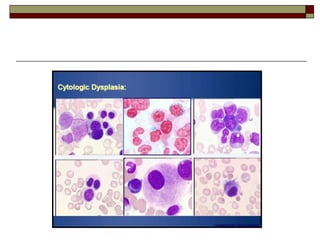
Myelodysplastic syndrome (MDS) It is a term for a heterogeneous collection of haemopoietic stem cell disorders usually affecting older adults. There is underlying ineffectiveness of haemopoiesis that results in dysplasia of bone marrow precursors and peripheral cytopenias.
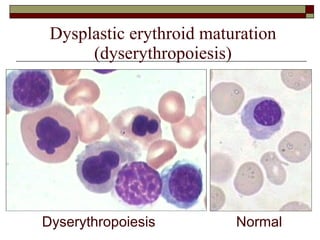
Dysplastic erythroid maturation (dyserythropoiesis) Normal Dyserythropoiesis
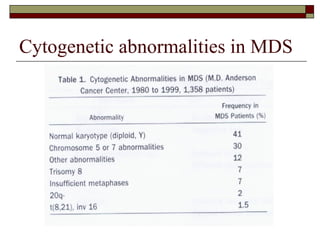
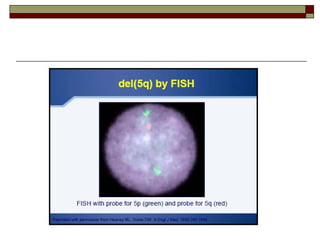
Pathology The cardinal features of MDS are  Increased marrow proliferation Failure of stem cells to differentiate And increased marrow apoptosis. The disease is of clonal origin Chromosomal abnormalities are detectable in 30-70% of patients. The no. of chromosomal abn. may correlate with the risk of progression to AML.
Epidemiology MDS is primarily a disease of the elderly, with a median age at diagnosis of between 60-80 years. The incidence is approximately double that of AML. The recent increase in MDS incidence may be related to growing awareness, better diagnosis, and an aging population.
Etiology Primary Secondary
MDS (clinical) Moderate anaemia is the most common clinical problem in MDS patients, but complete myeloid bone marrow failure also occurs leading to death from bleeding or infection. Approximately half of the patients transform to AML.
MDS (clinical) May be preceded by a few years by  an unexplained macrocytic anemia with no evidence of megaloblastic anemia and a mild thrombocytopenia or neutropenia. Thrombocytopenia  as the presenting symptom may be mistaken for immune thrombocytopenia.
Cytogenetic abnormalities in MDS
 
 
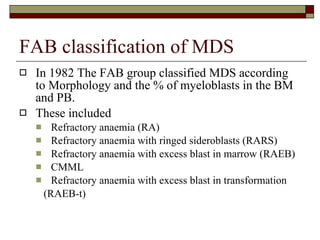
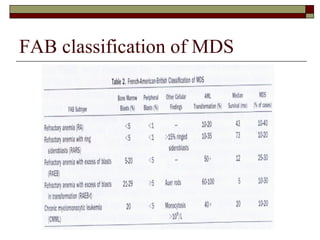
FAB classification of MDS In 1982 The FAB group classified MDS according to Morphology and the % of myeloblasts in the BM and PB. These included Refractory anaemia (RA) Refractory anaemia with ringed sideroblasts (RARS) Refractory anaemia with excess blast in marrow (RAEB) CMML Refractory anaemia with excess blast in transformation (RAEB-t)
FAB classification of MDS
Newer classifications WHO IPSS
Treatment Stem cell transplant DNA methyl transferase inhibitors Azacytidine Immunomodulation Thalidomide and lenalidomide Immunosupression Histone deacetylase inhibitors Chemotherapy
Fate of MDS Transformation to acute leukaemia occurs in up to 40% of patients. Although progression to frank AML is a primary concern, 20-40 % or more of patients die of infections and/or haemorrhagic complications.
Sideroblastic anemias Inherited (X-linked) Acquired Myelodysplasis Myeloproliferative disorders Myeloid leukemia Lead toxcicity Drugs e.g INH Alcohol others
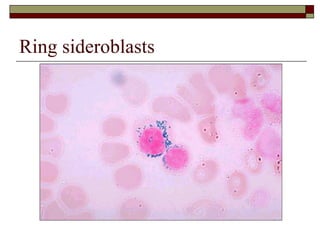
Ring sideroblasts
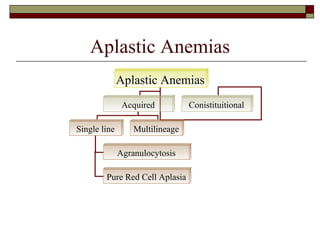
Aplastic Anemias Aplastic Anemias Acquired Conistituitional Single line Agranulocytosis Pure Red Cell Aplasia Multilineage
Aplastic Anemia Named so in 1904 The theoretical basis for marrow failure includes primary defects in or damage to the stem cell or the marrow microenvironment  Distinction between congenital or acquired may be difficult 80 % of patients have acquired cause which is an autoimmune disease
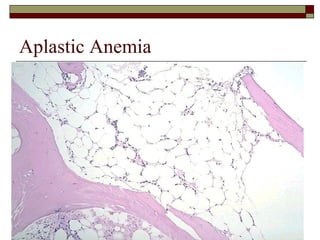
Aplastic Anemia
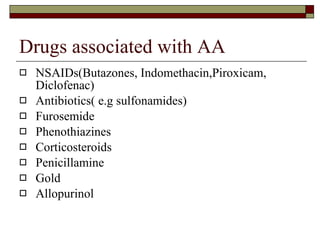
Drugs associated with AA NSAIDs(Butazones, Indomethacin,Piroxicam, Diclofenac) Antibiotics( e.g sulfonamides) Furosemide Phenothiazines Corticosteroids Penicillamine Gold Allopurinol
Pancytopenia Pancytopenia has many causes of which AA is not the most common
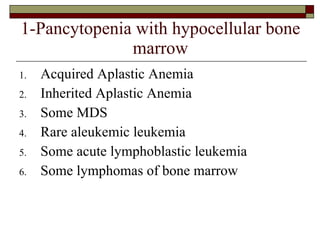
1-Pancytopenia with hypocellular bone marrow Acquired Aplastic Anemia Inherited Aplastic Anemia Some MDS Rare aleukemic leukemia Some acute lymphoblastic leukemia Some lymphomas of bone marrow
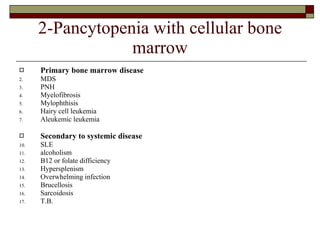
2-Pancytopenia with cellular bone marrow Primary bone marrow disease MDS PNH Myelofibrosis Mylophthisis Hairy cell leukemia Aleukemic leukemia Secondary to systemic disease SLE alcoholism B12 or folate difficiency Hypersplenism Overwhelming infection Brucellosis Sarcoidosis T.B.
3- Hypocellular marrow with or without cytopenia Q fever Ligionaires Toxoplasmosis Anorexia Nervosa T.B. Hypothyroidism
Investigations of MDS CBC, film, retics….. Bone marrow examination Cytogenitics
Iron Studies SI TIBC Transferrin Saturation Ferritin
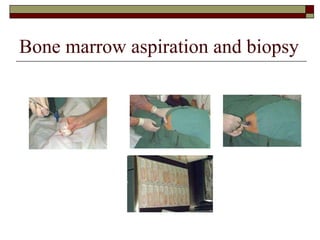
Bone marrow aspiration and biopsy
PNH Hemolysis Venous thrombosis Aplastic anemia
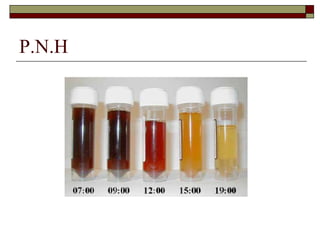
P.N.H
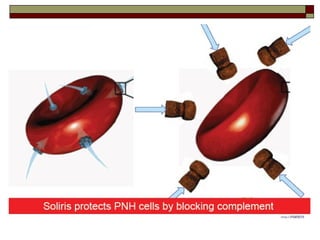
PNH and Aplastic Anemia PNH is caused by an acquired genetic defect limited to the stem-cell compartment affecting the  PIGA  gene. Mutations in the  PIGA  gene render cells of hematopoietic origin sensitive to increased complement lysis.  Approximately 20% of patients with aplastic anemia have evidence of PNH at presentation, as detected by means of flow cytometry. Furthermore, patients whose disease responds after immunosuppressive therapy frequently recover with clonal hematopiesis and PNH.
 
Approaches to treatment of Bone Marrow Failure Syndromes Transfusions Growth Factors Immunosuppression SCT Others drugs
References Bethesda Handbook of Clinical hematology 2010 Hamilton et al : Hematology in Clinical practice 2005 E-medicine online textbook, Hematology Other web resources
THANK  YOU

Mds

  • 1.
  • 2.
    Myelodysplasia :from marrow failure to malignant transformation Ahmed Elshebiny, MD University of Menoufyia
  • 3.
  • 4.
    The Bone Marrowis the blood Factory May be exposed to damage or failure
  • 5.
  • 6.
  • 7.
    Bone Marrow FailureSyndromes Bone Marrow Failure Syndromes AA PNH MDS Acquired Constitutional Autoimmune Fanconi DC Diamond-Blackfan others Toxic, Irradiation, Infection Pure Red Cell Aplasia Agranulocytosis
  • 8.
    Bone Marrow FailureMay involve one or more cell lines Lymphocytes are usually spared
  • 9.
    Venn Diagram AMLAPLASTIC ANEMIA MDS PNH
  • 10.
  • 11.
  • 12.
    Myelodysplastic syndrome (MDS)It is a term for a heterogeneous collection of haemopoietic stem cell disorders usually affecting older adults. There is underlying ineffectiveness of haemopoiesis that results in dysplasia of bone marrow precursors and peripheral cytopenias.
  • 13.
    Dysplastic erythroid maturation(dyserythropoiesis) Normal Dyserythropoiesis
  • 14.
    Pathology The cardinalfeatures of MDS are Increased marrow proliferation Failure of stem cells to differentiate And increased marrow apoptosis. The disease is of clonal origin Chromosomal abnormalities are detectable in 30-70% of patients. The no. of chromosomal abn. may correlate with the risk of progression to AML.
  • 15.
    Epidemiology MDS isprimarily a disease of the elderly, with a median age at diagnosis of between 60-80 years. The incidence is approximately double that of AML. The recent increase in MDS incidence may be related to growing awareness, better diagnosis, and an aging population.
  • 16.
  • 17.
    MDS (clinical) Moderateanaemia is the most common clinical problem in MDS patients, but complete myeloid bone marrow failure also occurs leading to death from bleeding or infection. Approximately half of the patients transform to AML.
  • 18.
    MDS (clinical) Maybe preceded by a few years by an unexplained macrocytic anemia with no evidence of megaloblastic anemia and a mild thrombocytopenia or neutropenia. Thrombocytopenia as the presenting symptom may be mistaken for immune thrombocytopenia.
  • 19.
  • 20.
  • 21.
  • 22.
    FAB classification ofMDS In 1982 The FAB group classified MDS according to Morphology and the % of myeloblasts in the BM and PB. These included Refractory anaemia (RA) Refractory anaemia with ringed sideroblasts (RARS) Refractory anaemia with excess blast in marrow (RAEB) CMML Refractory anaemia with excess blast in transformation (RAEB-t)
  • 23.
  • 24.
  • 25.
    Treatment Stem celltransplant DNA methyl transferase inhibitors Azacytidine Immunomodulation Thalidomide and lenalidomide Immunosupression Histone deacetylase inhibitors Chemotherapy
  • 26.
    Fate of MDSTransformation to acute leukaemia occurs in up to 40% of patients. Although progression to frank AML is a primary concern, 20-40 % or more of patients die of infections and/or haemorrhagic complications.
  • 27.
    Sideroblastic anemias Inherited(X-linked) Acquired Myelodysplasis Myeloproliferative disorders Myeloid leukemia Lead toxcicity Drugs e.g INH Alcohol others
  • 28.
  • 29.
    Aplastic Anemias AplasticAnemias Acquired Conistituitional Single line Agranulocytosis Pure Red Cell Aplasia Multilineage
  • 30.
    Aplastic Anemia Namedso in 1904 The theoretical basis for marrow failure includes primary defects in or damage to the stem cell or the marrow microenvironment Distinction between congenital or acquired may be difficult 80 % of patients have acquired cause which is an autoimmune disease
  • 31.
  • 32.
    Drugs associated withAA NSAIDs(Butazones, Indomethacin,Piroxicam, Diclofenac) Antibiotics( e.g sulfonamides) Furosemide Phenothiazines Corticosteroids Penicillamine Gold Allopurinol
  • 33.
    Pancytopenia Pancytopenia hasmany causes of which AA is not the most common
  • 34.
    1-Pancytopenia with hypocellularbone marrow Acquired Aplastic Anemia Inherited Aplastic Anemia Some MDS Rare aleukemic leukemia Some acute lymphoblastic leukemia Some lymphomas of bone marrow
  • 35.
    2-Pancytopenia with cellularbone marrow Primary bone marrow disease MDS PNH Myelofibrosis Mylophthisis Hairy cell leukemia Aleukemic leukemia Secondary to systemic disease SLE alcoholism B12 or folate difficiency Hypersplenism Overwhelming infection Brucellosis Sarcoidosis T.B.
  • 36.
    3- Hypocellular marrowwith or without cytopenia Q fever Ligionaires Toxoplasmosis Anorexia Nervosa T.B. Hypothyroidism
  • 37.
    Investigations of MDSCBC, film, retics….. Bone marrow examination Cytogenitics
  • 38.
    Iron Studies SITIBC Transferrin Saturation Ferritin
  • 39.
  • 40.
    PNH Hemolysis Venousthrombosis Aplastic anemia
  • 41.
  • 42.
    PNH and AplasticAnemia PNH is caused by an acquired genetic defect limited to the stem-cell compartment affecting the PIGA gene. Mutations in the PIGA gene render cells of hematopoietic origin sensitive to increased complement lysis. Approximately 20% of patients with aplastic anemia have evidence of PNH at presentation, as detected by means of flow cytometry. Furthermore, patients whose disease responds after immunosuppressive therapy frequently recover with clonal hematopiesis and PNH.
  • 43.
  • 44.
    Approaches to treatmentof Bone Marrow Failure Syndromes Transfusions Growth Factors Immunosuppression SCT Others drugs
  • 45.
    References Bethesda Handbookof Clinical hematology 2010 Hamilton et al : Hematology in Clinical practice 2005 E-medicine online textbook, Hematology Other web resources
  • 46.