Basic
Histopathological
Techniques :
Dr Mohan Singh Dhakad
1
objective
At the end of student should know
 Steps of tissue fixation
 Grossing
 Tissue processing
 Microtomy
 And staining of section using routine hematoxylin and
eosin stain
2
Tissue fixation
Aims :
To prevent the process of autolysis and
bacterial putrefaction.
To allow hardening of tissue.
To allow clear staining of sections
obtained from the tissue.
Commonly used fixative are,
formaldehyde and glutaraldehyde.
3
Grossing of specimens
General format of the gross description should includes:
1. What organ does the specimen includes?
2. Size
3. Appearance
4. Colour
5. Consistency
6. Any identifiable pathology
4
Labeling of Tissues
 A unique identification number or code is
assigned to the tissue sample in the lab.
 Number may be electronically or manually generated.
Recent technologies for labeling of tissues includes:
 Bar code
 Character Recognition system
 Automated Pre-labeling system
 Chemically resistant pen, pencil and labels
5
Tissue Processing
 Principle : tissue processing is
designed to remove all
extractable water from the tissue
replacing it with a support media
that provides sufficient rigidity to
enable sectioning of tissue
without damage or distortion
6
Stages of Tissue Processing
.
7
Dehydration
•Removal of water and fixatives from tissue.
Clearing
•Removal of dehydrating solution.
Infiltration
•Permeating tissue with a support medium.
Embedding
•Orienting the tissue sample in a support medium
and allowing it to solidify.
Dehydration
 Removal of unbound water and aqueous fixatives
from the tissue components.
 Dehydration should be accomplished slowly.
 Specimens are always processed through a graded
series of reagents of increasing concentration.
 There are numerous dehydrating agents:
- Ethanol - Acetone
- Methanol - Isopropyl Alcohol
- Denatured Alcohols - Butanol
8
Dehydration
9
50% Alcohol
for 1 hour
70% Alcohol
for 1 hour
80% Alcohol
for 1 hour
90% Alcohol
for 1 hour
100% Alcohol
for 1 hour
100% Alcohol
for 1 hour
Clearing
 Removal of dehydrating solutions, making the tissue
components receptive to the infiltrating medium.
 Clearing reagent act as an intermediary between the
dehydration and infiltration solutions. It should be
miscible with both solutions.
 When dehydrating agent has been entirely replaced
by most of these solvents the tissue has a translucent
appearance.
10
Clearing
 Criteria for choosing a suitable clearing agents are:
 Rapid removal of dehydrating agent.
 Ease of removal by melted paraffin.
 Minimal : tissue damage.
Flammability.
Toxicity.
Cost.
11
Clearing
 Clearing Agents suitable for routine use:
 Xylene
 Toluene
 Chloroform
 Methyl Benzoate
 Citrus fruit oils - Limonene Reagents
12
Clearing
13
This Process is carried out as follows:
Infiltration and Impregnation
 In infiltration process Xylene is eliminated from the tissue
by diffusion in the surrounding melted wax.
 In Impregnation wax diffuses in the tissue by replacing
the Xylene.
 Paraffin is the most popular infiltration and embedding
medium in histology laboratories.
 Process of infiltration and impregnation is carried out in
paraffin oven for 2 to 3 hours at temperature of 50°C to
60°C.
14
Paraffin Wax
 Mixture of long chain hydrocarbons.
 Its properties are varied depending on
the melting point.
 Melting point ranges from 40°C to 70°C.
 Infiltered paraffin maintains the intercellular structure
during the tissue cutting procedure on microtome.
 Paraffin wax additives like bees wax, diethylene
glycol distearate, creates paraffin with desired
hardness to promote good ribboning during
microtomy.
15
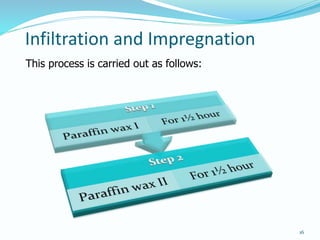
Infiltration and Impregnation
This process is carried out as follows:
16
Embedding
 It means casting or blocking.
 It involves the enclosing of properly
processed, correctly oriented specimens in a
support medium that provides external
support during microtomy.
 For this infiltered and impregnated tissue is
placed in warm liquid paraffin which form a
firm block after cooling.
 Embedding enables the tissue to be cut on a
microtome.
17
Embedding
 This procedure is carried out as follows:
 Leuckhard embedding mould is arranged on a glass
plate.
 The specimen is placed at the bottom of the cavity
with its identification number.
 Paraffin wax melted, filtered and then poured into
the mould containing the specimen.
 The mould is then placed in container of cold water
or kept in a refrigerator, until the wax hardens.
 The hardened block is now ready for the section
cutting on the microtome.
18
Automated Tissue Processing
 This equipment is used to carry out
automatically the procedure of tissue
processing.
 This equipment decreases the human error
and saves the time.
19
20
Microtomy
 It is the means by which tissue can be
sectioned and attached to a surface for
further microscopic examination.
 The basic instrument used is Microtome.
 This instrument is designed to cut 1µ to 60µ
thin sections.
21
Types of Microtome
22
Rotary microtome
Base sledge microtome
Rotary rocking microtome
Sliding microtome
Ultra microtome
Freezing or cryostat microtome
Paraffin Section Cutting
Sectioning:
• Trimming the
tissue blocks and
cutting sections.
Floating out sections:
• To float and
separate ribbons of
paraffin embedded
tissues while
mounting the
section on the
slide.
• It is done in
floatation (water)
bath.
• It is a
thermostatically
controlled water
bath maintain
temperature of
about 43°C, 10°C
below the melting
point of paraffin.
Drying sections:
• Small amount of
water held under
the section will
allow further
flattening to occur
when heat is
applied to dry the
section.
• This procedure is
carried out in
drying oven or hot
plate. It performs
the function of
removal of paraffin
for the staining.
Temperature
should be at the
melting point of
the paraffin.
23
Frozen Sections
This method produces sections without the use of
dehydrating and clearing solutions and without
embedding media.
Its principle is, when the tissue is frozen, the water
in the tissue turns to ice, and in this state the tissue
is firm, the ice acting as the embedding medium.
Reducing the temperature will produce harder
block and raising the temperature makes the tissue
softer.
24
Uses of Frozen Sections
 Rapid production of sections for intra-
operative diagnosis.
 Diagnostic and research enzyme
histochemistry.
 Immunofluorescent methods.
 Immunohistochemistry methods.
 Diagnostic and research non enzyme
histochemistry.
 Silver methods.
25
Cryostat Technique
 This technique is used to cut high quality frozen
sections of tissue.
 Techniques for suitable freezing fresh unfixed tissue:
 Liquefied nitrogen (-190°C).
 Isopentane (2 methyl butane) cooled by liquid
nitrogen (-150°C).
 Dry ice (-70°C).
 Carbon dioxide gas (-70°C).
 Aerosol sprays (-50°C).
 The best frozen sections are obtained when tissue is
frozen quickly.
26
Cryostat Sectioning
 Cryostat is a refrigerated cabinet in which a
specialty microtome is housed and all the
controls of the microtome are operated outside
the cabinet.
 Freezing microtome and the cold or cryostat
microtome is used for cutting frozen section of a
tissue.
 Most unfixed material will section well between
-15°C and -23°C.
 Most fixed tissues section best within the range
of -7°C to -12°C.
27
Ultracryotomy
 Used primarily in research laboratories. It
involves rapid freezing of fixed or unfixed
tissue by using Isopentane and liquid
nitrogen and cutting sections at 50 to 150
nm.
28
Freeze Drying
 It is technique of rapid freezing (quenching) of
fresh tissue at -160°C and the subsequent
removal of water molecules (in the form of ice)
by sublimation in a vacuum at a higher
temperature (-40°c).
 The technique minimizes:
 Loss of soluble substances.
 Displacement of cell constituents.
 Chemical alteration of reactive groups.
 Denaturation of proteins.
 Destruction or inactivation of enzymes
29
Stages to Freeze Drying
1. Quenching:
 It instantly stops chemical reactions and
diffusion in the tissue, bringing the tissue
into a solid state in which unbound water in
the tissue is changed into small ice crystals ,
which are subsequently removed in the
drying phase.
30
Stages to Freeze Drying
2. Drying:
 Tissues contain 70 to 80 % water by weight
that has to be removed without damage to
the tissue.
 Drying is divide into 3 distinct steps:
a) Introduction of heat to the tissue to cause
sublimation of ice.
b) Transfer of water vapor from the ice crystals
through the dry portions of the tissue.
c) Removal of water vapor from the surface of
the specimen.
31
Stages to Freeze Drying
3. Fixation and Embedding :
 Vapor fixation:
 Use fixatives in vapor form like formaldehyde,
gluteraldehyde and osmium tetra oxide.
 Following fixation, tissue is embedded in paraffin.
32
Applications and uses of Freeze dried material
 Demonstrating fine structural details.
 Immunohistochemical methods.
 Demonstration of hydrolytic enzymes.
 Fluorescent antibody studies.
 Autoradiography.
 Microspectrofluorimetry of auto fluorescent substances.
 Formaldehyde induced fluorescence.
 Mucosubstances.
 Proteins.
 Scanning electron microscopy.
33
staining
 Procedure of staining :
1. dewaxing- xylene (I)jar For 2 minute
2. Xylene (ii)jar for another 2 minute
3. Dehydration – 100%,90%and 70% alcohal
4. Haematoxylene stain 2-5 minutes
5. wash the slide in running tap water
6. Eosin staining- 2 minut
7. Wash under running tap water
8. Pass it in increasing concentration of alcohal( 70% ,90%
and 100%)
9. Clear in xylene for 2 minut and
Mounting
34
35
36
Cryostat
37
Rotary Microtome
38
Heater with Block Holders
39
Slide Warmer
40
Paraffin Blocks- Notice Labeling
41
Paraffin Tissue Blocks
42
Microtome Knife Sharpener
43
Digital Incubator
44
Floatation (water) Bath
45
Histokinette
46

Basic Histopathological Techniques (1).pptx

  • 1.
  • 2.
    objective At the endof student should know  Steps of tissue fixation  Grossing  Tissue processing  Microtomy  And staining of section using routine hematoxylin and eosin stain 2
  • 3.
    Tissue fixation Aims : Toprevent the process of autolysis and bacterial putrefaction. To allow hardening of tissue. To allow clear staining of sections obtained from the tissue. Commonly used fixative are, formaldehyde and glutaraldehyde. 3
  • 4.
    Grossing of specimens Generalformat of the gross description should includes: 1. What organ does the specimen includes? 2. Size 3. Appearance 4. Colour 5. Consistency 6. Any identifiable pathology 4
  • 5.
    Labeling of Tissues A unique identification number or code is assigned to the tissue sample in the lab.  Number may be electronically or manually generated. Recent technologies for labeling of tissues includes:  Bar code  Character Recognition system  Automated Pre-labeling system  Chemically resistant pen, pencil and labels 5
  • 6.
    Tissue Processing  Principle: tissue processing is designed to remove all extractable water from the tissue replacing it with a support media that provides sufficient rigidity to enable sectioning of tissue without damage or distortion 6
  • 7.
    Stages of TissueProcessing . 7 Dehydration •Removal of water and fixatives from tissue. Clearing •Removal of dehydrating solution. Infiltration •Permeating tissue with a support medium. Embedding •Orienting the tissue sample in a support medium and allowing it to solidify.
  • 8.
    Dehydration  Removal ofunbound water and aqueous fixatives from the tissue components.  Dehydration should be accomplished slowly.  Specimens are always processed through a graded series of reagents of increasing concentration.  There are numerous dehydrating agents: - Ethanol - Acetone - Methanol - Isopropyl Alcohol - Denatured Alcohols - Butanol 8
  • 9.
    Dehydration 9 50% Alcohol for 1hour 70% Alcohol for 1 hour 80% Alcohol for 1 hour 90% Alcohol for 1 hour 100% Alcohol for 1 hour 100% Alcohol for 1 hour
  • 10.
    Clearing  Removal ofdehydrating solutions, making the tissue components receptive to the infiltrating medium.  Clearing reagent act as an intermediary between the dehydration and infiltration solutions. It should be miscible with both solutions.  When dehydrating agent has been entirely replaced by most of these solvents the tissue has a translucent appearance. 10
  • 11.
    Clearing  Criteria forchoosing a suitable clearing agents are:  Rapid removal of dehydrating agent.  Ease of removal by melted paraffin.  Minimal : tissue damage. Flammability. Toxicity. Cost. 11
  • 12.
    Clearing  Clearing Agentssuitable for routine use:  Xylene  Toluene  Chloroform  Methyl Benzoate  Citrus fruit oils - Limonene Reagents 12
  • 13.
    Clearing 13 This Process iscarried out as follows:
  • 14.
    Infiltration and Impregnation In infiltration process Xylene is eliminated from the tissue by diffusion in the surrounding melted wax.  In Impregnation wax diffuses in the tissue by replacing the Xylene.  Paraffin is the most popular infiltration and embedding medium in histology laboratories.  Process of infiltration and impregnation is carried out in paraffin oven for 2 to 3 hours at temperature of 50°C to 60°C. 14
  • 15.
    Paraffin Wax  Mixtureof long chain hydrocarbons.  Its properties are varied depending on the melting point.  Melting point ranges from 40°C to 70°C.  Infiltered paraffin maintains the intercellular structure during the tissue cutting procedure on microtome.  Paraffin wax additives like bees wax, diethylene glycol distearate, creates paraffin with desired hardness to promote good ribboning during microtomy. 15
  • 16.
    Infiltration and Impregnation Thisprocess is carried out as follows: 16
  • 17.
    Embedding  It meanscasting or blocking.  It involves the enclosing of properly processed, correctly oriented specimens in a support medium that provides external support during microtomy.  For this infiltered and impregnated tissue is placed in warm liquid paraffin which form a firm block after cooling.  Embedding enables the tissue to be cut on a microtome. 17
  • 18.
    Embedding  This procedureis carried out as follows:  Leuckhard embedding mould is arranged on a glass plate.  The specimen is placed at the bottom of the cavity with its identification number.  Paraffin wax melted, filtered and then poured into the mould containing the specimen.  The mould is then placed in container of cold water or kept in a refrigerator, until the wax hardens.  The hardened block is now ready for the section cutting on the microtome. 18
  • 19.
    Automated Tissue Processing This equipment is used to carry out automatically the procedure of tissue processing.  This equipment decreases the human error and saves the time. 19
  • 20.
  • 21.
    Microtomy  It isthe means by which tissue can be sectioned and attached to a surface for further microscopic examination.  The basic instrument used is Microtome.  This instrument is designed to cut 1µ to 60µ thin sections. 21
  • 22.
    Types of Microtome 22 Rotarymicrotome Base sledge microtome Rotary rocking microtome Sliding microtome Ultra microtome Freezing or cryostat microtome
  • 23.
    Paraffin Section Cutting Sectioning: •Trimming the tissue blocks and cutting sections. Floating out sections: • To float and separate ribbons of paraffin embedded tissues while mounting the section on the slide. • It is done in floatation (water) bath. • It is a thermostatically controlled water bath maintain temperature of about 43°C, 10°C below the melting point of paraffin. Drying sections: • Small amount of water held under the section will allow further flattening to occur when heat is applied to dry the section. • This procedure is carried out in drying oven or hot plate. It performs the function of removal of paraffin for the staining. Temperature should be at the melting point of the paraffin. 23
  • 24.
    Frozen Sections This methodproduces sections without the use of dehydrating and clearing solutions and without embedding media. Its principle is, when the tissue is frozen, the water in the tissue turns to ice, and in this state the tissue is firm, the ice acting as the embedding medium. Reducing the temperature will produce harder block and raising the temperature makes the tissue softer. 24
  • 25.
    Uses of FrozenSections  Rapid production of sections for intra- operative diagnosis.  Diagnostic and research enzyme histochemistry.  Immunofluorescent methods.  Immunohistochemistry methods.  Diagnostic and research non enzyme histochemistry.  Silver methods. 25
  • 26.
    Cryostat Technique  Thistechnique is used to cut high quality frozen sections of tissue.  Techniques for suitable freezing fresh unfixed tissue:  Liquefied nitrogen (-190°C).  Isopentane (2 methyl butane) cooled by liquid nitrogen (-150°C).  Dry ice (-70°C).  Carbon dioxide gas (-70°C).  Aerosol sprays (-50°C).  The best frozen sections are obtained when tissue is frozen quickly. 26
  • 27.
    Cryostat Sectioning  Cryostatis a refrigerated cabinet in which a specialty microtome is housed and all the controls of the microtome are operated outside the cabinet.  Freezing microtome and the cold or cryostat microtome is used for cutting frozen section of a tissue.  Most unfixed material will section well between -15°C and -23°C.  Most fixed tissues section best within the range of -7°C to -12°C. 27
  • 28.
    Ultracryotomy  Used primarilyin research laboratories. It involves rapid freezing of fixed or unfixed tissue by using Isopentane and liquid nitrogen and cutting sections at 50 to 150 nm. 28
  • 29.
    Freeze Drying  Itis technique of rapid freezing (quenching) of fresh tissue at -160°C and the subsequent removal of water molecules (in the form of ice) by sublimation in a vacuum at a higher temperature (-40°c).  The technique minimizes:  Loss of soluble substances.  Displacement of cell constituents.  Chemical alteration of reactive groups.  Denaturation of proteins.  Destruction or inactivation of enzymes 29
  • 30.
    Stages to FreezeDrying 1. Quenching:  It instantly stops chemical reactions and diffusion in the tissue, bringing the tissue into a solid state in which unbound water in the tissue is changed into small ice crystals , which are subsequently removed in the drying phase. 30
  • 31.
    Stages to FreezeDrying 2. Drying:  Tissues contain 70 to 80 % water by weight that has to be removed without damage to the tissue.  Drying is divide into 3 distinct steps: a) Introduction of heat to the tissue to cause sublimation of ice. b) Transfer of water vapor from the ice crystals through the dry portions of the tissue. c) Removal of water vapor from the surface of the specimen. 31
  • 32.
    Stages to FreezeDrying 3. Fixation and Embedding :  Vapor fixation:  Use fixatives in vapor form like formaldehyde, gluteraldehyde and osmium tetra oxide.  Following fixation, tissue is embedded in paraffin. 32
  • 33.
    Applications and usesof Freeze dried material  Demonstrating fine structural details.  Immunohistochemical methods.  Demonstration of hydrolytic enzymes.  Fluorescent antibody studies.  Autoradiography.  Microspectrofluorimetry of auto fluorescent substances.  Formaldehyde induced fluorescence.  Mucosubstances.  Proteins.  Scanning electron microscopy. 33
  • 34.
    staining  Procedure ofstaining : 1. dewaxing- xylene (I)jar For 2 minute 2. Xylene (ii)jar for another 2 minute 3. Dehydration – 100%,90%and 70% alcohal 4. Haematoxylene stain 2-5 minutes 5. wash the slide in running tap water 6. Eosin staining- 2 minut 7. Wash under running tap water 8. Pass it in increasing concentration of alcohal( 70% ,90% and 100%) 9. Clear in xylene for 2 minut and Mounting 34
  • 35.
  • 36.
  • 37.
  • 38.
  • 39.
  • 40.
  • 41.
  • 42.
  • 43.
  • 44.
  • 45.
  • 46.