What is Synovial Sarcoma?
 The name "synovial sarcoma" was coined early in the
20th century, as some researchers thought that the
microscopic similarity of some tumors to
synovial, and its propensity to arise adjacent to
joints, indicated a synovial origin; however, the
actual cells from which the tumour develops are
unknown and not necessarily synovial.
 Synovial sarcoma is a misnomer because this
malignancy is only rarely found within joints and it
has no immunocytochemical relationship to the CK-
negative normal synovium
What is Synovial Sarcoma?
 This is a rare and aggressive soft tissue malignant tumor that
begins near joints in the body.
 Site-
 Typically around ankle and knee joint.
 Around shoulder and hip joint.
 Other site- including neck (particularly the retropharyngeal
area), anterior abdominal wall, abdominal
cavity, retroperitoneum, mediastinum , blood vessels, nerves.
 Lately, it has become evident that the distribution of this
tumor is even wider, with cases reported in the oral cavity
salivary glands, lung, gastrointestinal tract , kidney, prostate
and vulva.
Who is Affected?
 Age- 30 yr.
 Male: Female- 1.2
Etiology
 The exact etiology of Synovial sarcomas is unknown.
 What is known is that many Synovial sarcoma cells
are characterized by a chromosomal translocation
that fuses the SYT gene from chromosome 18 to
either the SSX1 or the SSX2 gene.
Etiology Continued
 The fusion proteins SYT-SSX1 and SYT-SSX2 are
believed to function as abnormal transcriptional
regulators that result in
 Either activation of proto-oncogenes or inhibition of
tumor suppressor genes.
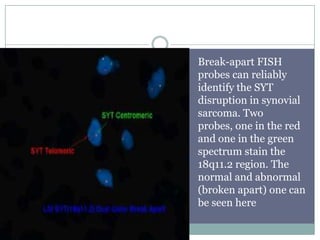
Break-apart FISH
probes can reliably
identify the SYT
disruption in synovial
sarcoma. Two
probes, one in the red
and one in the green
spectrum stain the
18q11.2 region. The
normal and abnormal
(broken apart) one can
be seen here
Symptoms
 The most common symptom experienced is a
swelling or mass that may be accompanied by pain
or tenderness.
 In a few cases it has been noted that pain or
tenderness was present for several years even
though a mass could not be felt.
 Limping or difficulty using legs, arms, hands or
feet have been reported.
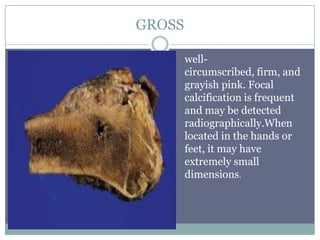
GROSS
well-
circumscribed, firm, and
grayish pink. Focal
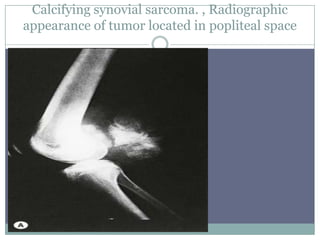
calcification is frequent
and may be detected
radiographically.When
located in the hands or
feet, it may have
extremely small
dimensions.
MICROSCOPY
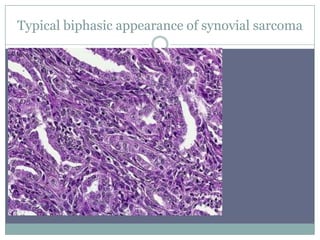
 Biphasic tumor composed of sharply segregated
epithelial and sarcomatous components
 The epithelial areas usually appear in the form of
gland-like spaces lined by cuboidal or columnar
cells, but can also present as solid nests of large pale
cells. It is exceptional for this component to exhibit
squamous features.[1537]
 The sarcomatous component is made up of spindle
cells with a fibroblast-like appearance.
 It tends to be hypercellular but with a relatively
monotonous appearance, plump nuclei, a focally
whorled pattern, distinct lobulation or fasciculation,,
 Large number of mast cells
 Hyalinization,
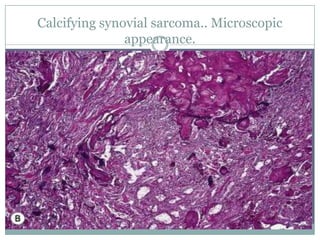
 calcification, and When the calcification is
particularly heavy, the term calcifying synovial
sarcoma has been used.
 osseous metaplasia can be present.
Typical biphasic appearance of synovial sarcoma
Calcifying synovial sarcoma. , Radiographic
appearance of tumor located in popliteal space
Calcifying synovial sarcoma.. Microscopic
appearance.
 Monophasic synovial sarcoma is composed of only
one of the two components.
 In the large majority of cases, this applies to the
spindle cell sarcomatous component, which is easily
misdiagnosed as fibrosarcoma,hemangiopericytoma.
 A search for epithelial-looking foci should be carried
out in these situations, as well as a thorough
immunohistochemical (and possibly molecular)
evaluation
 Theoretically, a monophasic form of synovial
sarcoma composed only of the epithelial elements of
the tumor should also exist.
 The fact that in some neoplasms the glandular
elements are so prominent as to simulate a
metastatic adenocarcinoma cannot be denied.
 However, the existence of a pure form of
monophasic epithelial synovial sarcoma has yet to be
convincingly demonstrated at the
cytogenetic/molecular level
 A poorly differentiated form of synovial sarcoma is
being increasingly recognized, characterized by a
greater degree of cellularity, atypia, and mitotic
activity.
 The tumor cells may be spindle, small, or large and
clear, Here too, immunohistochemical and
particularly cytogenetic/molecular confirmation
becomes crucial
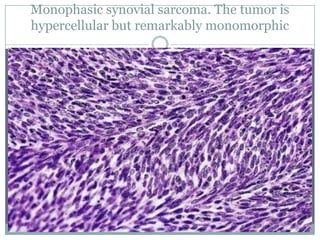
Monophasic synovial sarcoma. The tumor is
hypercellular but remarkably monomorphic
Differential diagnosis
 Fibrosarcoma.
 Adenocarcinoma
 Mesothelioma (WT-1)
 Small round cell tumour.
SPECIAL STAIN
 Special stains: Histochemistry- Secretions within
the epithelial cell and pseudoglandular spaces
are PAS positive and diastase resistant, alcian
blue and mucicarmine positive.
 The stromal mucin secreted by the spindle cells
are alcian blue positive but PAS negative.
Reticulin stain demonstrate the biphasic pattern
of the tumor. Nests of plump rounded cells are
highlighted by the reticulin stain.]
Immunohistochemistry:
 In Synovial sarcoma there is usually
coexpression of mesenchymal (vimentin) and
epithelial markers (cytokeratin & EMA).
The following immuno markers are useful in the
diagnosis:

- Cytokeratin (+)
Only synovial sarcoma is positive
with cytokeratins 7 & 19 , other soft tissue
sarcomas incl. synovial sarcoma is positive with
cytokeratin 8 & 18 ;
- EMA (+) ,
- Vimentin (+),
 in some cases
 S100 protein (+)
 , CD99 (+) .
- bcl-2 (+)

Application of a panel of
immunohistochemical markers is suggested
to avoid diagnostic pitfalls.
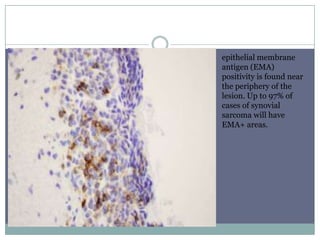
epithelial membrane
antigen (EMA)
positivity is found near
the periphery of the
lesion. Up to 97% of
cases of synovial
sarcoma will have
EMA+ areas.
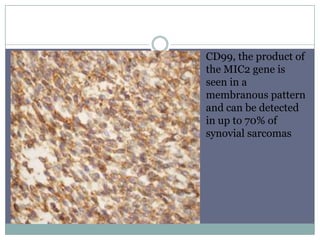
CD99, the product of
the MIC2 gene is
seen in a
membranous pattern
and can be detected
in up to 70% of
synovial sarcomas
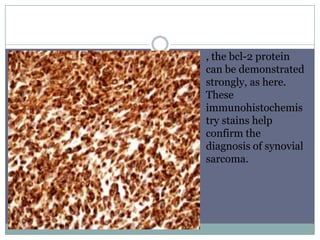
, the bcl-2 protein
can be demonstrated
strongly, as here.
These
immunohistochemis
try stains help
confirm the
diagnosis of synovial
sarcoma.
Cytogenetics
 Synovial sarcoma is associated with
chromosomal translocation t(x ;18) (p11.2 ;
q11.2).
 Synovial sarcoma can recur locally .
 Metastasize distantly, particularly to the lung and
lymph nodes.
 The incidence of nodal metastases is in the range of
10–15%
Prognosis
 Better for the synovial sarcomas associated with
heavy calcification (calcifying synovial sarcoma),
 Age (better in young patients),
 Site (better for distal lesions),
 SIZE-better for tumors less than 5 cm in diameter),
 Status of the surgical margins,
 Mitotic activity (better for tumors having fewer than
15 mitoses per 10 high-power fields),
 Necrosis (worse for tumors having tumor necrosis of
more than 50%),
 Rhabdoid cells (worse when present),
 Dysadherin expression (worse when
present, indicating E-cadherin dysfunction),
 DNA ploidy pattern (worse for aneuploid tumors).[
Treatments
 Synovial sarcomas may be treated by using the
following medical approaches…
 Surgery
 Radiation
 Chemotherapy
Surgery
 Complete surgical excision of the tumor, nearby
muscle and lymph nodes is the best way of treating
this cancer.
 Depending on the location and size of the tumor, it
may be necessary to remove all or part of a limb.
Radiation
 Radiation is often used in conjunction with surgery
to kill cancer cells.
 It can be given before surgery in order to shrink a
tumor or afterwards to kill any remaining cancer
cells.
 On rare occasions radiation alone has been used for
treatment of the primary tumor.
Chemotherapy
 Chemotherapy has been proven highly effective with
treating this form of cancer and it may be
administered in one of the following ways…
 As a pill to swallow
 As an injection into the muscle or fat tissue
 Intravenously is the most common form of delivery for
chemotherapy drugs.
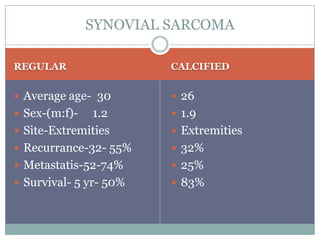
REGULAR CALCIFIED
 Average age- 30
 Sex-(m:f)- 1.2
 Site-Extremities
 Recurrance-32- 55%
 Metastatis-52-74%
 Survival- 5 yr- 50%
 26
 1.9
 Extremities
 32%
 25%
 83%
SYNOVIAL SARCOMA
 THANK YOU
SYNOVIAL CELL SARCOMA DR NARMADA

SYNOVIAL CELL SARCOMA DR NARMADA

  • 2.
    What is SynovialSarcoma?  The name "synovial sarcoma" was coined early in the 20th century, as some researchers thought that the microscopic similarity of some tumors to synovial, and its propensity to arise adjacent to joints, indicated a synovial origin; however, the actual cells from which the tumour develops are unknown and not necessarily synovial.
  • 3.
     Synovial sarcomais a misnomer because this malignancy is only rarely found within joints and it has no immunocytochemical relationship to the CK- negative normal synovium
  • 4.
    What is SynovialSarcoma?  This is a rare and aggressive soft tissue malignant tumor that begins near joints in the body.  Site-  Typically around ankle and knee joint.  Around shoulder and hip joint.  Other site- including neck (particularly the retropharyngeal area), anterior abdominal wall, abdominal cavity, retroperitoneum, mediastinum , blood vessels, nerves.  Lately, it has become evident that the distribution of this tumor is even wider, with cases reported in the oral cavity salivary glands, lung, gastrointestinal tract , kidney, prostate and vulva.
  • 5.
    Who is Affected? Age- 30 yr.  Male: Female- 1.2
  • 6.
    Etiology  The exactetiology of Synovial sarcomas is unknown.  What is known is that many Synovial sarcoma cells are characterized by a chromosomal translocation that fuses the SYT gene from chromosome 18 to either the SSX1 or the SSX2 gene.
  • 7.
    Etiology Continued  Thefusion proteins SYT-SSX1 and SYT-SSX2 are believed to function as abnormal transcriptional regulators that result in  Either activation of proto-oncogenes or inhibition of tumor suppressor genes.
  • 8.
    Break-apart FISH probes canreliably identify the SYT disruption in synovial sarcoma. Two probes, one in the red and one in the green spectrum stain the 18q11.2 region. The normal and abnormal (broken apart) one can be seen here
  • 9.
    Symptoms  The mostcommon symptom experienced is a swelling or mass that may be accompanied by pain or tenderness.  In a few cases it has been noted that pain or tenderness was present for several years even though a mass could not be felt.  Limping or difficulty using legs, arms, hands or feet have been reported.
  • 10.
    GROSS well- circumscribed, firm, and grayishpink. Focal calcification is frequent and may be detected radiographically.When located in the hands or feet, it may have extremely small dimensions.
  • 11.
    MICROSCOPY  Biphasic tumorcomposed of sharply segregated epithelial and sarcomatous components  The epithelial areas usually appear in the form of gland-like spaces lined by cuboidal or columnar cells, but can also present as solid nests of large pale cells. It is exceptional for this component to exhibit squamous features.[1537]
  • 12.
     The sarcomatouscomponent is made up of spindle cells with a fibroblast-like appearance.  It tends to be hypercellular but with a relatively monotonous appearance, plump nuclei, a focally whorled pattern, distinct lobulation or fasciculation,,  Large number of mast cells
  • 13.
     Hyalinization,  calcification,and When the calcification is particularly heavy, the term calcifying synovial sarcoma has been used.  osseous metaplasia can be present.
  • 14.
    Typical biphasic appearanceof synovial sarcoma
  • 15.
    Calcifying synovial sarcoma., Radiographic appearance of tumor located in popliteal space
  • 16.
    Calcifying synovial sarcoma..Microscopic appearance.
  • 17.
     Monophasic synovialsarcoma is composed of only one of the two components.  In the large majority of cases, this applies to the spindle cell sarcomatous component, which is easily misdiagnosed as fibrosarcoma,hemangiopericytoma.  A search for epithelial-looking foci should be carried out in these situations, as well as a thorough immunohistochemical (and possibly molecular) evaluation
  • 18.
     Theoretically, amonophasic form of synovial sarcoma composed only of the epithelial elements of the tumor should also exist.  The fact that in some neoplasms the glandular elements are so prominent as to simulate a metastatic adenocarcinoma cannot be denied.  However, the existence of a pure form of monophasic epithelial synovial sarcoma has yet to be convincingly demonstrated at the cytogenetic/molecular level
  • 19.
     A poorlydifferentiated form of synovial sarcoma is being increasingly recognized, characterized by a greater degree of cellularity, atypia, and mitotic activity.  The tumor cells may be spindle, small, or large and clear, Here too, immunohistochemical and particularly cytogenetic/molecular confirmation becomes crucial
  • 20.
    Monophasic synovial sarcoma.The tumor is hypercellular but remarkably monomorphic
  • 21.
    Differential diagnosis  Fibrosarcoma. Adenocarcinoma  Mesothelioma (WT-1)  Small round cell tumour.
  • 22.
    SPECIAL STAIN  Specialstains: Histochemistry- Secretions within the epithelial cell and pseudoglandular spaces are PAS positive and diastase resistant, alcian blue and mucicarmine positive.  The stromal mucin secreted by the spindle cells are alcian blue positive but PAS negative. Reticulin stain demonstrate the biphasic pattern of the tumor. Nests of plump rounded cells are highlighted by the reticulin stain.]
  • 23.
    Immunohistochemistry:  In Synovialsarcoma there is usually coexpression of mesenchymal (vimentin) and epithelial markers (cytokeratin & EMA). The following immuno markers are useful in the diagnosis:  - Cytokeratin (+) Only synovial sarcoma is positive with cytokeratins 7 & 19 , other soft tissue sarcomas incl. synovial sarcoma is positive with cytokeratin 8 & 18 ; - EMA (+) , - Vimentin (+),
  • 24.
     in somecases  S100 protein (+)  , CD99 (+) . - bcl-2 (+)  Application of a panel of immunohistochemical markers is suggested to avoid diagnostic pitfalls.
  • 25.
    epithelial membrane antigen (EMA) positivityis found near the periphery of the lesion. Up to 97% of cases of synovial sarcoma will have EMA+ areas.
  • 26.
    CD99, the productof the MIC2 gene is seen in a membranous pattern and can be detected in up to 70% of synovial sarcomas
  • 27.
    , the bcl-2protein can be demonstrated strongly, as here. These immunohistochemis try stains help confirm the diagnosis of synovial sarcoma.
  • 28.
    Cytogenetics  Synovial sarcomais associated with chromosomal translocation t(x ;18) (p11.2 ; q11.2).
  • 29.
     Synovial sarcomacan recur locally .  Metastasize distantly, particularly to the lung and lymph nodes.  The incidence of nodal metastases is in the range of 10–15%
  • 30.
    Prognosis  Better forthe synovial sarcomas associated with heavy calcification (calcifying synovial sarcoma),  Age (better in young patients),  Site (better for distal lesions),  SIZE-better for tumors less than 5 cm in diameter),  Status of the surgical margins,
  • 31.
     Mitotic activity(better for tumors having fewer than 15 mitoses per 10 high-power fields),  Necrosis (worse for tumors having tumor necrosis of more than 50%),  Rhabdoid cells (worse when present),
  • 32.
     Dysadherin expression(worse when present, indicating E-cadherin dysfunction),  DNA ploidy pattern (worse for aneuploid tumors).[
  • 33.
    Treatments  Synovial sarcomasmay be treated by using the following medical approaches…  Surgery  Radiation  Chemotherapy
  • 34.
    Surgery  Complete surgicalexcision of the tumor, nearby muscle and lymph nodes is the best way of treating this cancer.  Depending on the location and size of the tumor, it may be necessary to remove all or part of a limb.
  • 35.
    Radiation  Radiation isoften used in conjunction with surgery to kill cancer cells.  It can be given before surgery in order to shrink a tumor or afterwards to kill any remaining cancer cells.  On rare occasions radiation alone has been used for treatment of the primary tumor.
  • 36.
    Chemotherapy  Chemotherapy hasbeen proven highly effective with treating this form of cancer and it may be administered in one of the following ways…  As a pill to swallow  As an injection into the muscle or fat tissue  Intravenously is the most common form of delivery for chemotherapy drugs.
  • 37.
    REGULAR CALCIFIED  Averageage- 30  Sex-(m:f)- 1.2  Site-Extremities  Recurrance-32- 55%  Metastatis-52-74%  Survival- 5 yr- 50%  26  1.9  Extremities  32%  25%  83% SYNOVIAL SARCOMA
  • 38.