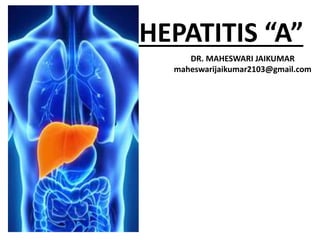
HEPATITIS “A”
DR. MAHESWARI JAIKUMAR
maheswarijaikumar2103@gmail.com
VIRAL HEPATITIS
• Viral hepatitis may be defined as
infection of the liver caused by
either by Hepatitis group of
viruses
HEPATITIS VIRUS
• Hepatitis virus A (HAV), Hepatitis
virus B (HAB), Hepatitis viruses
C,D & E are the aetiological
agents of viral hepatitis
VIRAL HEPATITIS
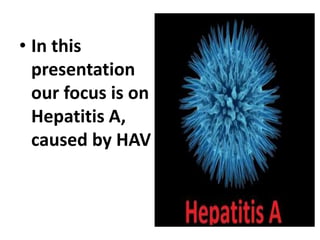
• In this
presentation
our focus is on
Hepatitis A,
caused by HAV
HEPATITIS “A”
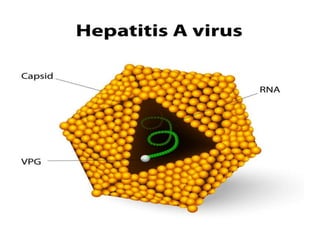
• Hepatitis ”A”(formerly known as
“infectious hepatitis or epidemic
jaundice) is an acute infectious
disease caused by hepatitis A
virus (HAV)
• The disease is manifested by non
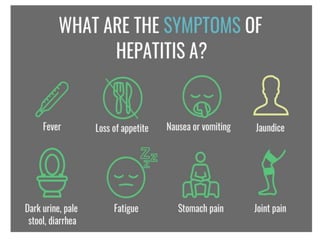
specific symptoms such as fever,
chills, headache, fatigue,
generalized weakness, aches and
pains followed by anorexia,
nausea, vomiting, dark urine and
jaundice
• The disease spectrum is
characterized by the occurrence
of numerous sub clinical or
asymptomatic cases
• The disease is benign with
complete recovery in several
weeks
• The disease is benign with
complete recovery in several
weeks
• Hepatitis being enterovirus
infection is endemic in most
developing countries
• In developing countries with very
poor sanitary conditions and
hygienic practices 90% children
have been affected with Hepatitis
A virus
• Those infected in childhood do
not experience any noticeable
symptoms.
• Epidemics are uncommon
because older children and
adults are generally immune
EPIDEMIOLOGICAL
DETERMINANTS
AGENT
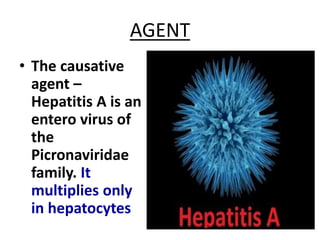
• The causative
agent –
Hepatitis A is an
entero virus of
the
Picronaviridae
family. It
multiplies only
in hepatocytes
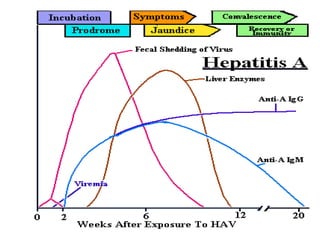
• Faecal shedding of the virus is at
its highest during the later part
of the incubation period and
early acute phase of illness
• Only one sero type is known
RESISTANCE
• The virus is fairly resistant to low
pH, heat and chemicals
• It withstands heating to 600 deg C
for one hour and is not affected by
chlorine in doses employed for
chlorination
• Formalin is found to be effective
disinfectant
• The virus is inactivated by UV
rays and by boiling for 5 min or
autoclaving
RESERVOIR OF INFECTION
• Human beings are the only
known reservoir of infection
• There is no evidence of chronic
carrier state
HOST FACTORS
• AGE: hepatitis A infection is
common among children.
Infection tends to be mild and
sub clinical. Clinical severity
increases with age
• GENDER: Both gender are equally
susceptible to infection
• IMMUNITY: Immunity after an
attack probably lasts for life
( second attacks have been
reported in 5% cases)
• Most individuals in endemic areas
acquire immunity thorough sub
clinical infection
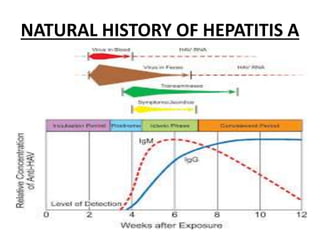
• The IgM antibody appears early in
the illness and persists for over 90
days, where ass IgG appears more
slowly bad persists for many years
ENVIRONMENTAL FACTORS
• Cases may occur throughout the
year
• In India the disease tends to be
associated with periods of heavy
rainfall
• Poor sanitation and over
crowding favour the spread of
infection, giving raise to water-
borne and food-borne epidemics
NATURAL HISTORY OF HEPATITIS A
MODE OF TRANSMISSION
• The disease is transmitted
through three possible routes:
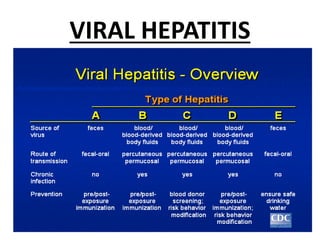
• 1. Faecal-oral route
• 2. parenteral route
• 3. sexual transmission
FAECAL-ORAL ROUTE
• This is the major route of
transmission
• It may occur by direct (person-to-
person) contact or indirectly by
way of contaminated water, food
and milk
• Water-borne transmission is the
major factor in developing
countries
• Food-borne outbreaks are
becoming more frequent
• Consumption of salads and
vegetables cultivated in sewage
polluted water is associated with
epidemic outbreaks of hepatitis
• Direct transmission comprises an
array of routes such as
contaminated hands or objects
such as eating utensils
• Direct transmission occurs
readily under conditions of poor
sanitation and overcrowding
PARETERAL ROUTE
• Hepatitis A is rarely transmitted
through parenteral route ( i.e. By
blood and blood products or by
skin penetration through
contaminated needles)
• This may occur during the stage
of viraemia. This route of
transmission is of minor
importance
SEXUAL TRASMISSION
• Sexual transmission may occur
mainly among homosexuals
because of oral-anal contact
INCUBATION PERIOD
• 10 – 50 days (usually 14-28 days)
• The length of incubation period
is directly proportional to the
dose of the virus ingested
CLINICAL SPECTRUM
• The onset of jaundice is
preceded by gastroenteritis
symptoms such as nausea,
vomiting, anorexia and mild
fever
• Jaundice may appear within few
days of the prodromal period but
anicteric hepatitis is more common
• Hepatitis A resolves completely in
98% of cases, but relapse of
symptoms may be noted in 5%
cases
DIAGNOSIS
• Include tests for abnormal liver
function such as serum alanine
aminotransferase (ALT) and
bilirubin, supplement the clinical
pathologic and epidemiological
findings
• Specific laboratory test may be
obtained by
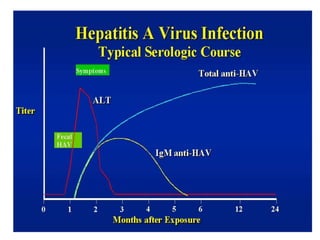
• 1. demonstration of HAV particles
or specific viral antigens in the
faeces, bile and blood. HAV is
detected in stool from about 2
weeks prior to the onset of
jaundice, up to 2 weeks after
• Anti HAV appears in the IgM
fraction during acute phase,
peaking about 2 weeks after
elevation of liver enzymes
• Anti-HAV IgM usually declines to
non-detectable levels within 3-6
months
• Anti-HAV IgG appears soon after
the onset of disease and persists
for decades
• Thus, detection of IgM-specific
anti-HAV in the blood of an
acutely infected patient confirms
the diagnosis of hepatitis. ELISA
is the method of choice for
measuring HAV antibodies
PREVENTION & CONTAINMENT
• CONTROL OF RESERVOIR:
Control of reservoir is difficult
because of the following factors:
• 1. faecal shedding of the virus is
at its highest during the early
phase f the disease
• Low socio economic profile of
the population does not
facilitate strict isolation of cases
and carriers.
• However attention should be
paid to the usual control
measures such as complete bed
rest and disinfection of faeces
and fomites
• The use of 0.5% sodium
hypochlorite is strongly
recommended as an effective
disinfectant
CONTROL OF TRANSMISSION
• The best means of reducing the
spread of infection is by promoting
simple measures of personal and
community hygiene (hand washing
before eating and after toilet,
sanitary disposal of excreta,
purification of community water,
flocculation , filtration and
adequate chlorination.
• 1 mg/L of free residual chlorine
can cause destruction of the
virus in 30 min at pH values 8.5
or less
• The water treatment and
distribution system should be
improved
• During epidemics boiled water
should be advocated for drinking
purposes
CONTROL OF SUSCEPTIBLE
POPULATION
• HUMAN IMMUNOGLOBULIN :
The protective efficacy of human
immunoglobulin (Ig) against HAV
is well documented.
• The duration of protection is for
1-2 months and 3-5 months
following administration of IgG
at dose 0.02 and 0.06 ml/kg
body weight respectively
• Prophylaxis is achieved within
hours of injection & is 80-90%
effective when administered or
no later than 14 days after
exposure
VACCINES
• Two types of hepatitis A vaccines
are used worldwide
• 1. Formaldehyde inactivated
vaccines
• 2. Live attenuated vaccines
• Formaldehyde inactivated
vaccines are foe use in persons
above 1 year
• The complete vaccination
schedule consists of 2 dose
administration into deltoid
muscle
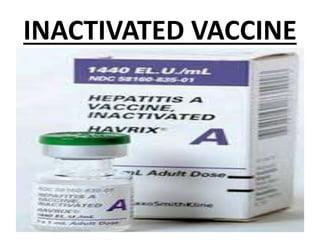
INACTIVATED VACCINE
• The interval between first
(primary) dose and second
(booster) is commonly 6-12
months
• The live attenuated vaccine is
administered as a single
subcutaneous dose
THANK YOU

HEPATITIS "A"

  • 1.
    HEPATITIS “A” DR. MAHESWARIJAIKUMAR maheswarijaikumar2103@gmail.com
  • 2.
    VIRAL HEPATITIS • Viralhepatitis may be defined as infection of the liver caused by either by Hepatitis group of viruses
  • 3.
    HEPATITIS VIRUS • Hepatitisvirus A (HAV), Hepatitis virus B (HAB), Hepatitis viruses C,D & E are the aetiological agents of viral hepatitis
  • 4.
  • 5.
    • In this presentation ourfocus is on Hepatitis A, caused by HAV
  • 7.
    HEPATITIS “A” • Hepatitis”A”(formerly known as “infectious hepatitis or epidemic jaundice) is an acute infectious disease caused by hepatitis A virus (HAV)
  • 8.
    • The diseaseis manifested by non specific symptoms such as fever, chills, headache, fatigue, generalized weakness, aches and pains followed by anorexia, nausea, vomiting, dark urine and jaundice
  • 9.
    • The diseasespectrum is characterized by the occurrence of numerous sub clinical or asymptomatic cases • The disease is benign with complete recovery in several weeks
  • 10.
    • The diseaseis benign with complete recovery in several weeks
  • 11.
    • Hepatitis beingenterovirus infection is endemic in most developing countries • In developing countries with very poor sanitary conditions and hygienic practices 90% children have been affected with Hepatitis A virus
  • 12.
    • Those infectedin childhood do not experience any noticeable symptoms. • Epidemics are uncommon because older children and adults are generally immune
  • 13.
  • 14.
    AGENT • The causative agent– Hepatitis A is an entero virus of the Picronaviridae family. It multiplies only in hepatocytes
  • 15.
    • Faecal sheddingof the virus is at its highest during the later part of the incubation period and early acute phase of illness • Only one sero type is known
  • 16.
    RESISTANCE • The virusis fairly resistant to low pH, heat and chemicals • It withstands heating to 600 deg C for one hour and is not affected by chlorine in doses employed for chlorination
  • 17.
    • Formalin isfound to be effective disinfectant • The virus is inactivated by UV rays and by boiling for 5 min or autoclaving
  • 18.
    RESERVOIR OF INFECTION •Human beings are the only known reservoir of infection • There is no evidence of chronic carrier state
  • 19.
    HOST FACTORS • AGE:hepatitis A infection is common among children. Infection tends to be mild and sub clinical. Clinical severity increases with age
  • 20.
    • GENDER: Bothgender are equally susceptible to infection • IMMUNITY: Immunity after an attack probably lasts for life ( second attacks have been reported in 5% cases)
  • 21.
    • Most individualsin endemic areas acquire immunity thorough sub clinical infection • The IgM antibody appears early in the illness and persists for over 90 days, where ass IgG appears more slowly bad persists for many years
  • 22.
    ENVIRONMENTAL FACTORS • Casesmay occur throughout the year • In India the disease tends to be associated with periods of heavy rainfall
  • 23.
    • Poor sanitationand over crowding favour the spread of infection, giving raise to water- borne and food-borne epidemics
  • 24.
    NATURAL HISTORY OFHEPATITIS A
  • 25.
    MODE OF TRANSMISSION •The disease is transmitted through three possible routes: • 1. Faecal-oral route • 2. parenteral route • 3. sexual transmission
  • 26.
    FAECAL-ORAL ROUTE • Thisis the major route of transmission • It may occur by direct (person-to- person) contact or indirectly by way of contaminated water, food and milk
  • 27.
    • Water-borne transmissionis the major factor in developing countries • Food-borne outbreaks are becoming more frequent
  • 28.
    • Consumption ofsalads and vegetables cultivated in sewage polluted water is associated with epidemic outbreaks of hepatitis
  • 29.
    • Direct transmissioncomprises an array of routes such as contaminated hands or objects such as eating utensils • Direct transmission occurs readily under conditions of poor sanitation and overcrowding
  • 30.
    PARETERAL ROUTE • HepatitisA is rarely transmitted through parenteral route ( i.e. By blood and blood products or by skin penetration through contaminated needles)
  • 31.
    • This mayoccur during the stage of viraemia. This route of transmission is of minor importance
  • 32.
    SEXUAL TRASMISSION • Sexualtransmission may occur mainly among homosexuals because of oral-anal contact
  • 33.
    INCUBATION PERIOD • 10– 50 days (usually 14-28 days) • The length of incubation period is directly proportional to the dose of the virus ingested
  • 34.
    CLINICAL SPECTRUM • Theonset of jaundice is preceded by gastroenteritis symptoms such as nausea, vomiting, anorexia and mild fever
  • 36.
    • Jaundice mayappear within few days of the prodromal period but anicteric hepatitis is more common • Hepatitis A resolves completely in 98% of cases, but relapse of symptoms may be noted in 5% cases
  • 38.
    DIAGNOSIS • Include testsfor abnormal liver function such as serum alanine aminotransferase (ALT) and bilirubin, supplement the clinical pathologic and epidemiological findings
  • 39.
    • Specific laboratorytest may be obtained by • 1. demonstration of HAV particles or specific viral antigens in the faeces, bile and blood. HAV is detected in stool from about 2 weeks prior to the onset of jaundice, up to 2 weeks after
  • 40.
    • Anti HAVappears in the IgM fraction during acute phase, peaking about 2 weeks after elevation of liver enzymes • Anti-HAV IgM usually declines to non-detectable levels within 3-6 months
  • 42.
    • Anti-HAV IgGappears soon after the onset of disease and persists for decades • Thus, detection of IgM-specific anti-HAV in the blood of an acutely infected patient confirms the diagnosis of hepatitis. ELISA is the method of choice for measuring HAV antibodies
  • 43.
    PREVENTION & CONTAINMENT •CONTROL OF RESERVOIR: Control of reservoir is difficult because of the following factors: • 1. faecal shedding of the virus is at its highest during the early phase f the disease
  • 44.
    • Low socioeconomic profile of the population does not facilitate strict isolation of cases and carriers. • However attention should be paid to the usual control measures such as complete bed rest and disinfection of faeces and fomites
  • 45.
    • The useof 0.5% sodium hypochlorite is strongly recommended as an effective disinfectant
  • 46.
    CONTROL OF TRANSMISSION •The best means of reducing the spread of infection is by promoting simple measures of personal and community hygiene (hand washing before eating and after toilet, sanitary disposal of excreta, purification of community water, flocculation , filtration and adequate chlorination.
  • 47.
    • 1 mg/Lof free residual chlorine can cause destruction of the virus in 30 min at pH values 8.5 or less • The water treatment and distribution system should be improved
  • 48.
    • During epidemicsboiled water should be advocated for drinking purposes
  • 49.
    CONTROL OF SUSCEPTIBLE POPULATION •HUMAN IMMUNOGLOBULIN : The protective efficacy of human immunoglobulin (Ig) against HAV is well documented.
  • 50.
    • The durationof protection is for 1-2 months and 3-5 months following administration of IgG at dose 0.02 and 0.06 ml/kg body weight respectively
  • 51.
    • Prophylaxis isachieved within hours of injection & is 80-90% effective when administered or no later than 14 days after exposure
  • 52.
    VACCINES • Two typesof hepatitis A vaccines are used worldwide • 1. Formaldehyde inactivated vaccines • 2. Live attenuated vaccines
  • 53.
    • Formaldehyde inactivated vaccinesare foe use in persons above 1 year • The complete vaccination schedule consists of 2 dose administration into deltoid muscle
  • 54.
  • 55.
    • The intervalbetween first (primary) dose and second (booster) is commonly 6-12 months • The live attenuated vaccine is administered as a single subcutaneous dose
  • 56.