VIRAL HEPATITIS
VIRAL HEPATITIS
A
A,B
,B,C
,C,
,D
D,
,E
E G
G ……..
……..
Dr.T.V.Rao MD
Dr.T.V.Rao MD
What Is Hepatitis?
What Is Hepatitis?
 The word "
The word "hepatitis
hepatitis" means inflammation of the
" means inflammation of the
liver
liver. Toxins, certain drugs, some diseases,
. Toxins, certain drugs, some diseases,
heavy alcohol use, bacterial and viral infections
can all cause hepatitis. Hepatitis is also the
name of a family of viral infections that affect the
liver; the most common types in the United
States are hepatitis A, hepatitis B, and hepatitis
C.
C.
Hepatitis
Hepatitis
 Hepatitis
Hepatitis (plural
(plural hepatitides
hepatitides) implies
) implies
injury to the liver characterized by the
presence of inflammatory cells in the
tissue of the organ. The name is from
ancient Greek
ancient Greek hepar
hepar or
or hepato
hepato, meaning
, meaning
liver
liver, and suffix
, and suffix -itis
-itis, meaning
, meaning
"inflammation" (c. 1727)
Viral Hepatitis
Viral Hepatitis
 A group of
A group of viruses
viruses known as the hepatitis
known as the hepatitis
viruses cause most cases of liver damage
worldwide. Hepatitis can also be due to toxins
(notably alcohol), other infections.
 Common viruses cause hepatitis include
Common viruses cause hepatitis include
A,B,C,D,E. G ……….
A,B,C,D,E. G ……….
 Acute hepatitis
Acute hepatitis
 Viral Hepatitis: Hepatitis A through E (more than
Viral Hepatitis: Hepatitis A through E (more than
95% of viral cause), Herpes simplex,
Cytomegalovirus, Epstein-Barr, yellow fever
virus, adenoviruses.
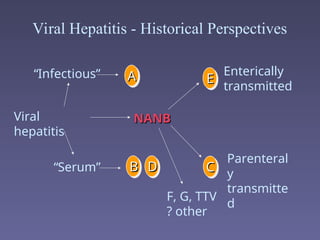
A
A
“Infectious”
“Serum”
Viral
hepatitis
Enterically
transmitted
Parenteral
y
transmitte
d
F, G, TTV
? other
E
E
NANB
NANB
B
B D
D C
C
Viral Hepatitis - Historical Perspectives
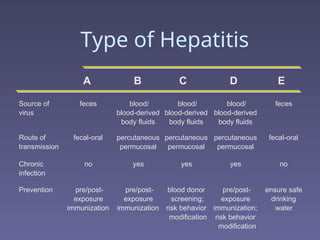
Source of
virus
feces blood/
blood-derived
body fluids
blood/
blood-derived
body fluids
blood/
blood-derived
body fluids
feces
Route of
transmission
fecal-oral percutaneous
permucosal
percutaneous
permucosal
percutaneous
permucosal
fecal-oral
Chronic
infection
no yes yes yes no
Prevention pre/post-
exposure
immunization
pre/post-
exposure
immunization
blood donor
screening;
risk behavior
modification
pre/post-
exposure
immunization;
risk behavior
modification
ensure safe
drinking
water
Type of Hepatitis
A B C D E
Hepatitis A
Hepatitis A
 Hepatitis A
Hepatitis A is an acute liver disease
is an acute liver disease
caused by the hepatitis A virus (HAV),
lasting from a few weeks to several
months. It does not lead to chronic
infection.
infection.
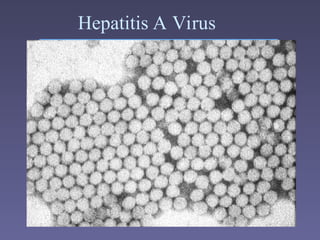
Hepatitis A Virus
Hepatitis A Virus
Hepatitis A Virus
 Naked RNA virus
Naked RNA virus
 Related to enteroviruses, formerly known as
Related to enteroviruses, formerly known as
enterovirus 72, now put in its own family: heptovirus
 One stable serotype only
One stable serotype only
 Difficult to grow in cell culture: primary marmoset
Difficult to grow in cell culture: primary marmoset
cell culture and also in vivo in chimpanzees and
marmosets
marmosets
 4 genotypes exist, but in practice most of them are
4 genotypes exist, but in practice most of them are
group 1
group 1
Nature of HAV virus
Nature of HAV virus
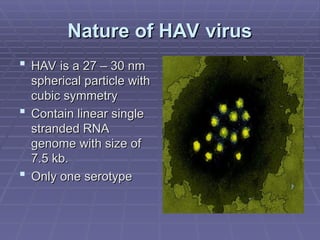
 HAV is a 27 – 30 nm
HAV is a 27 – 30 nm
spherical particle with
cubic symmetry
cubic symmetry
 Contain linear single
Contain linear single
stranded RNA
stranded RNA
genome with size of
genome with size of
7.5 kb.
7.5 kb.
 Only one serotype
Only one serotype
HAV characters
HAV characters
 HAV are stable to treatment with 20% ether,acid
HAV are stable to treatment with 20% ether,acid
and heat at 60
and heat at 600
0
c for 1 hour.
c for 1 hour.
 The virus are destroyed by autoclaving at 121
The virus are destroyed by autoclaving at 1210
0
c
c
for 20 minutes, boiling in water for 5 minutes
 Treatment with chlorine 1 ppm for 30 minutes
Treatment with chlorine 1 ppm for 30 minutes
 Heating food > 85
Heating food > 850
0
c for 1 minute destroys
Culturing HAV virus
Culturing HAV virus
 Various primate cell lines will support
Various primate cell lines will support
grwoth of HAV,though fresh isolates of
virus are difficult to adapt and grow.
 Usually to cytopathic effects are apparent
Usually to cytopathic effects are apparent
Pathology in Viral Hepatitis
 Indicates inflamation of liver.
Indicates inflamation of liver.
 Microscopically there is spotty parenchymal cell
Microscopically there is spotty parenchymal cell
degeneration, with necrosis of Hepatocytes, with
disruption of liver cell cords
 The parenchymal changes are accompanied by
The parenchymal changes are accompanied by
Reticuloendothelial ( KUFFER) cell
hyperplasia,periportal infiltration by monoculear
cells and cell degeneration.
Causes liver damage
Causes liver damage
 Localised areas of necrosis are frequently
Localised areas of necrosis are frequently
observed
observed
 Later accumulation of macrophages near
Later accumulation of macrophages near
degenerating Hepatocytes
Transmission Of Hepatitis A
:
: Ingestion of food or water contaminated
Ingestion of food or water contaminated
with faecal matter, Even in
microscopic amounts, From close
person-to-person
person-to-person
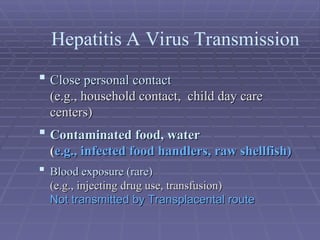
 Close personal contact
Close personal contact
(e.g., household contact, child day care
centers)
centers)
 Contaminated food, water
Contaminated food, water
(
(e.g., infected food handlers, raw shellfish)
e.g., infected food handlers, raw shellfish)
 Blood exposure (rare)
Blood exposure (rare)
(e.g., injecting drug use, transfusion)
Not transmitted by Transplacental route
Hepatitis A Virus Transmission
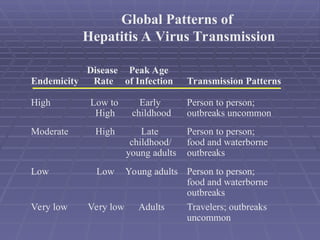
Endemicity
Disease
Rate
Peak Age
of Infection Transmission Patterns
High Low to
High
Early
childhood
Person to person;
outbreaks uncommon
Moderate High Late
childhood/
young adults
Person to person;
food and waterborne
outbreaks
Low Low Young adults Person to person;
food and waterborne
outbreaks
Very low Very low Adults Travelers; outbreaks
uncommon
Global Patterns of
Hepatitis A Virus Transmission
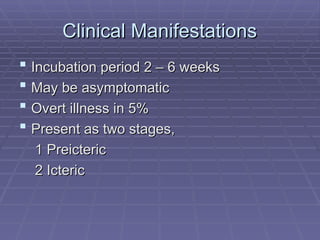
Clinical Manifestations
 Incubation period 2 – 6 weeks
Incubation period 2 – 6 weeks
 May be asymptomatic
May be asymptomatic
 Overt illness in 5%
Overt illness in 5%
 Present as two stages,
Present as two stages,
1 Preicteric
1 Preicteric
2 Icteric
2 Icteric
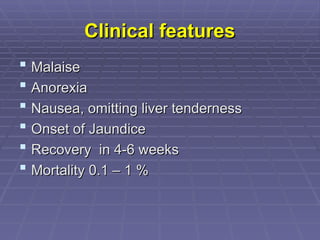
Clinical features
Clinical features
 Malaise
Malaise
 Anorexia
Anorexia
 Nausea, omitting liver tenderness
Nausea, omitting liver tenderness
 Onset of Jaundice
Onset of Jaundice
 Recovery in 4-6 weeks
Recovery in 4-6 weeks
 Mortality 0.1 – 1 %
Mortality 0.1 – 1 %
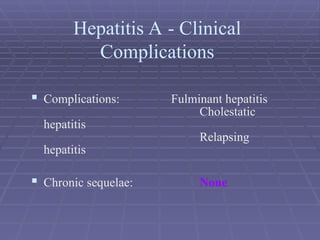
 Complications: Fulminant hepatitis
Cholestatic
hepatitis
Relapsing
hepatitis
 Chronic sequelae: None
Hepatitis A - Clinical
Complications
Laboratory Diagnosis
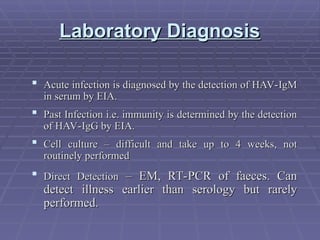
 Acute infection is diagnosed by the detection of HAV-IgM
Acute infection is diagnosed by the detection of HAV-IgM
in serum by EIA.
in serum by EIA.
 Past Infection i.e. immunity is determined by the detection
Past Infection i.e. immunity is determined by the detection
of HAV-IgG by EIA.
of HAV-IgG by EIA.
 Cell culture – difficult and take up to 4 weeks, not
Cell culture – difficult and take up to 4 weeks, not
routinely performed
routinely performed
 Direct Detection
Direct Detection – EM, RT-PCR of faeces. Can
– EM, RT-PCR of faeces. Can
detect illness earlier than serology but rarely
performed.
performed.
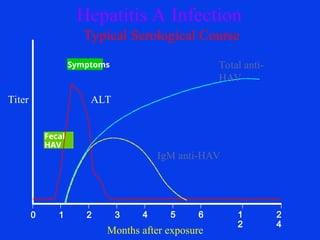
Fecal
HAV
Symptoms
0 1 2 3 4 5 6 1
2
2
4
Hepatitis A Infection
Total anti-
HAV
Titer ALT
IgM anti-HAV
Months after exposure
Typical Serological Course
Treatment
Treatment
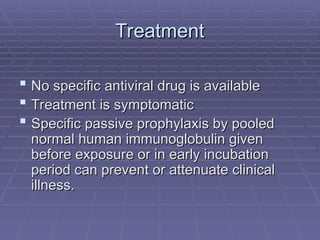
 No specific antiviral drug is available
No specific antiviral drug is available
 Treatment is symptomatic
Treatment is symptomatic
 Specific passive prophylaxis by pooled
Specific passive prophylaxis by pooled
normal human immunoglobulin given
before exposure or in early incubation
period can prevent or attenuate clinical
illness.
illness.
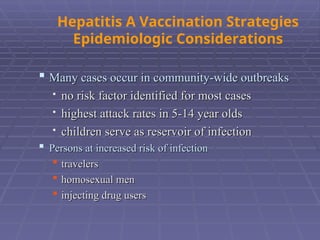
 Many cases occur in community-wide outbreaks
Many cases occur in community-wide outbreaks
 no risk factor identified for most cases
no risk factor identified for most cases
 highest attack rates in 5-14 year olds
highest attack rates in 5-14 year olds
 children serve as reservoir of infection
children serve as reservoir of infection
 Persons at increased risk of infection
Persons at increased risk of infection
 travelers
travelers
 homosexual men
homosexual men
 injecting drug users
injecting drug users
Hepatitis A Vaccination Strategies
Epidemiologic Considerations
Vaccination for HAV
Vaccination for HAV
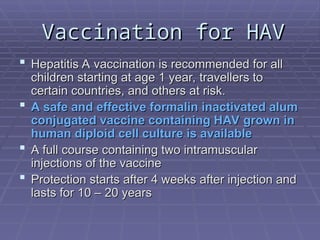
 Hepatitis A vaccination is recommended for all
Hepatitis A vaccination is recommended for all
children starting at age 1 year, travellers to
certain countries, and others at risk.
 A safe and effective formalin inactivated alum
A safe and effective formalin inactivated alum
conjugated vaccine containing HAV grown in
human diploid cell culture is available
 A full course containing two intramuscular
A full course containing two intramuscular
injections of the vaccine
 Protection starts after 4 weeks after injection and
Protection starts after 4 weeks after injection and
lasts for 10 – 20 years
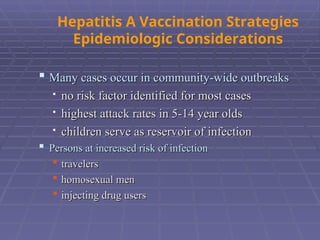
 Many cases occur in community-wide outbreaks
Many cases occur in community-wide outbreaks
 no risk factor identified for most cases
no risk factor identified for most cases
 highest attack rates in 5-14 year olds
highest attack rates in 5-14 year olds
 children serve as reservoir of infection
children serve as reservoir of infection
 Persons at increased risk of infection
Persons at increased risk of infection
 travelers
travelers
 homosexual men
homosexual men
 injecting drug users
injecting drug users
Hepatitis A Vaccination Strategies
Epidemiologic Considerations
Epidemiology
Epidemiology
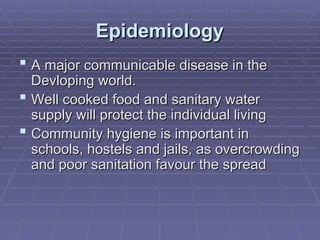
 A major communicable disease in the
A major communicable disease in the
Devloping world
Devloping world.
.
 Well cooked food and sanitary water
Well cooked food and sanitary water
supply will protect the individual living
 Community hygiene is important in
Community hygiene is important in
schools, hostels and jails, as overcrowding
and poor sanitation favour the spread
Prevention of Hepatitis A
Infection
Infection
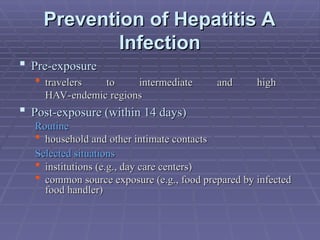
 Pre-exposure
Pre-exposure
 travelers to intermediate and high
travelers to intermediate and high
HAV-endemic regions
HAV-endemic regions
 Post-exposure (within 14 days)
Post-exposure (within 14 days)
Routine
Routine
 household and other intimate contacts
household and other intimate contacts
Selected situations
Selected situations
 institutions (e.g., day care centers)
institutions (e.g., day care centers)
 common source exposure (e.g., food prepared by infected
common source exposure (e.g., food prepared by infected
food handler)
food handler)
Hepatitis B
Hepatitis B
Infection
Infection
Most Important Infectious
Disease
Disease
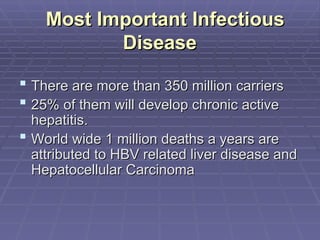
 There are more than 350 million carriers
There are more than 350 million carriers
 25% of them will develop chronic active
25% of them will develop chronic active
hepatitis.
hepatitis.
 World wide 1 million deaths a years are
World wide 1 million deaths a years are
attributed to HBV related liver disease and
Hepatocellular Carcinoma
Hepatitis B
Hepatitis B
 Hepatitis B
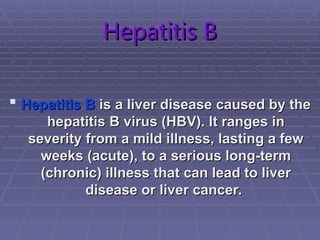
Hepatitis B is a liver disease caused by the
is a liver disease caused by the
hepatitis B virus (HBV). It ranges in
severity from a mild illness, lasting a few
weeks (acute), to a serious long-term
(chronic) illness that can lead to liver
disease or liver cancer.
Hepatitis B Virus
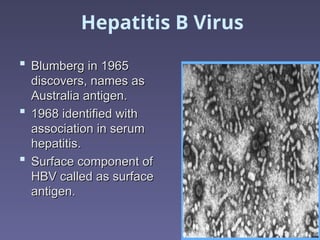
 Blumberg in 1965
Blumberg in 1965
discovers, names as
discovers, names as
Australia antigen.
Australia antigen.
 1968 identified with
1968 identified with
association in serum
hepatitis.
hepatitis.
 Surface component of
Surface component of
HBV called as surface
antigen.
antigen.
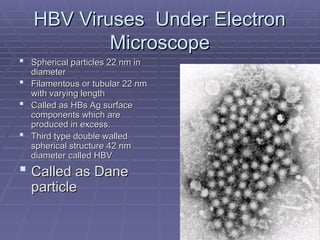
HBV Viruses Under Electron
Microscope
Microscope
 Spherical particles 22 nm in
Spherical particles 22 nm in
diameter
diameter
 Filamentous or tubular 22 nm
Filamentous or tubular 22 nm
with varying length
with varying length
 Called as HBs Ag surface
Called as HBs Ag surface
components which are
produced in excess.
produced in excess.
 Third type double walled
Third type double walled
spherical structure 42 nm
diameter called HBV
diameter called HBV
 Called as Dane
Called as Dane
particle
particle
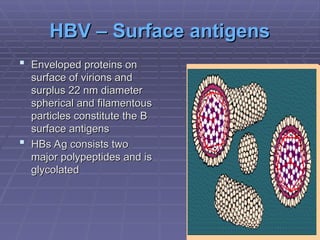
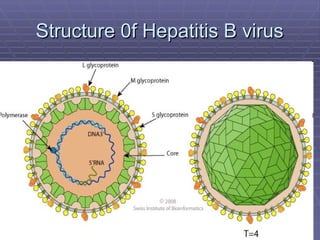
HBV – Surface antigens
 Enveloped proteins on
Enveloped proteins on
surface of virions and
surplus 22 nm diameter
spherical and filamentous
particles constitute the B
surface antigens
surface antigens
 HBs Ag consists two
HBs Ag consists two
major polypeptides and is
glycolated
glycolated
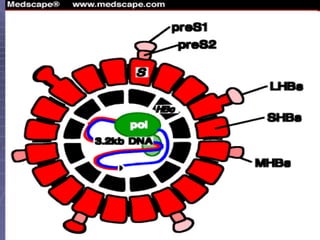
Structure 0f Hepatitis B virus
HBV shows antigenic
HBV shows antigenic
diversity
diversity
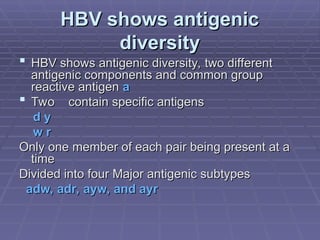
 HBV shows antigenic diversity, two different
HBV shows antigenic diversity, two different
antigenic components and common group
reactive antigen
reactive antigen a
a
 Two contain specific antigens
Two contain specific antigens
d y
d y
w r
w r
Only one member of each pair being present at a
time
time
Divided into four Major antigenic subtypes
adw, adr, ayw, and ayr
Geographic distribution
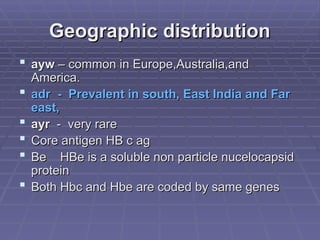
 ayw
ayw – common in Europe,Australia,and
– common in Europe,Australia,and
America.
America.
 adr - Prevalent in south, East India and Far
adr - Prevalent in south, East India and Far
east,
east,
 ayr
ayr - very rare
- very rare
 Core antigen HB c ag
Core antigen HB c ag
 Be HBe is a soluble non particle nucelocapsid
Be HBe is a soluble non particle nucelocapsid
protein
protein
 Both Hbc and Hbe are coded by same genes
Both Hbc and Hbe are coded by same genes
Replication
Replication
 The RNA dependent DNA synthesis takes
The RNA dependent DNA synthesis takes
place within the newly assembled Virion
core in the cytoplasam.
 Hepadnaviruses the only virus that
Hepadnaviruses the only virus that
produce genome DNA by reverse
transcription with mRNA as the
template
template
Pathogenesis of HBV infection
 Disease is Immune mediated
Disease is Immune mediated
 Hepatocytes carry viral antigen
Hepatocytes carry viral antigen
 Immune response subject to antibody dependent.
Immune response subject to antibody dependent.
 N K cell and cytotoxic T cell attack
N K cell and cytotoxic T cell attack
 In the absence of adequate immune response HBV
In the absence of adequate immune response HBV
infection may not cause hepatitis.
 But lead to carrier state.
But lead to carrier state.
 Infection – Immunodeficient person are likely to because
Infection – Immunodeficient person are likely to because
asymptomatic carrier followed infection
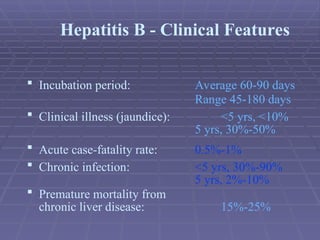
 Incubation period: Average 60-90 days
Range 45-180 days
 Clinical illness (jaundice): <5 yrs, <10%
5 yrs, 30%-50%
 Acute case-fatality rate: 0.5%-1%
 Chronic infection: <5 yrs, 30%-90%
5 yrs, 2%-10%
 Premature mortality from
chronic liver disease: 15%-25%
Hepatitis B - Clinical Features
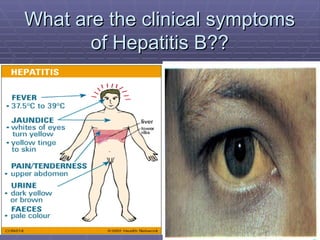
What are the clinical symptoms
of Hepatitis B??
of Hepatitis B??
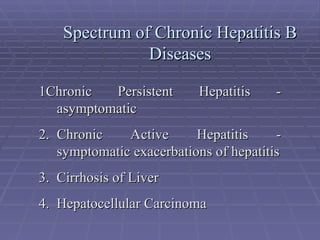
Spectrum of Chronic Hepatitis B
Diseases
Diseases
1
1Chronic Persistent Hepatitis -
Chronic Persistent Hepatitis -
asymptomatic
asymptomatic
2.
2. Chronic Active Hepatitis -
Chronic Active Hepatitis -
symptomatic exacerbations of hepatitis
3. Cirrhosis of Liver
4. Hepatocellular Carcinoma
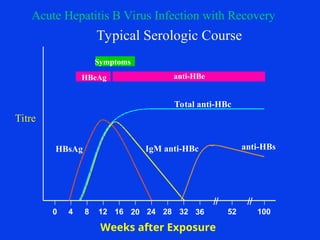
Symptoms
HBeAg anti-HBe
Total anti-HBc
IgM anti-HBc anti-HBs
HBsAg
0 4 8 12 16 20 24 28 32 36 52 100
Acute Hepatitis B Virus Infection with Recovery
Typical Serologic Course
Weeks after Exposure
Titre
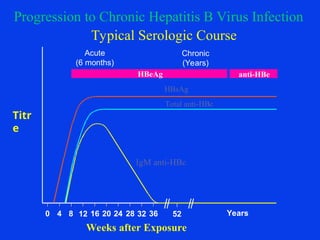
IgM anti-HBc
Total anti-HBc
HBsAg
Acute
(6 months)
HBeAg
Chronic
(Years)
anti-HBe
0 4 8 12 16 20 24 28 32 36 52 Years
Weeks after Exposure
Titr
e
Progression to Chronic Hepatitis B Virus Infection
Typical Serologic Course
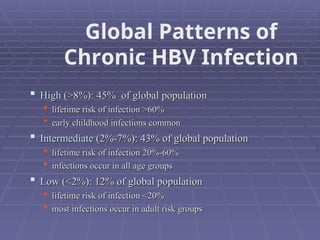
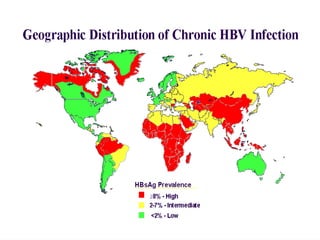
 High
High (>8%): 45% of global population
(>8%): 45% of global population
 lifetime risk of infection >60%
lifetime risk of infection >60%
 early childhood infections common
early childhood infections common
 Intermediate
Intermediate (2%-7%): 43% of global population
(2%-7%): 43% of global population
 lifetime risk of infection 20%-60%
lifetime risk of infection 20%-60%
 infections occur in all age groups
infections occur in all age groups
 Low
Low (<2%): 12% of global population
(<2%): 12% of global population
 lifetime risk of infection <20%
lifetime risk of infection <20%
 most infections occur in adult risk groups
most infections occur in adult risk groups
Global Patterns of
Chronic HBV Infection
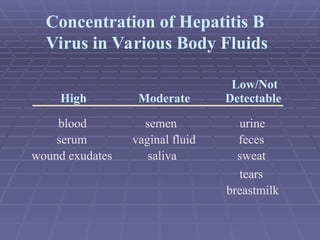
High Moderate
Low/Not
Detectable
blood semen urine
serum vaginal fluid feces
wound exudates saliva sweat
tears
breastmilk
Concentration of Hepatitis B
Virus in Various Body Fluids
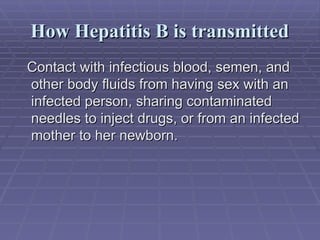
How Hepatitis B is transmitted
Contact with infectious blood, semen, and
other body fluids from having sex with an
infected person, sharing contaminated
needles to inject drugs, or from an infected
mother to her newborn.
 Sexual - sex workers and homosexuals are
particular at risk.
 Parenteral - IVDA, Health Workers are at
increased risk.
 Perinatal - Mothers who are HBeAg positive are
much more likely to transmit to their offspring
than those who are not. Perinatal transmission is
the main means of transmission in high
prevalence populations.
Hepatitis B Virus
Modes of Transmission
Diagnosis
Diagnosis
 A battery of serological tests are used for the diagnosis of
A battery of serological tests are used for the diagnosis of
acute and chronic hepatitis B infection.
 HBsAg
HBsAg - used as a general marker of infection.
- used as a general marker of infection.
 HBsAb
HBsAb - used to document recovery and/or immunity to
- used to document recovery and/or immunity to
HBV infection.
HBV infection.
 anti-HBc IgM
anti-HBc IgM - marker of acute infection.
- marker of acute infection.
 anti-HBcIgG
anti-HBcIgG - past or chronic infection.
- past or chronic infection.
 HBeAg
HBeAg - indicates active replication of virus and therefore
- indicates active replication of virus and therefore
infectiveness.
infectiveness.
 Anti-Hbe
Anti-Hbe - virus no longer replicating. However, the
- virus no longer replicating. However, the
patient can still be positive for HBsAg which is made by
integrated HBV.
integrated HBV.
 HBV-DNA
HBV-DNA - indicates active replication of virus, more
- indicates active replication of virus, more
accurate than HBeAg especially in cases of escape mutants.
Used mainly for monitoring response to therapy.
Treatment
Treatment
 Patients with Hepatitis needs supportive
Patients with Hepatitis needs supportive
treatment
treatment
 Recombinant Interferon alfa therpay is
Recombinant Interferon alfa therpay is
beneficial in HBV and HCV
Treatment
Treatment
 Interferon -
Interferon - for HBeAg +ve carriers with chronic active hepatitis. Response
for HBeAg +ve carriers with chronic active hepatitis. Response
rate is 30 to 40%.
rate is 30 to 40%.
 alpha-interferon 2b (original)
alpha-interferon 2b (original)
 alpha-interferon 2a (newer, claims to be more efficacious and efficient)
alpha-interferon 2a (newer, claims to be more efficacious and efficient)
 Lamivudine
Lamivudine - a nucleoside analogue reverse transcriptase inhibitor. Well
- a nucleoside analogue reverse transcriptase inhibitor. Well
tolerated, most patients will respond favorably. However, tendency to
relapse on cessation of treatment. Another problem is the rapid emergence of
drug resistance.
drug resistance.
 Adefovir – less likely to develop resistance than Lamivudine and may be
Adefovir – less likely to develop resistance than Lamivudine and may be
used to treat Lamivudine resistance HBV. However more expensive and
toxic
toxic
 Entecavir – most powerful antiviral known, similar to Adefovir
Entecavir – most powerful antiviral known, similar to Adefovir
 Successful response to treatment will result in the disappearance of HBsAg,
Successful response to treatment will result in the disappearance of HBsAg,
HBV-DNA, and seroconversion to HBeAg.
High Risk Individuals
 Medical and Dental surgeons
Medical and Dental surgeons
 Pathologists
Pathologists
 Physicians
Physicians
 Laboratory technicians
Laboratory technicians
 Blood bank personnel
Blood bank personnel
HBV is common in
HBV is common in
 Patients undergoing Dialysis
Patients undergoing Dialysis
 Staff of Hem dialysis Units
Staff of Hem dialysis Units
Vaccination Genetically
Engineered
Engineered
 Vaccination
Vaccination - highly effective
- highly effective
recombinant vaccines are now available.
Vaccine can be given to those who are
at increased risk of HBV infection such
as health care workers. It is also given
routinely to neonates as universal
vaccination in many countries.
Hepatitis B Immunoglobulin
 Hepatitis B Immunoglobulin
Hepatitis B Immunoglobulin - HBIG may be
- HBIG may be
used to protect persons who are exposed to
hepatitis B. It is particular efficacious within
48 hours of the incident. It may also be given
to neonates who are at increased risk of
contracting hepatitis B i.e. whose mothers are
HBsAg and HBeAg positive
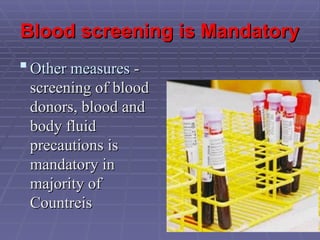
Blood screening is Mandatory
 Other measures
Other measures -
-
screening of blood
screening of blood
donors, blood and
donors, blood and
body fluid
body fluid
precautions is
precautions is
mandatory in
mandatory in
majority of
majority of
Countreis
Countreis
Universal Precautions
 Universal precautions," as defined by
Universal precautions," as defined by
CDC, are a set of precautions designed to
prevent transmission of human
immunodeficiency virus (HIV), hepatitis B
virus (HBV), and other blood borne
pathogens when providing first aid or
health care.
health care.
Universal Precautions
 Under universal precautions, blood and
Under universal precautions, blood and
certain body fluids of all patients are
considered potentially infectious for HIV,
HBV and other blood borne pathogens.
Hand washing Minimal health
precaution to Medical and
Paramedical staff
Paramedical staff
Hepatitis C Infection
Hepatitis C Virus
Hepatitis C Virus
Non A, non B
Non A, non B
Hepaci virus
Hepaci virus
What is Hepatitis C Virus
 Hepatitis C virus also known as Non A or
Hepatitis C virus also known as Non A or
Non B virus found while doing experiments
on Chimpanzees.
on Chimpanzees.
 HCV infections are seen only in humans
HCV infections are seen only in humans
 The epidemiology is like HBV infection.
The epidemiology is like HBV infection.
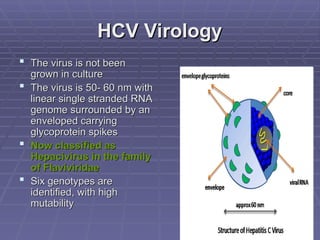
HCV Virology
HCV Virology
 The virus is not been
The virus is not been
grown in culture
grown in culture
 The virus is 50- 60 nm with
The virus is 50- 60 nm with
linear single stranded RNA
genome surrounded by an
enveloped carrying
enveloped carrying
glycoprotein spikes
glycoprotein spikes
 Now classified as
Now classified as
Hepacivirus in the family
of Flaviviridae
of Flaviviridae
 Six genotypes are
Six genotypes are
identified, with high
mutability
mutability
hypervariable
region
capsid envelop
e
protein
protease/
helicase
RNA-
dependent
RNA polymerase
c22
5’
cor
e
E1 E2 NS
2
NS
3
33c
NS
4
c-100
NS
5
3’
Hepatitis C Virus
Hepatitis C Virus
Hepatitis C Virus
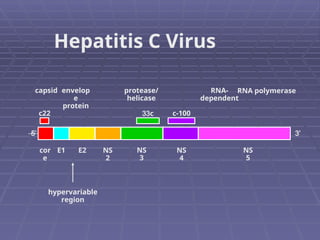
Genome resembled that of a flavivirus
Genome resembled that of a flavivirus
positive stranded RNA genome of around
10,000 bases
10,000 bases
1 single reading frame, structural genes at the
1 single reading frame, structural genes at the
5' end, the non-structural genes at the 3' end.
enveloped virus, virion thought to 30-60nm in
diameter
diameter
 Morphological structure remains unknown
Morphological structure remains unknown
Hepatitis C virus
Hepatitis C virus
Genotype 1 and 4 has a poorer
Genotype 1 and 4 has a poorer
prognosis and response to interferon
therapy,
therapy,
In Hong Kong, genotype 1 accounts
In Hong Kong, genotype 1 accounts
for around 67% of cases and genotype
6 around 25%.
6 around 25%.
Now 6 genotypes are identified
Now 6 genotypes are identified.
.
Terminology
Terminology
Term Definition % Nucleotide
Similarity
Genotype Genetic heterogeneity among
different HCV isolates
65.7-68.9
Subtype Closely related isolates within each
of the major genotypes
76.9-80.1
Quasispecies Complex of genetic variants within
individual isolates
90.8-99
Family Genus Species Genotype Subtype Quasispecies
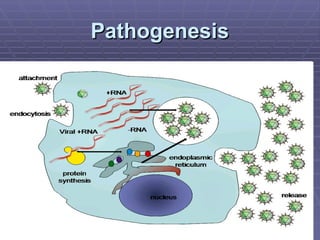
Pathogenesis
Pathogenesis
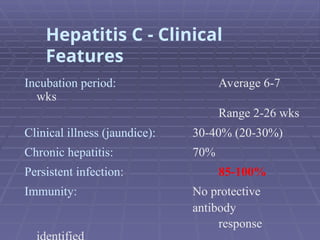
Incubation period: Average 6-7
wks
Range 2-26 wks
Clinical illness (jaundice): 30-40% (20-30%)
Chronic hepatitis: 70%
Persistent infection: 85-100%
Immunity: No protective
antibody
response
Hepatitis C - Clinical
Features
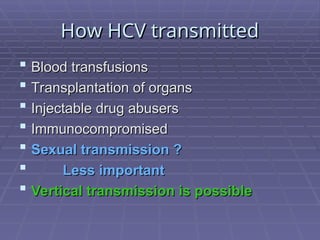
How HCV transmitted
How HCV transmitted
 Blood transfusions
Blood transfusions
 Transplantation of organs
Transplantation of organs
 Injectable drug abusers
Injectable drug abusers
 Immunocompromised
Immunocompromised
 Sexual transmission ?
Sexual transmission ?
 Less important
Less important
 Vertical transmission is possible
Vertical transmission is possible
Clinical features
Clinical features
 Overt Jaundice is seen in 5% of patients
Overt Jaundice is seen in 5% of patients
 About 50 – 80% patients progress to
About 50 – 80% patients progress to
chronic hepatitis
chronic hepatitis
 May progress to Cirrhosis, or
May progress to Cirrhosis, or
Hepatocellular carcinoma
Chronic Hepatitis C Infection
 The spectrum of chronic hepatitis C infection is
The spectrum of chronic hepatitis C infection is
essentially the same as chronic hepatitis B
infection.
infection.
 All the manifestations of chronic hepatitis B
All the manifestations of chronic hepatitis B
infection may be seen, albeit with a lower
frequency i.e. chronic persistent hepatitis, chronic
active hepatitis, cirrhosis, and hepatocellular
carcinoma
carcinoma.
.
Transmission of HCV
Transmission of HCV
 Percutaneous
Percutaneous
 IV drugs
IV drugs
 Clotting factors before viral inactivation
Clotting factors before viral inactivation
 Transfusion, transplant from infected donor
Transfusion, transplant from infected donor
 Therapeutic (contaminated equipment, unsafe
Therapeutic (contaminated equipment, unsafe
injection practices)
 Occupational (needle stick)
Occupational (needle stick)
 Per mucosal
Per mucosal
 Perinatal
Perinatal
 Sexual
Sexual
HCV - Occupational
HCV - Occupational
Transmission
Transmission
 Inefficiently transmitted
Inefficiently transmitted
 Average incidence 1.8% following needle stick from
Average incidence 1.8% following needle stick from
HCV-positive source
HCV-positive source
 10 times lower than HBV infection
10 times lower than HBV infection
 Hollow-bore needles
Hollow-bore needles
 Case reports from blood splash to eye
Case reports from blood splash to eye
 No reports from skin exposures to blood
No reports from skin exposures to blood
 Prevalence 1-2% among health care workers
Prevalence 1-2% among health care workers
 Lower than in the general population
Lower than in the general population
 Transfusion or transplant from infected donor
 Injecting drug use
 Hemodialysis (yrs on treatment)
 Accidental injuries with needles/sharps
 Sexual/household exposure to anti-HCV-positive
contact
 Multiple sex partners
Risk Factors Associated
with Transmission of HCV
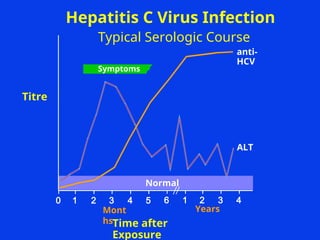
Symptoms
anti-
HCV
ALT
Normal
0 1 2 3 4 5 6 1 2 3 4
Hepatitis C Virus Infection
Typical Serologic Course
Titre
Mont
hs
Years
Time after
Exposure
Laboratory Diagnosis
 HCV antibody
HCV antibody - generally used to diagnose
- generally used to diagnose
hepatitis C infection. Not useful in the acute
phase as it takes at least 4 weeks after
infection before antibody appears.
 ELISA test results to be confirmed with
ELISA test results to be confirmed with
Immunoblotting assay
Molecular Methods in
Diagnosis
Diagnosis
 HCV-RNA
HCV-RNA - various techniques are available e.g.
- various techniques are available e.g.
PCR and branched DNA. May be used to diagnose
HCV infection in the acute phase. However, its main
use is in monitoring the response to antiviral therapy.
 HCV-antigen
HCV-antigen - an EIA for HCV antigen is available.
- an EIA for HCV antigen is available.
It is used in the same capacity as HCV-RNA tests but
is much easier to carry out.
Prognostic Tests
Prognostic Tests
 Genotyping – genotype 1 and 4 have a worse prognosis overall and
Genotyping – genotype 1 and 4 have a worse prognosis overall and
respond poorly to interferon therapy. A number of commercial and
in-house assays are available.
 Genotypic methods – DNA sequencing, PCR-hybridization e.g. INNO-
Genotypic methods – DNA sequencing, PCR-hybridization e.g. INNO-
LIPA.
LIPA.
 Serotyping – particularly useful when the patient does not have
Serotyping – particularly useful when the patient does not have
detectable RNA.
detectable RNA.
 Viral Load – patients with high viral load are thought to have a
Viral Load – patients with high viral load are thought to have a
poorer prognosis. Viral load is also used for monitoring response to
IFN therapy. A number of commercial and in-house tests are
available.
available.
HCV Treatment
HCV Treatment
 α
α-
-Interferon
Interferon
 Ribavirin
Ribavirin
 Effective in about 50% of cases
Effective in about 50% of cases
 No vaccine
No vaccine
Treatment
Treatment
 Interferon
Interferon - may be considered for patients with
- may be considered for patients with
chronic active hepatitis. The response rate is
around 50% but 50% of responders will relapse
upon withdrawal of treatment.
 Ribavirin
Ribavirin - there is less experience with ribavirin
- there is less experience with ribavirin
than interferon. However, recent studies suggest
that a combination of interferon and ribavirin is
more effective than interferon alone.
 Screening of blood, organ, tissue donors
 High-risk behavior modification
 Blood and body fluid precautions
Prevention of Hepatitis
C
Hepatitis D
Hepatitis D
Delta agent
Delta agent
Hepatitis D Virus
Hepatitis D Virus
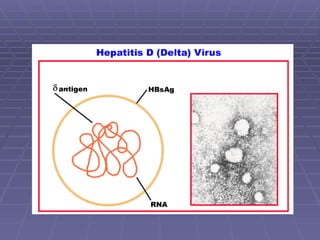
 The delta agent is a defective virus which
The delta agent is a defective virus which
shows similarities with the viroids in plants.
 The agent consists of a particle 35 nm in
The agent consists of a particle 35 nm in
diameter consisting of the delta antigen
surrounded by an outer coat of HBsAg.
 The genome of the virus is very small and
The genome of the virus is very small and
consists of a single-stranded RNA
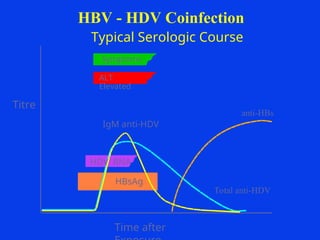
 Coinfection
– severe acute disease.
– low risk of chronic infection.
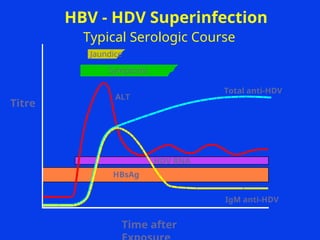
 Superinfection
– usually develop chronic HDV infection.
– high risk of severe chronic liver disease.
– may present as an acute hepatitis.
Hepatitis D - Clinical
Features
 Percutanous exposures
injecting drug use
 Permucosal exposures
sex contact
Hepatitis D Virus Modes
of Transmission
anti-HBs
Symptoms
ALT
Elevated
Total anti-HDV
IgM anti-HDV
HDV RNA
HBsAg
HBV - HDV Coinfection
Typical Serologic Course
Time after
Titre
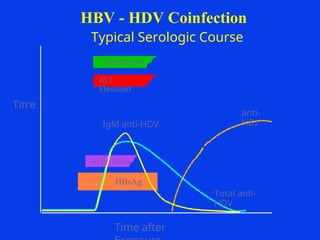
anti-
HBs
Symptoms
ALT
Elevated
Total anti-
HDV
IgM anti-HDV
HDV RNA
HBsAg
HBV - HDV Coinfection
Typical Serologic Course
Time after
Titre
Jaundice
Symptoms
ALT
Total anti-HDV
IgM anti-HDV
HDV RNA
HBsAg
HBV - HDV Superinfection
Typical Serologic Course
Time after
Titre
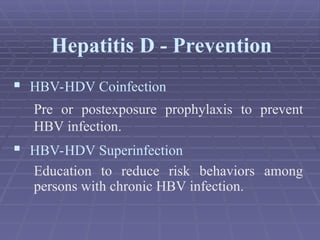
 HBV-HDV Coinfection
Pre or postexposure prophylaxis to prevent
HBV infection.
 HBV-HDV Superinfection
Education to reduce risk behaviors among
persons with chronic HBV infection.
Hepatitis D - Prevention
Hepatitis E infection
NANB
NANB
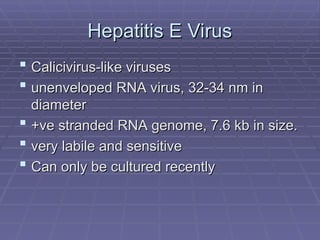
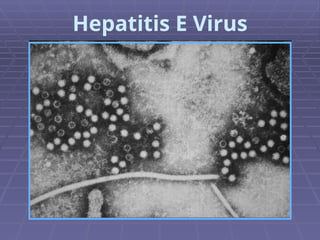
Hepatitis E Virus
Hepatitis E Virus
 Calicivirus-like viruses
Calicivirus-like viruses
 unenveloped RNA virus, 32-34 nm in
unenveloped RNA virus, 32-34 nm in
diameter
diameter
 +ve stranded RNA genome, 7.6 kb in size.
+ve stranded RNA genome, 7.6 kb in size.
 very labile and sensitive
very labile and sensitive
 Can only be cultured recently
Can only be cultured recently
Hepatitis E Virus
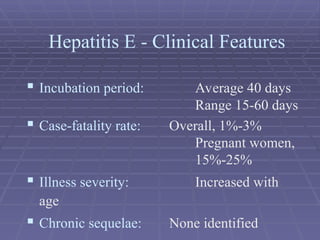
 Incubation period: Average 40 days
Range 15-60 days
 Case-fatality rate: Overall, 1%-3%
Pregnant women,
15%-25%
 Illness severity: Increased with
age
 Chronic sequelae: None identified
Hepatitis E - Clinical Features
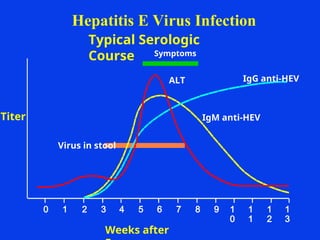
Symptoms
ALT IgG anti-HEV
IgM anti-HEV
Virus in stool
0 1 2 3 4 5 6 7 8 9 1
0
1
1
1
2
1
3
Hepatitis E Virus Infection
Typical Serologic
Course
Titer
Weeks after
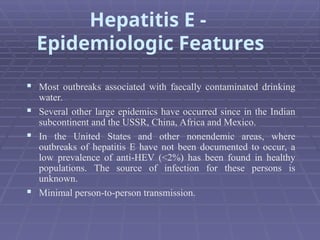
 Most outbreaks associated with faecally contaminated drinking
water.
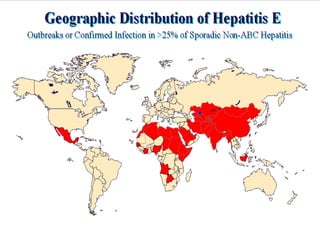
 Several other large epidemics have occurred since in the Indian
subcontinent and the USSR, China, Africa and Mexico.
 In the United States and other nonendemic areas, where
outbreaks of hepatitis E have not been documented to occur, a
low prevalence of anti-HEV (<2%) has been found in healthy
populations. The source of infection for these persons is
unknown.
 Minimal person-to-person transmission.
Hepatitis E -
Epidemiologic Features
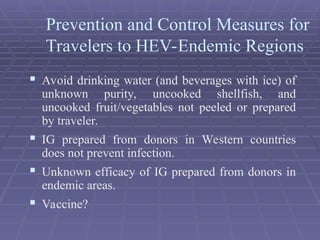
 Avoid drinking water (and beverages with ice) of
unknown purity, uncooked shellfish, and
uncooked fruit/vegetables not peeled or prepared
by traveler.
 IG prepared from donors in Western countries
does not prevent infection.
 Unknown efficacy of IG prepared from donors in
endemic areas.
 Vaccine?
Prevention and Control Measures for
Travelers to HEV-Endemic Regions
Hepatitis G virus
Hepatitis G virus
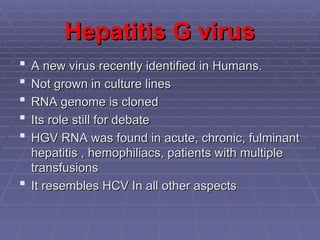
 A new virus recently identified in Humans.
A new virus recently identified in Humans.
 Not grown in culture lines
Not grown in culture lines
 RNA genome is cloned
RNA genome is cloned
 Its role still for debate
Its role still for debate
 HGV RNA was found in acute, chronic, fulminant
HGV RNA was found in acute, chronic, fulminant
hepatitis , hemophiliacs, patients with multiple
transfusions
transfusions
 It resembles HCV In all other aspects
It resembles HCV In all other aspects
Protect yourself
Protect yourself
Medical and Paramedical staff can
reduce, avoid the incidences of
accidental infection with
HBV,HCV,HDV,and Hepatitis G
infections with, safe handling of
needles
needles
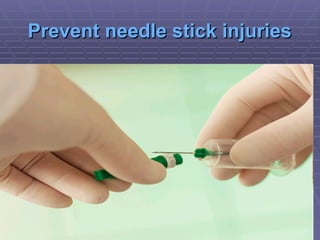
Prevent needle stick injuries
Report your needle stick injuries
to higher authorities
Created for benefit of
Medical and Paramedical
Students in Developing
World
World
Dr.T.V.Rao MD
Dr.T.V.Rao MD
Email
Email
doctortvrao@gmail.com

viral hepatitis good.ppt.............................

  • 1.
    VIRAL HEPATITIS VIRAL HEPATITIS A A,B ,B,C ,C, ,D D, ,E EG G …….. …….. Dr.T.V.Rao MD Dr.T.V.Rao MD
  • 2.
    What Is Hepatitis? WhatIs Hepatitis?  The word " The word "hepatitis hepatitis" means inflammation of the " means inflammation of the liver liver. Toxins, certain drugs, some diseases, . Toxins, certain drugs, some diseases, heavy alcohol use, bacterial and viral infections heavy alcohol use, bacterial and viral infections can all cause hepatitis. Hepatitis is also the can all cause hepatitis. Hepatitis is also the name of a family of viral infections that affect the name of a family of viral infections that affect the liver; the most common types in the United liver; the most common types in the United States are hepatitis A, hepatitis B, and hepatitis States are hepatitis A, hepatitis B, and hepatitis C. C.
  • 3.
    Hepatitis Hepatitis  Hepatitis Hepatitis (plural (pluralhepatitides hepatitides) implies ) implies injury to the liver characterized by the injury to the liver characterized by the presence of inflammatory cells in the presence of inflammatory cells in the tissue of the organ. The name is from tissue of the organ. The name is from ancient Greek ancient Greek hepar hepar or or hepato hepato, meaning , meaning liver liver, and suffix , and suffix -itis -itis, meaning , meaning "inflammation" (c. 1727) "inflammation" (c. 1727)
  • 4.
    Viral Hepatitis Viral Hepatitis A group of A group of viruses viruses known as the hepatitis known as the hepatitis viruses cause most cases of liver damage viruses cause most cases of liver damage worldwide. Hepatitis can also be due to toxins worldwide. Hepatitis can also be due to toxins (notably alcohol), other infections. (notably alcohol), other infections.  Common viruses cause hepatitis include Common viruses cause hepatitis include A,B,C,D,E. G ………. A,B,C,D,E. G ……….  Acute hepatitis Acute hepatitis  Viral Hepatitis: Hepatitis A through E (more than Viral Hepatitis: Hepatitis A through E (more than 95% of viral cause), Herpes simplex, 95% of viral cause), Herpes simplex, Cytomegalovirus, Epstein-Barr, yellow fever Cytomegalovirus, Epstein-Barr, yellow fever virus, adenoviruses. virus, adenoviruses.
  • 5.
    A A “Infectious” “Serum” Viral hepatitis Enterically transmitted Parenteral y transmitte d F, G, TTV ?other E E NANB NANB B B D D C C Viral Hepatitis - Historical Perspectives
  • 6.
    Source of virus feces blood/ blood-derived bodyfluids blood/ blood-derived body fluids blood/ blood-derived body fluids feces Route of transmission fecal-oral percutaneous permucosal percutaneous permucosal percutaneous permucosal fecal-oral Chronic infection no yes yes yes no Prevention pre/post- exposure immunization pre/post- exposure immunization blood donor screening; risk behavior modification pre/post- exposure immunization; risk behavior modification ensure safe drinking water Type of Hepatitis A B C D E
  • 7.
    Hepatitis A Hepatitis A Hepatitis A Hepatitis A is an acute liver disease is an acute liver disease caused by the hepatitis A virus (HAV), caused by the hepatitis A virus (HAV), lasting from a few weeks to several lasting from a few weeks to several months. It does not lead to chronic months. It does not lead to chronic infection. infection.
  • 9.
  • 10.
    Hepatitis A Virus HepatitisA Virus  Naked RNA virus Naked RNA virus  Related to enteroviruses, formerly known as Related to enteroviruses, formerly known as enterovirus 72, now put in its own family: heptovirus enterovirus 72, now put in its own family: heptovirus  One stable serotype only One stable serotype only  Difficult to grow in cell culture: primary marmoset Difficult to grow in cell culture: primary marmoset cell culture and also in vivo in chimpanzees and cell culture and also in vivo in chimpanzees and marmosets marmosets  4 genotypes exist, but in practice most of them are 4 genotypes exist, but in practice most of them are group 1 group 1
  • 11.
    Nature of HAVvirus Nature of HAV virus  HAV is a 27 – 30 nm HAV is a 27 – 30 nm spherical particle with spherical particle with cubic symmetry cubic symmetry  Contain linear single Contain linear single stranded RNA stranded RNA genome with size of genome with size of 7.5 kb. 7.5 kb.  Only one serotype Only one serotype
  • 12.
    HAV characters HAV characters HAV are stable to treatment with 20% ether,acid HAV are stable to treatment with 20% ether,acid and heat at 60 and heat at 600 0 c for 1 hour. c for 1 hour.  The virus are destroyed by autoclaving at 121 The virus are destroyed by autoclaving at 1210 0 c c for 20 minutes, boiling in water for 5 minutes for 20 minutes, boiling in water for 5 minutes  Treatment with chlorine 1 ppm for 30 minutes Treatment with chlorine 1 ppm for 30 minutes  Heating food > 85 Heating food > 850 0 c for 1 minute destroys c for 1 minute destroys
  • 13.
    Culturing HAV virus CulturingHAV virus  Various primate cell lines will support Various primate cell lines will support grwoth of HAV,though fresh isolates of grwoth of HAV,though fresh isolates of virus are difficult to adapt and grow. virus are difficult to adapt and grow.  Usually to cytopathic effects are apparent Usually to cytopathic effects are apparent
  • 14.
    Pathology in ViralHepatitis Pathology in Viral Hepatitis  Indicates inflamation of liver. Indicates inflamation of liver.  Microscopically there is spotty parenchymal cell Microscopically there is spotty parenchymal cell degeneration, with necrosis of Hepatocytes, with degeneration, with necrosis of Hepatocytes, with disruption of liver cell cords disruption of liver cell cords  The parenchymal changes are accompanied by The parenchymal changes are accompanied by Reticuloendothelial ( KUFFER) cell Reticuloendothelial ( KUFFER) cell hyperplasia,periportal infiltration by monoculear hyperplasia,periportal infiltration by monoculear cells and cell degeneration. cells and cell degeneration.
  • 15.
    Causes liver damage Causesliver damage  Localised areas of necrosis are frequently Localised areas of necrosis are frequently observed observed  Later accumulation of macrophages near Later accumulation of macrophages near degenerating Hepatocytes degenerating Hepatocytes
  • 16.
    Transmission Of HepatitisA Transmission Of Hepatitis A : : Ingestion of food or water contaminated Ingestion of food or water contaminated with faecal matter, Even in with faecal matter, Even in microscopic amounts, From close microscopic amounts, From close person-to-person person-to-person
  • 17.
     Close personalcontact Close personal contact (e.g., household contact, child day care (e.g., household contact, child day care centers) centers)  Contaminated food, water Contaminated food, water ( (e.g., infected food handlers, raw shellfish) e.g., infected food handlers, raw shellfish)  Blood exposure (rare) Blood exposure (rare) (e.g., injecting drug use, transfusion) (e.g., injecting drug use, transfusion) Not transmitted by Transplacental route Not transmitted by Transplacental route Hepatitis A Virus Transmission
  • 18.
    Endemicity Disease Rate Peak Age of InfectionTransmission Patterns High Low to High Early childhood Person to person; outbreaks uncommon Moderate High Late childhood/ young adults Person to person; food and waterborne outbreaks Low Low Young adults Person to person; food and waterborne outbreaks Very low Very low Adults Travelers; outbreaks uncommon Global Patterns of Hepatitis A Virus Transmission
  • 19.
    Clinical Manifestations Clinical Manifestations Incubation period 2 – 6 weeks Incubation period 2 – 6 weeks  May be asymptomatic May be asymptomatic  Overt illness in 5% Overt illness in 5%  Present as two stages, Present as two stages, 1 Preicteric 1 Preicteric 2 Icteric 2 Icteric
  • 20.
    Clinical features Clinical features Malaise Malaise  Anorexia Anorexia  Nausea, omitting liver tenderness Nausea, omitting liver tenderness  Onset of Jaundice Onset of Jaundice  Recovery in 4-6 weeks Recovery in 4-6 weeks  Mortality 0.1 – 1 % Mortality 0.1 – 1 %
  • 21.
     Complications: Fulminanthepatitis Cholestatic hepatitis Relapsing hepatitis  Chronic sequelae: None Hepatitis A - Clinical Complications
  • 22.
    Laboratory Diagnosis Laboratory Diagnosis Acute infection is diagnosed by the detection of HAV-IgM Acute infection is diagnosed by the detection of HAV-IgM in serum by EIA. in serum by EIA.  Past Infection i.e. immunity is determined by the detection Past Infection i.e. immunity is determined by the detection of HAV-IgG by EIA. of HAV-IgG by EIA.  Cell culture – difficult and take up to 4 weeks, not Cell culture – difficult and take up to 4 weeks, not routinely performed routinely performed  Direct Detection Direct Detection – EM, RT-PCR of faeces. Can – EM, RT-PCR of faeces. Can detect illness earlier than serology but rarely detect illness earlier than serology but rarely performed. performed.
  • 23.
    Fecal HAV Symptoms 0 1 23 4 5 6 1 2 2 4 Hepatitis A Infection Total anti- HAV Titer ALT IgM anti-HAV Months after exposure Typical Serological Course
  • 24.
    Treatment Treatment  No specificantiviral drug is available No specific antiviral drug is available  Treatment is symptomatic Treatment is symptomatic  Specific passive prophylaxis by pooled Specific passive prophylaxis by pooled normal human immunoglobulin given normal human immunoglobulin given before exposure or in early incubation before exposure or in early incubation period can prevent or attenuate clinical period can prevent or attenuate clinical illness. illness.
  • 25.
     Many casesoccur in community-wide outbreaks Many cases occur in community-wide outbreaks  no risk factor identified for most cases no risk factor identified for most cases  highest attack rates in 5-14 year olds highest attack rates in 5-14 year olds  children serve as reservoir of infection children serve as reservoir of infection  Persons at increased risk of infection Persons at increased risk of infection  travelers travelers  homosexual men homosexual men  injecting drug users injecting drug users Hepatitis A Vaccination Strategies Epidemiologic Considerations
  • 26.
    Vaccination for HAV Vaccinationfor HAV  Hepatitis A vaccination is recommended for all Hepatitis A vaccination is recommended for all children starting at age 1 year, travellers to children starting at age 1 year, travellers to certain countries, and others at risk. certain countries, and others at risk.  A safe and effective formalin inactivated alum A safe and effective formalin inactivated alum conjugated vaccine containing HAV grown in conjugated vaccine containing HAV grown in human diploid cell culture is available human diploid cell culture is available  A full course containing two intramuscular A full course containing two intramuscular injections of the vaccine injections of the vaccine  Protection starts after 4 weeks after injection and Protection starts after 4 weeks after injection and lasts for 10 – 20 years lasts for 10 – 20 years
  • 27.
     Many casesoccur in community-wide outbreaks Many cases occur in community-wide outbreaks  no risk factor identified for most cases no risk factor identified for most cases  highest attack rates in 5-14 year olds highest attack rates in 5-14 year olds  children serve as reservoir of infection children serve as reservoir of infection  Persons at increased risk of infection Persons at increased risk of infection  travelers travelers  homosexual men homosexual men  injecting drug users injecting drug users Hepatitis A Vaccination Strategies Epidemiologic Considerations
  • 28.
    Epidemiology Epidemiology  A majorcommunicable disease in the A major communicable disease in the Devloping world Devloping world. .  Well cooked food and sanitary water Well cooked food and sanitary water supply will protect the individual living supply will protect the individual living  Community hygiene is important in Community hygiene is important in schools, hostels and jails, as overcrowding schools, hostels and jails, as overcrowding and poor sanitation favour the spread and poor sanitation favour the spread
  • 29.
    Prevention of HepatitisA Prevention of Hepatitis A Infection Infection  Pre-exposure Pre-exposure  travelers to intermediate and high travelers to intermediate and high HAV-endemic regions HAV-endemic regions  Post-exposure (within 14 days) Post-exposure (within 14 days) Routine Routine  household and other intimate contacts household and other intimate contacts Selected situations Selected situations  institutions (e.g., day care centers) institutions (e.g., day care centers)  common source exposure (e.g., food prepared by infected common source exposure (e.g., food prepared by infected food handler) food handler)
  • 30.
  • 31.
    Most Important Infectious MostImportant Infectious Disease Disease  There are more than 350 million carriers There are more than 350 million carriers  25% of them will develop chronic active 25% of them will develop chronic active hepatitis. hepatitis.  World wide 1 million deaths a years are World wide 1 million deaths a years are attributed to HBV related liver disease and attributed to HBV related liver disease and Hepatocellular Carcinoma Hepatocellular Carcinoma
  • 32.
    Hepatitis B Hepatitis B Hepatitis B Hepatitis B is a liver disease caused by the is a liver disease caused by the hepatitis B virus (HBV). It ranges in hepatitis B virus (HBV). It ranges in severity from a mild illness, lasting a few severity from a mild illness, lasting a few weeks (acute), to a serious long-term weeks (acute), to a serious long-term (chronic) illness that can lead to liver (chronic) illness that can lead to liver disease or liver cancer. disease or liver cancer.
  • 33.
    Hepatitis B Virus Blumberg in 1965 Blumberg in 1965 discovers, names as discovers, names as Australia antigen. Australia antigen.  1968 identified with 1968 identified with association in serum association in serum hepatitis. hepatitis.  Surface component of Surface component of HBV called as surface HBV called as surface antigen. antigen.
  • 34.
    HBV Viruses UnderElectron HBV Viruses Under Electron Microscope Microscope  Spherical particles 22 nm in Spherical particles 22 nm in diameter diameter  Filamentous or tubular 22 nm Filamentous or tubular 22 nm with varying length with varying length  Called as HBs Ag surface Called as HBs Ag surface components which are components which are produced in excess. produced in excess.  Third type double walled Third type double walled spherical structure 42 nm spherical structure 42 nm diameter called HBV diameter called HBV  Called as Dane Called as Dane particle particle
  • 35.
    HBV – Surfaceantigens HBV – Surface antigens  Enveloped proteins on Enveloped proteins on surface of virions and surface of virions and surplus 22 nm diameter surplus 22 nm diameter spherical and filamentous spherical and filamentous particles constitute the B particles constitute the B surface antigens surface antigens  HBs Ag consists two HBs Ag consists two major polypeptides and is major polypeptides and is glycolated glycolated
  • 37.
    Structure 0f HepatitisB virus Structure 0f Hepatitis B virus
  • 38.
    HBV shows antigenic HBVshows antigenic diversity diversity  HBV shows antigenic diversity, two different HBV shows antigenic diversity, two different antigenic components and common group antigenic components and common group reactive antigen reactive antigen a a  Two contain specific antigens Two contain specific antigens d y d y w r w r Only one member of each pair being present at a Only one member of each pair being present at a time time Divided into four Major antigenic subtypes Divided into four Major antigenic subtypes adw, adr, ayw, and ayr adw, adr, ayw, and ayr
  • 39.
    Geographic distribution Geographic distribution ayw ayw – common in Europe,Australia,and – common in Europe,Australia,and America. America.  adr - Prevalent in south, East India and Far adr - Prevalent in south, East India and Far east, east,  ayr ayr - very rare - very rare  Core antigen HB c ag Core antigen HB c ag  Be HBe is a soluble non particle nucelocapsid Be HBe is a soluble non particle nucelocapsid protein protein  Both Hbc and Hbe are coded by same genes Both Hbc and Hbe are coded by same genes
  • 40.
    Replication Replication  The RNAdependent DNA synthesis takes The RNA dependent DNA synthesis takes place within the newly assembled Virion place within the newly assembled Virion core in the cytoplasam. core in the cytoplasam.  Hepadnaviruses the only virus that Hepadnaviruses the only virus that produce genome DNA by reverse produce genome DNA by reverse transcription with mRNA as the transcription with mRNA as the template template
  • 41.
    Pathogenesis of HBVinfection Pathogenesis of HBV infection  Disease is Immune mediated Disease is Immune mediated  Hepatocytes carry viral antigen Hepatocytes carry viral antigen  Immune response subject to antibody dependent. Immune response subject to antibody dependent.  N K cell and cytotoxic T cell attack N K cell and cytotoxic T cell attack  In the absence of adequate immune response HBV In the absence of adequate immune response HBV infection may not cause hepatitis. infection may not cause hepatitis.  But lead to carrier state. But lead to carrier state.  Infection – Immunodeficient person are likely to because Infection – Immunodeficient person are likely to because asymptomatic carrier followed infection asymptomatic carrier followed infection
  • 42.
     Incubation period:Average 60-90 days Range 45-180 days  Clinical illness (jaundice): <5 yrs, <10% 5 yrs, 30%-50%  Acute case-fatality rate: 0.5%-1%  Chronic infection: <5 yrs, 30%-90% 5 yrs, 2%-10%  Premature mortality from chronic liver disease: 15%-25% Hepatitis B - Clinical Features
  • 43.
    What are theclinical symptoms What are the clinical symptoms of Hepatitis B?? of Hepatitis B??
  • 44.
    Spectrum of ChronicHepatitis B Spectrum of Chronic Hepatitis B Diseases Diseases 1 1Chronic Persistent Hepatitis - Chronic Persistent Hepatitis - asymptomatic asymptomatic 2. 2. Chronic Active Hepatitis - Chronic Active Hepatitis - symptomatic exacerbations of hepatitis symptomatic exacerbations of hepatitis 3. Cirrhosis of Liver 3. Cirrhosis of Liver 4. Hepatocellular Carcinoma 4. Hepatocellular Carcinoma
  • 45.
    Symptoms HBeAg anti-HBe Total anti-HBc IgManti-HBc anti-HBs HBsAg 0 4 8 12 16 20 24 28 32 36 52 100 Acute Hepatitis B Virus Infection with Recovery Typical Serologic Course Weeks after Exposure Titre
  • 46.
    IgM anti-HBc Total anti-HBc HBsAg Acute (6months) HBeAg Chronic (Years) anti-HBe 0 4 8 12 16 20 24 28 32 36 52 Years Weeks after Exposure Titr e Progression to Chronic Hepatitis B Virus Infection Typical Serologic Course
  • 47.
     High High (>8%):45% of global population (>8%): 45% of global population  lifetime risk of infection >60% lifetime risk of infection >60%  early childhood infections common early childhood infections common  Intermediate Intermediate (2%-7%): 43% of global population (2%-7%): 43% of global population  lifetime risk of infection 20%-60% lifetime risk of infection 20%-60%  infections occur in all age groups infections occur in all age groups  Low Low (<2%): 12% of global population (<2%): 12% of global population  lifetime risk of infection <20% lifetime risk of infection <20%  most infections occur in adult risk groups most infections occur in adult risk groups Global Patterns of Chronic HBV Infection
  • 49.
    High Moderate Low/Not Detectable blood semenurine serum vaginal fluid feces wound exudates saliva sweat tears breastmilk Concentration of Hepatitis B Virus in Various Body Fluids
  • 50.
    How Hepatitis Bis transmitted How Hepatitis B is transmitted Contact with infectious blood, semen, and Contact with infectious blood, semen, and other body fluids from having sex with an other body fluids from having sex with an infected person, sharing contaminated infected person, sharing contaminated needles to inject drugs, or from an infected needles to inject drugs, or from an infected mother to her newborn. mother to her newborn.
  • 51.
     Sexual -sex workers and homosexuals are particular at risk.  Parenteral - IVDA, Health Workers are at increased risk.  Perinatal - Mothers who are HBeAg positive are much more likely to transmit to their offspring than those who are not. Perinatal transmission is the main means of transmission in high prevalence populations. Hepatitis B Virus Modes of Transmission
  • 52.
    Diagnosis Diagnosis  A batteryof serological tests are used for the diagnosis of A battery of serological tests are used for the diagnosis of acute and chronic hepatitis B infection. acute and chronic hepatitis B infection.  HBsAg HBsAg - used as a general marker of infection. - used as a general marker of infection.  HBsAb HBsAb - used to document recovery and/or immunity to - used to document recovery and/or immunity to HBV infection. HBV infection.  anti-HBc IgM anti-HBc IgM - marker of acute infection. - marker of acute infection.  anti-HBcIgG anti-HBcIgG - past or chronic infection. - past or chronic infection.  HBeAg HBeAg - indicates active replication of virus and therefore - indicates active replication of virus and therefore infectiveness. infectiveness.  Anti-Hbe Anti-Hbe - virus no longer replicating. However, the - virus no longer replicating. However, the patient can still be positive for HBsAg which is made by patient can still be positive for HBsAg which is made by integrated HBV. integrated HBV.  HBV-DNA HBV-DNA - indicates active replication of virus, more - indicates active replication of virus, more accurate than HBeAg especially in cases of escape mutants. accurate than HBeAg especially in cases of escape mutants. Used mainly for monitoring response to therapy. Used mainly for monitoring response to therapy.
  • 53.
    Treatment Treatment  Patients withHepatitis needs supportive Patients with Hepatitis needs supportive treatment treatment  Recombinant Interferon alfa therpay is Recombinant Interferon alfa therpay is beneficial in HBV and HCV beneficial in HBV and HCV
  • 54.
    Treatment Treatment  Interferon - Interferon- for HBeAg +ve carriers with chronic active hepatitis. Response for HBeAg +ve carriers with chronic active hepatitis. Response rate is 30 to 40%. rate is 30 to 40%.  alpha-interferon 2b (original) alpha-interferon 2b (original)  alpha-interferon 2a (newer, claims to be more efficacious and efficient) alpha-interferon 2a (newer, claims to be more efficacious and efficient)  Lamivudine Lamivudine - a nucleoside analogue reverse transcriptase inhibitor. Well - a nucleoside analogue reverse transcriptase inhibitor. Well tolerated, most patients will respond favorably. However, tendency to tolerated, most patients will respond favorably. However, tendency to relapse on cessation of treatment. Another problem is the rapid emergence of relapse on cessation of treatment. Another problem is the rapid emergence of drug resistance. drug resistance.  Adefovir – less likely to develop resistance than Lamivudine and may be Adefovir – less likely to develop resistance than Lamivudine and may be used to treat Lamivudine resistance HBV. However more expensive and used to treat Lamivudine resistance HBV. However more expensive and toxic toxic  Entecavir – most powerful antiviral known, similar to Adefovir Entecavir – most powerful antiviral known, similar to Adefovir  Successful response to treatment will result in the disappearance of HBsAg, Successful response to treatment will result in the disappearance of HBsAg, HBV-DNA, and seroconversion to HBeAg. HBV-DNA, and seroconversion to HBeAg.
  • 55.
    High Risk Individuals HighRisk Individuals  Medical and Dental surgeons Medical and Dental surgeons  Pathologists Pathologists  Physicians Physicians  Laboratory technicians Laboratory technicians  Blood bank personnel Blood bank personnel
  • 56.
    HBV is commonin HBV is common in  Patients undergoing Dialysis Patients undergoing Dialysis  Staff of Hem dialysis Units Staff of Hem dialysis Units
  • 57.
    Vaccination Genetically Vaccination Genetically Engineered Engineered Vaccination Vaccination - highly effective - highly effective recombinant vaccines are now available. recombinant vaccines are now available. Vaccine can be given to those who are Vaccine can be given to those who are at increased risk of HBV infection such at increased risk of HBV infection such as health care workers. It is also given as health care workers. It is also given routinely to neonates as universal routinely to neonates as universal vaccination in many countries. vaccination in many countries.
  • 58.
    Hepatitis B Immunoglobulin HepatitisB Immunoglobulin  Hepatitis B Immunoglobulin Hepatitis B Immunoglobulin - HBIG may be - HBIG may be used to protect persons who are exposed to used to protect persons who are exposed to hepatitis B. It is particular efficacious within hepatitis B. It is particular efficacious within 48 hours of the incident. It may also be given 48 hours of the incident. It may also be given to neonates who are at increased risk of to neonates who are at increased risk of contracting hepatitis B i.e. whose mothers are contracting hepatitis B i.e. whose mothers are HBsAg and HBeAg positive HBsAg and HBeAg positive
  • 59.
    Blood screening isMandatory Blood screening is Mandatory  Other measures Other measures - - screening of blood screening of blood donors, blood and donors, blood and body fluid body fluid precautions is precautions is mandatory in mandatory in majority of majority of Countreis Countreis
  • 60.
    Universal Precautions Universal Precautions Universal precautions," as defined by Universal precautions," as defined by CDC, are a set of precautions designed to CDC, are a set of precautions designed to prevent transmission of human prevent transmission of human immunodeficiency virus (HIV), hepatitis B immunodeficiency virus (HIV), hepatitis B virus (HBV), and other blood borne virus (HBV), and other blood borne pathogens when providing first aid or pathogens when providing first aid or health care. health care.
  • 61.
    Universal Precautions Universal Precautions Under universal precautions, blood and Under universal precautions, blood and certain body fluids of all patients are certain body fluids of all patients are considered potentially infectious for HIV, considered potentially infectious for HIV, HBV and other blood borne pathogens. HBV and other blood borne pathogens.
  • 62.
    Hand washing Minimalhealth Hand washing Minimal health precaution to Medical and precaution to Medical and Paramedical staff Paramedical staff
  • 63.
    Hepatitis C Infection HepatitisC Infection Hepatitis C Virus Hepatitis C Virus Non A, non B Non A, non B Hepaci virus Hepaci virus
  • 64.
    What is HepatitisC Virus What is Hepatitis C Virus  Hepatitis C virus also known as Non A or Hepatitis C virus also known as Non A or Non B virus found while doing experiments Non B virus found while doing experiments on Chimpanzees. on Chimpanzees.  HCV infections are seen only in humans HCV infections are seen only in humans  The epidemiology is like HBV infection. The epidemiology is like HBV infection.
  • 65.
    HCV Virology HCV Virology The virus is not been The virus is not been grown in culture grown in culture  The virus is 50- 60 nm with The virus is 50- 60 nm with linear single stranded RNA linear single stranded RNA genome surrounded by an genome surrounded by an enveloped carrying enveloped carrying glycoprotein spikes glycoprotein spikes  Now classified as Now classified as Hepacivirus in the family Hepacivirus in the family of Flaviviridae of Flaviviridae  Six genotypes are Six genotypes are identified, with high identified, with high mutability mutability
  • 66.
  • 67.
    Hepatitis C Virus HepatitisC Virus Genome resembled that of a flavivirus Genome resembled that of a flavivirus positive stranded RNA genome of around positive stranded RNA genome of around 10,000 bases 10,000 bases 1 single reading frame, structural genes at the 1 single reading frame, structural genes at the 5' end, the non-structural genes at the 3' end. 5' end, the non-structural genes at the 3' end. enveloped virus, virion thought to 30-60nm in enveloped virus, virion thought to 30-60nm in diameter diameter  Morphological structure remains unknown Morphological structure remains unknown
  • 68.
    Hepatitis C virus HepatitisC virus Genotype 1 and 4 has a poorer Genotype 1 and 4 has a poorer prognosis and response to interferon prognosis and response to interferon therapy, therapy, In Hong Kong, genotype 1 accounts In Hong Kong, genotype 1 accounts for around 67% of cases and genotype for around 67% of cases and genotype 6 around 25%. 6 around 25%. Now 6 genotypes are identified Now 6 genotypes are identified. .
  • 69.
    Terminology Terminology Term Definition %Nucleotide Similarity Genotype Genetic heterogeneity among different HCV isolates 65.7-68.9 Subtype Closely related isolates within each of the major genotypes 76.9-80.1 Quasispecies Complex of genetic variants within individual isolates 90.8-99 Family Genus Species Genotype Subtype Quasispecies
  • 70.
  • 71.
    Incubation period: Average6-7 wks Range 2-26 wks Clinical illness (jaundice): 30-40% (20-30%) Chronic hepatitis: 70% Persistent infection: 85-100% Immunity: No protective antibody response Hepatitis C - Clinical Features
  • 72.
    How HCV transmitted HowHCV transmitted  Blood transfusions Blood transfusions  Transplantation of organs Transplantation of organs  Injectable drug abusers Injectable drug abusers  Immunocompromised Immunocompromised  Sexual transmission ? Sexual transmission ?  Less important Less important  Vertical transmission is possible Vertical transmission is possible
  • 73.
    Clinical features Clinical features Overt Jaundice is seen in 5% of patients Overt Jaundice is seen in 5% of patients  About 50 – 80% patients progress to About 50 – 80% patients progress to chronic hepatitis chronic hepatitis  May progress to Cirrhosis, or May progress to Cirrhosis, or Hepatocellular carcinoma Hepatocellular carcinoma
  • 74.
    Chronic Hepatitis CInfection Chronic Hepatitis C Infection  The spectrum of chronic hepatitis C infection is The spectrum of chronic hepatitis C infection is essentially the same as chronic hepatitis B essentially the same as chronic hepatitis B infection. infection.  All the manifestations of chronic hepatitis B All the manifestations of chronic hepatitis B infection may be seen, albeit with a lower infection may be seen, albeit with a lower frequency i.e. chronic persistent hepatitis, chronic frequency i.e. chronic persistent hepatitis, chronic active hepatitis, cirrhosis, and hepatocellular active hepatitis, cirrhosis, and hepatocellular carcinoma carcinoma. .
  • 75.
    Transmission of HCV Transmissionof HCV  Percutaneous Percutaneous  IV drugs IV drugs  Clotting factors before viral inactivation Clotting factors before viral inactivation  Transfusion, transplant from infected donor Transfusion, transplant from infected donor  Therapeutic (contaminated equipment, unsafe Therapeutic (contaminated equipment, unsafe injection practices) injection practices)  Occupational (needle stick) Occupational (needle stick)  Per mucosal Per mucosal  Perinatal Perinatal  Sexual Sexual
  • 76.
    HCV - Occupational HCV- Occupational Transmission Transmission  Inefficiently transmitted Inefficiently transmitted  Average incidence 1.8% following needle stick from Average incidence 1.8% following needle stick from HCV-positive source HCV-positive source  10 times lower than HBV infection 10 times lower than HBV infection  Hollow-bore needles Hollow-bore needles  Case reports from blood splash to eye Case reports from blood splash to eye  No reports from skin exposures to blood No reports from skin exposures to blood  Prevalence 1-2% among health care workers Prevalence 1-2% among health care workers  Lower than in the general population Lower than in the general population
  • 77.
     Transfusion ortransplant from infected donor  Injecting drug use  Hemodialysis (yrs on treatment)  Accidental injuries with needles/sharps  Sexual/household exposure to anti-HCV-positive contact  Multiple sex partners Risk Factors Associated with Transmission of HCV
  • 78.
    Symptoms anti- HCV ALT Normal 0 1 23 4 5 6 1 2 3 4 Hepatitis C Virus Infection Typical Serologic Course Titre Mont hs Years Time after Exposure
  • 80.
    Laboratory Diagnosis Laboratory Diagnosis HCV antibody HCV antibody - generally used to diagnose - generally used to diagnose hepatitis C infection. Not useful in the acute hepatitis C infection. Not useful in the acute phase as it takes at least 4 weeks after phase as it takes at least 4 weeks after infection before antibody appears. infection before antibody appears.  ELISA test results to be confirmed with ELISA test results to be confirmed with Immunoblotting assay Immunoblotting assay
  • 81.
    Molecular Methods in MolecularMethods in Diagnosis Diagnosis  HCV-RNA HCV-RNA - various techniques are available e.g. - various techniques are available e.g. PCR and branched DNA. May be used to diagnose PCR and branched DNA. May be used to diagnose HCV infection in the acute phase. However, its main HCV infection in the acute phase. However, its main use is in monitoring the response to antiviral therapy. use is in monitoring the response to antiviral therapy.  HCV-antigen HCV-antigen - an EIA for HCV antigen is available. - an EIA for HCV antigen is available. It is used in the same capacity as HCV-RNA tests but It is used in the same capacity as HCV-RNA tests but is much easier to carry out. is much easier to carry out.
  • 82.
    Prognostic Tests Prognostic Tests Genotyping – genotype 1 and 4 have a worse prognosis overall and Genotyping – genotype 1 and 4 have a worse prognosis overall and respond poorly to interferon therapy. A number of commercial and respond poorly to interferon therapy. A number of commercial and in-house assays are available. in-house assays are available.  Genotypic methods – DNA sequencing, PCR-hybridization e.g. INNO- Genotypic methods – DNA sequencing, PCR-hybridization e.g. INNO- LIPA. LIPA.  Serotyping – particularly useful when the patient does not have Serotyping – particularly useful when the patient does not have detectable RNA. detectable RNA.  Viral Load – patients with high viral load are thought to have a Viral Load – patients with high viral load are thought to have a poorer prognosis. Viral load is also used for monitoring response to poorer prognosis. Viral load is also used for monitoring response to IFN therapy. A number of commercial and in-house tests are IFN therapy. A number of commercial and in-house tests are available. available.
  • 83.
    HCV Treatment HCV Treatment α α- -Interferon Interferon  Ribavirin Ribavirin  Effective in about 50% of cases Effective in about 50% of cases  No vaccine No vaccine
  • 84.
    Treatment Treatment  Interferon Interferon -may be considered for patients with - may be considered for patients with chronic active hepatitis. The response rate is chronic active hepatitis. The response rate is around 50% but 50% of responders will relapse around 50% but 50% of responders will relapse upon withdrawal of treatment. upon withdrawal of treatment.  Ribavirin Ribavirin - there is less experience with ribavirin - there is less experience with ribavirin than interferon. However, recent studies suggest than interferon. However, recent studies suggest that a combination of interferon and ribavirin is that a combination of interferon and ribavirin is more effective than interferon alone. more effective than interferon alone.
  • 85.
     Screening ofblood, organ, tissue donors  High-risk behavior modification  Blood and body fluid precautions Prevention of Hepatitis C
  • 86.
  • 87.
    Hepatitis D Virus HepatitisD Virus  The delta agent is a defective virus which The delta agent is a defective virus which shows similarities with the viroids in plants. shows similarities with the viroids in plants.  The agent consists of a particle 35 nm in The agent consists of a particle 35 nm in diameter consisting of the delta antigen diameter consisting of the delta antigen surrounded by an outer coat of HBsAg. surrounded by an outer coat of HBsAg.  The genome of the virus is very small and The genome of the virus is very small and consists of a single-stranded RNA consists of a single-stranded RNA
  • 89.
     Coinfection – severeacute disease. – low risk of chronic infection.  Superinfection – usually develop chronic HDV infection. – high risk of severe chronic liver disease. – may present as an acute hepatitis. Hepatitis D - Clinical Features
  • 90.
     Percutanous exposures injectingdrug use  Permucosal exposures sex contact Hepatitis D Virus Modes of Transmission
  • 91.
    anti-HBs Symptoms ALT Elevated Total anti-HDV IgM anti-HDV HDVRNA HBsAg HBV - HDV Coinfection Typical Serologic Course Time after Titre
  • 92.
    anti- HBs Symptoms ALT Elevated Total anti- HDV IgM anti-HDV HDVRNA HBsAg HBV - HDV Coinfection Typical Serologic Course Time after Titre
  • 93.
    Jaundice Symptoms ALT Total anti-HDV IgM anti-HDV HDVRNA HBsAg HBV - HDV Superinfection Typical Serologic Course Time after Titre
  • 95.
     HBV-HDV Coinfection Preor postexposure prophylaxis to prevent HBV infection.  HBV-HDV Superinfection Education to reduce risk behaviors among persons with chronic HBV infection. Hepatitis D - Prevention
  • 96.
    Hepatitis E infection HepatitisE infection NANB NANB
  • 97.
    Hepatitis E Virus HepatitisE Virus  Calicivirus-like viruses Calicivirus-like viruses  unenveloped RNA virus, 32-34 nm in unenveloped RNA virus, 32-34 nm in diameter diameter  +ve stranded RNA genome, 7.6 kb in size. +ve stranded RNA genome, 7.6 kb in size.  very labile and sensitive very labile and sensitive  Can only be cultured recently Can only be cultured recently
  • 98.
  • 99.
     Incubation period:Average 40 days Range 15-60 days  Case-fatality rate: Overall, 1%-3% Pregnant women, 15%-25%  Illness severity: Increased with age  Chronic sequelae: None identified Hepatitis E - Clinical Features
  • 100.
    Symptoms ALT IgG anti-HEV IgManti-HEV Virus in stool 0 1 2 3 4 5 6 7 8 9 1 0 1 1 1 2 1 3 Hepatitis E Virus Infection Typical Serologic Course Titer Weeks after
  • 101.
     Most outbreaksassociated with faecally contaminated drinking water.  Several other large epidemics have occurred since in the Indian subcontinent and the USSR, China, Africa and Mexico.  In the United States and other nonendemic areas, where outbreaks of hepatitis E have not been documented to occur, a low prevalence of anti-HEV (<2%) has been found in healthy populations. The source of infection for these persons is unknown.  Minimal person-to-person transmission. Hepatitis E - Epidemiologic Features
  • 103.
     Avoid drinkingwater (and beverages with ice) of unknown purity, uncooked shellfish, and uncooked fruit/vegetables not peeled or prepared by traveler.  IG prepared from donors in Western countries does not prevent infection.  Unknown efficacy of IG prepared from donors in endemic areas.  Vaccine? Prevention and Control Measures for Travelers to HEV-Endemic Regions
  • 104.
    Hepatitis G virus HepatitisG virus  A new virus recently identified in Humans. A new virus recently identified in Humans.  Not grown in culture lines Not grown in culture lines  RNA genome is cloned RNA genome is cloned  Its role still for debate Its role still for debate  HGV RNA was found in acute, chronic, fulminant HGV RNA was found in acute, chronic, fulminant hepatitis , hemophiliacs, patients with multiple hepatitis , hemophiliacs, patients with multiple transfusions transfusions  It resembles HCV In all other aspects It resembles HCV In all other aspects
  • 105.
    Protect yourself Protect yourself Medicaland Paramedical staff can Medical and Paramedical staff can reduce, avoid the incidences of reduce, avoid the incidences of accidental infection with accidental infection with HBV,HCV,HDV,and Hepatitis G HBV,HCV,HDV,and Hepatitis G infections with, safe handling of infections with, safe handling of needles needles
  • 106.
    Prevent needle stickinjuries Prevent needle stick injuries
  • 107.
    Report your needlestick injuries Report your needle stick injuries to higher authorities to higher authorities
  • 108.
    Created for benefitof Created for benefit of Medical and Paramedical Medical and Paramedical Students in Developing Students in Developing World World Dr.T.V.Rao MD Dr.T.V.Rao MD Email Email doctortvrao@gmail.com doctortvrao@gmail.com