HEPATITIS
Cause of hepatitis
■ Hepatitis A
■ Hepatitis B
■ Hepatitis C
■ Hepatitis D
■ Hepatitis E
■ Herpes simplex
■ Cytomegalovirus
■ Epstein-Barr
■ Adenoviruses
■ Drugs
■ Toxins
■ Alcohol
■ Ischemia
■ Wilson'sdisease
■ Other
Hepatitis A
■ PROPERTIES:
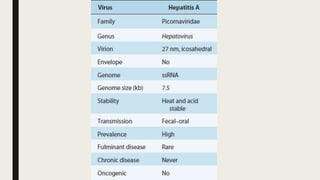
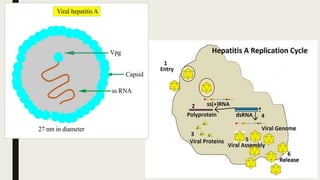
■ member of the picornavirus family
■ cubic symmetry
■ containing a linear single-stranded RNA genome with a size of 7.5 kb
■ Only one serotype is known,There is no antigenic cross-reactivity with the other hepatitis viruses.
■ Stable to treatment with 20% ether, acid (pH1.0 for 2 hours), and heat (60°C for 1 hour), and
its infectivity can be preserved for at least 1 month after being dried and stored at 25°C or for years
at −20°C
■ Destroyed by autoclaving (121°C for 20 minutes), boiling in water for 5 minutes, dry heat
(180°C for 1 hour), ultraviolet irradiation (1 minute at 1.1 watts), treatment with formalin (1:4000 for
3 days at 37°C),chlorine (10–15 ppm for 30 minutes). Heating food to above 85°C for 1 minute
,sodium hypochlorite (1:100 dilution of chlorine bleach) are necessary to inactivate HAV.
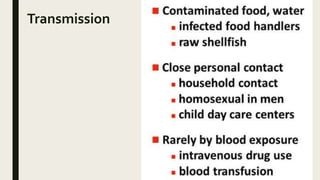
Transmission
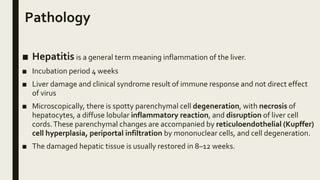
Pathology
■ Hepatitis is a general term meaning inflammation of the liver.
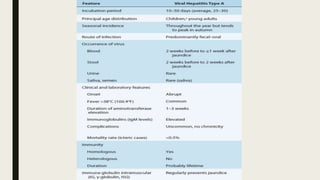
■ Incubation period 4 weeks
■ Liver damage and clinical syndrome result of immune response and not direct effect
of virus
■ Microscopically, there is spotty parenchymal cell degeneration, with necrosis of
hepatocytes, a diffuse lobular inflammatory reaction, and disruption of liver cell
cords.These parenchymal changes are accompanied by reticuloendothelial (Kupffer)
cell hyperplasia, periportal infiltration by mononuclear cells, and cell degeneration.
■ The damaged hepatic tissue is usually restored in 8–12 weeks.
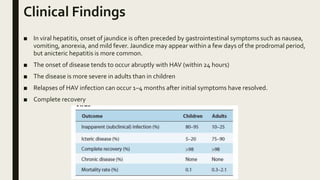
Clinical Findings
■ In viral hepatitis, onset of jaundice is often preceded by gastrointestinal symptoms such as nausea,
vomiting, anorexia, and mild fever. Jaundice may appear within a few days of the prodromal period,
but anicteric hepatitis is more common.
■ The onset of disease tends to occur abruptly with HAV (within 24 hours)
■ The disease is more severe in adults than in children
■ Relapses of HAV infection can occur 1–4 months after initial symptoms have resolved.
■ Complete recovery
■ Fatigue
■ Fever
■ Nausea
■ Appetite loss
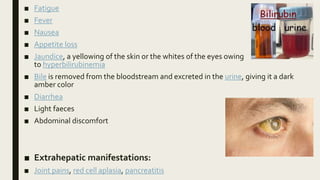
■ Jaundice, a yellowing of the skin or the whites of the eyes owing
to hyperbilirubinemia
■ Bile is removed from the bloodstream and excreted in the urine, giving it a dark
amber color
■ Diarrhea
■ Light faeces
■ Abdominal discomfort
■ Extrahepatic manifestations:
■ Joint pains, red cell aplasia, pancreatitis
Lab diagnosis
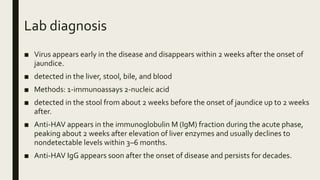
■ Virus appears early in the disease and disappears within 2 weeks after the onset of
jaundice.
■ detected in the liver, stool, bile, and blood
■ Methods: 1-immunoassays 2-nucleic acid
■ detected in the stool from about 2 weeks before the onset of jaundice up to 2 weeks
after.
■ Anti-HAV appears in the immunoglobulin M (IgM) fraction during the acute phase,
peaking about 2 weeks after elevation of liver enzymes and usually declines to
nondetectable levels within 3–6 months.
■ Anti-HAV IgG appears soon after the onset of disease and persists for decades.
Virus–Host Interactions
■ Most cases of hepatitis type A presumably occur without jaundice during
childhood, and by late adulthood there is a widespread resistance to reinfection.
■ the incidence of infection may be declining as a result of
■ 1- improvements in sanitation
■ 2-rise in the standard of living
■ 3-expanded use of the vaccine in some countries
Epidemiology
■ HAV is widespread throughout the world.
■ Outbreaks of type A hepatitis are common in families and institutions, summer
camps, day care centers, neonatal intensive care units, and among military troops.
■ Stool specimens may be infectious for up to 2 weeks before to 2 weeks after onset of
jaundice.
■ In poor country children become immune by age 10 years.
■ The ratio of anicteric to icteric cases in adults is about one to three; in children, it
may be as high as 12 to one.
■ Fecal excretion of HAV antigen and RNA persists longer in the young than in adults.
■ Individuals with chronic liver disease are at increased risk for fulminant hepatitis if a
hepatitis A infection occurs.These groups should be vaccinated.
Prevention and Control
■ Formalin-inactivated HAV vaccines made from cell culture adapted virus were
licensed in the United States in 1995.The vaccines are safe, effective, and
recommended for use in Persons more than 1 year of age.Vaccination in tow dose
:1st dose at time 0 and 2nd dose 6-12 months
■ Routine vaccination of all children is now recommended also International
travelers, men who have sex with men, and drug users.
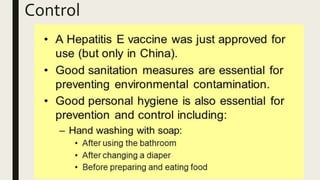
■ Control measures are directed toward the prevention of fecal contamination of
food, water, or other sources by the individual.
■ Reasonable hygiene—such as handwashing, the use of disposable plates, and the
use of 0.5% sodium hypochlorite as a disinfectant—is essential in preventing the
spread of HAV.
■ IG as passive immunization does not prevent infection but rather makes the
infection mild or subclinical and permits active immunity to develop.
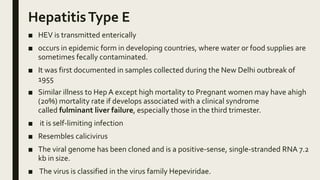
HepatitisType E
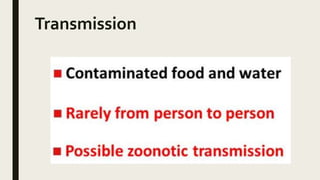
■ HEV is transmitted enterically
■ occurs in epidemic form in developing countries, where water or food supplies are
sometimes fecally contaminated.
■ It was first documented in samples collected during the New Delhi outbreak of
1955
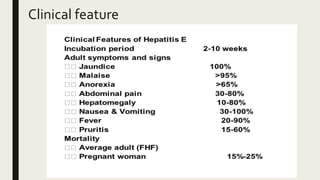
■ Similar illness to Hep A except high mortality to Pregnant women may have ahigh
(20%) mortality rate if develops associated with a clinical syndrome
called fulminant liver failure, especially those in the third trimester.
■ it is self-limiting infection
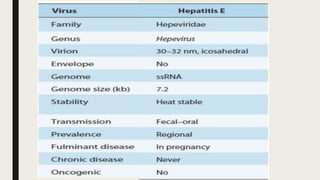
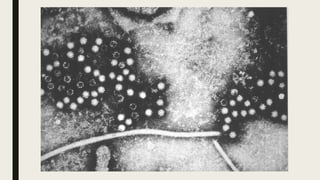
■ Resembles calicivirus
■ The viral genome has been cloned and is a positive-sense, single-stranded RNA 7.2
kb in size.
■ The virus is classified in the virus family Hepeviridae.
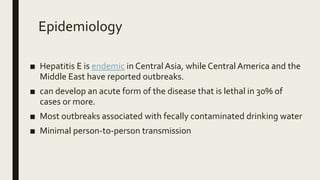
Epidemiology
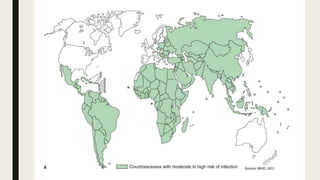
■ Hepatitis E is endemic in Central Asia, while Central America and the
Middle East have reported outbreaks.
■ can develop an acute form of the disease that is lethal in 30% of
cases or more.
■ Most outbreaks associated with fecally contaminated drinking water
■ Minimal person-to-person transmission
Transmission
Clinical feature
Control

Hepatitis A,E

  • 1.
  • 2.
    Cause of hepatitis ■Hepatitis A ■ Hepatitis B ■ Hepatitis C ■ Hepatitis D ■ Hepatitis E ■ Herpes simplex ■ Cytomegalovirus ■ Epstein-Barr ■ Adenoviruses ■ Drugs ■ Toxins ■ Alcohol ■ Ischemia ■ Wilson'sdisease ■ Other
  • 3.
    Hepatitis A ■ PROPERTIES: ■member of the picornavirus family ■ cubic symmetry ■ containing a linear single-stranded RNA genome with a size of 7.5 kb ■ Only one serotype is known,There is no antigenic cross-reactivity with the other hepatitis viruses. ■ Stable to treatment with 20% ether, acid (pH1.0 for 2 hours), and heat (60°C for 1 hour), and its infectivity can be preserved for at least 1 month after being dried and stored at 25°C or for years at −20°C ■ Destroyed by autoclaving (121°C for 20 minutes), boiling in water for 5 minutes, dry heat (180°C for 1 hour), ultraviolet irradiation (1 minute at 1.1 watts), treatment with formalin (1:4000 for 3 days at 37°C),chlorine (10–15 ppm for 30 minutes). Heating food to above 85°C for 1 minute ,sodium hypochlorite (1:100 dilution of chlorine bleach) are necessary to inactivate HAV.
  • 6.
  • 7.
    Pathology ■ Hepatitis isa general term meaning inflammation of the liver. ■ Incubation period 4 weeks ■ Liver damage and clinical syndrome result of immune response and not direct effect of virus ■ Microscopically, there is spotty parenchymal cell degeneration, with necrosis of hepatocytes, a diffuse lobular inflammatory reaction, and disruption of liver cell cords.These parenchymal changes are accompanied by reticuloendothelial (Kupffer) cell hyperplasia, periportal infiltration by mononuclear cells, and cell degeneration. ■ The damaged hepatic tissue is usually restored in 8–12 weeks.
  • 8.
    Clinical Findings ■ Inviral hepatitis, onset of jaundice is often preceded by gastrointestinal symptoms such as nausea, vomiting, anorexia, and mild fever. Jaundice may appear within a few days of the prodromal period, but anicteric hepatitis is more common. ■ The onset of disease tends to occur abruptly with HAV (within 24 hours) ■ The disease is more severe in adults than in children ■ Relapses of HAV infection can occur 1–4 months after initial symptoms have resolved. ■ Complete recovery
  • 9.
    ■ Fatigue ■ Fever ■Nausea ■ Appetite loss ■ Jaundice, a yellowing of the skin or the whites of the eyes owing to hyperbilirubinemia ■ Bile is removed from the bloodstream and excreted in the urine, giving it a dark amber color ■ Diarrhea ■ Light faeces ■ Abdominal discomfort ■ Extrahepatic manifestations: ■ Joint pains, red cell aplasia, pancreatitis
  • 11.
    Lab diagnosis ■ Virusappears early in the disease and disappears within 2 weeks after the onset of jaundice. ■ detected in the liver, stool, bile, and blood ■ Methods: 1-immunoassays 2-nucleic acid ■ detected in the stool from about 2 weeks before the onset of jaundice up to 2 weeks after. ■ Anti-HAV appears in the immunoglobulin M (IgM) fraction during the acute phase, peaking about 2 weeks after elevation of liver enzymes and usually declines to nondetectable levels within 3–6 months. ■ Anti-HAV IgG appears soon after the onset of disease and persists for decades.
  • 12.
    Virus–Host Interactions ■ Mostcases of hepatitis type A presumably occur without jaundice during childhood, and by late adulthood there is a widespread resistance to reinfection. ■ the incidence of infection may be declining as a result of ■ 1- improvements in sanitation ■ 2-rise in the standard of living ■ 3-expanded use of the vaccine in some countries
  • 13.
    Epidemiology ■ HAV iswidespread throughout the world. ■ Outbreaks of type A hepatitis are common in families and institutions, summer camps, day care centers, neonatal intensive care units, and among military troops. ■ Stool specimens may be infectious for up to 2 weeks before to 2 weeks after onset of jaundice. ■ In poor country children become immune by age 10 years. ■ The ratio of anicteric to icteric cases in adults is about one to three; in children, it may be as high as 12 to one. ■ Fecal excretion of HAV antigen and RNA persists longer in the young than in adults. ■ Individuals with chronic liver disease are at increased risk for fulminant hepatitis if a hepatitis A infection occurs.These groups should be vaccinated.
  • 15.
    Prevention and Control ■Formalin-inactivated HAV vaccines made from cell culture adapted virus were licensed in the United States in 1995.The vaccines are safe, effective, and recommended for use in Persons more than 1 year of age.Vaccination in tow dose :1st dose at time 0 and 2nd dose 6-12 months ■ Routine vaccination of all children is now recommended also International travelers, men who have sex with men, and drug users. ■ Control measures are directed toward the prevention of fecal contamination of food, water, or other sources by the individual. ■ Reasonable hygiene—such as handwashing, the use of disposable plates, and the use of 0.5% sodium hypochlorite as a disinfectant—is essential in preventing the spread of HAV. ■ IG as passive immunization does not prevent infection but rather makes the infection mild or subclinical and permits active immunity to develop.
  • 16.
    HepatitisType E ■ HEVis transmitted enterically ■ occurs in epidemic form in developing countries, where water or food supplies are sometimes fecally contaminated. ■ It was first documented in samples collected during the New Delhi outbreak of 1955 ■ Similar illness to Hep A except high mortality to Pregnant women may have ahigh (20%) mortality rate if develops associated with a clinical syndrome called fulminant liver failure, especially those in the third trimester. ■ it is self-limiting infection ■ Resembles calicivirus ■ The viral genome has been cloned and is a positive-sense, single-stranded RNA 7.2 kb in size. ■ The virus is classified in the virus family Hepeviridae.
  • 19.
    Epidemiology ■ Hepatitis Eis endemic in Central Asia, while Central America and the Middle East have reported outbreaks. ■ can develop an acute form of the disease that is lethal in 30% of cases or more. ■ Most outbreaks associated with fecally contaminated drinking water ■ Minimal person-to-person transmission
  • 20.
  • 21.
  • 22.