
VIRAL HEPATITISDR.PARTH GURAGAIN
Viral hepatitis can be defined as the infection of liver caused by different viral agents.AEITOLOGICAL AGENTSHAVHBVHCVHDVHEVHGVThey can be other viruses which can be impliciated in hepatitis  such as Cytomegalo virus, Epstein-Barr virus ,rubella virus.VIRAL HEPATITIS
Hepatitis A is caused by hepatitis A virus(HAV).The disease manifest by non-specific symptoms FeverChillsHeadacheFatigueGeneralized weaknessFollowed by AnorexiaNauseaVomittingDark urinejaundiceHEPATITIS A
The disease is completely recovered in most of the cases and has mortality rate of 0.1% but patients may be incapaciated for weeks.
AGENT FACTORSAgent-it is an entero-virus(type 72) of picornaviridae family.    it multiplies in hepatocytes.     only one serotype is known.RESISTANCE- The virus is fairly resistant to heat and chemicals.     It can survive for more than 10 weeks in well water, withstand heating of 60deg for more than 1 hour, not affected by chlorination that is employed, formaline is effective .UV rays, boiling for 5 minutes and autoclaving is effective.  EPIDEMIOLOGICAL DETERMINANTS
RESERVOIR OF INFECTIONHumans are only reservoir.Cases ranges from asymptomatic to severe form.Asymptomatic cases are mainly present in childrens , these cases are responsible for maintaining chain of transmission.No evidence of chronic carrier state.PERIOD OF INFECTIVITY2 week before to one week after onset of jaundiceInfectivity falls with onset of jaundice.
INFECTIVE MATERIALMan’s faecesmainly.Blood, serum and other fluid are infective only during brief period of viraemia.VIRUS EXCRETIONIt is excreted 2 weeks before onset on jaundice and 1 week thereafter.May also be excreted in urine.
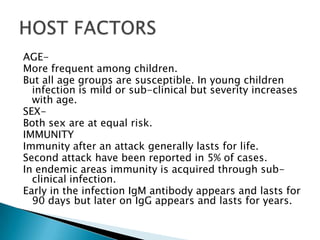
AGE-More frequent among children.But all age groups are susceptible. In young children infection is mild or sub-clinical but severity increases with age.SEX- Both sex are at equal risk.IMMUNITYImmunity after an attack generally lasts for life.Second attack have been reported in 5% of cases.In endemic areas immunity is acquired through sub-clinical infection.Early in the infection IgM antibody appears and lasts for 90 days but later on IgG appears and lasts for years. HOST FACTORS
Cases are seen throughout the year but mostly associated during period of heavy rainfall.Poor sanitation and over-crowding favors spread of infection. ENVIRONMENTAL FACTORS
Faecal-oral route –this the major route of tranmision.      directly- contaminated hands or objects as eating utensils. direct transmission occur under condition of poor sanitation or over-crowding.      indirect- contaminated water, food or milk.Parenteral route – very rare. It is transmitted by blood, blood products or contaminated needles during stage of viraemia.Sexual transmission- seen in homosexual.  MODE OF TRANSMISSION
15-45 Days (usually 25 to 30 days)The length of incubation period depends upon the dose of virus ingested.INCUBATION PERIOD
Demonstration of HAV particles or specific viral antigen in the faeces.Demonstration of a rise in anti-HAV titre.Detection of IgM antibody to HAV in the patient’s serum or IgG antibody to HAV.DIAGNOSIS
Control of reservoirControl of reservoir is difficultFaecal shedding is highest during incubation period and early phase of illness.Occurrence of large number of sub-clinical cases.Absence of specific treatment.Low socio-economic profile of popullation involved.      so notification, complete bed rest and disinfection of faeces and fomites should be done.   Prevention and containment
Can be obtained by simple measures asHandwashingSanitary disposal of excreta will prevent contamination of water, milk ,food.Purification of community water by flocculation, filtration or chlorination.During epidemics people should be advised to boil water before using for drinking purposes. Other control measure can be proper autoclaving of syringes, needles and other instruments.   2.Control of transmission
Human immunoglobulinUse of human immunoglobulin prepared from pooled plasma of healthy donor for induction of passive immunity. It is recommended forSusceptible person travelling to highly endemic area.Close personal contact.For control of institutional out-breaks.Dose-3.2-8.0 mg/kg body weight 3.Control of susceptible population
Several inactivated and live attenuated vaccine have been developed.Vaccine must commonly used is combination vaccine containing inactivated hepatitis A and recombinant hepatitis B .the combination vaccine is used in 3 dose series ie, 0,1 and 6 month series. 4.vaccines

Viral hepatitis

  • 1.
  • 2.
    Viral hepatitis canbe defined as the infection of liver caused by different viral agents.AEITOLOGICAL AGENTSHAVHBVHCVHDVHEVHGVThey can be other viruses which can be impliciated in hepatitis such as Cytomegalo virus, Epstein-Barr virus ,rubella virus.VIRAL HEPATITIS
  • 3.
    Hepatitis A iscaused by hepatitis A virus(HAV).The disease manifest by non-specific symptoms FeverChillsHeadacheFatigueGeneralized weaknessFollowed by AnorexiaNauseaVomittingDark urinejaundiceHEPATITIS A
  • 4.
    The disease iscompletely recovered in most of the cases and has mortality rate of 0.1% but patients may be incapaciated for weeks.
  • 5.
    AGENT FACTORSAgent-it isan entero-virus(type 72) of picornaviridae family. it multiplies in hepatocytes. only one serotype is known.RESISTANCE- The virus is fairly resistant to heat and chemicals. It can survive for more than 10 weeks in well water, withstand heating of 60deg for more than 1 hour, not affected by chlorination that is employed, formaline is effective .UV rays, boiling for 5 minutes and autoclaving is effective. EPIDEMIOLOGICAL DETERMINANTS
  • 6.
    RESERVOIR OF INFECTIONHumansare only reservoir.Cases ranges from asymptomatic to severe form.Asymptomatic cases are mainly present in childrens , these cases are responsible for maintaining chain of transmission.No evidence of chronic carrier state.PERIOD OF INFECTIVITY2 week before to one week after onset of jaundiceInfectivity falls with onset of jaundice.
  • 7.
    INFECTIVE MATERIALMan’s faecesmainly.Blood,serum and other fluid are infective only during brief period of viraemia.VIRUS EXCRETIONIt is excreted 2 weeks before onset on jaundice and 1 week thereafter.May also be excreted in urine.
  • 8.
    AGE-More frequent amongchildren.But all age groups are susceptible. In young children infection is mild or sub-clinical but severity increases with age.SEX- Both sex are at equal risk.IMMUNITYImmunity after an attack generally lasts for life.Second attack have been reported in 5% of cases.In endemic areas immunity is acquired through sub-clinical infection.Early in the infection IgM antibody appears and lasts for 90 days but later on IgG appears and lasts for years. HOST FACTORS
  • 9.
    Cases are seenthroughout the year but mostly associated during period of heavy rainfall.Poor sanitation and over-crowding favors spread of infection. ENVIRONMENTAL FACTORS
  • 10.
    Faecal-oral route –thisthe major route of tranmision. directly- contaminated hands or objects as eating utensils. direct transmission occur under condition of poor sanitation or over-crowding. indirect- contaminated water, food or milk.Parenteral route – very rare. It is transmitted by blood, blood products or contaminated needles during stage of viraemia.Sexual transmission- seen in homosexual. MODE OF TRANSMISSION
  • 11.
    15-45 Days (usually25 to 30 days)The length of incubation period depends upon the dose of virus ingested.INCUBATION PERIOD
  • 12.
    Demonstration of HAVparticles or specific viral antigen in the faeces.Demonstration of a rise in anti-HAV titre.Detection of IgM antibody to HAV in the patient’s serum or IgG antibody to HAV.DIAGNOSIS
  • 13.
    Control of reservoirControlof reservoir is difficultFaecal shedding is highest during incubation period and early phase of illness.Occurrence of large number of sub-clinical cases.Absence of specific treatment.Low socio-economic profile of popullation involved. so notification, complete bed rest and disinfection of faeces and fomites should be done. Prevention and containment
  • 14.
    Can be obtainedby simple measures asHandwashingSanitary disposal of excreta will prevent contamination of water, milk ,food.Purification of community water by flocculation, filtration or chlorination.During epidemics people should be advised to boil water before using for drinking purposes. Other control measure can be proper autoclaving of syringes, needles and other instruments. 2.Control of transmission
  • 15.
    Human immunoglobulinUse ofhuman immunoglobulin prepared from pooled plasma of healthy donor for induction of passive immunity. It is recommended forSusceptible person travelling to highly endemic area.Close personal contact.For control of institutional out-breaks.Dose-3.2-8.0 mg/kg body weight 3.Control of susceptible population
  • 16.
    Several inactivated andlive attenuated vaccine have been developed.Vaccine must commonly used is combination vaccine containing inactivated hepatitis A and recombinant hepatitis B .the combination vaccine is used in 3 dose series ie, 0,1 and 6 month series. 4.vaccines