PENICILLOSIS
Presented to :
Dr. K. Amala
Assistant professor
Department of Microbiology
Sacred heart college (Autonomous)
Tirupattur
Presented by:
A. R. Deborah (BP211501)
I M.Sc. Applied Microbiology
Department of Microbiology
Sacred heart college (Autonomous)
Tirupattur
Introduction
 Penicillium species are saprophytes, present in the
environment and grow on various substances like bread, jam,
fruit and cheese.
 It is common air-borne contaminants of culture media.
 The colonies are blue-green in colour with a white border and
powdery surface.
Pathogenesis of Penicillium marneffei
 Disseminated mycosis
 Dimorphic fungi
 Mononuclear phagocytic system
 Penicilliosis is an infection caused by Penicillium marneffei/
Talaromyces marneffei. Once considered rare, its occurrence
has increased due to AIDS.
 It is now the third most common opportunistic infection (after
extrapulmonary tuberculosis and cryptococcosis) in HIV-
positive individuals within the endemic area of Southeast Asia.
Symptoms
 The most common symptoms are
 Fever,
 Skin lesions,
 Anemia,
 Generalized lymphadenopathy,
 Hepatomegaly.
Laboratory diagnosis
 Yeast are small.
 Oval
 2 – 4 µm in diameter
 Mycelia form produces red diffusible pigment
 It resembles other members of penicillium species.
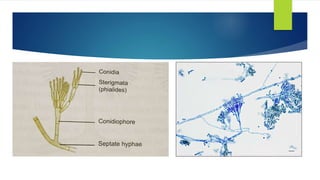
 Under the microscope, septate hyphae with conidiophores and with
two rows of sterigmata chains of spores.
 The appearance is like a brush or broom.
 Collected specimens
 Blood
 Bone marrow
 Bronchoalveolar lavage
 Tissue
 In culture at 25°C to 30°C, isolation of a mold that exhibits typical Penicillium
morphology and a diffusible red pigment is highly suggestive. Conversion to the
yeast phase at 37°C is confirmatory. Microscopic detection of the elliptic fission
yeasts inside phagocytes in buffy coat preparations or smears of bone marrow,
ulcerative skin lesions, or lymph nodes is diagnostic. Serologic tests are under
development.
Treatment
 Penicillosis can be treated with
 Amphotericin B
 Oral itraconazole.
Thank you!

PENICILLOSIS.pptx

  • 1.
    PENICILLOSIS Presented to : Dr.K. Amala Assistant professor Department of Microbiology Sacred heart college (Autonomous) Tirupattur Presented by: A. R. Deborah (BP211501) I M.Sc. Applied Microbiology Department of Microbiology Sacred heart college (Autonomous) Tirupattur
  • 2.
    Introduction  Penicillium speciesare saprophytes, present in the environment and grow on various substances like bread, jam, fruit and cheese.  It is common air-borne contaminants of culture media.  The colonies are blue-green in colour with a white border and powdery surface.
  • 3.
    Pathogenesis of Penicilliummarneffei  Disseminated mycosis  Dimorphic fungi  Mononuclear phagocytic system  Penicilliosis is an infection caused by Penicillium marneffei/ Talaromyces marneffei. Once considered rare, its occurrence has increased due to AIDS.  It is now the third most common opportunistic infection (after extrapulmonary tuberculosis and cryptococcosis) in HIV- positive individuals within the endemic area of Southeast Asia.
  • 4.
    Symptoms  The mostcommon symptoms are  Fever,  Skin lesions,  Anemia,  Generalized lymphadenopathy,  Hepatomegaly.
  • 5.
    Laboratory diagnosis  Yeastare small.  Oval  2 – 4 µm in diameter  Mycelia form produces red diffusible pigment  It resembles other members of penicillium species.  Under the microscope, septate hyphae with conidiophores and with two rows of sterigmata chains of spores.  The appearance is like a brush or broom.
  • 7.
     Collected specimens Blood  Bone marrow  Bronchoalveolar lavage  Tissue  In culture at 25°C to 30°C, isolation of a mold that exhibits typical Penicillium morphology and a diffusible red pigment is highly suggestive. Conversion to the yeast phase at 37°C is confirmatory. Microscopic detection of the elliptic fission yeasts inside phagocytes in buffy coat preparations or smears of bone marrow, ulcerative skin lesions, or lymph nodes is diagnostic. Serologic tests are under development.
  • 8.
    Treatment  Penicillosis canbe treated with  Amphotericin B  Oral itraconazole.
  • 9.